
Introduction
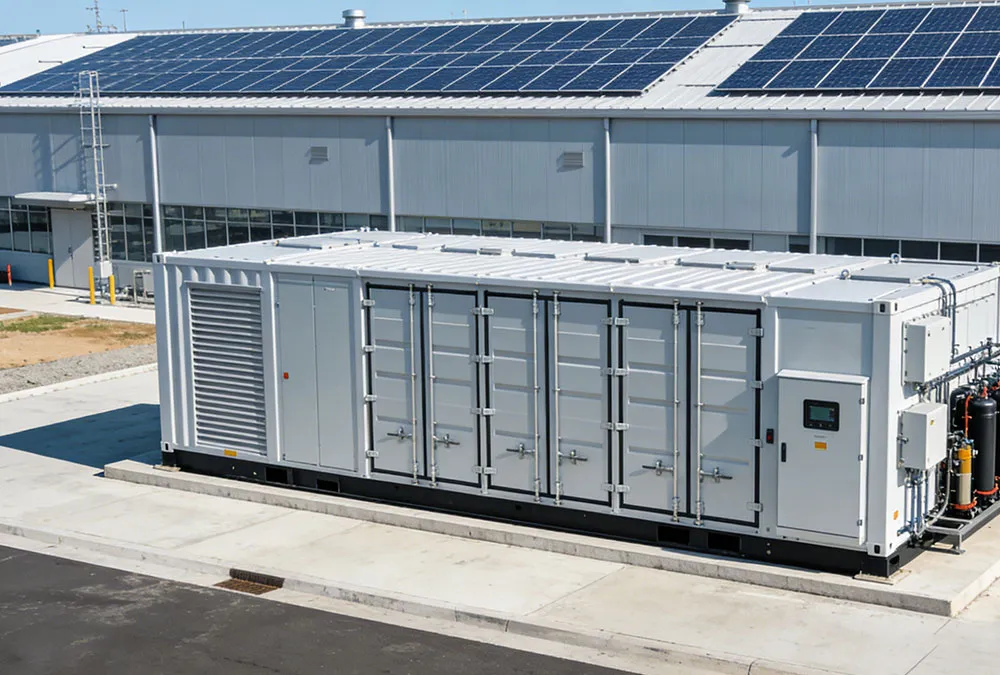
As we move into 2026, the global shift toward decentralized energy and grid decarbonization has reached a tipping point. For industrial facility managers and electrical engineers, the Battery Energy Storage System is no longer an optional “green” addition but a core strategic asset. A high-performance battery energy storage system provides the necessary infrastructure to mitigate volatile electricity tariffs, avoid astronomical peak demand charges, and ensure operational continuity during grid instability. Whether you are integrating a battery energy storage system for commercial and industrial use to support solar self-consumption or building out a high-power EV charging hub, understanding the technical depth of this technology is critical for maximizing long-term financial viability.
What Is a Battery Energy Storage System (BESS)?
Simple Definition of Battery Energy Storage System
In its simplest form, a battery energy storage system is a sophisticated electrochemical solution designed to capture energy when it is abundant (and cheap) and release it when it is scarce (and expensive). Unlike traditional lead-acid systems, a modern BESS utilizes advanced lithium-ion battery storage controlled by intelligent software to provide instantaneous, high-density power delivery.
Why Battery Energy Storage Is Critical in Modern Power Systems
Modern grids are under unprecedented stress. The transition from base-load fossil fuels to intermittent renewables has created “The Duck Curve,” where energy supply peaks at midday (solar) but demand peaks in the evening. A BESS acts as a “power buffer,” providing the flexibility required to maintain grid frequency and voltage stability without relying on carbon-intensive “peaker” plants.
Role of BESS in Renewable Energy Integration and Grid Stability
For the C&I sector, energy storage integration (solar + storage) is the most effective way to reach carbon neutrality. By storing midday solar generation surplus, a BESS allows a factory to run on 100% renewable energy even after sunset, effectively “firming” the intermittent nature of green power.
How Does a Battery Energy Storage System Work?
Step-by-Step Charging and Discharging Process
- Charging: The energy management system (EMS) detects a surplus of power or a low-tariff window. Alternating Current (AC) from the grid or solar is converted to Direct Current (DC) by the power conversion system (PCS) and stored in the battery cells.
- Monitoring: The BMS ensures every cell stays within safe voltage and temperature ranges.
- Discharging: When the facility load exceeds a set threshold (Peak Shaving) or when grid prices spike, the EMS triggers a discharge. The PCS converts DC back to AC for immediate use.
Interaction Between Battery, PCS, and EMS
Think of the battery as the “fuel tank,” the power conversion system (PCS) as the “engine,” and the energy management system (EMS) as the “driver.” In 2026, AI-driven EMS software can predict factory load spikes by analyzing historical 15-minute interval data, ensuring the system is always ready to intervene before a demand charge is triggered.
How BESS Supports Peak Shaving and Load Management
Peak shaving energy storage works by capping the maximum power drawn from the utility. If a factory’s peak is 1MW but the BESS provides 300kW, the utility meter only sees 700kW. In many 2025-2026 industrial tariff structures, this 30% reduction in “Peak Demand” can account for 50% of the total monthly savings.
Battery Energy Storage System Components Explained
A truly robust battery energy storage system components and design consists of six critical layers of hardware and software.
Battery System (Lithium-ion Modules, LFP Batteries)
The foundation is the battery rack. For industrial energy storage system solutions, the market has consolidated around Lithium Iron Phosphate (LFP). These modules are stacked to create strings, which are then combined to reach MWh capacities. 2026 models feature high-density cell packing that allows for more energy in a smaller footprint.
Power Conversion System (PCS / Inverter)
The PCS is the bi-directional heart of the system. It doesn’t just convert AC/DC; it manages “Grid-Forming” capabilities, allowing a BESS to restart a facility during a total blackout (Black Start).
Battery Management System (BMS)
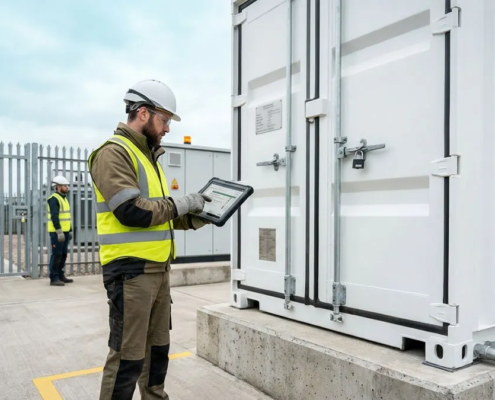
The BMS is a multi-tier protective layer. It monitors the “State of Health” (SoH) and “State of Charge” (SoC). In high-end commercial battery storage system designs, the BMS can isolate a single failing module without shutting down the entire rack, ensuring maximum uptime.
Energy Management System (EMS)
The EMS is the high-level brain. It integrates with weather forecasts, real-time energy market prices, and factory production schedules to execute complex strategies like “Arbitrage” or “Revenue Stacking.”
Thermal Management and Cooling System
Modern BESS units generate significant heat. While air cooling is common for small cabinets, 2026 industrial energy storage solution designs prioritize Liquid Cooling. This provides 25% better temperature uniformity, extending the battery cycle life by up to 2-3 years.
Safety and Fire Protection System
Following NFPA 855 and IEC 62619 standards, systems now include multi-stage fire suppression (Aerosol or Novec), smoke detectors, and combustible gas sensors to prevent “thermal runaway” before it starts.
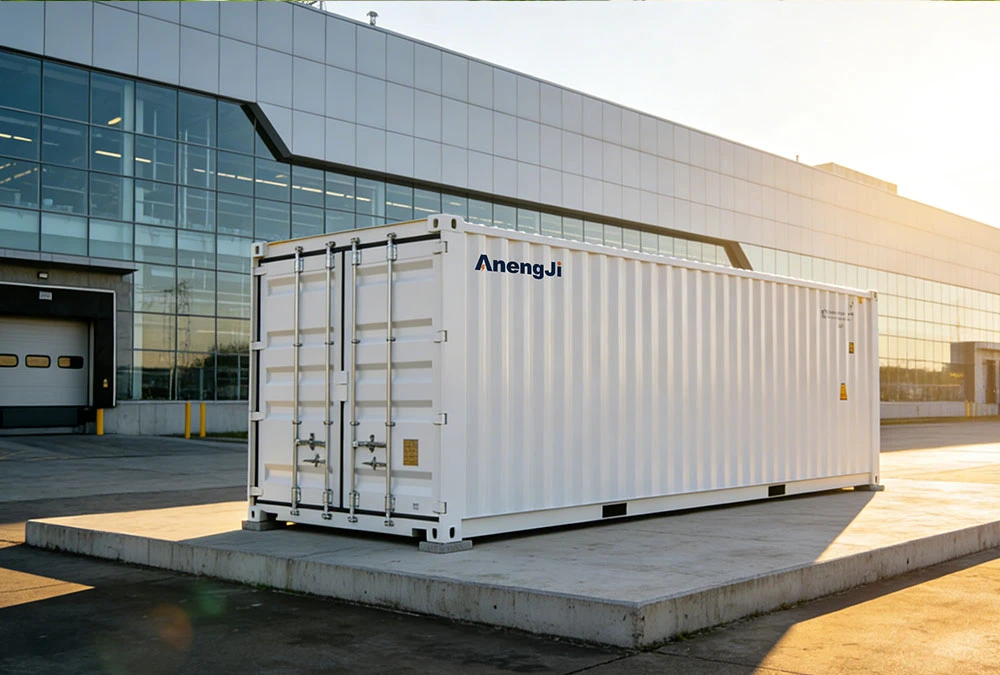
Enclosure Design (Cabinet vs Containerized BESS)
- Cabinet BESS: (100kWh – 500kWh) Perfect for battery storage for factories with limited space.
- Containerized BESS: (1MWh – 5MWh+) Pre-integrated 20ft/40ft units for large-scale utility or heavy industrial use.
Key Benefits of Battery Energy Storage Systems
- Reduce Electricity Costs: By shifting consumption away from high-price windows.
- Improve Energy Efficiency: Minimizing wasted solar energy via energy storage integration.
- Backup Power and Energy Resilience: Providing seamless transition during grid outages.
- Support ESG Goals: Directly reducing Scope 2 emissions.
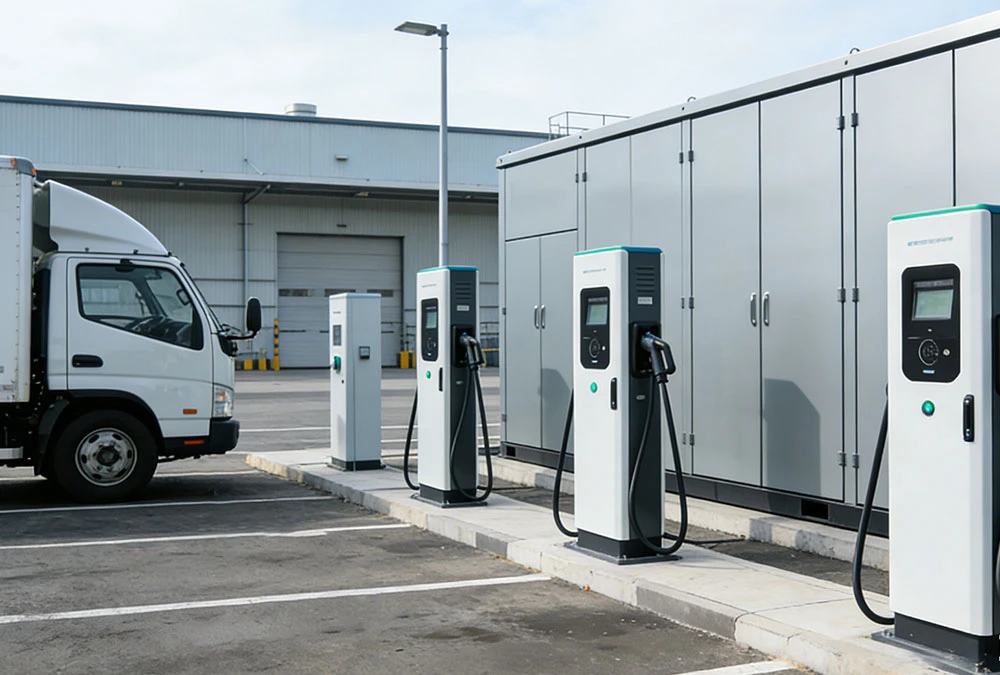
- Enable EV Charging Expansion: Acting as a “buffer” to support high-power DC fast chargers without upgrading the local grid transformer.
Key Features of BESS (Performance Metrics)
- Power (kW) vs Energy (kWh): Power is the instantaneous discharge capability; Energy is the “fuel” available. A 1MW/2MWh system is a “2-hour system.”
- Round-Trip Efficiency (RTE): High-quality systems in 2026 achieve 89%–92% RTE.
- Cycle Life: Standard LFP systems now guarantee 6,000 to 10,000 cycles before reaching 80% capacity.
- Depth of Discharge (DoD): Modern systems allow for 90%–100% DoD, maximizing the usable energy for the investment.
Battery Chemistries: LFP vs NMC vs Emerging Tech
Following the technical evolution of industrial battery energy storage system solutions, the chemistry choice dictates both safety and ROI.
Lithium Iron Phosphate (LFP) – Safety and Longevity
LFP has become the 2026 global standard for stationary BESS. Its chemical structure is inherently stable, meaning it can withstand high temperatures without releasing oxygen—the primary cause of fires in older lithium technologies.
- Pros: 10+ year life, high safety, lower cost.
- Cons: Lower energy density (requires more space).
Nickel Manganese Cobalt (NMC) – High Energy Density
Once dominant in EVs, NMC is now rarely used for industrial BESS due to safety concerns and higher costs. It is only considered where space is extremely limited.
- Pros: Extremely compact.
- Cons: Higher fire risk, shorter cycle life.
Emerging Technologies (Sodium-ion, Solid-state Batteries)
- Sodium-ion: In 2025-2026, Sodium-ion has entered the “Pilot Project” phase. It is cheaper and more sustainable than lithium but has lower energy density.
- Solid-state: Still 3-5 years from mass industrial adoption but promises “infinite” safety and double the energy density.
Comparison of Battery Types for Commercial and Industrial Use
| Feature | LFP (Current Standard) | NMC (Legacy/Specialized) | Sodium-ion (Emerging) |
| Safety Profile | Excellent (Non-flammable) | Moderate (Fire risk) | Excellent |
| Cycles (80% SoH) | 8,000+ | ~3,500 | ~4,500 |
| Environmental Impact | Low (No Cobalt/Nickel) | High | Minimal |
| 2026 Market Share | 85% | 10% | 5% |
Applications in the C&I Sectors
- Manufacturing Facilities: Primarily for peak shaving energy storage to reduce high-voltage demand charges.
- Commercial Buildings: Optimizing TOU (Time of Use) rates and providing critical backup for server rooms.
- EV Charging Stations: Using a BESS to support 240kW chargers where the grid only provides 100kW.
- Microgrid and Off-Grid: Creating 100% self-sufficient energy islands for remote mining or research sites.
Revenue Streams and ROI Analysis
An industrial battery energy storage system solutions investment is no longer a “sunk cost”—it is a revenue generator.
Energy Arbitrage (Time-of-Use Optimization)
The EMS automatically charges the BESS during off-peak hours (e.g., 2:00 AM) when electricity is $0.05/kWh and discharges it during peak hours (e.g., 6:00 PM) when prices hit $0.25/kWh. This $0.20 spread goes directly to the bottom line.
Demand Charge Reduction for Industrial Users
In many regions, the “Demand Charge” is calculated based on the highest 15-minute peak of the month. A BESS can reduce this peak by 20%–40%, typically resulting in an ROI of 3 to 5 years.
Frequency Regulation and VPP Participation
In 2026, “Virtual Power Plants” (VPP) allow BESS owners to sell capacity back to the grid during emergencies. Grid operators pay a premium for “Instantaneous Frequency Response,” creating a passive revenue stream.
Case Study: 1MWh System ROI (2026 Projection)
| Income/Savings Source | Annual Value (Estimated) |
| Demand Charge Savings | $85,000 |
| TOU Arbitrage | $32,000 |
| Grid Service Revenue (VPP) | $15,000 |
| Total Annual Benefit | $132,000 |
| Estimated Payback Period | 4.2 Years |
Alternative Storage Technologies vs BESS
While battery energy storage system for commercial and industrial use is the most popular, other technologies serve specific niches.
Detailed Interpretation of Technologies
- Pumped Hydro (PHES): Uses gravity to move water between two reservoirs. It is the most mature technology but requires specific geography (mountains) and 10+ years to build.
- Flywheel: Stores energy as kinetic energy in a spinning rotor. It provides nearly infinite cycles and rapid response but has very low energy density (short duration).
- Thermal Storage: Storing energy as heat or ice. Common in “District Cooling” but inefficient for electrical output.
- Hydrogen: Using electricity to split water (electrolysis). Hydrogen is excellent for long-term (seasonal) storage but currently suffers from low “round-trip efficiency” (35%–40%).
Comparison Table of Energy Storage Technologies
| Technology | Efficiency | Deployment Speed | Scalability | Best Use Case |
| BESS (Lithium) | 90% | 3–6 Months | High (Modular) | Factories, EV, Buildings |
| Pumped Hydro | 75% | 10+ Years | Low (Geography) | National Grid |
| Flywheel | 85% | 6 Months | Low | Data Centers (UPS) |
| Hydrogen | 40% | 2–3 Years | High | Heavy Industry/Shipping |
Choosing the Right BESS for Your Business
Selecting the right energy storage system manufacturers requires analyzing your Load Profile.
- Cabinet vs Container: For systems under 500kWh, a cabinet is cheaper and easier to permit. For over 1MWh, containers offer better thermal management.
- System Integration: Ensure your energy storage system design includes a seamless interface between Solar, BESS, and EV Chargers (the “All-in-One” approach).
- Safety First: Only buy systems with Tier 1 cell providers and integrated liquid cooling to ensure your insurance premiums don’t spike.
Future Trends (2026–2030)
- AI-Driven VPPs: Every BESS will eventually be part of a larger network, trading energy autonomously.
- Long-Duration Energy Storage (LDES): New flow-batteries designed to discharge for 10-24 hours.
- Circular Economy: Second-life EV batteries being repurposed for lower-cost stationary BESS.
Frequently Asked Questions About BESS
What is a battery energy storage system in simple terms?
A battery energy storage system (BESS) is a “giant rechargeable battery” that stores electricity from the grid or solar to be used later when prices are high or the power goes out.
How does a battery energy storage system work?
It converts AC power to DC for storage in batteries. When needed, it converts that DC back to AC for your facility, managed by a brain called an EMS.
What are the main components of a BESS?
The core battery energy storage system components and design includes Battery Modules, BMS, PCS (Inverter), EMS (Software), and Thermal/Fire protection systems.
What are the benefits of battery energy storage systems?
They reduce electricity bills through peak shaving, provide backup power, and allow for higher renewable energy use.
What is the difference between ESS and BESS?
ESS is the category (all energy storage); BESS is the specific type that uses batteries (the most common for businesses).
 https://anengjipower.com/wp-content/uploads/2026/10/AnengjiPower-BESS-Battery-Passport-Data-Handover.webp
675
1000
Alex Yang
https://anengjipower.com/wp-content/uploads/2025/09/anengji-dc-fast-charging-station-manufacturer-and-supplier-logo-white-1.png
Alex Yang2026-10-23 03:24:462026-10-23 03:25:06What Is the EU Battery Regulation? BESS Compliance Guide
https://anengjipower.com/wp-content/uploads/2026/10/AnengjiPower-BESS-Battery-Passport-Data-Handover.webp
675
1000
Alex Yang
https://anengjipower.com/wp-content/uploads/2025/09/anengji-dc-fast-charging-station-manufacturer-and-supplier-logo-white-1.png
Alex Yang2026-10-23 03:24:462026-10-23 03:25:06What Is the EU Battery Regulation? BESS Compliance Guide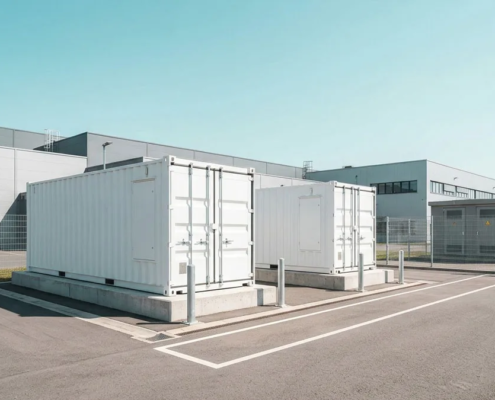 https://anengjipower.com/wp-content/uploads/2026/10/AnengjiPower-Multi-Service-BESS-Dispatch-at-a-CI-Site.webp
675
1000
Alex Yang
https://anengjipower.com/wp-content/uploads/2025/09/anengji-dc-fast-charging-station-manufacturer-and-supplier-logo-white-1.png
Alex Yang2026-10-22 06:21:262026-10-22 06:21:47Multi-Service BESS Dispatch: EMS Priority Guide
https://anengjipower.com/wp-content/uploads/2026/10/AnengjiPower-Multi-Service-BESS-Dispatch-at-a-CI-Site.webp
675
1000
Alex Yang
https://anengjipower.com/wp-content/uploads/2025/09/anengji-dc-fast-charging-station-manufacturer-and-supplier-logo-white-1.png
Alex Yang2026-10-22 06:21:262026-10-22 06:21:47Multi-Service BESS Dispatch: EMS Priority Guide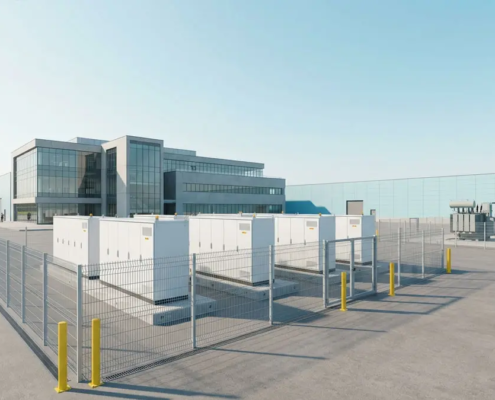 https://anengjipower.com/wp-content/uploads/2026/10/AnengjiPower-Time-of-Use-Battery-Storage-at-a-European-CI-Site.webp
675
1000
Alex Yang
https://anengjipower.com/wp-content/uploads/2025/09/anengji-dc-fast-charging-station-manufacturer-and-supplier-logo-white-1.png
Alex Yang2026-10-21 03:56:212026-10-21 03:56:32Time-of-Use Battery Storage for European C&I Sites
https://anengjipower.com/wp-content/uploads/2026/10/AnengjiPower-Time-of-Use-Battery-Storage-at-a-European-CI-Site.webp
675
1000
Alex Yang
https://anengjipower.com/wp-content/uploads/2025/09/anengji-dc-fast-charging-station-manufacturer-and-supplier-logo-white-1.png
Alex Yang2026-10-21 03:56:212026-10-21 03:56:32Time-of-Use Battery Storage for European C&I Sites


Leave a Reply
Want to join the discussion?Feel free to contribute!