
Introduction
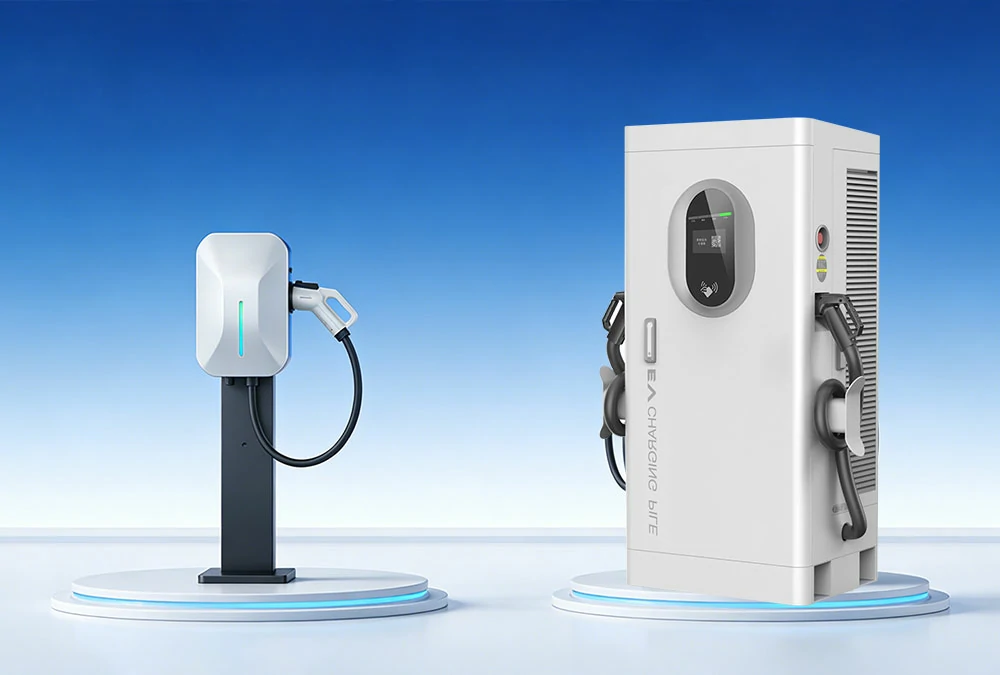
If you’ve just joined the electric vehicle revolution, you’ve probably noticed that not all charging plugs are created equal. The debate between AC vs DC EV chargers is one of the most common topics for new owners. While both get your car back on the road, they work in very different ways.
Understanding the difference between AC and DC EV chargers helps you plan your trips better, save money, and keep your battery healthy for the long haul. Let’s break down how these two power sources work, where you’ll find them, and which one is right for your daily routine.
The Science Simplified: How EV Batteries Store Energy
First things first: your EV battery only stores Direct Current (DC). This is a physical rule of battery chemistry. However, the power grid—the lines running to your house and along your street—carries Alternating Current (AC).
Because of this, every EV charging process involves a “handshake” between the grid and your battery. The main difference lies in where that power gets converted from AC to DC.
How AC Charging Works?
When you plug into an AC EV charger (like the one in your garage), the AC power flows into the car first. Inside your vehicle, there is a component called an on-board charger. This device acts as a translator, converting that AC power into DC power so it can be stored in the battery. Because this on-board converter is small (to save space in the car), the process is relatively slow.
How DC Charging Works?
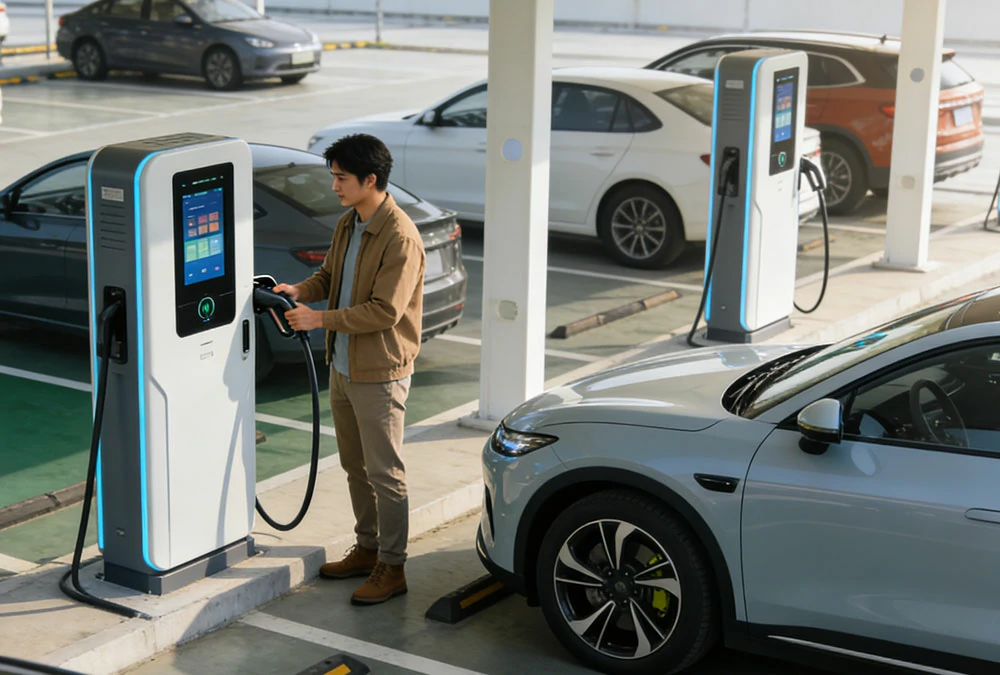
DC fast charging stations do the heavy lifting outside the car. These massive units have the converter built right into the station itself. often following standardized SAE J1772 and CCS connectors to ensure compatibility. They bypass the car’s limited on-board charger and feed DC power directly into the battery. This is why DC charging is significantly faster than AC charging—the “middleman” in the car is skipped entirely.
7 Key Differences Between AC and DC EV Chargers
1. Where the Power Conversion Happens
As an EV charging station supplier, we often explain it this way: the grid always outputs AC. With AC charging, the conversion happens inside your car. With DC charging, the conversion happens inside the charging station. This “off-board” conversion allows for much larger, more powerful components that wouldn’t fit inside a vehicle.
2. Why AC is King for Home Use
For your driveway, an AC EV charger is almost always the better bet. DC fast charger manufacturers design their units for industrial use; they are bulky, expensive, and require a high-voltage grid connection (usually 480V or more) that most homes simply don’t have.
By 2025, a quality Level 2 vs Level 3 charger comparison shows that home AC units cost between $300 and $1,200, while a DC station can run you tens of thousands of dollars. Plus, your home’s electrical panel is already set up for AC.
3. Portability and Flexibility
AC chargers are much more portable. Because they don’t need a massive internal transformer, you can even carry a mobile AC charging cable in your trunk. DC fast charging stations, however, are permanent fixtures. They require specialized thermal management and cooling systems to handle the intense heat generated during the energy transfer, making them strictly for public or commercial locations.
4. The Massive Gap in Charging Speed
If you’re looking for charging speed, DC wins by a mile. A standard Level 2 AC charging station might take 8 to 10 hours to fully juice up a 400km-range battery—perfect for overnight. A DC fast charging station, however, can get you to 80% in just 30 to 60 minutes. Keep in mind, though, that actual speed depends on your car’s charging curve and the unit’s kW charging power.
5. Understanding the Charging Curve
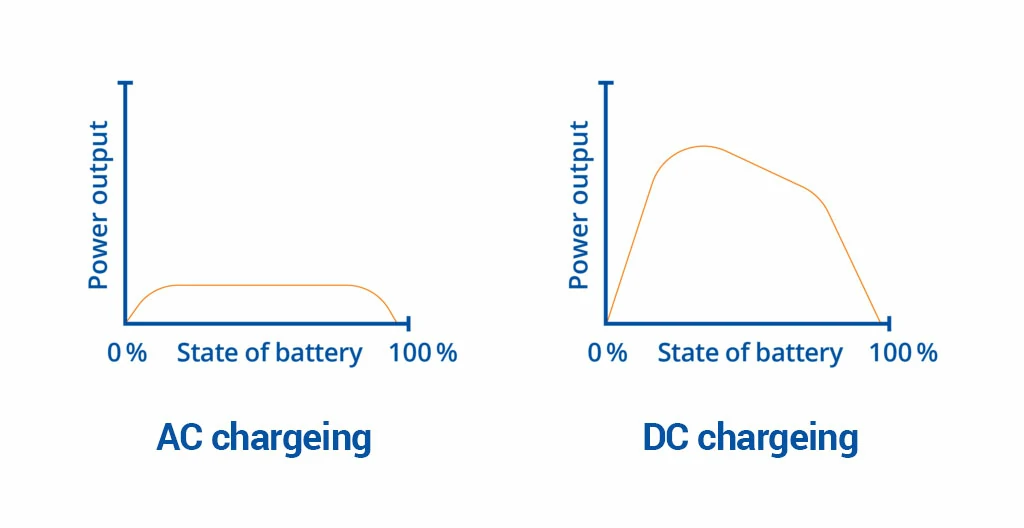
If you look at an EV charging comparison graph, you’ll see that AC charging is a flat line; it delivers a steady flow of power until the battery is full. DC charging follows a curve. It starts very fast but slows down significantly as the battery reaches 80% to protect the cells from overheating.
6. Battery Health and Degradation
Is DC fast charging bad for your battery? If used exclusively, it can be. Fast charging generates high heat and increases the “ripple effect.” Research by Geotab suggests that EVs in hot climates that fast-charge more than three times a month show about 10% more battery degradation over four years compared to those using AC. For long-term battery health, home EV charging with AC is much gentler.
7. The Bottom Line: Installation and Charging Cost
The installation cost for an AC unit is relatively low—usually just a few hundred dollars for a licensed electrician. In contrast, a commercial EV charging station (DC) involves heavy infrastructure and high utility fees. While you pay a premium for the speed of a public DC station, AC charging at home or the office remains the most budget-friendly way to “refuel.”
Which One Should You Choose?
- For Daily Commuting: Stick with an AC EV charger. It’s cheaper, better for your battery, and lets you wake up to a “full tank” every morning.
- For Road Trips: Use DC fast charging. When you’re on the highway and need to get back on the road, the convenience of a quick 30-minute top-off is worth the extra cost.
- For Business Owners: If you are looking for an EV charger manufacturer to outfit your workplace, AC units are great for employee parking (long stay), while DC units attract travelers who need a quick stop.
Summary
Both AC and DC EV charging have their place in the ecosystem. AC is the marathon runner—steady, reliable, and efficient for the long haul. DC is the sprinter—built for speed when time is of the essence. As an OEM EV charger specialist, we recommend a “balanced diet” of mostly AC charging with DC used only when necessary for travel.
FAQ: Common Questions About AC vs DC Charging
Q: Can I install a DC fast charger at my house? A: Generally, no. Most residential areas don’t have the required voltage input, and the installation cost is prohibitive. A Level 2 AC charger is the standard for home use.
Q: Is DC charging more expensive than AC? A: Yes. Public DC stations charge a premium for the high kW charging power and the convenience of speed. Charging at home with an AC unit is the cheapest way to power your EV.
Q: Does every EV support DC fast charging? A: Most modern EVs do, but the maximum charging speed varies by model. Some older or smaller EVs may only support AC charging.
Q: Why does DC charging slow down after 80%? A: This is a safety feature to prevent battery degradation and manage heat. Think of it like filling a glass of water—you slow down at the top so you don’t spill.
 https://anengjipower.com/wp-content/uploads/2026/03/industrial-solar-battery-storage-solutions-container.webp
675
1000
Charging Station Engineer
https://anengjipower.com/wp-content/uploads/2025/09/anengji-dc-fast-charging-station-manufacturer-and-supplier-logo-white-1.png
Charging Station Engineer2026-03-18 07:10:422026-03-18 07:11:38Solar Energy Battery Storage: Commercial Guide & ROI Analysis
https://anengjipower.com/wp-content/uploads/2026/03/industrial-solar-battery-storage-solutions-container.webp
675
1000
Charging Station Engineer
https://anengjipower.com/wp-content/uploads/2025/09/anengji-dc-fast-charging-station-manufacturer-and-supplier-logo-white-1.png
Charging Station Engineer2026-03-18 07:10:422026-03-18 07:11:38Solar Energy Battery Storage: Commercial Guide & ROI Analysis https://anengjipower.com/wp-content/uploads/2026/03/containerized-energy-storage-system-for-industrial-use.webp
675
1000
Charging Station Engineer
https://anengjipower.com/wp-content/uploads/2025/09/anengji-dc-fast-charging-station-manufacturer-and-supplier-logo-white-1.png
Charging Station Engineer2026-03-18 02:55:302026-03-18 02:56:51Energy Storage System Guide: Types, ROI & Technical Comparison
https://anengjipower.com/wp-content/uploads/2026/03/containerized-energy-storage-system-for-industrial-use.webp
675
1000
Charging Station Engineer
https://anengjipower.com/wp-content/uploads/2025/09/anengji-dc-fast-charging-station-manufacturer-and-supplier-logo-white-1.png
Charging Station Engineer2026-03-18 02:55:302026-03-18 02:56:51Energy Storage System Guide: Types, ROI & Technical Comparison https://anengjipower.com/wp-content/uploads/2026/03/containerized-energy-storage-system-industrial-park.webp
675
1000
Charging Station Engineer
https://anengjipower.com/wp-content/uploads/2025/09/anengji-dc-fast-charging-station-manufacturer-and-supplier-logo-white-1.png
Charging Station Engineer2026-03-13 09:04:512026-03-13 09:05:40What Are Commercial Energy Storage Systems?
https://anengjipower.com/wp-content/uploads/2026/03/containerized-energy-storage-system-industrial-park.webp
675
1000
Charging Station Engineer
https://anengjipower.com/wp-content/uploads/2025/09/anengji-dc-fast-charging-station-manufacturer-and-supplier-logo-white-1.png
Charging Station Engineer2026-03-13 09:04:512026-03-13 09:05:40What Are Commercial Energy Storage Systems?


Leave a Reply
Want to join the discussion?Feel free to contribute!