
Introduction
When a company decides to swap its internal combustion engines (ICE) for electric vehicles, the real work is just beginning. As we hit 2025, the number of commercial and government-operated EVs in the U.S. has officially surpassed one million, with forecasts pointing to over four million by 2030. However, without a scientifically planned fleet EV charging system, fleets face major risks: grounded vehicles, skyrocketing utility bills, overloaded grids, and even regulatory fines.
Buying the trucks is only Step One. The real secret to a successful transition is figuring out how to get dozens or hundreds of vehicles charged at the right time, at the lowest possible cost, and with 100% reliability. This fleet EV charging planning guide offers a deep, practical dive into everything from strategic value to technical architecture. It’s built specifically for managers in logistics, municipal services, transit, and corporate fleets.
What is Fleet EV Charging?
EV fleet charging isn’t as simple as plugging a few cars into the wall. It is a complex engineering ecosystem that brings together energy dispatch, load management, data synchronization, and maintenance. The core mission is to meet the operational needs of every vehicle while minimizing electricity spend, grid impact, and downtime.
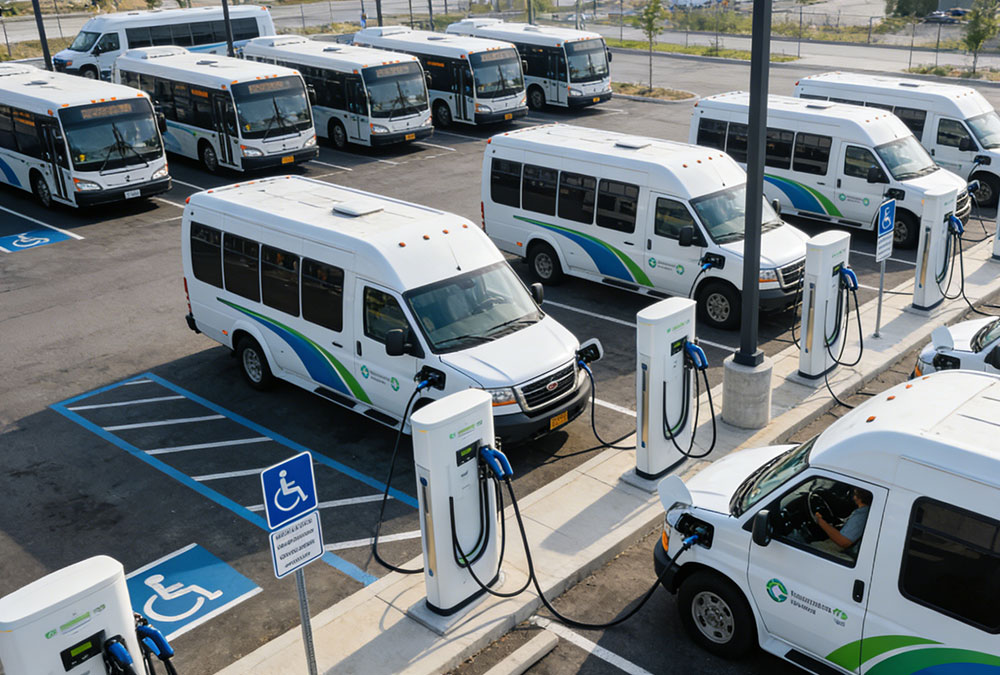
Unlike the “charge whenever” habit of individual drivers, commercial fleet EV charging is highly disciplined and scheduled. We see this most in fleet depot charging scenarios—think logistics hubs where vans return at night, bus depots with fixed shifts, or municipal sanitation bases. These locations have stable “dwell times,” making them the perfect spots to deploy dedicated fleet charging infrastructure. Through centralized management, a business can control its charging tempo, monitor energy use, track carbon emissions, and check battery state of health (SOH) in real-time. It’s a shift from “passive fueling” to “active energy optimization.”
Why Fleet Electrification Depends on Smart Charging Management
Slashing Total Cost of Ownership (TCO)
The financial win for EVs isn’t just about the fuel; it’s about the efficiency. Based on 2025 average U.S. electricity rates, the cost per mile is roughly $0.04–$0.06, while a comparable gas vehicle sits at $0.12–$0.18. For a light-duty delivery van covering 200 miles a day, the annual fuel savings can exceed $5,000. Furthermore, because EVs lack complex parts like oil filters and exhaust systems, your maintenance operating expenditure (OpEx) can be 30%–50% lower than ICE vehicles (NREL, 2024).
However, without a fleet charging strategy, those gains can vanish. For example, if you fast-charge 20 trucks simultaneously during peak hours, you’ll likely trigger massive demand charge management fees, which can spike a monthly bill by tens of thousands of dollars. Smart fleet charging is the only way to actually unlock the economic potential of your fleet.
Meeting Stricter Regulations and ESG Goals
Policies are moving fast to phase out fossil-fuel fleets. New York has legislation requiring all state-owned vehicles to be zero-emission by 2040; California is banning the sale of new ICE light-duty vehicles by 2035; and the EU’s “Fit for 55” plan is hitting high-emission fleets with carbon tariffs. Beyond the law, giants like Walmart and Amazon now require their logistics partners to disclose Scope 1 and Scope 2 emissions data.
Investing in commercial EV fleet charging infrastructure today isn’t just about being a good “corporate citizen.” it’s a strategic move to avoid future market access risks and earn the trust of high-value clients.
Improving Energy Resilience and Operational Continuity
Depending on the public gas station network means you are at the mercy of price swings and supply chain hiccups. By building your own charging station—especially when paired with local renewables like rooftop solar and a battery energy storage system (BESS)—your fleet can stay operational during extreme weather or grid failures. This kind of energy autonomy has become a pillar of business resilience in an era of increasing climate risks.
Comparing the 3 Main Charging Modes: Which Fits Your Fleet?
Choosing the right mode requires a balance of operational rhythm, vehicle type, and budget. Here are the three primary fleet charging solutions:
| Charging Mode | Use Case | Cost ($/kWh) | Control Level | Data Integrity |
| Depot/Private Charging | Fixed routes, overnight (Logistics, Transit) | $0.10–$0.15 | High | Full |
| Public Charging | Long-haul, emergency top-offs | $0.30–$0.60+ | Low | Limited |
| Home Charging | Distributed fleets, take-home vans | $0.12–$0.20 | Medium | Weak |
Industry data shows that mid-to-large fleets (10+ vehicles) should prioritize building their own fleet depot charging stations. Even though the capital expenditure (CapEx) is higher upfront, the total cost over five years is the lowest, and it allows for load balancing and carbon tracking. Public charging should be reserved for emergencies, and home charging—while convenient—is a nightmare for scale and reimbursement.
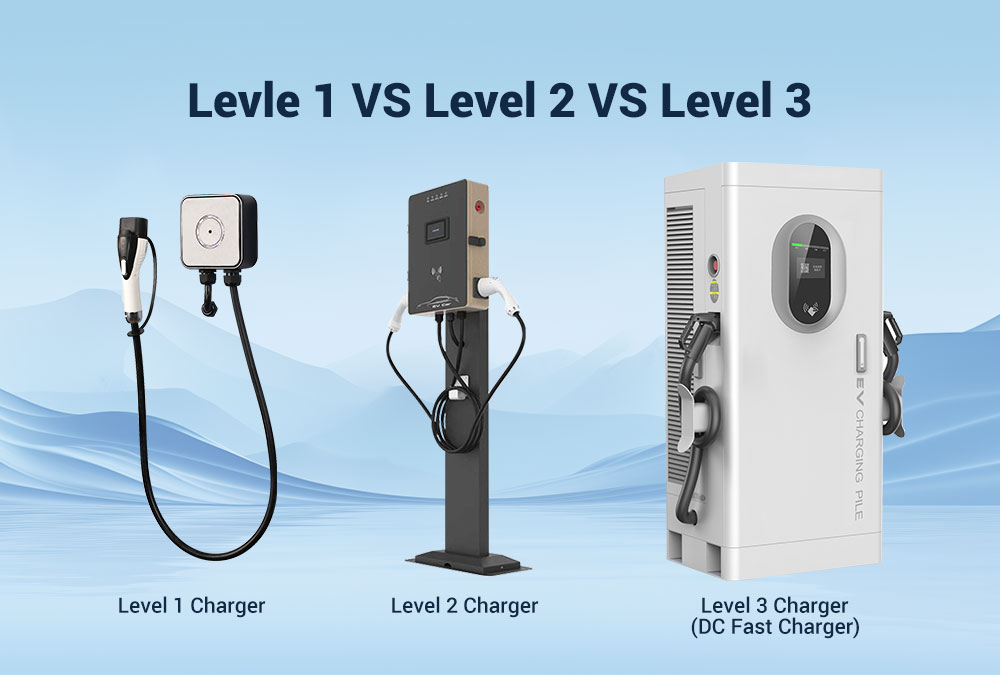
Hardware Selection: The Trade-off Between Level 2 and DCFC
Level 2 EV Charging: The Reliable Heavy-Lifter
Level 2 chargers use 208–240V AC power, delivering 7–19 kW. This adds roughly 10–65 miles of range per hour. These are ideal for vehicles parked for 6+ hours, such as regional delivery vans, school buses, or employee shuttles. They are cost-effective to install ($600–$12,700 per port), compatible with most existing electrical systems, and have a long lifespan (around 7 years).
As of 2025, over 70% of commercial fleets rely on Level 2 chargers for fleet charging, especially for vehicles doing under 200 miles a day. Their stability, low cost, and low maintenance make them the first choice for building a foundation.
DC Fast Charging (DCFC): For High-Turnover Operations
DCFC bypasses the onboard charger and sends DC power straight to the battery at 50–350 kW (with heavy-duty units hitting 1 MW+). A light-duty vehicle can reach an 80% state of charge (SOC) in 20–30 minutes, drastically cutting downtime.
You’ll need DCFC for:
- Multi-shift last-mile delivery
- Ride-sharing and taxi fleets
- Intercity freight hubs
While a single DCFC unit can cost $4,000–$51,000 and often requires a transformer capacity upgrade, the ROI for “time is money” businesses is clear. Every hour of downtime reduced can add thousands in annual revenue. Just be careful: frequent fast charging can impact your battery state of health (SOH), so use it strategically and pair it with a health monitoring system.
Best Practice: Use a hybrid deployment—80% Level 2 for overnight fleet charging and 20% DCFC for quick midday top-offs.
The 5 Core Pillars of Smart Charging Infrastructure
A truly efficient EV fleet charging system consists of five layers working together:
1. Charging Hardware (EVSE)
Choose hardware that supports OCPP 1.6 or 2.0 protocols. This ensures your software is compatible with different brands and prevents you from being locked into a single vendor. Prioritize brands that offer remote firmware updates and self-diagnostics to keep your charging uptime high.
2. Charging Management System (CMS)
The CMS is the “brain” of the operation. Its core jobs include:
- Load balancing across multiple vehicles to prevent grid overloads.
- Executing smart fleet charging strategies to charge during off-peak time-of-use electricity rates.
- Generating real-time reports on energy, billing, and carbon.
3. Energy Management System (EMS)
An EMS looks at the whole site’s energy flow. It can integrate solar panels, battery energy storage systems (BESS), and the grid. By using this “Solar-Storage-Charging” model, you can reduce peak demand charges by over 40%.
4. Fleet Telematics Integration
By connecting to your vehicle’s data via API, the system knows the exact state of charge (SOC), location, and health. The system can then auto-trigger tasks, like: “If SOC is below 20% and the truck is within 500 meters of the depot, initiate Level 2 charging.”
5. Driver and O&M Support
You need driver training and a preventive maintenance for EV chargers plan. For DCFC equipment especially, regular maintenance is required to keep OEM warranties valid. Data shows that stations without a dedicated maintenance plan have 3x higher failure rates.
The 5-Step Implementation Path: From Assessment to Optimization
Step 1: Conduct a Comprehensive Feasibility Study
Analyze your historical data (mileage, dwell times, SOC swings), evaluate your site’s electrical capacity, and determine the number of ports needed. Usually, a 1:1.5 or 1:2 ratio (ports to vehicles) is sufficient.
Step 2: Design a Scalable System Architecture
Always leave 20%–30% redundancy in your power and space planning. Use a modular design that lets you expand easily and choose platforms that are ready for vehicle-to-grid (V2G) in the future.
Step 3: Optimize Financing and Incentives
As of 2025, several U.S. incentives are available:
- Federal ITC: Covers 30% of charging equipment and installation costs.
- California HVIP: Up to $9,000 per Class 8 electric truck.
- Utility Rebates: Companies like PG&E or Con Edison offer up to 50% installation subsidies.
- Consider Charging-as-a-Service (CaaS) for a zero-down setup, turning CapEx into a manageable monthly OpEx.
Step 4: Professional Construction and Commissioning
Select a provider with EPC (Engineering, Procurement, and Construction) capabilities. Ensure all work meets NEC 2023 and UL 2594 safety standards, and perform full API integration tests between your CMS and fleet management software.
Step 5: Continuous O&M and Data-Driven Tweaks
Perform quarterly maintenance (especially on DCFC units). Every six months, analyze your charging efficiency and carbon data to refine your dispatch strategies and further lower costs.
Future Trends: Your Charging System is an Energy Asset
Vehicle-to-Grid (V2G) Goes Mainstream
V2G technology allows your fleet to send power back to the grid during peak demand. By 2025, many U.S. municipal and school bus fleets are already earning $500–$1,200 per vehicle per year by participating in grid services. Your fleet is no longer just a transportation tool; it’s a revenue-generating battery.
Megawatt Charging (MCS) for Heavy-Duty Trucks
For Class 8 semis, the Megawatt Charging System (MCS) is rolling out. Adding 300 miles of range in 15 minutes completely removes “range anxiety” for long-haul freight. Models like the Tesla Semi and Volvo FH Electric are already pushing this standard forward.
AI-Powered Predictive Charging
By analyzing weather, route orders, and real-time energy prices, AI can generate the perfect charging plan 24 hours in advance. If a storm is coming, it ensures a full charge; if electricity is cheap at 2 AM, it focuses power then. This can slash costs by another 10%–15%.
Deep Clean Energy Integration
More fleets are creating “Zero-Carbon Charging Parks” by combining chargers with solar and microgrids. For instance, UPS hubs are now using massive solar and storage arrays to self-generate 80% of their charging energy, making them immune to utility price spikes.
Conclusion
Fleet EV charging has graduated from being a “support project” to a core competitive advantage. A well-designed infrastructure provides a clear financial return (often within 5 years) while boosting your resilience and brand reputation.
In 2025, the question is no longer “should we electrify?” but “how can we do it better?” Successful strategies go beyond hardware—they lean into system integration and data-driven energy management. With the right planning, your fleet won’t just keep up with the future; it will lead it.
Fleet EV Charging FAQ
Q1: How do I build EV fleet charging infrastructure without blowing my budget?
A: The most effective way is to use smart fleet charging to manage your load. By capping the total power draw, you can often avoid expensive utility transformer upgrades. Also, look into Charging-as-a-Service (CaaS) to move the cost from CapEx to a monthly OpEx model.
Q2: What are the EV fleet charging best practices for 2025?
A: Prioritize overnight fleet charging on Level 2 chargers for 80% of your energy needs. Ensure your hardware is OCPP compliant and integrated with your fleet telematics to monitor SOC and prioritize vehicles with early morning departures.
Q3: Is a fleet EV charging cost analysis much better than diesel?
A: Absolutely. While the initial setup for fleet charging infrastructure is higher, the fuel and maintenance savings typically pay for the investment within 4 to 6 years. Electricity is not only cheaper but also more stable in price compared to diesel.
Q4: Can public stations support commercial EV fleet charging?
A: Only as a backup. Public charging is significantly more expensive ($0.30/kWh+ vs $0.12/kWh at a depot) and doesn’t allow for the fleet charging management integration needed to optimize your operations and battery health.
Q5: What should I look for in a fleet EV charging solutions provider?
A: Look for a turnkey fleet charging solutions provider that offers EPC services, including electrical assessment, software integration, and preventive maintenance. Ensure their chargers are UL 2594 certified and support the latest OCPP standards.
 https://anengjipower.com/wp-content/uploads/2026/03/industrial-solar-battery-storage-solutions-container.webp
675
1000
Charging Station Engineer
https://anengjipower.com/wp-content/uploads/2025/09/anengji-dc-fast-charging-station-manufacturer-and-supplier-logo-white-1.png
Charging Station Engineer2026-03-18 07:10:422026-03-18 07:11:38Solar Energy Battery Storage: Commercial Guide & ROI Analysis
https://anengjipower.com/wp-content/uploads/2026/03/industrial-solar-battery-storage-solutions-container.webp
675
1000
Charging Station Engineer
https://anengjipower.com/wp-content/uploads/2025/09/anengji-dc-fast-charging-station-manufacturer-and-supplier-logo-white-1.png
Charging Station Engineer2026-03-18 07:10:422026-03-18 07:11:38Solar Energy Battery Storage: Commercial Guide & ROI Analysis https://anengjipower.com/wp-content/uploads/2026/03/containerized-energy-storage-system-for-industrial-use.webp
675
1000
Charging Station Engineer
https://anengjipower.com/wp-content/uploads/2025/09/anengji-dc-fast-charging-station-manufacturer-and-supplier-logo-white-1.png
Charging Station Engineer2026-03-18 02:55:302026-03-18 02:56:51Energy Storage System Guide: Types, ROI & Technical Comparison
https://anengjipower.com/wp-content/uploads/2026/03/containerized-energy-storage-system-for-industrial-use.webp
675
1000
Charging Station Engineer
https://anengjipower.com/wp-content/uploads/2025/09/anengji-dc-fast-charging-station-manufacturer-and-supplier-logo-white-1.png
Charging Station Engineer2026-03-18 02:55:302026-03-18 02:56:51Energy Storage System Guide: Types, ROI & Technical Comparison https://anengjipower.com/wp-content/uploads/2026/03/containerized-energy-storage-system-industrial-park.webp
675
1000
Charging Station Engineer
https://anengjipower.com/wp-content/uploads/2025/09/anengji-dc-fast-charging-station-manufacturer-and-supplier-logo-white-1.png
Charging Station Engineer2026-03-13 09:04:512026-03-13 09:05:40What Are Commercial Energy Storage Systems?
https://anengjipower.com/wp-content/uploads/2026/03/containerized-energy-storage-system-industrial-park.webp
675
1000
Charging Station Engineer
https://anengjipower.com/wp-content/uploads/2025/09/anengji-dc-fast-charging-station-manufacturer-and-supplier-logo-white-1.png
Charging Station Engineer2026-03-13 09:04:512026-03-13 09:05:40What Are Commercial Energy Storage Systems?


Leave a Reply
Want to join the discussion?Feel free to contribute!