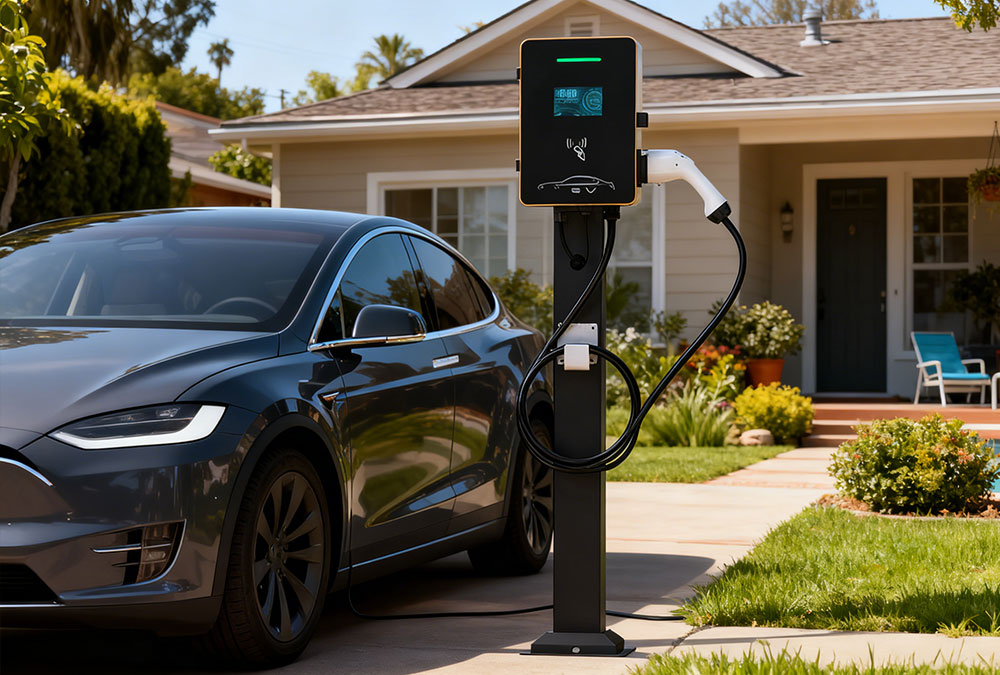
Introduction
As global electric vehicle (EV) sales keep climbing—projected to hit 25 million in 2025 (IEA, 2025)—home EV charging has become the cornerstone of daily driving. With “22kW 3 phase fast chargers” growing more common on the market, many owners face a dilemma: stick with the affordable 7kW standard charger, or invest in a higher-power 22kW system for quicker top-ups?
This decision isn’t as simple as it seems. It involves power infrastructure, vehicle compatibility, installation costs, long-term usage, and even future tech trends. This guide breaks down the real value of a 22kW home EV charger from seven key angles—tech basics, actual efficiency, vehicle support, power requirements, cost-benefit, ideal users, and alternatives—to help you make a smart, future-ready choice.
22kW represents the highest AC charging power available for residential settings. It relies on a three-phase AC electrical system, delivering power to the vehicle through three live wires (L1/L2/L3). This design triples the power transfer of a single-phase system at the same current.
Here’s the breakdown:
- 7kW single-phase charging: 230V × 32A ≈ 7.4kW
- 22kW three-phase charging: √3 × 400V (line voltage) × 32A × power factor (≈0.95) ≈ 21–22kW
But there’s a crucial catch: 22kW is AC charging. Energy must be converted to DC by the vehicle’s onboard charger (OBC) before it charges the battery. If your OBC maxes out at 11kW, even with a 22kW charger, the actual charging power will be capped at 11kW—this is a key bottleneck most consumers miss.
For a 22kW home EV charger to perform at its best, both your grid and vehicle need to match. One without the other won’t work.
Charging time depends on more than just the charger’s power—it’s also limited by battery capacity and the vehicle’s OBC. The table below shows estimated times to charge popular battery sizes from 10% to 90% (excluding inefficient start/end phases):
Note: Data based on standard temperature (20°C) with no thermal management limits. Actual times may vary slightly due to battery condition, ambient temperature, or vehicle software.
Key insight: A 22kW charger only delivers full speed if your vehicle natively supports 22kW. For mainstream models like the Tesla Model 3, Volkswagen ID.4, or Hyundai IONIQ 5 (all with 11kW OBC limits), a 22kW charger will charge at the same speed as an 11kW model—meaning you’re paying thousands extra for unused power.
As of 2025, only about 10–15% of new EVs come with native 22kW AC charging support. Why? High-power OBCs are larger, require better heat management, and cost significantly more (usually €300–€800 extra). Most automakers offer them as a premium or optional feature.
22kW Support for Popular Models (2025 Update)
Pro tip: Before buying, check the “AC Charging Power” in the official specs or ask your dealer to confirm OBC capacity. Don’t fall for “max charging power” claims—those usually refer to DC fast charging (e.g., 150kW, 350kW) and have nothing to do with home AC charging.
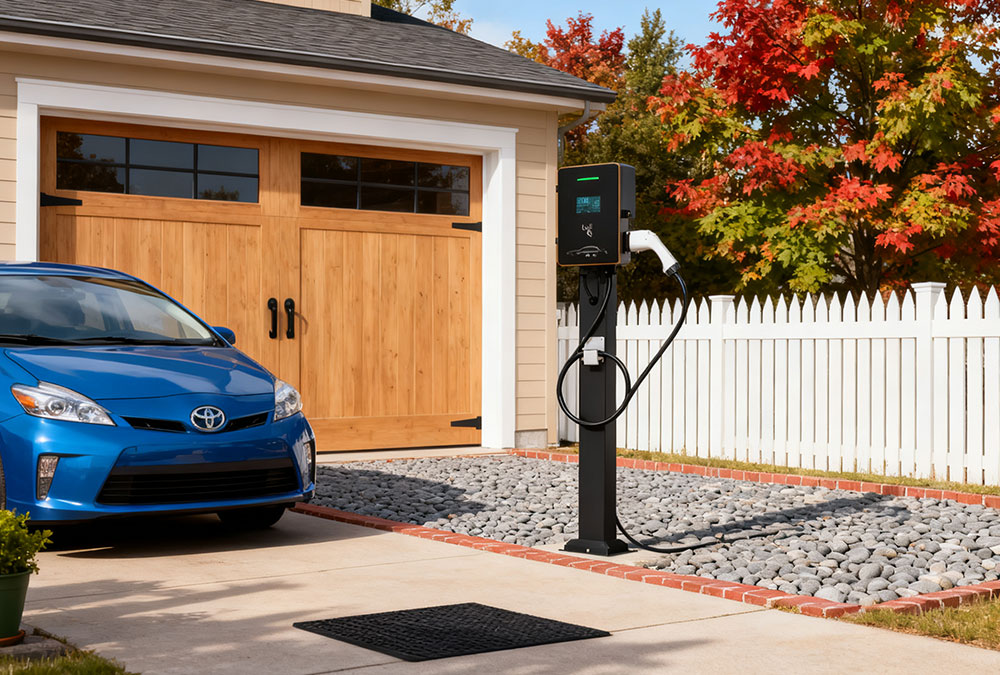
3 phase power is common in industrial areas, commercial buildings, and new high-end homes—but rare in standard residences. Here’s how to check if you have it:
- Look for three main circuit breakers in your consumer unit (each phase controlled separately)
- Check your electricity meter for “3Φ” or “Three-phase” labeling
- Consult a licensed electrician or local utility for a professional assessment
Upgrading from single-phase to three-phase typically involves:
- Grid-side wiring modifications (external connection)
- Installing a new three-phase meter
- Upgrading your internal consumer unit and running dedicated circuits
Cost range: €2,000–€12,000, depending on your location and project complexity. Some areas may deny requests due to grid capacity limits. Plus, approval can take 4–12 weeks—plan ahead.
For most households, a 7kW smart charger strikes the best balance between cost, compatibility, and practicality.
We’ve built a 5-year Total Cost of Ownership (TCO) model to compare the two options (assuming 3 phase upgrade is needed):
💡 Key conclusion: Electricity costs are identical—total energy usage doesn’t change, only charging time. Unless you need multiple quick top-ups daily (e.g., ride-hailing, delivery, fleet operations), the extra cost of 22kW won’t be recouped through time savings.
Highly Recommended For:
- Homes with pre-installed 3 phase power (no upgrade cost)
- Households with two+ EVs that support 22kW (e.g., Zoe + Smart)
- Frequent daytime drivers who can’t rely on overnight charging
- Those living in remote areas with few public fast charging stations (e.g., mountains, rural areas)
- Business or small fleet managers needing efficient charging at offices
- Forward-thinkers planning to buy a 22kW-compatible EV in the next 3–5 years
Not Recommended For:
- Single-EV households with daily mileage <80km
- Vehicles only supporting 7kW or 11kW AC charging
- Renters (low approval chance from landlords/property managers)
- Budget-conscious users prioritizing value and quick ROI
- Drivers who mainly use public DC fast charging for long trips
As one user put it: “Charging a phone with a 22kW charger overnight—you’ll wake up to a full battery either way. You’ll never notice that ‘saved’ hour.”
- Does my home have 3 phase electricity?
- Does my EV support 22kW AC charging?
- Do I often need quick daytime top-ups?
If any answer is “No,” a 7kW charger is the better choice.
For most households, a 7kW smart charger is still the best option. It works with almost all EVs, installs easily, and maximizes benefits through smart features:
- Time-of-use tariff integration: Automatically charges during off-peak hours (e.g., 00:00–06:00) with rates as low as €0.04–€0.06/kWh—saving 30–50% annually
- Solar panel pairing: A 5kW rooftop solar system generates ~4,500–5,500kWh yearly, covering 60–80% of charging needs for true “zero-carbon driving”
- Smart scheduling & remote control: Use an app to schedule charging, track energy usage, and set charge limits—boosting energy management efficiency
- Future compatibility: Even if you buy a 22kW-compatible EV later, the 7kW charger can serve as a backup or guest charger—no waste
Short-term (2025–2027): Remain niche, limited by OBC costs and grid access challenges.
Mid-term (2028–2030): Three trends may drive adoption:
- Updated building codes: Some countries are piloting requirements for 3 phase wiring in new homes
- Automaker shifts: More brands will make 11kW standard and 22kW a high-trim option
- Grid smart: Dynamic load management allows automatic power reduction during peak hours, easing local grid pressure
Long-term: As 800V high-voltage platforms become mainstream (e.g., Porsche Taycan, Hyundai E-GMP), onboard chargers may be eliminated. Home charging could shift to small DC modules (e.g., 11kW DC), completely reshaping the current AC charging system.
A 22kW 3 phase home EV charger is an advanced but highly scenario-dependent solution. It’s not “faster = better”—it’s “right = optimal.”
Before investing, ask yourself three key questions:
- Does my home have 3 phase electricity?
- Does my EV support 22kW AC charging?
- Do I truly need quick daytime top-ups?
If any answer is “No,” a 7kW smart charger + off-peak tariffs + renewable energy integration is the most economical, reliable, and sustainable path. The true essence of green driving isn’t chasing extreme speed—it’s building an efficient, flexible, future-ready home energy ecosystem.
If you’re ready to buy a 22kW EV charger or need help finding the best home EV charger 2025 has to offer, AnengJi is your trusted home EV charger supplier. We’re a leading 3 phase EV charger manufacturer with wholesale EV chargers and professional EV charger installation services to fit your needs.

 https://anengjipower.com/wp-content/uploads/2026/03/industrial-solar-battery-storage-solutions-container.webp
675
1000
Charging Station Engineer
https://anengjipower.com/wp-content/uploads/2025/09/anengji-dc-fast-charging-station-manufacturer-and-supplier-logo-white-1.png
Charging Station Engineer2026-03-18 07:10:422026-03-18 07:11:38Solar Energy Battery Storage: Commercial Guide & ROI Analysis
https://anengjipower.com/wp-content/uploads/2026/03/industrial-solar-battery-storage-solutions-container.webp
675
1000
Charging Station Engineer
https://anengjipower.com/wp-content/uploads/2025/09/anengji-dc-fast-charging-station-manufacturer-and-supplier-logo-white-1.png
Charging Station Engineer2026-03-18 07:10:422026-03-18 07:11:38Solar Energy Battery Storage: Commercial Guide & ROI Analysis https://anengjipower.com/wp-content/uploads/2026/03/containerized-energy-storage-system-for-industrial-use.webp
675
1000
Charging Station Engineer
https://anengjipower.com/wp-content/uploads/2025/09/anengji-dc-fast-charging-station-manufacturer-and-supplier-logo-white-1.png
Charging Station Engineer2026-03-18 02:55:302026-03-18 02:56:51Energy Storage System Guide: Types, ROI & Technical Comparison
https://anengjipower.com/wp-content/uploads/2026/03/containerized-energy-storage-system-for-industrial-use.webp
675
1000
Charging Station Engineer
https://anengjipower.com/wp-content/uploads/2025/09/anengji-dc-fast-charging-station-manufacturer-and-supplier-logo-white-1.png
Charging Station Engineer2026-03-18 02:55:302026-03-18 02:56:51Energy Storage System Guide: Types, ROI & Technical Comparison https://anengjipower.com/wp-content/uploads/2026/03/containerized-energy-storage-system-industrial-park.webp
675
1000
Charging Station Engineer
https://anengjipower.com/wp-content/uploads/2025/09/anengji-dc-fast-charging-station-manufacturer-and-supplier-logo-white-1.png
Charging Station Engineer2026-03-13 09:04:512026-03-13 09:05:40What Are Commercial Energy Storage Systems?
https://anengjipower.com/wp-content/uploads/2026/03/containerized-energy-storage-system-industrial-park.webp
675
1000
Charging Station Engineer
https://anengjipower.com/wp-content/uploads/2025/09/anengji-dc-fast-charging-station-manufacturer-and-supplier-logo-white-1.png
Charging Station Engineer2026-03-13 09:04:512026-03-13 09:05:40What Are Commercial Energy Storage Systems?


Leave a Reply
Want to join the discussion?Feel free to contribute!