

Introduction
Three suppliers can quote what looks like the same 1 MW / 2 MWh system. One is offering battery-side DC energy only. Another includes an AC-integrated block. A third is pricing equipment while leaving the PCS, medium-voltage scope, controls integration, or site acceptance to someone else. The containers may look alike in a quotation. The risk does not.
That is the uncomfortable part of choosing a BESS manufacturer for a European EPC project: the word manufacturer says very little about who designed the quoted configuration, who owns an interface failure, or who must restore the plant after commissioning. The U.S. Department of Energy’s 2024 Battery Energy Storage System Procurement Checklist is useful here for one reason: it treats commercial-scale lithium-ion procurement as a sequence of defined tasks and questions, not a catalogue comparison. It is a U.S. federal procurement resource—not a European compliance rule—but that discipline travels well.
This guide gives EPC procurement and engineering teams a practical route from supplier claim to proof: claim → document → verification event → contract owner → handover record. Use it before award, while changes are still inexpensive. Country-specific grid, fire, planning and market requirements still need to be confirmed with the applicable authority, DSO/TSO and project advisers; no manufacturer brochure can do that work for you.
The decision this page helps you make: Can this bidder support the exact project duty, provide evidence for the exact supplied configuration, and remain accountable after COD—not merely ship hardware?
One Quote, Three Questions
A good supplier review brings the people who will live with the decision into the same conversation. The bid may arrive with a clean one-line price, but your engineering lead, buyer and future O&M colleague are usually testing three different things. If those questions are not answered together, they come back later as a variation, a hold point or a difficult support call.
None of these is a “nice-to-have” question. Together, they are the real scope of a manufacturer decision. The sections below turn them into a short, defensible RFQ process.
Define What You Are Buying
Start by stripping the sales labels out of the bid. “Manufacturer,” “OEM,” “integrator,” and “EPC partner” can all be legitimate descriptions. They are not interchangeable contractual roles. A cell supplier may not own the system controls. A system integrator may not install the MV equipment. An EPC may be the single point of contract while relying on separate battery, PCS and EMS providers.
The costly failure mode is familiar: a protection trip appears during energisation, the PCS supplier says it is an EMS command issue, the controls provider says the BMS limit is wrong, and the site team is left coordinating three support desks. Avoid the blame loop before it exists. Ask every bidder for a one-page responsibility map that names the legal entity and accountable person for each layer.
Map Five Accountable Roles
| Role | What to identify | Why the EPC should care |
|---|---|---|
| Battery supplier | Cell, module, rack and BMS scope; serial and batch traceability. | A module warranty is not automatically a whole-system remedy. |
| System integrator | Who owns the final battery–PCS–thermal–fire–controls configuration. | This is often the interface that determines whether a quoted system is actually deliverable. |
| PCS and controls provider | PCS limits, EMS logic, firmware authority, communications and point list. | It defines usable AC performance, grid response and many commissioning interfaces. |
| EPC / electrical contractor | Civil works, transformer, MV/LV works, protection, interconnection and site integration. | Site scope cannot be assumed from an equipment quotation. |
| O&M / service provider | Alarm triage, log access, spares, repair authorisation and escalation. | The buyer needs a recovery path after COD, not just a warranty statement. |
Put the role map in the bid return. If one company owns several roles, record that. If responsibilities pass through subcontractors, record that too. This is not bureaucracy: it is the shortest route to a clear variation, defect and warranty path.
Start With Project Duty
A fair supplier comparison begins with a fair question. If your RFQ says only “1 MW / 2 MWh BESS,” each bidder can make different hidden assumptions about AC/DC boundary, state-of-charge (SoC) window, auxiliary load, ambient temperature, cycling, transformer losses and site scope. The lowest total can then become the largest variation order.
Before you request a quotation, issue one common duty sheet. The Europe-focused BESS design guide can help teams frame the electrical and site inputs, but the supplier selection pack should contain your own project data and a deviations register.
- Operating job: peak shaving, PV shifting, backup, flexibility market participation, or a defined combination.
- Power boundary: required kW/MW at battery terminals, PCS output, plant AC bus or PCC—state one.
- Energy boundary: required usable AC kWh/MWh, duration, SoC window, test rate and whether auxiliary consumption sits inside the guarantee.
- Site and grid: country, voltage, frequency, single-line diagram, export/import limit, ambient conditions, space, access and the current DSO/TSO position.
- Interfaces and acceptance: transformer/MV scope, protection, SCADA/EMS, fire interfaces, FAT, SAT, data handover and delivery dates.
| Illustrative quote-normalisation check — not a product specification | ||
|---|---|---|
| Project duty | 1.0 MW for 2.0 hours at the PCS AC output | The first-order requirement is 1.0 MW × 2.0 h = 2.0 MWh usable AC at the stated boundary. |
| Quote A says | “2.0 MWh DC nameplate” | Pass/fail is unknown: no usable AC output, SoC window, test rate or auxiliary treatment is stated. |
| Quote B says | “2.0 MWh usable AC at PCS output” | Potentially comparable, but only after the test conditions, meter and guarantee tolerance are added. |
| Quote C says | “2.0 MWh delivered at PCC” | Most directly comparable to a PCC duty, provided transformer/cable losses and site conditions are defined. |
How to use this example: do not apply a generic loss factor to turn Quote A into a pass. The missing boundary is the procurement issue. Ask each bidder to fill the same line in the bid form, then compare the evidence behind it.
A useful bid rule: every bidder either accepts each duty-sheet value or records a deviation against the same line item. “Included” without a boundary is not a comparable answer.
Verify the Company Behind the Quote
A credible company can sell through a regional office, agent or distribution partner. That is not the problem. The problem is ambiguity between the sales entity, contracting entity, factory, certificate holder and warranty obligor. Ask the bidder to declare each one, along with the physical assembly location for the proposed configuration and the critical subcontractors whose failure would stop delivery or service.
For this stage, check the registered legal entity, contract party, factory address, equipment serial-number convention, design-control responsibility and the named owner for the system bill of materials (BOM). Then sample, rather than merely request, evidence: a redacted serial-traceability record, a calibration record from the test bay, a non-conformance procedure, and an example of a signed test-deviation closure. A polished slide deck does not answer those questions.
Do Not Treat a Factory Tour as an Audit
A factory tour can be worthwhile, but it is only a starting point. A buyer should see whether the site can demonstrate traceability, controlled drawings, incoming inspection, assembly records, test instrumentation and non-conformance closure for the proposed product family. Ask whether the observed unit is a representative line item or the actual project configuration.
Here is a detail that experienced teams ask early: a type test and a test on the supplied project block are not the same evidence. Type-test results can be valuable, but the contract must state which evidence applies to the exact configuration, which checks will be repeated in FAT, and what happens when a tested option differs from the delivered BOM.
A familiar bid-room moment: the supplier says, “FAT is included.” The right next question is not “Can we attend?” It is “What exactly will this FAT prove on the supplied configuration?”
Ask for three entries before booking travel: the unit or sample being tested, the measurement boundary, and the consequence of a failed result. PVB’s factory-process guide makes the same practical point: depending on the contract and configuration, factory verification can use full-unit tests, partial tests, simulations or sampling. Attendance alone does not define acceptance.
Check the Exact Configuration
For a European project, compliance is never proven by a logo wall. A document may apply to a component rather than the complete system; to a different battery/PCS pairing; or to a different destination scope. The EPC needs a configuration-specific compliance matrix tied to the quoted BOM and project country. The local authority, grid operator and insurer may still ask for additional evidence, so this matrix is an input to project approval—not a substitute for it.
| Supplier claim | Evidence to request | What must match | Buyer benefit |
|---|---|---|---|
| “Europe-ready” | Project compliance matrix and document register. | Destination country, exact model/BOM, project interfaces and any open items. | Prevents an unqualified marketing phrase becoming an approval assumption. |
| “Certified system” | Certificate/test record, issuer, holder, scope and validity evidence. | Battery, PCS, enclosure and the offered combination—not a neighbouring model. | Allows the engineering team to identify gaps before delivery. |
| “Same as reference project” | Reference scope, configuration summary and permission to verify the relevant role. | Comparable duty, climate, grid boundary and bidder responsibility. | Stops unrelated installations from being presented as proof of project fit. |
| “Full documentation included” | Document index with issue stage and owner. | Drawings, interfaces, manuals, firmware/configuration and test records. | Makes the handover package measurable before purchase order release. |
The IOGP 2025 supplementary BESS specification to IEC TS 62933-3-1 is not a European legal requirement. It is, however, a helpful purchaser-side model: it connects purchaser requirements and technical documentation rather than treating them as separate folders. Use that logic in your own technical schedule.
Once the duty sheet and evidence boundary are settled, it is reasonable to discuss C&I system configurations. Capacity alone is not a recommendation: the AC duty, duration, electrical boundary, site layout and acceptance plan remain the selection inputs.
Turn Claims Into Tests
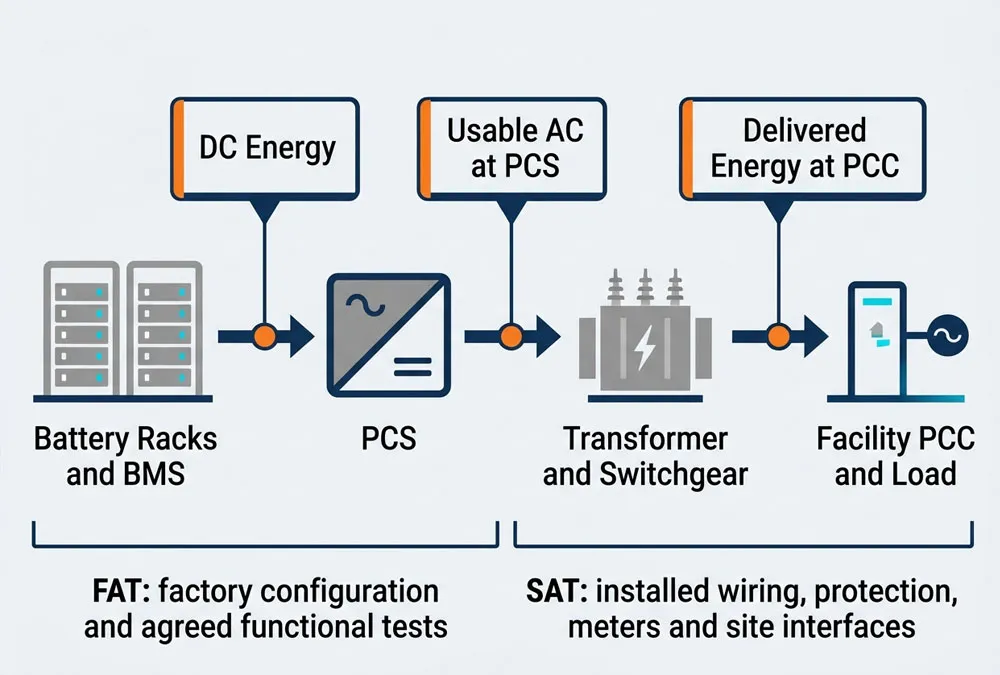
This is where a BESS manufacturer comparison becomes quantitative. “2 MWh” is a storage nameplate, not a complete performance guarantee. The number becomes commercially useful only when the electrical boundary and conditions are written down. Is it gross DC energy, usable AC energy at PCS output, or energy delivered at the PCC? What SoC window, temperature, discharge rate, auxiliary load and meter are included?
The International Association of Oil & Gas Producers’ January 2026 Quality Requirements for BESS treats energy capacity, input/output power, round-trip efficiency, response/ramp performance, auxiliary consumption, self-discharge, and rated voltage/frequency as separate assessment areas. Its purchaser-selected assessment system has four levels (A–D). That is not a mandatory European test programme; it is useful proof that one “passed FAT” statement cannot carry all of those performance meanings.
| Performance item | Boundary or condition to define | Evidence route | Decision consequence |
|---|---|---|---|
| Usable energy | DC, PCS output or PCC; SoC range, temperature, rate and auxiliaries. | Defined energy-capacity protocol; raw time-series and meter boundary. | Avoids paying for energy that cannot serve the owner’s load or market window. |
| Discharge / charge power | Battery limit, PCS limit, transformer, ambient and site export/import constraint. | Power test plus the agreed limit hierarchy. | Shows whether the proposed system can meet the actual peak or response obligation. |
| Round-trip efficiency | Measurement boundary, charge/discharge profile and treatment of auxiliary energy. | Agreed efficiency protocol and data file. | Makes revenue or savings models comparable without implying a universal result. |
| Response, alarms and protection | Command source, ramp, interlocks, trip logic and reset authority. | Functional test, alarm matrix and signed deviation list. | Reduces late discovery that controls do not behave as the site requires. |
For example, if a factory result reports 1.85 MWh at a DC boundary while the project needs 1.70 MWh usable AC at the PCC, you cannot subtract a generic loss percentage and call it accepted. The EPC needs the agreed test boundary, actual auxiliary treatment and site-loss scope. Until then, the 0.15 MWh difference is an engineering question, not proof of a performance shortfall.
Separate FAT From SAT
Factory acceptance testing (FAT) confirms the agreed factory configuration and documented test scope. Site acceptance testing (SAT) confirms the installed system, wiring, protection, metering, communications and grid/site interfaces. A FAT witness trip is not automatically a witnessed energy-capacity test on the delivered block, and a successful SAT cannot repair an unclear factory configuration record.
Request a signed FAT plan before travel is booked: test item, actual unit or sample, pass/fail criterion, test boundary, data format, witness rights, deviation disposition and retest process. The same discipline belongs in the SAT plan. The IOGP document explicitly separates FAT and SAT conformity activities; use that separation as a prompt for scope clarity, not as a claim that every European project follows its template.
Make Warranty Recoverable
A ten-year headline can be less useful than a shorter warranty with a workable remedy. For each offer, compare capacity-retention conditions, throughput, power, availability, exclusions, evidence required to make a claim, and the legal entity that must respond. If an issue occurs, who supplies parts? Who pays diagnosis, travel, removal, reinstallation and recommissioning? Who can authorise a parameter change? Those answers decide downtime exposure.
This matters because a replacement module “under warranty” may still leave an EPC negotiating freight, labour, access, firmware approval and commissioning responsibility. Put the remedy workflow in the contract and make it traceable to the role map. The buyer-side Energy Storage Contract Alliance model BESS agreement is aimed at utility-scale procurement, not a complete C&I contract template, but it usefully foregrounds FAT/SAT, warranties, quality, traceability and data-monitoring terms—areas that are too often left vague in supplier paper.
Why this deserves attention: ESCA puts the industry problem bluntly: “By default, the supplier writes your BESS contract.” Its model is utility-scale oriented, so it should not be copied blindly into a C&I purchase order. The message is still useful for every EPC: a supplier’s standard warranty document is the beginning of the review, not the finish line.
A practical response is to add one plain-language remedy flow: fault reported → data reviewed → responsible party confirmed → temporary operating limit agreed → repair authorised → test evidence accepted → close-out signed. The contract can then name who owns each arrow.
Test Controls and Service Exit
A plant can be electrically healthy and still be operationally stuck. A derated system may require an OEM login, a firmware approval or a proprietary log export before anyone can diagnose it. That dependency should be visible before award, especially for distributors who must support a customer after the equipment is delivered.
The less obvious handover records are often the ones you need at 02:00 on a commissioning weekend: the approved firmware baseline, BMS–PCS–EMS point list, alarm and cause-and-effect matrix, user roles, exportable event logs, change-control process and safe/offline fallback. PVB’s factory-process guide for C&I BESS describes configuration lists, firmware lists, I/O point lists, alarm matrices and FAT records as project documentation. It is manufacturer guidance, not an independent universal standard; use it as a concrete checklist of records to require.
- Who can view and export raw alarms, trends and event logs?
- Who approves, applies and validates firmware or configuration changes?
- What local operating mode remains available if the remote platform is unavailable?
- What is the escalation chain, and who owns the spare-parts decision?
- If the commercial relationship ends, which records, access rights and manuals remain with the asset owner?
This can sound like an edge case until the first commissioning delay. Imagine the site team can see “PCS unavailable” on the dashboard but cannot determine whether the BMS power limit, a communications map or a protective interlock caused it. The fastest route is rarely a long email chain. It is a controlled configuration record, timestamped event data and a named person authorised to decide whether a change is safe. Treat those items as a handover deliverable, just like drawings and manuals.
Score Manufacturers Fairly
Do not publish a universal “best BESS manufacturer” ranking from this exercise. Your project duty, country, delivery model and risk appetite decide what good looks like. Instead, use a common evidence score for every bidder. It stops a polished assertion from receiving the same credit as a document, a witnessed test and a named contractual owner.
| Evidence Chain Scorecard | 0 points | 1 point | 2 points | Why it matters |
|---|---|---|---|---|
| Role and contract owner | Sales assertion | Role matrix | Role matrix plus named contract owner | Prevents unowned interfaces. |
| Configuration and compliance | Generic brochure | Document register | BOM-matched matrix with open items | Exposes approval gaps early. |
| FAT and SAT | “Tested at factory” | Draft procedure | Signed protocol, data and deviation owner | Connects claim to acceptance. |
| Warranty and remedy | Headline term | Warranty text | Warranty plus remedy / escalation workflow | Makes recovery responsibilities visible. |
| Controls and service exit | Verbal assurance | Support statement | Access, change control and handover plan | Reduces post-COD dependency. |
The numbers are a completeness tool, not a supplier quality rating. Weight the rows to match the project: a backup-critical site may weight response, service and local operating modes more heavily; a PV-shifting system may place more weight on usable AC energy and cycling duty. Record the weights in the bid evaluation report so the decision can be revisited if project assumptions change.
Make the score visible: with the five rows above, the maximum evidence-completeness score is 10 points.
Evidence completeness = (supplier points ÷ 10) × 100%
For example, 7 ÷ 10 × 100% = 70%. This is an illustration of document/test completeness, not a performance, safety, bankability or quality score. A bid with a zero in a critical row should be clarified even if its total is high.
Ask Before You Award
Use these questions in the RFP clarification log. Each answer should point to a document, test or contractual owner—not an unsupported promise.
- Which legal entity signs the supply and warranty obligations?
- Who owns the final battery, PCS, controls and enclosure configuration?
- What is the exact BOM and controlled configuration baseline for this offer?
- Where is usable energy measured, and under which SoC, rate, temperature and auxiliary assumptions?
- Which requirements are verified by document, factory test, site test or project approval?
- Which tests are on the actual supplied block, and which are type or sample evidence?
- Who signs a FAT/SAT deviation, pays for retest and owns the corrective action?
- What firmware, point-list, alarm-matrix and raw-data records are delivered at handover?
- Who can authorise changes, access logs and operate safely during a remote-platform outage?
- What does the warranty remedy include beyond the replacement part?
- Which spares, repair authorisations and escalation contacts exist after COD?
- Which project-country questions remain with the EPC, DSO/TSO, authority or insurer rather than the equipment supplier?
BESS Manufacturer FAQs
Is a BESS manufacturer the same as an EPC?
No. A manufacturer or system integrator may supply equipment and controls, while an EPC may design the site, install electrical works, manage permits and complete commissioning. One company can perform both roles, but the contract should state the boundaries explicitly.
What does a BESS factory acceptance test prove?
It proves only the test scope, unit and conditions written in the approved FAT procedure. It can demonstrate important factory evidence, but it does not automatically prove site wiring, grid interfaces, PCC performance or every claimed energy condition. Those are often SAT or project acceptance matters.
Which BESS documents should an EPC verify for Europe?
Start with a BOM-matched compliance matrix, technical drawings, interface schedule, test plan, certificate/test-record register, shipment and traceability records, firmware/configuration baseline, FAT/SAT records and warranty remedy procedure. The exact destination-country and DSO/authority requirements must be confirmed for the project; there is no one universal Europe-wide approval folder.
How should usable capacity appear in a warranty or acceptance test?
As a measurable boundary and condition set: the AC/DC/PCC point, SoC window, temperature, test rate, auxiliary treatment, meter/data source, degradation or throughput condition, tolerance and remedy if the result misses the agreed threshold. A capacity number without those details is not yet a project acceptance condition.
Send a Project Data Pack
A useful first review does not require a perfect tender package. Send the country, application, target power and energy boundary, one-line diagram or available grid data, expected operating profile, site conditions, preferred delivery date and the test/acceptance points that matter most. That lets the technical conversation start with configuration fit and evidence scope instead of a generic catalogue quote.
For projects moving toward turnkey delivery, review the intended BESS EPC delivery scope alongside the equipment quotation. The final supplier decision should make roles, evidence, acceptance and support boundaries clearer—not move uncertainty downstream.
Ready to compare a real RFQ? Share the project duty and the documents you already have. We can discuss a suitable BESS configuration and the evidence needed for your procurement path.
Tags: BESS Manufacturer, BESS warranty

 https://anengjipower.com/wp-content/uploads/2026/06/epc-vs-turnkey-solar-project-bess.webp
675
1000
Charging Station Engineer
https://anengjipower.com/wp-content/uploads/2025/09/anengji-dc-fast-charging-station-manufacturer-and-supplier-logo-white-1.png
Charging Station Engineer2026-06-22 07:16:042026-06-24 07:13:17What Is the Difference Between EPC and Turnkey Contract Models in Energy Projects?
 https://anengjipower.com/wp-content/uploads/2026/06/anengji-commercial-solar-plus-storage-benefits-site.webp
675
1000
Charging Station Engineer
https://anengjipower.com/wp-content/uploads/2025/09/anengji-dc-fast-charging-station-manufacturer-and-supplier-logo-white-1.png
Charging Station Engineer2026-06-20 14:34:102026-06-20 14:37:43What Are the Top Benefits of Solar Battery Storage in Factories?
 https://anengjipower.com/wp-content/uploads/2026/06/modular-commercial-solar-battery-storage-cabinet.webp
675
1000
Charging Station Engineer
https://anengjipower.com/wp-content/uploads/2025/09/anengji-dc-fast-charging-station-manufacturer-and-supplier-logo-white-1.png
Charging Station Engineer2026-06-18 09:16:522026-07-03 03:05:13What Is Solar Battery Storage? Complete C&I Engineering Guide



Leave a Reply
Want to join the discussion?Feel free to contribute!