

Introduction
A factory owner receives two C&I battery storage system quotations. Both show a neat cabinet image, a capacity figure and a promising payback line. Neither supplier has seen the site’s interval load data. Neither has confirmed where the billing meter sits, whether the transformer can support recharge, or which works are included beyond the battery enclosure. That is how a sensible energy project turns into an expensive assumption.
The commercial case is rarely decided by annual electricity consumption alone. A 20-minute production start, refrigeration defrost cycle, lift motor, compressor bank or fleet-charging overlap can set the part of the bill that storage is meant to reduce. Equally, a battery that discharges successfully once may fail the next event because it cannot recharge inside the real operating window. The uncomfortable question is not “How many kilowatt-hours should we buy?” It is what must the system deliver at the metered point, when must it deliver it, and what evidence proves that it can repeat the duty?
This Europe-first guide helps owners, developers and EPC teams turn a broad BESS proposal into a decision. Germany is used where a current official source supports a specific point. It is not treated as a tariff, funding or connection template for every EU country, the UK or the United States.
The Short Answer
A commercial battery is worth serious evaluation when a site has a measurable electrical problem, a tariff or operating value that rewards solving it, enough PCC and recharge headroom, and a complete installed-project cost scope. The battery format comes later. First prove the duty, the boundary and the numbers that belong in the investment case.
Before accepting any payback claim, ask three questions: Which meter and tariff rule create the cost? What MW and MWh are actually available at the PCC? Which civil, connection, controls and commissioning items are inside the quoted price?
What the Data Proves
Market growth can explain why BESS is on the agenda; it cannot prove a site will pay back. The figures below are included to separate a real market signal from a project decision. Each number has a defined geography and boundary, and none should be copied into a site ROI model.
| Verified data point | Source and boundary | What it means for a C&I buyer | What it does not prove |
|---|---|---|---|
| 108 GW of new battery-storage capacity deployed in 2025, 40% above 2024. | Global; IEA Global Energy Review 2026. The IEA also says around 80% of new capacity was utility scale. | Storage is scaling rapidly, but most recent deployment does not directly describe a behind-the-meter factory project. | Your tariff, installed cost, usable capacity or payback. |
| About two-thirds of EU countries made major network-tariff methodology changes recently or plan to do so. | EU; ACER 2025 tariff-methodology report. | A copied tariff assumption deserves a country and contract check before it enters a 10–15 year model. | That every European site faces the same tariff or grid-charge treatment. |
| 1 January 2025: German suppliers must offer at least one dynamic tariff. | Germany; Bundesnetzagentur dynamic-tariff guidance. | A German buyer has reason to check the actual contract, meter and price signal for flexible operation. | That grid charging or arbitrage is profitable for the site. |
The first row is based on the IEA’s Global Energy Review 2026 battery-storage analysis. The European country comparison comes from ACER’s 2025 report on electricity network tariff methodologies. The German date comes from Bundesnetzagentur guidance. These sources support the stated facts; they do not support a universal C&I return claim.
Find the Costly Moment First
A C&I BESS is not a single application. It may reduce a short import peak, move surplus PV to a later load period, limit an export constraint, support a defined critical load, or combine more than one of those duties. Each objective changes the required power, energy, control logic and evidence. Treating every site as a generic “solar battery” is the quickest way to pay for capacity that is never used.
The practical starting point is a 12-month interval load file, the electricity bills and tariff conditions, plus the single-line diagram. An owner may say that the plant “has a high peak,” but the project team needs to see the height, duration, frequency and timing of that peak. A charge based on a 15-minute interval behaves differently from one based on another settlement interval or a ratchet rule. Do not assume a rule from another country, another utility or another site.
| What the site needs | Main power driver | Main energy driver | Evidence to request | Buyer benefit |
|---|---|---|---|---|
| Reduce a billed import peak | kW above the agreed grid-import target. | Area above that target during each relevant event. | Interval load, tariff window, demand-charge and ratchet terms. | Avoids choosing capacity from annual consumption. |
| Use PV later on site | Charge/discharge limit at the AC and PCC boundaries. | Coincidence of PV surplus and later load. | PV interval generation, export settlement and load profile. | Separates a useful PV shift from a generic self-consumption claim. |
| Keep a critical load running | Starting and running kW of the protected circuits. | Required ride-through duration and reserve policy. | Critical-load list, transfer/protection concept and permitted interruption time. | Stops a bill-saving battery being misrepresented as backup-ready. |
This is where many buyers feel they have a battery problem when they actually have a data problem. If only monthly bills are available, do not invent a peak profile from annual kWh. Ask the supplier, utility or metering provider for interval data; if it cannot be obtained, label the result as a preliminary screen and do not use it as a final procurement basis. The United States-based NREL study of battery storage in commercial buildings found that demand-charge level was a key predictor of economic viability and load-profile shape materially affected optimal size. Its tariff results are not transferable to Europe, but its engineering lesson is: the load curve matters more than a brochure capacity.
For a deeper explanation of the peak-reduction use case, the site’s peak-shaving guide can sit behind this decision point. The present page stays focused on whether that use case belongs in a complete C&I investment case.
Price the Whole Project
A low €/kWh figure can describe a battery rack, a container, a DC block, an AC block or a completed project. Those are not comparable purchases. The price only becomes useful when the supplier declares the measurement boundary, delivery point and scope. A battery may be physically delivered while the PCC meter, transformer, protection study, foundations, fire provisions, communications and commissioning remain outside the number.
This is a direct buyer pain, not a paperwork detail. The cheapest equipment quote often becomes the most expensive project when unpriced work appears after a purchase order is awarded. By then, the owner has less freedom to change architecture, and the EPC must price risk into a variation. The remedy is simple but disciplined: give every bidder the same site data and make every bidder fill the same cost-scope matrix.
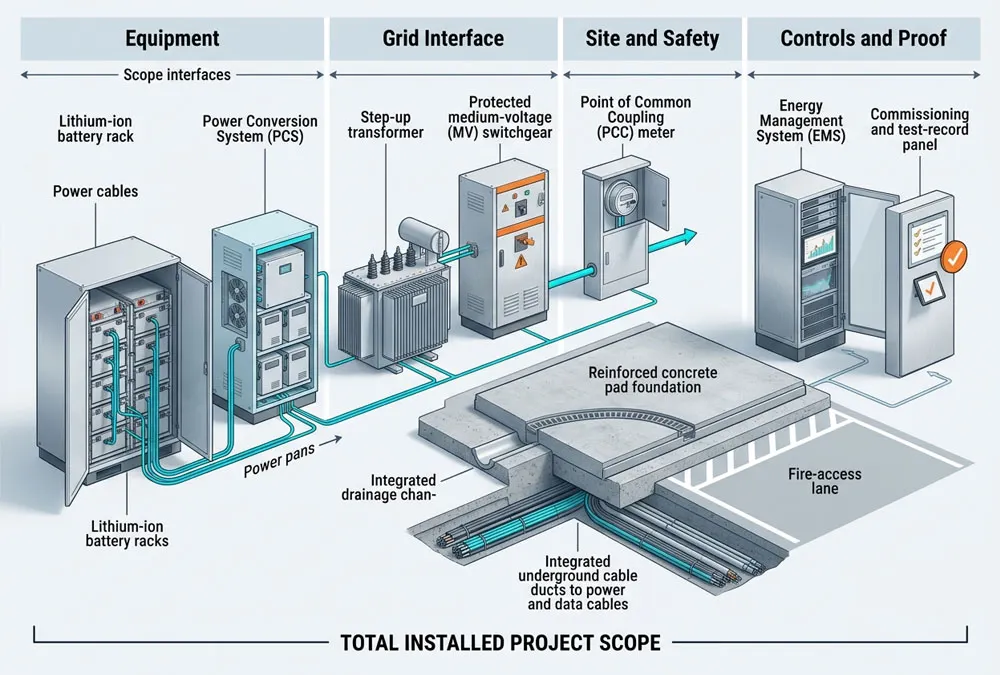
| Cost boundary | Question every quotation must answer | Risk if omitted | Buyer benefit |
|---|---|---|---|
| BESS and PCS | Are ratings DC, PCS AC or available at the PCC? What usable energy is warranted? | The selected system cannot meet the assumed duty after losses or reserve limits. | Makes power and energy claims comparable. |
| Grid interface | Who supplies transformer, switchgear, protection, meter changes and PCC works? | A hardware quotation cannot be commissioned at the actual connection point. | Reveals the real electrical project cost. |
| Site and safety | Which foundation, drainage, access, fire and insurer requirements are in scope? | The layout needs redesign or construction pauses after delivery. | Prevents civil and approval surprises. |
| Controls and proof | Who provides EMS integration, meter data, test records and event reporting? | Savings cannot be verified or the dispatch logic conflicts with site limits. | Connects the business case to operating evidence. |
AnengJi’s EPC scope overview is useful for identifying the interfaces that exist between design, equipment, installation, grid connection and commissioning. It is not a substitute for a site-specific cost schedule. The project country, PCC arrangement, civil condition and agreed delivery scope still decide what belongs in the price.
Test Payback Before Finance
A credible payback model should be able to answer a difficult question: which input would break first in a weak month? It should separate avoided peak cost, net PV or tariff-shift contribution, defined resilience value, operating cost, financing, availability and degradation. It should also show which value streams are contractually available and which are simply possible in theory.
Do not double count the battery. If the asset is held at a high state of charge for backup, that same stored energy is not freely available for evening arbitrage. If 250 kW of PCS capacity is committed to a site-import cap, it cannot simultaneously be promised to a different service without checking the actual control and connection constraints. The safest rule is to allocate every value stream its own time window, MW capability, MWh/SoC band and final command owner.
A transparent screening model
Use the following only as a feasibility screen. It is not a project forecast:
Annual peak-value screen = verified reduction in billed kW × the applicable tariff value.
Net energy-shift screen = delivered AC kWh × verified net value per kWh after charge cost, losses and operating constraints.
Simple payback screen = installed project cost ÷ annual net benefit. A final approval should still test NPV, financing, tax, warranty, degradation, availability and connection risk.
Build three cases instead of one flattering number. The base case uses only values supported by the current tariff and operating data. The downside case lowers achievable dispatch or value and includes a more conservative availability/degradation assumption. The upside case may include an additional value stream, but it must stay separate from the approval case until its route, controls and economics are verified. This approach gives a CFO an honest decision instead of a fragile headline ROI.
For Germany, the Bundesnetzagentur’s dynamic-tariff guidance explains that electricity suppliers have been required to offer a dynamic tariff from 2025 and that the energy-price component can follow exchange prices. That does not prove a C&I project will make money from arbitrage: the specific supply contract, metering, network charges, operating load and usable spread must be checked. Likewise, KfW’s Renewable Energies—Standard (270) lists storage among eligible investment categories, but it is a financing programme, not an automatic project grant; current eligibility and terms belong with the financing partner.
Size the Peak and Recharge
Power and energy answer different questions. Power is how quickly the BESS must change site import or export. Energy is how long it can hold that response. A battery can have enough MWh and still fail because its PCS, transformer or PCC limit cannot supply the required kW. It can also have enough kW but not enough usable energy to cover the event duration.
Illustrative event calculation
Assume, solely for illustration, that a site must hold grid import 250 kW below its measured peak for 45 minutes. The delivered energy duty is 250 kW × 0.75 h = 187.5 kWh. If the early design basis assumes an 80% usable SoC band and 93% AC delivery efficiency, the nominal energy screen is 187.5 ÷ (0.80 × 0.93) ≈ 252 kWh, before any project-specific end-of-life, availability or contingency margin.
This is not a product recommendation. The correct inputs come from the target duty, equipment data, warranty boundary, temperature, auxiliary loads, required reserve and measured PCC conditions.
| Same 250 kW duty | Delivered AC energy | Illustrative nominal-energy screen* | What changes for the buyer |
|---|---|---|---|
| 250 kW for 15 minutes | 62.5 kWh | ≈ 84 kWh | Short event: power and controller response may dominate the design. |
| 250 kW for 45 minutes | 187.5 kWh | ≈ 252 kWh | Energy capacity now becomes material; the system must still recover before the next event. |
| 250 kW for 2 hours | 500 kWh | ≈ 672 kWh | The same power target needs eight times the delivered energy of the 15-minute event. |
*Engineering illustration only. The nominal-energy screen uses a common set of illustrative assumptions: 80% usable SoC and 93% AC delivery efficiency, so nominal energy = delivered AC energy ÷ (0.80 × 0.93). It excludes reserve, end-of-life retention, availability and contingency margin. The table shows why “250 kW BESS” is not a complete request for quotation.
The detail that often appears only after commissioning is the recharge window. A BESS can look perfect on a discharge chart but create the next billed peak while it recharges. Charge power, PCS and transformer losses, HVAC/auxiliary consumption and other site loads all appear somewhere in the electrical balance. If low-cost charging overlaps a process restart, refrigeration cycle or EV fleet connection, the model may simply move the problem to another interval.
Ask the engineer to model every event at the same declared boundary: usually the PCC or billing meter. The model should show meter location, transformer headroom, import/export limits, schedule, expected charge source, available battery blocks and EMS priority. This is the difference between “the battery has 300 kWh” and “the site can deliver the duty repeatedly without breaching its connection or tariff constraint.”
Teams that need to test their own load-shifting window can use the site’s load-shifting sizing calculator as a first screen. Its output remains a candidate configuration until the site tariff, connection and actual equipment boundaries are checked.
Choose Format After Fit
Only after the duty and connection are clear should the team decide between a compact cabinet, multiple cabinets or a containerised solution. More energy capacity is not automatically better. A larger unit may increase delivery or expansion options, but it also changes crane access, foundation, fire access, protection, cable routing and the amount of energy that the site can realistically cycle.
| Candidate format | When it can fit | What still needs proof | Buyer benefit |
|---|---|---|---|
| Compact cabinet | A defined site duty with constrained footprint and practical service access. | Electrical duty, ventilation, protection, clearance and expansion path. | Avoids buying a container when the real duty is compact. |
| Multi-cabinet system | Growth is expected or power and energy need modular adjustment. | Control coordination, common PCC limit, site layout and maintenance plan. | Lets the project scale only where data supports it. |
| Containerised system | The site has a larger, sustained duty and suitable access/civil/electrical infrastructure. | Foundation, drainage, transformer/PCC, protection, fire access and logistics. | Aligns project format with deliverable duty instead of headline MWh. |
The C&I BESS formats shown by AnengJi can be a useful starting point for discussing cabinet and container options. Format availability does not prove the system is right for a particular site; the final configuration still depends on the duty, PCC, layout, compliance and acceptance criteria above.
Keep Country Rules Specific
Europe is a useful market focus, not a single tariff or grid-connection regime. The 2025 ACER report on electricity network tariff methodologies explains that national regulatory authorities fix or approve tariff methodologies and that no one tariff design fits every country. Germany may offer a relevant example of dynamic pricing, while the actual commercial case for a project elsewhere depends on its local utility/DSO, supply contract, meter setup, import/export limits, planning requirements and insurer expectations. A design copied from another country can have the right battery and still have the wrong economics.
The Bundesnetzagentur’s 2025 Monitoring Report explains that German electricity-price components include items beyond supplier-controlled procurement and margin, and that network tariffs can vary between network areas. For this article, that fact supports one narrow lesson: a country or site model must use the project’s own tariff and network context. It does not provide a universal European C&I rate or battery-saving figure.
Before an investment committee sees a final number, request the current tariff sheet, billing methodology, connection agreement, meter capability, written import/export limits and a local permitting/safety review. Readers who are ready to move from feasibility into detailed design can continue with the site’s European BESS design guide.
Make Quotes Comparable
When three suppliers provide three different BESS sizes, the difference is often not chemistry. One may be pricing nominal DC energy; another may be allowing for usable AC energy; a third may have assumed a different peak window or omitted the PCC scope. Price should be the last comparison, not the first.
- Twelve months of interval load data, bills and the exact tariff/demand-charge rule.
- PCC location, single-line diagram, transformer rating, import/export limits and known protection requirements.
- PV generation/export data, critical-load expectation and the priority between backup and bill savings.
- The proposed MW, nominal and usable energy, duration, charging source, SoC policy and declared AC/PCC boundary.
- An itemised scope, exclusions, performance test method, commissioning responsibilities and warranty/O&M assumptions.
The result is a cleaner procurement conversation. The owner can ask what is missing rather than guessing why quotations differ; the EPC can price the true interfaces; and the supplier can propose a configuration against a stated operating duty. That is the right time to compare c&i energy storage solutions—after the decision boundary is shared.
Need a Site-Data Review?
Share the country, tariff, interval load data, PV details, PCC limit and primary operating objective. AnengJi can help structure the candidate BESS configuration and the evidence questions that should be closed before a final scope is issued.
Know When to Pause
A responsible supplier should sometimes recommend waiting. Pause the project if the site has no interval data, the tariff rule is unknown, there is no identifiable dispatchable event, recharge headroom is unverified, a value stream is assumed but not available to the asset, or the quotation does not show its installed-cost boundary. Delaying an order to obtain these facts is usually cheaper than commissioning a system that cannot deliver the promised duty.
That is not a rejection of storage. It is the first step toward a BESS that operations can actually use, finance can defend and an EPC can commission without a late scope dispute.
C&I Battery Storage FAQs
How much does C&I battery storage cost in Europe?
There is no defensible single European price. A useful budget separates equipment, grid interface, civil/safety works, controls, commissioning, service and financing. Compare quotations only after each supplier declares what sits inside that boundary.
How do I calculate commercial battery payback?
Start with the site’s verified peak reduction and/or net energy-shift value, then subtract operating costs and test availability, degradation, financing and connection assumptions. Keep uncontracted or unproven value streams in a separate upside case.
What data is needed to size a C&I battery storage system?
At minimum: interval load data, tariff and billing method, PCC and transformer information, import/export limits, PV data where relevant, site operating calendar and the primary duty. Add a critical-load list and transfer requirements if backup is part of the scope.
Can one battery provide bill savings and backup?
Potentially, but backup energy and power must be reserved before other dispatch is scheduled. The control, protection and transfer arrangement must also match the required interruption tolerance. Do not count reserved backup energy twice in the bill-saving model.
Why is nominal capacity different from usable energy?
Nominal battery energy is not automatically deliverable AC energy. Usable SoC limits, PCS and transformer losses, auxiliary consumption, temperature, degradation, availability and a protected reserve can all reduce what the site can use for a defined duty.
Turn the Quote Into a Decision
Bring a real tariff, interval profile and connection boundary to the first engineering conversation. We will help turn those inputs into a candidate configuration, quotation checklist and evidence plan—without treating a catalogue capacity or headline ROI as the answer.
Recommended Reading
Sources and Evidence
The economic and sizing method in this article is deliberately site-specific. Authority sources are used for the adjacent, bounded claims: IEA’s Global Energy Review 2026 for global deployment context; NREL’s commercial-building BESS analysis for the role of demand charges and load shape; Bundesnetzagentur’s dynamic-tariff guidance and 2025 Monitoring Report for Germany-only tariff context; ACER’s 2025 tariff-methodology report for the country-specific European context; and KfW 270 for financing-scope context. Before procurement, validate current tariff, connection, permitting, finance and technical requirements with the relevant project parties.

 https://anengjipower.com/wp-content/uploads/2026/06/epc-vs-turnkey-solar-project-bess.webp
675
1000
Charging Station Engineer
https://anengjipower.com/wp-content/uploads/2025/09/anengji-dc-fast-charging-station-manufacturer-and-supplier-logo-white-1.png
Charging Station Engineer2026-06-22 07:16:042026-06-24 07:13:17What Is the Difference Between EPC and Turnkey Contract Models in Energy Projects?
 https://anengjipower.com/wp-content/uploads/2026/06/anengji-commercial-solar-plus-storage-benefits-site.webp
675
1000
Charging Station Engineer
https://anengjipower.com/wp-content/uploads/2025/09/anengji-dc-fast-charging-station-manufacturer-and-supplier-logo-white-1.png
Charging Station Engineer2026-06-20 14:34:102026-06-20 14:37:43What Are the Top Benefits of Solar Battery Storage in Factories?
 https://anengjipower.com/wp-content/uploads/2026/06/modular-commercial-solar-battery-storage-cabinet.webp
675
1000
Charging Station Engineer
https://anengjipower.com/wp-content/uploads/2025/09/anengji-dc-fast-charging-station-manufacturer-and-supplier-logo-white-1.png
Charging Station Engineer2026-06-18 09:16:522026-07-03 03:05:13What Is Solar Battery Storage? Complete C&I Engineering Guide


Leave a Reply
Want to join the discussion?Feel free to contribute!