
Introduction
Imagine the project meeting six weeks before procurement closes. The financial model assumes revenue from frequency response; the EPC has selected a 10 MW battery; everyone agrees that the PCS is “fast.” Then the grid-services partner asks a basic question: which exact product will the plant provide, and can it still move power in both directions after backup reserve, temperature derate and the agreed state-of-charge limits are applied? If nobody can answer with data, the headline revenue is not a revenue stream yet. It is an assumption.
That is the uncomfortable gap behind many ancillary services claims. A developer may see a 10 MW PCS rating and model frequency-response income; the EPC may later discover that the named product needs a specific telemetry path, prequalification test, bidirectional state-of-charge headroom, or connection agreement that the original design never considered. This is not a minor software setting. It can reduce usable MW or MWh, add controls scope, delay commissioning and leave an owner with a battery that works but cannot deliver the service used to justify the project.
This guide gives European BESS owners, developers and EPC teams a practical way to turn that uncertainty into a decision. It explains the grid function, the country-specific product, the operating envelope and the proof required before a service belongs in a revenue model. Germany is used for detailed, source-backed examples; it is not presented as a substitute for the rules in every EU Member State, the UK or the United States.
The Short Answer
Energy storage provides ancillary services by changing active power, reactive power, or both in response to a defined grid need. But an electrical action becomes a deliverable service only when the actual grid product, connection terms, qualification, available BESS capability and operating evidence all line up.
- Frequency services usually use controlled charge/discharge power and need state-of-charge management.
- Voltage support uses reactive-power capability and is limited by the PCS MVA/P-Q envelope, voltage and thermal conditions.
- Reserve and restoration services also need a named product, test path and operating agreement—not just stored energy.
The Three Questions That Save a Project
- What is the exact product? “Frequency support” is not enough. Name the operator, country, product, delivery point and activation rule.
- What capability is genuinely free? Test MW, MWh, SoC headroom, MVA/P-Q headroom and current derates at the PCC—not the catalogue headline.
- What proves delivery? Require prequalification, control/telemetry evidence, test records and a clear party responsible for bidding and non-delivery.
What Are Ancillary Services?
Ancillary services are the functions that help a power system remain secure while electricity is generated, transmitted and consumed in real time. They are not one global market with one price or one technical rule. The European Union’s Commission Regulation (EU) 2017/2195 establishing a guideline on electricity balancing sets common principles for the procurement and settlement of frequency containment, frequency restoration and replacement reserves. Individual countries and TSOs still define the product terms, access route and implementation details that a project must meet.
That distinction matters commercially. “We support frequency regulation” describes a possible engineering function. “We are eligible for Product X in Country Y” is a much stronger statement that needs product-specific proof. A responsible BESS proposal keeps those two statements separate until the operator, technical unit, controls, tests and contractual route have been checked.
| Grid function | What the BESS does | Primary limit | Buyer question | Buyer benefit |
|---|---|---|---|---|
| Frequency containment / regulation | Raises or lowers active power by discharging or charging. | MW response, usable SoC range, energy management and telemetry. | Which exact product is being offered, and how is SoC kept available? | Avoids modelling a fast response that cannot be sustained. |
| Frequency restoration / reserve | Follows an operator target or activation instruction to restore balance. | Contracted duration, dispatch/control interface and available energy. | Who owns the activation signal, bid and non-delivery exposure? | Turns a broad reserve claim into a testable scope. |
| Voltage / reactive-power support | Injects or absorbs MVAr through the PCS. | MVA/P-Q curve, AC voltage, thermal condition and connection rules. | What P-Q duty is required at the PCC, not just at the PCS terminals? | Prevents unequal bids being compared only on MW. |
| Black start / restoration | Establishes or supports voltage and frequency through an approved restoration sequence. | Grid-forming controls, auxiliaries, protection and proving test. | Can the whole electrical path operate with no external reference? | Avoids calling stored energy a black-start capability. |
| Site power quality | May help manage a site-level electrical disturbance under a defined design. | Measured event, electrical architecture and protection/control design. | Is this a site requirement or an externally procured grid product? | Stops a plant-quality problem being mislabelled as market revenue. |
From Signal to Response
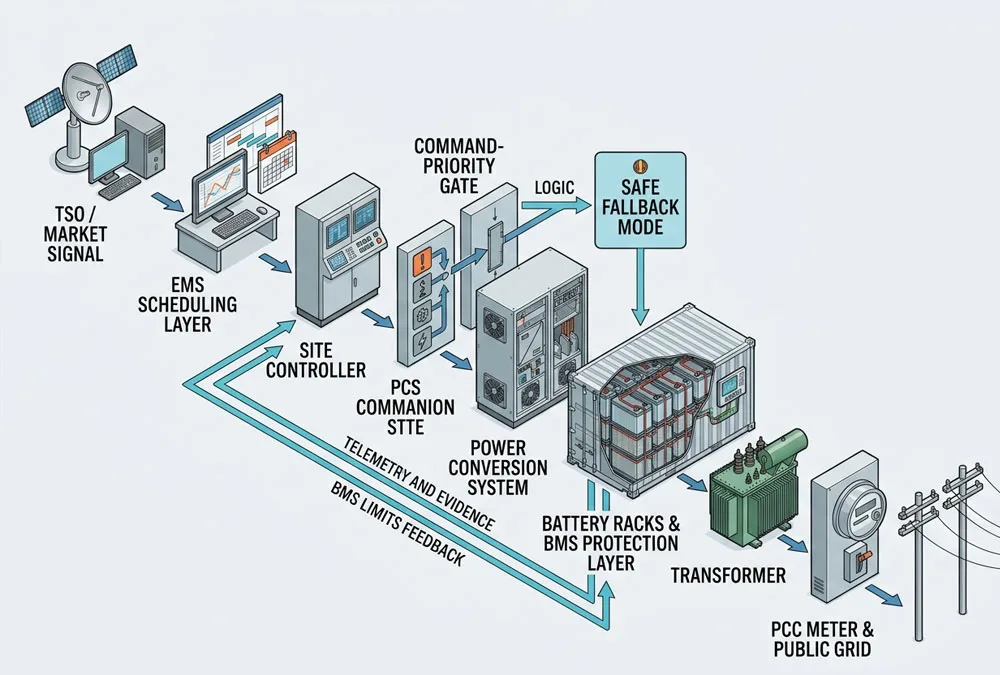
The physical path is straightforward in principle: a grid-frequency measurement, PCC meter or operator instruction reaches the relevant plant controller; the controller requests a power setpoint; the PCS executes only the active and reactive response that remains feasible; and the BMS can reduce or block that response to protect the battery. The difficult part is naming the final command owner and proving what happened after a request arrives.
A common commissioning surprise: at 14:00 the EMS is charging against a price schedule, a site controller is holding an export limit and a grid-service activation arrives. If those instructions do not have a documented priority, the plant may respond late, hit the PCC limit or protect the wrong energy reserve. Before a controls package is accepted, ask for the final write access to the PCS, the timeout for a stale external signal, the local fallback state and an event replay showing the command path. The practical fix is not another generic software licence; it is a signed cause-and-effect matrix and a witnessed control test.
A real EPC risk: the aggregator, EMS, PPC and PCS may all be able to issue a power instruction. If the project does not define which command wins, a battery can follow a grid-service request while another controller caps export, protects backup energy or starts an economic charge cycle. The remedy is a signed control-responsibility matrix: signal source, setpoint owner, override order, data-freshness limit and safe fallback state.
What each layer does
- BMS: measures battery condition and applies cell/rack protection limits. It does not certify a market product.
- PCS: converts DC and AC power and follows a feasible active/reactive setpoint. Its current MVA, temperature and voltage envelope matter.
- PPC or site controller: coordinates the PCC, transformer, PV and other connected assets against connection constraints.
- EMS: schedules energy and maintains the agreed state-of-charge position for the service and other site objectives.
- Aggregator or market interface: may bid capacity, receive an activation or manage settlement; the exact role is contract and market specific.
For the wider battery-to-PCC equipment chain, see the site’s grid-connection design guide. It helps establish the physical and control boundary that must be known before an ancillary-service claim is assessed.
Use the Five-Layer Test
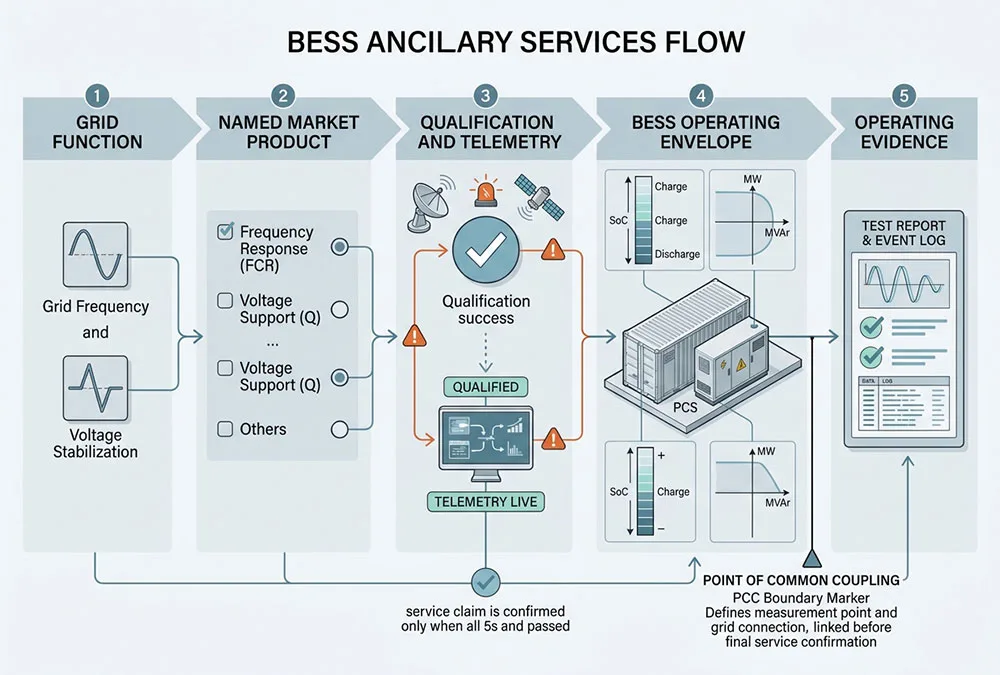
A useful way to turn an attractive service list into an engineering decision is to test it in five layers. The sequence is deliberate: do not select a cabinet or model revenue until the first two layers are known. The costly mistake is starting at layer four—choosing containers because they look large enough—then discovering that the connection, product or test route will not support the planned service.
- Grid function: Identify the physical problem—frequency containment, reserve, voltage, restoration or a site-quality event.
- Market product: Name the actual TSO, DSO, ISO, connection-agreement or private-contract product, including country and delivery point.
- Qualification: Identify prequalification, communications, metering, testing, certificates, pool structure and route-to-market responsibilities.
- BESS operating envelope: Check available MW, usable MWh, charge and discharge headroom, SoC range, MVA/P-Q capability, derates and control mode at the declared boundary.
- Operating evidence: Specify the telemetry, event log, maintenance exclusion, availability record and settlement evidence that prove delivery over time.
If one of these layers is blank, mark the service as unconfirmed in the base case. It may still be valuable upside, but it should not be used to justify the battery size, debt case or EPC scope until the missing evidence is closed.
The German TSOs’ prequalification process illustrates why layers two and three cannot be skipped. It assesses IT, product-specific and technical requirements and includes an operating test, a control-system test and certificates. A manufacturer can support the equipment and system-integration scope, but prequalification remains a project, technical-unit and operator process.
When reviewing a commercial or containerised BESS format, use it as the equipment starting point—not proof that any named ancillary product is available. The applicable power rating, usable energy, PCS mode, transformer, PCC, controller, country rules and qualified market-access arrangement still decide service fit.
Need to test a service claim?
Share the project country, target service, proposed MW/MWh, connection voltage and PCC limits. We can help identify the BESS configuration and evidence questions that should be resolved before technical scope is fixed.
Frequency Services in Germany
Germany provides a useful, but deliberately bounded, European example. The German TSO platform distinguishes Frequency Containment Reserve (FCR), automatic Frequency Restoration Reserve (aFRR) and manual Frequency Restoration Reserve (mFRR). Its technical-characteristics table states that FCR is fully activated within 30 seconds and is symmetric; aFRR has a first reaction after 30 seconds and full activation within five minutes; mFRR has full activation within 12.5 minutes. These are German product characteristics, not generic BESS response promises.
| Germany product | Control principle | Direction | Key BESS design issue | Buyer benefit |
|---|---|---|---|---|
| FCR | Automatic, decentralised response to frequency deviation. | Symmetrical. | Both charge-absorption and discharge capability must remain available inside the operating SoC band. | Exposes why nameplate MW alone is insufficient. |
| aFRR | Automatic response to TSO target-value specifications. | Positive and negative products. | Signal interface, real-time availability and energy management after activation. | Tests controls and route-to-market scope, not only cell capacity. |
| mFRR | Manual activation through the market process. | Positive and negative products. | Committed power, duration and dispatch/activation process must match the product. | Prevents a generic “reserve” promise from entering the model unchecked. |
The FCR energy-band reality
Here is the detail that often disappears from a sales slide. FCR is not a simple export service. Because it is symmetric, a BESS must be able to increase output in one direction and absorb power in the other. The German TSO FAQ says that German TSOs continue to insist on 30 minutes for the battery-capacity criterion; the published English PQ conditions also require suitable storage management so limited-energy units keep the full marketable power available within the allowed upper and lower SoC limits. The FAQ and the English PQ conditions establish those Germany-specific requirements.
Illustrative FCR screen — not a prequalification design rule: for a ±10 MW symmetric service with a 30-minute availability basis, 10 MW × 0.5 h = 5 MWh is needed for a full discharge-direction event. The same 5 MWh of empty space is needed for an equal charge-direction event.
Ideal usable operating swing ≈ 2 × 10 MW × 0.5 h = 10 MWh. This is why the BESS would normally operate around a managed middle SoC position rather than simply remain full or empty.
The real requirement can be larger or differently structured after usable-SoC limits, auxiliary consumption, losses, temperature, degradation margin, block availability and the current TSO method are applied. The calculation is a screening question for an EPC and owner—not a substitute for the current prequalification route.
An asset can therefore show healthy average SoC and still be unable to give the committed response: a rack may be derated, a controller may reserve backup energy, or the BMS may reduce current at a temperature limit. Ask for live, block-level available power and energy rather than relying solely on a dashboard’s aggregate SoC percentage.
| What you see in a bid or dashboard | Why it can fail | What to ask for |
|---|---|---|
| “10 MW frequency service” | A one-way discharge rating does not demonstrate symmetric FCR capability. | The bidirectional SoC band, charge/discharge limits and test evidence at the declared PCC boundary. |
| One average SoC figure | It can hide unavailable blocks, thermal limits or a protected backup reserve. | Available MW and MWh by block, plus the controller’s restriction reason. |
| “EMS keeps SoC balanced” | The statement does not show how energy is recovered after an activation or what takes priority. | The SoC target, recovery rule, constraints and the latest applicable TSO product conditions. |
Voltage Support Needs P-Q Proof
Voltage support is often described as a benefit of inverter-based storage, but it is not free capacity. A PCS has an apparent-power boundary. In a simplified steady-state check, S = √(P² + Q²), where S is apparent power in MVA, P is active power in MW and Q is reactive power in MVAr. An illustrative request for 8 MW and 6 MVAr requires 10 MVA before margins. That arithmetic is not a PCS guarantee: the manufacturer’s P-Q curve at the required AC voltage, temperature and control mode is the authority.
This is where a bid comparison can fail a buyer. One proposal may quote 10 MW, while another includes the MVA rating and P-Q capability curve. If the project expects export plus voltage support, those offers may not be comparable. Put the required PCC voltage range, active/reactive duty points, transformer and cable constraints, grid-code mode and thermal derating conditions into the RFQ. The present question is not whether the PCS has a headline MW rating; it is whether its documented operating envelope satisfies the named grid service.
Use this RFQ question: “At the PCC, at the specified voltage and ambient condition, can the plant hold X MW and Y MVAr at the same time, and for how long?” If a bidder cannot supply a referenced P-Q curve and the assumptions behind it, that capability is not yet a usable design input.
Power Quality Is Different
A factory may have a serious power-quality problem: voltage sags, flicker, harmonics, sensitive production equipment or a process that cannot tolerate a short disturbance. That deserves an engineered solution. It should not automatically be presented as an ancillary-service product or a new grid-revenue stream. The US Energy Information Administration’s energy-storage explainer discusses fast-response storage for frequency support and separately describes power quality as an electricity attribute; the US Federal Energy Regulatory Commission’s ancillary-services overview lists frequency regulation, operating reserves, voltage support, black start and reactive power categories. The comparison supports a simple procurement lesson: name the exact external product or the site-quality performance requirement—do not assume they are the same.
For a C&I project, start with a power-quality survey at the affected bus and PCC: what event occurs, what duration and magnitude are measured, which load must ride through, and what isolation or transfer architecture is allowed? A plant manager who says “the line trips twice a month” needs an event record before being sold an ancillary-service story. The result may call for a BESS, a PCS control function, filtering, a static-transfer arrangement or another solution. The chosen architecture must be assessed against the site single-line diagram and connection agreement, not a generic market-service list.
Check Rules Before Revenue
Europe-first does not mean there is one European ancillary-services product. The EU balancing guideline sets common principles, while access and operation remain tied to national or operator implementation. In Germany, the TSO tendering page shows product differences in symmetry, product length, offer size and remuneration. A Germany-specific model should use the current product documents. A project in another Member State, or in the UK, needs its own TSO/DSO and route-to-market review.
The model risk is simple: a 15-year spreadsheet can look robust because a current ancillary-service value was copied across every operating year. Treat a service as contracted or qualified income only after its access route, availability obligations and responsibility for non-delivery are evidenced. Until then, use a separate sensitivity case and show the battery’s base business case without that assumption.
| Readiness question | Evidence to request | Why it matters commercially |
|---|---|---|
| Which operator and service product apply at this connection? | Current TSO/DSO product document, connection agreement and named delivery point. | Prevents the model from using a service that is unavailable to the asset. |
| Who will bid, activate and settle the service? | Aggregator/market-access agreement, responsibility and non-delivery terms. | Clarifies revenue split, obligations and operational authority. |
| Can the plant prove qualified capability? | PQ status or plan, IT/control architecture, test records and exclusions. | Separates an equipment feature from a bankable service assumption. |
| What capability is withheld from other uses? | Committed MW/MWh/MVAr, SoC policy, derate rules and maintenance calendar. | Avoids selling the same capability twice. |
The US is not a copy-paste alternative. FERC explains that US ancillary services can include frequency regulation, operating reserves, voltage support, black start capability and reactive power, while RTOs/ISOs determine procurement and product details. FERC Order No. 841 addresses storage participation in regional capacity, energy and ancillary-service markets; it does not create one nationwide BESS product. A US project therefore needs the relevant ISO/RTO or utility tariff, not a German FCR template.
Avoid Double-Booking Capability
A BESS can support several objectives over its life, but it cannot guarantee the same MW, MWh or MVA twice at the same moment. An FCR commitment may need charge and discharge headroom. A backup promise may ring-fence energy. A peak-shaving schedule may reserve discharge power at precisely the time an aggregator wants a service. The correct question is not “does the EMS have optimisation?” It is “which capability is contractually unavailable to the next request?”
This is where the project’s operating logic should reserve power, energy and control states separately. A battery can have enough stored energy but not enough available PCS headroom; it can have full inverter capacity but no safe SoC headroom to absorb power. Build a project-specific priority matrix that names the committed service, backup reserve, PCC limit, state-transition logic and final command owner. Do that after the service product itself has been identified—not before.
A practical daily conflict: a site expects a 6 MW late-afternoon peak while the market partner has reserved 10 MW of symmetric frequency capacity. The EMS cannot simply add both figures. It must first deduct the non-overlapping committed power, the required charge/discharge headroom, PCC constraints and safety margins under the actual operating state. The solution is an approved priority rule before the contract is signed—not an operator improvising during an event.
Put Proof Into the RFQ
The cleanest way to avoid an ancillary-services dispute is to make the evidence part of the procurement scope. An EPC cannot fairly compare two systems if one bidder prices battery containers while another prices the communications, plant controller, protection study and qualification support needed by the target product. AnengJi’s BESS EPC delivery scope is a useful starting point for connecting equipment, grid connection, testing and commissioning; the project must add the named service product, operator rules and market-access responsibilities.
Inputs the owner should provide
- Project country, connecting TSO/DSO, PCC voltage and written import/export limits.
- Named target product or connection requirement, including the intended delivery point and market-access party.
- Required active MW, expected duration, reactive MVAr duty and any backup/critical-load obligation.
- Single-line diagram, transformer and switchgear data, expected operating temperature and co-located PV/generation assets.
- Which service commitments have priority, and the consequence if a service cannot be delivered.
Five questions that make quotations comparable:
- Which country, operator, product and delivery point does this quotation address?
- Which MW, MWh and MVAr are available at the PCC under stated voltage, ambient and SoC conditions?
- What is already qualified or tested, and what remains a project-specific scope?
- Who supplies the metering, communications, aggregation interface and event evidence?
- Who carries the cost and responsibility if the target service is not delivered?
Outputs every bidder should return
- A declared capability boundary at the PCC, including MW, usable MWh, MVA/P-Q curve and derating conditions.
- A BMS–PCS–PPC–EMS control-responsibility matrix, with fallback on data or communications loss.
- The SoC-management and recharge method for the named product, not a generic “smart EMS” claim.
- PQ / FAT / SAT scope, telemetry and evidence-retention plan, plus all exclusions that require an aggregator, TSO, DSO or specialist study.
- A clear statement separating equipment capability, system-integration scope and external market qualification.
FAT and SAT scenarios
For each test, record the initial SoC, thermal state, available blocks, requested service, PCC condition, expected command owner, expected active/reactive setpoint, data timestamp and pass/fail criterion. Useful scenarios include a frequency/activation request at the target SoC midpoint; the same request at defined operating limits; active MW plus reactive MVAr demand; a lost telemetry path; one unavailable PCS or container; a competing site limit; and export of an auditable event record. The exact acceptance values must come from the named product, equipment data and project specification—not a generic blog benchmark.
Assess Your Grid-Service Scope
Send the target country, named service, PCC limit, target MW/MWh, reactive-power requirement and intended operating partner. AnengJi can help structure the BESS configuration and evidence checklist for an EPC or owner review. Final qualification, market access and operator acceptance remain subject to the relevant project parties and current local rules.
Ancillary Services FAQs
Can battery storage provide ancillary services?
Yes, when the BESS, controls, connection and market route meet the requirements of the named service. Fast battery response is helpful, but it does not replace prequalification, available SoC/MVA headroom, telemetry or an approved operating arrangement.
Why does state of charge matter?
State of charge determines how much further the battery can charge or discharge. For a symmetric frequency product, both directions can matter. A BESS near its upper or lower operating limit may be unable to provide the full committed response even if the PCS has spare MW on paper.
Can a BESS provide MW and MVAr together?
Sometimes, but the answer depends on the PCS P-Q curve, MVA rating, AC voltage, thermal state, transformer/cable limits and connection rules. Ask for the relevant operating curve and project study rather than assuming the quoted MW remains fully available.
Is power quality automatically an ancillary service?
No. A site-level power-quality solution can be technically valuable, but a paid ancillary product is defined by the relevant operator or contract. Diagnose the electrical problem and the available programme separately.
Can one BESS provide grid services and energy arbitrage?
Potentially, but only after the project reserves the committed MW, MWh/SoC range, MVA headroom and control authority for each obligation. The same capability cannot be guaranteed to two services at the same instant.
Related Reading
Sources and Evidence
This article uses direct sources from the European Commission, German TSOs, FERC and EIA for the regulatory and product-specific points. The external sources support the adjacent claims; they do not verify an individual project or product. Before bidding, qualifying or commissioning a service, check the current product documentation, connection agreement, equipment data and route-to-market contract.

 https://anengjipower.com/wp-content/uploads/2026/06/epc-vs-turnkey-solar-project-bess.webp
675
1000
Charging Station Engineer
https://anengjipower.com/wp-content/uploads/2025/09/anengji-dc-fast-charging-station-manufacturer-and-supplier-logo-white-1.png
Charging Station Engineer2026-06-22 07:16:042026-06-24 07:13:17What Is the Difference Between EPC and Turnkey Contract Models in Energy Projects?
 https://anengjipower.com/wp-content/uploads/2026/06/anengji-commercial-solar-plus-storage-benefits-site.webp
675
1000
Charging Station Engineer
https://anengjipower.com/wp-content/uploads/2025/09/anengji-dc-fast-charging-station-manufacturer-and-supplier-logo-white-1.png
Charging Station Engineer2026-06-20 14:34:102026-06-20 14:37:43What Are the Top Benefits of Solar Battery Storage in Factories?
 https://anengjipower.com/wp-content/uploads/2026/06/modular-commercial-solar-battery-storage-cabinet.webp
675
1000
Charging Station Engineer
https://anengjipower.com/wp-content/uploads/2025/09/anengji-dc-fast-charging-station-manufacturer-and-supplier-logo-white-1.png
Charging Station Engineer2026-06-18 09:16:522026-07-03 03:05:13What Is Solar Battery Storage? Complete C&I Engineering Guide


Leave a Reply
Want to join the discussion?Feel free to contribute!