
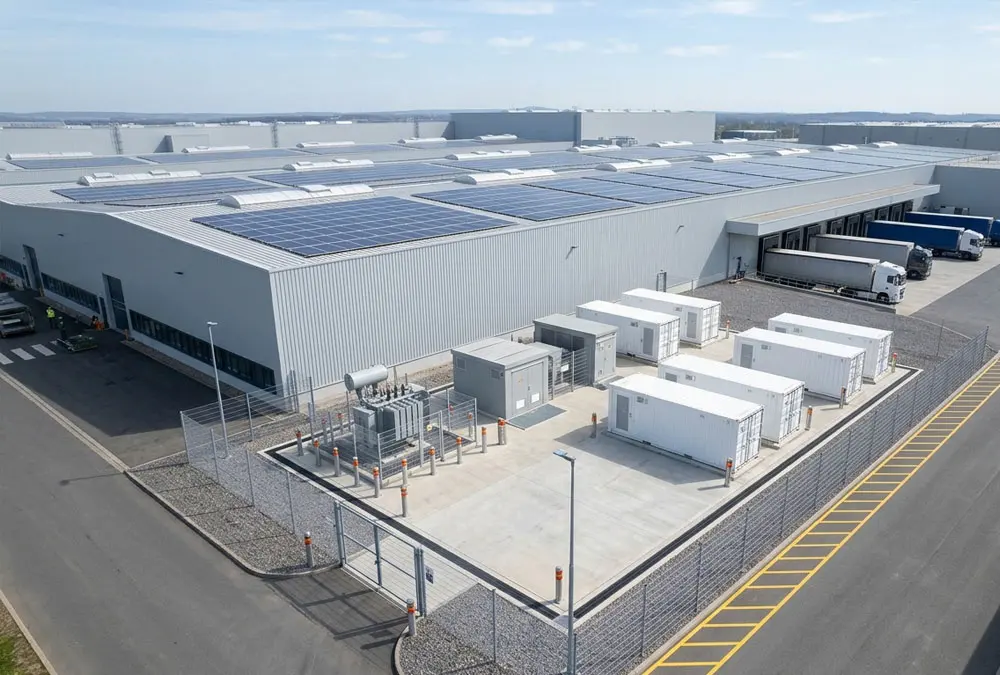
Introduction
At 07:00, a factory may start compressors, chillers, pumps, drives and a production line within minutes. That can create the import peak that changes the month’s electricity bill—but it can also be the moment when a poorly defined battery strategy creates a production problem. An industrial BESS is not automatically a whole-factory backup system, a power-quality cure or a tariff-saving machine. It is a system that must perform a specific electrical duty at a specific boundary, usually the point of common coupling (PCC), while preserving the energy and control margin the plant genuinely needs.
That distinction matters for European manufacturers. A proposal can look complete because it states MW and MWh, yet still leave unanswered questions: Which loads are protected? Is the stated power available at the factory’s actual voltage and operating state? What happens when peak shaving conflicts with a reserved safe-shutdown window? Who proves the controls and safety interfaces before production relies on them? This guide turns those questions into a practical decision path: define the manufacturing event, translate it into power and energy, set the safety and control boundaries, and agree the evidence required at handover.
What an Industrial BESS Must Do
In manufacturing, battery energy storage is an operating system rather than a stand-alone box. Battery racks store DC energy; the battery management system (BMS) supervises battery conditions; the power conversion system (PCS) exchanges power between DC and AC; and the energy management system (EMS), plant controller, transformer and switchgear connect that capability to the plant. The relevant import or export boundary is usually the PCC, not the battery container door.
This is where early projects often go wrong. A buyer may see “1 MW / 2 MWh” and assume the system can deliver 1 MW to any load for two hours. In reality, the usable AC energy and feasible AC power depend on the agreed operating limits, state of charge, battery and PCS conditions, auxiliary consumption, transformer and cable constraints, protection settings, site voltage and control logic. A BESS can be designed to cap import, shift charging, support a defined critical load, or enable a controlled response to an event. Those are different duties and should not be bundled into one vague promise.
The IEC 62933-5-2:2025 safety standard for grid-integrated energy storage systems frames safety as a system-level, lifecycle subject. For a manufacturer, that is a helpful principle: equipment documentation is necessary, but it does not by itself show that the factory’s electrical interfaces, site layout, operating procedures and emergency responsibilities work together.
Use a Manufacturing Continuity Map
Before requesting quotations, map the factory event to the BESS duty and the proof needed. This keeps the procurement discussion rooted in the plant rather than in catalogue capacity.
- Planned line or utility start: a short import spike or rapid ramp may require the BESS to cap PCC import. Retain the meter trace, control sequence and PCS response record so the test reflects the event that drove the purchase.
- Process upset: operations may need energy reserved for controls or a safe response. The EMS should protect that reserve and block lower-priority tariff dispatch; the interlock test proves the rule is active.
- Supply disturbance: a defined critical load may need ride-through, transfer or a controlled shutdown. An approved protection and transfer study is more meaningful than a broad “backup power” label.
For an overview of the equipment blocks that may sit behind that map, see AnengJi Power’s battery energy storage system solutions. The right configuration still depends on the duty, PCC and site interfaces—not on energy capacity alone.
Start With the Production Event
Monthly bills are useful for identifying demand and energy charges, but they rarely explain the factory event a BESS must manage. A process restart can be brief, high-ramp and operationally important. If several motor-driven loads start together, the average load over a 15-minute or 30-minute interval may hide the sequence that determines whether the PCS, transformer, protection settings and control strategy can respond as intended.
The practical data pack is modest but specific: interval data at the best available resolution, a production calendar, the one-line diagram, transformer information, known import/export constraints, generator or UPS interfaces, and a list of events that production considers unacceptable. If power quality is suspected—such as voltage disturbance affecting sensitive drives or controls—measure it before promising a battery remedy. A BESS may be part of a power-quality strategy, but it is not an automatic cure for every harmonic, voltage or process-control issue.
Measure the Restart Peak
A useful first check separates power from energy. The power gap is the difference between measured import during the event and the import target agreed by the plant. The event energy is that gap accumulated over time. The equations are simple; the quality of the meter boundary and time resolution is what makes them useful.
Illustrative calculation — not a project result or product recommendation
Pgap = measured import during the event − agreed import target
Eevent = Σ(Pgap × time interval)
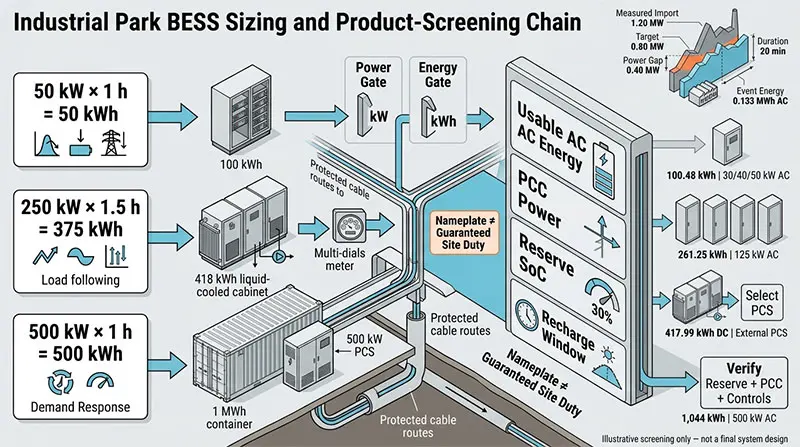
If a measured factory event reaches 1.20 MW, the agreed import target is 0.80 MW, and the 0.40 MW gap lasts 20 minutes, the event requires 0.133 MWh of AC delivered energy (0.40 MW × 1/3 hour). That is only the event energy. A real design also needs an agreed operating reserve, availability assumptions, conversion and auxiliary-load effects, recharge time, equipment limits and the actual control sequence.
This is one of the details experienced plant teams tend to insist on: the “worst moment” is not always the highest daily kWh total. It may be a short start or restart sequence that needs a defined ramp response. A container’s MW label cannot prove that the complete chain—from battery and PCS to transformer, PCC meter and plant controller—will behave correctly during that moment.
Set Power, Energy and Reserve
Once the event is known, size the duty in three layers. First, determine the feasible discharge or charge power at the required electrical boundary. Second, determine usable AC energy over the required duration. Third, lock the energy that must remain protected for an agreed operational response. Treating these as one number is a common source of disappointment in factory storage projects.
The difficult conversation is usually not about batteries; it is about priorities. A facility may want the system to reduce a demand event every morning and also expect it to preserve energy for safety and controls. If the EMS does not explicitly ring-fence the reserve, a normal tariff optimisation command can consume the very margin operations expected to have. The solution is not a generic “larger battery” recommendation. It is a documented priority order, a reserve rule, and a test that proves lower-priority commands are blocked when that rule applies.
- Safety and control loads come first. Record interruption tolerance, required duration and transfer expectation. This prevents the phrase “factory backup” from becoming an undefined whole-site promise.
- Quality-sensitive processes come next. Name the product or process loss the BESS is meant to avoid, then document the event and control sequence that would cause it.
- Essential utilities need a bounded duty. State their kW, runtime and restart order instead of treating pumps, cooling or compressed air as an open-ended load.
- Deferrable loads receive the remaining flexibility. Tariff optimisation and charging schedules should operate inside dispatch and recharge limits, never across the protected reserve.
For the broader question of European design inputs—such as AC/DC boundary, charge source, duration and site rules—our European BESS design guide is a useful next read. The manufacturing layer remains separate: the plant must decide which loads receive priority when objectives conflict.
Make Storage Safe by Design
“Safe” is not a property that can be established by a product photograph or a single certificate. It is a site decision that connects the selected equipment with foundations, drainage, access, cable routing, electrical protection, ventilation or thermal-management design, emergency procedures and named responsibilities. In a factory, late changes to that arrangement can affect routes, service access, construction sequencing and insurer or authority discussions.
In its 2024 overview of safety tests in standards for stationary BESS, the European Commission Joint Research Centre noted that available standards covered some, but not all, of the tests considered in its comparison. That is a useful warning against a document-only safety conclusion. Neither that report nor IEC 62933-5-2 creates one Europe-wide container spacing rule. European projects must be checked country by country; UK requirements must not be assumed to be identical to EU member-state practice.
EU safety evidence is broader than one certificate
Article 12 and Annex V of Regulation (EU) 2023/1542 identify 11 safety parameters for stationary battery storage, applied where the corresponding hazard exists under the manufacturer’s envisaged conditions:
- 4 thermal categories: thermal shock/cycling, over-temperature protection, thermal propagation protection and thermal abuse.
- 4 electrical categories: external short circuit, overcharge, over-discharge and internal short circuit.
- 2 physical/fire categories: mechanical damage by external forces and fire testing.
- 1 emissions category: hazardous-gas emissions across the applicable test conditions.
This is product technical-documentation evidence. It does not replace the factory’s site layout, protection study, emergency plan or local approval path.
Safety Needs Named Owners
A workable early responsibility split is simple. The factory provides operating constraints, EHS information and access requirements. The EPC integrates civil and electrical interfaces. The equipment supplier provides applicable equipment documentation. The protection and controls engineer owns the interfaces between BESS, switchgear and plant controls. The competent project parties establish the local approval and emergency-response path. Putting these owners into the design basis early is more useful than pretending there is a universal checklist that approves every site.
Verify Controls Before Production
A battery that charges and discharges during a demonstration has not necessarily proved its manufacturing duty. The handover question is whether it will follow the intended dispatch priority, preserve reserve energy, communicate its state, and enter the agreed response when an alarm, protection operation, interlock or communications problem occurs. That is why the test matrix should be agreed while the system architecture is still being specified—not added as an afterthought when the line is ready to start.
The IOGP’s 2026 Quality Requirements for BESS is procurement guidance for petroleum and natural-gas projects, not a binding European law or a ready-made factory acceptance plan. It nevertheless offers a useful procurement idea: its conformity-assessment system has four levels, from A (highest verification intensity) to D (lowest), selected according to risk. A manufacturing RFQ can use the same discipline without copying the standard: name the critical functions, specify the evidence required, and agree who may review or witness it.
A measurable procurement principle
The IOGP quality specification distinguishes 4 conformity-assessment levels and defines level A as the highest level of purchaser verification, while level D is the lowest. This is not a factory rule. It is a practical prompt: apply more verification to the interfaces whose failure would stop production or defeat the agreed safety response.
| Test trigger | Expected BESS / plant response | Evidence retained | Why it matters |
|---|---|---|---|
| Defined production peak | PCS follows agreed import cap without breaching protected reserve | PCC trend plus command/status log | Connects the proposal to the plant’s real event |
| Reserve threshold reached | EMS blocks lower-priority dispatch | Setpoint, timestamp and event log | Proves economics cannot silently consume contingency energy |
| Loss of communications | System enters the approved fail-safe or hold mode | Alarm and control record | Clarifies operational behaviour before an upset |
| Protection or interlock event | Equipment response follows the approved philosophy | Signed test record and issue log | Makes responsibility and remediation traceable |
The U.S. Department of Energy’s 2024 Energy Storage Safety Strategic Plan organises project execution into six phases: planning, procurement, construction, acceptance testing/commissioning, operations and maintenance, and decommissioning. It is a U.S. source, not a European legal requirement. The useful lesson is that test records sit in a lifecycle evidence chain; they are not paperwork added after the system has entered service.
Choose the BESS Configuration
Only after the duty is clear should the team compare a modular cabinet approach, a containerized industrial BESS, or a split arrangement with separate PCS, transformer and switchgear scopes. A smaller modular arrangement can suit a constrained site or a staged deployment. A larger containerized block can suit a higher-energy duty where logistics, foundations, service access, transport route and local safety review support it. Neither is inherently “better” without the factory’s electrical and civil design basis.
The configuration discussion should also expose scope boundaries. Is the supplier delivering the battery and PCS only? Who owns transformer sizing, switchgear, protection coordination, SCADA/EMS integration, foundations, cable route, commissioning and training? If one quote includes a tested functional duty and another lists only DC battery capacity, their headline totals are not comparable. Normalise the scope before comparing price.
Match Products to the Duty
The earlier 400kW, 20-minute example makes product selection more concrete. It needs 133kWh of AC event energy, but it also needs 400kW at the PCC. That power requirement immediately rules out choosing a cabinet from kWh alone. The following screen uses ratings published on AnengJi product pages; it is not a final design, quotation or guarantee of AC energy at site conditions.
| Product family | Published headline rating | Manufacturing scenario to screen | What the buyer must verify |
|---|---|---|---|
| 100kWh all-in-one cabinet | 100.48kWh battery; 30/40/50kW rated AC options | Distributed solar self-consumption, a pilot installation or a localised low-power peak | It cannot meet the illustrative 400kW event as one cabinet; check AC output, parallel operation and usable energy. |
| 261kWh liquid-cooled cabinet | 261.25kWh battery; 125kW rated AC | Modular factory peak management or solar-plus-storage where phased expansion matters | Power alone suggests at least four cabinets for a 400kW screen (4 × 125kW = 500kW), before derating, reserve, control and PCC limits. |
| 418kWh liquid-cooled cabinet | 417.99kWh DC battery cabinet; external PCS integration | Higher-density, modular capacity where the EPC will engineer PCS and voltage-conversion scope | Battery energy does not define AC power. Select the PCS, transformer and protection boundary against the measured event. |
| 1MWh containerized system | 1,044kWh battery; 500kW rated AC at 400V | Larger manufacturing sites with longer-duration or multiple coordinated duties | Its headline power and energy exceed the illustrative event, but that does not prove backup performance, economic fit, reserve policy or grid acceptance. |
The comparison exposes a useful engineering truth. Four 261kWh cabinets would provide 500kW of published AC power and about 1,045kWh of nominal battery energy—far more nominal energy than the 133kWh event itself. In that screen, power drives the cabinet count. A 1MWh/500kW container also clears the headline event values, but may carry capacity that only makes sense if the plant adds protected reserve, solar shifting or another validated service. The right answer comes from the full duty stack, not from choosing the smallest kWh number above 133.
Build a Manufacturing BESS RFQ
An RFQ should let competing suppliers respond to the same duty and produce comparable evidence. Ask for a clear AC/DC and PCC boundary, the defined production event, load-priority hierarchy, minimum protected reserve, site electrical information, control and communications interfaces, civil/layout constraints, safety and approval responsibilities, proposed test matrix, documentation/training deliverables, warranty boundaries and exclusions.
This is not bureaucracy. It prevents a painful situation in which the production manager expects a defined response, the electrical team assumes a different boundary, and the supplier is only contractually responsible for battery capacity. If the plant cannot yet supply every input, state the unknowns visibly and request an assumptions register. A good preliminary review makes assumptions easier to challenge; it does not hide them behind an attractive system total.
When Your Site Is Ready
You do not need a final EPC design to begin a battery-storage feasibility discussion. You do need enough evidence to distinguish a plant objective from an equipment wish list. Use this readiness check to decide what to collect next:
- Load and production data: move beyond a bill. The review becomes useful when interval data can be tied to named start, restart or process events.
- Operating duty: replace “reduce cost” with a measurable import target, duration, reserve rule or critical-load requirement.
- Site interfaces: provide the latest single-line diagram and identify the PCC, transformer, protection and physical-access constraints.
- Safety ownership: identify the factory EHS lead, EPC responsibilities and the local approval or insurer route before layout decisions harden.
Bring the Right Data First
Share interval load data, the operating objective, one-line diagram and critical-load requirement. AnengJi Power can discuss initial equipment and system-integration considerations. Final backup, protection, safety and grid capabilities depend on the selected configuration and project engineering validation.
Manufacturing BESS FAQ
What is a factory BESS?
A factory BESS is a battery energy storage system designed around an industrial electrical duty, such as managing an import peak, shifting charging, supporting a defined critical load or enabling a controlled process response. It includes more than batteries: PCS, BMS, EMS or plant controls, electrical interfaces and a project-specific safety design are all relevant.
Can a BESS keep a factory running during an outage?
Possibly for a defined load and duration, but it is not automatic. The PCS operating mode, electrical isolation and transfer architecture, protection design, load interruption tolerance, reserve energy, site controls and commissioning results must demonstrate the intended function. Do not treat stored energy as proof of whole-factory uninterrupted supply.
How is storage sized for a startup peak?
Measure the event at the relevant PCC, calculate the power gap against the agreed target, accumulate the required energy over the event duration, and then assess reserve, recharge, equipment limits and controls. A daily average or annual consumption figure is not enough for a short high-ramp event.
What safety evidence should the project retain?
The exact package is jurisdiction- and contract-specific, but it should normally include the agreed design basis, equipment documentation, electrical/protection and control records, site safety and emergency inputs, commissioning tests, alarm/event records, training documentation and a clear assumptions or issue register.
Does a BESS automatically improve power quality?
No. Identify and measure the actual voltage, harmonic, flicker or process-control issue first. A compatible PCS and control design may contribute to a solution in some cases, but the required performance should be defined, studied and tested at the plant boundary.
Related reading
BESS design considerations for European projects can help your team frame the wider system boundary before an RFQ or feasibility review.

 https://anengjipower.com/wp-content/uploads/2026/06/epc-vs-turnkey-solar-project-bess.webp
675
1000
Charging Station Engineer
https://anengjipower.com/wp-content/uploads/2025/09/anengji-dc-fast-charging-station-manufacturer-and-supplier-logo-white-1.png
Charging Station Engineer2026-06-22 07:16:042026-06-24 07:13:17What Is the Difference Between EPC and Turnkey Contract Models in Energy Projects?
 https://anengjipower.com/wp-content/uploads/2026/06/anengji-commercial-solar-plus-storage-benefits-site.webp
675
1000
Charging Station Engineer
https://anengjipower.com/wp-content/uploads/2025/09/anengji-dc-fast-charging-station-manufacturer-and-supplier-logo-white-1.png
Charging Station Engineer2026-06-20 14:34:102026-06-20 14:37:43What Are the Top Benefits of Solar Battery Storage in Factories?
 https://anengjipower.com/wp-content/uploads/2026/06/modular-commercial-solar-battery-storage-cabinet.webp
675
1000
Charging Station Engineer
https://anengjipower.com/wp-content/uploads/2025/09/anengji-dc-fast-charging-station-manufacturer-and-supplier-logo-white-1.png
Charging Station Engineer2026-06-18 09:16:522026-07-03 03:05:13What Is Solar Battery Storage? Complete C&I Engineering Guide


Leave a Reply
Want to join the discussion?Feel free to contribute!