
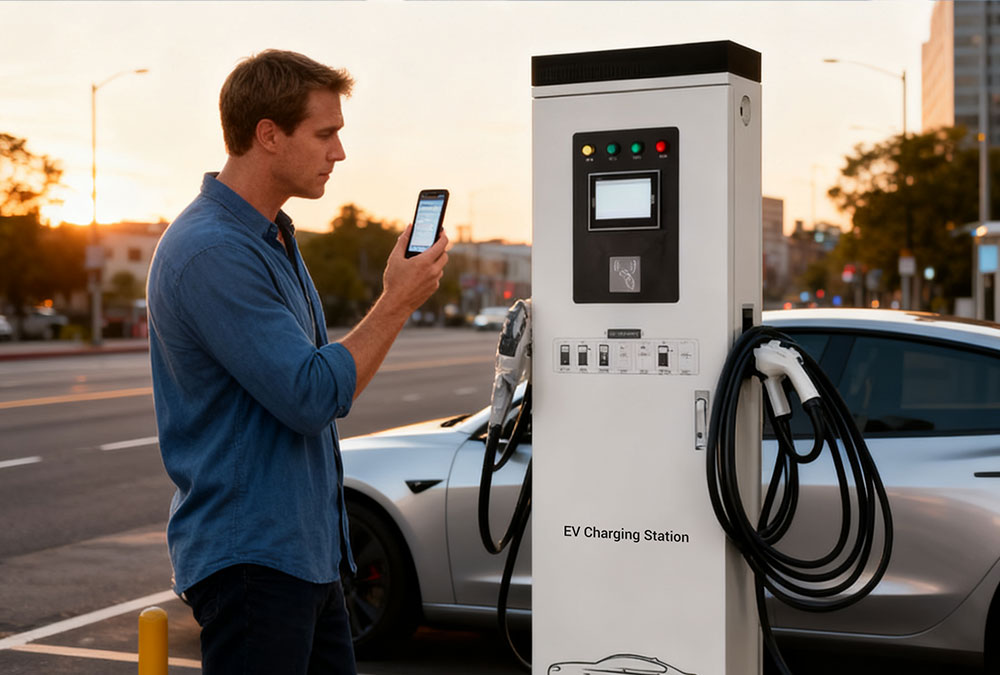
Introduction
In the era of gasoline cars, “5 minutes to fill up and 300 miles to go” was the norm. But when you sit in an electric vehicle (EV) for the first time and see “23% charge remaining” on the dashboard, the immediate question is: How long will it take to fully charge?
The answer isn’t as simple as “a few minutes.” The charging time depends on several factors: your vehicle type, battery state, charger type, grid conditions, and even the weather that day. This guide will give you a practical, step-by-step approach to calculating EV charging times, helping you go from an anxious newbie to a charging pro.
How to Calculate EV Charging Time? Formula and Example Explained
All EV charging time estimates come down to one simple and reliable physical relationship: Charging time equals the amount of power needed divided by the output power of the charger.
Charging Time (hours) = Amount of Power Needed (kWh) ÷ Charger Output Power (kW)
Let’s break this down with an example. Take a Tesla Model Y Long Range with a 75 kWh battery. If the current charge is at 25%, and you want to charge it up to 90%, you’ll need about 48.75 kWh of power. If you’re using a standard 7.68 kW Level 2 charger, it would take roughly 6.35 hours to fully charge, which works well for overnight charging.
However, if you switch to a 150 kW DC fast charger, the theoretical charging time is only around 20 minutes. But in reality, it may take 30–35 minutes. That’s because most EVs reduce charging power after hitting 80% to protect the battery. Understanding this non-linear charging behavior is key: fast charging works best between 10% and 80% of the battery’s capacity.
How Much Battery Charge Do You Really Need?
To properly plan your charging routine, you first need to know how far you typically drive each day. According to the International Energy Agency (IEA) Global EV Outlook 2024, the average daily driving distance for global EV owners is between 45 and 60 km (28 to 37 miles), and over 75% of charging happens at home or work. That means, with a 7 kW Level 2 charger, you can meet your daily commute needs with ease.
Battery sizes in most EVs today range from 40 kWh to 112 kWh. Here’s a look at the range and efficiency of some popular EVs:
| Model | Battery Capacity (kWh) | EPA/WLTP Range | Range per kWh |
|---|---|---|---|
| Nissan Leaf | 40 | 270 km | ~6.8 km/kWh |
| Chevrolet Bolt EV | 65 | 417 km | ~6.4 km/kWh |
| Tesla Model 3 RWD | 60 | 491 km | ~8.2 km/kWh |
| Hyundai Ioniq 5 | 77.4 | 502 km | ~6.5 km/kWh |
| Lucid Air Grand Touring | 112 | 830 km | ~7.4 km/kWh |
The key takeaway here is that most EV owners don’t need to charge their battery from 0% to 100%. Charging between 20% and 80% is often the most efficient way to preserve battery life, shorten charging times, and avoid unnecessary wear on the battery.
Home Chargers vs DC Fast Chargers
Your charging experience can vary widely depending on which charger you use. There are three main types of EV chargers: Level 1, Level 2, and DC Fast Charging.
Level 1 Charging: Typically uses a standard 120V outlet and delivers 1.4 to 1.9 kW. Charging a 60 kWh battery could take more than 30 hours, so it’s best for emergency or occasional use.
Level 2 Charging: Uses a 240V circuit and can deliver between 3.3 kW and 19.2 kW. The most common home chargers are 7.68 kW (32A) models. These can add 30 to 50 miles of range per hour of charging, making them perfect for overnight recharges.
DC Fast Charging: With power outputs ranging from 50 kW to 350 kW, this type of charging is ideal for long trips or quick top-ups. For example, a Hyundai Ioniq 5 can get 320 miles of range in just 18 minutes on a 350 kW charger.
Here’s a quick comparison of the three types:
| Charging Type | Typical Power (kW) | Range Added per Hour | Best Use Case | Installation Complexity |
|---|---|---|---|---|
| Level 1 | 1.4 – 1.9 | 4–6 miles | Emergency | Very Low (standard outlet) |
| Level 2 | 3.3 – 19.2 | 20–40 miles | Home, Office | Medium (requires 240V circuit) |
| DC Fast | 50 – 350 | 100–200+ miles | Road trips | High (requires special infrastructure) |
Key Factors Affecting Your EV Charging Time
Even with the right formula and charger type, several factors can affect your charging time. Here are five to watch out for:
1. Load Sharing
In shared parking lots or buildings, multiple chargers may be connected to the same power line. If several cars are charging at once, the power will be divided, slowing down the charging time.
2. Temperature and Weather Conditions
Extreme temperatures can significantly affect charging speed. Cold weather (<0°C) slows down charging because the battery’s chemical activity decreases. Hot weather (>40°C) can cause thermal management systems to kick in, reducing charging efficiency.
3. Battery Protection Settings
To extend battery life, most EVs limit charging to 80% or 90% by default. This helps protect the battery from wear, but it can also slow down charging.
4. Charging Acceptance Rate
This is the maximum charging power your vehicle can accept. Even if you’re connected to a 350 kW fast charger, your car may only be able to handle a lower power rate. The best charging speeds are often between 10% and 50% charge.
5. Charger Type and Power
Different EVs have different charging capabilities. For example, a Tesla Model 3 can handle up to 250 kW on a fast charger, while a BYD Dolphin may only handle 80 kW.
How Much Does EV Charging Cost?
Charging costs vary depending on where you charge your vehicle. In the U.S., home electricity costs about $0.15/kWh, which would mean charging a 48 kWh battery would cost around $7.20. But fast charging at public stations can cost up to $0.30–$0.60/kWh, which can double your costs.
Why Choose AnengJi? Smart Charging Solutions
At AnengJi, we offer reliable, efficient, and smart charging solutions for both individual EV owners and commercial properties. Our charging network boasts a 98.5% uptime, and our stations support features like remote booking, contactless payment, and real-time status tracking.
Whether you’re a homeowner or managing a large commercial property, we provide a full turnkey solution, including everything from electrical assessments and equipment selection to installation and maintenance.
Final Thoughts: Mastering Charging for a Sustainable EV Experience
Charging your EV is no longer a hassle — it’s an opportunity to embrace a smarter, more efficient lifestyle. By understanding how to calculate charging time, the different types of chargers, and the factors that affect speed, you can eliminate range anxiety and enjoy the cost-saving and eco-friendly benefits of driving electric.
At AnengJi, we believe that each time you plug in, you’re taking a step toward a more sustainable future.
FAQs:
Q1: How do I calculate the time it takes to charge my electric car?
A1: To calculate EV charging time, use the formula: Charging Time = Battery Capacity (kWh) ÷ Charging Power (kW). For example, if you have a 75 kWh battery and are using a 7.68 kW charger, the charging time will be around 6.35 hours.
Q2: What factors affect EV charging time?
A2: Several factors can affect EV charging time, including battery size, charger type, charging power, weather conditions, and battery health. For example, colder temperatures can slow down charging speed.
Q3: What is the difference between Level 1, Level 2, and DC fast charging?
A3: Level 1 charging uses a standard 120V outlet and is slow, adding only 4-6 miles per hour. Level 2 uses a 240V outlet and is faster, adding 20-40 miles per hour. DC fast charging is the fastest, adding 100-200+ miles in as little as 20 minutes.
Q4: How do I estimate the cost of charging my EV?
A4: To estimate the cost of charging, multiply the energy used (in kWh) by your local electricity rate. For example, if your home rate is $0.15 per kWh and you need to charge 48 kWh, it will cost you about $7.20.
Q5: Can I use my EV charger in cold weather?
A5: Cold temperatures can slow down EV charging, but many vehicles are equipped with thermal management systems to minimize this effect. It’s recommended to allow extra time for charging in cold weather conditions.
 https://anengjipower.com/wp-content/uploads/2026/09/AnengJipower-European-BESS-Project-Design-Environment-1.webp
675
1000
Charging Station Engineer
https://anengjipower.com/wp-content/uploads/2025/09/anengji-dc-fast-charging-station-manufacturer-and-supplier-logo-white-1.png
Charging Station Engineer2026-09-24 09:05:462026-09-24 09:08:39Battery Energy Storage System Design Guide for Europe
https://anengjipower.com/wp-content/uploads/2026/09/AnengJipower-European-BESS-Project-Design-Environment-1.webp
675
1000
Charging Station Engineer
https://anengjipower.com/wp-content/uploads/2025/09/anengji-dc-fast-charging-station-manufacturer-and-supplier-logo-white-1.png
Charging Station Engineer2026-09-24 09:05:462026-09-24 09:08:39Battery Energy Storage System Design Guide for Europe https://anengjipower.com/wp-content/uploads/2026/09/anengjipower-How-BESS-Power-and-Energy-Shape-Storage-Duration.webp
675
1000
Charging Station Engineer
https://anengjipower.com/wp-content/uploads/2025/09/anengji-dc-fast-charging-station-manufacturer-and-supplier-logo-white-1.png
Charging Station Engineer2026-09-23 09:06:532026-09-23 09:08:02BESS Duration Guide: How to Choose 1, 2 or 4 Hours
https://anengjipower.com/wp-content/uploads/2026/09/anengjipower-How-BESS-Power-and-Energy-Shape-Storage-Duration.webp
675
1000
Charging Station Engineer
https://anengjipower.com/wp-content/uploads/2025/09/anengji-dc-fast-charging-station-manufacturer-and-supplier-logo-white-1.png
Charging Station Engineer2026-09-23 09:06:532026-09-23 09:08:02BESS Duration Guide: How to Choose 1, 2 or 4 Hours https://anengjipower.com/wp-content/uploads/2026/09/AnengJIPower-Cabinet-vs-Containerized-BESS-3D-Isometric-Structural-Cutaway.webp
675
1000
Charging Station Engineer
https://anengjipower.com/wp-content/uploads/2025/09/anengji-dc-fast-charging-station-manufacturer-and-supplier-logo-white-1.png
Charging Station Engineer2026-09-18 07:19:042026-09-18 07:19:38Cabinet vs Containerized BESS: How to Choose for Large C&I
https://anengjipower.com/wp-content/uploads/2026/09/AnengJIPower-Cabinet-vs-Containerized-BESS-3D-Isometric-Structural-Cutaway.webp
675
1000
Charging Station Engineer
https://anengjipower.com/wp-content/uploads/2025/09/anengji-dc-fast-charging-station-manufacturer-and-supplier-logo-white-1.png
Charging Station Engineer2026-09-18 07:19:042026-09-18 07:19:38Cabinet vs Containerized BESS: How to Choose for Large C&I


Leave a Reply
Want to join the discussion?Feel free to contribute!