
Introduction
The “Golden Age” of the EV charging market isn’t coming—it’s already here. Driven by aggressive government policies, rapid tech shifts, and a massive wave of driver demand, the global EV charging infrastructure business is expanding at a breakneck pace. For entrepreneurs and investors, this is more than just an energy shift; it’s a total rewrite of how we power our lives and cities.
Market Demand: From “Growth” to “Explosion”
According to the IEA’s 2025 Global EV Outlook, over 48 million EVs were on the road by the end of last year—nearly double the count from 2022. In 2025 alone, 17.5 million new EVs were registered globally, making up 22% of total car sales. While China leads with 60% of that share, North America is closing the gap, reaching a 12% market share.
The real story, though, is how driver behavior has changed:
- Consumer Shift: A 2025 AAA survey shows 42% of potential buyers now prefer an EV, up from 30% in 2022.
- Urban Demand: In the EU, over 55% of commuters say they’d switch to electric immediately if they had reliable public charging stations nearby.
BloombergNEF predicts a 29.1% CAGR for the electric vehicle charging business through 2030. In short: if there’s a car, there needs to be a plug. Charging demand is the new “must-have” utility.
Global Policy: The Wind at Your Back
Governments are no longer just encouraging charging—they are funding the backbone of the EV charging infrastructure market:
- United States: The NEVI program is deploying $7.5 billion to build 500,000 fast chargers along interstate highways. Furthermore, the Inflation Reduction Act (IRA) offers a 30% investment tax credit (ITC) for commercial EV charging solutions.
- European Union: The AFIR regulation mandates a fast-charging station every 60km on major highways, aiming for 3.5 million public plugs by 2030.
- China: The “14th Five-Year Plan” aims for over 20 million chargers by 2025, pushing for a 2:1 vehicle-to-pile ratio with a massive $80 billion investment.
Tech Innovation: Speed, Intelligence, and Fusion
Technology is moving faster than the cars themselves, reshaping the EV charging station business:
- 800V High-Voltage Platforms: Brands like Porsche and Hyundai now offer “5 minutes for 200km” charging. This surge in ultra-fast EV charging stations meets the user’s desire for a “gas station-like” experience.
- Solid-State Breakthroughs: With Toyota and CATL moving toward trial production, battery energy density is up 40%, further intensifying the need for high-power hardware.
- Smart Operations: Platforms like AnengJi Energy offer white label EV charging software that uses load balancing and peak shaving to boost station utilization by over 30%.
- Solar-Storage-Charging (Microgrid): This integrated model is seeing an IRR of 15–22% in regions like California and Germany by allowing owners to capitalize on peak-valley price differences.
6 Core EV Charging Business Opportunities
1. Charging Network Operator (CPO)
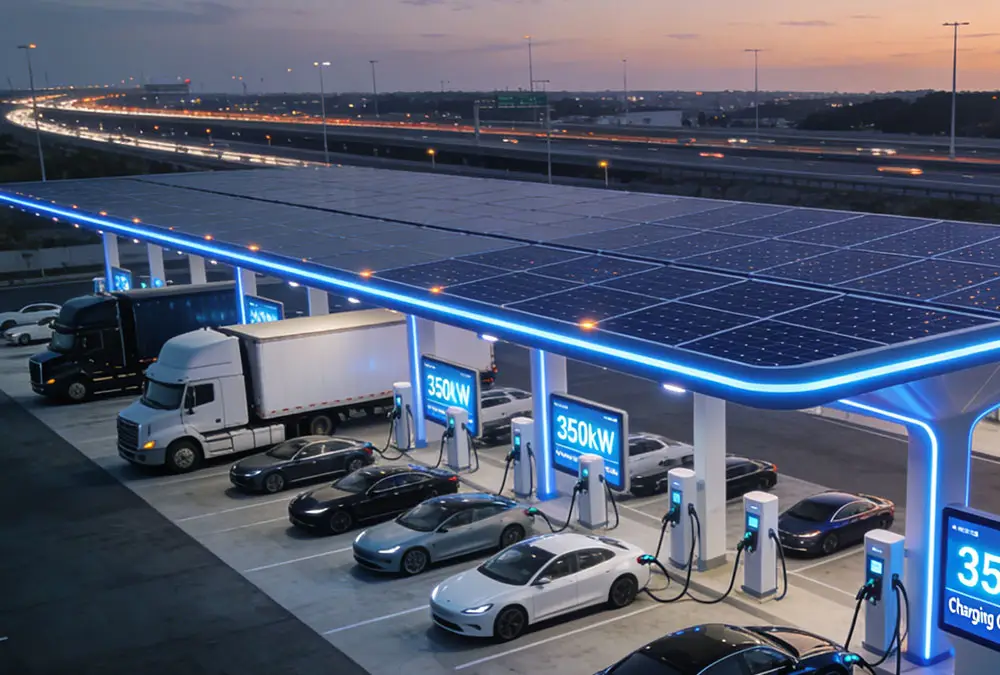
Think of this as the “New Age Gas Station.” CPOs deploy high-density fast chargers at highways and transit hubs.
- Revenue Model: Profit from electricity spreads ($0.35–$0.65/kWh premium), subscriptions, and screen advertising.
- 2026 Trend: While upfront costs for a DC fast charging business are high ($150k–$250k per site), the industry is consolidating into “Megawatt Charging Corridors” to support electric heavy-duty trucks.
2. Turnkey Installation Services
Every mall, hotel, and office building is looking for EV charging installation services.
- Revenue Model: Project contracts ($3,000–$8,000 per plug), subsidy consulting commissions (10–15%), and annual maintenance.
- The Opportunity: As the IRA and AFIR make charging prep mandatory for new buildings, this has shifted from an “option” to a “standard.”
3. Integrated Service Providers (CaaS)
“Charging as a Service” is perfect for property owners who don’t want to manage tech.
- Revenue Model: 20–30% revenue share and SaaS platform fees ($50–$200/plug/month).
- Key Advantage: Using an OCPP compliant EV charging platform allows small businesses to launch their own branded network instantly.
4. EV Charging Consultants
With complex grids and regulations, developers need “navigators.”
- Focus: Demand modeling, site selection, and EV charging regulations compliance.
- Value: This is critical for Public-Private Partnerships (PPP) where expertise in grid capacity and energy management is a high-priced commodity.
5. Destination Charging Ecosystems
Focusing on “high-dwell” areas like malls or resorts.
- Logic: Free or low-cost charging drives secondary spending. For example, Costco members who charge their EVs stay 35% longer and spend 18% more.
- 2026 Strategy: Creating “Charging+” micro-ecosystems with automated retail or lounge areas.
6. Mobile & Emergency Charging
A blue ocean for old residential areas or highway rescue.
- Target: Fleet operators and drivers without fixed parking.
- Profit: High-margin per-service fees ($50–$150). As solid-state battery costs drop, the service radius for mobile charging vans is expanding to 50km.
Market Segments: Where to Focus
- Commercial Properties: Parking lots are the “new traffic entry point.” Office buildings use it for ESG goals, while retail centers use it to extend customer stay time.
- Residential Market: From apartments to luxury villas. Property managers can package “installation + O&M” into a monthly management fee.
- Public-Private Partnerships (PPP): Local governments need private partners for municipal parking and schools via BOT (Build-Operate-Transfer) models.
Final Takeaway: The Window is Open
History is repeating itself. Just as the 1950s highways built the empires of fast food and motels, the “Electric Highway” is building the next infrastructure giants.
To succeed, you must:
- Secure high-traffic locations early.
- Maximize government subsidies.
- Use a scalable smart EV charging management system (like AnengJi Energy).
- Focus on user LTV through a “Charging+” ecosystem.
Conclusion
In 2026, EVs are the reality, and charging stations are the new hubs of energy, transit, and data. Whether you are a developer, an energy firm, or a startup, the blue ocean is waiting.
AnengJi Energy provides a hardware-agnostic, white-label charging platform. We handle the technical heavy lifting—from load balancing to carbon emissions tracking—so you can focus on growth.
Contact us today to power your future.
FAQ: EV Charging Business Insights
Q: Is the EV charging station business profitable in 2026? A: Absolutely. With the charging station utilization rate rising and diverse revenue streams (ads, energy storage, premium charging), the EV charging station ROI has significantly improved.
Q: How much is the EV charging station investment cost? A: It ranges from $2,000 for a basic Level 2 setup to over $200,000 for an ultra-fast DC fast charger hub, but government incentives can often cover 30% or more of these costs.
Q: What are the best EV charging solutions for businesses? A: For most commercial properties, a mix of Level 2 destination chargers and at least one DC fast charger is the gold standard to balance cost and customer needs.
 https://anengjipower.com/wp-content/uploads/2026/09/AnengJIPower-Cabinet-vs-Containerized-BESS-3D-Isometric-Structural-Cutaway.webp
675
1000
Charging Station Engineer
https://anengjipower.com/wp-content/uploads/2025/09/anengji-dc-fast-charging-station-manufacturer-and-supplier-logo-white-1.png
Charging Station Engineer2026-09-18 07:19:042026-09-18 07:19:38Cabinet vs Containerized BESS: How to Choose for Large C&I
https://anengjipower.com/wp-content/uploads/2026/09/AnengJIPower-Cabinet-vs-Containerized-BESS-3D-Isometric-Structural-Cutaway.webp
675
1000
Charging Station Engineer
https://anengjipower.com/wp-content/uploads/2025/09/anengji-dc-fast-charging-station-manufacturer-and-supplier-logo-white-1.png
Charging Station Engineer2026-09-18 07:19:042026-09-18 07:19:38Cabinet vs Containerized BESS: How to Choose for Large C&I https://anengjipower.com/wp-content/uploads/2026/09/AnengjiPower-Modern-CI-Energy-Storage-System-Cabinet-Detail.webp
675
1000
Charging Station Engineer
https://anengjipower.com/wp-content/uploads/2025/09/anengji-dc-fast-charging-station-manufacturer-and-supplier-logo-white-1.png
Charging Station Engineer2026-09-17 07:38:352026-09-17 07:39:08C&I vs Utility-Scale Energy Storage: Key Differences in Applications, Technology, Cost & ROI
https://anengjipower.com/wp-content/uploads/2026/09/AnengjiPower-Modern-CI-Energy-Storage-System-Cabinet-Detail.webp
675
1000
Charging Station Engineer
https://anengjipower.com/wp-content/uploads/2025/09/anengji-dc-fast-charging-station-manufacturer-and-supplier-logo-white-1.png
Charging Station Engineer2026-09-17 07:38:352026-09-17 07:39:08C&I vs Utility-Scale Energy Storage: Key Differences in Applications, Technology, Cost & ROI https://anengjipower.com/wp-content/uploads/2026/09/anengjiPower-Commercial-Solar-Battery-Storage-System-Architecture-Cutaway.webp
675
1000
Charging Station Engineer
https://anengjipower.com/wp-content/uploads/2025/09/anengji-dc-fast-charging-station-manufacturer-and-supplier-logo-white-1.png
Charging Station Engineer2026-09-16 07:14:022026-09-16 07:15:37Commercial Solar Battery Storage: How to Size Systems & Maximize ROI
https://anengjipower.com/wp-content/uploads/2026/09/anengjiPower-Commercial-Solar-Battery-Storage-System-Architecture-Cutaway.webp
675
1000
Charging Station Engineer
https://anengjipower.com/wp-content/uploads/2025/09/anengji-dc-fast-charging-station-manufacturer-and-supplier-logo-white-1.png
Charging Station Engineer2026-09-16 07:14:022026-09-16 07:15:37Commercial Solar Battery Storage: How to Size Systems & Maximize ROI


Leave a Reply
Want to join the discussion?Feel free to contribute!