
Introduction
Let’s be completely practical about industrial operations today. If you are running a manufacturing plant, a food processing facility, or a heavy logistics park, your biggest silent margin killer sits right inside your monthly utility bill. European industrial electricity prices have seen intense volatility over recent financial quarters, leaving corporate operational budgets highly vulnerable. At the same time, corporate ESG mandates are no longer a simple public relations checkbox; they are hard baseline metrics tied directly to your institutional supply chain financing.
You want to wipe out those aggressive midday peak grid charges. You want to make sure an unexpected regional grid flicker doesn’t halt your assembly lines for an expensive shift. This is exactly why implementing an Industrial Solar Battery Storage framework has transitioned from a progressive luxury into an essential defensive asset. Relying on raw grid injection or unbuffered solar fields leaves you completely exposed to grid price cannibalization.
This comprehensive guide details how an integrated infrastructure setup protects your facility from volatile market price exposure. It outlines how these systems insulate your daily manufacturing schedules from rolling utility network constraints, helping you maximize your local investment returns from day one.
⭐ Featured Snippet (Google Search Target Focus):
Industrial solar battery storage is an integrated energy solution that combines solar PV generation with battery energy storage systems (BESS). It enables factories and commercial facilities to store excess solar electricity during the day and use it during peak demand, reducing electricity costs, improving energy resilience, and maximizing renewable energy utilization.
What Is Industrial Solar Battery Storage?
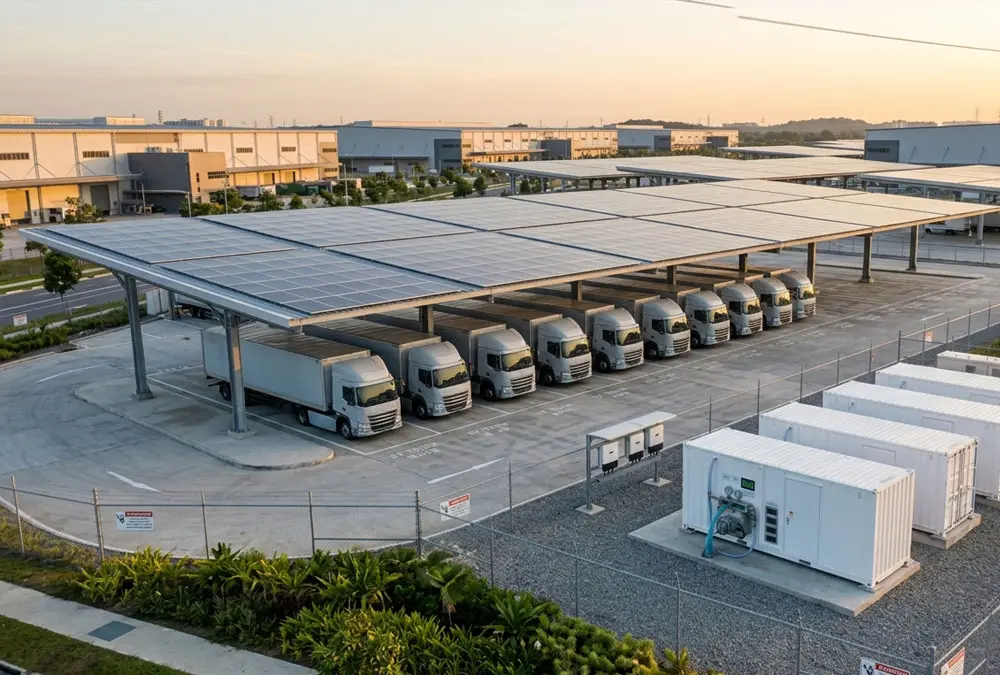
At its core engineering layer, this hardware combines localized solar PV arrays with ruggedized, heavy-duty industrial battery components. Instead of throwing away excess midday solar generation or back-feeding it to a crowded grid at zero value, you store that clean volume inside a local physical buffer. The system functions as a high-capacity, automated power valve for your factory, letting you manage your connection profile with real-time precision.
Why More Industrial Facilities Are Investing in Industrial Solar Battery Storage
Operating an energy-intensive business without a localized power buffer is becoming highly risky. Plant managers face several converging infrastructure challenges that threaten daily profit margins.
Rising Industrial Electricity Prices
Macro market data confirms that regional retail electricity costs for energy-intensive sectors remain unstable. For instance, recent reports from the European Union Agency for the Cooperation of Energy Regulators (ACER) emphasize that structural grid congestion continues to keep peak industrial operational tariffs elevated. You cannot afford to leave your daily production expenses tied to volatile wholesale energy markets.
Peak Demand Charges Continue to Increase
Most factory owners do not realize that up to 30% to 50% of their monthly utility invoice has nothing to do with total energy consumed. It is driven entirely by peak demand charges—the single highest 15-minute load spike recorded during the month. As utilities struggle to balance aging distribution networks, they are raising these localized demand penalties, punishing facilities that start heavy machinery during peak times.
Energy Security Has Become a Priority
A regional transmission voltage dip lasting only a few milliseconds can knock sensitive CNC machinery or automated packaging lines completely offline. The time required to clear blocked lines and restart production equipment results in significant, irrecoverable labor and material losses. Installing an onsite industrial energy storage system delivers automated, high-speed power protection that keeps your facility running smoothly through local grid dropouts.
ESG and Carbon Reduction Requirements
Global consumer brands now expect their industrial manufacturing and parts suppliers to provide audited Scope 1 and Scope 2 carbon reduction metrics. Failing to meet these clean energy standards risks losing major multi-year supply contracts. Transitioning your facility to a solar plus battery storage model delivers verifiable carbon reduction data that keeps your business competitive in modern corporate procurement bidding.
Government Incentives and Energy Policies
The regulatory landscape is highly favorable for developers deploying on-site commercial battery energy storage platforms. Financial incentives like the US Investment Tax Credit (ITC) under the Inflation Act, alongside localized European green infrastructure grants, significantly offset upfront capital equipment costs, shortening your project’s overall payback timeline.
How Industrial Solar Battery Storage Works
Understanding how a commercial solar energy storage network functions is easiest when you trace a typical 24-hour manufacturing cycle.
Daytime — Solar Panels Generate Electricity
When the sun hits your facility’s rooftop PV array, the system generates clean DC power. The local inverters convert this instantly into AC power to feed your running machinery. If your factory load is lower than the solar field output—such as during weekend shifts—the excess power is automatically routed into the battery packs instead of being lost to grid restrictions.
Peak Hours — Stored Energy Reduces Electricity Costs
When evening approaches and regional grid prices spike, the energy management system stops drawing expensive utility power. The system switches seamlessly to your stored daytime solar volume. This process, known as peak shaving battery storage, ensures your facility avoids high peak charges without requiring you to alter your core manufacturing schedules.
Power Outages — Battery Provides Backup Power
If a local substation fails or extreme weather cuts grid power, your system instantly switches to backup mode. The internal switchgear isolates your factory from the dead utility grid within milliseconds. This rapid transition provides stable, continuous power to your critical assembly equipment, assembly lines, and server racks.
Energy Management System (EMS) Optimizes the Entire Process
The true value of modern industrial solar battery storage systems lies in the intelligent EMS software. The EMS runs advanced AI algorithms that track real-time weather forecasts, historical factory load patterns, and live wholesale utility price feeds. The software automates charge and discharge cycles to ensure your system always operates at peak financial efficiency.
Industrial Solar Battery Storage System Components
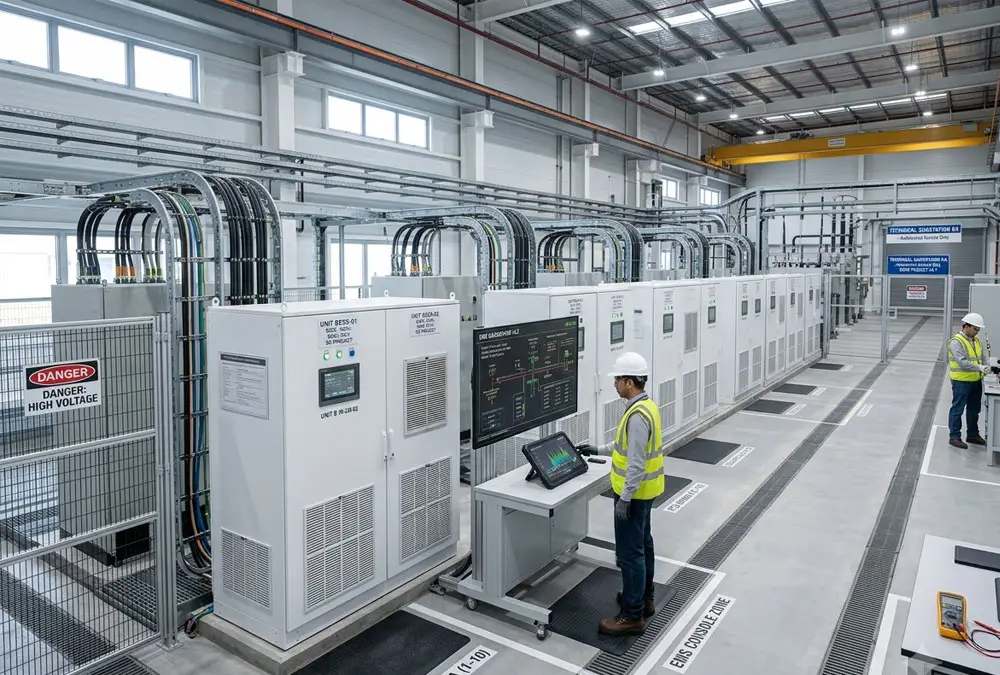
A reliable industrial BESS requires several heavy-duty, factory-matched hardware layers working together seamlessly.
- Solar PV Modules: High-efficiency Tier 1 monocrystalline solar modules are installed across factory rooftops, ground mounts, or carports to capture maximum clean energy.
- Battery Packs: The core chemical storage core uses heavy, rack-mounted battery modules. Modern installations rely almost exclusively on Lithium Iron Phosphate (LFP) chemistry rather than older NMC alternatives. LFP cells deliver excellent thermal stability and highly reliable performance under daily, high-power cycling.
- Battery Management System (BMS): The BMS functions as the continuous digital protector of your battery investment. It monitors cell-level voltages, internal balance currents, and localized temperatures across the entire array to prevent cell degradation.
- Power Conversion System (PCS): The PCS serves as the bi-directional high-voltage gateway for the asset. It converts incoming AC power from the solar field or utility grid into DC power for storage, and reverses the process during high-demand discharge periods.
- Energy Management System (EMS): The EMS serves as the central brain of the installation, managing real-time data tracking and market-driven dispatch automation. It interfaces directly with localized SCADA networks.
- Thermal Management & Fire Protection: Industrial battery systems require strict, active temperature control to ensure safe operation. Enclosures feature multi-layered safety infrastructure, combining specialized liquid cooling networks with automated fire suppression systems to satisfy rigorous safety codes.
Industrial Energy Storage Technologies Compared
Choosing the wrong storage medium can ruin your factory’s ROI. Here is how leading technologies stack up, translated into direct bottom-line impacts for your facility:
| Technology Type | Lifespan & Efficiency | Buyer’s Financial Hesitation (Your Doubt) | What It Actually Delivers For Your Factory (The Real Benefit) |
|---|---|---|---|
| Lithium Iron Phosphate (LFP) | 15-20 Years (90% Efficiency) | “Is the initial capital expenditure too high compared to standard diesel grids?” | Zero-maintenance daily savings. It offsets your highest daytime peak demand charges immediately, leading to a full project payback within 5-7 years with zero fuel costs. |
| Vanadium Flow Batteries | 20+ Years (70% Efficiency) | “Can I use this for instant backup power during sudden voltage sags?” | Best for long, slow 8+ hour continuous discharge. However, it responds too slowly for sudden millisecond drops, meaning it won’t protect sensitive automated CNC assembly lines from blinking off. |
| Thermal Energy Storage | 20 Years (80% Thermal Efficiency) | “Can this run my factory’s electrical motors during grid blackouts?” | Pure heat, zero electricity. It cannot run your machinery. It only saves you money if your factory directly requires massive volumes of steam or industrial process boiling water. |
Benefits of Commercial & Industrial Solar Battery Storage
Investing in integrated industrial solar battery storage solutions yields clear operational advantages.
- Reduce Peak Demand Charges: By monitoring your factory’s real-time electricity consumption, the system can automatically discharge power the moment heavy machinery creates a load spike. This active peak shaving keeps your recorded grid demand flat.
- Shift Energy Consumption to Lower Tariff Periods: If your local utility uses Time-of-Use (TOU) pricing, electricity costs skyrocket during specific afternoon and evening hours. This setup allows you to draw power from your batteries during these expensive windows.
- Increase Solar Self-Consumption: Without on-site storage, excess weekend solar generation is often back-fed to the utility grid for minimal financial return. Adding an integrated battery array allows you to save this clean power locally.
- Provide Reliable Backup Power: An unexpected power outage can ruin expensive batches of raw materials and halt automated production lines. High-speed systems transition to backup mode within milliseconds, providing reliable, continuous power.
- Reduce Carbon Emissions: Storing clean daytime solar power to run your evening operations allows you to displace high-carbon grid electricity. This delivers verifiable carbon reduction data to satisfy corporate ESG goals.
- Participate in Demand Response Programs: During periods of extreme grid stress, regional utilities will pay industrial facilities to reduce their power draw. With an intelligent behind-the-meter system, your factory can reduce its grid demand instantly by switching to battery power.
- Generate Additional Revenue from Grid Services: When your battery capacity is not required for internal factory operations, your EMS can use the asset to provide rapid frequency response and voltage stabilization services to the regional utility grid, turning your infrastructure into a steady revenue source.
Industrial Solar Battery Storage Applications
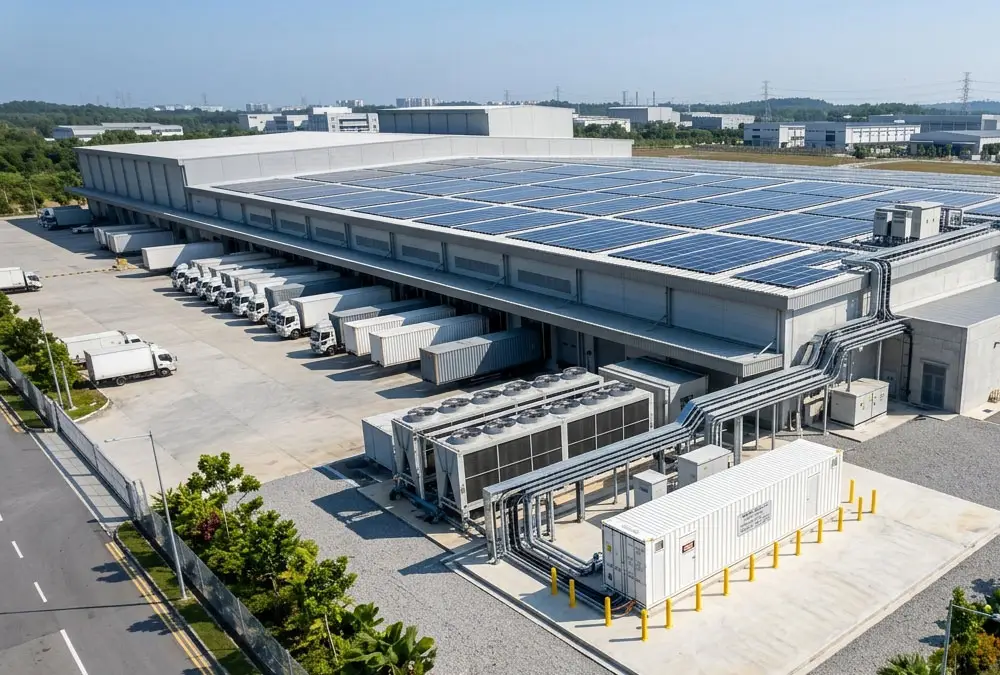
Don’t let brokers over-size your system just to increase their commission. Here is the exact hardware matching based on real factory pain points and specific scenario constraints:
| Your Factory Profile | Your Biggest Pain Point & Concern | Recommended Solution | Why This Choice Protects Your Investment |
|---|---|---|---|
| Heavy Manufacturing & Automotive Factories | Massive voltage drops when heavy robotic welding lines start up, causing system trip-outs. | AnengJi 1MWh+ Utility Container Series | Handles massive sub-second current surges. The integrated high-power PCS grid-forming system acts as a wall between the grid and your machinery, absorbing heavy motor startup currents effortlessly. Great for energy storage for manufacturing. |
| Food Processing & Cold Storage Logistics | Constant 24/7 cooling load. Local fire marshals are incredibly strict about battery safety indoors. | AnengJi 418kWh Liquid-Cooled Block | Maximum safety code compliance. Built with automated off-gas detection and certified NFPA 855 clean-agent fire suppression, ensuring rapid local municipal and insurance sign-offs. |
| Mid-Sized Warehouse / High-Speed EV Charging Fleet | Rooftop solar generates massive power on weekends, but the logistics office is completely closed. | AnengJi 261kWh Enclosure | Captures stranded weekend profit. Stores 100% of your free weekend solar generation and delivers it back to your delivery truck fast-chargers on Monday morning, avoiding utility price spikes completely. |
| Mining Operations & Industrial Parks | Weak regional substation links or complete off-grid isolation requiring a stable localized frequency network. | AnengJi 100kWh Cabinet Series | Perfect for distributed microgrid configurations. Deploys quickly as modular microgrid battery storage blocks to clean up grid noise and support massive machinery loads safely. |
How to Size an Industrial Solar Battery Storage System
Sizing an industrial C&I battery storage asset requires a careful evaluation of your factory’s specific electrical data. You cannot rely on guesswork; you must analyze your historical 15-minute interval utility data to build an accurate consumption profile.
A Buyer’s Practical Example: Consider a mid-sized plastics manufacturing facility with a continuous baseline load of 300 kW and brief afternoon machinery spikes that push the peak load to 500 kW for two hours. If the plant manager wants to erase that 200 kW peak demand charge and secure 1 hour of full emergency backup power for critical extruder lines, a standard 100 kWh cabinet will be insufficient. In this scenario, engineering data suggests deploying a 261 kWh liquid-cooled enclosure paired with a 200 kW PCS inverter to provide the necessary power capacity and run-time buffer.
- Daily Energy Consumption: Calculate the total kilowatt-hours used across your peak and off-peak factory shifts to determine your base energy needs.
- Peak Load Requirements: Identify your highest recorded kilowatt spikes to size an inverter network capable of handling those sudden equipment starts.
- Desired Backup Duration: Decide if your system only needs to provide brief protection during short voltage sags or sustain full factory operations through multi-hour blackouts.
- Solar PV Capacity: Match your battery’s storage volume to your rooftop solar field’s peak generation to ensure no clean energy is wasted.
- Future Expansion Plans: Choose a modular container system that allows you to add extra battery racks easily as your manufacturing facility grows.
How Much Does Industrial Solar Battery Storage Cost?
Navigating the total industrial solar battery storage cost requires looking past the invoice price of the battery racks alone. A complete installation includes several capital expenditure and civil engineering components:
- Equipment Cost: Covers the physical LFP battery cells, inverter units, internal BMS wiring, thermal liquid cooling loops, and integrated fire safety hardware.
- Installation Cost: Covers specialized electrical labor, heavy crane onsite rentals, and high-voltage substation integration work.
- Civil Engineering: Includes the cost of site preparation, code compliance evaluations, and pouring reinforced concrete pads for the enclosures.
- Grid Connection: Covers utility interconnection applications, engineering impact assessments, and necessary local transformer upgrades.
- Operation & Maintenance: Minimal ongoing costs for annual cooling fluid top-offs, air filter checks, and remote software updates.
While the initial capital investment for an intelligent renewable energy storage solutions project requires careful planning, the long-term returns are compelling. Most factories combining peak shaving with solar self-consumption achieve a full return on investment (ROI) within 5 to 7 years, creating decades of lower operational costs afterward.
Common Questions When Choosing Industrial Solar Battery Storage
Every industrial project developer and financial controller usually brings the same core technical questions to our consulting sessions. Let’s address these concerns directly from a practical project perspective.
Can the Battery Handle Peak Loads?
Yes, provided your engineering team pairs the installation with a properly sized, industrial-grade Power Conversion System (PCS). The PCS must be calibrated to match the high starting currents of your largest factory motors and heavy automated machinery lines.
Is It Safe?
Safety depends entirely on your choice of cell chemistry and enclosure design. Selecting Lithium Iron Phosphate (LFP) containers equipped with cell-level thermal monitoring and automated clean-agent gas suppression ensures your installation complies with strict local fire codes and municipal safety standards.
Can It Be Expanded Later?
Yes, if you select a modular, parallel-ready system configuration. Working with an experienced vendor allows you to place extra container blocks onto your concrete pads and link them directly into your existing substation framework without requiring a complete redesign.
How Long Will It Last?
Modern industrial energy storage containers last between 15 and 20 years. This longevity is backed by advanced liquid thermal management that prevents rapid cell aging under harsh continuous weather.
How to Choose the Right Industrial Solar Battery Storage Supplier
Selecting an energy storage partner requires evaluating several core capabilities beyond simple hardware pricing:
- Battery Technology: Ensure the vendor utilizes premium Tier 1 LFP cells backed by clear multi-year performance and degradation guarantees.
- PCS Performance: Verify the inverters offer fast response times and grid-forming capabilities to protect your factory from sudden voltage drops.
- EMS Capability: Choose a platform running intelligent, AI-driven software that supports automated multi-market trading and multi-revenue stacking.
- Safety Standards: Confirm the entire integrated enclosure holds full certified compliance with international safety benchmarks like NFPA 855.
- Project Experience: Prioritize manufacturers with a proven portfolio of operational commercial and microgrid battery storage installations.
- After-sales Service & Warranty: Ensure the supplier provides clear performance indexing guarantees, localized maintenance support, and rapid component sourcing pipelines.
Why Choose AnengJi Industrial Solar Battery Storage Solutions
At AnengJi, we build rugged, factory-integrated energy storage networks designed to withstand harsh industrial environments while maximizing facility profitability. We combine premium LFP cell chemistry, smart liquid cooling loops, and advanced EMS controllers into dependable, plug-and-play enclosures. Our products are fully optimized to provide reliable industrial solar battery storage systems for high-stakes enterprise projects.
- Integrated LFP Battery Systems: We supply factory-tested, pre-configured LFP arrays built for intense thermal durability, delivering continuous cycle health across long multi-year operating periods.
- Advanced PCS + EMS + BMS: Our tightly paired electronic stack communicates perfectly, utilizing smart predictive control algorithms to deliver automated grid balancing and high-speed emergency backup safety.
- Flexible Cabinet & Container Solutions: From modular weather-proof indoor cabinets to massive outdoor multi-megawatt systems, our hardware designs conform precisely to your land footprint boundaries.
- Scalable from Commercial to Utility Projects: Our parallel block structures enable smooth modular scaling, allowing enterprise clients to expand power capabilities incrementally as project budgets allow.
- Turnkey Integration Support: We configure systems that effortlessly manage multi-directional energy paths (Solar + Storage + EV Fleet Charging) and provide professional EPC technical support from early load sizing simulations through utility interconnect permitting.
Frequently Asked Questions (FAQ)
What size battery does my factory need?
Your ideal system size depends on your peak load demands and daily solar output. Most mid-sized manufacturing facilities begin with a 261 kWh or 418 kWh modular block, scaling up as their energy needs grow.
How long do industrial batteries last?
High-quality LFP systems typically deliver an operational lifespan of 15 to 20 years, provided the cells are maintained under uniform temperatures via an integrated liquid cooling network.
Can industrial solar batteries work without solar panels?
Yes. The system can run as a standalone asset, charging from the utility grid during low-cost off-peak hours and discharging during high-priced peak demand windows to generate savings.
Is LFP better than NMC?
For stationary industrial installations, LFP is superior. It delivers significantly higher thermal stability, an extended cycle lifespan, and excellent safety margins compared to NMC cells.
How much money can factories save?
Savings depend on your local utility tariff structures. Most facilities reduce their monthly electricity bills by 30% to 70% by combining solar self-consumption with active peak demand charge reduction.
Conclusion
Transitioning to smart, dispatchable generation is essential for long-term commercial success in the modern renewable energy market. Integrating a modular Industrial Solar Battery Storage system protects your asset from grid constraints and turns energy curtailment risks into reliable revenue. By matching your capacity configurations to local tariff structures and utilizing pre-wired, factory-tested hardware, you ensure stable operational returns. Partnering with an experienced manufacturer allows you to deploy high-density infrastructure smoothly, securing strong financial performance from day one.
 https://anengjipower.com/wp-content/uploads/2026/06/epc-vs-turnkey-solar-project-bess.webp
675
1000
Charging Station Engineer
https://anengjipower.com/wp-content/uploads/2025/09/anengji-dc-fast-charging-station-manufacturer-and-supplier-logo-white-1.png
Charging Station Engineer2026-06-22 07:16:042026-06-24 07:13:17What Is the Difference Between EPC and Turnkey Contract Models in Energy Projects?
https://anengjipower.com/wp-content/uploads/2026/06/epc-vs-turnkey-solar-project-bess.webp
675
1000
Charging Station Engineer
https://anengjipower.com/wp-content/uploads/2025/09/anengji-dc-fast-charging-station-manufacturer-and-supplier-logo-white-1.png
Charging Station Engineer2026-06-22 07:16:042026-06-24 07:13:17What Is the Difference Between EPC and Turnkey Contract Models in Energy Projects? https://anengjipower.com/wp-content/uploads/2026/06/anengji-commercial-solar-plus-storage-benefits-site.webp
675
1000
Charging Station Engineer
https://anengjipower.com/wp-content/uploads/2025/09/anengji-dc-fast-charging-station-manufacturer-and-supplier-logo-white-1.png
Charging Station Engineer2026-06-20 14:34:102026-06-20 14:37:43What Are the Top Benefits of Solar Battery Storage in Factories?
https://anengjipower.com/wp-content/uploads/2026/06/anengji-commercial-solar-plus-storage-benefits-site.webp
675
1000
Charging Station Engineer
https://anengjipower.com/wp-content/uploads/2025/09/anengji-dc-fast-charging-station-manufacturer-and-supplier-logo-white-1.png
Charging Station Engineer2026-06-20 14:34:102026-06-20 14:37:43What Are the Top Benefits of Solar Battery Storage in Factories? https://anengjipower.com/wp-content/uploads/2026/06/modular-commercial-solar-battery-storage-cabinet.webp
675
1000
Charging Station Engineer
https://anengjipower.com/wp-content/uploads/2025/09/anengji-dc-fast-charging-station-manufacturer-and-supplier-logo-white-1.png
Charging Station Engineer2026-06-18 09:16:522026-07-03 03:05:13What Is Solar Battery Storage? Complete C&I Engineering Guide
https://anengjipower.com/wp-content/uploads/2026/06/modular-commercial-solar-battery-storage-cabinet.webp
675
1000
Charging Station Engineer
https://anengjipower.com/wp-content/uploads/2025/09/anengji-dc-fast-charging-station-manufacturer-and-supplier-logo-white-1.png
Charging Station Engineer2026-06-18 09:16:522026-07-03 03:05:13What Is Solar Battery Storage? Complete C&I Engineering Guide


Leave a Reply
Want to join the discussion?Feel free to contribute!