
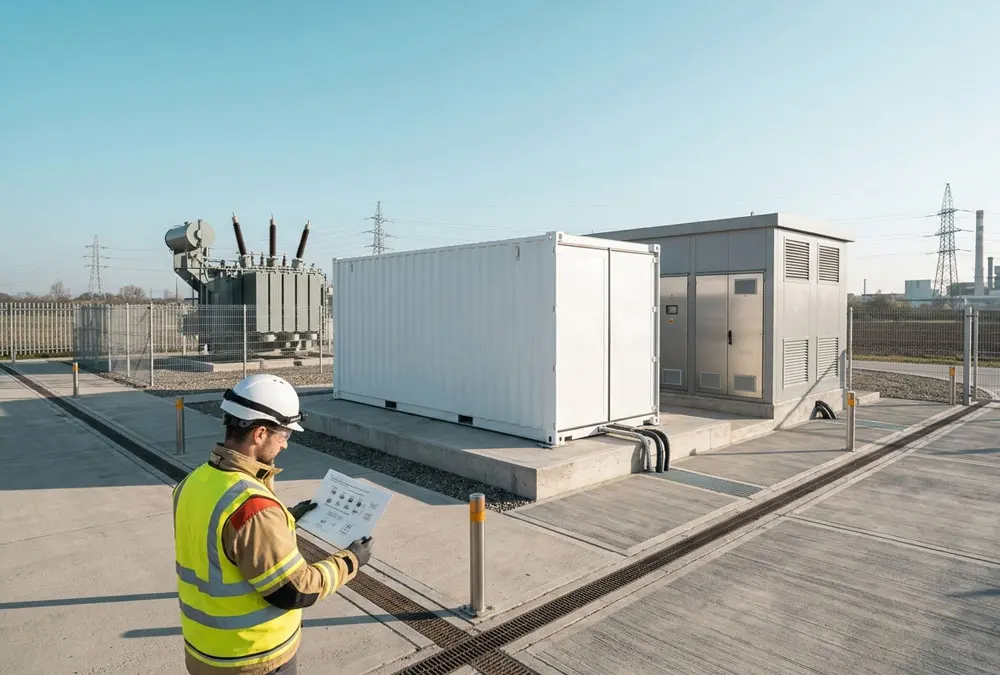
Introduction
A battery can be fully charged when the grid goes dark and still be unable to help restore anything. Its power conversion system may need an AC reference it no longer has; its control power, pre-charge circuit, breaker coils or communications may not be available; or its protection settings may trip during the first transformer energisation. That is why a black start BESS is not simply a large battery with a backup mode. It is a defined, tested restoration pathway from a dead bus to a stable electrical island.
For an EPC team, developer or plant owner, the costly mistake is treating “grid-forming” as a complete answer in an RFQ. Grid-forming control is often necessary, but the real question is harder: can this system self-start, energise the agreed path, carry the next load block or plant auxiliary, and remain operable until the network operator’s sequence reaches the next stable source? This Europe-first guide explains the engineering proof behind that question, with Germany used as a specific procurement example rather than a rule for every European market.
Direct answer: black start means re-energising a de-energised part of an electricity system without relying on external grid power for the initial start. A BESS can support that job only when its battery, grid-forming PCS, auxiliary supply, switchgear, protection, plant controller and operating sequence work together—and when that sequence has been accepted and demonstrated for the intended restoration path.
If this is your situation, do not start by asking for a container price.
Your operating team says “we need the site back after an outage”; the power-plant team says “we need to crank Unit 2”; or a developer says “we want to bid a TSO restoration service.” Those are three different engineering jobs. Sending all three out as a generic “black start BESS” inquiry is how bids become incomparable, schedules slip and a claimed function turns into an unfunded variation order.
What a Black Start BESS Is—and What It Is Not
In its Policy on Emergency and Restoration, ENTSO-E defines a power-generating module with black-start capability as one able to move from shutdown to operating condition and deliver power without external electrical energy from the TSO or DSO grid; it also includes island-operation capability (page 7, C-1-7). That definition is deliberately broader than “the battery can discharge.”
| Capability claim | What it may establish | What it does not establish | Buyer consequence |
|---|---|---|---|
| Battery backup | Stored energy may support a load during a defined outage mode. | Dead-bus energisation, transformer pickup, plant restart or TSO restoration service. | Do not pay for “black start” because the proposal only shows autonomy hours. |
| Grid-forming PCS | The converter can establish a local voltage and frequency reference under its specified conditions. | That all auxiliaries, protection settings and restoration loads can be started safely. | Treat it as a necessary input, not a complete black-start certificate. |
| Intentional islanding | A site can separate from a live grid and support a defined local bus. | That it can start from a completely de-energised state or reconnect according to a restoration plan. | Ask whether the mode was tested from a truly dead bus. |
| Black-start restoration service | A specified asset can initiate and support an agreed restoration sequence. | Universal ability to restart every grid, load or generation plant. | The contract and test plan must name the route, loads, handover points and availability obligation. |
This distinction is especially important for factories, malls or EV depots. A site may need a resilience microgrid that restores a critical-load bus; that is a valuable project, but it is not automatically a transmission-system restoration service. Conversely, a power plant black start may use the BESS first to energise station auxiliaries and crank a larger generation source before normal customers are reconnected. The restoration objective decides the design.
Choose the Restoration Job Before You Buy Hardware
This is the first place where a buyer can save time and avoid paying for the wrong scope. A commercial facility may genuinely need a black-start-capable microgrid, but the engineering evidence is different from the evidence required to restart a gas turbine or offer a grid-restoration service. The table gives your team a more useful starting brief than “please quote a black start battery.”
| What the buyer really needs | First electrical endpoint | The mistake that costs time | What to put in the RFQ |
|---|---|---|---|
| Factory, mall, data facility or depot must restore critical operations | A designated critical-load bus and its priority loads. | Assuming normal building backup automatically supports motor starts, PV reconnection or every site load. | Critical-load schedule, motor-start sequence, isolation/transfer philosophy, minimum autonomy and acceptable interruption. |
| Power plant must restart after a blackout | Station-service bus, plant auxiliaries and the target unit’s cranking path. | Sizing only from the target generator’s MW rating instead of its auxiliary and motor sequence. | Auxiliary one-line, motor list, start attempts, transformer data, DCS changes and handover condition. |
| Developer wants a TSO/DSO restoration role | Operator-defined dead bus, line/transformer route and the next restoration source. | Treating an OEM’s GFM brochure as operator qualification. | Relevant operator specification, target route, communication rules, availability/SOC policy and proving-test obligations. |
If the project team cannot complete the second column, it is too early to compare BESS quotations. That is not a delay tactic: it is the fastest way to stop battery, PCS, MV works and controls from being quoted against different, unstated restoration targets.
The Six Proofs of a Black Start BESS
Before comparing containers, PCS brands or nominal MWh, use these six proofs. They turn a broad resilience claim into evidence an EPC team, owner and network operator can inspect together.
| Proof | What must happen | Evidence to request | Buyer benefit |
|---|---|---|---|
| 1. Self-start | Controls, pre-charge and required auxiliaries wake without grid supply. | Blackout auxiliary one-line, UPS/DC feed design and readiness budget. | Avoids a charged but unavailable BESS. |
| 2. Voltage reference | PCS establishes controlled voltage and frequency at a dead bus. | GFM operating mode, transition logic and limits. | Separates a GFM requirement from a sales label. |
| 3. Energisation path | Transformers, lines and switchgear are energised in an approved order. | EMT/transient study, soft-start plan and protection settings. | Prevents the first switching event from ending the attempt. |
| 4. Load or cranking control | The island accepts defined load blocks or starts target-plant auxiliaries. | Motor/load sequence, MW/Mvar profile and controller priority table. | Makes the claimed restoration target measurable. |
| 5. Reserve endurance | Usable SOC remains available until the next stable source or handover. | SOC reserve logic, thermal/aging conditions and conflict rules for other services. | Protects a rare but contracted service from routine dispatch. |
| 6. Operator proof | PPC, SCADA, communications and test procedures work with the operator plan. | FAT/SAT, proving-test and periodic-test scope. | Replaces an untestable promise with an acceptance obligation. |
Proof 1: a system must wake itself before it can restore anything
The least visible equipment can decide the outcome. The Australian Energy Market Operator’s 2025 FAQ on inverter-based-resource black start, page 5, Question 1.6 identifies pre-charge circuits, a way to supply inverter-level auxiliaries during a system-black condition, soft-start capability, PPC/SCADA frequency control and appropriate protection as features a BESS needs for black-start capability. This is technical evidence from Australia, not a European rule, but it directly exposes the engineering checks a procurement document should request.
Here is the practical trap: a small UPS may keep a screen alive while cooling, BMS, relay power, PCS controls or breaker actuation cannot support the required sequence. The remedy is not “add more battery MWh.” Map every essential auxiliary to its source after loss of grid, note its start current and duration, and show how the system transitions from DC battery energy to the first AC bus. The design review should also identify which functions may remain off during the initial minutes and which must be available before a breaker can close.
Put this requirement in blunt commercial language: “Show the blackout supply source for every device that must operate before the first critical breaker closes.” If a supplier cannot mark those sources on an auxiliary single-line diagram, the black-start claim is not ready for price comparison. This one request exposes missing UPS autonomy, omitted DC supplies, unpowered HVAC/control dependencies and interface gaps between the battery vendor and the MV contractor before they reach site.
Proofs 2 and 3: form the island, then energise the real electrical path
A grid-following inverter synchronises to an existing waveform. With a dead grid, there may be no waveform to follow. The National Laboratory of the Rockies’ black-start research page explains that inverter-based resources need grid-forming operation to provide a reference AC waveform. It also highlights a less obvious constraint: the inductive loads encountered in a restart—such as compressors and next-plant auxiliaries—can create transient inrush current that typical inverters may find difficult to supply.
This is why a steady-state load list is not enough. Transformer energisation can create a short-duration current event that is very different from its normal MW demand. Long cable or line sections can introduce charging/reactive-power behaviour. A PCS power rating in MW does not on its own describe MVA, power-factor, overload, fault-current or voltage-control capability. Before the project team writes “black start capable,” it needs an energisation order, OEM models and an EMT or equivalent transient study that matches the actual bus, transformer, line and motor configuration.
The operational consequence is painfully simple: the first transformer is energised, the inverter reaches a current limit or a relay sees an abnormal condition, and the newly formed island collapses before the first useful load comes online. The solution is not a generic assurance that the PCS is “robust.” Ask for the study case list: dead-bus voltage ramp, transformer energisation, each major motor start, load rejection, loss of the target unit during cranking, and resynchronisation. Then ask which settings group is active in each case and which result is a contractual acceptance criterion.

From a Dead Bus to a Stable Power Island: The Restoration Sequence
The sequence below is a decision model, not an instruction to operate a live network. The exact switching order must be developed and approved by the responsible operator. It shows why a black start BESS is a plant-level and network-level system, not only an enclosure at the fence line.
| Stage | BESS role | Critical check | What proves success |
|---|---|---|---|
| 1. Isolate and verify readiness | Maintains the agreed SOC reserve and boots designated controls. | No unintended backfeed; essential auxiliaries have a blackout supply. | Approved SLD, interlocks and readiness status. |
| 2. Establish the first AC bus | Grid-forming PCS builds voltage and frequency from the DC source. | Pre-charge, GFM controls and black-start protection group are active. | Dead-bus energisation test record. |
| 3. Energise the route | Ramps voltage and holds the island through transformer/line energisation. | Inrush, reactive demand and relay behaviour stay within proven limits. | EMT study and approved switching plan. |
| 4. Pick up auxiliaries or load blocks | Supplies controlled active/reactive power while loads are connected in steps. | Motor starts and step changes do not collapse voltage/frequency. | Load sequence and transient acceptance criteria. |
| 5. Hand over or resynchronise | Supports target generation or a larger island until the planned handover. | PPC/SCADA, frequency and voltage control follow the operator sequence. | Witnessed proving test and handover procedure. |
ENTSO-E’s same policy recommends more than a simple start test. Its complex test guidance on page 12 expects the black-start-capable module to regulate voltage and frequency on a separated island and balance active and reactive load switching in steps. Page 12 also says re-energisation paths should be pre-set to restoration facilities and defined load blocks. That is the right standard of thinking for an EPC scope: start the system, then prove the sequence it was bought to perform.
Where Black-Start BESS Proposals Usually Break Down
Most project teams do not lose a black-start function because they forgot that batteries store DC. They lose it at interfaces between the battery supplier, PCS supplier, MV contractor, power-plant controls and operator. These are the three conversations worth having before contract award.
| What you hear in a bid meeting | What can go wrong in the field | Evidence that resolves it | Commercial protection for the buyer |
|---|---|---|---|
| “The PCS is grid-forming.” | The PCS can form a test bus, but its auxiliaries, protection or dead-bus sequence were never included. | Blackout auxiliary diagram, controller mode narrative, settings-group list and dead-bus FAT/SAT step. | Include the complete initiation sequence in the scope and acceptance schedule. |
| “The battery has plenty of MWh.” | The required SOC is used for market dispatch, degraded, unavailable at temperature, or insufficient after a failed restart attempt. | Usable-energy ledger at delivery point, SOC reserve policy, availability logic and multi-attempt scenario. | Define a measurable availability state—not a nominal capacity promise. |
| “We will integrate with the plant controls.” | DCS/PPC ownership, SCADA points, relay changes and target-generator logic appear after procurement as extra work. | Interface responsibility matrix, I/O list, cyber/communications boundary and witnessed handover test. | Prevents a low hardware price from becoming an uncontrolled controls variation. |
This is also why black start should not be sold as “free extra functionality” on top of an arbitrage or peak-shaving project. A restoration contract can require the asset to remain available when an energy-market strategy would prefer to discharge it. The owner needs one priority rule: when the required reserve threshold is reached, market dispatch must yield to restoration readiness unless the contracted operator permits another arrangement.
How to Screen Black Start BESS Power and Energy Requirements
Do not select a black-start system from a container’s nominal MWh. Start with the restoration path and calculate each step at the relevant delivery point. The simple screening relationship is:
Energy screen: Required usable restoration energy ≥ Σ (step load × step duration) + BESS/plant auxiliary energy + path losses + agreed reserve.
Power screen: PCS capability at each critical step must cover the active-power demand plus the required reactive/voltage-control behaviour, transformer/motor transient limits and the agreed operating margin. This is not a universal sizing formula; it is a checklist for the dynamic study.
Consider an illustrative sequence only: 0.25 MW of essential auxiliaries for 10 minutes consumes 0.042 MWh at the defined AC bus; a 0.80 MW cranking or controlled-load step for 15 minutes consumes 0.20 MWh; and a 0.50 MW holding load for 20 minutes consumes about 0.167 MWh. The arithmetic subtotal is about 0.409 MWh at that bus. It is not the required battery nameplate capacity. The real design must add the agreed conversion-path losses, BESS and plant auxiliaries, usable SOC window, thermal/degradation conditions, restart-attempt policy and the reserve needed if the next generation source does not start on its first attempt.
The more serious limitation may be power rather than energy. A transformer or large motor can impose a transient that does not look like its normal MW demand. Therefore, the required evidence includes the transformer MVA and energisation method, motor dynamic data, PCS overload and current limits, protection coordination and the short-circuit behaviour expected by the local network. This is where an EMT study earns its cost: it tests the event the normal load-flow model does not capture.
A Product Route Is Not a Black-Start Guarantee
A BESS product can be the battery block within a restoration solution, but product capacity alone does not establish the six proofs. For example, AnengJi’s published 5 MWh liquid-cooled battery container is described as a battery container supplied without PCS and transformer. That can be a sensible starting point where an EPC needs to engineer an external grid-forming PCS, MV transformer, switchgear and plant controller around a battery block. It is not, by itself, a statement that the container is black-start-qualified.
| Restoration objective | System route to investigate | Data needed before product selection | Scope boundary to state clearly |
|---|---|---|---|
| Critical-load microgrid restart | Battery block + GFM PCS + critical-load switchboard + microgrid controller + suitable isolation/protection design. | Critical load steps, load PF, PV/genset interface, autonomy and transfer tolerance. | Does not automatically provide transmission-system restoration service. |
| Power-plant auxiliary or cranking path | Battery block + black-start-capable PCS + dedicated transformer/switchgear + plant DCS/PPC integration. | Auxiliary/motor sequence, transformer data, target-unit starting attempts and operator procedure. | A plant-specific dynamic study and proving test remain required. |
| TSO/DSO restoration pathway | BESS blocks + GFM PCS + MV/HV integration + PPC/SCADA + an operator-agreed restoration plan. | Re-energisation route, voltage level, load blocks, comms, availability, test and commercial requirements. | Qualification is operator- and location-specific, not a generic factory feature. |
For a broader configurable-scope discussion, the site’s BESS EPC approach describes configuring battery, PCS, cooling, EMS and safety elements around project inputs. For a black-start scope, add the restoration route, blackout auxiliary diagram, dead-bus control mode, protection study and proving test to those inputs. Without them, a product comparison remains incomplete.
Europe First: Restoration Rules and Procurement Do Not Travel Automatically
Europe has a common emergency-and-restoration framework, but a BESS supplier should not represent one national tender, connection code or test practice as the rule for all countries. The European Commission’s Commission Regulation (EU) 2017/2196 on electricity emergency and restoration requires each TSO to maintain system-defence and restoration plans with relevant stakeholders and to identify restoration resources, essential substations and procedures. It provides a framework; the actual route and qualification belong to the relevant operator and jurisdiction.
Germany provides a concrete example. Netztransparenz’s market-procurement guidance states that a German black-start unit must independently energise a predefined part of the network without external supply and regulate voltage and frequency; it also describes regionally staged, market-based procurement. The Bundesnetzagentur’s Schwarzstartfähigkeit page sets out the national regulatory context for the procurement of this non-frequency-related system service. These sources support a Germany-specific discussion, not a blanket EU eligibility claim.
Great Britain uses the term Restoration. NESO’s Restoration Services guidance says a provider may be required to initialise sections of the transmission/distribution network, manage a stable power island, start other assets and eventually synchronise islands; it also describes availability and periodic test expectations. That is a useful commercial comparison, but the UK has its own framework and should be treated separately from EU-27 requirements.
What an EPC Should Request Before Calling a BESS “Black-Start Capable”
The following request list turns a broad claim into comparable bids and an executable acceptance plan:
- A restoration single-line diagram showing the battery, PCS, DC auxiliary source, UPS, MV/HV transformer, switchgear, plant-controller and communication boundary.
- The defined dead-bus-to-handover sequence, including each switching state, load block, motor start and target generation or critical-load endpoint.
- PCS evidence for grid-forming, pre-charge, soft voltage ramp, voltage/frequency control, MVA/PF limits, overload/current limits and applicable protection modes.
- An auxiliary-load and SOC-reserve budget that remains valid at the agreed temperature, state of health and restart-attempt condition.
- EMT/transient-study boundaries and models for transformers, motors, cables/lines, protection, controls and the intended grid interface.
- A FAT/SAT and operator witnessing plan: dead-bus initiation, staged load pickup, alarms, manual fallback, communications, handover and periodic proof tests.
- Clear exclusions, including which grid studies, operator approvals, civil/MV works and target-plant modifications are outside the quoted BESS scope.
The key commercial benefit is not a longer specification. It is avoiding a late discovery that one bidder priced batteries and another priced a restoration system. The comparison should use the same restoration path, availability window, test standard and responsibility matrix for every bidder.
Make the proving test produce an event record—not a demonstration video
A successful button press during commissioning is not enough for an owner that is buying a restoration obligation. Require an event record for the agreed test sequence: the initial usable SOC and battery temperature; the live source for each essential auxiliary; PCS voltage/frequency set-points; transformer energisation current; MW/Mvar at each load block; active protection-settings group; relay events; and the timing and conditions of the final handover. These data points let the EPC prove which physical and control assumptions were actually tested, and make later periodic tests comparable instead of anecdotal.
This is a useful dividing line in a tender. A supplier that can define the record, acceptance limits and responsible witness understands the restoration function as an operating system. A supplier that can only promise that a battery will “support black start” has not yet given the buyer a verifiable scope.
Black Start BESS FAQs
Can any BESS provide black start?
No. It needs a defined self-start path, appropriate grid-forming and protection functions, sufficient usable reserve, a proven energisation/load sequence and the approvals or contract required for the intended system-restoration role.
Is grid-forming capability enough for black start?
No. Grid-forming control can establish a voltage/frequency reference, but black start also depends on auxiliaries, pre-charge, switching, transformer/motor behaviour, protection, communications, usable SOC and a tested restoration sequence.
Can a BESS black start a power plant?
It can support a specifically engineered plant-restart pathway by supplying auxiliaries or cranking loads, then holding a stable island until the target generation source is available. The plant’s motor sequence, transformer, controls and protection define whether that pathway is feasible.
How much energy does a black-start BESS need?
There is no universal MWh answer. Use the complete restoration sequence, including auxiliary demand, start attempts, load-block durations, losses, thermal conditions and reserve policy. The binding constraint can also be PCS MVA or transient current rather than energy.
Is black start the same as backup power?
No. Backup keeps selected loads supplied under a designed outage condition. Black start initiates an electrical island from a de-energised condition and supports an approved restoration pathway. Some microgrids can do both, but each function must be designed and tested separately.
Start With the Restoration Path, Not the Container
The right black-start BESS is the system that can demonstrate its assigned restoration sequence under the agreed site, operating and operator conditions. Start with the first dead bus, the next transformer or load block, the target generation source and the handover point. Then select the battery block, PCS, transformer, controls and test scope needed to make that pathway real.

 https://anengjipower.com/wp-content/uploads/2026/06/epc-vs-turnkey-solar-project-bess.webp
675
1000
Charging Station Engineer
https://anengjipower.com/wp-content/uploads/2025/09/anengji-dc-fast-charging-station-manufacturer-and-supplier-logo-white-1.png
Charging Station Engineer2026-06-22 07:16:042026-06-24 07:13:17What Is the Difference Between EPC and Turnkey Contract Models in Energy Projects?
 https://anengjipower.com/wp-content/uploads/2026/06/anengji-commercial-solar-plus-storage-benefits-site.webp
675
1000
Charging Station Engineer
https://anengjipower.com/wp-content/uploads/2025/09/anengji-dc-fast-charging-station-manufacturer-and-supplier-logo-white-1.png
Charging Station Engineer2026-06-20 14:34:102026-06-20 14:37:43What Are the Top Benefits of Solar Battery Storage in Factories?
 https://anengjipower.com/wp-content/uploads/2026/06/modular-commercial-solar-battery-storage-cabinet.webp
675
1000
Charging Station Engineer
https://anengjipower.com/wp-content/uploads/2025/09/anengji-dc-fast-charging-station-manufacturer-and-supplier-logo-white-1.png
Charging Station Engineer2026-06-18 09:16:522026-07-03 03:05:13What Is Solar Battery Storage? Complete C&I Engineering Guide


Leave a Reply
Want to join the discussion?Feel free to contribute!