
Introduction
The expensive end-of-life mistake is rarely made on the day a battery is removed. It is usually made years earlier, when a BESS purchase order defines warranty and delivery but says almost nothing about the asset’s exit. A project can reach a repowering decision with no final serial-number map, no reliable condition history, no agreed removal boundary and no evidence of who will accept the equipment. That turns a planned upgrade into a difficult site, logistics and contract problem. Practical energy storage lifecycle solutions begin at procurement, not at the recycling gate.
Battery energy storage end of life is not one event and it is not automatically “recycling day.” A system may no longer meet its original contracted energy duty yet remain technically functional. It may need augmentation, full repowering, a documented assessment for reuse or repurposing, or recycling. The correct route depends on condition, safety, the intended next duty, applicable rules, commercial responsibility and the records that follow the equipment off site.
The 30-Second Answer
A BESS end-of-life plan has four jobs: decide the next use, make the plant safe to remove, route every material stream to the right destination, and retain proof of what happened.
- Owners need to protect asset value, lease obligations and future auditability.
- EPCs need clear isolation, removal, cable, civil and handover boundaries.
- Procurement teams need a written route for responsibility, acceptance conditions and final evidence.
The UK government’s Health and safety in grid-scale electrical energy storage systems guidance describes decommissioning as permanent shutdown, disconnection, removal, land restoration and an appropriate reuse, recycling or disposal route. It also advises developers to establish supplier take-back and recycling processes early. This is UK guidance rather than a universal European legal rule, but the project lesson is widely useful: a generic future promise is not an exit plan.
End of Life Is a Decision Point
“End of life” is often used as though it means one thing. In a real BESS project, it can mean at least four different things. Treating them as the same is how a capacity warranty, a safety event and a waste-management decision become confused.
| What triggered the discussion? | What it really means | First question to answer | Possible next route |
|---|---|---|---|
| Contractual threshold | The system no longer meets a guaranteed energy, power or availability duty. | Can it still meet the actual site duty safely and economically? | Continue, augment, repower or retire. |
| Safety or defect event | Damage, water ingress, abnormal heating, recall or a failed inspection changes the risk profile. | What is the equipment’s condition and what route will the receiving party accept? | Specialist assessment, controlled removal and an approved treatment route. |
| Repowering decision | The owner replaces or upgrades part/all of the plant to restore duty or improve economics. | Which existing electrical, civil and safety systems remain suitable? | Engineering review, controlled replacement and a separate exit route for removed equipment. |
| Waste decision | The battery is assigned to a regulated collection, treatment or recycling route. | Who owns transport, acceptance, treatment and final records? | Recycling or another lawful treatment pathway. |
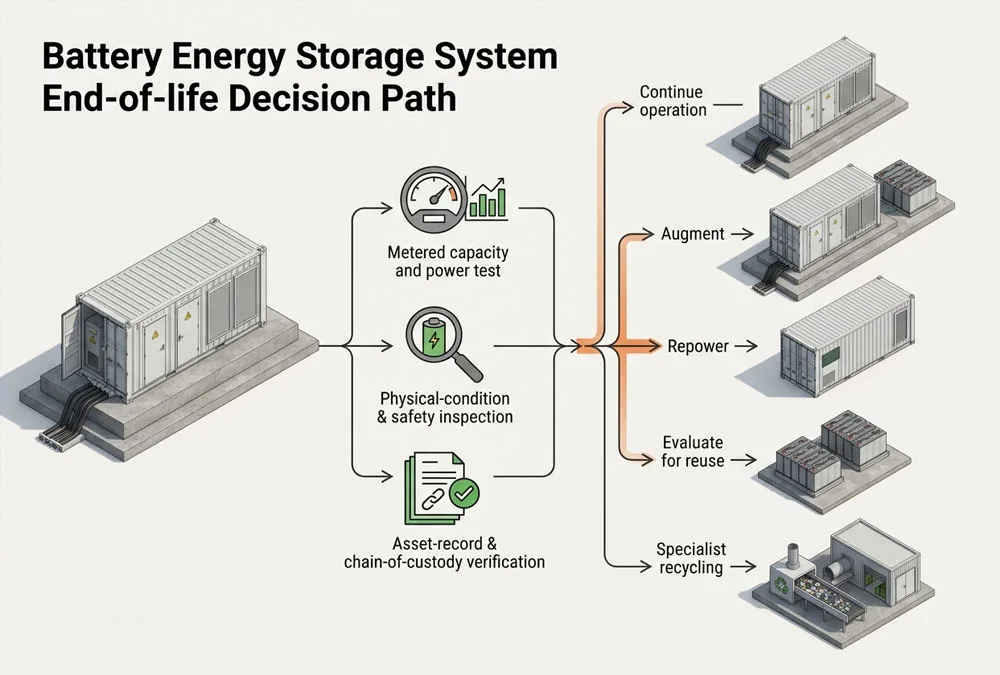
For a factory, shopping centre or grid-connected project, a battery that has lost capacity may still turn on. That does not prove it can deliver the backup runtime, export limit or dispatch obligation the site needs. Before deciding to keep it in service, compare actual usable energy and power with the current duty, then review safety condition, warranty position, temperature history and the compatibility of the remaining plant. State of health is useful evidence; it is not a stand-alone decision.
Measure the Exit Gap
Compare duty at one boundary
An end-of-life decision becomes clearer when the comparison is made at one stated electrical boundary. For a site that buys a usable AC-energy duty at the point of connection, compare the current measured deliverable AC energy at that same point with the duty now required. Record the test temperature, state-of-charge window, auxiliary-load treatment and discharge rate. Mixing a DC rack figure from a data sheet with an AC site test is a common way to make a battery look better—or worse—than it really is.
Illustrative owner check — not a universal retirement threshold: a site needs 2.00 MWh usable AC energy at its stated point of connection. A like-for-like test shows 1.62 MWh currently deliverable under that same boundary.
Energy gap = required duty − measured deliverable energy = 2.00 − 1.62 = 0.38 MWh.
Relative gap = 0.38 ÷ 2.00 = 19%. This 19% is a decision signal, not proof that the system must be recycled. It tells the owner to test whether the remaining system can still support the duty, whether augmentation or repowering is viable, and whether safety, warranty and grid constraints change the answer.
Use three practical checks
| Check | What an owner can verify | Why it changes the route |
|---|---|---|
| Duty gap | Required MW and MWh versus measured, currently deliverable AC power and energy at the same boundary. | Separates a performance or revenue problem from a waste decision. |
| Condition gate | Known damage, water ingress, abnormal heating, incident history, actual state of charge and isolation status. | Affects whether equipment can be assessed, moved, reused or needs a specialist controlled route. |
| Evidence gate | Serial-number map, chemistry, replacement history, current owner, custody plan and receiving-party acceptance basis. | Prevents a technically workable option from stalling because the asset cannot be identified or accepted. |
Use a capacity ratio
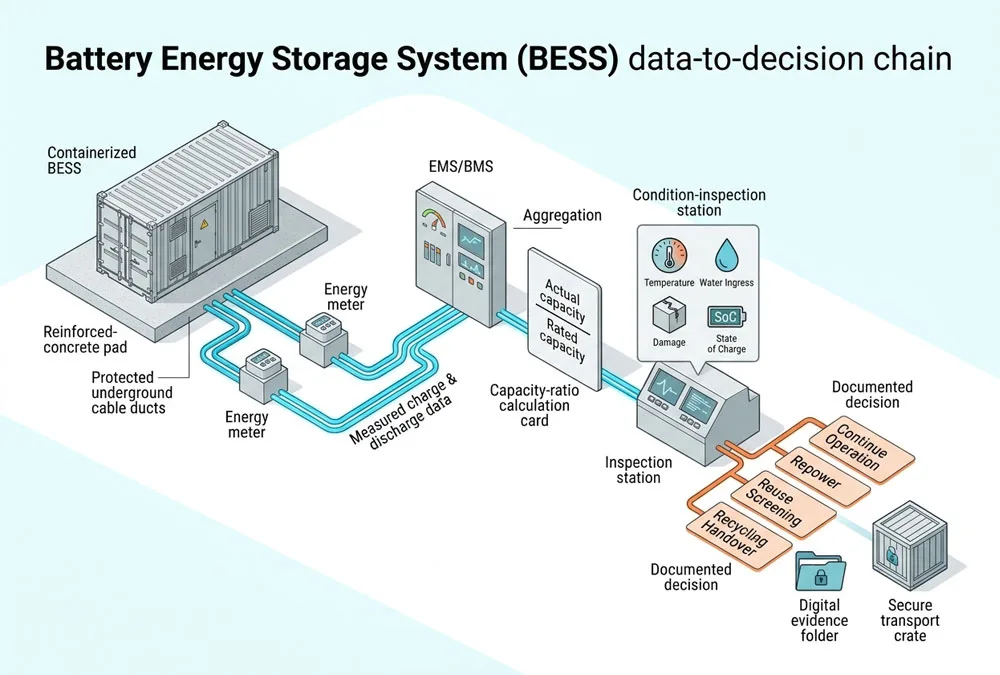
For a more disciplined trend measure, the US Department of Energy Federal Energy Management Program’s 2024 Battery Energy Storage System Evaluation Method uses metered charge and discharge data to calculate demonstrated capacity, then normalises it as a Capacity Ratio. It is a proposed performance-evaluation method, not a legal retirement rule, but it gives owners a better basis for comparing results across time than an isolated state-of-health screen.
Capacity Ratio (CR) = demonstrated capacity ÷ [rated capacity × (1 − minimum SOC)].
Example at a consistent measurement boundary: rated capacity = 2.50 MWh; controller minimum SOC = 20%; demonstrated capacity from metered data = 1.62 MWh. The accessible rated reference is 2.50 × (1 − 0.20) = 2.00 MWh. Therefore, CR = 1.62 ÷ 2.00 = 81%.
An 81% Capacity Ratio does not automatically mean “replace” or “recycle.” It means the owner has a documented result to compare with the contract duty, warranty terms, earlier tests and the revised business case. Do not compare a DC capacity ratio with an AC site-delivery requirement unless the conversion losses and electrical boundary are explicitly reconciled.
Check the data quality
The number is only as useful as the data behind it. The DOE method notes that at least one full charge-discharge cycle is needed, and a longer record may be needed where normal dispatch does not reach both ends of the operating window. It also distinguishes charge from discharge metering and cautions that meter accuracy and time resolution affect the result. In other words, a small apparent decline should not trigger a replacement decision until the measurement boundary and uncertainty are understood.
| Data point | Minimum question to ask | Bad conclusion it prevents |
|---|---|---|
| Charge and discharge record | Does the dataset include at least one complete cycle and separately record energy in and out? | Calling an incompletely observed dispatch window a capacity test. |
| SOC operating window | What minimum SOC reserve was enforced, and did it match the reference period? | Mistaking a more conservative controller reserve for battery degradation. |
| Meter and interval | What is the meter accuracy, placement and time resolution? | Treating a marginal change as real when metering or time aggregation can explain it. |
| Temperature and duty | Were temperature, charge/discharge rate and auxiliary loads comparable? | Comparing two tests that represent different operating conditions. |
Plan the Exit at Procurement
Assign the lifecycle owner
A BESS has more parties than a brochure suggests: owner, project company, EPC, equipment supplier, importer, distributor, service provider, producer-responsibility organisation, transporter and treatment facility can all be different. In Europe, the current consolidated Regulation (EU) 2023/1542 on batteries and waste batteries defines a stationary battery energy storage system as an industrial battery and establishes extended producer responsibility for the producer that first makes batteries available in a Member State. The final legal role depends on the market route and national implementation; it should be checked for the actual project, not assumed from the cell manufacturer’s location.
That legal framework does not remove the owner’s project work. Someone must still plan site isolation, remove balance-of-plant equipment, preserve asset data, manage the lease or land-restoration scope, and hand over the physical material under an agreed contract. The strongest approach is a lifecycle responsibility schedule that names each party, trigger, deliverable and exclusion from commissioning through final disposition.
Price the exit boundary
“Take-back available” is useful only when it has a boundary. Ask whether the statement includes collection, packaging, dangerous-goods transport, temporary storage, damaged or event-affected batteries, treatment, container strip-out, PCS and cable removal, foundations, land restoration and final documentation. It is entirely possible for a supplier to offer a legitimate battery take-back route while the project still carries the cost and risk of making a heavy containerised system ready for collection.
When selecting a commercial and industrial battery storage configuration, keep the information needed for its later exit in the same project file as its performance and safety requirements. A scalable container can simplify deployment, but it does not eliminate the need for an exit boundary around the batteries, PCS, cooling equipment, cables and site works.
A useful contract test: if a module is damaged during removal, can every party identify who has custody, who pays for the changed packaging/transport route, and what record proves the final outcome? If not, the exit boundary is still incomplete.
Choose the Right Exit Route
Continue, augment or repower
Keeping an installed BESS in service may be the right answer, especially if the original application has changed or the site has more flexibility than its first revenue model assumed. Augmentation adds capacity; repowering replaces or upgrades a larger part of the asset. Neither is a simple “swap and restart.” New battery modules can change voltage windows, controls, thermal behaviour, protection assumptions, fire strategy, grid-code evidence and the warranty boundary. The remaining transformer, PCS, RMU, cables and civil works must be assessed for the new configuration.
The buyer question is not “Can we add new batteries?” It is “Can the revised system meet the required duty safely, compliantly and with an accepted performance boundary?” Put that question into a documented technical review before the retirement decision. It avoids spending money on new modules only to find that an upstream component, a grid agreement or a safety layout prevents the planned upgrade.
Reuse or repurpose carefully
Second life is not a synonym for “still has some capacity.” Reuse, preparation for reuse and repurposing have different practical and legal consequences. A used battery offered for a new purpose needs a condition assessment, a defined duty, traceable identity, appropriate safety evidence and a responsible party. The UK Office for Product Safety and Standards’ study on second-life batteries in BESS reviews risks specific to second-life use and the importance of gateway testing and risk controls.
This does not mean reuse is impossible. It means an owner should reject casual assumptions such as “the old packs can go to another site.” The study’s UKESL case example used pass/fail checks for visible corrosion or damage, pressure and BMS status, followed by capacity, internal-resistance and charge/discharge-power testing. That is a useful evidence sequence for a reuse assessment, not a universal pass mark and not a rule that an operating BESS at a given SoH must be retired. A mixed-age, partially documented or event-affected set of modules may be a poor candidate for a predictable BESS duty. The evidence, new use case, transport route and new operator’s responsibilities need to be settled before it leaves the original site.
Recycle when the route is clear
Recycling is specialist material recovery after the asset has been safely removed and accepted into the appropriate route. Different chemistries, formats, contamination levels and facilities produce different processing pathways and outputs. That is why a responsible BESS battery recycling plan should not promise a single universal recovery result. Its job is to establish the receiving route, the safety controls, the documentation and the final evidence for the actual equipment.
Under the current consolidated Regulation (EU) 2023/1542, collected waste batteries must not be disposed of or subjected to energy recovery, and permitted facilities must treat them under the Regulation’s minimum requirements and applicable best available techniques. The same Regulation sets a framework for recycling efficiency and material recovery. For project teams, the immediate action is not to calculate a theoretical recycling percentage. It is to verify that the proposed route, parties and records are appropriate for the installed battery and country.
A BESS Leaves in Several Streams
A battery container is not one homogeneous object that can be handed to a general scrap contractor. It contains batteries, electrical equipment, fluids, control electronics, cable materials and structural parts. Each may have a different removal sequence, hazard, data need and downstream route. Treating the entire site as “battery recycling” makes the plan look simple but leaves the hard work unassigned.
| Asset stream | Why it needs its own plan | Evidence before release | Typical owner decision |
|---|---|---|---|
| Modules, racks and packs | Residual charge, chemistry, damage and incident history affect handling and acceptance. | Configuration, SoC/condition record, removal plan, receiving route and custody record. | Reuse/repurpose assessment or specialist recycling route. |
| Cooling and auxiliary fluids | Fluids and containment can require separate controlled handling. | Fluid inventory, drain/containment scope and receiving route. | Assign removal and treatment in the decommissioning work pack. |
| PCS, controls and cables | Power electronics, data-bearing devices and copper require different treatment and data controls. | Asset list, data-retention/wipe decision and equipment-specific route. | Refurbish, reuse, electronics route or material recovery. |
| Transformer and MV equipment | Grid disconnection, isolation and equipment-specific condition must be handled safely. | Authorised isolation, DSO interface and equipment record. | Keep, reuse, refurbish or remove under an approved scope. |
| Enclosure and site works | Steel, aluminium, insulation, foundations and land restoration are not battery-material decisions. | Strip-out sequence, materials schedule, civil close-out and lease requirements. | Recycle, retain, refurbish or restore the site. |
The UK Environment Agency’s waste-battery treatment guidance gives a useful illustration of this complexity: large lithium-ion packs, including BESS packs, can include cooling liquids and electronic components, while discharge and treatment processes need controls for electrical, gas, leakage and temperature hazards. This is UK guidance for permitted facilities; it explains why an EPC should plan the material inventory rather than issue a generic scrap-removal instruction.
Keep the Records That Matter
Build an asset identity pack
The industry detail that changes an end-of-life outcome is often not chemistry alone. It is whether the owner can produce a coherent identity and condition pack for the equipment that is actually installed—not the equipment that appeared in the original bid. Over a BESS life, warranty replacements, augmentation, BMS changes and site modifications can make an old data sheet incomplete.
Maintain these records as living project documents:
- Battery chemistry, model, rack/container hierarchy and final serial-number mapping.
- Configuration-controlled bill of materials, augmentation and replacement history.
- Usable energy, operating limits, state-of-health trend and approved duty changes.
- Known physical damage, water, smoke, abnormal heating and warranty-event history.
- Cooling-fluid inventory, BMS/firmware state, emergency documentation and safety records.
- Current asset owner, authorised isolation responsibility and emergency contact chain.
This is not paperwork for its own sake. A recycler, transporter, insurer, lender or purchaser may need to know exactly what is being accepted and under which condition. A site can have a nominal “LFP BESS” description but still face delay if it cannot show which modules were replaced, whether an event occurred, what residual charge is expected and who can legally authorise removal.
Keep final disposition proof
Define the end record before project delivery: custody handover, receiving confirmation, weights or inventory reconciliation where applicable, treatment/disposition evidence and the named party that stores the file. The exact documents vary by country and contract. What should not vary is the question an owner can answer later: what left the site, where did it go, who accepted it and what evidence supports that answer?
Europe and US Rules Differ
EU Rules and Targets
For Europe, start with the battery category and market role. The current consolidated Regulation (EU) 2023/1542 on batteries and waste batteries covers batteries and waste batteries across their lifecycle. Its waste-battery provisions address producer responsibility, separate collection, treatment and recycling; Annex XII includes requirements around safe handling and storage of waste lithium-based batteries. The Regulation gives the EU framework, while Member State arrangements, permitting, transport rules and contracts determine the route your project must follow.
It also provides concrete recycling and material-recovery benchmarks. These are EU requirements for recycling activity, not a promise that one retired BESS project will achieve those percentages, and not a formula for estimating an owner’s recycling credit or cost.
| EU Annex XII benchmark | Deadline | Minimum target | How to use it in procurement |
|---|---|---|---|
| Lithium-based battery recycling efficiency | 31 Dec 2025 | 65% by average weight | Ask the proposed route how its compliance and documentation apply to the relevant battery stream. |
| Lithium-based battery recycling efficiency | 31 Dec 2030 | 70% by average weight | Do not turn this facility-level target into a guaranteed value for an individual container. |
| Material recovery | 31 Dec 2027 | Co, Cu, Pb, Ni: 90%; Li: 50% | Confirm the downstream facility and the evidence it can issue for the actual material route. |
| Material recovery | 31 Dec 2031 | Co, Cu, Pb, Ni: 95%; Li: 80% | Use as a regulatory context check, alongside country-specific and contract requirements. |
There is an important limit to what these percentages mean. The European Commission Joint Research Centre’s 2026 technical assessment of battery recycling targets found no immediate reason to amend the existing targets, while also noting that recovery of some fractions, including lithium, is not yet fully implemented at industrial scale. That is why a project should ask a receiving route for its actual acceptance basis and final evidence instead of turning a regulatory percentage into a guaranteed project outcome.
The practical implication is simple: “EU compliant recycling” is not enough language for an EPC contract. State the country, who first places the battery on that market, the anticipated EPR/take-back route, the planned operator category, the information owner and the evidence expected at project exit. Obtain current legal advice where those roles or routes are uncertain.
US Rules Are Different
A US project should not import EU classifications or responsibilities. The US Environmental Protection Agency’s Lithium-Ion Battery Recycling FAQ explains that most discarded lithium batteries are likely to be hazardous waste because of ignitability/reactivity, that battery condition and chemistry matter, and that state requirements can be more stringent. EPA also notes that batteries may retain hazardous characteristics even after discharge. That is a US federal perspective; the transferable engineering lesson is to classify the actual material and transport route before removal, rather than assume every retired battery can travel the same way.
Vet Recycling Services Properly
Searching for energy storage battery recycling services is a sensible start, but a capability page is not an acceptance agreement. The service provider must be able to accept your chemistry, physical format, condition, location and schedule. That is especially important for batteries affected by damage, recall, water, smoke or abnormal thermal behaviour.
- Which chemistries, module/rack formats and condition categories can the receiving route accept?
- What changes if equipment is damaged, defective, recalled or incident-affected?
- Who owns packaging, lifting, temporary storage, transport and custody at each handover?
- Which permits, destination facilities and downstream treatment routes are appropriate to the country and material?
- What safety plan, escalation process and insurance boundary apply during removal?
- What chain-of-custody and final-disposition evidence will the owner receive?
- Are PCS, control hardware, transformers, cables, fluids and container materials included or excluded?
- Which pricing triggers, assumptions and change-control items apply?
The red flag is not necessarily an exclusion. Exclusions are normal in a complex project. The red flag is an exclusion with no named next owner. Ask for a written acceptance basis, defined material boundary and documented handover path before treating a recycling offer as part of your BESS lifecycle solution.
Lifecycle Questions for Your RFQ
These questions turn a future-facing promise into a project input:
- Which party owns the asset records and keeps them updated after commissioning?
- What event, performance threshold or commercial decision triggers the exit review?
- What data is required before an augmentation, repowering or reuse decision?
- How will removed modules be identified, assessed and routed if they are replaced during warranty?
- Who is responsible for site isolation, MV disconnection, lifting and removal?
- Which items are batteries, which are balance-of-plant, and what is the planned route for each?
- What happens if a battery is damaged or incident-affected when removal starts?
- What take-back, EPR or treatment route is expected in the project country?
- What final evidence must be issued, and who retains it?
- Which assumptions must be rechecked at contract award, repowering and decommissioning?
The relationship can be stated plainly: owner and site → authorised decommissioning scope → approved logistics/treatment route → retained final evidence. Every handover needs a party, a condition record and a document. That is what makes the lifecycle plan useful when the project is no longer new.
Plan the Exit Before the Project Is Fixed
Share your project country, application, system configuration, expected operating duty and current documentation status. AnengJi can help identify the BESS configuration and lifecycle documentation questions that should be resolved during project planning. Regulated transport, waste treatment, recycling acceptance and legal advice remain subject to the relevant qualified parties and local rules.
BESS End-of-Life FAQs
What happens when a BESS reaches end of life?
The owner assesses whether the system can continue operating, be augmented or repowered, be prepared for reuse/repurposing, or be routed to recycling. A capacity threshold alone does not decide the route.
Are BESS batteries recyclable?
Yes, specialist routes can process BESS batteries. The correct route depends on chemistry, format, condition, safety history, transport requirements, the receiving facility and the applicable jurisdiction.
Is repowering the same as recycling?
No. Repowering upgrades or replaces some or all of an operating asset. Every removed battery, electronic component and balance-of-plant item still needs its own documented reuse, recycling or disposal route.
Who pays for BESS battery recycling?
The answer depends on jurisdiction, producer-responsibility role, condition, logistics and the supply contract. Do not infer it from a generic take-back statement; assign the cost and scope in writing.
What records does a recycler need?
Expect the receiving route to ask about battery chemistry/configuration, condition, residual charge, damage history, safe removal and transport information. The exact acceptance record is project- and jurisdiction-specific.
Can used BESS batteries have a second life?
Possibly, but only when a documented assessment establishes that the battery, its new duty and the responsible operator meet the relevant safety, technical, legal and commercial conditions.

 https://anengjipower.com/wp-content/uploads/2026/06/epc-vs-turnkey-solar-project-bess.webp
675
1000
Charging Station Engineer
https://anengjipower.com/wp-content/uploads/2025/09/anengji-dc-fast-charging-station-manufacturer-and-supplier-logo-white-1.png
Charging Station Engineer2026-06-22 07:16:042026-06-24 07:13:17What Is the Difference Between EPC and Turnkey Contract Models in Energy Projects?
 https://anengjipower.com/wp-content/uploads/2026/06/anengji-commercial-solar-plus-storage-benefits-site.webp
675
1000
Charging Station Engineer
https://anengjipower.com/wp-content/uploads/2025/09/anengji-dc-fast-charging-station-manufacturer-and-supplier-logo-white-1.png
Charging Station Engineer2026-06-20 14:34:102026-06-20 14:37:43What Are the Top Benefits of Solar Battery Storage in Factories?
 https://anengjipower.com/wp-content/uploads/2026/06/modular-commercial-solar-battery-storage-cabinet.webp
675
1000
Charging Station Engineer
https://anengjipower.com/wp-content/uploads/2025/09/anengji-dc-fast-charging-station-manufacturer-and-supplier-logo-white-1.png
Charging Station Engineer2026-06-18 09:16:522026-07-03 03:05:13What Is Solar Battery Storage? Complete C&I Engineering Guide


Leave a Reply
Want to join the discussion?Feel free to contribute!