
How to Design Battery Energy Storage for an Industrial Park
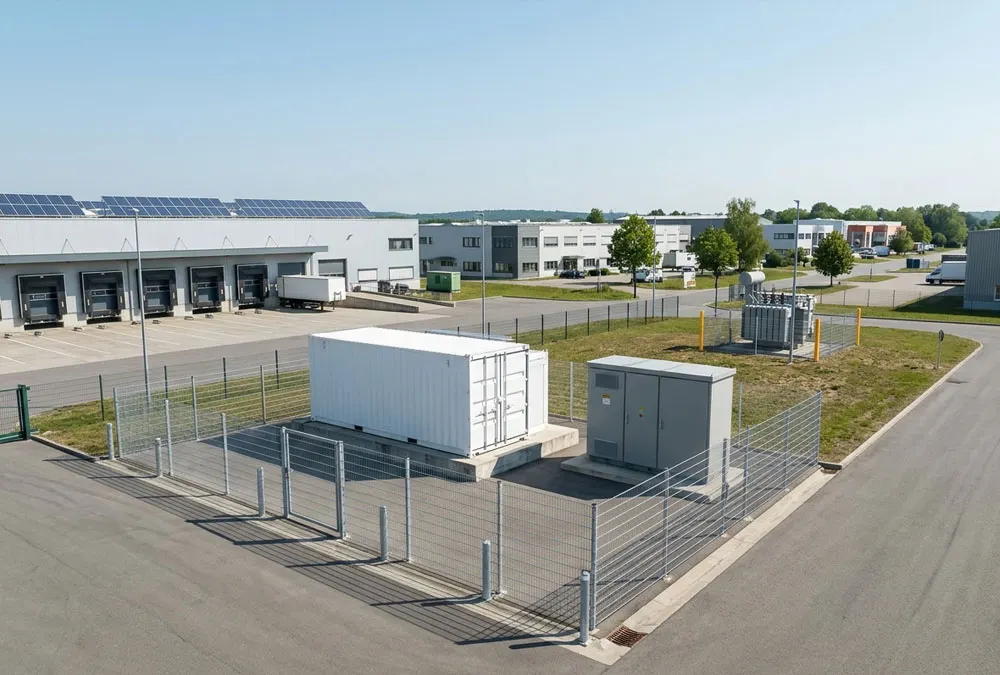
An industrial park can have a full transformer, an expensive peak on the utility bill, unused rooftop-PV output and a new tenant asking for more capacity—all at the same time. It is tempting to treat battery energy storage for industrial park applications as a simple equipment purchase: collect the combined load, select an MWh figure and ask for quotations. That is how a technically sound battery can still miss the commercial problem. The battery may sit behind one meter while the costly peak is billed at another, protect a feeder that is not actually constrained, or reserve energy for backup without an electrical path that can keep critical production loads running.
Europe’s connection and tariff environment makes that distinction more important, not less. The European Commission notes that networks face growing connection requests and capacity constraints on both the demand and supply sides. Meanwhile, ACER’s 2025 report on electricity network tariff practices finds that about two-thirds of EU countries have recently made, or plan to make, major methodology changes. A battery case therefore needs to start with the actual park boundary, current tariff and local connection terms—not a generic European savings claim.
What this guide helps you decide: where a shared BESS should connect, which meter and load interval it must control, how kW and kWh should be specified at the point of common coupling (PCC), what safety and site evidence to collect, and how to turn the results into comparable EPC quotations.
Industrial Park BESS Design
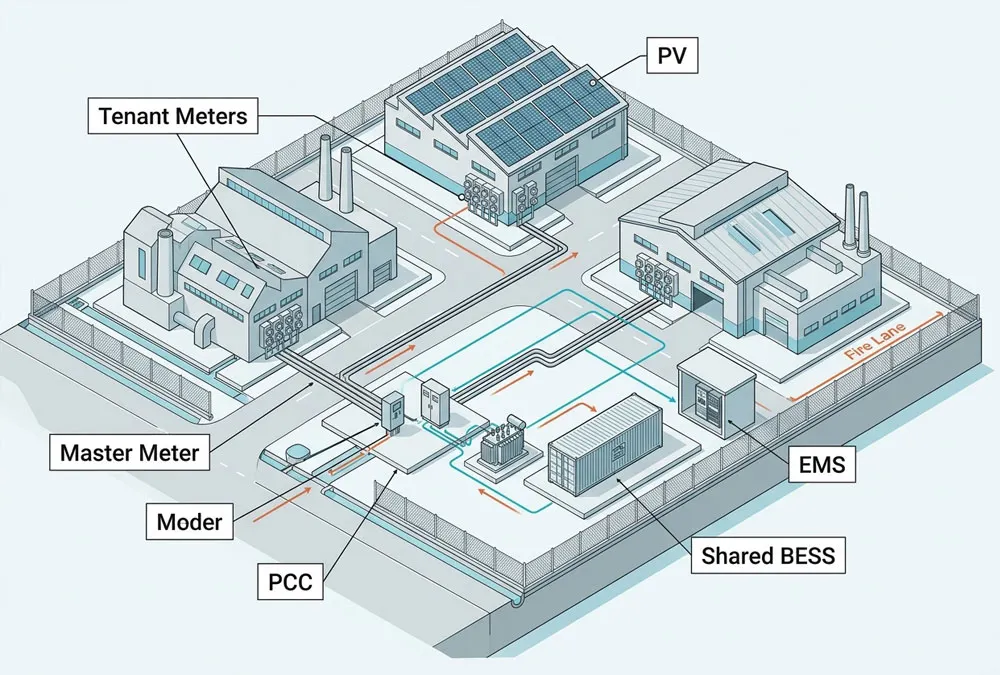
A single factory normally has one dominant revenue meter, one load owner and one operating team. An industrial park may have a master import meter, tenant meters, separate feeders, a shared medium-voltage ring and lease agreements that decide who benefits from lower demand. That changes the core question from “what battery should we buy?” to “what electrical and commercial boundary are we trying to control?”
This matters in a very practical way. Assume Factory A creates the highest 15-minute demand interval, while the proposed BESS is electrically behind Factory B’s feeder. Unless the topology, metering and local rules permit the battery to reduce the billing point that records Factory A’s peak, the expected saving may never appear. The equipment can be working perfectly while the business case fails. Before a supplier prices hardware, the owner should establish four boundaries.
- Commercial boundary: decide who owns the asset, receives the bill saving and carries the cost of keeping energy in reserve. Without this, a successful dispatch can still create a tenant dispute.
- Electrical boundary: name the PCC, transformer or feeder where the BESS must deliver AC power. A nameplate kW figure is not useful if it cannot reduce the binding grid limit.
- Operating boundary: set the order between peak control, PV capture and backup. Otherwise, the EMS may use the energy reserved for the wrong purpose.
- Physical boundary: confirm safe access, cable routes, drainage, emergency response and expansion space before selecting the enclosure.
Decide Who Receives the Value
This is the question that turns a technically attractive shared BESS into a workable park project. If the asset is paid for by the park owner but it reduces a tenant’s meter charge, the allocation method must be agreed before operation. If the battery protects a common transformer against a capacity breach, the value may be avoided reinforcement or protected tenant growth rather than a line item on a single electricity invoice. Neither result should be left to an EMS algorithm to settle after commissioning.
- Park-owned shared asset: sensible when the park bears a common capacity constraint or has one master meter. The owner needs the master-meter data, connection limit and a written tenant dispatch policy.
- Tenant-dedicated asset: often clearer when a tenant has its own meter, operating duty and investment case. Savings, backup reserve and dispatch rights remain transparent, but shared-load diversity may be lost.
- Shared service-fee model: possible when several users accept a measured common constraint and a common operating rule. It needs metering architecture, contribution logic, curtailment priority and auditable data from day one.
Industrial Park BESS Inputs
The first deliverable is not a battery size. It is a design-data pack. For an industrial park, collecting only annual kWh and the largest monthly demand is rarely enough. Annual energy cannot reveal whether three factories peak together, whether the master meter sees the same event as a tenant meter, or whether the proposed battery can recharge before the next production shift.
Collect these inputs before asking for a capacity recommendation:
- Twelve months of native-interval data for every relevant revenue or tenant meter. It reveals coincidence, ramp rates and realistic charge windows.
- The single-line diagram, transformer rating and feeder limits. These show where power can flow and where the delivered-power guarantee should be measured.
- Invoices, tariff schedule and connection agreement. These identify the energy, power, reactive-power and timing signals the project can actually monetise.
- PV generation, export and curtailment intervals. These test whether solar surplus is available when the BESS can accept it.
- Tenant growth and critical-load schedule. These keep connection headroom, peak control and resilience from being mixed into one unsupported promise.
This is consistent with the method—not the geography—of the National Laboratory of the Rockies’ 2023 industrial-park PV+BESS case study, which used techno-economic optimisation to test BESS together with onsite solar and resilience objectives. Its case is in Vietnam, so it is not evidence of European returns. It is useful evidence that industrial-park decisions require the interaction of load, tariff, PV and operating objective—not a capacity estimate from one input.
Find the Meter That Binds
Here is a detail that often appears only when commissioning is close: the peak that matters commercially is the one measured at the billing or connection boundary. A controller may see a machine-load peak and command discharge, but if BESS charging was scheduled during another busy interval, PCS and transformer losses and auxiliary consumption can lift import at the PCC. The result can be a new billed peak created by the project intended to remove one.
The fix is not a bigger battery by default. Model, meter and test the same electrical point and the same time interval used by the applicable tariff or connection condition. Put the PCC meter identifier, interval length, import cap and control deadband in the functional design specification. For a primer on the basic method, see the site’s guide to controlling C&I peak demand; an industrial park must add tenant and feeder topology to that base logic.
Industrial Park BESS Dispatch
A shared BESS can support peak control, PV self-consumption, time-based energy shifting, connection headroom and selected critical loads. It cannot promise all of them from the same kilowatt-hour at the same instant. The owner needs an explicit priority order before the EMS is configured.
A workable hierarchy might be:
- safety and protection constraints;
- contractual critical-load reserve, if the architecture truly supports backup;
- PCC import limit or transformer protection;
- approved tariff or PV-capture optimisation; and
- other optional market services only where permitted and separately validated.
Operations teams often raise a fair objection: “Will cost optimisation consume the energy we need when the grid fails?” It can, if the reserve is only a spreadsheet assumption. A state-of-charge floor is necessary but not sufficient. Backup also needs an appropriate PCS mode, an islanding/transfer arrangement, protection coordination and loads that can tolerate the real transfer sequence. Treat a backup claim as an electrical-system requirement to be proven in site tests—not as a percentage of battery capacity.
Industrial Park BESS Sizing
Power and energy answer different questions. Required BESS kW is the instantaneous AC contribution needed to hold the chosen PCC import limit. Required kWh is how long that contribution must last. Both should be defined at a stated AC boundary and operating condition.
| Illustrative duty | First-order AC energy | What still has to be verified | Buyer consequence |
|---|---|---|---|
| 600 kW for 15 minutes | 150 kWh 600 × 0.25 h | PCS overload curve, PCC losses, reserve and event frequency. | A high-power, short-duration duty can be limited by PCS capability rather than battery MWh. |
| 600 kW for 45 minutes | 450 kWh 600 × 0.75 h | Usable SoC window, conversion and auxiliary losses, end-of-life retained capacity. | The nominal DC battery capacity will be higher than 450 kWh. |
| 600 kW for 2 hours | 1,200 kWh 600 × 2 h | Recharge window, daily cycling, PV availability and the competing backup reserve. | Duration and recharge feasibility may dominate the design. |
These are arithmetic illustrations, not a product recommendation. A final nominal capacity must account for the contractual usable state-of-charge window, one-way conversion efficiency at the stated duty, auxiliary consumption, temperature, degradation allowance, availability and any non-overlapping reserve. An energy reserve assigned to backup must not be deducted again if the usable-energy figure already excludes it. The requested figure should read like this: “minimum delivered AC power and usable AC energy at the PCC, under stated ambient, state-of-charge and end-of-life conditions.”
Prove the Recharge Window
The discharge calculation is only half of the design. If the 600 kW / 45-minute example delivers 450 kWh today, the EMS must restore more than 450 kWh at its upstream AC boundary once charge losses are included. It must do so within the real window of spare grid or PV headroom, without causing another PCC peak or breaking an import/export limit. When the next production peak arrives before the battery is ready, the strategy is not repeatable.
Use the site’s load-shifting sizing screen as a first-pass calculation aid, then replace every illustrative efficiency, usable-SoC and recharge-headroom assumption with evidence from the proposed system, interval data and connection agreement.
Industrial Park BESS Options
Factory size by itself is a poor sizing rule: two 1 MW factories can have completely different coincident peaks. A better first screen is the measured grid-facing gap in kW and the period it must be covered. The examples below help a buyer match a real operating duty to a practical product route. They are not quotations, performance guarantees or final configurations.
| Typical park situation | First calculation | Product route to assess | What must still be checked |
|---|---|---|---|
| Small tenant or one feeder A solar self-consumption or short peak-control duty, not whole-factory backup. | 50 kW × 1 h = 50 kWh Delivered AC energy before reserves and losses. | A 100 kWh all-in-one cabinet is a sensible product class to investigate. Its published options include 30, 40 and 50 kW rated AC outputs with 100.48 kWh nominal DC energy. | The actual usable AC energy at the agreed boundary, battery reserve, recharge window and whether the selected inverter output—not nominal kWh—covers the duty. |
| Growing production feeder One high-demand process or a tenant with staged load growth. | 250 kW × 1.5 h = 375 kWh A first energy target, not nominal battery capacity. | A 418 kWh liquid-cooled cabinet can be assessed as a modular energy block. The published product is 417.99 kWh nominal DC and is designed to work with external PCS/boost equipment. | One 418 kWh nominal block does not automatically provide 375 kWh delivered AC after reserve, conversion losses and end-of-life allowance; the PCS rating and cabinet count must be modelled together. |
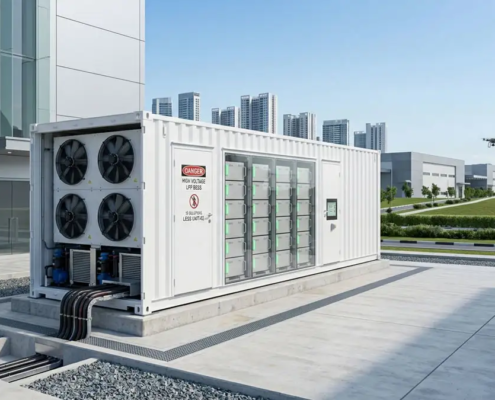
| Common transformer constraint A park-side import cap or shared capacity issue. | 500 kW × 1 h = 500 kWh The PCC duty is the starting point. | A 1 MWh integrated C&I container is a relevant comparison route: its published rating is 1,044 kWh nominal DC and 500 kW rated AC output. | A 500 kW × 2 h request equals 1,000 kWh delivered AC. That should not be accepted from a 1,044 kWh nameplate alone; ask for the guaranteed AC usable-energy calculation and the reserve policy. |
The useful pattern is simple: start with the actual kW gap and time window, then choose a cabinet or container class that can be engineered around that duty. For a phased park expansion, modular battery blocks may fit better than prematurely installing a large central container. For a hard 500 kW PCC cap, a product with a 500 kW published AC rating is relevant to the shortlist—but only if its net deliverable energy, site transformer and control logic also pass the project model.
Industrial Park BESS Architecture
Once the duty and boundary are defined, the team can choose an architecture. A central BESS near the park-side transformer may be appropriate when one master meter and one connection limit drive value. Feeder-level storage can make more sense when a specific feeder is constrained. Tenant-side systems can simplify benefit allocation but may lose load diversity and require repeated balance-of-plant work. There is no universally best topology.
| Architecture | Best fit | Main trade-off | Buyer benefit |
|---|---|---|---|
| Central park-side BESS | One master meter, common transformer or shared import cap. | Needs clear tenant allocation and coordinated protection/controls. | Can use diversified park load if the PCC is the economic boundary. |
| Feeder-level BESS | A known bottleneck or production area creates the constraint. | Less flexibility across the wider park. | Directly targets a verifiable electrical problem. |
| Tenant-side BESS | Separate meters and independent tenant investment cases. | May duplicate civil, controls and maintenance scope. | Makes bill savings and dispatch rights easier to assign. |
At this stage, a system range becomes relevant—but only as an implementation option, not as the design starting point. Buyers can review commercial and industrial storage configurations after defining the AC duty, site environment, grid interface and required operational functions. The final selection must still be confirmed against the project’s single-line diagram, studies and local compliance path.
Industrial Park BESS Site Plan
Do not place a BESS in the last unused corner of the park and solve access later. The site layout must consider concrete foundations or engineered pads, drainage, protected or underground cable routing, equipment clearances, service access, vehicle separation, security, emergency access and the local authority/insurer process. Exact distances and requirements are jurisdiction- and project-specific; copying a layout from another country is not a compliance strategy.
The UK Government’s guidance on grid-scale electrical energy storage health and safety is useful here as a risk-assessment reference: it states that location, chemistry, scale, nearby premises and environmental hazards must be assessed together. It is UK guidance, not an EU-wide installation rule. For a European park, confirm the applicable national requirements, DSO conditions, fire authority expectations and insurance requirements for the actual plot.
CIGRE’s Design Guideline for Substations Connecting Battery Energy Storage Solutions treats BESS as a lifecycle project: carry out system studies, evaluate performance at the PCC, then define installation, commissioning and asset-management responsibilities. That gives owners a useful procurement test. If a quotation only describes the container but leaves the point of connection, studies, testing and operating interfaces undefined, it is not yet a complete industrial-park solution.
Industrial Park BESS RFQ
The most expensive quotation is not always the one with the highest price. It is often the apparently low hardware quote that leaves the owner to discover transformer work, protection studies, civil scope, fire provisions, EMS integration or testing exclusions later. Build a common design basis and ask every bidder to respond to it.
Industrial-Park BESS RFQ Checklist
- Guaranteed delivered AC kW at the named PCC, including stated ambient and state-of-charge conditions.
- Usable AC kWh, duration, degradation basis, auxiliary-load treatment and availability assumptions.
- PCS, transformer, switchgear, protection, metering and communications scope.
- Civil works, foundation, cable routes, layout risk controls, fire/emergency interfaces and permitting responsibilities.
- EMS dispatch hierarchy, data ownership, manual override, alarm escalation and tenant-access permissions.
- Factory and site acceptance tests, including the PCC performance evidence required for handover.
- Warranty performance terms, exclusions, maintenance scope, spares and response process.
For projects moving from feasibility into delivery, an integrated EPC delivery discussion can help clarify which party owns design, equipment, installation, grid interface and commissioning. Those duties should still be written into the contract and validated against local approvals; an EPC label alone does not remove them.
Industrial Park BESS Readiness
Before committing to a standard MWh quotation, take the project through five gates. A “no” at any gate does not mean the park cannot use storage. It means the next spend should be on the missing survey, study or commercial rule—not on a premature equipment selection.
- Meter gate: Is there a measured, monetisable import, export or power-quality problem at a clearly named meter?
- Grid gate: Are the PCC, transformer, protection and DSO constraints evidenced—not assumed?
- Operation gate: Can the battery recharge before the next event while preserving any true critical-load reserve?
- Site gate: Is a risk-based layout feasible with access, drainage, separation, emergency planning and local review?
- Contract gate: Can every bidder price the same delivered-duty, scope and acceptance-test basis?
A well-designed battery energy storage system for an industrial park is not defined by the largest container that fits on site. It is defined by a verified park boundary, a proven operational duty and an RFQ that makes performance comparable. If you can supply interval data, a single-line diagram, tariff information, future-load plans and the intended operating priorities, the next engineering conversation can be specific and useful.
Plan the Right BESS Study
Share the park’s load intervals, meter map, grid limit and intended operating objectives. AnengJi can discuss suitable equipment and system-integration pathways; final capacity, backup capability, grid acceptance and project economics depend on the verified site data, agreed configuration and local engineering review.
FAQs
Can one battery serve several factories?
Potentially, yes—when the electrical topology lets the BESS affect the relevant common meter or feeder, and the owner has defined how dispatch rights and financial benefits are allocated. A shared BESS is not automatically useful across separately billed or electrically isolated tenant loads.
Can a BESS increase an industrial park’s grid capacity?
A BESS can reduce or reshape site import at selected times if the PCS, controls and connection terms allow it. It does not automatically change the contracted connection capacity or replace a DSO approval. Treat it as a controlled operating measure until the relevant network operator confirms otherwise.
How much storage does an industrial park need?
There is no credible universal MWh answer. Start with the required AC kW at the named PCC, the duration and frequency of the event, usable energy conditions, recharge headroom, critical-load reserve, PV profile and local tariff/connection terms. Then validate the result with interval simulation and the proposed system’s contractual performance data.
Does a BESS automatically provide backup power?
No. Stored energy alone does not prove islanding capability, transfer time, protection coordination or which loads remain energised. Specify the critical-load sequence and validate the architecture in site acceptance testing.
Related Reading
- How peak shaving changes a C&I site’s measured grid demand
- A first-pass calculator for discharge and recharge duty
- A broader Europe-focused BESS design guide
Sources
- ACER — Electricity Network Tariff Methodologies in Europe (2025, tariff-methodology context).
- European Commission — European grids (connection-capacity context).
- CIGRE — Design Guideline for Substations Connecting Battery Energy Storage Solutions (PCC, lifecycle and commissioning scope).
- GOV.UK — Health and safety in grid-scale electrical energy storage systems (risk-assessment reference; UK context).
- National Laboratory of the Rockies — Lessons Learned From Techno-Economic Analysis of Solar PV and BESS at a Vietnam Industrial Park (2023; optimisation-method reference, not European economic evidence).

 https://anengjipower.com/wp-content/uploads/2026/06/epc-vs-turnkey-solar-project-bess.webp
675
1000
Charging Station Engineer
https://anengjipower.com/wp-content/uploads/2025/09/anengji-dc-fast-charging-station-manufacturer-and-supplier-logo-white-1.png
Charging Station Engineer2026-06-22 07:16:042026-06-24 07:13:17What Is the Difference Between EPC and Turnkey Contract Models in Energy Projects?
 https://anengjipower.com/wp-content/uploads/2026/06/anengji-commercial-solar-plus-storage-benefits-site.webp
675
1000
Charging Station Engineer
https://anengjipower.com/wp-content/uploads/2025/09/anengji-dc-fast-charging-station-manufacturer-and-supplier-logo-white-1.png
Charging Station Engineer2026-06-20 14:34:102026-06-20 14:37:43What Are the Top Benefits of Solar Battery Storage in Factories?
 https://anengjipower.com/wp-content/uploads/2026/06/modular-commercial-solar-battery-storage-cabinet.webp
675
1000
Charging Station Engineer
https://anengjipower.com/wp-content/uploads/2025/09/anengji-dc-fast-charging-station-manufacturer-and-supplier-logo-white-1.png
Charging Station Engineer2026-06-18 09:16:522026-07-03 03:05:13What Is Solar Battery Storage? Complete C&I Engineering Guide


Leave a Reply
Want to join the discussion?Feel free to contribute!