
Introduction
When C&I factory owners or EPC engineers start evaluating energy storage, a common procurement trap occurs early in project planning. A plant manager sees a raw 280Ah or 314Ah LFP cell rack priced at $80/kWh, compares it to a fully integrated $180/kWh cabinet quote, and wonders why the system cost looks so high. That initial misunderstanding often leads to major technical roadblocks later on. Evaluating a Battery VS BESS purchase isn’t just about comparing hardware prices; it’s about choosing between an unmanaged chemical component and a fully commissioned grid asset.
A raw DC battery array simply holds charge. In contrast, a modern Battery VS BESS deployment brings together liquid thermal control, bi-directional power conversion, 3-tier BMS protection, and dynamic EMS dispatch software. Trying to run a manufacturing plant or solar farm on bare DC cells without an integrated system architecture usually leads to grid tie delays, unexpected site engineering expenses, and elevated thermal risks.
Battery VS BESS: Understanding the Basic Definitions and System Structure
Evaluating energy storage options requires looking closely at system design. You need to understand the structural layers that separate raw electrochemical cells from an operational, grid-interactive energy asset.
What Is a Battery in Energy Storage Applications?
In electrical engineering, a battery is purely the chemical storage medium. It moves lithium ions between cathode and anode during charge and discharge cycles, producing raw direct current (DC) power.
Understanding Modern Battery Chemistries in Industrial Use:
- Lithium Iron Phosphate (LiFePO4 / LFP): The industry standard for C&I and utility projects. LFP features a stable olivine crystal structure that resists thermal breakdown up to 500°C. Modern 314Ah prismatic LFP cells offer 6,000 to 8,000 cycles at 80% Depth of Discharge (DoD) without using volatile cobalt or nickel.
- Nickel Manganese Cobalt (NMC): Offers higher energy density in small footprints, but carries a lower thermal runaway threshold (~210°C). It requires active fire barriers and continuous cell monitoring in indoor environments.
- Lead-Acid / VRLA: Low upfront hardware cost, but hampered by poor round-trip efficiency (<75%), severe discharge depth limits (<50%), and short cycle life (<1,200 cycles).
- Flow Batteries (Vanadium Redox): Separates power (kW) from energy capacity (kWh) using liquid electrolyte tanks. Ideal for long-duration storage (>8 hours), but limited by a large physical footprint and ongoing pump maintenance.
Engineering Takeaway: A raw battery pack cannot convert DC to AC power, manage three-phase voltage imbalances, or respond to facility peak load shifts on its own.
What Is a Battery Energy Storage System (BESS)?
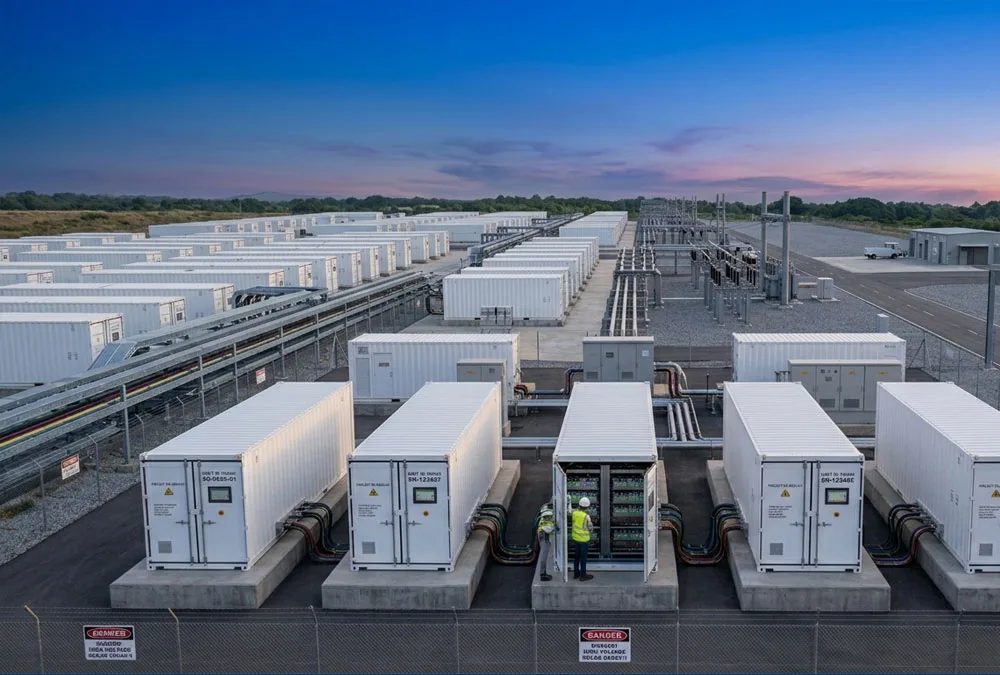
A Battery Energy Storage System (BESS) is a complete, self-contained power management solution. According to BloombergNEF’s 2026 market analysis, global stationary storage installations reached 158 GW / 459 GWh, driven by rapid demand for integrated, factory-certified BESS units.
The 6 Critical Sub-Systems Inside a Modern BESS:
- High-Voltage DC Rack Architecture: Prismatic LFP cells grouped into modules and racks, wired in series to create 700V DC to 1500V DC high-efficiency strings.
- 3-Tier Battery Management System (BMS): Monitors cell voltages, module temperatures, state of charge (SOC), and state of health (SOH) across every string, executing active cell balancing in real time.
- Power Conversion System (PCS): Bi-directional four-quadrant inverters that handle DC/AC power conversion, reactive power support (VAR), and grid-forming voltage reference during grid outages.
- Energy Management System (EMS): The control center running local optimization logic for peak shaving, TOU arbitrage, and solar self-consumption, or taking Modbus/TCP inputs from factory SCADA.
- Closed-Loop Thermal Management: Liquid cooling plates circulating glycol across battery cells, keeping temperature variations within ≤2°C across all modules.
- Multi-Layer Safety Systems: Gas sensors (CO/H2), deflagration venting panels, aerosol fire suppression, and automated DC isolation contactors built to NFPA 855 standards.
Buyer’s Reality Check: “Can we source battery racks and inverters separately to lower upfront CAPEX?”
Sourcing unintegrated components often creates major site liabilities. When an unintegrated inverter fails to communicate with a third-party BMS during a peak discharge event, the resulting over-current trip can cause uncoordinated contactor dropouts. This leads to unexpected downtime penalties and component damage. Factory-integrated BESS enclosures arrive with pre-tested Modbus communication, unified warranties, and system-level UL 9540 compliance ready for inspection.
Battery VS BESS: Key Technical Differences Before Selecting a Solution
Comparing unmanaged DC storage racks to a fully integrated AC-coupled BESS shows clear differences in how both options operate on site:
| Engineering Parameter | Standalone Battery Module | Fully Integrated BESS Enclosure | Direct Operational Benefit for Buyers |
|---|---|---|---|
| Power Conditioning & Control | None (Unregulated DC Output) | Built-in Bi-Directional PCS | Eliminates custom engineering fees and delivers clean AC grid power. |
| System Control Logic | None (Requires External PLC) | Embedded EMS Algorithms | Automates peak shaving and demand charge management without manual input. |
| Thermal Management | Passive Air Vents / Fan Cooling | Closed-Loop Active Liquid Cooling | Extends cell service life by keeping thermal delta below 2°C across modules. |
| Safety & Compliance Listing | Component Level (UL 1973 Cell/Rack) | Full System (UL 9540, UL 9540A, NFPA 855) | Passes local fire inspections smoothly and simplifies site insurance approvals. |
Capacity and System Scaling Differences
Unmanaged battery arrays work reliably in small DC setups under 20 kWh, like telecom backup racks or off-grid solar systems.
However, as project capacity grows into 100 kWh to 5+ MWh commercial scales, unmanaged batteries face severe operational limits. Parallel multi-rack DC strings develop cell imbalances, cumulative impedance variances, and thermal hot spots during rapid power cycles. A containerized BESS overcomes these challenges by using string-level BMS isolation, structured liquid cooling channels, and busbar systems engineered for heavy fault currents.
Project Application Decision Guide: Should You Choose a Battery or a BESS?
Choosing between a standalone battery array and an integrated BESS comes down to your project’s AC/DC architecture, control requirements, and grid connection rules.
Choose Standalone Batteries ONLY If Your Project Matches These Criteria:
- Small-Scale DC Architectures: Telecom base stations, remote monitoring gear, or marine equipment requiring direct 48V DC power.
- Existing Hybrid System Retrofits: Small residential or commercial sites that already have a functioning hybrid inverter with open BMS protocols.
- Low-Power Backup Needs: Facilities requiring simple emergency standby power without dynamic peak shaving or automated tariff optimization.
Choose a Fully Integrated BESS If Your Project Involves Any of the Following:
- Commercial & Industrial Peak Shaving: Manufacturing plants, plastics processors, or cold storage facilities facing heavy utility demand charges.
- Rooftop Solar Integration: Facilities needing to store excess midday solar generation and discharge it during high-cost peak rate hours.
- DC Fast Charging Infrastructure: EV charging hubs needing a battery buffer to handle high power demands without exceeding utility transformer limits.
- Microgrids & Critical Power Continuity: Remote industrial operations, island power grids, or hospitals needing seamless islanding and black-start capabilities.
Industrial-Grade BESS Solutions for Commercial Facilities
Matching BESS capacity to your facility’s electrical load profile is essential for maximizing project ROI:
- 100kWh All-In-One Outdoor Cabinet: Integrated with a 50kW PCS, liquid cooling loop, and aerosol fire suppression. Ideal for auto dealerships, light manufacturing, and localized EV charging stations.
- 261kWh Industrial Storage Cabinet: Equipped with high-density 314Ah LFP cell racks and an integrated 100kW PCS. Purpose-built for medium industrial facilities targeting automated peak shaving.
- 418kWh container: Designed for energy-intensive industrial plants, chemical processing facilities, and large solar integration projects.
- 1MWh – 5MWh Containerized Systems: Standard 20ft and 40ft ISO container configurations engineered for utility solar shifting, IPP assets, and large microgrids.
Procurement Risk Mitigation: How to Avoid Technical and Supplier Pitfalls
Procuring a commercial BESS involves evaluating multi-year operational reliability, supplier viability, and safety compliance. Below are the top technical risks buyers encounter and how to mitigate them:
1. Cell Quality & Sourcing Transparency
The Risk: Low-cost suppliers may use B-grade cells or mixed-lot batches with inconsistent internal resistance. Over 1,000 charge cycles, these cell variations cause string imbalances, reduced usable capacity, and premature module failure.
Procurement Checklist: Always require Tier-1 cell origin documentation (CATL, EVE, Hithium) with matching batch test certificates. Verify that the supplier provides active cell balancing at the BMS level, not just passive balancing, to maintain long-term string harmony.
2. Fire Safety & Local Code Compliance
The Risk: Purchasing hardware that lacks full UL 9540 system listings or UL 9540A thermal runaway fire test reports can stall your project during local fire marshal inspections, delaying utility interconnection.
Procurement Checklist: Confirm that UL 9540 listing applies to the entire integrated enclosure, not just individual components like the inverter or cells. Request the supplier’s full UL 9540A test report to review deflagration gas venting performance and required setback distances.
3. Long-Term After-Sales Support & Warranties
The Risk: Energy storage warranties often include strict operational limits on operating temperature, C-rate limits, and daily throughput. Working with suppliers that lack local service infrastructure can result in lengthy downtime if a PCS module or BMS board fails.
Procurement Checklist: Verify whether the supplier offers guaranteed field response times, local spare parts stock, and remote EMS telemetry diagnostics. Make sure the warranty explicitly covers a clear performance guarantee (such as 70% capacity retention after 10 years or 6,000 cycles).
Battery VS BESS Financial Comparison: Total Cost of Ownership (TCO)
Focusing strictly on initial hardware purchase prices can result in unexpected field integration expenses later. Below is a full breakdown comparing unintegrated cell arrays with factory-integrated BESS enclosures:
| Cost Component | Unintegrated Battery Stack | Turnkey Factory-Integrated BESS | Direct Economic Advantage for Buyers |
|---|---|---|---|
| Initial CAPEX Outlay | Lower initial hardware cost | Higher packaged initial investment | BESS bundles inverters, thermal controls, and safety systems into a single purchase order. |
| Site Installation & Civil Works | High (Custom Field Integration) | Low (Pre-Wired Factory Cabinet) | Cuts field electrical assembly time and contractor labor costs by 50% to 65%. |
| Automated Value Generation | Passive (Requires External Controls) | Active (Automated Peak Shaving) | Smart EMS dispatch optimizes peak shaving savings to shorten payback periods to 3-5 years. |
Battery VS BESS Lifespan: System Control and Longevity
Battery degradation is governed by key operational stress factors: C-rates, Depth of Discharge (DoD), and average cell operating temperature.
Unmanaged batteries running without active thermal controls face rapid capacity loss in hot industrial environments. Operating LFP cells above 35°C accelerates Solid Electrolyte Interphase (SEI) layer growth on the cell anodes, reducing total system capacity by up to 5% annually.
A high-performance liquid-cooled BESS protects cells from temperature extremes. Liquid cooling plates hold cell temperature variances within a tight 22°C ± 2°C window. Combined with active BMS balancing, a liquid-cooled LFP BESS achieves 6,000+ full cycles while retaining 80% capacity, delivering 12 to 15 years of reliable service in heavy industrial applications.
Frequently Asked Questions About Battery VS BESS
Is BESS just a larger battery rack?
No. A battery rack simply stores direct current energy. A BESS is a complete energy management system that combines battery modules with power conversion inverters, BMS protection, liquid cooling, aerosol fire suppression, and EMS control software.
Can a standalone battery work without a BESS architecture in commercial buildings?
No. Commercial facilities operate on three-phase AC power networks. Unmanaged batteries produce raw DC power and lack the inverter hardware, grid synchronization, or safety systems required to power facility loads directly.
Why are liquid-cooled BESS units replacing air-cooled systems in C&I projects?
Liquid cooling provides far higher thermal transfer efficiency than air cooling. It maintains uniform temperatures across dense cell arrays, uses less auxiliary HVAC power, and extends battery cycle life by eliminating thermal hot spots.
Conclusion: Strategic Energy Storage Selection
Navigating a Battery VS BESS selection requires matching system capabilities to your project’s long-term operational and financial goals. While standalone battery modules suit small, low-voltage DC applications, commercial and industrial facilities need a fully integrated BESS. A turnkey BESS delivers factory-tested safety, streamlined utility interconnection, and automated energy management that turns raw energy storage into a long-term profitable asset.
Optimize Your Project’s Energy Storage Strategy
Speak with our application engineering team to analyze your load profile, calculate peak shaving savings, and receive a customized turnkey BESS proposal.
 https://anengjipower.com/wp-content/uploads/2026/06/epc-vs-turnkey-solar-project-bess.webp
675
1000
Charging Station Engineer
https://anengjipower.com/wp-content/uploads/2025/09/anengji-dc-fast-charging-station-manufacturer-and-supplier-logo-white-1.png
Charging Station Engineer2026-06-22 07:16:042026-06-24 07:13:17What Is the Difference Between EPC and Turnkey Contract Models in Energy Projects?
https://anengjipower.com/wp-content/uploads/2026/06/epc-vs-turnkey-solar-project-bess.webp
675
1000
Charging Station Engineer
https://anengjipower.com/wp-content/uploads/2025/09/anengji-dc-fast-charging-station-manufacturer-and-supplier-logo-white-1.png
Charging Station Engineer2026-06-22 07:16:042026-06-24 07:13:17What Is the Difference Between EPC and Turnkey Contract Models in Energy Projects? https://anengjipower.com/wp-content/uploads/2026/06/anengji-commercial-solar-plus-storage-benefits-site.webp
675
1000
Charging Station Engineer
https://anengjipower.com/wp-content/uploads/2025/09/anengji-dc-fast-charging-station-manufacturer-and-supplier-logo-white-1.png
Charging Station Engineer2026-06-20 14:34:102026-06-20 14:37:43What Are the Top Benefits of Solar Battery Storage in Factories?
https://anengjipower.com/wp-content/uploads/2026/06/anengji-commercial-solar-plus-storage-benefits-site.webp
675
1000
Charging Station Engineer
https://anengjipower.com/wp-content/uploads/2025/09/anengji-dc-fast-charging-station-manufacturer-and-supplier-logo-white-1.png
Charging Station Engineer2026-06-20 14:34:102026-06-20 14:37:43What Are the Top Benefits of Solar Battery Storage in Factories? https://anengjipower.com/wp-content/uploads/2026/06/modular-commercial-solar-battery-storage-cabinet.webp
675
1000
Charging Station Engineer
https://anengjipower.com/wp-content/uploads/2025/09/anengji-dc-fast-charging-station-manufacturer-and-supplier-logo-white-1.png
Charging Station Engineer2026-06-18 09:16:522026-07-03 03:05:13What Is Solar Battery Storage? Complete C&I Engineering Guide
https://anengjipower.com/wp-content/uploads/2026/06/modular-commercial-solar-battery-storage-cabinet.webp
675
1000
Charging Station Engineer
https://anengjipower.com/wp-content/uploads/2025/09/anengji-dc-fast-charging-station-manufacturer-and-supplier-logo-white-1.png
Charging Station Engineer2026-06-18 09:16:522026-07-03 03:05:13What Is Solar Battery Storage? Complete C&I Engineering Guide


Leave a Reply
Want to join the discussion?Feel free to contribute!