
Introduction
The global energy transition in 2026 has reached a critical inflection point where the stability of the power grid is no longer solely the responsibility of centralized utilities. As electrification accelerates, particularly within the industrial and transport sectors, the debate surrounding behind the meter vs front of the meter energy storage has moved from the boardroom of power companies to the desks of facility managers and EV infrastructure developers. Understanding the nuances of where a battery sits—physically and electrically—relative to the utility meter is the difference between a project that merely provides backup power and one that generates a double-digit Return on Investment (ROI). By strategically deploying behind the meter vs front of the meter energy storage solutions, businesses can navigate the complexities of rising demand charges and grid volatility while securing long-term energy independence.
Behind the Meter vs Front of the Meter Energy Storage: Core Definitions
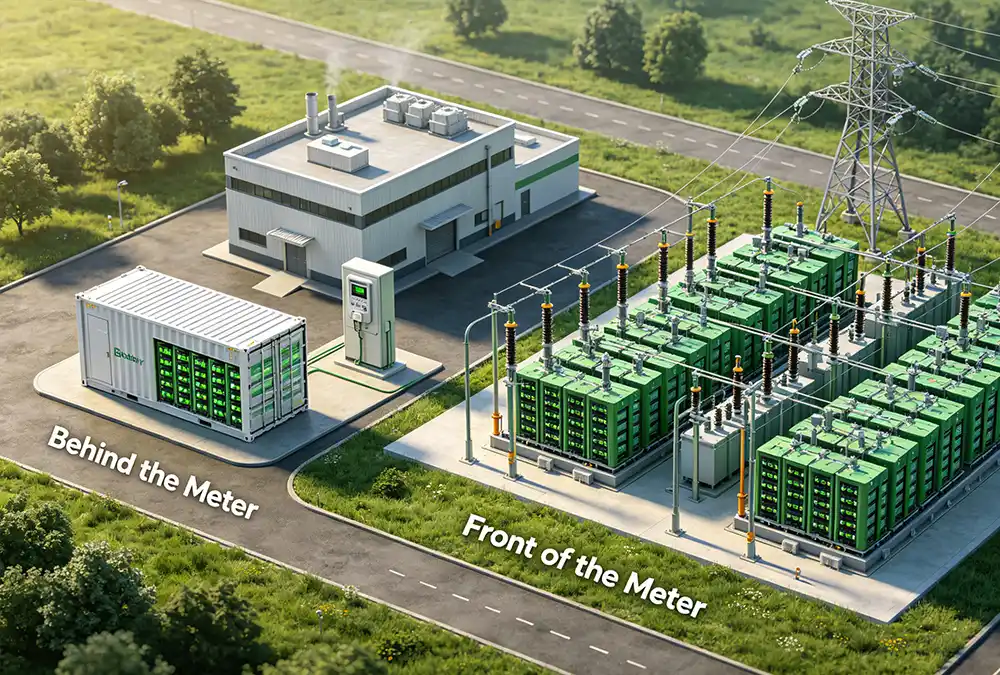
To understand the modern energy landscape, we must first define the boundary line: the utility revenue meter. This device is the legal and physical demarcation point between the utility’s jurisdiction and the customer’s property.
What Is Behind the Meter (BTM) Energy Storage?
Behind-the-meter energy storage refers to systems installed on the customer side of the utility meter. In this configuration, the battery system is primarily designed to serve the on-site electrical loads of a specific facility, such as a factory, shopping mall, or data center.
- Typical Locations: Industrial parks, commercial high-rises, and behind the meter data center facilities.
- System Components: A BTM setup usually consists of a Battery Energy Storage System (BESS), a Power Conversion System (PCS) or bidirectional inverter, a Battery Management System (BMS), and most importantly, an energy management system (EMS) that optimizes local consumption.
- Primary Goal: To reduce the facility’s electricity bill by managing on-site energy storage system resources to avoid high-utility tariffs.
What Is Front of the Meter (FTM) Energy Storage?
Front-of-the-meter energy storage, often called utility-scale battery storage, is installed on the utility side of the meter. These systems are connected directly to the distribution or transmission network and are controlled by grid operators or independent power producers.
- Typical Locations: Utility substations, large-scale solar or wind farms, and dedicated grid-balancing sites.
- System Scale: While BTM systems are measured in kilowatts (kW) or small megawatt-hours (MWh), FTM projects are typically MW or GWh-scale installations.
- Primary Goal: To provide bulk energy services, maintain grid stability, and participate in wholesale energy markets.
Behind the Meter vs Front of the Meter: Key Differences
Choosing between these two architectures requires a deep dive into the financial and technical trade-offs. Below is a comprehensive behind the meter vs front of the meter energy storage cost comparison and operational breakdown based on latest 2025/2026 industry data.
BTM vs FTM Comparison Table
| Metric | Behind the Meter (BTM) | Front of the Meter (FTM) |
| Physical Location | Customer side (Factories, EV Stations) | Utility side (Substations, Power Plants) |
| System Scale | 50kW to 10MW | 10MW to 500MW+ |
| Primary Investor | Business owners / ESCOs | Utilities / Independent Power Producers |
| Primary Revenue | Bill savings (Peak Shaving) | Energy Arbitrage & Grid Services |
| Grid Complexity | Low (Internal facility integration) | High (Requires grid interconnection study) |
| Typical ROI Cycle | 3.5 to 5.5 years | 7 to 10 years |
| Key LSI Target | Demand charge management | Frequency Regulation |
Charging Behind the Meter vs Front of the Meter (EV Perspective)
For EV charging operators, the BTM vs FTM battery storage for EV charging stations choice is a frequent point of contention. Behind the meter solutions are generally superior for private charging hubs because they allow the operator to use the battery as a “power buffer.” This means you can install 350kW ultra-fast chargers on a grid connection only rated for 100kW, using the battery to bridge the gap during peak charging sessions.
Conversely, an FTM configuration for EV charging is typically only seen in massive public “charging forests” where the energy storage serves the entire local distribution node rather than just the chargers themselves.
Behind the Meter Energy Storage Use Cases
As we look at what is behind the meter in 2026, the applications have evolved beyond simple emergency backup.
Commercial & Industrial (C&I) Energy Storage
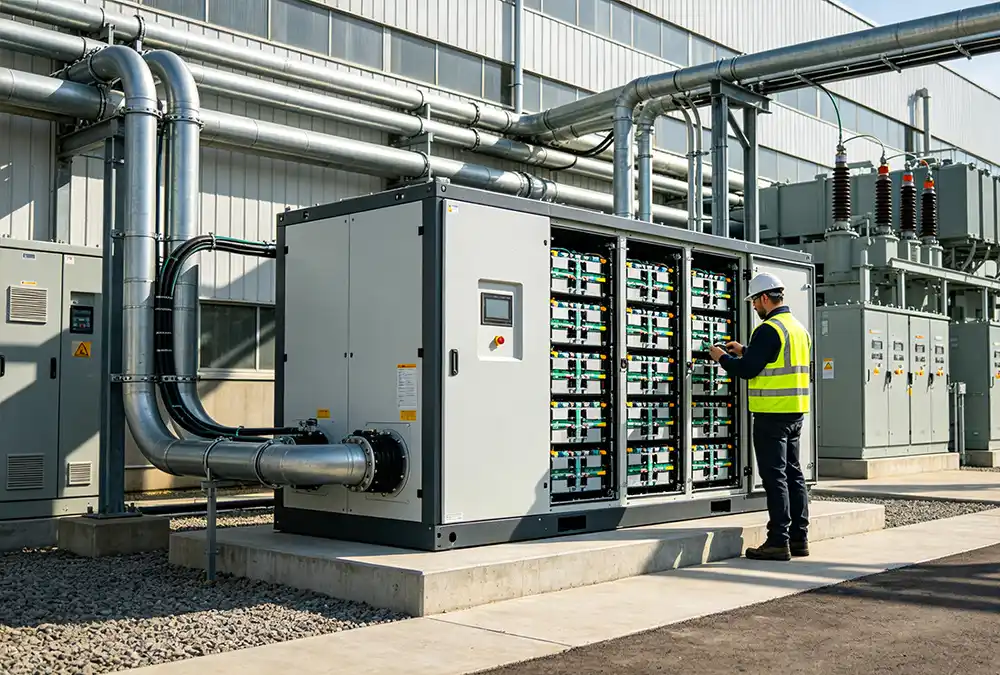
Industrial facilities use BTM systems for demand charge management. Since utilities charge heavy industrial users based on their highest 15-minute peak of the month, the BESS discharges energy to flatten these spikes, a process known as peak shaving.
EV Charging Stations + Battery Storage
The behind the meter vs front of the meter debate is most active here. BTM systems allow operators to avoid massive transformer upgrade costs. Instead of paying the utility $500,000 for a new substation, a 200kWh BESS can provide the same peak power capability at a lower total cost of ownership (TCO).
Solar + Storage (Self-Consumption Optimization)
With the decline of generous Feed-in Tariffs (FiTs), a solar plus storage system is now optimized for self-consumption. The BTM battery stores excess solar generation during the day and releases it at night, maximizing the “behind-the-meter power” and reducing reliance on the grid.
Flexible Loads and Microgrid Systems
In regions with unreliable grids, BTM systems form the heart of a microgrid energy storage setup. They allow a facility to “island” themselves, maintaining operations during blackouts while coordinating distributed energy resources (DER).
Front of the Meter Energy Storage Systems
While BTM focuses on the individual, grid scale energy storage (FTM) focuses on the collective health of the network.
Utility-Scale Battery Storage Projects
These projects are the “new peaker plants.” By 2026, many coal and gas peaking plants have been replaced by GWh-scale FTM batteries that can respond to grid imbalances in milliseconds, providing frequency regulation and voltage support.
Energy Arbitrage and Grid Services
FTM operators make money through energy arbitrage: buying electricity when the wind is blowing and prices are negative/low, and selling it back to the grid during peak evening hours. This is the cornerstone of utility energy storage projects.
Grid Stability and Renewable Integration
As we move toward 100% renewable energy, FTM systems provide the necessary “synthetic inertia” to keep the grid at a steady 50Hz or 60Hz. This is the ultimate customer side vs utility scale difference: BTM saves money for one person; FTM saves the grid for everyone.
Advantages of Behind the Meter Energy Storage
- Direct Bill Reduction: The most immediate benefit is the reduction of demand charges and volumetric energy rates through time-of-use optimization.
- Energy Resilience: BTM provides a localized UPS (Uninterruptible Power Supply) that FTM systems cannot offer to an individual building.
- Fast Deployment: Installing a 215kWh industrial cabinet (like the Anengji Liquid-Cooled BESS) typically requires far fewer permits than a utility-scale FTM project.
- Avoid Infrastructure Costs: It is often cheaper to install a behind the meter battery storage system than to pay for a utility transformer expansion.
Advantages of Front of the Meter Energy Storage
- Economies of Scale: On a per-kWh basis, FTM systems are cheaper to build because of the massive volume of battery cells and shared balance-of-plant equipment.
- Market Access: FTM systems can participate in “Wholesale Ancillary Services” markets, which often have higher revenue potential than simple bill savings.
- Grid Decarbonization: FTM is the primary tool for decarbonizing the macro-grid, allowing for the retirement of fossil fuel assets at a national level.
Why Behind the Meter Energy Storage Is Growing Fast
In 2026, the growth of behind the meter solutions is outpacing FTM in many urban markets. This is driven by the decentralized nature of the modern economy.
- Rising Demand Charges: Utility companies have shifted their revenue models toward “Power Charges” (kW) rather than just “Energy Charges” (kWh), making peak shaving vs grid services a clear win for BTM.
- EV Charging Expansion: Every new DC fast charger installed is a potential BTM battery site.
- DER Growth: The rise of distributed energy resources (DER) means that every rooftop and parking lot is now a potential power plant.
How Behind the Meter Solutions Create Value for Businesses
The ROI of a behind the meter energy storage system is calculated through three main channels:
Demand Charge Savings: By lowering the peak kW recorded by the utility meter.
Energy Arbitrage: Charging from solar or cheap off-peak grid power and discharging during “Red” or “Peak” price periods.
Revenue from Grid Interaction: Through programs like Demand Response, where the utility pays the business to not use power during a grid crisis.
Calculating BTM ROI: The Technical Formula
For any facility manager, calculating the payback period is essential. Use the following text-based formula for an initial assessment:
Annual Savings = (Monthly Peak Reduction in kW * Monthly Demand Charge Rate * 12) + (Annual kWh Shifted * (Peak Rate - Off-Peak Rate))
Simple Payback Period (Years) = Total System Cost / Annual Savings
Example: If a factory reduces its peak by 200kW at a $20/kW rate, and shifts 50,000kWh annually with a $0.10/kWh price spread:
Savings = (200 * 20 * 12) + (50,000 * 0.10) = $48,000 + $5,000 = $53,000 per year.
Battery Technologies: LFP vs. Alternatives
In the behind the meter vs front of the meter world, the chemistry matters.
Lithium Iron Phosphate (LFP)
LFP is the 2026 industry standard for commercial energy storage solutions. It offers 6,000 to 10,000 cycles and is significantly safer (lower thermal runaway risk) than the NMC (Nickel Manganese Cobalt) batteries used in older EVs.
Sodium-Ion (The 2026 Alternative)
Sodium-ion batteries have emerged as a viable alternative to lithium ion for BTM applications where space is not a constraint. They are cheaper and perform better in cold climates, though their energy density is lower.
Long-Duration Energy Storage (LDES)
For FTM applications, we are seeing the rise of Flow Batteries (Vanadium) and Iron-Air batteries. These are utility-scale solutions designed to discharge for 10+ hours, whereas most BTM lithium systems are 2-to-4-hour systems.
Is Behind the Meter or Front of the Meter Right for Your Business?
Choose BTM If You Are:
- A Manufacturing Plant or Industrial Facility with high demand charges.
- An EV Charging Station operator looking to support ultra-fast chargers on a weak grid.
- A Commercial Building owner wanting to maximize on-site solar ROI.
A Data Center requiring localized backup and power quality improvement.
Choose FTM If You Are:
- A Utility Company or Grid Operator needing to balance regional power.
- An Energy Investor looking to build a “merchant” battery asset to trade on the electricity market.
- A Developer of large-scale renewable energy projects (100MW+ solar/wind).
The Hybrid Model: Virtual Power Plants (VPP)
The most advanced solution in 2026 is the “Hybrid VPP.” This involves a network of behind the meter systems that act like an FTM system. The business keeps the bill savings, but during grid emergencies, an AI-driven EMS aggregates thousands of BTM batteries to provide a massive “Virtual” discharge to support the utility.
Real-World Examples of Behind the Meter Solutions
Case 1: The “Peak Shaving” Factory
A textile factory in Southeast Asia installed a 500kW/1.2MWh industrial energy storage solution. By shaving the morning startup peaks of their industrial looms, they reduced their monthly utility bill by 22%, resulting in a 4.2-year payback.
Case 2: The “Grid-Ready” EV Hub
An EV charging hub in an urban parking garage used a behind the meter BESS to support four 180kW DC chargers. The local grid could only provide 150kW total. The battery allowed all four chargers to run at full speed simultaneously by discharging stored energy, avoiding a $400,000 grid upgrade cost.
Recommended Industrial BTM Product: Anengji Liquid-Cooled BESS
When selecting a system for behind the meter energy storage, engineering quality is paramount. I recommend the Anengji ECO-E215LP Industrial Liquid-Cooled BESS.
- Technology: LFP cells with advanced liquid cooling (essential for maintaining State of Health).
- Integration: All-in-one cabinet including PCS, BMS, and an AI-driven EMS for demand charge management.
- Safety: Multi-level fire suppression system compliant with NFPA 855 and UL 9540A.
- Application: Ideal for commercial energy storage solutions and behind the meter EV charging.
Future Trends of BTM vs FTM Energy Storage
By 2030, the distinction between behind the meter vs front of the meter will blur further.
- AI-Driven EMS: Software will automatically switch between “Saving the Business Money” and “Supporting the Grid” based on real-time price signals.
- Vehicle-to-Grid (V2G): Your electric fleet will become part of your behind the meter storage strategy.
- Solid-State Batteries: Expect a 50% increase in energy density for BTM cabinets, allowing twice the power in the same footprint.
Quick Summary – Behind the Meter vs Front of the Meter (Featured Snippet)
What Is the Difference Between Behind the Meter and Front of the Meter?
Behind the meter energy storage is installed on the customer side of the meter to reduce electricity costs and improve energy independence. Front of the meter storage operates at the grid level to provide large-scale energy services like frequency regulation and energy arbitrage.
Which Is Better: BTM or FTM?
BTM is best for industrial businesses and EV charging operators looking to cut demand charges and improve local reliability. FTM is ideal for utilities and large investors targeting grid-scale energy trading and decarbonization.
Can You Combine Both?
Yes. Hybrid systems allow BTM assets to participate in Virtual Power Plants (VPP), providing local savings while occasionally acting as an FTM asset to support the regional grid for additional revenue.
Related Article
 https://anengjipower.com/wp-content/uploads/2026/09/AnengJipower-European-BESS-Project-Design-Environment-1.webp
675
1000
Charging Station Engineer
https://anengjipower.com/wp-content/uploads/2025/09/anengji-dc-fast-charging-station-manufacturer-and-supplier-logo-white-1.png
Charging Station Engineer2026-09-24 09:05:462026-09-24 09:08:39Battery Energy Storage System Design Guide for Europe
https://anengjipower.com/wp-content/uploads/2026/09/AnengJipower-European-BESS-Project-Design-Environment-1.webp
675
1000
Charging Station Engineer
https://anengjipower.com/wp-content/uploads/2025/09/anengji-dc-fast-charging-station-manufacturer-and-supplier-logo-white-1.png
Charging Station Engineer2026-09-24 09:05:462026-09-24 09:08:39Battery Energy Storage System Design Guide for Europe https://anengjipower.com/wp-content/uploads/2026/09/anengjipower-How-BESS-Power-and-Energy-Shape-Storage-Duration.webp
675
1000
Charging Station Engineer
https://anengjipower.com/wp-content/uploads/2025/09/anengji-dc-fast-charging-station-manufacturer-and-supplier-logo-white-1.png
Charging Station Engineer2026-09-23 09:06:532026-09-23 09:08:02BESS Duration Guide: How to Choose 1, 2 or 4 Hours
https://anengjipower.com/wp-content/uploads/2026/09/anengjipower-How-BESS-Power-and-Energy-Shape-Storage-Duration.webp
675
1000
Charging Station Engineer
https://anengjipower.com/wp-content/uploads/2025/09/anengji-dc-fast-charging-station-manufacturer-and-supplier-logo-white-1.png
Charging Station Engineer2026-09-23 09:06:532026-09-23 09:08:02BESS Duration Guide: How to Choose 1, 2 or 4 Hours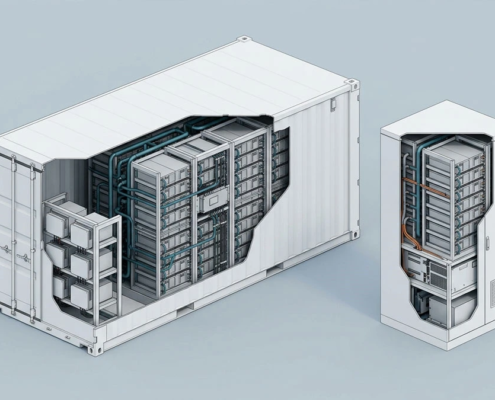 https://anengjipower.com/wp-content/uploads/2026/09/AnengJIPower-Cabinet-vs-Containerized-BESS-3D-Isometric-Structural-Cutaway.webp
675
1000
Charging Station Engineer
https://anengjipower.com/wp-content/uploads/2025/09/anengji-dc-fast-charging-station-manufacturer-and-supplier-logo-white-1.png
Charging Station Engineer2026-09-18 07:19:042026-09-18 07:19:38Cabinet vs Containerized BESS: How to Choose for Large C&I
https://anengjipower.com/wp-content/uploads/2026/09/AnengJIPower-Cabinet-vs-Containerized-BESS-3D-Isometric-Structural-Cutaway.webp
675
1000
Charging Station Engineer
https://anengjipower.com/wp-content/uploads/2025/09/anengji-dc-fast-charging-station-manufacturer-and-supplier-logo-white-1.png
Charging Station Engineer2026-09-18 07:19:042026-09-18 07:19:38Cabinet vs Containerized BESS: How to Choose for Large C&I


Leave a Reply
Want to join the discussion?Feel free to contribute!