
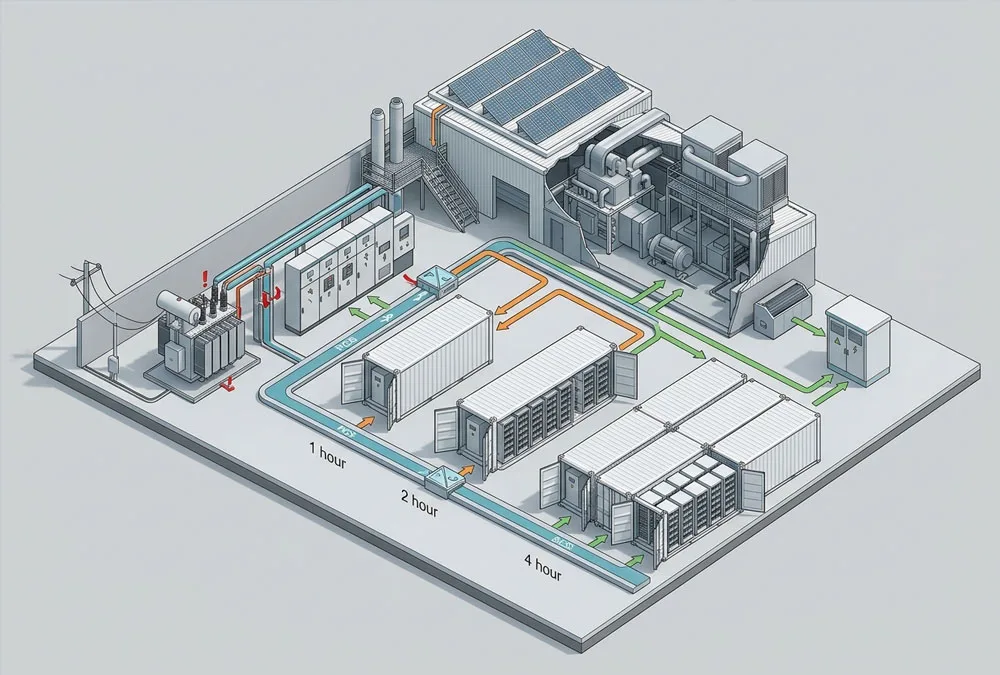
BESS duration tells you how long a battery energy storage system can discharge at its rated power, but that simple ratio does not tell you which system will make money, protect production, or pass a technical review. A one-hour battery may be right for a short demand spike. A two-hour configuration may fit a combined peak-shaving and solar-shifting duty. A four-hour system may serve a long energy window—but only if the site can charge, discharge, and repeatedly use the additional capacity.
This is where many commercial and industrial projects go wrong. Buyers receive proposals labelled “1-hour,” “2-hour,” or “4-hour,” yet the offers may use different definitions of usable energy, different measurement points, and different degradation assumptions. The apparent comparison is not a like-for-like comparison. The result can be an under-sized battery that runs empty during a billing peak, or an over-sized system carrying MWh that rarely generate savings or revenue.
The buyer’s decision rule: select the shortest configuration that can reliably cover the valuable operating window after state-of-charge limits, conversion losses, auxiliary loads, operating reserves, temperature effects, and lifetime degradation are included.
Why Duration Has Become a Serious German Market Question
Germany’s storage pipeline makes duration more than a theoretical specification. On its official “Stromspeicher” information page, the Bundesnetzagentur reports that, as of 15 October 2025, German large-scale batteries above 999 kW totalled approximately 2.4 GW of gross power and 3.2 GWh of usable storage capacity. That is an observed national fleet figure for large systems—not a C&I sizing rule. Dividing the two totals gives an indicative fleet ratio of about 1.3 hours, but individual assets can differ substantially.
The same Bundesnetzagentur passage reports planned large-scale projects of roughly 5.0 GW and 10.4 GWh. The implied ratio is a little above two hours. This calculation is an inference from registry aggregates, not proof that every new project should be two hours. It does, however, show why developers and investors increasingly test more than one duration case instead of treating a one-hour configuration as an automatic default.
Commercial market data now reflects the same need for comparison. In its 1 April 2025 methodology notice, S&P Global Commodity Insights states in the section “Battery Spreads” that Platts created German spread assessments and duration ratios for one-, two-, and four-hour cycles. The notice defines the spread as the wholesale arbitrage opportunity between the selected charging and discharging hours, using one cycle per day. That is useful evidence that duration has measurable market value; it is not a project revenue forecast because it excludes each site’s connection, tax, fee, financing, warranty, and operating conditions.
What BESS Duration Actually Measures
At its simplest, duration is the ratio of usable energy to rated discharge power:
Duration (hours) = Usable Energy (MWh) ÷ Rated Discharge Power (MW)
Power and energy solve different problems. Power, measured in kW or MW, determines the instantaneous load the power conversion system (PCS) can serve. Energy, measured in kWh or MWh, determines how long that output can be sustained. A 1 MW/1 MWh system is nominally one hour; 1 MW/2 MWh is two hours; and 1 MW/4 MWh is four hours.
Now consider a factory with a 400 kW peak above its desired grid limit. A 100 kW/400 kWh battery has enough stored energy for four hours at 100 kW, but it cannot remove a 400 kW instantaneous peak because its PCS is too small. A 400 kW/400 kWh system can address the full peak, but only for about one hour before allowances for losses and reserve. Buyers who compare only kWh can therefore buy plenty of energy and still fail to solve the power problem.
Nameplate Hours Are Not Guaranteed Operating Hours
A professional specification must identify where energy is measured. DC nameplate energy is the sum of battery capacity before conversion. Usable DC energy reflects the permitted state-of-charge window. Usable AC energy at the point of interconnection is lower again after PCS, transformer, cable, and auxiliary losses. If one bidder quotes beginning-of-life DC capacity while another guarantees end-of-life AC delivery, their €/kWh figures cannot be compared directly.
- State-of-charge reserve: energy held back to protect the cells or maintain backup and grid-service headroom.
- Conversion losses: losses across the PCS, transformer, cabling, and switchgear path.
- Auxiliary demand: cooling, controls, pumps, heaters, and communications consume part of the stored energy.
- Capacity fade: usable energy declines with calendar age, energy throughput, temperature, depth of discharge, and operating strategy.
- Availability: maintenance, faults, and contractual availability affect whether the full rating is available when the peak occurs.
The solution is to state the contractual guarantee point: for example, usable AC MWh at the site meter, at a defined ambient condition, at beginning and end of life, while delivering the specified MW. Without that sentence, “two-hour BESS” is a category label rather than a procurement-grade performance requirement.
Five Buyer Pain Points—and How to Resolve Them
Pain Point 1: “We Know Our Monthly Consumption, but Not Our Peak Shape”
Consequence: monthly kWh hides the height, width, and recurrence of demand peaks. A battery may have enough annual throughput in theory but run empty during the specific 15-minute intervals that determine the charge or operating constraint.
Solution: use at least 12 months of interval data and construct a “peak energy envelope.” For every event, subtract the desired grid-import ceiling from actual demand, then integrate the remaining kW across time. This produces both required power and theoretical energy. The approach is consistent with the problem identified in the Fraunhofer IPA publication “Sizing Electric Storage Systems for Industrial Peak Shaving Applications”. Its abstract specifically identifies storage sizing and resulting economic efficiency as the challenge and presents a methodology aimed at reducing industrial grid charges.
Pain Point 2: “We Have Solar, So Four Hours Must Capture More Value”
Consequence: PV nameplate capacity does not reveal the energy available to charge a battery. A factory may consume most solar production directly, leaving little surplus. A four-hour system can then spend many days partially charged, weakening the return on its additional MWh.
Solution: align time-series PV generation on the AC side with site demand, export limits, curtailment, and the later discharge window. Calculate how often the incremental third and fourth hours can complete a valuable cycle. If the project has a 2 MWp PV array, do not assume it needs 2 MW or 8 MWh of storage; the correct result depends on simultaneous surplus energy and the operating objective.
Pain Point 3: “The Battery Must Provide Backup as Well as Savings”
Consequence: holding energy for resilience reduces the state-of-charge range available for peak shaving, arbitrage, or PV shifting. In addition, a grid-connected battery does not automatically provide power during an outage. Islanding, protection coordination, grid-forming controls, black-start requirements, and critical-load switching must be designed explicitly.
Solution: create a critical-load schedule rather than using the entire facility peak. Define minimum kW, required autonomy, permissible interruption, motor-starting duty, and coordination with generators. Then reserve that energy in the EMS model. A nominal one-hour battery serving a critical load below its rated MW may last longer than one hour, but only within its usable-energy and inverter limits.
Pain Point 4: “The Supplier Says the Market Will Pay for the Extra Duration”
Consequence: merchant revenue can be overstated when a sales model assumes perfect hindsight, ignores locked market positions, or omits grid fees, optimizer fees, O&M, and warranty costs.
Solution: demand a transparent dispatch methodology and a reconciliation from gross market revenue to project cash flow. The Modo Energy Germany Benchmark Methodology is useful as a disclosure example. Section 2.2 lists the representative asset assumptions, including 50 MW power, 1/2/4-hour variants, 88% AC-to-AC round-trip efficiency, 1.5 maximum cycles per day, and an import/export limit equal to rated power. Section 3.2 then states that site-specific grid charges, bilateral contracts, operator fees, warranty costs, and O&M are excluded. Section 5.2 explains that its model allocates capacity across energy markets, FCR/aFRR capacity, and aFRR activated energy. For a buyer, the lesson is not to copy those assumptions; it is to require the same level of transparency for the actual site.
Pain Point 5: “All Proposals Use the Same Duration Label”
Consequence: a lower-priced offer may quietly use a wider state-of-charge window, a beginning-of-life guarantee, higher assumed availability, or no allowance for site auxiliaries. The buyer discovers the gap only during performance testing or after degradation.
Solution: issue a common RFQ schedule requiring each bidder to state rated AC power, DC nameplate energy, usable AC energy at the agreed meter, beginning- and end-of-life values, ambient-temperature limits, auxiliary-load treatment, availability, cycles, throughput, and augmentation responsibility.
1-Hour vs. 2-Hour vs. 4-Hour BESS
| Decision factor | 1 hour | 2 hours | 4 hours | Buyer consequence |
|---|---|---|---|---|
| Design bias | Power-oriented | Balanced power and energy | Energy-oriented | Start with the duty, not a preferred container size. |
| Peak shape | Short, sharp events | Medium-width peaks | Long plateaus | A duration shorter than the peak can leave residual demand charges. |
| Solar shifting | Limited shift window | Moderate shift window | Extended shift window | Extra hours create value only when surplus and later demand coexist. |
| Footprint | Lowest cell quantity for equal MW | Intermediate | Highest cell quantity for equal MW | Civil layout, access, fire strategy, and MV design may eliminate an option. |
| Unused-energy risk | Usually lower | Project-dependent | Higher if valuable windows are short | Model marginal value, not only total revenue. |
The table is a screening tool, not a design recommendation. The same facility may need a high-power one-hour system for a short peak, but a lower-power four-hour system for backup. Fixing energy capacity while changing power produces a different comparison from fixing power while changing energy. The procurement team must state which variable is held constant.
Use the Duty-Window Fit Test
A defensible BESS duration decision can be made through five gates. If a candidate fails one gate, adding a more optimistic revenue forecast should not rescue it.
- Define the commercial objective. Rank peak shaving, self-consumption, backup, grid services, and arbitrage. Specify which objective has priority when two uses compete for the same state of charge.
- Set the required power. Calculate the kW or MW needed at the relevant meter. Check the PCS, transformer, switchgear, import limit, and export limit independently.
- Measure the valuable time window. Determine the duration and recurrence of the actual peak, solar deficit, price spread, or critical-load event.
- Convert theoretical energy into guaranteed usable energy. Include the state-of-charge window, one-way discharge losses, auxiliaries, reserve, temperature, availability, and degradation.
- Test the marginal hour. Compare the incremental lifetime value of moving from one to two hours and from two to four hours with the incremental cells, containers, maintenance, insurance, and augmentation exposure.
Low-Friction Project Check
Send one sample month of interval load data, your tariff structure, and an available PV profile. The review can identify obvious power-versus-energy mismatches before a full feasibility study.
Germany-Specific Constraints Can Override the Preferred Duration
Import and Export Capacity Must Both Be Checked
In the “Netzanschluss” section of its storage FAQ, the Bundesnetzagentur explains that, where charging and discharging sides face different network constraints, battery projects may need to participate in capacity-allocation procedures for both sides. The same passage points to flexible connection agreements under Section 17(2b) of the German Energy Industry Act as a possible mechanism.
The buyer’s pain point is practical: a 2 MW/8 MWh system may physically fit, yet the available connection may not permit 2 MW charging and 2 MW export whenever the EMS wants them. The solution is to obtain written import and export conditions early, model any static or dynamic curtailment, and prevent the supplier from assuming an unconstrained connection.
Connection Costs Can Affect the Economic Optimum
Under “Netzentgelte > Baukostenzuschüsse,” the Bundesnetzagentur FAQ states its position that a construction-cost contribution can be levied on grid-connected batteries above low voltage. It also notes that the specific calculation belongs to the network operator and should be transparent and non-discriminatory. This means a duration comparison that excludes project-specific connection costs is incomplete. Buyers should obtain the operator’s price sheet and project calculation rather than inserting a generic national €/MW value.
Technical Connection and Metering Concepts Are Configuration-Specific
VDE FNN’s page “Compatible Network Connection for Energy Storage” states in the section “Nationwide Network Connection Rules for Energy Storage Systems” that VDE application rules define requirements by voltage level. It names VDE-AR-N 4100 for low-voltage technical connection rules and VDE-AR-N 4105 for generating plants in the low-voltage grid. The following section on the FNN storage guideline says connection variants depend on the onsite generation configuration and highlights measurement concepts and energy-flow direction sensors.
For a C&I project, the implication is direct: storage duration cannot be separated from the single-line diagram, metering concept, PV arrangement, and permitted energy-flow direction. An EPC should confirm the applicable voltage-level rules and the network operator’s current technical connection conditions for the actual site.
Build the Business Case Around Marginal Value
Power-related and energy-related costs do not scale identically. PCS capacity, transformers, switchgear, protection, and parts of the connection are driven primarily by MW. Cells, modules, racks, cabinets or containers, and part of the thermal-management system scale more directly with MWh. Moving from two to four hours at the same MW therefore adds substantial energy equipment, but it does not necessarily double every project cost.
The correct economic question is not, “Which duration produces the most gross revenue?” It is, “Does the incremental value of the next usable MWh exceed its incremental lifetime cost and risk?” Test at least three cases using the same:
- load, PV, and price time series;
- import and export constraints;
- usable-energy definition and measurement point;
- efficiency, auxiliary demand, availability, and degradation model;
- warranty throughput and cycle restrictions;
- optimizer, O&M, insurance, connection, financing, and tax assumptions; and
- downside cases for load changes and market-value compression.
Any payback, NPV, or IRR is a project-specific model output, not an inherent property of a one-, two-, or four-hour battery. If a vendor presents a return without disclosing the charging cost, revenue boundary, degradation treatment, and excluded expenses, the number is not ready for an investment decision.
Data Required Before a Recommendation
| Data category | Minimum input | Decision affected |
|---|---|---|
| Load | 12 months at 15-minute resolution | Required MW, MWh, seasonality, and peak recurrence |
| Tariff | Energy, demand, and time-based charges | Avoided-cost window and dispatch priority |
| PV | Time-series AC generation, export, and curtailment | Chargeable surplus and solar-shifting duration |
| Grid | Voltage level, import/export limits, connection terms | PCS rating and dispatch feasibility |
| Resilience | Critical kW, autonomy, start-up duty | Reserve energy and islanding design |
| Site | Layout, access, ambient conditions, fire concept | Container count, derating, and constructability |
| Commercial | Ownership, optimizer, financing horizon | Revenue rights, risk allocation, and decision metric |
How to Compare EPC and Supplier Proposals
Require every bidder to complete the same technical schedule. Ask where the energy is measured, when it is guaranteed, and what operating envelope preserves the warranty. Then examine the hardware boundary: cell, module, rack, cabinet or container, battery management system, PCS, energy management system, transformer, switchgear, plant controller, and grid-interface equipment should not be blended into a vague “battery package.”
- What AC MW and usable AC MWh are guaranteed at the agreed point?
- Are values stated at beginning of life, end of life, or both?
- Which ambient temperature, state-of-charge range, and auxiliary loads apply?
- How many equivalent full cycles and how much throughput are warranted?
- Can the EMS reserve energy for backup while executing peak shaving or market dispatch?
- Who pays for augmentation, performance testing, software licences, and warranty remedies?
- Is physical and electrical headroom reserved if duration is expanded later?
Fire protection, permitting, noise, drainage, emergency access, and insurer requirements must be reviewed for the actual jurisdiction and design. They should not be reduced to a universal “European compliance” statement. A four-hour option that cannot meet the site layout or authority requirements is not a viable economic case, however attractive its spreadsheet revenue appears.
Make the Decision With Comparable Scenarios
The final BESS duration recommendation should compare one-, two-, and four-hour cases on the same technical and commercial basis. It should report required power, usable energy at the agreed point, beginning- and end-of-life performance, annual utilisation, unserved peak energy, unused stored energy, connection constraints, and sensitivities. It should also explain why the rejected options lose—not merely announce a preferred duration.
For many buyers, the most valuable result is not a larger battery. It is clarity: enough power to control the target load, enough energy to cover the valuable window, and no unproductive MWh added simply because a standard product or generic market narrative made it convenient.
Request a Site-Specific BESS Sizing Consultation
Share your interval load data, PV profile, tariff structure, critical-load requirements, and grid limits. The consultation will compare 1-hour, 2-hour, and 4-hour configurations using consistent operating, degradation, and lifetime assumptions.
Evidence Sources
- Bundesnetzagentur, “Stromspeicher”: national registry figures dated 15 October 2025; “Netzanschluss” FAQ; and “Netzentgelte > Baukostenzuschüsse” FAQ.
- VDE FNN, “Compatible Network Connection for Energy Storage”: “Nationwide Network Connection Rules for Energy Storage Systems” and the FNN low-voltage storage-guideline section.
- Modo Energy, Germany Benchmark Methodology: Sections 2.2, 3.2, 4.2, and 5.2.
- S&P Global Commodity Insights: 1 April 2025 methodology notice, “Battery Spreads” and German duration-ratio tables.
- Fraunhofer IPA, “Sizing Electric Storage Systems for Industrial Peak Shaving Applications”: publication abstract and linked methodology paper.
 https://anengjipower.com/wp-content/uploads/2026/06/epc-vs-turnkey-solar-project-bess.webp
675
1000
Charging Station Engineer
https://anengjipower.com/wp-content/uploads/2025/09/anengji-dc-fast-charging-station-manufacturer-and-supplier-logo-white-1.png
Charging Station Engineer2026-06-22 07:16:042026-06-24 07:13:17What Is the Difference Between EPC and Turnkey Contract Models in Energy Projects?
https://anengjipower.com/wp-content/uploads/2026/06/epc-vs-turnkey-solar-project-bess.webp
675
1000
Charging Station Engineer
https://anengjipower.com/wp-content/uploads/2025/09/anengji-dc-fast-charging-station-manufacturer-and-supplier-logo-white-1.png
Charging Station Engineer2026-06-22 07:16:042026-06-24 07:13:17What Is the Difference Between EPC and Turnkey Contract Models in Energy Projects? https://anengjipower.com/wp-content/uploads/2026/06/anengji-commercial-solar-plus-storage-benefits-site.webp
675
1000
Charging Station Engineer
https://anengjipower.com/wp-content/uploads/2025/09/anengji-dc-fast-charging-station-manufacturer-and-supplier-logo-white-1.png
Charging Station Engineer2026-06-20 14:34:102026-06-20 14:37:43What Are the Top Benefits of Solar Battery Storage in Factories?
https://anengjipower.com/wp-content/uploads/2026/06/anengji-commercial-solar-plus-storage-benefits-site.webp
675
1000
Charging Station Engineer
https://anengjipower.com/wp-content/uploads/2025/09/anengji-dc-fast-charging-station-manufacturer-and-supplier-logo-white-1.png
Charging Station Engineer2026-06-20 14:34:102026-06-20 14:37:43What Are the Top Benefits of Solar Battery Storage in Factories? https://anengjipower.com/wp-content/uploads/2026/06/modular-commercial-solar-battery-storage-cabinet.webp
675
1000
Charging Station Engineer
https://anengjipower.com/wp-content/uploads/2025/09/anengji-dc-fast-charging-station-manufacturer-and-supplier-logo-white-1.png
Charging Station Engineer2026-06-18 09:16:522026-07-03 03:05:13What Is Solar Battery Storage? Complete C&I Engineering Guide
https://anengjipower.com/wp-content/uploads/2026/06/modular-commercial-solar-battery-storage-cabinet.webp
675
1000
Charging Station Engineer
https://anengjipower.com/wp-content/uploads/2025/09/anengji-dc-fast-charging-station-manufacturer-and-supplier-logo-white-1.png
Charging Station Engineer2026-06-18 09:16:522026-07-03 03:05:13What Is Solar Battery Storage? Complete C&I Engineering Guide

Leave a Reply
Want to join the discussion?Feel free to contribute!