
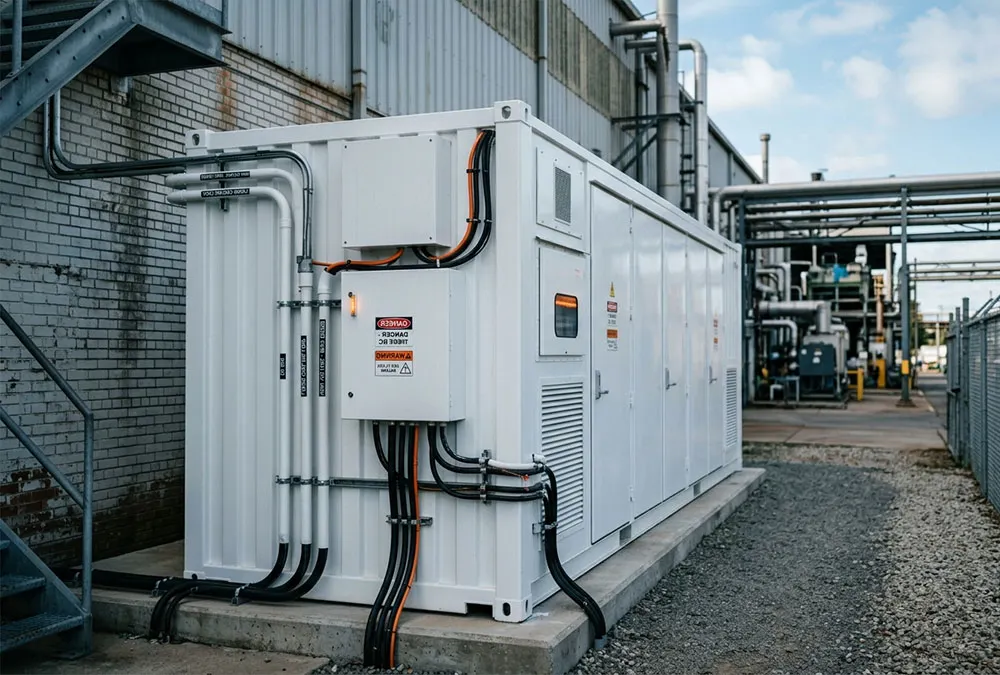
Introduction
Deciding between C&I vs Utility Scale Energy Storage often confuses commercial facilities and IPP developers because raw capacity alone does not define system boundary logic. Many factory owners ask me whether installing a 2 MWh container behind their facility transformer automatically turns it into a utility asset. It does not. The actual distinction between a commercial and industrial BESS and a utility-scale BESS boils down to point of interconnection (POI), tariff structures, grid services capabilities, and revenue generation models. A 1 MWh battery operating behind a factory meter aims to cut expensive demand charges, whereas a 100 MWh front-of-the-meter asset serves the wholesale market. If you size a battery purely by megawatt-hours without mapping your local transformer capacity, load profiles, or grid interconnection rules, you risk severe ROI degradation. Let’s walk through the actual engineering and economic boundaries that separate these two market segments.
What Is the Difference Between C&I and Utility-Scale Energy Storage?
What Is Commercial and Industrial Battery Energy Storage?
A commercial and industrial energy storage system operates primarily inside a business site or industrial campus. It links to the customer’s low-voltage or medium-voltage distribution board. The primary operational objective revolves around optimizing facility energy usage, controlling peak loads, maximizing solar self-consumption, and mitigating steep demand tariffs levied by the local electric utility.
What Is Utility-Scale Battery Energy Storage?
A utility-scale BESS (also referred to as grid-scale battery storage) connects directly to high-voltage or extra-high-voltage transmission lines. Owned by Independent Power Producers (IPPs), utilities, or infrastructure funds, these massive installations feed energy straight into the public grid to supply bulk power, stabilize regional frequency, or arbitrage wholesale power price spreads.
Why Battery Size Alone Does Not Define C&I or Utility-Scale BESS
Engineers often fall into the trap of labeling any system over 10 MWh as “utility-scale.” That is technically incorrect. A massive data center or steel processing plant might deploy a 20 MWh system strictly for behind-the-meter BESS load management and backup power. Conversely, a 2 MW / 2 MWh battery installed on a weak rural feeder to provide localized voltage control functions strictly as a grid-facing asset. The true discriminator lies in system ownership, market access, and electrical location.
Behind-the-Meter vs Front-of-the-Meter Energy Storage
According to the official National Renewable Energy Laboratory (NREL) Energy Storage Boundary Framework, the distinction between behind-the-meter energy storage (BTM) and front-of-the-meter energy storage (FTM) rests entirely on which side of the utility revenue meter the system resides. BTM systems serve onsite loads directly and reduce utility bills, whereas FTM systems export power straight through utility revenue meters to earn wholesale revenue.
C&I vs Utility-Scale BESS at a Glance
Connection Point and Grid Position
C&I units sit downstream of the main site breaker, sharing the transformer with factory machinery. Grid-scale systems sit upstream, utilizing dedicated step-up transformers linked directly to distribution or transmission sub-stations.
Typical Customers and Project Owners
Commercial asset buyers are facility owners, manufacturing enterprises, logistics parks, and data centers. Utility-scale owners are utility corporations, power developers, and institutional infrastructure investors.
Primary Applications and Value Streams
C&I assets rely heavily on demand charge management, bill reduction, peak shaving, and power reliability. Grid assets prioritize wholesale energy arbitrage, frequency response, capacity compensation, and curtailment avoidance.
Typical System Architecture
C&I BESS installations rely on compact, cabinet-style or small modular container configurations (e.g., 100 kWh to 261 kWh liquid-cooled cabinets). Utility systems utilize 20-foot or 40-foot high-cube containers housing multi-megawatt-hour blocks tied to central power conversion skids.
Sizing and Storage Duration
C&I durations typically range from 1 to 2 hours to cover narrow facility demand peaks. Utility systems routinely run 2, 4, or 8 hours to align with wholesale market clearing windows and evening ramp periods.
Grid Connection Requirements
C&I sites follow standard low-voltage or medium-voltage customer interconnection rules. Utility BESS projects must undergo exhaustive impact studies, thermal overload checks, and complex dynamic grid code compliance procedures.
Revenue and Savings Models
C&I revenue is actually cost avoidance (savings on utility bills). Utility BESS revenue comes from cash invoices generated through wholesale power sales and ancillary market clearing.
| Dimension | C&I BESS | Utility-Scale BESS | User Selection Advantage |
|---|---|---|---|
| Typical Position | Behind the meter (BTM) | Front of the meter (FTM) | BTM avoids complex grid export permits; FTM unlocks open market bidding. |
| Main User | Factory / Business / Data Center | Utility / IPP / Grid Operator | C&I empowers plant managers to control site power directly without energy market desks. |
| Main Value | Electricity bill savings & reliability | Grid wholesale market cash flow | C&I delivers guaranteed internal expense cuts; Utility scale captures high market upside. |
| Typical Use | Peak shaving, self-consumption | Arbitrage, frequency regulation | C&I applications protect sensitive production lines from costly local grid outages. |
| Sizing Driver | Site load profile + utility tariff | Grid capacity + power market rules | C&I sizing scales neatly with actual operational power demands, eliminating wasted CAPEX. |
| Grid Connection | Facility distribution (LV/MV) | Dedicated MV/HV substation link | C&I bypasses multi-year transmission queue delays and excessive network upgrades. |
What Are the Main Applications of C&I Energy Storage?
Peak Shaving and Demand Charge Management
Industrial operations often face hefty monthly demand charges, which utility companies calculate based on the highest 15-minute load spike recorded. By automatically discharging a c&i energy storage system when facility loads surge past a pre-set threshold, plant managers smooth out demand spikes and cut power bills significantly.
Time-of-Use Energy Cost Optimization
Time-of-Use (TOU) utility rates penalize energy consumption during afternoon hours. A commercial battery storage setup charges during off-peak night windows when rates drop, then discharges during expensive peak windows to lower grid power costs.
Solar Self-Consumption
Rooftop PV systems frequently generate excess energy during noon hours when site demand drops. Storing surplus power in an onsite distributed battery energy storage unit prevents cheap feed-in to the grid and offsets expensive evening energy purchases.
Commercial Backup and Energy Resilience
A short power flicker can ruin batches at injection molding or semiconductor plants. A properly integrated BESS acts as an uninterruptible power supply, bridging the gap during outages or holding off loads until emergency generators start up.
EV Charging Load Management
Installing DC fast chargers at logistics hubs creates severe, sudden power demands that can overload facility transformers. An onsite battery buffers those rapid load spikes, allowing high-power EV charging without expensive utility grid upgrades.
Industrial Load Management and Electrification
As heavy industrial facilities replace gas boilers with electric equipment, their peak electrical loads climb sharply. Onsite storage provides local power buffering, allowing expanded operations without overstepping utility connection limits.
What Are the Main Applications of Utility-Scale Energy Storage?
Energy Arbitrage
Utility-scale battery storage developers earn revenue by buying low during periods of negative or minimal spot prices and selling back to the wholesale market when power supplies tighten.
Frequency Regulation and Ancillary Services
Grid operators pay grid-scale BESS owners to deliver rapid millisecond-level charge/discharge responses (frequency regulation) to keep system frequency stable at 50 Hz or 60 Hz.
Capacity and Resource Adequacy
Utilities contract multi-megawatt battery reserves through capacity markets to guarantee reliable power supplies during peak heatwaves or extreme cold snaps.
Renewable Energy Integration
Large solar and wind farms use co-located front-of-the-meter BESS assets to smooth out generation fluctuations and prevent curtailment when transmission lines hit capacity.
Grid Balancing and Flexibility
Regional transmission operators rely on utility storage assets to respond flexibly to unexpected power plant trips or sudden swings in renewable generation.
Transmission and Distribution Support
Deploying grid-connected battery storage at congested substations defers multi-million-dollar power line upgrades by absorbing surplus local generation during peak hours.
How Do C&I and Utility-Scale BESS Technical Architectures Differ?
Battery System and BMS Architecture
C&I projects frequently feature all-in-one liquid-cooled cabinets housing battery packs, localized thermal management, and internal protection switches. Utility-scale architectures rely on multi-tier battery management system (BMS) setups across massive containerized battery racks.
PCS and Power Conversion
C&I systems typically use localized string inverters (50 kW to 250 kW) for modular expansion and easy maintenance. Utility assets utilize massive central Power Conversion System (PCS) skids (1 MW to 4 MW) outfitted with integrated liquid cooling and high-voltage DC bus links.
EMS, SCADA and PPC Controls
A C&I energy management system (EMS) focuses on facility tariff maps, site load forecasting, and localized peak shaving. Utility EMS platforms use Power Plant Controllers (PPC) and SCADA loops to follow dispatch commands from regional market operators.
Transformers and Switchgear
C&I units step up voltage to standard facility distribution levels (400V, 480V, or 11kV). Utility plants utilize massive oil-immersed medium-to-high voltage step-up transformers (33kV, 66kV, or 132kV) connected to outdoor protection switchgear.
Low-Voltage, Medium-Voltage and High-Voltage Connections
C&I electrical scope ends at the main distribution board. Utility installations require full high-voltage substation engineering, including insulation coordination, busbar design, and utility-grade metering protection sets.
Fire Protection and Thermal Management
Commercial systems follow strict building proximity standards, utilizing localized gas suppression systems like Novec 1230 or FK-5-1-12. Utility projects rely on multi-stage explosion venting, deflagration panels, localized water sprinklers, and strict boundary separation clearances per NFPA 855 guidelines.
Grid Protection and Power Quality
C&I systems focus on maintaining indoor power factor and preventing local harmonic distortions. Utility plants provide dynamic reactive power support (VAR support), fault ride-through performance, and black-start grid capabilities.
AC-Coupled and DC-Coupled Architectures
C&I retrofits are predominantly AC-coupled for simple installation on existing plant switchgear. New utility solar-plus-storage developments often favor DC-coupled options to share inverter infrastructure and capture clipped solar energy directly.
Why Is C&I BESS More Site-Specific Than Utility-Scale Storage?
Existing Electrical Infrastructure Determines the Design
Unlike greenfield utility sites, a commercial industrial vs utility scale battery storage project must integrate seamlessly into aging, existing plant infrastructure. Available circuit breaker space, main busbar ratings, and panelboard space dictate the final design limits.
Load Profile Determines BESS Power Requirements
A factory running steady 24/7 loads presents completely different BESS requirements than a office facility with sharp 2-hour afternoon cooling spikes. Sizing must be custom-tailored to site consumption profiles.
Electricity Tariffs Determine Economic Value
A C&I BESS project generates zero ROI if local utility rate structures lack demand charges or TOU price spreads. Site economics depend entirely on specific utility rate sheets.
Transformer Capacity and Export Limits Matter
If a facility’s step-down transformer is already fully loaded, adding an improperly sized battery will trigger immediate thermal overloads, requiring costly equipment replacements.
Solar PV and EV Charging Change the BESS Configuration
Adding rooftop solar and EV fast chargers creates complex local energy dynamics. The BESS control software must actively manage fluctuating solar generation and sudden charger demand spikes simultaneously.
Future Load Growth Should Be Considered
Industrial buyers often ask: “What happens when we add two new production lines in three years?” Modular BESS architectures let commercial operators expand storage capacity down the road without throwing away initial equipment investments.
Why Utility-Scale BESS Requires More Grid and Market Engineering
Utility Interconnection Studies
Connecting a 50 MW battery to the high-voltage grid requires extensive load flow analyses, transient stability simulations, and fault level calculations. These technical studies often take over a year to complete.
Transmission and Distribution Constraints
Utility project locations depend heavily on existing high-voltage transmission headroom. Grid congestion can easily trigger curtailment mandates, dramatically cutting overall energy export capacity.
Grid Code and Protection Requirements
Grid-scale installations must comply with strict national grid codes, providing automated voltage support, frequency response, and fault ride-through capabilities to keep regional networks stable.
Wholesale Market Participation
Grid storage systems require direct integration with wholesale electricity trading platforms. Automated algorithms must handle day-ahead and real-time bidding without violating battery warranty terms.
Revenue Stacking and Dispatch Optimization
Maximizing ROI requires stacking multiple revenue streams—such as combining energy arbitrage with frequency response. The dispatch system must constantly evaluate market prices against cell degradation costs.
Degradation, Augmentation and Long-Term Availability
Utility power contracts enforce strict capacity availability guarantees. Project developers build structured battery augmentation strategies into their plans, installing fresh cell racks at years 5, 10, and 15 to offset natural battery degradation.
C&I vs Utility-Scale BESS: How Does the Cost Structure Differ?
Battery and PCS Costs
Utility projects benefit from substantial volume discounts on bulk battery cells and central PCS hardware, lowering equipment costs per kilowatt-hour.
Balance-of-Plant Costs
C&I projects face higher relative Balance-of-Plant (BOP) expenses proportional to total project size due to localized, customized site wiring needs and space limitations.
Engineering and EPC Costs
Utility-scale engineering expenses concentrate heavily on civil site development, environmental reviews, and high-voltage substation designs, driving total upfront EPC costs higher.
Grid Interconnection Costs
Interconnection expenses for C&I BESS projects are usually modest, involving simple distribution panel hookups. Utility-scale projects, however, often face millions of dollars in network upgrade fees.
Civil, Fire Protection and Site Costs
C&I systems rely on simple concrete pads located near plant utility rooms. Utility installations require full land development, security fencing, heavy access roads, and elaborate fire suppression systems.
O&M and Lifecycle Costs
C&I operations utilize simple scheduled preventive maintenance contracts. Utility systems demand 24/7 operational monitoring, strict performance guarantees, and dedicated technical response teams.
Why Comparing $/kWh Alone Can Be Misleading
According to NREL’s Commercial BESS Cost Model Benchmark Report, evaluating a battery system purely on upfront cost per kilowatt-hour ($/kWh) distorts economic reality. A lower-cost DC battery container omits essential balance-of-plant costs, specialized EMS software, site installation fees, and long-term service agreements. Comparing total turn-key costs reveals a much clearer financial picture.
C&I vs Utility-Scale BESS: How Do the Economics and ROI Differ?
How C&I BESS Creates Value From Electricity Bill Savings
C&I battery financial models derive their ROI from reliable, predictable cost reduction rather than speculative market trading. Lowering monthly facility utility charges creates stable, dependable energy savings.
How C&I BESS Creates Value From Peak Shaving
In regions with steep demand tariffs, shaving even a few hundred kilowatts off peak monthly loads can trim thousands of dollars from facility electricity bills, accelerating overall system paybacks.
How Utility-Scale BESS Creates Revenue From Energy Arbitrage
Utility BESS assets generate revenue by trading wholesale power spreads. However, their financial returns fluctuate based on daily market price volatility.
How Utility BESS Earns From Ancillary and Capacity Services
Contracting with system operators for grid frequency control or capacity reserves provides steady revenue streams that complement daily energy arbitrage profits.
Why C&I ROI Depends on Load Profile and Tariffs
A C&I project’s financial return hinges entirely on local utility rate structures. If demand charges are low, the payback timeline lengthens significantly regardless of battery quality.
Why Utility-Scale ROI Depends on Market Access and Dispatch
Financial returns on grid-scale storage assets rely on wholesale market structures, node pricing dynamics, and smart dispatch software that optimizes trading revenue.
How Battery Degradation Changes Project Economics
Data from the Lazard Levelized Cost of Storage (LCOS) Analysis Report emphasizes that excessive cycling accelerates cell degradation. Uncontrolled degradation erodes capacity, directly reducing long-term project revenue and investment returns.
Commercial & Industrial Storage Solutions
Selecting the proper modular block is critical to matching facility load profiles and avoiding over-spending. Here is how our primary commercial configurations address real-world industrial needs:
- 100 kWh / 261 kWh Outdoor Liquid-Cooled Cabinets: Engineered specifically for small-to-medium factories and commercial sites looking to minimize peak demand charges. Features a compact footprint, easy outdoor placement, and simple expansion capabilities without requiring major electrical upgrades.
- 418 kWh All-in-One Energy Storage Container: Optimized for heavy manufacturing plants, EV fast-charging hubs, and commercial solar self-consumption projects. Combines built-in liquid cooling, internal fire suppression, and smart EMS integration into a single turn-key enclosure.
- 1 MWh Modular Energy Storage Block: Designed for large industrial campuses, microgrids, and data centers seeking backup power and demand management. Delivers maximum energy density in a small footprint while keeping site integration straight-forward.
How Do You Size C&I and Utility-Scale BESS Differently?
C&I BESS Sizing Based on Load Profile
Sizing a commercial battery requires analyzing 15-minute interval demand data spanning a full year. The goal is to accurately identify recurring power spikes without over-specifying storage capacity.
C&I BESS Sizing for Peak Shaving
The discharge power rating (kW) must match the target load reduction threshold, while total storage capacity (kWh) must cover the duration of peak facility demand windows.
C&I BESS Sizing for Solar Self-Consumption
For solar integration, storage capacity should absorb midday rooftop solar excess and discharge during high-tariff evening hours to maximize energy self-use.
Utility-Scale BESS Sizing Based on Market and Grid Requirements
Grid-scale storage sizing aligns directly with utility PPA terms, regional transmission capacity headroom, and local ancillary market participation rules.
Power-to-Energy Ratio and Storage Duration
A 1 MW / 1 MWh battery (1-hour system) delivers rapid power response, while a 1 MW / 4 MWh battery (4-hour system) excels at energy shifting and wholesale arbitrage.
How 1-Hour, 2-Hour and 4-Hour BESS Serve Different Applications
A 1-hour BESS is ideal for quick peak shaving and frequency response. A 2-hour BESS fits standard commercial demand management perfectly. A 4-hour system is the preferred choice for grid-scale energy shifting and solar capacity smoothing.
How Does Grid Connection Differ Between C&I and Utility-Scale BESS?
Behind-the-Meter C&I Grid Connection
C&I systems tie straight into standard plant distribution switchboards using dedicated protection circuit breakers, simplifying overall integration.
Front-of-the-Meter Utility-Scale Interconnection
Utility-scale projects connect directly to regional transmission networks, requiring specialized high-voltage switchgear, ring main units, and dedicated utility metering setups.
C&I Transformer and Medium-Voltage Connection
When commercial system sizing exceeds standard low-voltage switchboard limits, the unit steps up to facility medium-voltage levels (e.g., 11kV or 22kV) via localized dry-type transformers.
Utility-Scale MV/HV Grid Connection
Utility installations rely on dedicated power step-up substations to elevate generation voltages to regional transmission line levels (e.g., 110kV or 220kV).
Protection and Interconnection Studies
Utility interconnection requires comprehensive fault current analyses, relay protection settings coordination, and complex harmonic distortion assessments prior to final approval.
Import and Export Limits
C&I interconnection approvals frequently prohibit exporting battery power back to the grid. Control software must strictly prevent reverse power flow past the utility meter.
Utility Approval and Commissioning
C&I commissioning focuses primarily on internal plant safety and local inspection sign-offs. Utility project commissioning requires extensive on-site grid compliance testing before commercial operational clearance is granted.
How Do EMS and Dispatch Strategies Differ Between C&I and Utility BESS?
C&I EMS for Peak Shaving and Energy Cost Optimization
A commercial BESS vs utility scale BESS comparison highlights clear control software differences. C&I control logic optimizes internal plant energy usage, triggering discharges whenever facility demand nears preset tariff limits.
C&I EMS for Solar Self-Consumption
Smart EMS software monitors rooftop PV output, facility demand, and local electricity tariffs in real time, steering surplus solar energy into storage rather than cheap grid exports.
Utility EMS/PPC for Market Dispatch
Grid-scale EMS platforms interface directly with regional transmission control centers, automatically executing charge/discharge dispatch commands in response to wholesale market price changes.
SOC Management and Battery Availability
Maintaining precise state-of-charge (SOC) control prevents deep cell discharge and prolongs battery lifespan, ensuring capacity remains available for critical demand events.
Revenue Stacking and Dispatch Conflicts
Attempting to handle peak shaving and frequency response simultaneously can trigger control conflicts. Intelligent EMS platforms resolve these by prioritizing high-value operational objectives based on real-time market data.
Remote Monitoring and Automated Dispatch
Modern BESS management relies on cloud-based telemetry, automated error alerts, and predictive maintenance tools to ensure maximum system uptime without requiring constant onsite staff supervision.
C&I vs Utility-Scale BESS: Safety, O&M and Service Differences
C&I Site and Fire-Code Constraints
Commercial units sit close to active factory buildings, requiring strict adherence to local building codes, NFPA 855 separation distances, and tight fire safety clearances.
Utility-Scale Fire Safety and Emergency Planning
Grid-scale installations incorporate dedicated fire isolation paths, thermal runaway containment boundaries, and emergency response protocols coordinated directly with regional fire departments.
HVAC and Thermal Management
Advanced liquid-cooling thermal management keeps internal cell temperature variations within a narrow 2°C window. This prevents dangerous localized hot spots and significantly extends overall battery lifespan.
Remote Monitoring and Alarm Management
Continuous remote telemetry tracks individual cell voltages, module temperatures, insulation resistance, and coolant pressure levels to flag anomalies long before hardware failures occur.
Spare Parts and Field Service
Minimizing project downtime requires working with suppliers that maintain regional spare parts inventories and qualified local service technicians capable of responding rapidly to site calls.
Availability and Long-Term O&M
Structured preventive maintenance—including coolant flushes, enclosure seal inspections, torque checks, and firmware updates—is essential to ensuring long-term operational performance.
BESS Value Boundary Matrix
| Value Boundary | Behind the Meter (BTM) | Hybrid / Aggregated | Front of the Meter (FTM) | Operational ROI Benefit |
|---|---|---|---|---|
| Customer Value Domain | Pure C&I BESS (Bill Savings) | C&I + VPP Aggregation | Not Applicable | Delivers direct, predictable internal facility cost cuts without complex market risk. |
| Shared Grid & Site Value | Solar Self-Consumption | Local Demand Response | Substation Congestion Relief | Unlocks bonus revenue streams through aggregator programs while protecting facility loads. |
| Pure Grid Value Domain | Not Applicable | Ancillary Bid Markets | Utility-Scale Wholesale BESS | Captures high wholesale energy spreads and utility-level grid service contracts. |
Is a Large C&I BESS Still Considered Commercial Storage?
Multi-MWh BESS at Data Centers and Industrial Campuses
Data centers routinely install multi-megawatt-hour battery systems to guarantee power reliability and avoid grid demand charges. Even at 20 MWh, if a system operates behind the facility meter to manage site load, it remains a C&I application.
Large Factories With Solar, BESS and EV Charging
Industrial manufacturing plants often integrate rooftop PV arrays, battery storage, and employee EV chargers into a unified microgrid. The system balances internal power flows, avoiding utility grid penalties.
C&I BESS Participating in Grid Services Through Aggregators
Through Virtual Power Plant (VPP) aggregators, multiple distributed commercial batteries can be grouped together to offer reserve capacity to regional grid operators without forfeiting local site support.
When a Customer-Sited BESS Behaves Like a Grid Resource
If a business-sited storage system signs contracts allowing the local utility to discharge the battery during regional grid emergencies, the asset functions as a hybrid grid resource.
What Are the Main Risks of C&I BESS Projects?
Site-Specific Electrical Constraints
Old main panelboards, undersized busbars, and cramped transformer bays can cause sudden installation delays and drive up integration costs.
Load Forecasting Errors
Relying on inaccurate historical consumption data leads to incorrect battery sizing. An undersized system misses peak demand events, while an oversized one wastes upfront CAPEX.
EMS and BMS Integration Problems
Communication incompatibilities between battery management systems, power conversion inverters, and facility EMS controllers often cause unexpected operational trips.
Transformer and Grid Connection Limitations
If the local distribution transformer lacks sufficient headroom, the utility may restrict BESS charging rates, undermining expected operational savings.
HVAC and Thermal Management
Poorly designed thermal systems lead to cell temperature imbalances, triggering protective power derating and shortening total battery lifespan.
Warranty and Service Response
Working with battery suppliers that lack local service networks leaves commercial operators stranded when unexpected component faults occur.
Project ROI Sensitivity
If the local electric utility restructures commercial tariffs or flattens peak demand pricing, anticipated BESS bill savings can drop rapidly.
What Are the Main Risks of Utility-Scale BESS Projects?
Grid Interconnection Delays
Lengthy utility interconnection study queues represent one of the single biggest threats to utility project development timelines.
Network Upgrade Costs
Utilities can assign unexpected transmission system upgrade expenses to developers, suddenly destabilizing overall project financial models.
Market Revenue Volatility
Wholesale electricity market spreads fluctuate continuously. Overly optimistic price projections can leave utility storage projects financially underperforming.
Performance and Availability Guarantees
Failing to meet strict capacity availability standards in off-take agreements can trigger expensive financial penalties for grid storage developers.
Battery Degradation and Augmentation
Underestimating cell degradation requires earlier-than-planned battery augmentation, imposing unexpected capital expenditure demands on the project.
EPC and Contract Interface Risk
Poorly defined contract boundaries between battery suppliers, inverter vendors, and civil engineering firms lead to costly project delays during construction.
Long-Term O&M and Bankability
Financial institutions require long-term operational guarantees from tier-one equipment suppliers before approving debt financing for utility projects.
C&I vs Utility-Scale Energy Storage in Europe
Utility-Scale Storage Is Becoming the Largest Growth Segment
According to the latest industry forecasts, grid-scale installations represent over half of all new annual storage capacity added across European energy markets.
C&I Storage Continues to Grow Through Distributed Applications
Driven by rising electricity tariffs and corporate sustainability goals, European commercial and industrial facility managers continue expanding on-site battery storage installations.
Grid Congestion and Renewable Curtailment Increase the Value of Storage
Severe grid congestion across regional networks makes battery storage crucial for absorbing surplus local solar and wind power before transmission lines overload.
Electricity Market Design Affects C&I and Utility BESS Differently
National market regulations vary widely across Europe. Countries offering dynamic time-of-use commercial tariffs accelerate C&I BESS returns, whereas countries with open capacity markets favor grid-scale projects.
Why Europe Should Not Be Treated as One BESS Market
Cross-border comparison reveals distinct regional landscape realities: the UK and Germany lead in grid-scale market access, whereas Southern European markets emphasize distributed commercial solar self-consumption.
How to Choose Between C&I and Utility-Scale Energy Storage
Choose C&I BESS When the Primary Value Comes From a Specific Facility
If your primary goal is reducing plant utility bills, mitigating demand spikes, improving power quality, or integrating solar on-site, a commercial battery energy storage system is the correct technical choice.
Choose Utility-Scale BESS When the Primary Value Comes From the Grid or Market
If your project objective focuses on selling wholesale power, providing regional frequency regulation, or supporting high-voltage transmission networks, build a utility-scale battery facility.
Evaluate Your Existing Grid Connection
Assess your physical connection point: behind an existing facility utility meter points directly toward C&I; a direct connection to a utility substation demands utility-scale engineering.
Evaluate Your Load Profile or Market Opportunity
Review internal site energy consumption profiles for C&I opportunities, or evaluate wholesale electricity price spreads and grid service market rules for utility-scale developments.
Compare CAPEX and Lifecycle Economics
Weigh upfront capital expenditure constraints against expected long-term operational savings or wholesale market revenues over a 15-year system operating life.
Evaluate Permitting, Interconnection and Development Timeline
C&I projects can often be installed and commissioned within 3 to 6 months. Utility-scale projects usually require 18 to 36 months for environmental reviews, grid impact studies, and substation construction.
Define the Primary Revenue or Savings Model Before Selecting BESS
Never procure hardware before mapping out financial return mechanisms. Clear tariff analysis or wholesale revenue modeling must dictate final battery specifications.
C&I vs Utility-Scale BESS Project-Fit Decision Matrix
| Project Requirement | C&I BESS | Utility-Scale BESS | Engineering Selection Advantage |
|---|---|---|---|
| Factory Peak Shaving | ✓ Recommended | — Not Applicable | Eliminates peak facility demand tariffs directly at local low-voltage panels. |
| Commercial Solar Self-Consumption | ✓ Recommended | — Not Applicable | Stores surplus midday solar generation for expensive evening facility operations. |
| EV Charging Depot Support | ✓ Recommended | — Not Applicable | Buffers sudden high-power charging spikes without overloading site transformers. |
| Wholesale Energy Arbitrage | — Not Applicable | ✓ Recommended | Trades multi-megawatt power blocks directly across wholesale spot markets. |
| Grid Frequency Regulation | Via Aggregator | ✓ Recommended | Delivers millisecond-level response directly to regional transmission operators. |
What Should You Consider Before Buying a C&I or Utility-Scale BESS?
Project Application and Revenue Model
Define whether your system generates returns via peak demand reduction, solar self-consumption, or wholesale energy trading.
Power and Energy Requirements
Determine your required power rating (kW/MW) and energy capacity (kWh/MWh) based on thorough site load profile analyses or grid connection limits.
Grid Connection and POI
Confirm available electrical space, main switchboard capacity, and local utility export regulations at your point of interconnection.
Battery Chemistry and System Architecture
Select safe, stable battery chemistry (such as Lithium Iron Phosphate / LFP) paired with reliable liquid-cooling thermal management enclosures.
PCS, BMS and EMS Compatibility
Verify that inverter hardware, battery protection units, and site control software use compatible, standard communication protocols (e.g., Modbus TCP, CANbus).
Safety and Certification
Ensure all system hardware carries essential international safety certifications, including UL 9540, UL 9540A, IEC 62619, and NFPA 855 fire compliance.
EPC and Commissioning Capability
Partner with experienced EPC teams capable of managing civil installation, electrical integration, and utility grid interconnection approvals efficiently.
Warranty, Augmentation and O&M
Review long-term performance warranties, degradation curves, and spare-parts support terms before finalizing component purchasing contracts.
Financial and Bankability Requirements
Ensure selected equipment suppliers satisfy tier-one bankability requirements to streamline project debt financing approvals.
Common Mistakes When Comparing C&I and Utility-Scale BESS
Defining the Category Only by MW or MWh
Assuming system megawatt capacity alone defines project classification leads to fundamental engineering errors during electrical design stages.
Comparing Battery Prices Without Comparing Scope
Evaluating standalone battery enclosure prices against fully integrated turn-key system quotes distorts budget expectations.
Ignoring Grid Connection Costs
Overlooking potential utility network upgrade fees can turn an apparently profitable energy storage project into a financial loss.
Using the Same ROI Model for C&I and Utility BESS
Applying wholesale trading revenue assumptions to behind-the-meter commercial installations produces completely unrealistic financial projections.
Underestimating EMS and Software Requirements
Treating management software as an afterthought routinely causes operational control issues and fails to deliver expected demand shaving savings.
Ignoring Long-Term O&M
Failing to budget for routine maintenance and field support leads to unaddressed system faults and reduced long-term equipment lifespan.
Assuming Every European Country Has the Same BESS Economics
Disregarding regional energy tariff differences across Europe leads to faulty business cases when expanding into new national markets.
Choosing the System Before Defining the Revenue Model
Procuring storage hardware before clarifying return-on-investment mechanisms frequently leads to mismatched system sizing and poor financial performance.
How AnengJi Supports C&I and Utility-Scale Energy Storage Projects
Commercial and Industrial BESS Solutions
We provide integrated, liquid-cooled cabinet configurations engineered specifically to simplify commercial installation and deliver reliable peak demand bill reduction.
Utility-Scale Battery Energy Storage Solutions
We manufacture high-density containerized energy storage units designed for seamless integration with wholesale energy networks and central substation assets.
Battery, PCS, BMS and EMS Integration
Our end-to-end engineering pre-integrates battery racks, power conversion inverters, protection systems, and intelligent EMS software before equipment leaves the factory floor.
Solar + BESS and EV Charging Integration
We deliver customized microgrid engineering solutions that combine rooftop solar arrays, fast EV chargers, and battery storage under unified local software control.
Grid Connection and Commissioning Support
Our field technical engineering teams guide projects through local utility protection compliance checks, site testing, and final operational commissioning.
Project-Specific System Sizing and Configuration
We analyze 15-minute facility interval load data to deliver optimized system sizing that maximizes financial return while keeping initial capital costs under control.
Long-Term Technical Support and O&M
We back our energy storage installations with comprehensive preventive maintenance plans, continuous remote health monitoring, and guaranteed spare parts support.
Download the C&I vs Utility-Scale BESS Project Checklist
Streamline your engineering evaluation and avoid costly site integration errors with our free technical planning checklist.
C&I vs Utility-Scale BESS Project Assessment Checklist
Application and Revenue Model Checklist
Verify target electric utility tariff structures, peak shaving windows, solar self-consumption goals, or wholesale market dispatch capabilities.
Technical Architecture Checklist
Confirm available physical site space, foundation load capacities, liquid cooling HVAC requirements, and outdoor enclosure protection ratings.
Grid and Interconnection Checklist
Inspect local transformer headroom, main plant switchboard busbar ratings, circuit breaker space, and utility reverse power protection rules.
Cost and ROI Checklist
Calculate total turn-key CAPEX—including balance-of-plant wiring and utility fees—and model 15-year net operational bill savings.
Warranty and O&M Checklist
Review manufacturer cell degradation guarantees, warranty response times, and local technical field service support coverage.
Request a BESS Project Assessment
Share your site energy consumption profiles or project technical specifications with our engineering consultants to receive an optimized system sizing and ROI analysis.
 https://anengjipower.com/wp-content/uploads/2026/06/epc-vs-turnkey-solar-project-bess.webp
675
1000
Charging Station Engineer
https://anengjipower.com/wp-content/uploads/2025/09/anengji-dc-fast-charging-station-manufacturer-and-supplier-logo-white-1.png
Charging Station Engineer2026-06-22 07:16:042026-06-24 07:13:17What Is the Difference Between EPC and Turnkey Contract Models in Energy Projects?
https://anengjipower.com/wp-content/uploads/2026/06/epc-vs-turnkey-solar-project-bess.webp
675
1000
Charging Station Engineer
https://anengjipower.com/wp-content/uploads/2025/09/anengji-dc-fast-charging-station-manufacturer-and-supplier-logo-white-1.png
Charging Station Engineer2026-06-22 07:16:042026-06-24 07:13:17What Is the Difference Between EPC and Turnkey Contract Models in Energy Projects? https://anengjipower.com/wp-content/uploads/2026/06/anengji-commercial-solar-plus-storage-benefits-site.webp
675
1000
Charging Station Engineer
https://anengjipower.com/wp-content/uploads/2025/09/anengji-dc-fast-charging-station-manufacturer-and-supplier-logo-white-1.png
Charging Station Engineer2026-06-20 14:34:102026-06-20 14:37:43What Are the Top Benefits of Solar Battery Storage in Factories?
https://anengjipower.com/wp-content/uploads/2026/06/anengji-commercial-solar-plus-storage-benefits-site.webp
675
1000
Charging Station Engineer
https://anengjipower.com/wp-content/uploads/2025/09/anengji-dc-fast-charging-station-manufacturer-and-supplier-logo-white-1.png
Charging Station Engineer2026-06-20 14:34:102026-06-20 14:37:43What Are the Top Benefits of Solar Battery Storage in Factories? https://anengjipower.com/wp-content/uploads/2026/06/modular-commercial-solar-battery-storage-cabinet.webp
675
1000
Charging Station Engineer
https://anengjipower.com/wp-content/uploads/2025/09/anengji-dc-fast-charging-station-manufacturer-and-supplier-logo-white-1.png
Charging Station Engineer2026-06-18 09:16:522026-07-03 03:05:13What Is Solar Battery Storage? Complete C&I Engineering Guide
https://anengjipower.com/wp-content/uploads/2026/06/modular-commercial-solar-battery-storage-cabinet.webp
675
1000
Charging Station Engineer
https://anengjipower.com/wp-content/uploads/2025/09/anengji-dc-fast-charging-station-manufacturer-and-supplier-logo-white-1.png
Charging Station Engineer2026-06-18 09:16:522026-07-03 03:05:13What Is Solar Battery Storage? Complete C&I Engineering Guide

Leave a Reply
Want to join the discussion?Feel free to contribute!