
Introduction
In the rapidly evolving landscape of global electrification and renewable energy, understanding the technical nuances of power measurement is paramount for engineers and facility managers alike. The difference between kW and kWh is not merely a linguistic technicality; it is the fundamental distinction between how an electrical system performs and how much work it can perform over time. For businesses investing in commercial electric vehicle (EV) charging infrastructure or industrial Battery Energy Storage Systems (BESS), miscalculating these metrics can lead to significant infrastructure bottlenecks and bloated operational costs. In this guide, we will break down the physics of power vs. energy, provide precise calculation formulas, and explore how these metrics dictate the ROI of modern energy solutions in 2025 and 2026.
What Is the Difference Between kW and kWh?
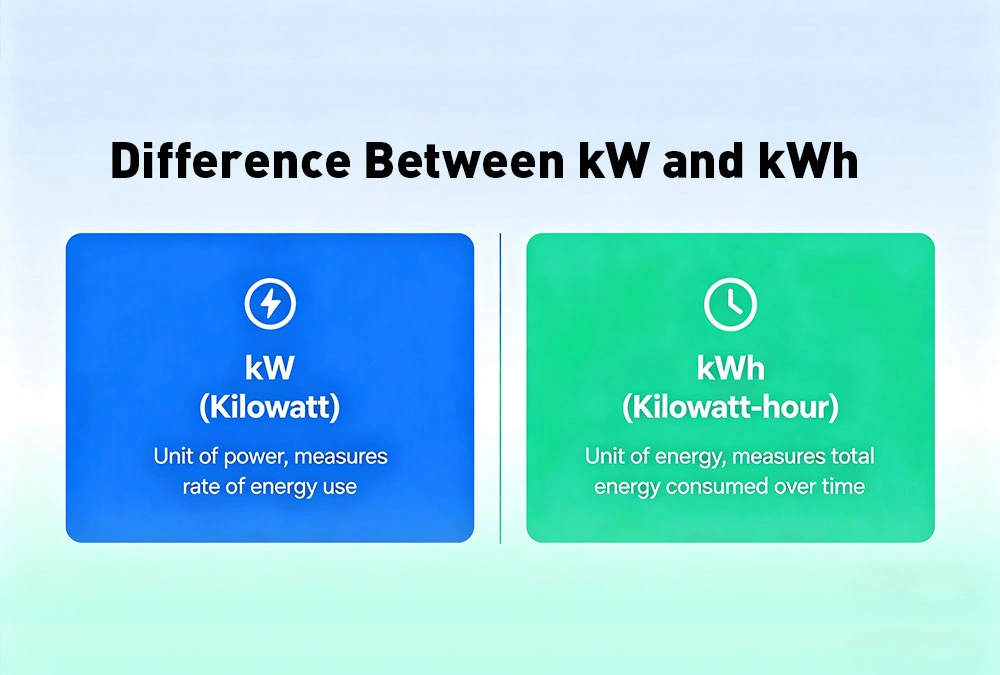
To grasp the difference between kW and kWh, one should look at the relationship between “capacity” and “volume.” In electrical engineering, these two units represent two different dimensions of the same reality: the flow of electrons.
What Is kW (Kilowatt)? – Power Output Explained
Definition: A kilowatt (kW) is a unit of power. It measures the instantaneous rate at which electricity is being used or generated. Think of it as the “size of the pipe” through which electricity flows.
- Mechanical Analogy: In a car, kW is equivalent to horsepower. It tells you how fast the car can accelerate or its top speed.
- EV Charging Application: When you see a DC Fast Charger rated at 120kW, that is its maximum delivery speed. It tells you how much energy the charger can push into a vehicle at any given second.
- Industrial Load: A factory’s electrical load is measured in kW. If you turn on all your HVAC systems and CNC machines simultaneously, your peak demand (kW) spikes.
What Is kWh (Kilowatt-hour)? – Energy Consumption Explained
Definition: A kilowatt-hour (kWh) is a unit of energy. It measures the total amount of electricity consumed or stored over a specific period. If kW is the “speed” of flow, kWh is the “volume” of the tank.
- Mechanical Analogy: In a car, kWh is equivalent to the size of the fuel tank. It tells you how far you can drive before you need to refuel.
- Electricity Bill: Your utility provider charges you based on kWh—the total volume of energy your facility used during the month.
- Battery Capacity: A battery storage system rated at 215kWh indicates how much total energy it can hold when fully charged.
kW vs kWh – Simple Comparison Table
For a quick summary that satisfies Google’s featured snippet requirements, refer to the table below:
| Feature | Kilowatt (kW) | Kilowatt-hour (kWh) |
| Measurement | Instantaneous Power | Total Energy over Time |
| Analogy | Speedometer (How fast?) | Odometer (How far?) |
| Role in BESS | Power Output (Inverter/PCS) | Capacity (Battery Cells) |
| Billing Impact | Demand Charges (Peak usage) | Consumption Charges (Total usage) |
| Key Question | How much can it handle? | How long will it last? |
Summary: The difference between kW and kWh is the difference between the rate of doing work and the total work done. To calculate energy (kWh), you simply multiply the power (kW) by the time (hours) the equipment is operational.
kW vs kWh Formula and Calculation (How to Convert kW to kWh)
Accurate sizing of energy systems requires a mastery of basic conversion formulas. This is essential for determining kW vs kWh for EV charging station design and industrial battery sizing.
The Basic Formula: kWh = kW × Time (Hours)
To find the total energy used, use the following formula:
Energy (kWh) = Power (kW) * Time (hours)
Conversely, to find the power if you know the energy and time:
Power (kW) = Energy (kWh) / Time (hours)
Real Examples: Converting kW to kWh in Daily Use
Example 1: Industrial Air Compressor
If a factory operates a 50kW air compressor for 8 hours a day, the daily energy consumption is:
50 kW * 8 hours = 400 kWh
Example 2: EV Charging Station Design
Consider a public parking facility planning a 180kW DC dual-gun charger. If the charger operates at full capacity for 10 hours a day, the daily energy demand on the local grid would be:
180 kW * 10 hours = 1,800 kWh
This calculation is vital for kW vs kWh electricity cost calculation commercial buildings, as it helps facility managers predict their utility impact before breaking ground.
| Electrical Equipment | Power Output (kW) | Time Used (Hours) | Energy Consumed (kWh) |
| 65″ LED Television | 0.1 kW | 10 Hours | 1 kWh |
| Industrial HVAC System | 2.5 kW | 1.5 Hours | 3.75 kWh |
| Home EV Charger (Level 1) | 3.5 kW | 10 Hours | 35 kWh |
| Level 2 EV Charger | 22 kW | 8 Hours | 176 kWh |
| DC Fast Charger (DCFC) | 60 kW | 0.5 Hours (30 mins) | 30 kWh |
| Utility-Scale BESS Discharge | 1,000 kW (1MW) | 2 Hours | 2,000 kWh (2MWh) |
Key Insight: As shown in the table, a high-power device like a 60kW DC Fast Charger consumes as much energy in 1 minute as a 100W (0.1kW) television consumes in 10 hours. This illustrates why kilowatt vs kilowatt hour explained in the context of time is so vital for grid stability.
Common Mistakes When Calculating Power and Energy
- Interchanging kW and kWh: Many procurement documents mistakenly list battery capacity in kW. Remember, a “100kW battery” only tells you how fast it can discharge, not how long it will last.
- Ignoring Duty Cycles: Most equipment doesn’t run at 100% of its kW rating 100% of the time. For accurate kWh estimation, you must use the average load factor.
- Efficiency Losses: Converting from DC (Battery) to AC (Grid) involves heat loss. Usually, a factor of 0.85 to 0.95 should be applied to your kWh calculations to account for round-trip efficiency (RTE).
kW vs kWh in Electricity Bills (Demand vs Energy Charges Explained)
Understanding the difference between kW and kWh is most financially critical when reviewing commercial utility bills. Unlike residential users who primarily pay for kWh, commercial and industrial (C&I) entities are billed for both.
What Is Demand Charge (kW) in Commercial Electricity?
Demand charges are based on the highest amount of power (kW) drawn from the grid during a specific interval (usually 15 or 30 minutes) within a billing cycle. Utilities must maintain infrastructure (transformers, wires) capable of handling your highest spike, so they charge you for that “readiness.”
What Is Energy Charge (kWh) in Utility Billing?
This is the standard charge for the total volume of electricity used. Whether you use 10kW for 10 hours or 100kW for 1 hour, the energy charge (100kWh) remains the same. However, the demand charge for the latter would be 10 times higher.
Why Understanding kW vs kWh Can Reduce Electricity Costs
By utilizing “Peak Shaving,” a facility can use a Battery Energy Storage System to discharge power during peak periods. This reduces the commercial electricity demand kW seen by the utility meter, effectively lowering the demand charge without necessarily reducing total kWh consumption.
kW vs kWh in Battery Energy Storage Systems (BESS Explained)
In the context of 2026 energy trends, BESS technology is the bridge between intermittent renewable energy and stable industrial power. Here, the difference between kW and kWh defines the system’s architecture.
Battery Power (kW) vs Battery Capacity (kWh)
- kW (Power): This is determined by the Power Conversion System (PCS) or Inverter. It dictates how many loads the battery can support simultaneously.
- kWh (Capacity): This is determined by the number of battery cells (typically Lithium Iron Phosphate or LiFePO4). It dictates how many hours the battery can provide that power.
How to Size a Battery System Using kW and kWh
To determine what size battery (kWh) needed for kW load, follow this logic:
- Identify the peak load you want to cover (e.g., 200kW).
- Identify how many hours you need that coverage (e.g., 4 hours).
200 kW * 4 hours = 800 kWh.- Add a safety margin for Depth of Discharge (DoD). Since LFP batteries should generally not be discharged to 0%, an 800kWh requirement might necessitate a 1000kWh system.
Why Both kW and kWh Matter in BESS Design
A system with high kW but low kWh (e.g., 100kW/50kWh) is built for Frequency Regulation—handling short, high-power bursts. A system with low kW but high kWh (e.g., 50kW/200kWh) is built for Energy Arbitrage—storing cheap solar energy during the day to use at night.
kW vs kWh in EV Charging and Industrial Applications
EV Charging Example: Power vs Energy
When designing an EV charging hub, the distinction is clear:
- Charging Station Power (kW): A 350kW “Ultra-Fast” charger can add 100km of range in minutes, provided the vehicle’s BMS can handle the intake.
- Vehicle Battery (kWh): A Tesla Model S has roughly a 100kWh battery. If you charge it on a 50kW charger from 0% to 100%, it will take approximately 2 hours (100kWh / 50kW = 2h).
Solar + Storage Systems (PV + BESS)
In a solar installation, the solar panels have a rated output in kWp (Kilowatt-peak). This is the maximum power they can generate under ideal sunlight. The battery storage capacity kWh then determines how much of that daily generation can be “shifted” for use after the sun goes down.
Why Understanding kW and kWh Is Critical for Energy Storage ROI
According to the 2025 Global Energy Storage Outlook by BloombergNEF, the cost of BESS has reached a “tipping point” where the ROI is driven more by smart software (EMS) than by hardware costs.
Peak Shaving and Demand Reduction
By reducing your peak demand vs energy consumption ratio, you can save thousands of dollars monthly. For example, if a factory peaks at 500kW for only 30 minutes a day, installing a 100kW BESS can “shave” that peak to 400kW, significantly lowering the demand charge.
Energy Arbitrage (Buy Low, Use High)
In regions with Time-of-Use (ToU) pricing, electricity is cheap at 2 AM (low demand) and expensive at 6 PM (high demand). A BESS allows you to buy 200kWh at the low rate and consume it during the high-rate period, capturing the price spread.
Faster ROI with Smart Energy Management Systems (EMS)
The EMS is the “brain” that decides when to use the kW and when to save the kWh. Modern EMS platforms use AI to predict weather patterns and grid prices, ensuring that the battery’s state of charge (SoC) is always optimized for the highest financial return.
Commercial & Industrial Battery Storage Solutions Based on kW and kWh
For enterprises looking to integrate these technologies, selecting the right hardware configuration is essential. Below are the industry-standard solutions for 2026.
Integrated Battery Cabinets (kWh Level Solutions)
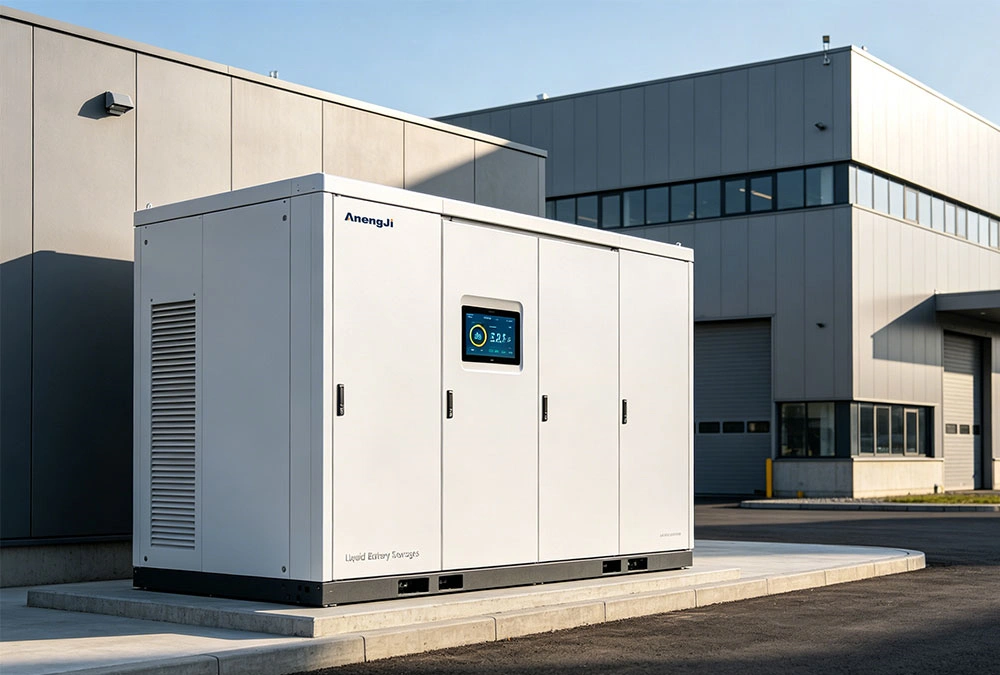
For small to medium businesses, an all-in-one liquid-cooled energy storage cabinet is often the best fit. These systems typically range from 30kW/60kWh to 100kW/215kWh.
- Best for: Supermarkets, office buildings, and EV charging stations.
- Advantage: Compact footprint and “Plug & Play” installation.
Containerized Battery Energy Storage Systems (MWh Level)
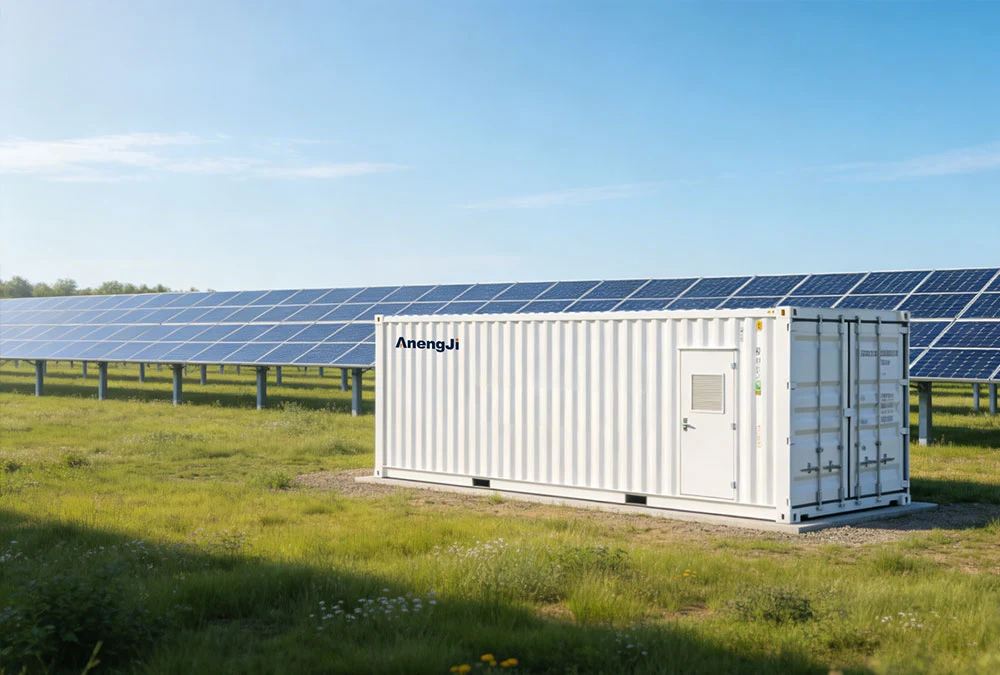
For heavy industry or utility-scale projects, containerized solutions (20ft or 40ft) offer megawatt-level power and multi-megawatt-hour capacity.
- Example Solution: 1MW / 2.15MWh Container.
- Key Features: Integrated Fire Suppression (Aerosol/Perfluoro), Intelligent Liquid Cooling, and high-density LFP cells.
- Application: Grid-scale frequency regulation and large-scale industrial peak shaving.
Featured Product Recommendation:
For C&I applications requiring high reliability, we recommend the 100kW / 215kWh Integrated Liquid-Cooling BESS. This system utilizes Tier-1 LFP cells and an integrated EMS, offering a round-trip efficiency of >90% and a design life of over 15 years. It is specifically optimized for reducing demand charges and supporting DC fast-charging infrastructure.
Summary: kW vs kWh Explained in Simple Terms
If you need a quick reference for your team, remember these three points:
- kW is the rate (Power): It tells you how much electricity is moving right now. Use this to size your breakers, cables, and inverters.
- kWh is the quantity (Energy): It tells you how much electricity was used over time. Use this to estimate your bill and size your battery capacity.
- The Relationship:
kWh = kW x Hours. To get more energy, you either need more power or more time.
FAQ – kW vs kWh Explained (Featured Snippet Optimized)
What is the main difference between kW and kWh?
The difference between kW and kWh is that kW measures instantaneous power (the rate of energy flow), while kWh measures total energy consumption or storage over a period of time.
How many kWh is 1 kW?
1 kW is not “equal” to a certain number of kWh. However, if a 1 kW device runs for exactly 1 hour, it will consume 1 kWh of energy.
Is electricity billed in kW or kWh?
Residential electricity is primarily billed in kWh (consumption). However, most commercial and industrial electricity bills include both kWh (consumption) and kW (demand charges).
How do I convert kW to kWh?
To convert kW to kWh, multiply the power rating (kW) by the number of hours the device is operational. Formula: kW * Hours = kWh.
What size battery do I need for my load?
To calculate the required battery size, use the formula: Battery size (kWh) = Load (kW) * Required backup time (Hours) / Depth of Discharge (%). For example, a 10kW load for 5 hours at 80% DoD requires a 62.5kWh battery.
Why is kW important in energy storage systems?
kW is important because it determines the maximum discharge capacity. It dictates whether the battery can power heavy machinery or just basic lighting during an outage.
This technical guide was developed based on 2026 energy market standards and IEEE electrical guidelines to ensure the highest level of accuracy for engineering and procurement professionals.
 https://anengjipower.com/wp-content/uploads/2026/04/Battery-Storage-Cost-per-kWh-in-2026-Pricing-ROI-Guide.webp
675
1000
Charging Station Engineer
https://anengjipower.com/wp-content/uploads/2025/09/anengji-dc-fast-charging-station-manufacturer-and-supplier-logo-white-1.png
Charging Station Engineer2026-04-17 08:18:372026-04-17 08:18:50Battery Storage Cost per kWh in 2026: Pricing & ROI Guide
https://anengjipower.com/wp-content/uploads/2026/04/Battery-Storage-Cost-per-kWh-in-2026-Pricing-ROI-Guide.webp
675
1000
Charging Station Engineer
https://anengjipower.com/wp-content/uploads/2025/09/anengji-dc-fast-charging-station-manufacturer-and-supplier-logo-white-1.png
Charging Station Engineer2026-04-17 08:18:372026-04-17 08:18:50Battery Storage Cost per kWh in 2026: Pricing & ROI Guide https://anengjipower.com/wp-content/uploads/2026/04/modular-types-of-battery-energy-storage-systems-lfp.webp
675
1000
Charging Station Engineer
https://anengjipower.com/wp-content/uploads/2025/09/anengji-dc-fast-charging-station-manufacturer-and-supplier-logo-white-1.png
Charging Station Engineer2026-04-16 08:55:442026-04-16 08:57:47Types of Battery Energy Storage Systems: Commercial & Industrial Guide
https://anengjipower.com/wp-content/uploads/2026/04/modular-types-of-battery-energy-storage-systems-lfp.webp
675
1000
Charging Station Engineer
https://anengjipower.com/wp-content/uploads/2025/09/anengji-dc-fast-charging-station-manufacturer-and-supplier-logo-white-1.png
Charging Station Engineer2026-04-16 08:55:442026-04-16 08:57:47Types of Battery Energy Storage Systems: Commercial & Industrial Guide https://anengjipower.com/wp-content/uploads/2026/04/How-Do-Battery-Energy-Storage-Systems-Work-A-Commercial-Guide.webp
675
1000
Charging Station Engineer
https://anengjipower.com/wp-content/uploads/2025/09/anengji-dc-fast-charging-station-manufacturer-and-supplier-logo-white-1.png
Charging Station Engineer2026-04-15 08:46:012026-04-15 08:46:37How Do Battery Energy Storage Systems Work? A Commercial Guide
https://anengjipower.com/wp-content/uploads/2026/04/How-Do-Battery-Energy-Storage-Systems-Work-A-Commercial-Guide.webp
675
1000
Charging Station Engineer
https://anengjipower.com/wp-content/uploads/2025/09/anengji-dc-fast-charging-station-manufacturer-and-supplier-logo-white-1.png
Charging Station Engineer2026-04-15 08:46:012026-04-15 08:46:37How Do Battery Energy Storage Systems Work? A Commercial Guide


Leave a Reply
Want to join the discussion?Feel free to contribute!