
Introduction
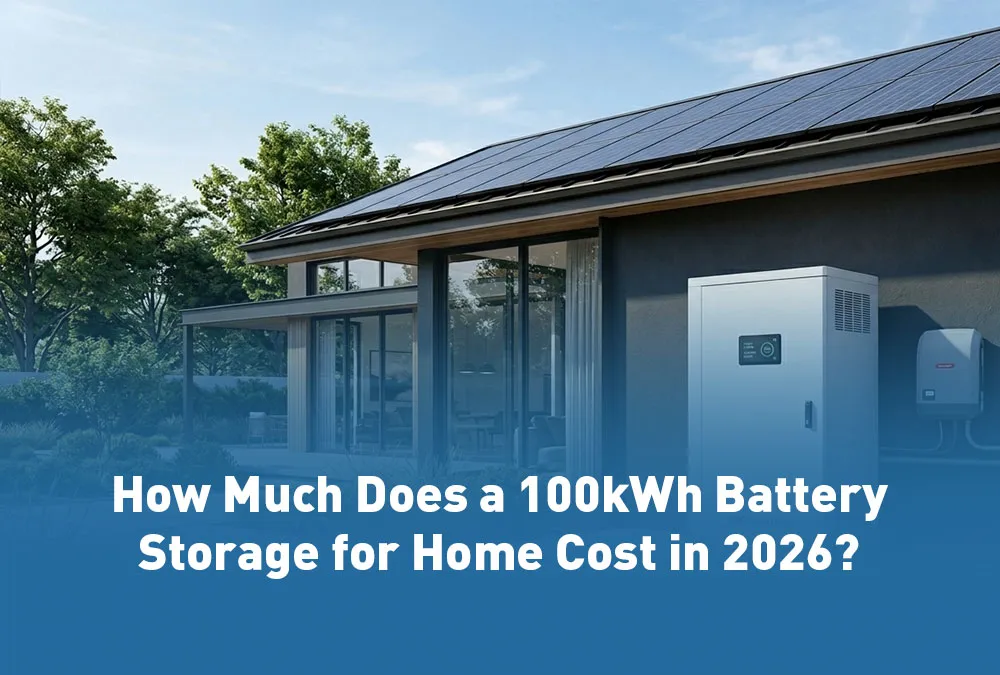
The global transition toward decentralized power grids and localized electrification has dramatically shifted consumer energy requirements. For properties with intensive energy profiles, heavy machinery, or multiple electric vehicles, a standard 10kWh or 20kWh backup pack is simply insufficient. Selecting a high-capacity 100kWh battery storage for home represents a significant infrastructural upgrade, shifting a property from basic backup protection to total microgrid resilience. In 2026, dropping stationary lithium-ion cell prices and more mature Power Conversion Systems (PCS) have made these three-phase, large-scale systems far more accessible. However, integrating this level of capacity requires precise electrical engineering considerations, accurate load assessments, and strict structural safety compliance.
What Is a 100kWh Battery Storage System for Home?
What does “100kWh home battery storage” actually mean?
In stationary electrical engineering, kilowatt-hours (kWh) denote the total volumetric energy capacity a battery can retain and subsequently release over a given duration. A 100kWh system possesses a nominal capacity capable of delivering 100 kilowatts of continuous electrical power for exactly one hour, or conversely, 5 kilowatts of power continuously for 20 hours. When deployed within a domestic context, it transforms into a comprehensive residential battery storage system capable of driving both single-phase essential loads and complex three-phase inductive loads.
Typical system configuration (battery + PCS + BMS + EMS)
A complete, institutional-grade home energy storage system (HESS) is never just a collection of cells. It operates via four closely synchronized sub-systems:
- The Battery Modules: A high-voltage DC assembly built using dense lithium battery home storage configurations.
- Power Conversion System (PCS / Inverter): The bidirectional inverter that rectifies incoming grid AC power into DC to charge the cells, and inverts DC back to smooth AC for home consumption or grid export.
- Battery Management System (BMS): The critical hardware and firmware layer monitoring cell-level voltage, state-of-charge (SoC), and operating temperatures to prevent thermal runaway.
- Energy Management System (EMS): The intelligent software interface controlling the dispatch strategy, managing time-of-use (TOU) scheduling, and orchestrating solar self-consumption.
Who really needs a 100kWh residential battery system?
Deploying a large home battery system of this scale is a specialized application. The average suburban household consumes roughly 30 kWh daily, meaning a 100kWh system would be heavily underutilized. Instead, this scale of storage is designed explicitly for architectural properties with extensive structural footprints. It serves as the primary mechanism for a battery storage for villa / luxury home setup, sprawling agricultural operations, or an off-grid 100kWh battery system for house profiles where utility connection is entirely absent or prohibitively expensive to run.
How Does a 100kWh Home Battery Storage System Work?
Energy flow: grid → battery → home loads
The operational loop of a modern Battery Energy Storage System (BESS) relies on dynamic power tracking. During off-peak periods when utility tariffs drop, or when local solar arrays generate excess power, the system directs electricity through the distribution panel into the BESS. When domestic energy demand spikes beyond solar production limits or during a utility outage, the system instantaneously discharges, routing power back to the home’s sub-panels to sustain continuity without a single millisecond of voltage sag.
Role of PCS (power conversion system) in AC/DC conversion
The efficiency of a whole home backup battery is fundamentally bounded by its PCS. Batteries natively operate on direct current (DC), whereas home appliances require alternating current (AC). The PCS utilizes high-frequency insulated-gate bipolar transistors (IGBTs) or silicon carbide (SiC) MOSFETs to efficiently flip the voltage waveform. For a 100kWh installation, a robust 30kW to 50kW three-phase hybrid inverter is typically utilized to manage high surge currents from air conditioners, deep-well pumps, and geothermal units.
How EMS optimizes energy usage and cost savings
The EMS serves as the brain of the storage infrastructure. By monitoring real-time utility pricing structures and localized meteorological forecasts, it shifts operational profiles programmatically. If utility rates spike between 4 PM and 9 PM, the EMS automatically isolates the property from the grid, utilizing stored energy from the solar battery storage for home configuration. This systematic shifting of heavy consumption away from peak rates significantly accelerates project payback periods.
How Much Energy Can a 100kWh Battery Provide for a Home?
Usable capacity vs nominal capacity
A critical rule of thumb for any power plant design is distinguishing between nominal and usable capacity. To prevent premature chemical degradation, systems limit their Depth of Discharge (DoD). High-quality lithium iron phosphate cells typically sustain a 90% to 95% DoD threshold.
Usable Capacity = Nominal Capacity * Depth of Discharge (DoD)
For instance, a nominal 100kWh pack set to a conservative 90% DoD provides exactly 90kWh of functional energy storage capacity.
Typical household daily consumption (kWh/day breakdown)
To understand what this looks like in practice, evaluate how power demands scale. Understanding how many kWh does a house use depends directly on automation systems, square footage, and climate control zones:
- Standard Luxury Villa (Baseline): Continuous HVAC cycling, lighting, high-end refrigeration, pool pumps, and automation logic: ~60 kWh/day.
- Electrified Estate / Mini-Farm: Multi-zone heat pumps, domestic water filtration, workshop tools, and agricultural refrigeration: ~90 kWh/day.
- High-Load Smart Home + Dual EVs: Daily commuting charging demands coupled with full structural conditioning: ~120 kWh/day.
Backup time scenarios
How long will a whole house battery backup 100kWh plant sustain a property during a critical backup battery for house power outage scenario? Let us isolate three distinct real-world load environments:
- Small to Medium Home (Conserving Power): Maintaining basic refrigeration, lighting, internet connectivity, and minimal cooking loads (avg. 1.2 kW continuous draw) yields over 75 hours of continuous runtime.
- Large Villa / Estate (Standard Operations): Running multi-zone climate control, variable-speed pumps, entertainment centers, and kitchen appliances (avg. 3.5 kW continuous draw) yields roughly 25 to 26 hours of absolute autonomy.
- EV Charging + High-Load Environment: Simultaneously operating automated systems while deploying battery storage for EV charging at home at a sustained 11kW level will deplete the available reserves in under 8.5 hours.
Quick formula: how to calculate backup time
To quickly size your runtime parameters during a black-start grid condition, use this straightforward text-formatted calculation formula:
Backup Time (Hours) = (Nominal Capacity [kWh] * Depth of Discharge [%]) / Average Continuous Load [kW]
Assuming a 100kWh pack, a 90% DoD profile, and a steady 4.5kW household load:
Backup Time = (100 * 0.90) / 4.5 = 90 / 4.5 = 20 Hours
How Long Does It Take to Charge a 100kWh Home Battery?
Charging via grid power (slow vs fast charging)
Replenishing a large home battery system directly via grid power depends directly on the current capacity of your electrical service panel and the inverter’s maximum output rating. If limited to a standard single-phase 7kW input charge rate, recharging a depleted 100kWh pack requires roughly 14 hours. Conversely, utilizing a robust three-phase 30kW commercial-grade inverter charging at full capacity can completely top up the cells from 0% to 100% in just over 3.3 hours.
Charging via solar system
To achieve absolute grid autonomy via a residential solar + storage system, charging must leverage daytime solar irradiance. Assuming an optimal winter or summer generation window yielding 5 hours of peak sun daily, a property requires a significant solar array to fully saturate a 100kWh bank while simultaneously running active household loads.
Factors affecting charging speed (power rating, inverter size, weather)
Real-world charging efficiency never matches theoretical maximums due to thermal throttling and conversion losses. If ambient temperatures exceed optimal limits, the BMS will instruct the inverter to taper the charge rate to preserve cell health. Furthermore, overcast conditions can cut PV string generation down to 10-20% of rated capacity, significantly lengthening the charge cycle.
What Size Solar System Is Needed for a 100kWh Home Battery? (Solar + Storage Sizing)
Solar panel capacity required (kW vs kWh relationship)
Sizing an array for a 100kWh solar battery storage for home asset requires balancing production against capacity. If you want to fully replenish the system on a typical sunny day, you cannot simply match numbers. Due to system-wide conversion efficiency losses (typically hovering around 85-90% for modern hybrid architectures), a 100kWh pack needs roughly 115kWh of direct input energy to hit maximum capacity.
Example: daily solar generation vs battery capacity
In an area with a standard peak sun index of 4.5 hours per day, we calculate the required photovoltaic array capacity using this formula:
Required Solar Array (kW) = Total Target Input Energy (kWh) / Peak Sun Hours (Hours)
Required Solar Array = 115 kWh / 4.5 Hours = 25.55 kW
Therefore, a property requires a minimum 25.5kW to 30kW solar panel installation to reliably fill the battery bank during standard daytime operating windows.
Off-grid vs grid-tied system sizing differences
In a standard grid-tied configuration, undersizing your solar array simply means pulling supplemental power from the utility grid when needed. However, in a pure off-grid home battery system, structural redundancy is critical. Engineers typically oversize the solar array by 30% to 50% above baseline calculations to ensure that even during consecutive cloudy winter days, the home generates enough threshold voltage to maintain battery health.
How Many Homes Can 100kWh Power? (Real-World Energy Scenarios)
Powering 1 home vs multiple households
To illustrate the scale of this capacity, look at average grid statistics. According to international energy data metrics, an average suburban home without heavy electrification uses approximately 25 to 30 kWh per day. Therefore, a single 100kWh energy block can completely power 3 to 4 average residential homes for a full 24-hour cycle during emergency scenarios.
Industrial vs residential comparison
In commercial settings, a 100kWh block is classified as a light Commercial and Industrial (C&I) asset. While a large residential home uses this to back up HVAC units and luxury systems over days, a small manufacturing shop or retail center utilizes this same footprint to run high-load CNC machinery, commercial refrigeration networks, and heavy overhead lighting grids during short-term peak demand intervals.
EV charging scenario (how many EVs can be charged)
With the rapid integration of high-power EV chargers, domestic storage sizing models have drastically changed. Let’s look at the numbers for standard modern electric vehicle battery capacities:
Tesla Model 3 / Y Standard Range: ~60 kWh Pack
Porsche Taycan / Ford F-150 Lightning: ~90 to 130 kWh Pack
A 100kWh battery storage for home configuration can deliver a complete 0-100% full charge to an entry-level EV, leaving roughly 30-40kWh of remaining capacity for standard home operations. However, it cannot fully replenish two long-range electric trucks simultaneously without grid or solar support.
Safety & Design Considerations for a 100kWh Home Battery Storage System
Battery chemistry (LFP vs NMC safety comparison)
When dealing with an energy volume as large as 100kWh inside a residential perimeter, choice of battery chemistry is paramount.
- Nickel Manganese Cobalt (NMC): Offers high energy density, but possesses a lower thermal runaway threshold (around 210°C) and carries risk of self-oxygenating fires if compromised.
- Lithium Iron Phosphate (LFP / LiFePO₄): The definitive industry standard for stationary BESS installations. LFP cells exhibit a much higher thermal runaway point (around 270°C), do not release volatile oxygen under puncture, and deliver significantly longer cycle life profiles.
Thermal management (air cooling vs liquid cooling)
Sustained high-power charging and discharging creates internal resistance heat within cell matrices. Standard residential enclosures utilize forced-air cooling fans, which work adequately in temperate zones. However, for 100kWh configurations exposed to extreme climates or high-duty cycles, advanced liquid-cooling thermal jackets are superior. They ensure temperature uniformity across all cells within a 2°C variance, dramatically preventing uneven cell aging.
Fire protection & certifications (CE, UL9540A)
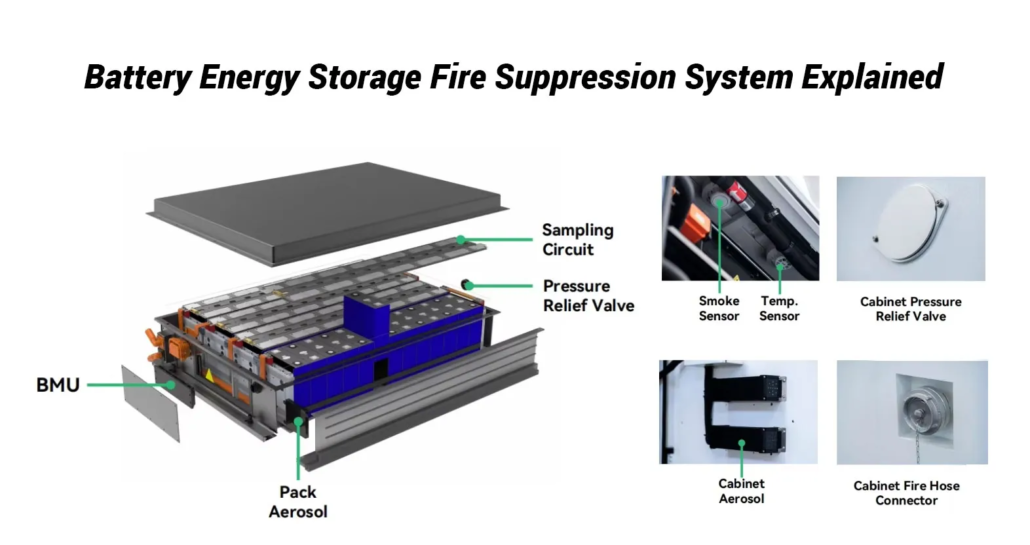
An uncertified large-scale battery installation is a liability that can void property insurance policies. Any high-voltage home energy independence system must carry definitive safety listings. Look for verification of UL 1973 (safety for battery packets) and UL 9540 (system-level certification for energy storage systems). Crucially, ensure the system has passed UL 9540A large-scale thermal runaway fire testing, confirming that any potential internal cell failure will be contained without propagating a structural fire.
Usage Guidelines & Warranty for 100kWh Residential Battery Storage
Daily operation best practices
To maximize the operational lifespan of your investment, avoid extreme state-of-charge states. Running the battery to absolute zero percent or keeping it parked at 100% continuous charge at high temperatures accelerates capacity loss. Programming your EMS to operate within a 10% to 90% SoC window provides an optimal balance between daily capacity utilization and long-term cell health.
Depth of discharge & battery lifespan
Modern tier-1 LFP cells are engineered to provide between 6,000 and 8,000 complete cycles before their original capacity degrades to 80% of its initial rating. If you fully cycle the storage system once every single day, an 8,000-cycle certified pack will deliver more than 20 years of continuous service life.
Warranty terms and degradation expectations
Standard manufacturer warranties for a premier home energy storage system (HESS) should cover a minimum of 10 years. A comprehensive warranty doesn’t just promise that the machine will turn on; it must explicitly guarantee a remaining capacity threshold—typically guaranteeing that the system will retain at least 70% to 80% of its nominal capacity at the end of the 10-year period.
How Much Does a 100kWh Home Battery Storage System Cost in 2026?
System cost breakdown
What is the realistic 100kWh home battery storage system cost in the current 2026 market? Thanks to massive global manufacturing scaling and stabilizing raw material inputs, turnkey project pricing has reached historic lows. A detailed breakdown of capital expenditure (CapEx) for an integrated residential installation includes:
| Component Category | Estimated Cost Range (USD) | Percentage of Total Budget |
| A-Grade LFP Battery Modules Core | $14,000 – $22,000 | 50% – 55% |
| 30kW–50kW Hybrid Inverter / PCS Unit | $5,000 – $8,000 | 18% – 20% |
| BMS, Smart EMS, and Pre-wired Cabinet | $3,000 – $4,500 | 10% – 12% |
| Engineering Design, Permitting, and On-Site Labor | $4,000 – $7,500 | 15% – 18% |
| Total Turnkey Cost Range | $26,000 – $42,000 | 100% |
Key factors affecting price
The wide variance in 100 kwh battery storage price profiles depends heavily on localization and certification requirements. Deploying an indoor-rated NEMA 1 system costs significantly less than a ruggedized, outdoor-rated IP65 climate-controlled industrial enclosure meant to withstand sub-zero winters or coastal environments. Furthermore, systems fully certified for North American UL standards carry a regulatory premium compared to entry-level systems built for markets with less stringent grid-compliance mandates.
ROI analysis: payback period (with/without solar)
The return on investment (ROI) profile of a 100kWh energy asset relies heavily on regional utility rate design:
- Without Solar (Arbitrage Only): In regions with steep Time-of-Use (TOU) differentials (e.g., $0.45/kWh peak vs $0.10/kWh off-peak), the system charges at night and discharges during peak hours. Expected payback: 6 to 8 years.
- With Solar Integration: Capturing completely free daytime solar energy to offset expensive peak night consumption eliminates grid reliance. This optimized model can compress the capital payback window down to 4 to 5 years, unlocking decades of pure financial upside thereafter.
Is a 100kWh Battery Storage System Right for Your Home?
When 100kWh makes sense
Investing in a large home battery system of this magnitude is highly logical under the following structural parameters:
- The property operates completely off-grid or is tied to a highly unstable rural electrical infrastructure prone to multi-day blackouts.
- The site features large inductive loads like automated gates, commercial workshop machinery, or expansive geothermal HVAC networks.
- The property owners manage multiple electric vehicles and demand fast charging capabilities at night without triggering utility peak demand penalties.
When smaller systems (10–50kWh) are better
If your primary residential goal is simply to keep your lights, internet routers, and single refrigerator running during a brief 4-hour storm outage, a 100kWh installation is completely unnecessary. A standard modular 10kWh to 20kWh stack easily covers these basic residential backup needs at a fraction of the initial capital investment.
Decision checklist for homeowners
Before signing an engineering procurement contract, run through this simple verification list:
- Does your property have sufficient concrete pad space to support an enclosure weighing over 800–1,200 kg?
- Is your main electrical service panel rated for at least 200 Amps to support the required bidirectional power flow?
- Do local zoning laws permit the installation of a high-capacity energy storage cabinet on your residential property?
Benefits of a 100kWh Home Battery Storage System
Reduce electricity bills & peak demand charges
Many electrical utilities are introducing commercial-style “demand charges” for high-load residential consumers. These penalties are calculated based on the single highest peak hour of energy use during a billing cycle. By using a 100kWh battery to smooth out those spikes—a strategy known as peak shaving—you ensure your property maintains a flat, predictable, low-cost utility profile.
Backup power during outages
Climate volatility continues to challenge the stability of centralized electrical grids worldwide. A 100kWh reservoir provides your home with unmatched security, allowing you to sustain a comfortable lifestyle during extended grid failures without relying on loud, emissions-heavy diesel backup generators.
Enable EV charging & solar self-consumption
Rooftop solar generation naturally peaks during midday when many homeowners are away from property. Without storage, that clean energy is back-fed to the utility company for minimal credit. A 100kWh BESS allows you to store every single watt of excess solar power locally, saving it to fast-charge your vehicles when you return home in the evening.
100kWh vs 10kWh vs 50kWh Home Battery Storage
To clearly understand how these capacities stack up against each other across the industry, look at this structured breakdown:
| Metric / Feature | 10kWh System | 50kWh System | 100kWh System |
| Primary Application | Critical load backup (lights, Wi-Fi, fridge) | Full-size home backup + light solar integration | Luxury estate, off-grid farm, or light C&I site |
| Phase Compatibility | Typically single-phase only | Single-phase or split-phase | Three-phase industrial architecture |
| Typical Physical Weight | ~90 kg – 120 kg | ~400 kg – 500 kg | ~900 kg – 1,200 kg |
| Installation Footprint | Small wall-mount footprint | Floor-standing compact cabinet | Dedicated outdoor concrete pad |
| Average Payback Window | 7 – 10 Years | 5 – 7 Years | 4 – 6 Years (with optimized solar) |
Can a 100kWh Battery Be Used for Commercial Applications?
When home systems become commercial-grade
The boundary line separating large residential energy assets from Commercial & Industrial (C&I) installations is fluid. Once a system scales to 100kWh, its internal component design matches the hardware specifications of commercial systems. It utilizes high-voltage DC bus lines (often running between 600V to 900V) to reduce current levels, minimize heat losses, and maximize system-wide round-trip efficiency.
EV charging stations + battery integration
For commercial operators building destination charging locations, integrating a 100kWh battery system is highly effective. It acts as an energy buffer, charging slowly from the grid during low-traffic periods and discharging rapidly when an electric vehicle pulls up to fast-charge. This clever setup allows property owners to provide high-speed EV charging services without needing expensive, complex upgrades to local utility grid infrastructure.
💬 From the Forums: Can I DIY a 100kWh Battery Pack to Save Money?
A frequent topic across renewable energy forums is whether an ambitious homeowner can source individual Grade-B prismatic cells online and build their own 100kWh storage bank to cut costs.
As an engineer, my answer is a definitive no. Assembling a high-voltage system of this scale yourself poses severe risks. Forcing hundreds of individual lithium cells into series without precise, high-pressure torque on busbars creates high-resistance connection points. Over time, these hot spots can easily melt components and trigger catastrophic failures. Professional, factory-integrated systems use automated laser-welded connections and undergo strict thermal stress testing to ensure safe operation. When dealing with 100kWh of energy, choosing a certified, factory-built option is a non-negotiable safety requirement.
AnengJi Home & Commercial Battery Energy Storage Solutions
As a leading innovator in clean energy infrastructure, AnengJi Power designs and manufactures high-performance, integrated energy systems engineered for ultimate reliability. Our advanced high-capacity platforms seamlessly combine tier-1 LFP chemistry with intelligent, three-phase power conversion architectures. Whether you are building a resilient, off-grid luxury estate or integrating high-power EV fast-charging stations, our turnkey systems deliver the safety, thermal efficiency, and cycle life required for demanding energy profiles. From initial engineering design and grid compliance verification through to installation and lifecycle maintenance support, AnengJi ensures complete energy independence.
Summary: Is a 100kWh Home Battery Storage System Worth It? (Key Takeaways)
Quick answers (for featured snippets)
What is a 100kWh battery? It is an institutional-grade energy storage system designed to manage large-scale power loads, high-capacity solar arrays, and intensive EV charging demands.
How long can it power a home? It can sustain a standard home for up to 3 to 4 days, or power a large, highly electrified luxury estate for a full 24 hours under normal load conditions.
Is it too big for residential use? For the average suburban house, yes. However, for off-grid properties, farms, or luxury estates with high power demands, it provides the ideal capacity framework.
What does it cost in 2026? A fully integrated, turnkey system installation typically ranges from $26,000 to $42,000, depending on your specific installation environment and required certifications.
FAQ – 100kWh Battery Storage for Home
Is 100kWh enough to run a house?
Yes, it is more than enough. For most standard residential properties, a 100kWh system can provide complete power backup for multiple days without needing any solar or grid input.
How many days can a 100kWh battery last?
If the property conserves power and limits energy use to critical loads like lighting, refrigeration, and basic electronics (~25 kWh/day), a 100kWh system can easily provide reliable power for 4 consecutive days.
Can I charge a 100kWh battery with solar panels?
Absolutely. To fully recharge the battery bank during a standard daytime window, you will need to pair it with a solar array rated for at least 25kW to 30kW.
How much does a 100kWh battery cost?
In 2026, the complete hardware and professional installation cost for a certified system typically falls between $26,000 and $42,000.
Is a 100kWh battery overkill for home use?
For a standard home with typical energy habits, it is usually larger than necessary. A capacity of this scale is specifically engineered for large luxury estates, off-grid properties, or homes with heavy EV charging demands.
Can a 100kWh system support EV fast charging at home?
Yes. Thanks to its robust power conversion system (PCS), it can easily supply the high peak currents needed by Level 2 and DC fast chargers without straining your home’s primary electrical panel.
 https://anengjipower.com/wp-content/uploads/2026/10/AnengjiPowr-AC-Coupled-Battery-Storage-at-a-CI-Solar-Site.webp
675
1000
Charging Station Engineer
https://anengjipower.com/wp-content/uploads/2025/09/anengji-dc-fast-charging-station-manufacturer-and-supplier-logo-white-1.png
Charging Station Engineer2026-10-16 03:03:192026-10-16 03:03:49What Is AC-Coupled Battery Storage? C&I BESS Guide
https://anengjipower.com/wp-content/uploads/2026/10/AnengjiPowr-AC-Coupled-Battery-Storage-at-a-CI-Solar-Site.webp
675
1000
Charging Station Engineer
https://anengjipower.com/wp-content/uploads/2025/09/anengji-dc-fast-charging-station-manufacturer-and-supplier-logo-white-1.png
Charging Station Engineer2026-10-16 03:03:192026-10-16 03:03:49What Is AC-Coupled Battery Storage? C&I BESS Guide https://anengjipower.com/wp-content/uploads/2026/10/AnengjiPower-What-Is-Peak-Shaving-at-an-Industrial-Site.webp
675
1000
Charging Station Engineer
https://anengjipower.com/wp-content/uploads/2025/09/anengji-dc-fast-charging-station-manufacturer-and-supplier-logo-white-1.png
Charging Station Engineer2026-10-15 06:49:012026-10-15 06:50:23What Is Peak Shaving? How Battery Energy Storage Reduces C&I Peaks
https://anengjipower.com/wp-content/uploads/2026/10/AnengjiPower-What-Is-Peak-Shaving-at-an-Industrial-Site.webp
675
1000
Charging Station Engineer
https://anengjipower.com/wp-content/uploads/2025/09/anengji-dc-fast-charging-station-manufacturer-and-supplier-logo-white-1.png
Charging Station Engineer2026-10-15 06:49:012026-10-15 06:50:23What Is Peak Shaving? How Battery Energy Storage Reduces C&I Peaks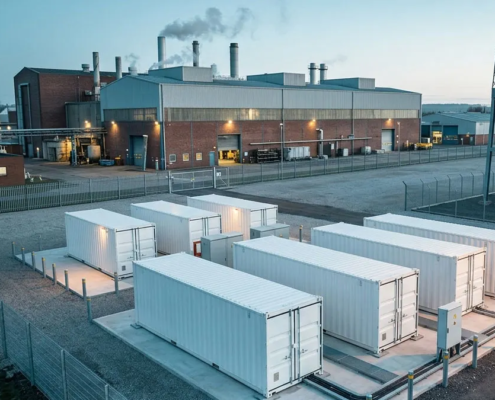 https://anengjipower.com/wp-content/uploads/2026/10/anengjipower-Peak-Shaving-vs-Load-Shifting-at-an-Industrial-Site.webp
675
1000
Charging Station Engineer
https://anengjipower.com/wp-content/uploads/2025/09/anengji-dc-fast-charging-station-manufacturer-and-supplier-logo-white-1.png
Charging Station Engineer2026-10-14 07:47:372026-10-14 07:48:01Peak Shaving vs Load Shifting: C&I Energy Storage Decision Guide
https://anengjipower.com/wp-content/uploads/2026/10/anengjipower-Peak-Shaving-vs-Load-Shifting-at-an-Industrial-Site.webp
675
1000
Charging Station Engineer
https://anengjipower.com/wp-content/uploads/2025/09/anengji-dc-fast-charging-station-manufacturer-and-supplier-logo-white-1.png
Charging Station Engineer2026-10-14 07:47:372026-10-14 07:48:01Peak Shaving vs Load Shifting: C&I Energy Storage Decision Guide


Leave a Reply
Want to join the discussion?Feel free to contribute!