
Introduction
The rapid transition toward electric mobility has created a surge in demand for robust infrastructure, yet many businesses remain confused about the fundamental charging pile vs charging station difference. Understanding this distinction is not merely a matter of semantics; it is a critical requirement for facility managers, fleet operators, and investors who need to deploy scalable, high-performance power solutions. While a “charging pile” refers to the individual unit providing energy to a vehicle, a “charging station” represents a complex, integrated system designed for high-volume energy distribution and grid stability. This guide provides a deep technical and commercial analysis of both, ensuring your investment aligns with the latest E-E-A-T (Experience, Expertise, Authoritativeness, and Trustworthiness) standards for the 2025-2026 energy market.
What Is a Charging Pile (EV Charger) and How Does It Work?
Definition of Charging Pile in EV Charging Infrastructure
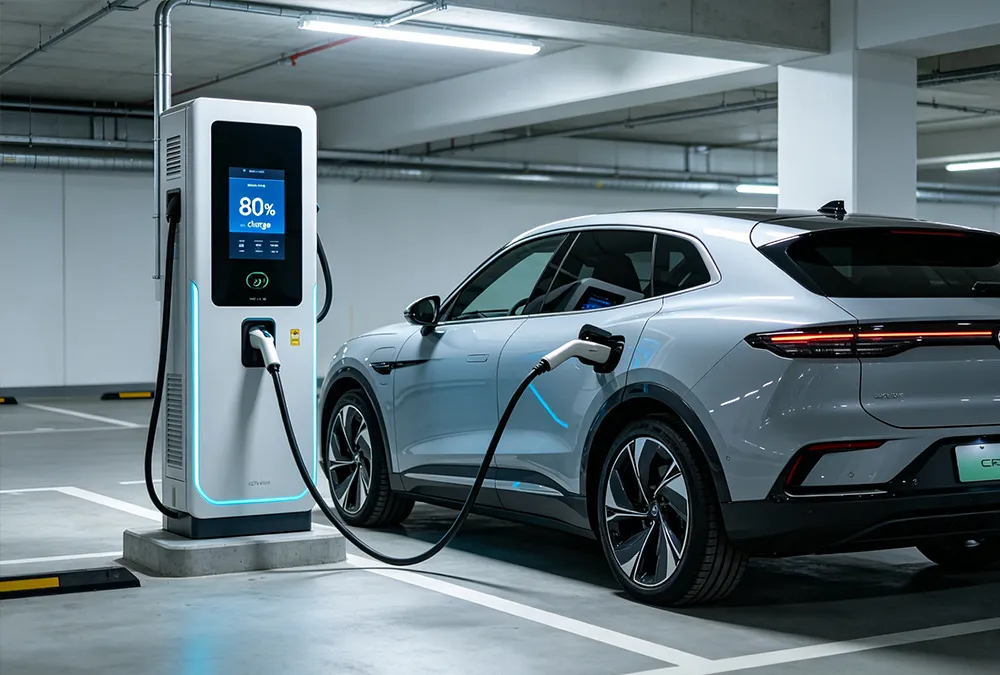
In technical terms, an EV charging pile is a terminal device installed at a fixed location—such as a parking spot or curbside—to provide electricity for electric vehicles. It serves as the physical interface between the power source and the vehicle’s battery. From an engineering perspective, it is the “point of delivery” that manages safety protocols, communication with the vehicle (via protocols like ISO 15118), and metering.
Key Components of a Charging Pile (Power Module, Connector, Control System)
A professional-grade charging pile consists of three primary layers:
- The Power Module: The “heart” of the charger, responsible for converting grid AC to vehicle-compatible DC (in fast chargers). Modern modules utilize Silicon Carbide (SiC) technology to achieve efficiency rates above 96%.
- The Connector and Cable: High-power DC piles often use liquid-cooled cables to manage heat during 250kW+ charging sessions. Common standards include CCS2, CHAdeMO, and GB/T.
- The Control System: This includes the Main Control Board, the Human-Machine Interface (HMI), and the Communication Module (OCPP 1.6J or 2.0.1) for cloud management.
AC vs DC Charging Pile Explained
The charging pile vs charging station difference is most evident when comparing current types.
- AC Charging Piles: These are essentially “gatekeepers.” They pass AC power from the grid to the vehicle’s onboard charger. They are compact and ideal for long-stay parking.
- DC Fast Charging Piles: These contain internal power conversion modules. They bypass the vehicle’s onboard charger to deliver high-voltage DC directly to the battery, significantly reducing charging time.
Typical Power Levels of EV Charging Piles
| Type | Power Range | Common Application |
| Level 2 AC | 7kW – 22kW | Residential & Office |
| DC Fast Charger | 30kW – 180kW | Commercial Hubs |
| Ultra-Fast DC | 240kW – 480kW | Highway Service Stations |
What Is an EV Charging Station and How Does It Differ from a Charging Pile?
Definition of EV Charging Station
An EV charging station is a comprehensive infrastructure system. It is not just a single piece of equipment but a site-wide solution that encompasses multiple charging piles, power distribution transformers, switchgear, and often, advanced software management platforms.
Charging Pile vs Charging Station: Core Differences
The charging pile vs charging station difference lies in the scope. A pile is an asset; a station is a facility. A station manages the “Macro” (grid interaction, site-wide load balancing), while the pile manages the “Micro” (individual vehicle safety and energy flow).
Infrastructure Elements in a Charging Station (Transformer, EMS, BESS)
To maintain a high-power charging station, engineers must integrate several auxiliary systems:
- Step-down Transformer: Converts high-voltage utility power to the 400V or 800V required by the equipment.
- Energy Management System (EMS): A software layer that dynamically allocates power between piles to prevent blowing a fuse.
- Battery Energy Storage System (BESS): This is increasingly vital in 2026. A BESS, like the Anengji ECO-E series, buffers the grid, storing energy during low-cost periods and discharging it during high-demand EV charging events.
Real-World Example of a Commercial Charging Station
Consider a public transit hub in a metropolitan area. It isn’t just a collection of “piles.” It is a station where a 2MW transformer feeds 10 DC fast chargers, all synchronized by an EMS to ensure that when a bus arrives, it receives priority power without destabilizing the local neighborhood’s electricity supply.
Charging Pile vs EV Charging Station: Detailed Comparison (System vs Equipment)
Single Device vs Integrated System
When evaluating the charging pile vs charging station difference, think of a smartphone versus a data center. A charging pile (the smartphone) is the user-facing tool. The charging station (the data center) is the backend infrastructure that makes the tool functional and reliable at scale.
Investment Cost and ROI Differences
A single DC charging pile might cost $10,000 to $50,000. However, a full-scale commercial EV charging solution (a station) involves civil engineering, grid connection fees, and software integration, which can drive costs into the hundreds of thousands.
ROI Comparison Table (Estimated for 2025-2026):
| Metric | Single Charging Pile | Full Charging Station |
| Initial Capex | Low to Moderate | High |
| Operational Costs | Moderate (Maintenance only) | High (Management + Demand Charges) |
| Revenue Potential | Linear (One car at a time) | Exponential (Multi-car + Load Shifting) |
| Scalability | Limited | Designed for growth |
Scalability and Future Expansion
A station is designed with “future-proofing” in mind. For instance, a station may be built with a 1000kVA transformer but only 4 piles initially. As demand grows, adding the 5th and 6th pile is a simple “plug-and-play” operation.
Operational Complexity and Management Systems
Modern stations require smart charging systems. This involves Load Balancing (Formula: $P_{available} = P_{total} – P_{building\_load}$). By managing this, a station operator can avoid $2,000+ monthly “Demand Charges” from the utility.
Types of Charging Pile and EV Charging Station Solutions
Residential Charging Pile (Home EV Charger)
Usually a 7kW AC unit. It is simple, affordable, and focused on overnight charging. It is almost always a “pile” rather than a “station.”
Commercial EV Charging Station Solutions
These are found in malls, hotels, and workplaces. They focus on commercial EV charging pile solutions that offer payment integration and user authentication via RFID or mobile apps.
Fleet Charging Station for Logistics and Bus Depots
Focuses on high-uptime and scheduled charging. Reliability is paramount here, as a 1% failure rate could mean a delivery truck stays grounded.
Ultra-Fast Charging Stations for Highways
These are the “gas stations” of the future. They utilize DC fast charging piles for business that can provide 200km of range in under 10 minutes.
Benefits of Charging Pile Deployment for Commercial and Industrial Applications
New Revenue Streams from EV Charging Services
Businesses can monetize parking spaces by charging per kWh or per minute. With 2025 energy prices stabilizing, the margin between utility costs and retail charging prices has become a viable business model.
Attracting Customers and Increasing Foot Traffic
Data from retail reports in early 2026 shows that EV drivers spend 40% more time in-store while waiting for their vehicle to charge compared to non-EV drivers.
Supporting Sustainability and ESG Goals
Deploying a public EV charging infrastructure directly contributes to a company’s Scope 3 emissions reduction, making the business more attractive to institutional investors.
Challenges of EV Charging Infrastructure and How to Overcome Them
Limited Grid Capacity and Power Constraints
The biggest hurdle is often the utility company. If your facility only has 200kW of spare capacity, you cannot install three 120kW DC chargers without a massive, expensive grid upgrade.
High Demand Charges and Electricity Costs
Utility companies charge a premium for the “peak” power you pull. This can make the EV charging system cost prohibitively high if not managed correctly.
Peak Load Management Issues
When ten EVs plug in at 5:00 PM simultaneously, the spike in demand can exceed the building’s safety limits. This is where smart charging systems become essential.
Battery Energy Storage + Charging Pile: Smart EV Charging Solution
How Battery Energy Storage Supports Charging Piles
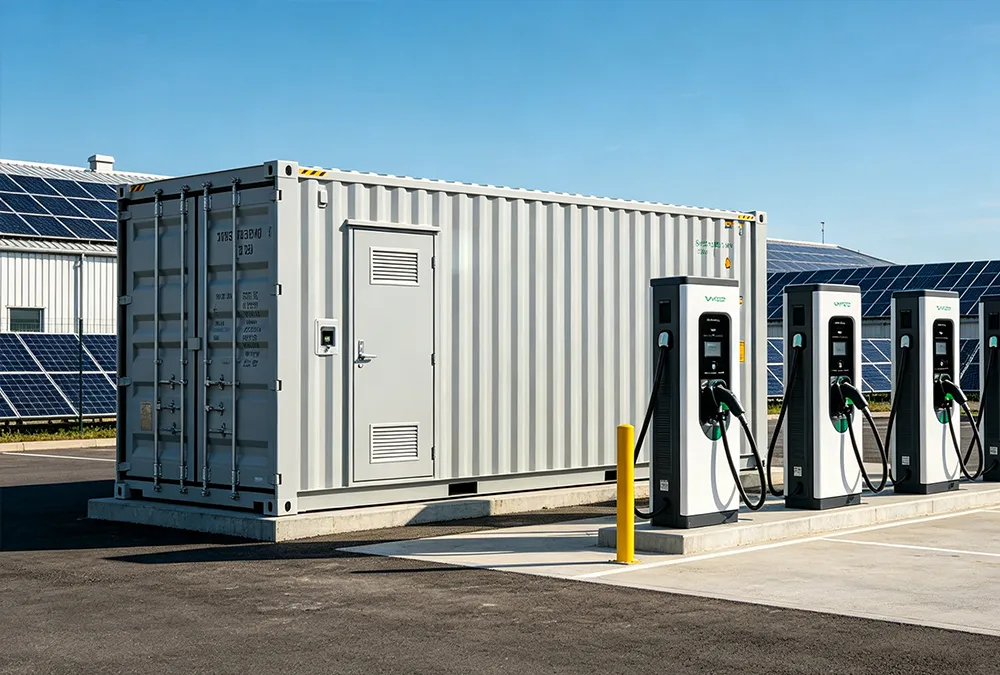
Integrating an EV charging pile with battery storage system is the ultimate “cheat code” for infrastructure. A BESS acts as a “buffer” or a “power reservoir.”
Peak Shaving and Demand Charge Reduction
By using a BESS, you can charge the internal batteries at 2:00 AM (low cost) and use that stored energy to charge EVs at 2:00 PM (high cost), avoiding grid peaks. This is known as “Peak Shaving.”
Off-Grid or Weak Grid Charging Solutions
In remote industrial parks or areas with weak grids, a commercial EV charging station can operate almost entirely on solar + BESS, reducing reliance on the unstable utility network.
Example: How Many EVs Can a BESS Support?
To calculate the support capacity of a BESS, use the following formula:
Number of Vehicles = (BESS Capacity in kWh * Depth of Discharge) / (Average Charging Amount per Vehicle in kWh)
For example, if you have a 233kWh Anengji ECO-E233LS storage system:
Number of Vehicles = (233kWh * 0.9) / 40kWh per car = ~5.2 vehicles
This means the BESS alone can fully charge 5 cars without pulling a single watt from the grid during peak hours.
Recommended Industrial Energy Storage Products
For industrial applications, we recommend the Anengji ECO-E series. Specifically:
- ECO-E233LS: A 100kW/233kWh All-in-one liquid-cooled system. This is the gold standard for commercial EV charging station integration. Liquid cooling ensures the battery lasts 15+ years by maintaining a precise temperature range of ±2°C.
- LFP Technology Explained: These systems use Lithium Iron Phosphate (LiFePO4). Unlike traditional NMC batteries, LFP is non-combustible and can handle over 6,000 cycles, making it the safest and most cost-effective choice for EV infrastructure.
How to Choose the Right Charging Pile or Charging Station for Your Business
Key Factors: Power Capacity, Location, and User Demand
If your users stay for 4+ hours (e.g., an office), AC piles are sufficient. If they stay for 30 minutes (e.g., a supermarket), DC fast chargers are mandatory.
Choosing Between AC and DC Charging Systems
- AC: Lower EV charging system cost, easy installation, slow.
- DC: High turnover, high revenue, complex installation.
When to Integrate Battery Energy Storage Systems
You should consider a BESS if:
- Your grid upgrade quote exceeds $50,000.
- Your local utility has high demand charges.
- You have existing solar PV that you want to maximize.
Why Choose a Professional EV Charging and Energy Storage Provider
Partnering with an EV charging equipment manufacturer like Anengji Power provides more than just hardware. It offers:
- End-to-End Services: From site survey to maintenance.
- Global Certifications: Systems are compliant with CE, UL, and local standards (like Malaysia’s Suruhanjaya Tenaga).
- Manufacturer Direct Supply: Eliminates the middleman, reducing the total EV charging system cost by 20-30%.
Summary: Charging Pile vs Charging Station Explained Simply
Quick Answer: What Is a Charging Pile?
A charging pile is a single EV charging device—the “pump”—that supplies power to electric vehicles.
Quick Answer: What Is a Charging Station?
A charging station is a complete system—the “facility”—that includes multiple charging piles, power infrastructure (transformers, BESS), and management systems.
Key Difference in One Sentence
Charging pile = the equipment; Charging station = the entire ecosystem.
Understanding the charging pile vs charging station difference ensures that your business doesn’t just buy a “plug,” but builds a future-proof energy asset.
FAQs About Charging Pile and EV Charging Station
Is a charging pile the same as a charging station?
No. A charging pile is a single charging device, while a charging station is a larger system consisting of multiple chargers and supporting infrastructure such as transformers and energy storage.
How much power does a charging pile use?
Charging piles typically range from 3.7 kW (AC slow charging) to 350 kW (DC ultra-fast charging). Most commercial DC fast charger units operate between 60kW and 180kW.
Can I install a charging pile without upgrading the grid?
Yes. By integrating a Battery Energy Storage System (BESS), you can store energy slowly from a limited grid and discharge it rapidly to an EV, effectively bypassing grid limitations.
Which is better for business: charging pile or charging station?
For small-scale use (like a small office), a charging pile is sufficient. For commercial operations seeking profit, a charging station provides the scalability and reliability needed for high vehicle turnover.
How many EVs can one charging station support?
Depending on the power capacity and management software, a station can support dozens to hundreds of vehicles per day. The inclusion of a BESS can increase this capacity by 30-50% during peak periods.
Related Article
 https://anengjipower.com/wp-content/uploads/2026/09/AnengJipower-European-BESS-Project-Design-Environment-1.webp
675
1000
Charging Station Engineer
https://anengjipower.com/wp-content/uploads/2025/09/anengji-dc-fast-charging-station-manufacturer-and-supplier-logo-white-1.png
Charging Station Engineer2026-09-24 09:05:462026-09-24 09:08:39Battery Energy Storage System Design Guide for Europe
https://anengjipower.com/wp-content/uploads/2026/09/AnengJipower-European-BESS-Project-Design-Environment-1.webp
675
1000
Charging Station Engineer
https://anengjipower.com/wp-content/uploads/2025/09/anengji-dc-fast-charging-station-manufacturer-and-supplier-logo-white-1.png
Charging Station Engineer2026-09-24 09:05:462026-09-24 09:08:39Battery Energy Storage System Design Guide for Europe https://anengjipower.com/wp-content/uploads/2026/09/anengjipower-How-BESS-Power-and-Energy-Shape-Storage-Duration.webp
675
1000
Charging Station Engineer
https://anengjipower.com/wp-content/uploads/2025/09/anengji-dc-fast-charging-station-manufacturer-and-supplier-logo-white-1.png
Charging Station Engineer2026-09-23 09:06:532026-09-23 09:08:02BESS Duration Guide: How to Choose 1, 2 or 4 Hours
https://anengjipower.com/wp-content/uploads/2026/09/anengjipower-How-BESS-Power-and-Energy-Shape-Storage-Duration.webp
675
1000
Charging Station Engineer
https://anengjipower.com/wp-content/uploads/2025/09/anengji-dc-fast-charging-station-manufacturer-and-supplier-logo-white-1.png
Charging Station Engineer2026-09-23 09:06:532026-09-23 09:08:02BESS Duration Guide: How to Choose 1, 2 or 4 Hours https://anengjipower.com/wp-content/uploads/2026/09/AnengJIPower-Cabinet-vs-Containerized-BESS-3D-Isometric-Structural-Cutaway.webp
675
1000
Charging Station Engineer
https://anengjipower.com/wp-content/uploads/2025/09/anengji-dc-fast-charging-station-manufacturer-and-supplier-logo-white-1.png
Charging Station Engineer2026-09-18 07:19:042026-09-18 07:19:38Cabinet vs Containerized BESS: How to Choose for Large C&I
https://anengjipower.com/wp-content/uploads/2026/09/AnengJIPower-Cabinet-vs-Containerized-BESS-3D-Isometric-Structural-Cutaway.webp
675
1000
Charging Station Engineer
https://anengjipower.com/wp-content/uploads/2025/09/anengji-dc-fast-charging-station-manufacturer-and-supplier-logo-white-1.png
Charging Station Engineer2026-09-18 07:19:042026-09-18 07:19:38Cabinet vs Containerized BESS: How to Choose for Large C&I


Leave a Reply
Want to join the discussion?Feel free to contribute!