
Introduction
Your factory has a 110kW import spike at the start of a shift. Two smaller 50kW cabinets would miss it; one 261kWh battery storage cabinet has a published 125kW AC rating and may cover it. But if that reduction must last three hours, its energy may run out first. The buyer’s real choice is not simply “small or large”: it is whether one integrated cabinet solves the measured duty without paying for extra cabinets or an external PCS.
That difference affects both the electricity bill and the installed project cost. This guide tests the 261kWh option against factory peak power, usable AC energy, the next recharge window, backup reserve and the scope of smaller and larger AnengJi systems. You can use the calculations to reject an unsuitable quote early and request a like-for-like price. All factory loads and example quotations below are illustrative, not customer results, market prices or guaranteed product performance.
When Does a 261kWh Cabinet Fit?
A cabinet can be a good first candidate for a defined, local duty: limiting a short process peak, using midday solar energy later in the shift, or supporting a selected critical-load circuit if the electrical design actually provides backup. It does not replace the factory’s normal grid supply merely because the label says 261kWh. The decisive inputs are the size and duration of the event, the available charging window, the grid-connection boundary and the operating reserve.
For a buyer screening the AnengJi 261kWh class, the company’s published system comparison cites a 261.25kWh nominal battery and 125kW rated AC output at 400Vac for its integrated reference configuration. These are manufacturer-published figures, not an independent site-performance test. Request the current signed datasheet, quotation and single-line diagram before treating them as the supplied configuration.
What Does 261kWh Actually Deliver?
The Energy Market Authority’s Handbook for Energy Storage Systems distinguishes power capacity, measured in watts, from stored energy, measured in watt-hours. In factory terms, kW answers “how much load can the cabinet offset now?” while kWh answers “for how long?” A 125kW PCS cannot deliver a 150kW reduction simply because its battery holds more than 150kWh.
The AnengJi reference comparison also lists a 95% depth-of-discharge setting and 89% maximum system efficiency. Those specifications should not automatically be multiplied to promise a discharge result: “system efficiency” may be measured over a different cycle or boundary from the buyer’s discharge event. For a transparent first screen, use an illustrative 90% permitted energy window and an assumed 95% DC-to-AC discharge path. Neither assumption is a published AnengJi guarantee:
261.25kWh DC × 0.90 operating window × 0.95 discharge-path factor = 223.37kWh AC, before protected backup reserve, site transformer losses, auxiliaries, temperature derating or ageing.
223.37kWh ÷ 125kW = 1.79 hours at rated power under those assumptions. Replace both factors with the supplier’s test definitions and project conditions.
This screen is useful because it exposes two different reasons a proposal can fail. A 180kW spike is a power problem; an otherwise modest two-hour duty may be an energy problem. The supplier should specify whether its quoted energy is measured at the cell, DC terminals, PCS AC terminals or point of common coupling (PCC), the grid connection where the factory’s import and export are assessed. A guaranteed end-of-life AC value is much more useful for a contract than a beginning-of-life DC nameplate.
| Illustrative factory duty | AC energy needed | One-cabinet screen | Buyer action |
|---|---|---|---|
| 80kW × 1 hour | 80kWh | Below 125kW and 223.37kWh screen | Check reserve, recharge and bill interval. |
| 120kW × 2 hours | 240kWh | Power passes; illustrative energy falls short by 16.63kWh | Request guaranteed AC energy or assess another configuration. |
| 150kW × 0.5 hour | 75kWh | Energy passes; power exceeds 125kW by 25kW | Test approved parallel output or reduce the target. |
These rows are arithmetic screens, not a pass/fail certificate. The 223.37kWh assumption can be optimistic or conservative for a specific design. Temperature, state of charge, inverter behaviour, auxiliary demand and warranty end-of-life conditions still need to be modelled.
Match the Cabinet to Factory Peaks
Begin with the factory’s interval import data, production calendar and tariff—not a single “typical day” chosen because its graph looks tidy. If the site’s target import is 400kW and the process reaches 510kW for 45 minutes, the desired reduction is 110kW × 0.75h = 82.5kWh AC. One 125kW cabinet appears plausible on both first-pass limits. The next question is whether that event occurs once, repeatedly, or while the battery is recharging.
Factory managers often see a monthly bill stay high after the BESS has visibly clipped most peaks. One missed interval can still establish a billing maximum, depending on the site’s tariff. The European Union Agency for the Cooperation of Energy Regulators (ACER), in its 2025 report on electricity network tariff methodologies in Europe, found that 27 of the 29 countries it surveyed applied power-based charges to at least some network users; 21 used measured-power charging for at least some users. Those are country counts, not the share of factories charged on peak demand. The report also distinguishes contracted and measured power, making the actual site tariff and supply contract essential inputs.
For a German facility, verify the network tariff’s demand measurement method, the supplier contract and the revenue-meter location. For a site elsewhere in Europe, repeat the check with that country’s documents. Ask the EPC to overlay the proposed EMS dispatch on the same time stamps and averaging intervals used for the bill. Plant SCADA, PCS telemetry and the revenue meter may use different clocks or sampling methods. That small detail can determine whether a claimed 100kW “peak reduction” actually appears on the invoice.
- Mark the real billing boundary: import at the PCC, not a convenient downstream sub-meter.
- Keep abnormal but recurring production days—start-up, changeover, cleaning and seasonal cooling—in the model.
- Model the cabinet’s actual output ceiling at relevant state of charge and ambient conditions.
- Compare the simulated monthly maximum against the current bill, while keeping avoided charges separate from energy-price savings.
Can It Recharge Before the Next Shift?
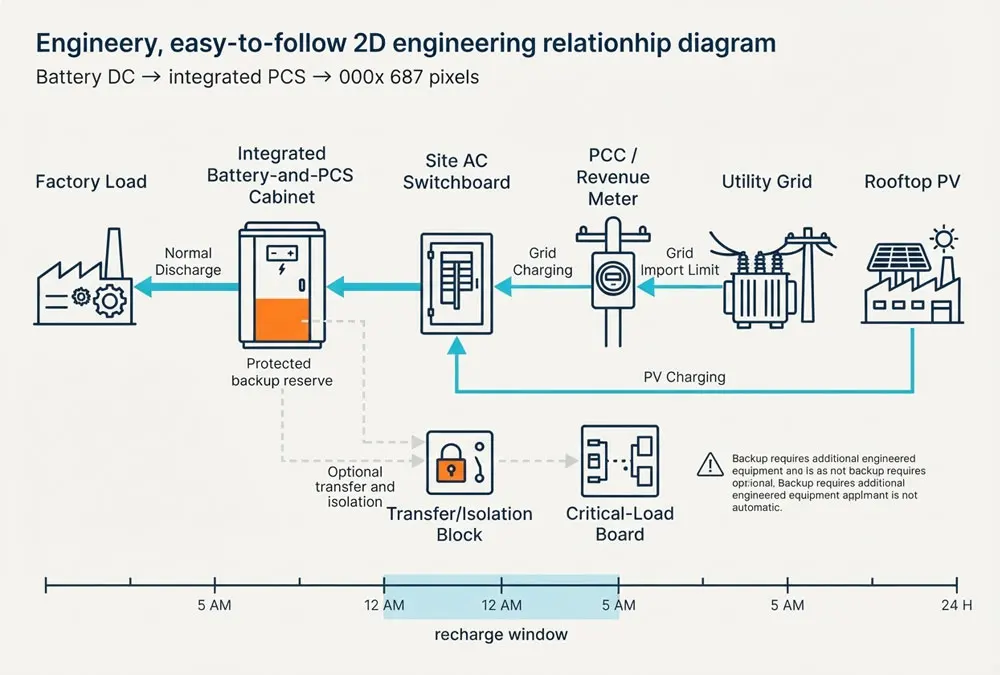
The first peak may be easy. The next production start is where an attractive spreadsheet often breaks down. Suppose a cabinet supplies 100kWh AC during an afternoon event and has a two-hour charging window before evening production. If charging from the grid and assuming a 90% AC-to-AC round-trip factor for illustration only, restoring the energy delivered to the factory needs roughly 100 ÷ 0.90 = 111.1kWh of purchased AC energy. Spread evenly over two hours, that is about 55.6kW additional import, before auxiliaries and control margins. The actual charge/discharge boundary and efficiency must come from the project design.
If the factory already operates near its contracted import limit during those two hours, the battery may create the next costly peak while trying to prevent one. The remedy is a charging schedule constrained by measured import headroom, the next required state of charge, available rooftop PV and any export or charging restrictions. An EMS should stop or taper charging when the site approaches its limit; that control behaviour belongs in the acceptance test, not only in a marketing diagram.
Where solar PV is involved, ask for separate traces for PV generation, factory consumption, battery charging, battery discharge and PCC exchange. “Solar plus storage” does not prove that midday excess PV is available on the production days that matter. A cloudy shift may force grid charging or leave the cabinet unavailable for the evening peak. The first useful simulation covers several difficult days, not the best solar day of the year.
Have a specific duty in mind?
Share interval load data, the tariff, a target import limit and the time until the next shift. Those inputs allow a preliminary cabinet-duty review; they do not substitute for detailed design.
One Cabinet, Two, or a Different System?
Two reference cabinets contain 522.5kWh nominal DC and have 250kW combined published rated AC power by simple addition. That arithmetic is helpful for an early screen but does not prove 250kW at the factory PCC. AC collection, transformer loading, export settings, protection coordination, control communications, state of charge and possible derating can all reduce the simultaneous deliverable output.
For example, a 190kW reduction over one hour is beyond the stated one-cabinet rating. A two-cabinet concept may clear the nominal power screen, but the EPC still needs an approved parallel arrangement and a tested output curve. If the site instead needs 120kW for three hours, adding power alone is not the decision: 360kWh AC is the governing energy duty. Compare two cabinets with a larger storage architecture on guaranteed AC output, reserve, floor space, connection work and total installed scope.
AnengJi’s system-size comparison explains where integrated cabinets, larger DC cabinets and container blocks have different PCS and project boundaries. Use it if the duty no longer looks like a local cabinet application. A bigger kWh figure is not automatically a better option; the larger 418kWh reference is a DC cabinet that needs an external PCS and additional integration.
Why Choose the 261kWh Size?
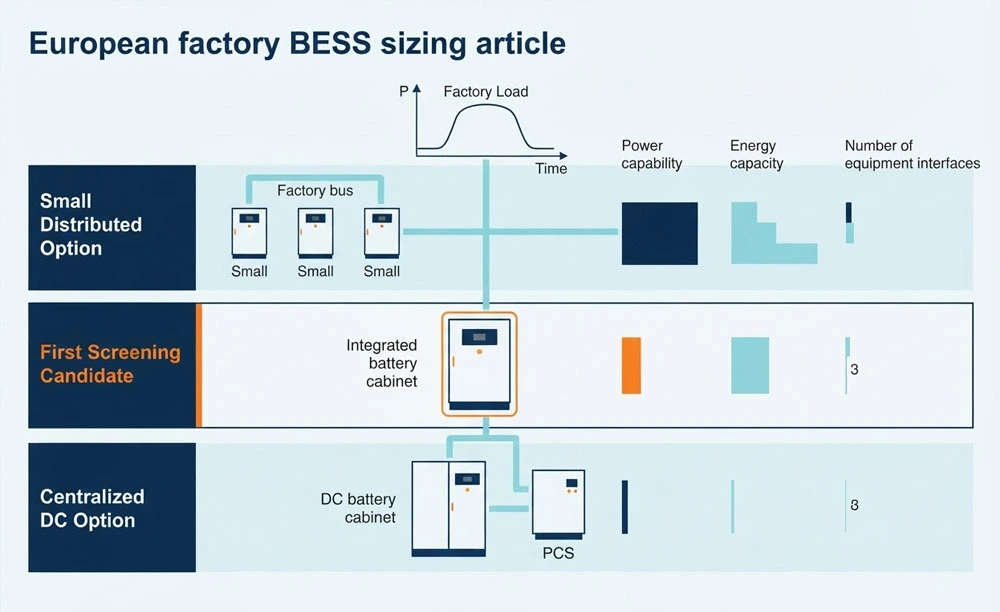
The 261kWh cabinet’s useful position is between two different procurement decisions. AnengJi’s smaller integrated 100kWh reference publishes 100.48kWh DC and AC variants rated 30, 40 or 50kW. Its 261kWh integrated reference publishes 261.25kWh and 125kW rated AC. The larger 418kWh reference publishes 417.99kWh DC and describes integration with an external PCS. All are manufacturer-stated configurations; the final supplied scope needs a signed datasheet and quotation.
| AnengJi reference | Published battery / AC boundary | 110kW × 1h factory duty | Cost decision to check |
|---|---|---|---|
| 100kWh integrated cabinet | 100.48kWh DC; up to 50kW rated AC per published variant | Two give 100kW on paper—10kW short. Three give 150kW and 301.44kWh nominal DC, subject to approved parallel operation. | Price three installed units, shared controls, protection and maintenance points—not one small unit. |
| 261kWh integrated cabinet | 261.25kWh DC; 125kW rated AC | Passes the published power screen by 15kW; 110kWh AC event still needs usable-energy proof. | One enclosure may avoid extra cabinet interfaces. Check its complete installed price and guaranteed AC energy. |
| 418kWh DC cabinet | 417.99kWh DC; external PCS required | No published stand-alone AC power from the battery cabinet; the selected PCS determines the AC screen. | Include PCS, DC protection and integration before comparing €/delivered AC kWh. |
The 261kWh advantage is therefore one published AC-rated unit for a mid-size local duty, with fewer cabinet interfaces than three small units and no separate PCS selection at the first screen. It is not automatically the cheapest system. Three smaller cabinets may be preferable if separated loads, staged installation or their solar-hybrid functions matter; 418kWh may make more sense when the project needs longer duration or already has an engineered central PCS. For an 80kW peak, even a smaller system may deserve consideration after its usable-energy check. For a 150kW peak, the single 261kWh cabinet fails the rated-power screen.
Calculate the Installed-Cost Difference
Cabinet price per nominal kWh hides the work outside the enclosure. Request prices on the same AC/PCC boundary: equipment, PCS where external, switchgear, controls, foundations, cabling, commissioning and service. Then calculate installed cost per required AC duty and run the tariff model separately. A quote for one DC battery cannot be compared with a grid-connected AC cabinet as though both are complete systems.
For the same 110kW × 1h duty, assume an EPC receives complete installed offers of €120,000 for one 261kWh cabinet, €150,000 for three 100kWh cabinets, and €135,000 for a 418kWh battery plus the required PCS and integration. On these invented inputs only, the 261kWh route is €30,000 (20%) below the three-cabinet offer and €15,000 (11.1%) below the 418kWh complete offer. It is not a claim about actual prices or savings. Replace every figure with real quotations before choosing.
A lower installed price is only useful if the option passes the same output and life test. Require each bid to state continuous AC kW, warranted delivered kWh at the agreed life point, charging limits, backup reserve, site works and excluded items. The smaller AnengJi reference includes solar-hybrid variants; price any required PV connection consistently rather than treating unlike functions as equal. If the 261kWh bid lacks a transformer or commissioning that the other bid includes, add those costs before comparing. To estimate annual bill value, simulate dispatch on the site’s tariff and load history; do not multiply 110kW by an assumed universal European demand rate.

Does the 261kWh Cabinet Include the PCS?
For the AnengJi reference considered here, the published 125kW AC rating and product description point to an integrated power-conversion boundary. That helps a factory buyer screen one cabinet against an AC load without first selecting a separate PCS. It does not tell the EPC where the supply package ends, who provides the site switchgear or what AC energy is warranted at the PCC. Ask for a single-line diagram marking the battery, PCS, cabinet AC terminals, site board and revenue meter.
The contrast that matters for this buyer is already visible within AnengJi’s range: the 418kWh reference is a DC battery unit intended to work with an external PCS, whereas the 261kWh reference publishes its own AC output rating. Compare the complete installed systems, not the battery enclosures alone. Keep a separate PCS or boost-converter cost in the 418kWh scope and verify that its selected AC output, voltage and protection suit the factory.
A sensible first product to examine for short, local factory duties is AnengJi’s liquid-cooled 261kWh cabinet. Its public specifications list 261.25kWh battery energy and 125kW rated AC power. Confirm the current signed datasheet, integrated PCS scope, approved parallel limit and delivery configuration with the supplier. The recommendation is a screening choice, not a claim that the cabinet suits every factory.
- Ask where ownership passes: DC terminals, cabinet AC terminals, LV switchboard or PCC.
- Request AC continuous power and usable-energy curves at the intended temperature and state-of-charge range.
- Identify the parties supplying the transformer, switchgear, metering, EMS interface and communications.
- Confirm factory acceptance testing and site acceptance testing for the complete operating mode, not only for battery racks.
What About Backup and Site Safety?
A factory may ask whether the same cabinet that reduces electricity costs can also keep a production line alive during an outage. A protected state-of-charge reserve is only one part of that answer. Backup requires a suitable PCS operating mode, isolation from the failed grid, protection coordination, a transfer or islanding arrangement, an identified critical-load board and a permissible interruption time for the actual equipment. An ordinary 261kWh cabinet should never be represented as a zero-interruption UPS solely because it contains stored energy.
Suppose essential controls and ventilation require 40kW for two hours. That is 80kWh AC reserved for resilience before conversion and operating limits. The same energy cannot also be counted in the daily peak-shaving model. Ask the EPC to show the state-of-charge floor, what happens if an outage occurs immediately after a scheduled discharge and how the system transitions between grid-connected and backup modes. A witnessed test with representative loads is more persuasive than the phrase “backup ready.”
For EU projects, Regulation (EU) 2023/1542, Article 12 requires stationary battery energy storage systems to be safe during normal operation and use; its technical-documentation provisions address applicable Annex V testing, additional hazards and mitigation instructions. This is a request for actual evidence, not a substitute for national grid rules, local fire review or a site-specific risk assessment. The Batteries Europe roadmap on stationary applications likewise treats safety as a system-level matter involving batteries, cooling, power electronics and controls—not cell chemistry alone.
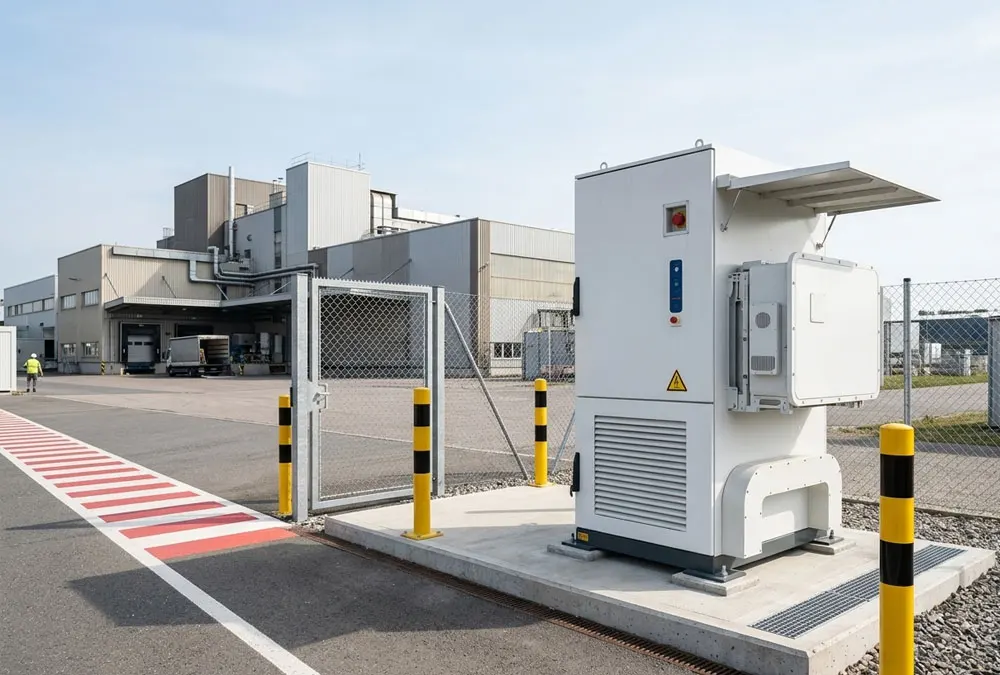
The physical layout needs equal attention. AnengJi’s product page gives a 1.4m² stated footprint and 2,620kg equipment weight for its reference cabinet. The small plan area does not make the civil design trivial: obtain the signed general arrangement, support and lifting details before sizing a foundation. Provide drainage, maintenance access and a protection strategy suitable for the site. Route power cables in designed ducts or protected containment; keep vehicle movement, fire access and personnel routes in the general arrangement. Required clearances and approvals come from the final equipment documentation and local authorities rather than a generic photograph.
Europe First: Check the Connection
European factories do not share a single tariff or connection approval. In Germany, VDE FNN’s energy-storage connection guidance explains that Technical Connection Rules set requirements by voltage level and describes additional low-voltage storage guidance. The buyer should identify the factory’s connection voltage, maximum import and export, protection concept, meter arrangement and distribution network operator process before finalizing cabinet count.
For another EU country, use that country’s grid-code and connection procedure, then check the actual supply and network tariff. If the project is in the United States, do not reuse the EU compliance answer. The U.S. Department of Energy’s 2024 BESS Procurement Checklist provides commercial-scale lithium-ion development questions, while the utility, adopted codes and authority having jurisdiction determine the project-specific path. The checklist is a procurement aid, not a permit or certification.
What Should the RFQ Prove?
When two suppliers quote “261kWh,” the cheapest line item may not include the same equipment or acceptance duty. Ask both to price and document one defined result: required AC kW, deliverable AC kWh at the agreed life point, dispatch boundary, installation scope and test method. The U.S. Department of Energy checklist cited above is designed around tasks and questions at the early procurement stage; this kind of evidence-based scope definition is useful for a European EPC as well, while local rules remain controlling.
- Electrical result: continuous AC power, measured usable energy, voltage, PCS inclusion, parallel configuration, PCC limit and warranty end-of-life condition.
- Controls result: peak-target logic, charging limit, PV interaction, protected reserve, telemetry time stamps and failure-mode response.
- Site result: signed single-line and general arrangement drawings, foundation loads, cable route, access, fire/protection concept and DSO interface.
- Commercial result: battery, PCS, switchgear, installation, commissioning, training, spare parts, service response and exclusions on the same quotation boundary.
This is also where a buyer should ask a question that rarely appears on a product card: What happens to the plant if one cabinet is unavailable on the day of the billing peak? Parallel cabinets can offer operational flexibility, but only if the controls, protection and maintenance arrangement allow the remaining equipment to operate. The answer belongs in the single-line diagram and service plan, not in a generic “modular” claim.
Where AnengJi Can Help
AnengJi can discuss the 261kWh liquid-cooled cabinet as part of a factory-specific configuration review, including whether a single unit, approved parallel cabinets or a larger system better matches the load duty. AnengJi states that 10-year warranty coverage is available for applicable BESS configurations and that it has after-sales service points in Europe and other regions. These are company-provided commercial claims, not an independent measure of response time or a promise that every cabinet and component has identical terms. Ask for the written model-specific warranty schedule, covered components, cycle or throughput limits, operating conditions, service location and response process in the quotation. The site’s BESS warranty guide explains why years alone are an incomplete comparison.
A credible technical review should return more than a product code. The output to request is a proposed AC power/energy boundary, a preliminary cabinet count, the recharge and reserve assumptions, a connection checklist and the missing site data that prevent a firm proposal. Final engineering, backup capability, approvals and guaranteed performance depend on the signed design and contract.
261kWh Factory Cabinet FAQ
Is 261kWh enough for a factory?
It can be enough for a defined short-duration duty, but the factory’s total size is not the sizing input. Compare the measured peak reduction in kW, its duration in hours, usable AC energy, reserve and recharge opportunity. A large factory may need only a small local reduction; a smaller site may have a short spike beyond one cabinet’s PCS rating.
How long will a 125kW/261kWh cabinet run?
Dividing 261kWh by 125kW gives about 2.09 hours using a nominal DC nameplate and rated AC power. Because those are different measurement boundaries, the quotient is only a crude arithmetic ratio, not a guaranteed AC runtime. The illustrative operating-window and discharge-path assumptions in this article give 1.79 hours before reserve, temperature, ageing and site losses. Obtain the supplier’s warranted AC energy and power curve for the intended duty.
Can it provide factory backup?
Only a designed backup architecture can answer yes. Confirm the PCS mode, transfer and isolation arrangement, critical-load board, interruption tolerance and protected energy reserve. A cabinet’s stored kWh alone do not establish UPS-like continuity.
Can two cabinets run in parallel?
They may be proposed as a parallel system, subject to the manufacturer’s approved configuration and the site’s AC collection, protection and grid limits. Two 125kW ratings add to 250kW on paper; ask for the validated simultaneous power at the required AC or PCC boundary.
Which data should I send for a first review?
Send interval import data covering representative production periods, your tariff and recent bill, the target peak or shifting duty, an electrical single-line diagram, any PV generation profile and any critical-load requirement. State the country and connection voltage. That lets an engineer test the duty before choosing equipment.
Choose the Duty Before the Cabinet
A 261kWh cabinet is most useful when its rated AC power, usable energy and recharge window all match a real factory duty. Start with the interval load and the actual meter, then account for reserve, temperature, lifetime and connection rules. If the design needs two cabinets, prove their simultaneous output and total installed scope. If it needs a longer or larger duty, compare architectures instead of forcing a nominal 261kWh product to fit.
Planning a Factory BESS?
Share the site’s load profile, tariff, electrical boundary and operating objective. Discuss a preliminary cabinet configuration and the evidence needed for an EPC-ready specification.

 https://anengjipower.com/wp-content/uploads/2026/06/epc-vs-turnkey-solar-project-bess.webp
675
1000
Charging Station Engineer
https://anengjipower.com/wp-content/uploads/2025/09/anengji-dc-fast-charging-station-manufacturer-and-supplier-logo-white-1.png
Charging Station Engineer2026-06-22 07:16:042026-06-24 07:13:17What Is the Difference Between EPC and Turnkey Contract Models in Energy Projects?
 https://anengjipower.com/wp-content/uploads/2026/06/anengji-commercial-solar-plus-storage-benefits-site.webp
675
1000
Charging Station Engineer
https://anengjipower.com/wp-content/uploads/2025/09/anengji-dc-fast-charging-station-manufacturer-and-supplier-logo-white-1.png
Charging Station Engineer2026-06-20 14:34:102026-06-20 14:37:43What Are the Top Benefits of Solar Battery Storage in Factories?
 https://anengjipower.com/wp-content/uploads/2026/06/modular-commercial-solar-battery-storage-cabinet.webp
675
1000
Charging Station Engineer
https://anengjipower.com/wp-content/uploads/2025/09/anengji-dc-fast-charging-station-manufacturer-and-supplier-logo-white-1.png
Charging Station Engineer2026-06-18 09:16:522026-07-03 03:05:13What Is Solar Battery Storage? Complete C&I Engineering Guide


Leave a Reply
Want to join the discussion?Feel free to contribute!