

Introduction
A battery energy storage system warranty can say “10 years” and still leave a project exposed much earlier. The clock may start at shipment rather than commercial operation. A throughput allowance may be consumed before year ten. The supplier may replace a module but leave the owner to pay for diagnosis, lifting, freight, installation, recommissioning and the lost operating time.
Put numbers on that risk. In the illustrative calculation used later in this guide, a 5 MWh system with a 20,000 MWh discharged-throughput allowance consumes that allowance in about 5.48 years at two equivalent full cycles per day. The ten-year headline remains factually present, but it no longer describes ten years of the planned duty. This is not a product specification—it is the kind of check a buyer should run before signing.
That is the real procurement problem for a European EPC, developer or industrial owner: the headline term is easy to compare, but the conditions that determine whether the warranty is still valid—and whether the remedy restores the plant—are scattered across the supply agreement, technical schedule, long-term service agreement and operating manual.
This guide turns those documents into a decision method. It shows how to identify the first expiry trigger, align the warranty with the intended dispatch, define the test boundary, assign component responsibility and build evidence for a future claim. The same method is useful in the United States and other markets, although contract law, codes and service arrangements remain jurisdiction-specific.
The 60-second answer
A useful BESS warranty defines seven things: what is covered, when coverage starts and expires, operating limits, the reference test, the accountable party, required records and notice, and the remedy after failure. A ten-year number without those seven items cannot be reliably modelled, compared or enforced.
What the Evidence Measures
The strongest warranty sources do not tell buyers to compare years alone. They repeatedly return to operating limits, repeatable tests, data and recovery responsibility. Four evidence points are especially useful for a European C&I project.
Up to 15 years
World Bank/ESMAP warranty context
The 2020 report notes that long-term BESS warranties may extend up to 15 years, subject to operating conditions. It also names throughput, temperature, charge/discharge rate, DoD, SOC and maintenance as possible validity conditions. The number of years is therefore only one layer.
10 / 15 / 20 years
DNV’s illustrative term examples
DNV’s warranty table uses 10-, 15- and 20-year terms and 0.25C, 0.5C and 1C examples to show how operating assumptions affect coverage. These are illustrative industry observations, not universal thresholds.
5 + 3 test points
PNNL performance-test structure
PNNL-22010 Rev. 2 uses five cycles at rated power for stored-energy reporting, then additional checks at 75%, 50% and 25% of rated power. It reports variability rather than relying on one convenient discharge.
5 + 5 data groups
EU battery health and lifetime data
Annex VII of Regulation (EU) 2023/1542 lists five state-of-health parameter groups and five expected-lifetime parameter groups for stationary BESS. Those records strengthen traceability, but the commercial remedy still comes from the contract.
These numbers answer different questions. The World Bank and DNV address warranty design and operating restrictions; PNNL provides a technical measurement framework; EU law specifies battery-data obligations. None of them replaces the project’s signed warranty schedule, but together they show what a serious schedule should be able to measure.
What a BESS Warranty Protects
The World Bank and ESMAP report Warranties for Battery Energy Storage Systems in Developing Countries separates manufacturing-defect protection from performance guarantees. It also identifies available energy, power, availability and efficiency as different possible performance commitments. That distinction matters because a contract can cover defective hardware without guaranteeing that the complete plant will deliver the owner’s required MW or MWh at the point of connection.
Product defects
A product warranty normally addresses defects in named equipment or workmanship. “Battery system,” however, is not a precise bill of materials. It might mean cells and modules only, or it might extend to racks, BMS hardware, cooling and selected auxiliaries. The PCS, EMS, transformer, medium-voltage switchgear and site works may have different warrantors and different start dates.
Performance over time
A performance warranty may promise a capacity-retention curve, minimum usable energy, power capability, round-trip efficiency or availability. Do not assume one metric includes the others. A battery can pass an energy-capacity test at low power while the plant still cannot sustain its contracted MW during a high-rate discharge. Likewise, a capacity guarantee at the battery DC terminals does not automatically guarantee net AC energy after PCS, transformer and auxiliary losses.
Service and recovery
“Repair or replace” sounds complete, but it may describe only the part supplied by the OEM. The World Bank/ESMAP report specifically recommends clarifying responsibility for diagnosis, replacement parts, on-site removal, installation of new hardware and recommissioning. If those duties are not allocated, an owner can receive a no-charge module and still fund most of the site recovery.
- Product layer: materials, workmanship and named components.
- Performance layer: usable energy, power, efficiency, availability or another signed metric.
- Service layer: response, diagnosis, repair, spare parts and technical labour.
- Recovery layer: logistics, lifting, installation, software validation, testing and return to service.
Find the First Expiry Trigger
The most important date in a battery energy storage system warranty is not always the date printed beside “warranty period.” Ask when coverage starts: shipment, delivery, mechanical completion, commissioning, acceptance or commercial operation date (COD). A project delayed by grid connection can lose months of coverage before it earns revenue if the clock started at shipment.
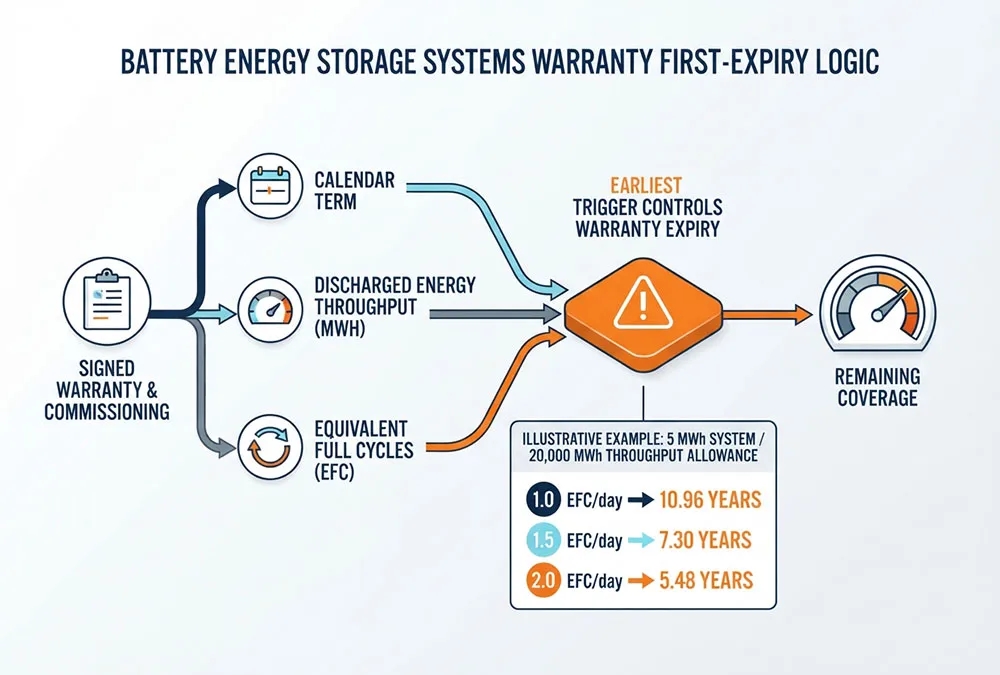
Next, identify every “whichever occurs first” condition. These commonly include calendar time, accumulated energy throughput or equivalent full cycles (EFC). Design cycle life is not the same as warranted cycles: one is a technical test or modelling claim, while the other is a contractual budget subject to defined operating conditions.
Illustrative calculation—not an AnengJi specification or an industry average
Assume 5 MWh of usable energy, a 20,000 MWh warranted discharged-throughput budget and a 10-year calendar term. Annual discharged throughput = usable MWh × EFC per day × 365. Throughput horizon = warranted MWh ÷ annual discharged MWh.
| Dispatch assumption | Annual throughput | Throughput horizon | Buyer consequence |
|---|---|---|---|
| 1.0 EFC/day | 1,825 MWh/year | 10.96 years | The 10-year calendar term would end first. |
| 1.5 EFC/day | 2,737.5 MWh/year | 7.30 years | Throughput could end coverage about 2.7 years early. |
| 2.0 EFC/day | 3,650 MWh/year | 5.48 years | A ten-year revenue model would materially outlive the illustrative throughput cover. |
This example does not predict real degradation. Its job is to expose a contract mismatch. If the optimiser assumes two equivalent cycles per day while procurement compares only the ten-year headline, the financial model and warranty are describing different assets. The solution is to put the same usable-energy value, counter direction and annual dispatch profile into both documents.
A second check: how much coverage remains today?
Warranty consumed (%) = counted discharged throughput ÷ warranted discharged throughput × 100
If the illustrative 20,000 MWh allowance has already recorded 8,000 MWh, then 40% is consumed and 12,000 MWh remains.
At 1.5 EFC/day on 5 MWh usable energy, the remaining throughput horizon is 12,000 ÷ 2,737.5 = 4.38 years. If seven calendar years remain, throughput still expires first. This turns a vague “warranty remaining” statement into a value the operator and financial model can both use.
DNV’s Energy Storage Capacity Warranties: Beyond the Fine Print illustrates how restrictive conditions can differ: its example table includes warranty terms of 10, 15 or 20 years; C-rates of 0.25C, 0.5C or 1C; and limits connected to temperature, average SOC and data retention. These are examples from DNV’s analysis—not universal limits. A buyer must use the signed model-specific schedule.
Define the Energy Boundary
A warranty claim can fail even when everyone’s meter is correct. The supplier may test DC energy at the battery terminals; the owner may be concerned with net AC energy at the point of common coupling (PCC). PCS losses, transformer losses and site auxiliaries sit between those points.
Nominal DC energy → Usable DC energy → PCS-side AC energy → Net PCC-delivered energy
Each arrow can introduce limits, losses or auxiliary consumption. The warranty must name the contractual measurement point.
PNNL’s Protocol for Uniformly Measuring and Expressing the Performance of Energy Storage Systems was developed to support repeatable performance measurement and fair comparison. Its stored-energy procedure uses five cycles at rated power, calculates a mean and standard deviation, and adds tests at 75%, 50% and 25% of rated power. Its RTE method also accounts for parasitic losses and requires the auxiliary power source to be declared. This does not create a project pass/fail warranty; it shows why one favourable discharge is weak evidence.
Fix the capacity test
The test schedule should state the starting and ending SOC or voltage, charge/discharge power, temperature, rest and preconditioning requirements, available racks, auxiliary treatment, meter class, timestamps, tolerance and retest rights. The US Department of Energy’s 2024 Battery Energy Storage System Evaluation Method uses metered charge and discharge time-series data to estimate efficiency and demonstrated capacity. It is a technical reference, not European law and not a replacement for the signed warranty test.
Keep power separate
Energy answers “how much”; power answers “how fast.” A 5 MWh system that can discharge 1 MW for five hours does not automatically meet a 2.5 MW two-hour duty. Power capability can also change with SOC, cell temperature, rack availability and PCS limits. Put MW, MWh and the test conditions into separate rows rather than treating capacity retention as a complete performance guarantee.
For a fuller explanation of these boundaries, read the guide to rated, usable and PCC-delivered battery capacity.
Is the warranty boundary missing?
Share the quotation, operating duty and proposed measurement point. We can identify the principal technical gaps before the warranty schedule is finalised.

Match Warranty to Dispatch
Peak shaving, load shifting, backup reserve and ancillary services do not consume the warranty budget in the same way. Procurement should translate the operating strategy into annual charged and discharged MWh, EFC, average SOC, maximum C-rate, expected temperature distribution and required availability. Then the EMS should enforce the resulting limits or record an approved exception.
This is where a commercially attractive opportunity can create a hidden problem. The optimiser may dispatch more often during a period of volatile prices. The extra cycles earn revenue now but consume throughput allowance faster. The correct solution is not to prohibit flexible operation; it is to model the value of the dispatch against the value and conditions of the remaining warranty budget.
Use one authoritative counter
An industry detail that often appears only after commissioning is that BMS throughput, PCS AC energy and PCC revenue-meter energy can all be correct while showing different totals. One counter may count discharged DC energy, another may record both charge and discharge, while the owner’s meter includes conversion losses and auxiliaries. The contract must define:
- whether the counter records charge, discharge or both;
- whether the boundary is battery DC, PCS AC or PCC;
- whether auxiliary consumption is included;
- how resets, replacements and firmware changes are handled; and
- how supplier and owner data are reconciled before a claim.
For sites that stack several operating objectives, the multi-service BESS dispatch guide explains why energy, power and backup reserves must be allocated before the EMS optimises the remaining capability.
Map Component Responsibility
A container is one physical product but often several contractual systems. Build a component–obligor–remedy matrix before award. The matrix below is a buyer-completion tool; it does not describe any universal supplier coverage.
| Component | Metric or defect | Named obligor | Recovery scope to confirm | Buyer benefit |
|---|---|---|---|---|
| Cells, modules and racks | Defect, usable energy, temperature | Name in contract | Parts, labour, lifting and retest | Prevents a cell promise being read as a plant guarantee. |
| BMS and controls | Sensing, balancing, alarms, firmware | Name in contract | Diagnosis, update and validation | Protects safety logic and claim evidence. |
| PCS | Power, conversion performance, faults | Name in contract | Repair, replacement and grid retest | Connects battery DC capacity to the AC duty. |
| EMS, SCADA and data | Dispatch, logs, API, licences | Name in contract | Access, patching and migration | Keeps counters and claim data available. |
| Cooling and HVAC | Temperature control, pumps and fans | Name in contract | Parts, fluid/refrigerant and labour | Preserves the warranted operating envelope. |
| Transformer, MV and site works | Interface defects and losses | EPC or local supplier | Site repair and recommissioning | Exposes the handoff between equipment and project warranties. |
For cabinet and container projects, request this matrix against the exact quotation rather than a generic product family. A liquid-cooled battery cabinet, PCS, transformer and EMS may come from one commercial offer while retaining separate technical warranties. A single sales contact does not automatically mean one performance obligor.
Price the Warranty Remedy
A warranty only has commercial value if the remedy returns the project to an acceptable operating state. “Repair,” “replace,” “augment” and “credit” are not equivalent. Replacement restores a failed component; augmentation adds capacity to recover a plant-level target; a credit may leave the owner to source and integrate another solution.
Ask the bidder to allocate and, where possible, price the following recovery items:
- remote diagnosis and engineering;
- technician labour and travel;
- lifting equipment and site access;
- freight, customs and temporary storage;
- removal and installation;
- failed-part custody or disposal;
- software and firmware validation;
- recommissioning and capacity testing; and
- lost production, savings or market revenue.
Another field detail matters: a replacement module may inherit only the remaining original warranty term instead of starting a new ten-year period. Mixing new and aged modules can also require a review of firmware, voltage windows, current sharing, balancing strategy and rack limits. The post-repair test should therefore verify system performance, not simply confirm that the replacement powers on.
If the supply, installation, grid interface and commissioning responsibilities are split across several companies, consider an integrated BESS EPC scope review. Integration does not remove exclusions, but it can make responsibility and handover evidence easier to map.
AnengJi’s 10-Year Warranty Advantage
A ten-year warranty becomes a genuine product advantage only when three things exist together: a configuration suited to the intended duty, a model-specific warranty schedule, and a practical recovery route after a fault. AnengJi can provide 10-year warranty coverage for applicable BESS configurations, supported by after-sales service points in Europe and other regions.
That does not mean every project receives identical operating limits or service inclusions. The final offer should confirm the product model, start date, throughput or cycle allowance, capacity curve, temperature and SOC conditions, included labour and logistics, nearest support route, spare-parts arrangement and post-repair acceptance test. Making those items visible strengthens the ten-year promise instead of weakening it with vague fine print.
Ten-year coverage
Applicable configurations can be supplied with a ten-year term. The contract should convert that term into a measurable operating envelope and remedy rather than leaving it as a brochure statement.
Regional service presence
European and wider overseas service presence can shorten the escalation path. Each project should still name the service location, contact route, stocked parts and included on-site scope.
Cabinet-to-container range
The AnengJi C&I BESS range provides cabinet and container options. Selection still begins with kW, usable AC kWh, duty, reserve, voltage and site interfaces—not capacity alone.
Which product should you shortlist?
100kWh all-in-one cabinet — smaller commercial sites
A practical screening option for workshops, retail or commercial buildings, smaller solar self-consumption projects and local peak management where the required power and event duration fit the cabinet.
Warranty check: confirm integrated PCS scope, usable AC energy, daily cycling, outdoor conditions and whether the owner’s meter or the cabinet counter governs throughput. Review the compact commercial cabinet.
418kWh liquid-cooled cabinet — modular C&I projects
The manufacturer-published reference is a 417.99kWh DC battery cabinet with a nominal 0.5C rate. It can suit factories, logistics facilities, campuses and phased multi-cabinet projects, but the external PCS and AC delivery boundary must be designed separately.
Warranty check: align the battery-side warranty with the selected PCS, cooling responsibility, cabinet-parallel logic and plant-level capacity test. Review the 418kWh liquid-cooled cabinet.
1MWh container — factories and microgrids
The published integrated reference combines 1,044kWh of nominal battery energy with 500kW rated AC output. Dividing those nameplates gives about 2.09 hours, but it crosses a DC-energy/AC-power boundary and is therefore not a guaranteed runtime; usable energy, losses, auxiliaries and operating limits must still be applied. It is relevant to larger C&I peak control, PV-plus-storage, diesel-hybrid and microgrid duties.
Warranty check: state whether the guarantee applies to DC capacity, PCS-side AC energy or the PCC; then confirm backup-transfer and hybrid-control equipment in the covered BOM. Review the 1MWh integrated container.
5MWh container — large industrial and utility blocks
A 5MWh-class battery block is a starting point for large industrial, renewable and utility-scale projects. It is not a complete project description: PCS MW, transformer/MV scope, grid interface, augmentation plan and plant controller still determine usable AC performance.
Warranty check: define container-level versus plant-level guarantees, block availability, rack isolation, throughput allocation across parallel containers and the logistics route for major replacement work. Review the 5MWh liquid-cooled container.
These are screening recommendations based on manufacturer-published configurations, not final sizing results. To match the ten-year warranty to a project, provide at least the interval load profile, required kW and usable AC kWh, intended services, annual throughput, backup reserve, grid voltage, site environment and target measurement boundary.
Which product and warranty fit your duty?
Share your load profile, operating objective and expected annual throughput for a preliminary configuration and warranty-boundary review.
Build Claim Evidence Before COD
Do not wait for degradation to become visible before deciding how to prove it. A claim normally depends on the baseline, historical data, maintenance record, change history and an agreed test. If any link is missing, the parties may disagree about whether the problem is a defective component, normal degradation, an operating-limit excursion or an external site condition.
Establish the baseline
Keep FAT and SAT records, commissioning capacity and power results, the meter map, sensor calibration information, available-rack count and the accepted configuration and firmware versions. If round-trip efficiency or availability is guaranteed, define its calculation period, exclusions and auxiliary boundary before COD.
Keep the data chain
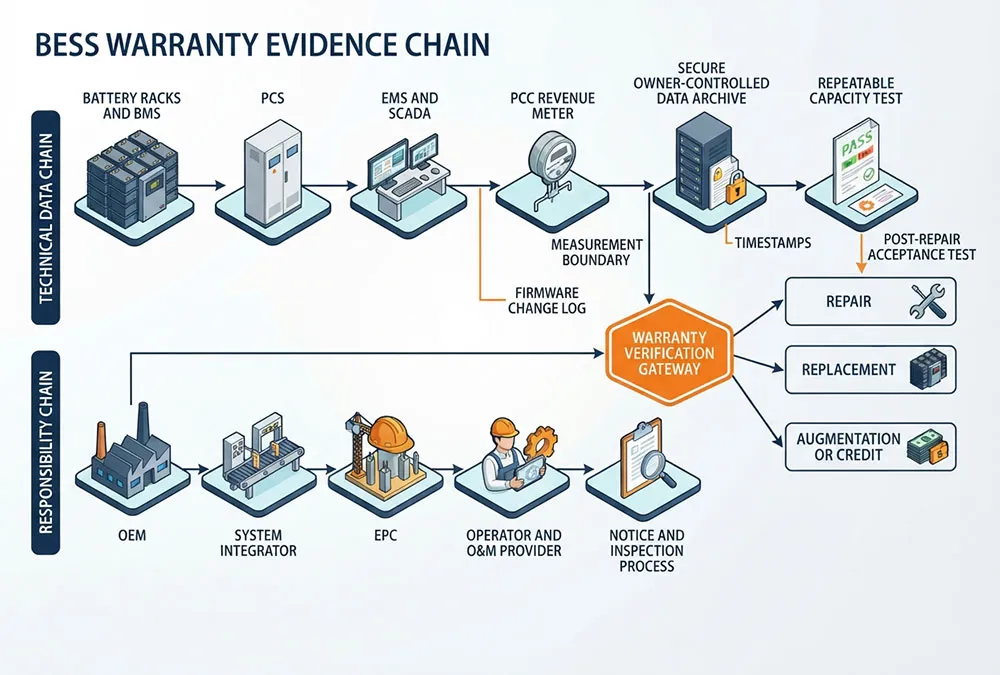
DNV notes that detailed BMS data may be recorded at second-level resolution for a limited period and later aggregated to minute or hourly data. The high-resolution evidence needed to explain an event can therefore disappear before a dispute begins. The owner or an agreed neutral party should retain raw exports, synchronised timestamps, alarm histories, counter definitions and change logs for the contractual retention period.
For stationary BESS in the EU, Regulation (EU) 2023/1542 requires up-to-date state-of-health and expected-lifetime parameters in the battery management system and read-only access for specified legitimate purposes. Annex VII of the official EUR-Lex Batteries Regulation identifies the following data groups:
- State of health: remaining capacity; where possible, remaining power capability and remaining round-trip efficiency; evolution of self-discharge; and, where possible, ohmic resistance.
- Expected lifetime: manufacture and service dates; energy throughput; capacity throughput; harmful events such as deep discharge or extreme-temperature exposure; and full equivalent cycles.
This is unusually relevant to a warranty discussion because it places throughput, harmful events and remaining capability in the same evidence chain. It still does not define a universal commercial capacity remedy. The supply contract must state which records control a claim, how they are exported and what happens after a confirmed shortfall.
Control changes and notice
Record parameter changes, firmware updates, rack isolation, alarm overrides, preventive maintenance and supplier approvals. Define how quickly the owner must report a suspected defect, who may troubleshoot, who pays for the initial test, how the supplier can inspect the system and what happens if the first test is disputed.
A common operational frustration is seeing declining performance in the dashboard but being unable to export the raw data after a platform or licence change. Make owner-accessible export, data format, retention and migration assistance contractual deliverables rather than optional software features.
Compare Warranty Offers
The WARRANT Evidence Score below is an editorial procurement tool—not a legal opinion, credit assessment or supplier ranking. It measures how complete the evidence is, not whether one supplier is financially stronger.
| WARRANT item | 0 points | 1 point | 2 points |
|---|---|---|---|
| What is covered | Sales statement | Partial component list | Signed model/BOM and metrics |
| Activation and expiry | Years only | Start or limits unclear | Start date and all first-expiry triggers |
| Run limits | Not provided | Limits without counter/method | Measurable duty and environmental envelope |
| Reference test | No method | Method with gaps | Boundary, conditions, tolerance and retest |
| Accountable party | Generic “supplier” | Some parties assigned | Named obligor for every interface |
| Notice and records | No evidence route | Procedure without data rights | Data, notice, inspection and dispute path |
| Treatment after failure | “Repair/replace” only | Part remedy, costs unclear | Remedy, cost allocation and acceptance test |
Score range: 0–14. A lower score means the quotation needs more evidence; it does not prove that the equipment is poor. A shorter but measurable and recoverable warranty can be more valuable than a longer headline term with an unclear counter, test and remedy.
Europe and US Differences
Europe: Regulation (EU) 2023/1542 creates battery-level safety, information and data obligations, including requirements relevant to stationary BESS. It does not create one standard commercial battery storage warranty for every EU-27 project. National contract law, grid requirements, permitting and site obligations still need project-specific review. The United Kingdom should be assessed separately rather than treated as an EU member state.
United States: PNNL and DOE methods are useful references for repeatable performance evaluation. They are not European law, and they do not determine the commercial remedy. US projects must also align the warranty with the applicable supply contract, codes, interconnection requirements and state-specific rules.
Warranty Review Checklist
- Identify the exact product model, bill of materials and covered components.
- Name the warrantor, contractual counterparty and any guarantor or insurer.
- Define the start date, registration conditions and every first-expiry trigger.
- Define throughput or EFC and the authoritative energy counter.
- Separate energy, power, efficiency and availability guarantees.
- Record SOC, DoD, C-rate, temperature, duty and maintenance limits.
- Agree the baseline, periodic test, tolerance and retest procedure.
- Secure data ownership, export, retention and change-control rights.
- Allocate repair, replacement, augmentation, credit and post-repair testing.
- Allocate labour, travel, lifting, freight, customs and recommissioning.
- Align OEM, EPC, operator and LTSA responsibilities and response times.
- Check transfer, insolvency, replacement-term and failed-part provisions.
Battery Storage Warranty FAQs
How long is a BESS warranty?
There is no universal term. Coverage may be limited by calendar years, throughput, EFC, start date and operating conditions, usually with the earliest applicable limit controlling. For applicable AnengJi configurations, a 10-year warranty can be provided, subject to the model-specific duty and signed warranty schedule.
What does a BESS warranty cover?
It depends on the contract. Separate product defects, performance metrics and recovery services. Confirm whether batteries, BMS, PCS, EMS, cooling, safety auxiliaries, transformer and site works are covered by the same or different documents.
Is cycle life the same as warranted cycles?
No. Cycle life may describe a laboratory test or design expectation under stated conditions. Warranted cycles or throughput are contractual limits with their own definitions, counter and operating envelope.
How is capacity tested?
The parties should use the agreed energy boundary, starting and ending SOC or voltage, power, temperature, preconditioning, meter and auxiliary treatment. The test also needs tolerance, data access and retest rules.
Does a replacement restart coverage?
Not necessarily. Some contracts apply only the remaining original term. Check the signed clause and require a mixed-age compatibility review plus a post-repair acceptance test.
Can the warranty transfer?
Only if the assignment, registration and notice provisions permit transfer. This matters for refinancing, asset sales and changes in the operating entity.
Turn Ten Years into Evidence
The right way to compare a battery energy storage system warranty is not “five years versus ten years.” Compare the first expiry trigger, the guaranteed measurement boundary, dispatch freedom, claim evidence and total recovery scope. Then connect those terms to the project’s load profile, revenue model and service geography.
For applicable BESS configurations, AnengJi can provide ten-year warranty coverage and after-sales service support through its European and wider overseas service presence. Final coverage remains model- and project-specific. Share the intended application, annual throughput, power and energy duty, site location, quotation and draft warranty schedule so the technical and commercial boundaries can be reviewed together.
Need a Clear Warranty Review?
Send your project duty, expected annual throughput and supplier warranty schedule for an initial technical review of missing boundaries and evidence.

 https://anengjipower.com/wp-content/uploads/2026/06/epc-vs-turnkey-solar-project-bess.webp
675
1000
Charging Station Engineer
https://anengjipower.com/wp-content/uploads/2025/09/anengji-dc-fast-charging-station-manufacturer-and-supplier-logo-white-1.png
Charging Station Engineer2026-06-22 07:16:042026-06-24 07:13:17What Is the Difference Between EPC and Turnkey Contract Models in Energy Projects?
 https://anengjipower.com/wp-content/uploads/2026/06/anengji-commercial-solar-plus-storage-benefits-site.webp
675
1000
Charging Station Engineer
https://anengjipower.com/wp-content/uploads/2025/09/anengji-dc-fast-charging-station-manufacturer-and-supplier-logo-white-1.png
Charging Station Engineer2026-06-20 14:34:102026-06-20 14:37:43What Are the Top Benefits of Solar Battery Storage in Factories?
 https://anengjipower.com/wp-content/uploads/2026/06/modular-commercial-solar-battery-storage-cabinet.webp
675
1000
Charging Station Engineer
https://anengjipower.com/wp-content/uploads/2025/09/anengji-dc-fast-charging-station-manufacturer-and-supplier-logo-white-1.png
Charging Station Engineer2026-06-18 09:16:522026-07-03 03:05:13What Is Solar Battery Storage? Complete C&I Engineering Guide


Leave a Reply
Want to join the discussion?Feel free to contribute!