
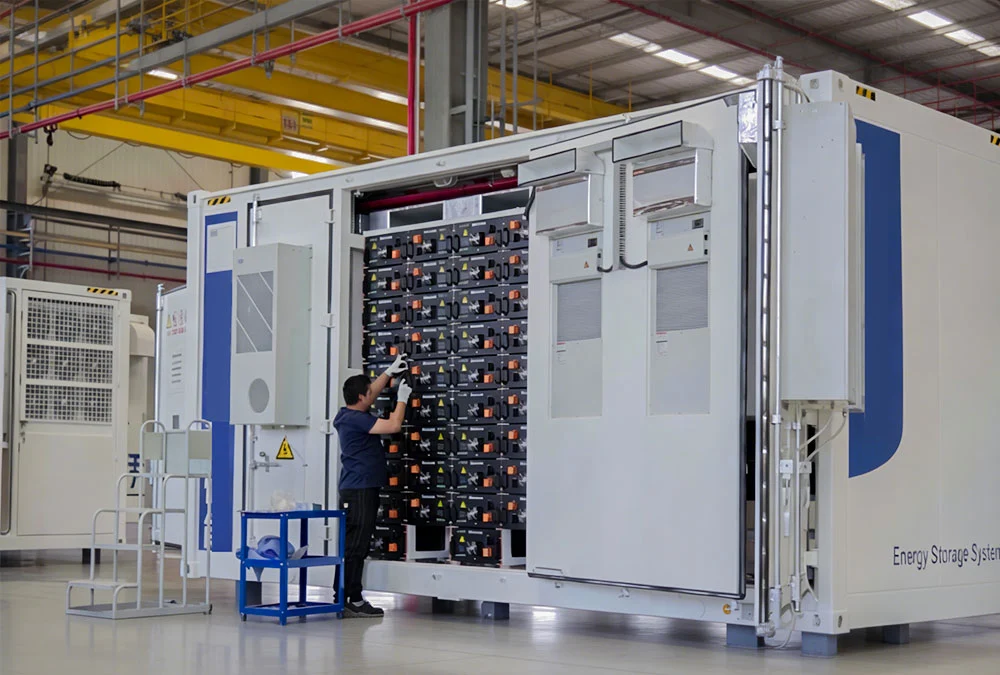
Introduction
Open three battery-storage quotations and the first numbers you see may be 261kWh, 418kWh and 5MWh. It is tempting to treat them as small, medium and large versions of the same product. That shortcut can be expensive. One offer may include a power conversion system (PCS) and deliver AC power to a 400V bus. Another may stop at a high-voltage DC cabinet. A third may cover a battery container while leaving the PCS, transformer, medium-voltage switchgear and site integration to the EPC.
That is the real purpose of this energy storage systems comparison: not to declare one capacity “best,” but to show where the electrical architecture, supply boundary and project responsibility change. For a factory owner, EPC or developer, choosing the wrong class can mean paying for unused energy, missing the required peak-reduction power, or discovering late that an apparently complete quotation is only a DC battery block.
Quick answer
- 261kWh class: screen it first for local C&I loads when integrated AC output, compact deployment and phased cabinet expansion matter.
- 418kWh class: screen it for denser modular storage where the EPC is prepared to design and price the external PCS and DC integration.
- 5MWh class: screen it for centralized multi-MW projects where PCS, transformer, MV connection, civil works and plant control are already part of the project architecture.
The timing matters in Europe. SolarPower Europe’s European Battery Market Outlook 2026–2030 reports that Europe added 36GWh of battery storage in 2025, up 48% year on year, taking operational capacity above 100GWh. Utility-scale systems supplied more than half of annual additions for the first time, while C&I systems represented 11% of cumulative capacity. As projects move from individual cabinets to centralized blocks, comparing only €/kWh or nameplate energy becomes less useful—not more.
Start With the Project Duty
Separate Power From Energy
Before choosing a cabinet, define what the battery must do. The Energy Market Authority’s Handbook for Energy Storage Systems defines an ESS through two key characteristics: power capacity in watts, which describes instantaneous output, and storage capacity in watt-hours, which describes stored energy. That distinction sounds basic, yet it explains many failed first-pass selections.
Illustrative factory duty
Required AC energy = 180kW × 1.5h = 270kWh
This tells you the delivered-energy requirement. It does not yet tell you the required DC nameplate, because operating limits, conversion losses, auxiliaries, reserve and degradation still sit between the battery cells and the site meter.
Here is the buyer’s common frustration: “The cabinet has more than 270kWh, so why can’t the supplier confirm the duty?” Because energy is only half the question. The PCS must also deliver 180kW for the full interval, the battery must be allowed to use enough of its state-of-charge window, and the system must have time and grid capacity to recharge before the next event. Extra kWh cannot repair an undersized PCS or an unavailable recharge window.
Fix the Measurement Boundary
Ask every supplier where its energy figure is measured. Cell or rack energy, DC cabinet energy, AC energy after the PCS and energy delivered at the point of common coupling (PCC) are not interchangeable. A practical normalization is:
PCC-deliverable energy = nominal DC energy × permitted operating window × conversion-path efficiency − protected reserve
For an investment-grade comparison, extend that equation to the contract’s end-of-life condition and include auxiliary consumption, temperature derating and unavailable modules. Do not insert a generic “industry efficiency.” Use values tied to the proposed PCS, transformer, operating temperature and test boundary. If one quotation gives beginning-of-life DC energy and another guarantees end-of-life AC energy, the numbers are not ready for commercial comparison.
Energy Storage Systems Comparison by Size
The table below uses manufacturer-published AnengJi reference configurations. It is a screening comparison, not a promise that every product with the same headline capacity has the same scope. Final values must come from the current datasheet, quotation, single-line diagram and signed general arrangement.
| Decision field | 261kWh class | 418kWh class | 5MWh class |
|---|---|---|---|
| Published reference energy | 261.25kWh DC battery | 417.99kWh DC battery | 5.015MWh DC battery |
| Published power basis | 125kW rated AC; 137kW maximum AC | 0.5C nominal battery rate, equal to about 209kW DC arithmetically; not an AC guarantee | 0.5C nominal battery rate, equal to about 2.51MW DC arithmetically; project PCS sets AC power |
| Power-conversion boundary | Integrated reference configuration publishes AC output at 400Vac | DC cabinet; external PCS/boost integration required | Pure battery container; PCS and transformer excluded |
| DC voltage architecture | 832Vdc nominal; 728–936Vdc range | 1331Vdc nominal; 1165–1498Vdc range | 1331Vdc nominal; 1165–1498Vdc range |
| Published physical reference | 1.4m² stated footprint; 2,620kg | 1.7m² stated footprint; 3,730kg | Containerized block requiring signed GA, mass, centre-of-gravity and lifting data |
| Expansion pattern | Add integrated cabinets in approved parallel groups | Add DC cabinets around an engineered PCS/DC collection architecture | Add central battery blocks and coordinate PCS/MV station ratios |
| Site-interface burden | Fewer external conversion interfaces per cabinet, but more cabinets as capacity grows | External PCS, DC protection, cabling and controls must be assigned | MV transformer, switchgear/RMU, civil works, auxiliary supply and plant control become central |
| Maintenance pattern | Small modular sections can be isolated, but cabinet count grows quickly | Cabinet isolation can support phased service; shared PCS may remain a common dependency | Fewer large blocks, but each outage or isolation decision affects more stored energy |
| Best first screening use | Local C&I duty, smaller factories and incremental deployment | Medium-to-large C&I, campuses and denser modular blocks | Large industrial microgrids, power projects and centralized multi-MW storage |
| Do not select first when… | One cabinet cannot meet the required kW or the project already needs centralized MV architecture | The buyer expects a complete AC system without defining the external PCS scope | The site has only a local low-power duty or cannot support the civil, grid and MV interfaces |
| First evidence to request | Parallel-limit statement, AC output curve and backup/transfer architecture | PCS compatibility, DC grouping, protection and interface matrix | Signed GA, SLD, PCS/MV scope, grid study and FAT/SAT responsibility |

261kWh Integrated Cabinet
The referenced 261kWh liquid-cooled cabinet publishes 261.25kWh of battery energy, 125kW rated AC power, 400Vac output, a 95% depth-of-discharge setting and 89% maximum system efficiency. That makes it the only one of the three reference configurations whose public page presents a direct AC output rating.
A transparent screening calculation is more useful than simply dividing 261 by 125. Using those published values, and before adding reserve, ageing or temperature derating:
Screening AC energy: 261.25kWh × 95% × 89% = approximately 220.9kWh
Screening duration at 125kW: 220.9kWh ÷ 125kW = approximately 1.77 hours
This is not a performance guarantee. The page’s “maximum system efficiency” may not match the contractual test method for your dispatch cycle, and the calculation contains no protected backup reserve. It does show why a 261kWh label should not automatically be described as “two hours at 125kW.” For a site needing 100kW for 1.5 hours, the class deserves detailed review. For 180kW, one cabinet fails the power screen even if the energy arithmetic looks close.

418kWh Modular DC Cabinet
The 418kWh modular DC cabinet publishes 417.99kWh, 1331Vdc nominal voltage, a 1165–1498Vdc operating range and a nominal 0.5C rate. Its product page also states that it integrates with external PCS and boost units. That external boundary is not a minor footnote—it changes the quotation.
A buyer may reasonably think, “Fewer cabinets should mean a simpler project.” Sometimes it does. But a DC cabinet can move complexity into the PCS grouping, DC collection, cable protection, communications and MV station. Before treating it as the middle option, request the approved PCS compatibility, DC voltage/current limits, maximum parallel grouping, short-circuit contribution data, protection concept and a responsibility matrix showing who owns each interface.
5MWh Containerized DC Block
The referenced 5.015MWh containerized battery block is described as a pure battery container without PCS or transformer equipment. It can be a logical building block for centralized projects, but it is not a grid-ready 5MWh plant by itself.
This distinction prevents a common procurement failure: the developer believes it has priced a complete block, while the EPC later adds the PCS, step-up transformer, RMU or switchgear, protection, SCADA, auxiliary supply, civil works and commissioning. Use the site’s detailed guide to review the wider 5MWh design and supplier boundary rather than forcing those topics into a capacity table.
Cabinets or One Container?
Now compare nominal energy. This is the arithmetic buyers often perform first—and where a useful comparison should begin, not end.
20 × 261.25kWh
5,225kWh
12 × 417.99kWh
5,015.88kWh
1 × 5.015MWh
5,015kWh
The 12-cabinet and one-container totals are almost identical on nameplate energy. They are not project-equivalent. An experienced EPC next counts the field interfaces: PCS groups, DC/AC protection devices, cooling loops, BMS controllers, EMS addresses, cable terminations, fire zones, foundations and maintenance isolation points. Every interface must be designed, installed, tested, documented and assigned to a responsible party.
This is also where service strategy changes the answer. Multiple cabinets may allow one section to be isolated while the remainder stays available, but they create more distributed devices. A central block may reduce some field interfaces while concentrating more energy behind one maintenance boundary. Neither architecture is inherently more reliable; availability depends on the single-line diagram, redundancy, spare-parts plan and recovery procedure.
Not sure whether your project belongs in the cabinet or container class?
Share the target kW, duration, connection voltage and available site information. The initial review can identify the most plausible system class and the missing inputs required before quotation.
Calculate Delivered Energy
Suppose the site needs 2.5MW for two hours at the PCC. The duty is 5MWh AC. One nominal 5.015MWh DC container cannot automatically satisfy it because any restricted operating window or conversion loss pushes the delivered figure below 5MWh.
The sensitivity below is deliberately labelled as an illustrative calculation. The percentages are not AnengJi specifications, market averages or guaranteed project performance. They show how two buyer-controlled assumptions change the result before reserve, auxiliaries, temperature and end-of-life degradation are added.
| Illustrative input | Operating window | Conversion path | Calculated AC energy | Buyer consequence |
|---|---|---|---|---|
| 5.015MWh DC | 95% | 98% | 4.669MWh | Already below the 5MWh AC duty |
| 5.015MWh DC | 90% | 96% | 4.333MWh | Additional nameplate or blocks required |
| 5.015MWh DC | 85% | 94% | 4.007MWh | The nameplate comparison materially understates required DC capacity |
For the real project, replace every percentage with the proposed contractual value and calculate at the required test condition and life point. If backup energy must remain protected, subtract it rather than counting the same kWh for peak shaving. This directly addresses another painful surprise: the commercial model assumes the full battery is available for daily optimization while the resilience specification reserves part of it for an outage.
Choose by Project Scale
Do not size storage from employee count, factory floor area or annual electricity consumption. Two plants with the same annual MWh can have very different peaks, tariff windows and recharge opportunities. The useful definition of customer “size” is the modeled discharge duty: required AC power, event duration, event frequency and the point where performance is measured.
The ranges below are illustrative screening bands, not universal product limits. They help a buyer decide which class to investigate first. Final selection still requires interval data, reserve, degradation, ambient conditions, PCS performance and grid review.
| Project profile | Illustrative AC duty | First class to screen | Configuration check | Why it fits—and what can reject it |
|---|---|---|---|---|
| Local C&I load Smaller factory, supermarket, warehouse or local EV buffer | 50–125kW for 1–1.5h 50–187.5kWh AC | One 261kWh cabinet | Published 125kW AC; article screening calculation gives about 220.9kWh before reserve, ageing and derating | Integrated AC rating simplifies the first screen. Reject or multiply cabinets if the required power exceeds 125kW, peaks repeat before recharge, or backup reserve consumes the energy margin. |
| Medium industrial site Growing factory, shopping centre, logistics hub or solar-plus-storage site | 125–200kW for 1.5–2h 187.5–400kWh AC | One 418kWh DC cabinet | 0.5C arithmetic is about 209kW DC; select and verify the external PCS, losses and reserve | Higher energy per cabinet can reduce unit count. Reject a one-cabinet design if the contracted AC power, usable-energy calculation or PCS/DC voltage window does not close. |
| Large factory or campus Multiple production lines, commercial campus or large charging depot | 250–500kW for 1.5–2h 375kWh–1MWh AC | Multiple 261kWh or 418kWh cabinets | Compare 2–4 integrated 261kWh cabinets with 2–4 DC 418kWh cabinets plus central PCS | Choose 261kWh units when distributed AC modularity is valuable. Choose 418kWh units when a central PCS and denser battery layout are acceptable. Compare interface count and partial-availability strategy. |
| Industrial park or power project Multi-MW microgrid, renewable plant or centralized storage site | Multi-MW power and several MWh per event | 5.015MWh DC container blocks | 0.5C arithmetic is about 2.51MW DC per block; engineer external PCS, transformer, MV and block count | Central blocks reduce the number of battery enclosures at scale. Reject a one-block assumption if the project requires 5MWh AC at the PCC, end-of-life delivery, backup reserve or redundancy. |
Compare Cabinet Combinations
For a large factory, the decision is often not “one 261 or one 418.” It is a choice between two modular architectures. Two referenced 261kWh cabinets publish a combined 250kW AC and 522.5kWh nominal DC energy. Applying the same 95% DoD and 89% maximum-efficiency screen used earlier gives about 441.8kWh before reserve and ageing. Four cabinets publish 500kW AC and 1.045MWh nominal DC, but the same screening method yields only about 883.5kWh—so four units would not automatically guarantee 500kW for two full hours at the AC boundary.
Two 418kWh cabinets provide 835.98kWh nominal DC; four provide 1.67196MWh. Their public specification does not provide a complete AC-system guarantee because the PCS is external. That is precisely why the 418kWh route may fit a larger engineered block: the EPC can select the PCS ratio and MV arrangement around the actual duty. It also means the quotation must include those components before it is compared with integrated 261kWh cabinets.
Choose by Application
- Short local peak shaving: begin with the 261kWh class when the required AC power is within one cabinet’s verified output and the event energy fits after reserve. Multiple cabinets can extend the range, but compare the added interfaces.
- Longer load shifting or solar capture: screen the 418kWh class when greater energy per cabinet and a central external PCS suit the site. Confirm the recharge window; a larger battery that cannot recharge before the next tariff period may still miss the business case.
- Backup plus economic dispatch: no capacity class is sufficient by itself. Verify grid-forming or islanding capability, transfer equipment, protection, critical-load kW and the protected state-of-charge reserve. Energy reserved for an outage cannot be counted again for daily arbitrage.
- Multi-MW renewable or grid project: begin with 5MWh-class blocks when central PCS/MV infrastructure is already justified. Size the number of blocks from end-of-life PCC delivery and availability requirements, not from a one-container headline.
A fast selection rule
If the duty is local, below the published 125kW AC limit and comfortably within the calculated usable-energy margin, screen one 261kWh cabinet first. If the site needs roughly a 200kW-class engineered block with more energy per cabinet and accepts an external PCS, screen 418kWh first. If the requirement is multi-MW and several MWh per event with MV integration, screen 5MWh blocks first. When the duty sits between these points, compare multi-cabinet combinations on AC/PCC output, interface count and lifecycle—not nominal kWh alone.
Check Europe-First Requirements
Germany and the EU
In Germany, VDE FNN’s storage connection guidance states that the Technical Connection Rules define specific requirements by voltage level. This means the grid path cannot be inferred from battery kWh. Identify the PCC, connection voltage, import/export limits, protection concept and DSO process before freezing the system class.
At EU level, Article 12 of Regulation (EU) 2023/1542 requires stationary battery energy storage systems to be safe during normal operation and use. Its technical-documentation requirements include evidence of testing against applicable Annex V safety parameters, assessment of additional hazards not covered there, evidence of mitigation and instructions for hazards such as fire or explosion. Article 14 also requires relevant BMS data for state of health and expected lifetime; Annex VII lists remaining capacity and, where possible, remaining power capability and round-trip efficiency among the parameters.
For a buyer, that turns “EU compliant” from a logo into an evidence request. Ask for the applicable technical documentation, test evidence, identified-hazard assessment, mitigation instructions and BMS data-access plan. The Regulation does not replace national grid rules, DSO requirements, building/fire approvals or project-specific risk assessment.
US Project Differences
Do not reuse the European compliance paragraph for a US site. The U.S. Department of Energy Federal Energy Management Program’s 2024 BESS Procurement Checklist provides federal agencies with tasks, questions and reference points for early commercial-scale lithium-ion project development. It is a useful procurement method, not a substitute for the project’s utility interconnection, state requirements, adopted codes or authority-having-jurisdiction review.
Use a Seven-Input Fit Gate
Before an EPC or owner requests a final quotation, seven inputs should be stable enough to prevent the product choice from being driven by a headline capacity:
- Operating objective: peak shaving, load shifting, PV capture, backup, grid service or a defined service stack.
- Residual power: the kW or MW the battery must deliver after other controllable assets are considered.
- Delivered energy and duration: measured at the agreed AC/PCC boundary.
- Recharge window: available hours, import headroom, PV source and the next expected event.
- Electrical architecture: PCS ratio, DC range, transformer, MV switchgear, protection and grid limit.
- Site and service constraints: foundations, drainage, fire access, maintenance clearances, noise, transport and lifting.
- Life and reserve: protected backup energy, expansion plan and required end-of-life performance.
One field detail deserves special attention: marketing pages are not lifting drawings. If a web page, brochure title and layout drawing describe the enclosure differently, the civil designer and logistics contractor must work from the signed general arrangement, mass, centre-of-gravity information and lifting plan. This check is mundane, but it prevents foundation, route and crane errors that a kWh comparison will never reveal.
Prepare a Quote-Ready Data Pack
A supplier cannot resolve the comparison from annual electricity consumption alone. For a useful first review, provide:
- interval load data and the tariff or contracted-capacity rules being addressed;
- the required kW/MW, duration, event frequency and recharge window;
- PV, generator or EV-charging profiles where they affect dispatch;
- a single-line diagram, connection voltage, transformer data and grid import/export limits;
- critical-load list and the permitted interruption or transfer requirement;
- site plan, access route, available footprint and environmental constraints;
- the required measurement boundary: battery-only, DC block, AC block or installed project;
- reserve, expansion and end-of-life performance requirements.
If quotations still look difficult to compare, create a one-page responsibility schedule with rows for battery, PCS, transformer, switchgear, EMS/SCADA, protection, auxiliaries, civil works, transport, installation, FAT, SAT, grid tests and warranty. Mark each row as included, excluded or by others. This exposes scope gaps faster than another round of headline-price negotiation. For a deeper Europe-first workflow, use the BESS design process for European projects.
Energy Storage System FAQs
Is 418kWh always better than 261kWh?
No. The larger cabinet stores more nominal energy, but the referenced 418kWh product is a DC cabinet requiring external power conversion. The 261kWh reference configuration publishes an integrated AC rating. The better option depends on required power, duration, voltage, PCS architecture, site layout, expansion and scope responsibility.
Can several cabinets replace a 5MWh container?
They can reach a similar nominal energy total, but that does not prove technical or commercial equivalence. Compare PCS grouping, field interfaces, controls, foundations, fire zones, maintenance isolation, commissioning and lifetime requirements.
Does 5MWh mean 2.5MW for two hours?
Only if the complete system can deliver that AC power and energy at the defined boundary and test condition. A 5.015MWh DC nameplate will deliver less after operating-window restrictions and conversion losses unless additional capacity is provided.
What is the first document to compare?
Start with a scope-normalized single-line diagram and responsibility schedule, supported by the current datasheets. A price table without those boundaries can make unlike systems look comparable.
Choose the Architecture, Not Just the Number
A useful energy storage systems comparison begins with the load duty and ends with a defined project boundary. The 261kWh class can simplify a local AC-connected C&I project. The 418kWh class can increase modular energy density when external PCS integration is deliberately engineered. The 5MWh class can reduce the number of central battery blocks in a multi-MW project, but it brings the PCS, MV and site interface into sharper focus.
Do not ask only, “Which battery is larger?” Ask which architecture can meet the end-of-life kW and kWh at the PCC, recharge before the next event, preserve the required reserve, fit the site and leave no unpriced responsibility gap. That question produces a specification an EPC can build and an owner can evaluate.
Turn the Comparison Into a Project Brief
Share your interval load data, target power, duration, connection voltage and intended supply boundary. AnengJi can review the initial battery, PCS and block configuration and identify the inputs that still need engineering confirmation.

 https://anengjipower.com/wp-content/uploads/2026/06/epc-vs-turnkey-solar-project-bess.webp
675
1000
Charging Station Engineer
https://anengjipower.com/wp-content/uploads/2025/09/anengji-dc-fast-charging-station-manufacturer-and-supplier-logo-white-1.png
Charging Station Engineer2026-06-22 07:16:042026-06-24 07:13:17What Is the Difference Between EPC and Turnkey Contract Models in Energy Projects?
 https://anengjipower.com/wp-content/uploads/2026/06/anengji-commercial-solar-plus-storage-benefits-site.webp
675
1000
Charging Station Engineer
https://anengjipower.com/wp-content/uploads/2025/09/anengji-dc-fast-charging-station-manufacturer-and-supplier-logo-white-1.png
Charging Station Engineer2026-06-20 14:34:102026-06-20 14:37:43What Are the Top Benefits of Solar Battery Storage in Factories?
 https://anengjipower.com/wp-content/uploads/2026/06/modular-commercial-solar-battery-storage-cabinet.webp
675
1000
Charging Station Engineer
https://anengjipower.com/wp-content/uploads/2025/09/anengji-dc-fast-charging-station-manufacturer-and-supplier-logo-white-1.png
Charging Station Engineer2026-06-18 09:16:522026-07-03 03:05:13What Is Solar Battery Storage? Complete C&I Engineering Guide


Leave a Reply
Want to join the discussion?Feel free to contribute!