
Energy Storage for EV Charging: Fast Charging & Grid Cost Solutions
Introduction
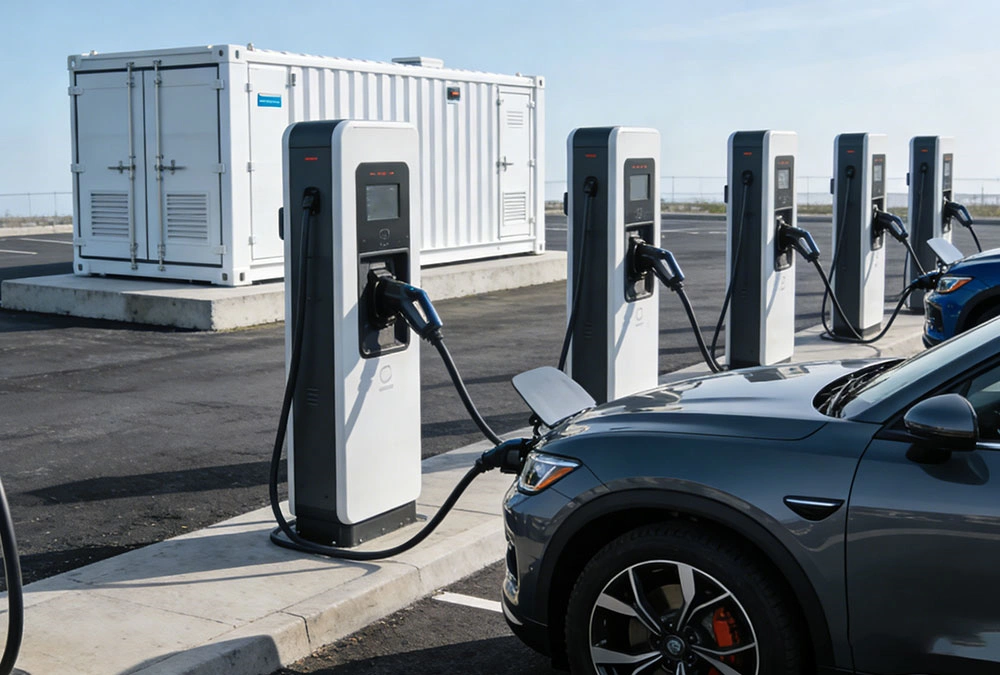
The global transition to electric mobility is no longer a forecast; it is an operational reality. However, for site hosts and grid operators, the primary bottleneck isn’t the availability of vehicles, but the EV charging infrastructure’s ability to handle massive, unpredictable power spikes. As charging speeds move from 50kW to 350kW and beyond, the strain on local distribution networks has reached a breaking point. Energy Storage for EV Charging has emerged as the most critical mechanical solution to this crisis. By decoupling high-power demand from the utility’s immediate capacity, battery systems allow for the deployment of ultra-fast chargers even in locations with severe grid capacity constraints, effectively turning a volatile load into a manageable, stable asset.
What Is Energy Storage for EV Charging and Why Is It Essential?
Definition of Energy Storage for EV Charging Systems
Energy Storage for EV Charging is a technical architecture where a battery energy storage system (BESS) is integrated with electric vehicle supply equipment (EVSE) to manage power flow. Instead of pulling the full peak load directly from the transformer—which can trigger expensive demand penalties or cause local grid instability—the station uses the battery as a “buffer.” The system draws a steady, low-power feed from the grid to fill the battery during idle times and “bursts” that stored energy into the vehicle during a high-speed charging session.
Why is energy storage needed for EV charging?
Energy storage is needed for EV charging to solve three primary challenges:
- Reduce Peak Grid Demand: It caps the maximum power drawn from the utility, preventing localized blackouts.
- Enable Fast Charging (150kW–350kW+): It provides the high-amperage current that many aging grid transformers cannot supply.
- Avoid Expensive Grid Upgrades: It eliminates the need for multi-year utility construction projects.
- Lower Electricity Costs: It utilizes peak shaving for EV charging to eliminate high “demand charges” on monthly utility bills.
Challenges in Modern EV Charging Infrastructure
The central conflict in the industry is the fast charging power demand. A single DC fast charger can pull as much power as a small commercial building. When four or eight of these chargers operate simultaneously at a highway rest stop, the grid often lacks the “Hosting Capacity” to support them. Furthermore, utility companies impose “Demand Charges” based on the highest 15-minute spike in a billing cycle. Without Energy Storage for EV Charging, a single charging session could cost the station owner hundreds of dollars in utility surcharges, making the business model unsustainable.
How Energy Storage for EV Charging Works: The Technical Architecture
System Architecture: EV Charger + Battery Energy Storage System (BESS)
A modern EV charging station with battery storage solution is a synergy of three distinct layers: the electrochemical storage (the battery), the power electronics (the converter), and the intelligence (the software). In 2026, the industry standard has shifted toward Lithium Iron Phosphate (LFP) for the battery energy storage system (BESS). LFP offers the high cycle life (6,000+ cycles) and thermal stability required for the intense “charge-discharge-charge” patterns found at busy public charging hubs.
Power Conversion System (PCS): Managing Bidirectional Flow
The PCS is the heart of any energy storage system for fast EV charging. It handles the conversion between the DC power in the batteries and the AC power of the grid. In a microgrid EV charging system, the PCS must be bidirectional. This allows the battery not only to power the chargers but also to provide “Grid Services” like frequency regulation or voltage support back to the utility. High-efficiency semiconductors, such as Silicon Carbide (SiC), are now used in the PCS to ensure that round-trip efficiency stays above 90%, even under high heat conditions.
Energy Management System (EMS): Load Balancing and Smart Dispatch
The EV charging load management system is governed by the EMS. This is the AI-driven software layer that makes real-time decisions. It monitors:
- Grid Prices: Charging the battery when rates are low.
- Station Load: Predicting when a vehicle will plug in based on historical traffic.
- State of Health (SoH): Ensuring the battery doesn’t overheat or degrade prematurely. By integrating an energy management system (EMS), station owners can automate their savings, ensuring they always use the cheapest electron available—whether it’s from the grid, the battery, or onsite solar.
Key Benefits of Energy Storage for EV Charging Stations
Reducing Grid Capacity Requirements and Upgrade Costs
For many commercial sites, a traditional grid upgrade (installing new transformers and high-voltage lines) can take 12 to 24 months and cost between $150,000 and $500,000. An EV charging station energy storage solution can be deployed in a fraction of that time. By acting as a DC fast charging with battery buffer, the storage system allows the station to run 350kW chargers on a grid connection only capable of 100kW, effectively bypassing the utility’s bottleneck.
Peak Shaving and Demand Charge Reduction
In industrial and commercial sectors, “Demand Charges” can account for 30% to 70% of an electricity bill. Peak shaving for EV charging is the process of using the battery to “cut off” the top of the power consumption curve. When the EV charger attempts to draw 150kW, the battery provides 100kW and the grid provides 50kW. The utility only sees the 50kW draw, significantly lowering the monthly bill and improving the commercial EV charging energy storage system cost-to-benefit ratio.
Enabling Ultra-Fast Charging in “Weak” Grid Areas
Rural highways and older urban neighborhoods often have “weak” grids that suffer from voltage instability. Battery storage for EV fast chargers provides the necessary voltage support to maintain a consistent 800V or 1000V charging curve for modern EVs like the Porsche Taycan or Hyundai Ioniq 6. Without this buffer, the charging speed would “throttle” down, leading to a poor user experience and long queues.
Types of Energy Storage Systems for EV Charging Infrastructure
Containerized Energy Storage for EV Charging Stations
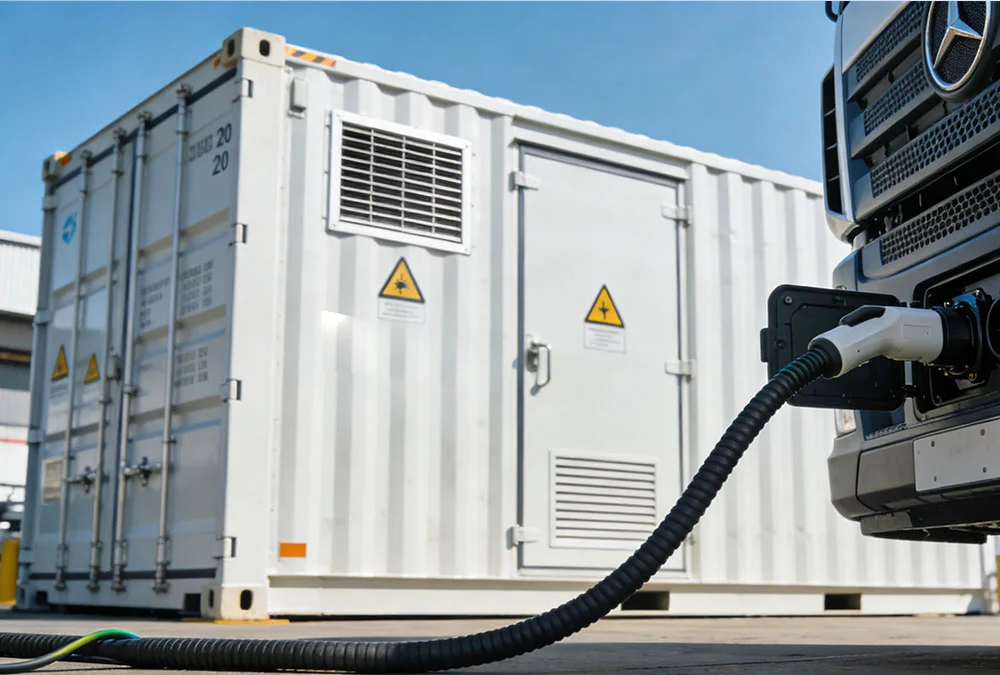
For large-scale highway hubs, containerized energy storage for EV charging stations is the gold standard. These are 20-foot or 40-foot ISO containers that arrive pre-integrated with HVAC, fire suppression, and battery racks. They are “plug-and-play” units that minimize onsite construction risks and are easily scalable as the station adds more dispensers.
Hybrid Systems: Solar + Energy Storage for EV Charging
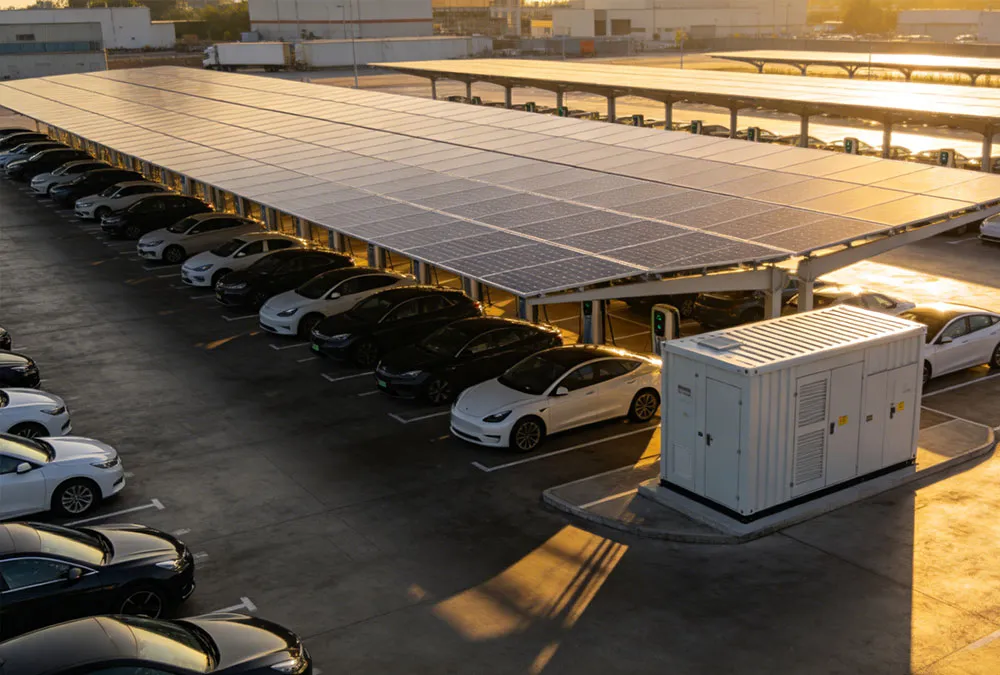
A solar + storage EV charging system represents the pinnacle of sustainability. By placing solar canopies over the parking stalls, the station harvests energy during the day, stores it in the BESS, and discharges it into vehicles at night. This setup is particularly effective for reduce grid demand EV charging with energy storage strategies, as it allows the station to operate partially or entirely “behind the meter.”
Off-Grid EV Charging with Battery Storage
In remote national parks or temporary construction sites, off-grid EV charging with battery storage is the only viable solution. These systems rely entirely on solar or wind power to fill a large battery bank, providing a reliable “power island” where no utility lines exist.
Energy Storage for EV Charging vs. Direct Grid Connection
When a developer evaluates a new charging site, they must choose between waiting for a utility upgrade or installing a battery. The table below outlines why Energy Storage for EV Charging is becoming the preferred choice for rapid deployment.
Comparison Table: Grid Expansion vs. BESS Deployment
| Feature | Direct Grid Connection (Upgrade) | Battery-Assisted (BESS) |
| Typical CAPEX | $200,000 – $600,000 | $150,000 – $350,000 |
| Time to Market | 12 – 24 Months | 3 – 6 Months |
| Monthly OPEX | High (Demand Charges) | Low (Capped Grid Draw) |
| Reliability | Susceptible to Grid Outages | Supports Backup/Island Mode |
| Environmental Impact | Grid-Dependent Mix | Enables Solar Integration |
Strategic Note: In high-growth markets, the “Time to Market” is often the most important factor. Opening a station 18 months earlier by using an EV charging station energy storage solution can generate enough revenue to pay for the battery system itself before the grid upgrade would have even been finished.
Sizing an Energy Storage System for EV Charging (kW vs. kWh)
Understanding Charging Load Profiles
Designing an Energy Storage for EV Charging system requires a deep dive into “Load Profiles.” You must analyze:
- Peak Power (kW): The maximum simultaneous draw when all chargers are full.
- Energy Consumption (kWh): The total energy delivered to vehicles over a 24-hour period. A highway station needs high power (kW) to support fast bursts, whereas a bus depot needs high energy (kWh) to support long, overnight charging cycles.
How to Size Battery Capacity for EV Charging Demand
To size a system correctly, we use the “Buffer Ratio.” If your chargers total 600kW but your grid is limited to 200kW, your battery storage for EV fast chargers must have a PCS rated at at least 400kW. The energy capacity (kWh) should then be sized to handle the “Busy Hour”—usually 2 to 4 hours of continuous peak traffic. A common ratio for highway fast charging is 1:2 (e.g., a 250kW / 500kWh system).
The Commercial ROI and Cost of Energy Storage for EV Charging
System Cost Breakdown
The commercial EV charging energy storage system cost is generally divided into four categories:
- Battery Modules (45%): The core LFP cells.
- Power Electronics/PCS (25%): The inverters and switchgear.
- Soft Costs (15%): Permitting, engineering, and commissioning.
- Installation (15%): Concrete pads, trenching, and wiring.
Revenue Streams: Demand Charge Reduction and Arbitrage
The ROI is driven by “Avoided Costs.” By using EV charging demand response programs, station owners can also get paid by the utility to reduce their draw or push power back to the grid during emergencies. When combined with “Energy Arbitrage” (buying cheap midnight power to sell at noon), the payback period for a commercial BESS typically falls between 3 and 5 years.
Future Trends in Energy Storage for EV Charging Infrastructure
Megawatt Charging Systems (MCS)
As heavy-duty trucking electrifies, we are moving toward Megawatt Charging Systems (MCS) that pull 1,000kW+ per truck. At this scale, the grid simply cannot function without Energy Storage for EV Charging. Every truck stop of the future will essentially be a localized microgrid, with multi-megawatt battery banks acting as the primary energy source.
Vehicle-to-Grid (V2G) and AI Optimization
In the future, the EVs themselves will act as part of the storage ecosystem. AI-driven Energy Management Systems will coordinate between the station’s battery and the connected vehicles’ batteries to stabilize the entire regional grid, turning the charging station into a virtual power plant (VPP).
FAQ: Energy Storage for EV Charging Explained
Why is energy storage needed for EV charging stations?
Energy storage is needed to reduce grid dependency, manage high power demand from fast chargers, and enable deployment in areas where the local transformer capacity is limited. It effectively acts as a buffer to prevent expensive grid upgrades and lower monthly demand charges.
How does battery storage support EV fast charging?
Battery storage supplies the “extra” power required for high-speed charging. If a charger needs 350kW but the grid can only provide 100kW, the battery provides the remaining 250kW instantaneously. This ensures the vehicle charges at maximum speed regardless of grid limitations.
Is energy storage for EV charging cost-effective?
Yes. While the upfront cost is significant, it is often cheaper than a major utility grid upgrade. Additionally, it provides a high ROI by eliminating “Demand Charges,” which can otherwise make up the majority of a station’s operating expenses.
What size battery is needed for an EV charging station?
The size depends on the number of chargers and the local grid limit. Typically, a station needs a battery with enough power (kW) to cover the gap between the grid limit and the chargers’ peak draw, and enough energy (kWh) to sustain that gap during the busiest hours of the day.
Can solar energy be combined with EV charging and battery storage?
Yes. A solar + storage EV charging system is the most efficient way to achieve energy independence. It allows the station to use clean, onsite energy to power vehicles, further reducing electricity costs and carbon footprints.
Next Step for Your Infrastructure: The first step in any successful deployment is a detailed load-profile simulation. By analyzing your local grid capacity against your expected traffic, we can determine the exact kW/kWh ratio needed to maximize your ROI. Would you like me to help you calculate the specific cost-savings of a BESS for your location or assist in drafting a technical specification for your equipment RFP?
Related Posts
Romania 3.5MW/7.3MWh Industrial Energy Storage: High-Capacity Grid Integration
Battery Energy Storage Projects https://anengjipower.com/wp-content/uploads/2026/03/new-zealand-500kw-industrial-bess-outdoor-installation.webp
675
1000
Charging Station Engineer
https://anengjipower.com/wp-content/uploads/2025/09/anengji-dc-fast-charging-station-manufacturer-and-supplier-logo-white-1.png
Charging Station Engineer2026-03-06 07:28:092026-03-06 07:28:31New Zealand BESS: 500kW/1165kWh Frequency Regulation Solution
https://anengjipower.com/wp-content/uploads/2026/03/new-zealand-500kw-industrial-bess-outdoor-installation.webp
675
1000
Charging Station Engineer
https://anengjipower.com/wp-content/uploads/2025/09/anengji-dc-fast-charging-station-manufacturer-and-supplier-logo-white-1.png
Charging Station Engineer2026-03-06 07:28:092026-03-06 07:28:31New Zealand BESS: 500kW/1165kWh Frequency Regulation Solution



Leave a Reply
Want to join the discussion?Feel free to contribute!