
Introduction
The global energy landscape in 2026 is defined by a fundamental shift from centralized, fossil-fuel-dependent generation to a decentralized, high-volatility renewable grid. As the World Economic Forum (WEF) has noted, the “energy trilemma”—balancing security, equity, and sustainability—is now being solved through the rapid deployment of grid connected battery storage. This technology has moved beyond its initial role as a simple backup mechanism to become the primary orchestrator of grid stability. In an era where coal-fired peaker plants are being retired at record rates, the ability of grid-scale battery systems to provide instantaneous “synthetic inertia” and frequency response is the thin line preventing widespread network instability during the transition to net-zero.
What Is Grid Connected Battery Storage (Grid-Tied BESS)?
Definition of Grid Connected Battery Storage Systems
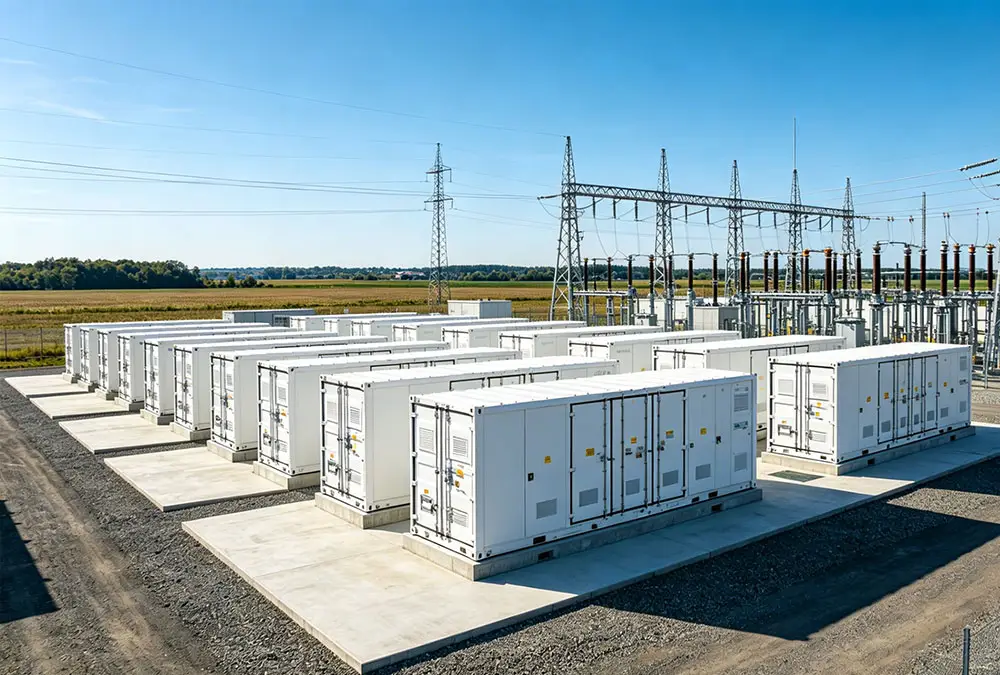
A grid connected battery storage system (BESS) is an industrial-grade electrochemical asset designed to operate in permanent synchronization with a utility network. Unlike isolated systems, a grid-tied BESS utilizes bi-directional power electronics to interact with the transmission or distribution infrastructure. It serves as a massive, high-speed “buffer” that can absorb or inject power based on real-time grid conditions or market signals.
How Grid Connected Battery Storage Fits into Modern Power Systems
In 2026, the grid is no longer a one-way street. Modern power systems are shifting toward a “Grid 2.0” architecture where grid integration energy storage provides a non-wires alternative (NWA) to traditional infrastructure upgrades.
- Generation Side: Firming intermittent output from wind and solar farms.
- Transmission/Distribution: Relieving congestion on overloaded lines, deferring the need for multi-billion dollar transformer upgrades.
- Consumer Side (C&I): Empowering factories and data centers to act as “prosumers”—both consuming energy and selling stability services back to the utility.
How Grid Connected Battery Storage Systems Work (BESS + PCS + EMS)
Core Components of a Grid Connected BESS
To ensure the utility scale grid connected battery storage solutions remain operational for their 15–20 year design life, four critical subsystems must operate in perfect harmony:
- The Battery System (LFP & Beyond): The storage medium itself. In 2026, grid scale lithium battery storage is dominated by Lithium Iron Phosphate (LFP) due to its superior safety profile and cycle life (up to 8,000 cycles).
- Power Conversion System (PCS): The bidirectional “heart” of the system. It manages the rectification (AC to DC for charging) and inversion (DC to AC for discharging) with efficiencies now exceeding 98.5%.
- Battery Management System (BMS): Operating at the cell and rack level, the BMS prevents thermal runaway and ensures cell balancing, which is critical for maintaining capacity over time.
- Energy Management System (EMS): The intelligent layer. Using AI-driven algorithms, the EMS monitors market prices, weather forecasts, and grid health to decide the optimal dispatch strategy.
Control Strategies for Grid Stability
The true value of battery storage for grid support lies in its speed. Traditional gas turbines take minutes to ramp up; a grid-tied BESS responds in less than 20 milliseconds.
- Frequency Regulation: Maintaining the grid at 50Hz/60Hz by injecting power when frequency drops.
- Voltage Support: Injecting or absorbing reactive power (VARs) to stabilize local voltage levels.
- Energy Arbitrage: The commercial practice of charging during off-peak hours (low cost) and discharging during peak periods (high cost).
Grid Connection Requirements for Battery Storage Systems
Technical Standards and Compliance
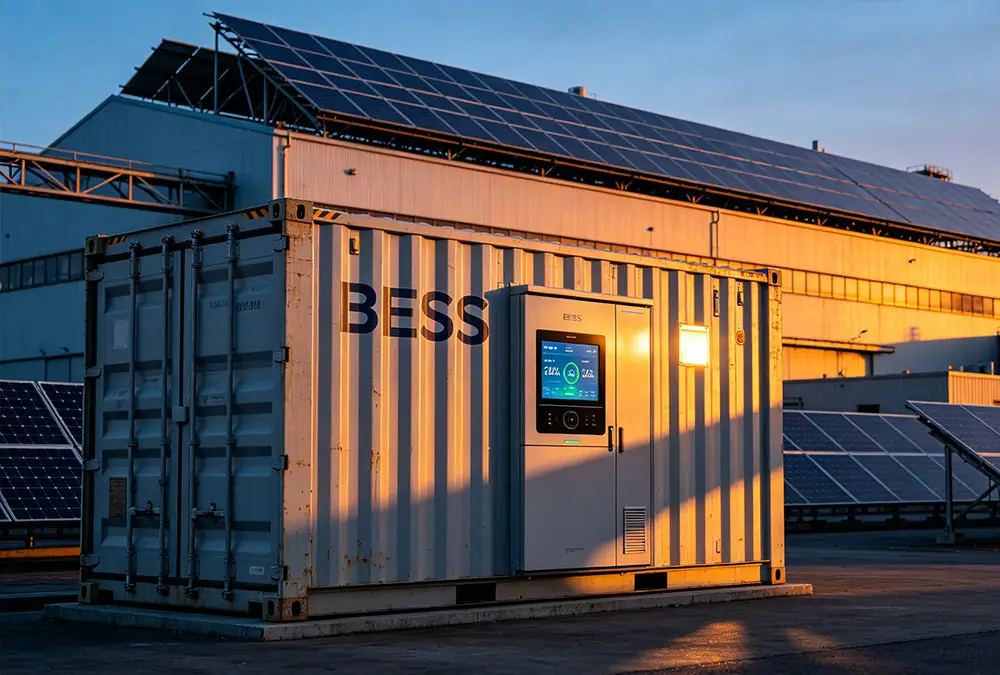
Navigating the battery energy storage system grid connection requirements is often the most significant hurdle in project development. In 2026, adherence to IEEE 1547 and IEC 62933 is mandatory. These codes ensure that the BESS does not negatively impact the grid’s power quality.
The Interconnection Process for Utility-Scale Projects
The path from a greenfield site to a commissioned utility scale battery storage plant involves a rigorous EPC (Engineering, Procurement, and Construction) workflow:
- Feasibility & Modeling: Running power flow simulations to ensure the local feeder can handle the BESS output.
- Interconnection Application: Submitting technical “one-line” diagrams to the Utility or Independent System Operator (ISO).
- Grid Impact Study: A detailed analysis by the utility to determine if network upgrades (like new transformers) are required.
- Testing & Commissioning: Verifying “anti-islanding” protection—ensuring the BESS shuts down if the grid fails to prevent injury to line workers.
Benefits of Grid Connected Battery Storage for Utilities and Industry
Peak Shaving and Demand Charge Reduction
For heavy industry, a grid tied battery storage system for industrial use is a direct tool for OpEx reduction. Most industrial utility bills include heavy “demand charges” based on the highest point of consumption.
Logic: By discharging the battery to cover peak factory loads, the facility “shaves” its peak demand from the grid, potentially saving hundreds of thousands of dollars annually.
Revenue Streams and Value Stacking
The 2026 market allows for “Value Stacking,” where a grid connected battery storage company generates revenue from multiple sources simultaneously:
| Revenue Stream | Description | Typical Market Participant |
| Ancillary Services | Frequency and Voltage regulation payments. | Utilities / Large Aggregators |
| Arbitrage | Profit from the buy/sell price spread. | Energy Traders / Industrial Plants |
| Capacity Markets | Payments for being “ready to help” during emergencies. | All Grid-Scale Assets |
| Avoided Infrastructure | Savings from not upgrading local substations. | Utilities |
Grid Connected Battery Storage vs Off-Grid and Hybrid Systems
Understanding the distinction is vital for accurate system design. On-grid battery storage is fundamentally different from the “solar plus storage” setups used in remote locations.
- On-Grid: Always synchronized. Optimized for grid services and high-power throughput.
- Off-Grid: Operates as a “Master” system, creating its own voltage and frequency. Optimized for duration and autonomy.
- Hybrid: Can do both, but usually at the cost of higher complexity and lower efficiency in the “tied” mode.
When to Choose Grid Connected Storage?
In 2026, if the facility is within 5km of a utility substation, a grid-tied system is almost always the more profitable choice due to the ability to participate in the energy market.
How to Size a Grid Connected Battery Storage System (MW vs MWh)
Correct sizing prevents “stranded assets” or insufficient performance.
- MW (Power): How much work can be done at once? (The width of the pipe).
- MWh (Energy): For how long can that work be sustained? (The size of the tank).
The Sizing Calculation
For an industrial peak-shaving application, the required capacity can be calculated as:
Energy Capacity (kWh) = (Peak Power (kW) - Target Threshold (kW)) x Duration of Peak (h) / Round Trip Efficiency
For a grid scale lithium battery storage project, the “Duration” (the ratio of MWh to MW) typically ranges from 2-hour to 4-hour for the 2026 market.
Grid Connected Battery Storage Cost in 2026
The grid connected battery storage system cost has reached a level of stability that makes the Internal Rate of Return (IRR) highly attractive for private equity and institutional investors.
Average Cost per kWh
In 2026, the turnkey cost for a grid-scale system has dropped to approximately $250 – $450 per kWh, depending on the duration and technical complexity of the grid connection.
CAPEX Breakdown (Estimated for a 5MW/10MWh Project)
- Battery Modules & Racks: 48%
- Power Conversion (PCS): 18%
- Balance of System (BOS) & Civil Works: 15%
- Soft Costs (EPC, Permitting, Interconnection): 12%
- EMS & Software Integration: 7%
Battery Technology and Alternatives: A Deep Dive
1. Lithium Iron Phosphate (LFP)
LFP remains the dominant technology for grid tied battery systems. Unlike NMC (Nickel Manganese Cobalt), LFP contains no cobalt and offers a higher thermal stability limit.
Interpretation: LFP uses iron and phosphate, making it less susceptible to the supply chain shocks seen in the early 2020s.
2. Sodium-Ion (The 2026 Disruptor)
Sodium-ion batteries are now entering the grid-scale market as a low-cost alternative.
Interpretation: While having lower energy density than lithium, sodium is abundant and the batteries perform better in sub-zero temperatures, making them ideal for high-latitude grid integration energy storage.
3. Flow Batteries (Vanadium Redox)
For long-duration storage (8-24 hours), flow batteries are the primary alternative.
Interpretation: Instead of storing energy in solid electrodes, they use liquid electrolytes stored in external tanks. They offer almost infinite cycle life but have a much larger physical footprint.
Real-World Applications of Grid Connected Battery Storage
Utility-Scale Battery Storage Plants
Massive 100MW+ installations are now replacing traditional “black-start” gas generators. These plants can restart the entire regional grid following a total blackout.
Commercial & Industrial (C&I) Applications
Factories and data centers are utilizing grid tied battery storage system for industrial use to ensure 99.999% power uptime while simultaneously reducing their carbon footprint by charging the BESS only when renewable energy is the dominant grid source.
EV Charging Infrastructure Integration
The “Mega-Charger” stations of 2026, capable of charging 30-50 vehicles simultaneously, would collapse the local grid without a buffer. Grid connected battery storage acts as a shock absorber, drawing a steady power stream from the grid and providing the necessary surge current to the vehicles.
Challenges and Limitations of Grid Connected Battery Storage
- Grid Constraints: Many older grids have “low hosting capacity,” meaning they cannot accept high-power injections from a BESS without expensive upgrades to local distribution lines.
- Battery Degradation: All batteries degrade. A 10MWh system in Year 1 might only be a 7MWh system in Year 10. Advanced energy storage for power grid management requires “augmentation”—adding new battery racks mid-lifecycle to maintain rated performance.
- Market Volatility: The ROI of arbitrage depends on the price difference between night and day. As more storage enters the market, this spread often shrinks, a phenomenon known as “cannibalization.”
Future Trends of Grid Connected Battery Storage (2026–2030)
AI-Driven EMS Optimization
The next generation of energy management system (EMS) will use Large Action Models (LAMs) to execute thousands of trades per second across multiple energy markets, finding the most profitable millisecond to discharge.
The Rise of LDES (Long Duration Energy Storage)
As we approach 2030, the focus will shift from 4-hour “shifting” to multi-day storage to cover “Dunkelflaute” (periods of no sun and no wind).
Featured Snippet: Key Takeaways About Grid Connected Battery Storage
What Is Grid Connected Battery Storage?
Grid connected battery storage is an industrial system connected directly to the utility grid, enabling bi-directional energy flow to manage supply, demand, and grid health.
What Are the Main Benefits?
- Cost Savings: Lowering industrial demand charges.
- Stability: Providing frequency and voltage regulation to the utility.
- Renewables: Allowing solar and wind to be used 24/7.
How Much Does It Cost in 2026?
Typical utility scale grid connected battery storage solutions range from $250 to $450 per kWh for fully installed systems.
Who Should Use It?
- Industrial facilities with high peak loads.
- Utilities looking to defer infrastructure upgrades.
- EV Charging Stations requiring high-power buffers.
Author’s Note: The 2026 energy landscape demands a data-driven approach to storage. Whether you are a utility looking for grid stability or a factory owner seeking to slash demand charges, grid-tied BESS is the most versatile tool in your arsenal. For personalized system sizing or to explore our industrial-grade LFP container solutions, consult with a qualified EPC specialist today.
 https://anengjipower.com/wp-content/uploads/2026/09/AnengJipower-European-BESS-Project-Design-Environment-1.webp
675
1000
Charging Station Engineer
https://anengjipower.com/wp-content/uploads/2025/09/anengji-dc-fast-charging-station-manufacturer-and-supplier-logo-white-1.png
Charging Station Engineer2026-09-24 09:05:462026-09-24 09:08:39Battery Energy Storage System Design Guide for Europe
https://anengjipower.com/wp-content/uploads/2026/09/AnengJipower-European-BESS-Project-Design-Environment-1.webp
675
1000
Charging Station Engineer
https://anengjipower.com/wp-content/uploads/2025/09/anengji-dc-fast-charging-station-manufacturer-and-supplier-logo-white-1.png
Charging Station Engineer2026-09-24 09:05:462026-09-24 09:08:39Battery Energy Storage System Design Guide for Europe https://anengjipower.com/wp-content/uploads/2026/09/anengjipower-How-BESS-Power-and-Energy-Shape-Storage-Duration.webp
675
1000
Charging Station Engineer
https://anengjipower.com/wp-content/uploads/2025/09/anengji-dc-fast-charging-station-manufacturer-and-supplier-logo-white-1.png
Charging Station Engineer2026-09-23 09:06:532026-09-23 09:08:02BESS Duration Guide: How to Choose 1, 2 or 4 Hours
https://anengjipower.com/wp-content/uploads/2026/09/anengjipower-How-BESS-Power-and-Energy-Shape-Storage-Duration.webp
675
1000
Charging Station Engineer
https://anengjipower.com/wp-content/uploads/2025/09/anengji-dc-fast-charging-station-manufacturer-and-supplier-logo-white-1.png
Charging Station Engineer2026-09-23 09:06:532026-09-23 09:08:02BESS Duration Guide: How to Choose 1, 2 or 4 Hours https://anengjipower.com/wp-content/uploads/2026/09/AnengJIPower-Cabinet-vs-Containerized-BESS-3D-Isometric-Structural-Cutaway.webp
675
1000
Charging Station Engineer
https://anengjipower.com/wp-content/uploads/2025/09/anengji-dc-fast-charging-station-manufacturer-and-supplier-logo-white-1.png
Charging Station Engineer2026-09-18 07:19:042026-09-18 07:19:38Cabinet vs Containerized BESS: How to Choose for Large C&I
https://anengjipower.com/wp-content/uploads/2026/09/AnengJIPower-Cabinet-vs-Containerized-BESS-3D-Isometric-Structural-Cutaway.webp
675
1000
Charging Station Engineer
https://anengjipower.com/wp-content/uploads/2025/09/anengji-dc-fast-charging-station-manufacturer-and-supplier-logo-white-1.png
Charging Station Engineer2026-09-18 07:19:042026-09-18 07:19:38Cabinet vs Containerized BESS: How to Choose for Large C&I


Leave a Reply
Want to join the discussion?Feel free to contribute!