
Introduction
Switching from an internal combustion engine to an electric vehicle (EV) changes the way you think about “fueling” your car. You no longer measure consumption in gallons; you measure it in kilowatt-hours (kWh). A common question for prospective and new EV owners is: “How much electricity does it take to charge a Tesla?”
The answer is not a single number. It depends entirely on the specific model you own, the size of its battery pack, and the efficiency of your charging method. Furthermore, the amount of electricity you pay for is often slightly higher than the capacity of the battery due to energy loss during the transfer from the grid to the car.
Understanding these metrics is crucial. It helps owners accurately estimate monthly utility bills, decide if their home electrical panel needs an upgrade, and evaluate the Return on Investment (ROI) of installing a home charging station. Below, we provide a deep dive into the battery capacities, charging methods, and costs associated with the entire Tesla lineup.
The Three Types of Tesla Charging: From Trickle to Supercharge
To understand energy usage, you must first understand the delivery method. Tesla vehicles can be charged at three distinct levels, each offering different speeds and efficiencies.
Level 1 and Level 2: The Home Charging Solutions
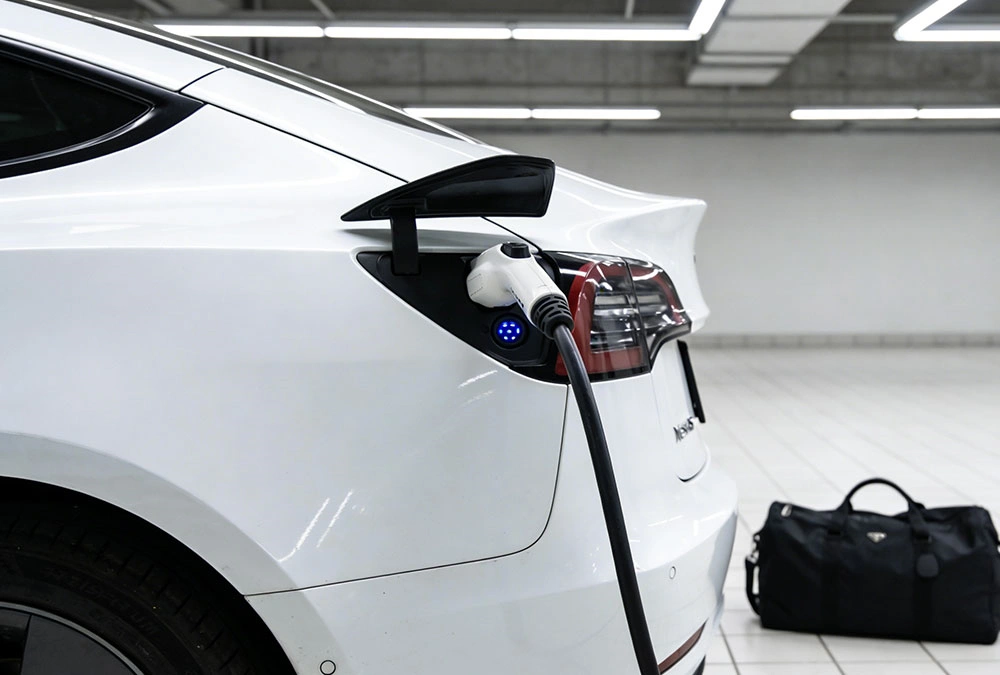
Level 1 Charging (120V) Level 1 is the entry-level charging method. It utilizes the standard 120-volt household outlet—the same plug you use for a lamp or phone charger.
- How it works: You use the Tesla Mobile Connector to plug directly into the wall. No electrician is required.
- The Pros and Cons: It is the most accessible method but also the slowest. Level 1 is often called “trickle charging” because it adds only 3 to 5 miles of range per hour.
- Best For: This is primarily a backup solution or a method for those with very short daily commutes (under 30 miles). It is best utilized for long overnight stops where the car sits for 10-12 hours.
Level 2 Charging (240V) Level 2 is the gold standard for EV ownership. It utilizes a 240-volt outlet (similar to a dryer or oven outlet) or a hardwired wall unit.
- The Speed Upgrade: This is the most practical everyday solution. A Level 2 setup can deliver between 10 to 45 miles of range per hour, depending on the amperage. This means a Tesla can easily be fully recharged overnight.
- Accessibility: Most owners install a Level 2 station (like the Tesla Wall Connector) at home. While this incurs an installation cost, the convenience of waking up to a full battery every morning is unmatched. Additionally, most public destination chargers found at hotels, shopping centers, and office parks use J1772 Level 2 connections, which Tesla owners can access via a standard adapter.
DC Fast Charging: The Supercharger Network
When you are on a road trip, you cannot wait six hours for a charge. This is where Direct Current (DC) Fast Charging comes in.
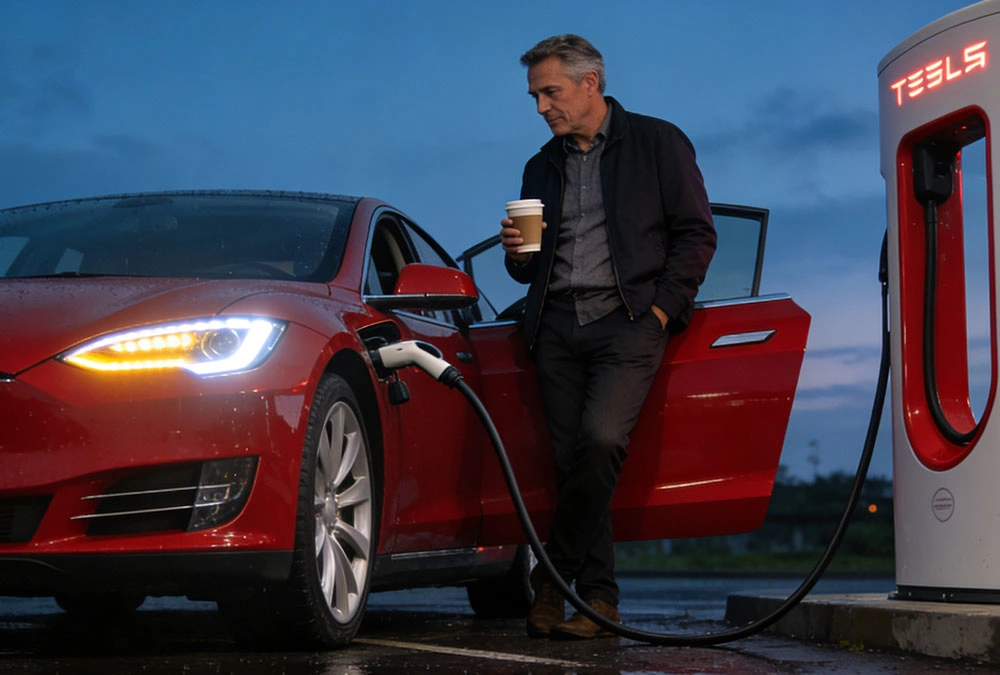
- The Technology: Unlike home charging, which uses Alternating Current (AC) that the car must convert to DC, Superchargers pump high-voltage DC electricity directly into the battery. This bypasses the onboard charger for incredible speeds.
- Speed: Tesla’s V3 Superchargers can output up to 250 kW of power. In ideal conditions, this can add up to 200 miles of range in just 15 minutes. Even the older V2 superchargers offer 150 kW, which is sufficient for most stops.
- Compatibility: While Tesla’s Supercharger network is the industry leader, owners can also use third-party networks (like Electrify America) using CCS or CHAdeMO adapters.
- Battery Health Warning: While convenient, DC fast charging generates significant heat. Frequent use over many years can accelerate battery degradation. Tesla’s Battery Management System (BMS) mitigates this by preconditioning the battery, but for longevity, it is recommended to stick to Level 2 charging for daily use and save Supercharging for long trips.
Decoding Tesla’s Battery Technology
The battery is the heart of an EV. The “kWh” (kilowatt-hour) rating of a battery is the electric equivalent of a gas tank’s gallon capacity.
Tesla currently utilizes two main types of lithium-ion battery chemistries:
- NCA (Nickel Cobalt Aluminum): Used in Long Range and Performance models for higher energy density.
- LFP (Lithium Iron Phosphate): Used in standard range models (like the base Model 3). These are cheaper to produce and have a longer cycle life but offer slightly less range per pound.
Battery Capacity by Model (Approximate Usable Capacity):
- Model 3: ~50 kWh (Standard) to ~82 kWh (Long Range)
- Model Y: ~60 kWh to ~81 kWh
- Model S: ~100 kWh
- Model X: ~100 kWh
- Cybertruck: ~123 kWh (with potential for range extenders)
Tesla is also rolling out 4680 battery cells. These structural battery packs are integrated directly into the vehicle’s chassis, reducing weight, improving safety, and lowering manufacturing costs. This constant innovation allows Tesla to maintain industry-leading range and efficiency.
Factors Affecting Charging Speed and Battery Health
Just because a charger can output 250 kW doesn’t mean your car will accept it. Several variables dictate how many kWh your Tesla pulls and how fast it charges.
- Ambient Temperature: Batteries are like humans; they prefer moderate temperatures. In freezing conditions, chemical reactions slow down, potentially cutting charging speeds by 50%. Conversely, extreme heat requires the car to expend energy cooling the battery, which also slows the charging rate to prevent damage.
- State of Charge (SoC): Batteries charge fastest when they are nearly empty. You will see the highest speeds between 10% and 50% SoC. As the battery approaches 80% and higher, the charging speed drops significantly to protect the cells—a phenomenon known as the “charging curve.”
- Charger Limitations: You are limited by the weakest link in the chain. If you plug a car capable of 250 kW charging into a 50 kW station, you will only get 50 kW.
- Battery Age: Over time and after thousands of cycles, a battery’s ability to accept high-current charging diminishes slightly.
- Charging Efficiency: This is a hidden factor. If you need to add 50 kWh to your battery, you might actually pull 55 or 60 kWh from the wall. Energy is lost as heat during the conversion from AC (wall) to DC (battery). Level 2 charging is generally more efficient (approx. 90-95%) than Level 1 charging (approx. 80-85%).
The Cost of Charging a Tesla: A Model-by-Model Breakdown
How much will you see on your electricity bill? That depends on your local utility rates. For these examples, we will use the U.S. national average electricity price of roughly $0.16 per kWh for home charging, and an estimated $0.25 to $0.50 per kWh for public Supercharging.
Tesla Model Y
The Model Y is currently the best-selling EV in the world.
- Battery Size: ~75-81 kWh for the Long Range AWD.
- Home Charging Cost: To fill a Model Y Long Range from 0% to 100% at home would cost roughly $12.00 to $14.00.
- Supercharging Cost: At public stations, a full charge could range from $20.00 to $40.00.
- Annual Estimate: For a driver covering 13,500 miles a year, the annual “fuel” cost is approximately $550 if charging primarily at home.
Tesla Model S
The flagship sedan features a massive battery for extended range.
- Battery Size: ~100 kWh.
- Home Charging Cost: A full charge at home costs approximately $16.00 to $17.50.
- Supercharging Cost: Public charging will run between $25.00 and $50.00 depending on peak pricing.
- Annual Estimate: Because the Model S is a larger, luxury vehicle, annual costs generally sit between $650 and $850. However, compared to a luxury gas sedan requiring premium fuel, the savings are massive.
Tesla Model 3
The efficiency king. The Model 3 is lighter and more aerodynamic, meaning it goes further on a single kWh than most other cars.
- Battery Size: ~50 kWh (RWD) to ~82 kWh (Long Range/Performance).
- Home Charging Cost: A standard RWD model costs just $9.20 to fully charge. The Long Range version costs about $13.50.
- Supercharging Cost: Expect to pay between $14.00 and $28.00 for the RWD model, and up to $37.00 for the Long Range.
- Annual Estimate: Most Model 3 owners pay between $500 and $600 per year. If your employer offers free charging, this number could drop to near zero.
Tesla Model X
The Model X is a large, heavy SUV with Falcon Wing doors, requiring more energy to move.
- Battery Size: ~100 kWh.
- Home Charging Cost: Like the Model S, it costs about $16.00 to fill up at home.
- Efficiency Note: While the battery is the same size as the Model S, the Model X consumes more kWh per mile due to weight and drag.
- Supercharging Cost: Typically $25.00 to $50.00.
- Annual Estimate: Expect annual costs between $700 and $900. This still represents significant savings over a gas-powered SUV that gets 15-20 MPG.
Tesla Cybertruck
The newest addition to the lineup is a heavy-duty truck with a battery to match.
- Battery Size: ~123 kWh.
- Home Charging Cost: A full charge at home will cost between $19.00 and $32.00, depending on efficiency losses.
- Supercharging Cost: Because of the massive pack, Supercharging can cost $30.00 to $100.00 depending on the location and state of charge.
- Commercial Use: Business owners may have access to commercial utility rates, potentially lowering these costs by 10-20% through enterprise agreements.
How Many kWh Do You Actually Need?
When asking “How many kWh to charge a Tesla,” it is important to distinguish between gross capacity and usable capacity.
- Gross Capacity: The total amount of energy the battery pack can theoretically hold.
- Usable Capacity: The amount of energy available for driving. Tesla locks away a small percentage (buffers) to prevent the battery from bricking at 0% or overheating at 100%.
For example, a Model 3 Long Range might have a gross capacity of 82 kWh, but the usable capacity is closer to 76-78 kWh. However, when you charge, you must account for wall-to-wheels efficiency. If you are charging at home, you might pay for 85 kWh of electricity to put 78 kWh into the car. This 10-15% overhead is normal for all electrical appliances and should be factored into your budgeting.
Beyond the Grid: Solar and Alternative Charging
One of the most financially savvy moves a Tesla owner can make is decoupling from the grid entirely.
Solar Charging Solar power is the ultimate environmentally friendly fuel.
- Production: A standard 10 kW home solar system can generate 40 to 50 kWh per day. Since most people drive less than 40 miles a day (consuming roughly 10-12 kWh), a solar system can easily power both your home and your car.
- The Investment: While systems cost $15,000 to $25,000 upfront, federal tax incentives (often 30%) and long-term fuel savings result in a payback period of just 6 to 10 years.
- Net Metering: In many states, if you produce more solar power than you use, you can sell it back to the utility company, effectively offsetting the cost of charging your car at night.
Tesla Powerwall To maximize solar, many owners install a Powerwall. This stationary battery stores excess solar energy generated during the day so you can charge your Tesla at night without drawing from the grid. This ensures true energy independence and protects you during power outages.
The Environmental Impact: Driving Green
The decision to buy a Tesla is often driven by performance and cost, but the environmental impact is undeniable.
Tesla’s vertical integration allows them to focus on sustainability in manufacturing and the vehicle lifecycle.
- Carbon Footprint: Even when charged on the average U.S. grid (which includes fossil fuels), a Tesla Model 3 produces roughly 65% fewer emissions over its lifetime than a comparable gas car.
- Renewable Synergy: When charged via solar or wind power, that reduction jumps to 95%.
- Manufacturing: Tesla is actively working to eliminate hazardous waste, reduce water usage in factories, and recycle battery materials.
Conclusion So, how many kWh does it take to charge a Tesla? It ranges from 50 kWh for a standard Model 3 to over 120 kWh for a Cybertruck. However, the real takeaway is the efficiency. By understanding your model’s battery capacity and utilizing low-cost home charging (especially off-peak or solar), you can drive a high-performance vehicle for a fraction of the cost of gasoline, all while contributing to a cleaner future.
FAQ: Common Questions About Charging Teslas
Q: Is it cheaper to charge a Tesla at home or at a Supercharger? A: It is significantly cheaper to charge at home. Home electricity rates are typically half to one-third the price of Supercharger rates.
Q: Should I charge my Tesla to 100% every night? A: For most models (NCA batteries), Tesla recommends charging to 80% or 90% for daily use to preserve battery health. Only charge to 100% for long trips. However, if you have an LFP battery (Model 3 RWD), Tesla recommends charging to 100% at least once a week.
Q: How much does a Tesla home charger cost? A: The Tesla Wall Connector costs roughly $450-$500. Installation varies by electrician and home setup but typically ranges from $750 to $1,500.
Q: Does cold weather drain the Tesla battery? A: Cold weather doesn’t “drain” the battery significantly when parked, but it reduces the available range because the battery is less efficient when cold, and energy is used to heat the cabin and the battery pack.
 https://anengjipower.com/wp-content/uploads/2026/09/AnengJipower-European-BESS-Project-Design-Environment-1.webp
675
1000
Charging Station Engineer
https://anengjipower.com/wp-content/uploads/2025/09/anengji-dc-fast-charging-station-manufacturer-and-supplier-logo-white-1.png
Charging Station Engineer2026-09-24 09:05:462026-09-24 09:08:39Battery Energy Storage System Design Guide for Europe
https://anengjipower.com/wp-content/uploads/2026/09/AnengJipower-European-BESS-Project-Design-Environment-1.webp
675
1000
Charging Station Engineer
https://anengjipower.com/wp-content/uploads/2025/09/anengji-dc-fast-charging-station-manufacturer-and-supplier-logo-white-1.png
Charging Station Engineer2026-09-24 09:05:462026-09-24 09:08:39Battery Energy Storage System Design Guide for Europe https://anengjipower.com/wp-content/uploads/2026/09/anengjipower-How-BESS-Power-and-Energy-Shape-Storage-Duration.webp
675
1000
Charging Station Engineer
https://anengjipower.com/wp-content/uploads/2025/09/anengji-dc-fast-charging-station-manufacturer-and-supplier-logo-white-1.png
Charging Station Engineer2026-09-23 09:06:532026-09-23 09:08:02BESS Duration Guide: How to Choose 1, 2 or 4 Hours
https://anengjipower.com/wp-content/uploads/2026/09/anengjipower-How-BESS-Power-and-Energy-Shape-Storage-Duration.webp
675
1000
Charging Station Engineer
https://anengjipower.com/wp-content/uploads/2025/09/anengji-dc-fast-charging-station-manufacturer-and-supplier-logo-white-1.png
Charging Station Engineer2026-09-23 09:06:532026-09-23 09:08:02BESS Duration Guide: How to Choose 1, 2 or 4 Hours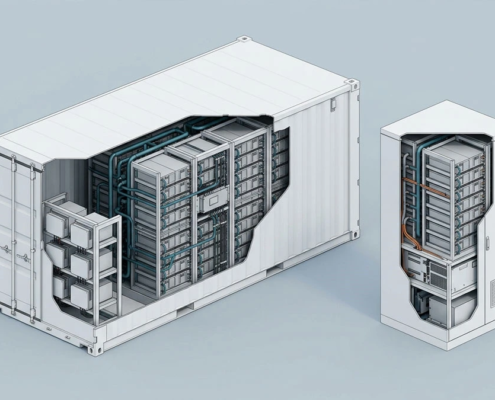 https://anengjipower.com/wp-content/uploads/2026/09/AnengJIPower-Cabinet-vs-Containerized-BESS-3D-Isometric-Structural-Cutaway.webp
675
1000
Charging Station Engineer
https://anengjipower.com/wp-content/uploads/2025/09/anengji-dc-fast-charging-station-manufacturer-and-supplier-logo-white-1.png
Charging Station Engineer2026-09-18 07:19:042026-09-18 07:19:38Cabinet vs Containerized BESS: How to Choose for Large C&I
https://anengjipower.com/wp-content/uploads/2026/09/AnengJIPower-Cabinet-vs-Containerized-BESS-3D-Isometric-Structural-Cutaway.webp
675
1000
Charging Station Engineer
https://anengjipower.com/wp-content/uploads/2025/09/anengji-dc-fast-charging-station-manufacturer-and-supplier-logo-white-1.png
Charging Station Engineer2026-09-18 07:19:042026-09-18 07:19:38Cabinet vs Containerized BESS: How to Choose for Large C&I


Leave a Reply
Want to join the discussion?Feel free to contribute!