
Introduction
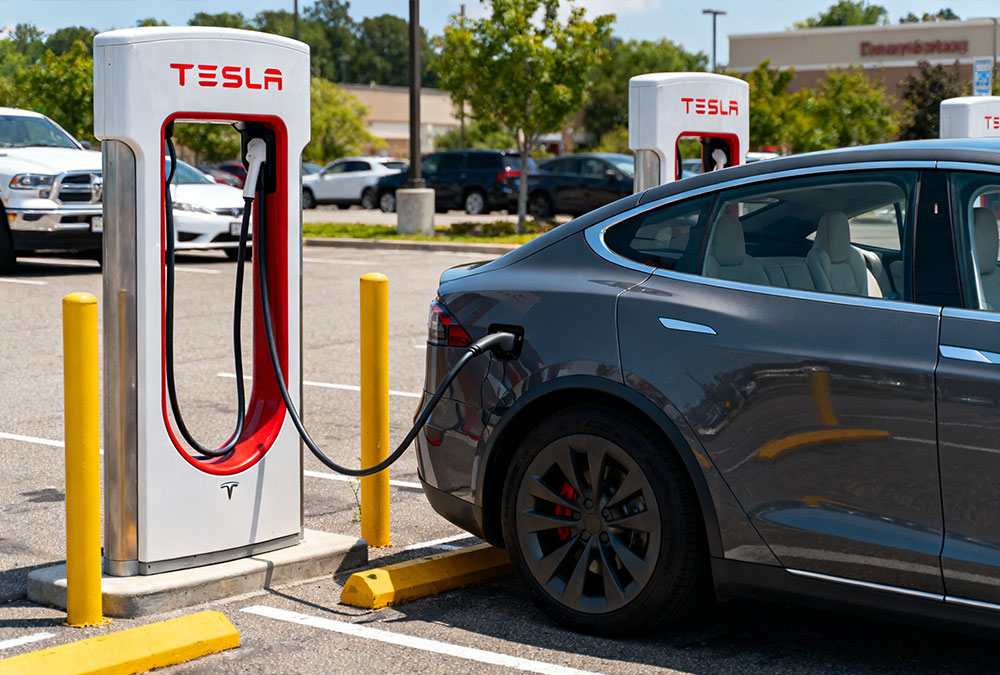
Many Tesla owners wonder whether their cars can use public AC charging stations found at shopping centers, hotels, workplaces, and city parking lots. You may worry about long-distance travel when Superchargers aren’t available, or you may already have a third-party home charger installed and aren’t sure if your Tesla can plug into it. This simple question affects your daily convenience and your freedom to drive wherever you need to go. Because the J1772 to Tesla adapter plays a key role, understanding it matters.
J1772 is the most widely used AC EV charging standard in North America, while Tesla uses its own charging port. Can these two systems work together? The answer depends on one essential accessory: a J1772 adapter for Tesla.
Before you decide whether to buy an adapter, it helps to know what it does, Tesla’s current policy on including it with new vehicles, and what real-world use looks like. With the right information, you can avoid charging frustrations and get the most from the existing AC charging network.
Where Did the J1772 Standard Come From? A Technical History Most People Overlook
To truly understand the value of J1772, we need to look back at its evolution.
In 2001, the California Air Resources Board (CARB) pushed EVs to use conductive charging instead of earlier, inefficient inductive systems such as the Avcon connector used by the Ford Ranger EV. Companies like Yazaki then developed a new connector that supported 120–240V single-phase AC charging with up to 80A.
In 2009, SAE International officially released the SAE J1772-2009 standard, backed by Ford, GM, Toyota, Honda, Nissan, and Tesla. It defined not only the physical connector but also an essential PWM-based communication protocol. This turned J1772 into the “universal language” for AC EV charging in North America and laid the groundwork for modern AC EVSE compatibility.
The standard continues to evolve:
- 2010: Added support for DC fast charging, leading to CCS Combo 1, which builds on the J1772 connector by adding two DC pins.
- 2017: Improved smart-charging functions, including dynamic load management and stronger safety protections.
- 2024: The J1772-2024 revision now supports up to 1000V/400A, preparing for future megawatt-scale charging needs.
Today, J1772 is far more than a plug. It’s a complete system combining power delivery, safety controls, EV interoperability, and smart communication.
What Does the J1772 Connector Look Like? The Five-Pin Design Has More Going On Than You Think
At first glance, a J1772 plug looks like a round AC connector with a latch. But inside, its design is more advanced.
The connector uses five pins, each with its own job:
| Pin | Name | Function |
|---|---|---|
| L/N | AC Line | Carries 120V or 240V AC power |
| PE | Protective Earth | Provides ground protection |
| CP | Control Pilot | Sends PWM signals to communicate available current |
| PP | Proximity Pilot | Detects plug insertion and prevents live disconnect |
The Control Pilot (CP) is the heart of intelligent AC EV charging. The charging station sets the PWM duty cycle to tell the vehicle how much current it can safely draw:
- 20% duty → max 12A
- 50% duty → max 30A
- 90% duty → max 72A
Your Tesla’s onboard charger (OBC) reads this signal and negotiates a safe charging amperage and output. This process ensures safe, stable Level 1 or Level 2 charging, no matter which AC EVSE you use.
💡 Because of this communication protocol, a Tesla J1772 adapter cannot be a simple physical converter. It must properly pass CP and PP signals. Otherwise, the car will reject the connection for safety.
How Long Does It Take to Charge a Tesla With a J1772 to Tesla Adapter?
When you urgently need power on the road, charging speed matters. Slow charging can disrupt your plans.
Using a J1772 charger to Tesla connection with an adapter, most Model Y or Model 3 vehicles charge to around 80% in 5 to 8 hours depending on the charger’s output:
32A (7.7kW) home charger → adds about 25 miles (40 km) per hour
48A (11.5kW) commercial charger → up to 37 miles (60 km) per hour
80A (19.2kW) charger → technically faster, but most Tesla onboard chargers cap at 11.5kW
By comparison, a Tesla Supercharger adds 180–200 miles in 15–20 minutes. That’s why J1772 charging for Tesla is ideal for home charging, workplace charging, destination charging, and overnight stays—rather than rapid on-the-go charging.
What Is a J1772 Adapter and How Does It Work With Tesla?
To understand the adapter’s purpose, it’s important to understand EV charging standards.
J1772 is an AC charging standard created by SAE for North American EVs. Its five-pin connector supports Level 1 charging (120V) and Level 2 charging (240V) at up to 19.2kW. This standard is used by non-Tesla EVs from Nissan, Ford, GM, Toyota, and many others.
Tesla uses its own charging port. Because of this difference, you need a Tesla-compatible J1772 charging adapter to plug a J1772 connector into a Tesla.
The adapter matches the pin layout and safely passes the communication protocol—especially the PWM signal on the control pilot line—so the vehicle and charging station can negotiate safe amperage and charging speed.
Does Tesla Currently Include a J1772 to Tesla Adapter?
This is one of the most common questions:
“Does my new Tesla come with the J1772 adapter?”
The policy has changed.
Before 2022: Tesla included a J1772 adapter with every car. It was usually stored in the glovebox or accessory bag.
After 2022: Tesla started phasing it out. Some trims or markets may still include it, but it is no longer guaranteed.
As of 2025: Most new Tesla vehicles—Model 3, Model Y, Model S, Model X, and even Cybertruck—do not come with a J1772 adapter.
If yours was not included at delivery, you’ll need to buy one from the Tesla online store for around $55.
It’s a good idea to confirm your accessory list during delivery or order one ahead of time to avoid discovering you can’t use most public AC chargers.
Why Is a J1772 Adapter Valuable for Tesla Owners?
1. Access to a Massive Public Charging Network
Over 85% of public Level 2 charging stations in North America use the J1772 standard. Without a J1772 plug for Tesla, you lose access to most public AC chargers.
2. Affordable Home Charging
If you already own a ChargePoint, JuiceBox, Wallbox, or another J1772 home charger, you don’t need to buy a Tesla Wall Connector. A J1772 charging adapter for Tesla saves hundreds of dollars.
3. Free Workplace Charging
More companies now offer workplace charging using J1772 stations. Eight hours at work can easily add 30–60 miles of range.
4. Backup Charging on Road Trips
In remote areas—rural communities, Alaska, Canada—J1772 chargers are often more common than Superchargers. Carrying an adapter is like having “range insurance.”
5. One Charger for Multiple EVs
Families that own both Tesla and non-Tesla EVs can use a single J1772 home EVSE for all vehicles. This improves home charging flexibility and cost efficiency.
How to Properly Use a Tesla J1772 Adapter
Using the adapter is simple:
- Find a J1772 charging station using PlugShare or A Better Routeplanner.
- Insert the J1772 connector into the adapter until it clicks.
- Plug the adapter into your Tesla charge port. The light turns blue when recognized.
- Start charging via the charger, Tesla app, or the in-car screen.
- When finished, unplug the adapter first, then remove the J1772 handle.
⚠️ Tip: Remove the adapter after each session. Leaving it attached long-term may cause pin wear or moisture intrusion.
Should You Buy a Spare J1772 Adapter?
If your Tesla didn’t include one—or if yours is lost or damaged—it’s smart to get a replacement.
Tesla’s official adapter supports up to 80A, carries an IP65 rating, and works with all models, including Model S/3/X/Y and Cybertruck.
Third-party or aftermarket adapters may be cheaper, but many lack proper communication-signal support, which can cause overheating or charging errors. For consistent charging safety, stick with the OEM version.
Frequent travelers or drivers who rely heavily on public charging may even benefit from having two—one stored at home and one in the vehicle.
Is the J1772 to Tesla Adapter Worth Buying?
For most Tesla owners, the answer is yes. This small accessory delivers major value.
While it won’t offer Supercharger speeds, a J1772 to Tesla adapter dramatically expands your charging options. It makes everyday driving easier, improves public charging flexibility, and integrates well with workplace or destination charging networks.
If your Tesla doesn’t include one from the factory, spending under $60 for an official adapter provides years of reliable, worry-free charging access.
Conclusion
So, does Tesla include a J1772 adapter? In the past, yes. Today, not always. But whether your car includes one or not, owning a J1772 to Tesla adapter ensures seamless access to the most widespread AC charging network in North America.
From the release of the J1772 standard in 2009 to powering hundreds of thousands of Level 2 chargers today, this connector is a foundation of the EV ecosystem. Understanding how it works—and having the right adapter—makes your Tesla more flexible and future-ready.
For drivers who depend on a home J1772 charger, workplace charging, or long-distance travel, this small accessory delivers peace of mind. Knowing your charging habits and preparing with the right equipment ensures your Tesla experience remains smooth, confident, and convenient.
 https://anengjipower.com/wp-content/uploads/2026/08/anengji-power-Top-10-Electric-Car-Charging-Station-Manufacturers-in-China.webp
675
1000
Charging Station Engineer
https://anengjipower.com/wp-content/uploads/2025/09/anengji-dc-fast-charging-station-manufacturer-and-supplier-logo-white-1.png
Charging Station Engineer2026-08-24 09:56:022026-08-24 09:56:53Top 10 Electric Car Charging Station Manufacturers in China (2026 Guide)
https://anengjipower.com/wp-content/uploads/2026/08/anengji-power-Top-10-Electric-Car-Charging-Station-Manufacturers-in-China.webp
675
1000
Charging Station Engineer
https://anengjipower.com/wp-content/uploads/2025/09/anengji-dc-fast-charging-station-manufacturer-and-supplier-logo-white-1.png
Charging Station Engineer2026-08-24 09:56:022026-08-24 09:56:53Top 10 Electric Car Charging Station Manufacturers in China (2026 Guide) https://anengjipower.com/wp-content/uploads/2026/08/anengji-power-Hybrid-AC-and-DC-Fast-EV-Fleet-Charging-Solutions-Depot-System.webp
675
1000
Charging Station Engineer
https://anengjipower.com/wp-content/uploads/2025/09/anengji-dc-fast-charging-station-manufacturer-and-supplier-logo-white-1.png
Charging Station Engineer2026-08-21 09:28:012026-08-21 09:28:38How to Choose the Best EV Fleet Charging Solution | Fleet Depot Guide
https://anengjipower.com/wp-content/uploads/2026/08/anengji-power-Hybrid-AC-and-DC-Fast-EV-Fleet-Charging-Solutions-Depot-System.webp
675
1000
Charging Station Engineer
https://anengjipower.com/wp-content/uploads/2025/09/anengji-dc-fast-charging-station-manufacturer-and-supplier-logo-white-1.png
Charging Station Engineer2026-08-21 09:28:012026-08-21 09:28:38How to Choose the Best EV Fleet Charging Solution | Fleet Depot Guide https://anengjipower.com/wp-content/uploads/2026/08/anengji-power-Best-EV-Charging-Companies-factory-view.webp
675
1000
Charging Station Engineer
https://anengjipower.com/wp-content/uploads/2025/09/anengji-dc-fast-charging-station-manufacturer-and-supplier-logo-white-1.png
Charging Station Engineer2026-08-20 09:12:392026-08-20 09:54:39Best EV Charging Companies in The World 2026: Top 10 Suppliers Compared
https://anengjipower.com/wp-content/uploads/2026/08/anengji-power-Best-EV-Charging-Companies-factory-view.webp
675
1000
Charging Station Engineer
https://anengjipower.com/wp-content/uploads/2025/09/anengji-dc-fast-charging-station-manufacturer-and-supplier-logo-white-1.png
Charging Station Engineer2026-08-20 09:12:392026-08-20 09:54:39Best EV Charging Companies in The World 2026: Top 10 Suppliers Compared


Leave a Reply
Want to join the discussion?Feel free to contribute!