
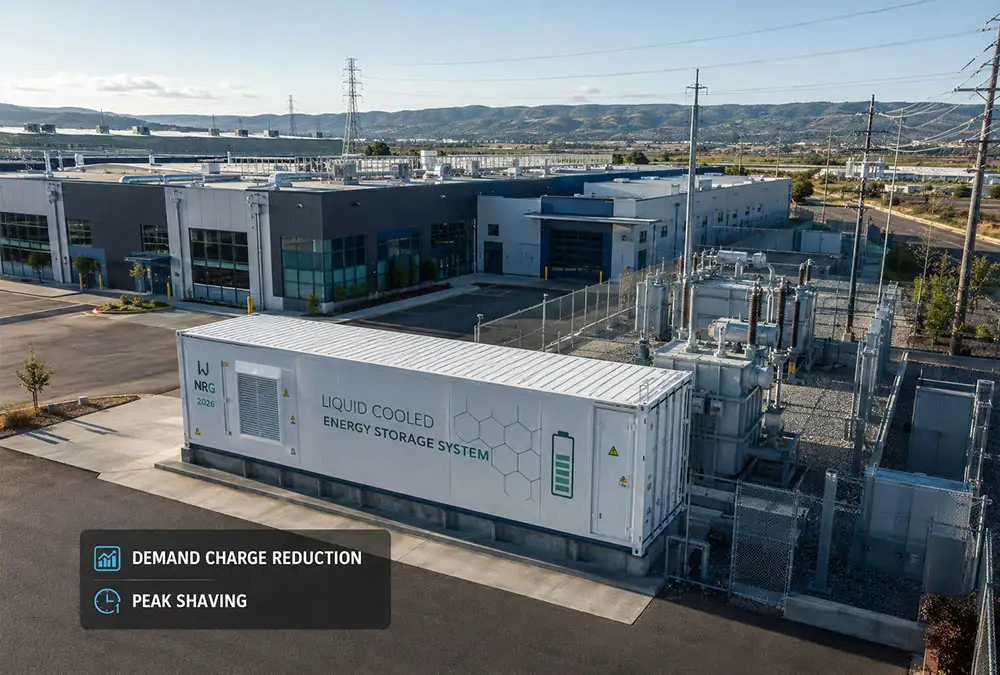
Introduction
In the rapidly evolving power landscape of 2026, commercial energy storage saves forward-thinking enterprises from the volatility of surging utility rates and the constraints of aging infrastructure. As grid demand hits historic highs due to the electrification of transport and heating, the traditional model of “pay-as-you-use” electricity has become a financial liability for high-load industries. Implementing a modernbattery energy storage system (BESS)is no longer just a sustainability goal; it is a critical strategy for electricity cost optimization and operational resilience. By shifting when and how a facility draws power from the utility, businesses can transform energy from an uncontrollable overhead into a strategic asset.
What Is Commercial Energy Storage and How Does It Save Money?
Quick Answer (For Featured Snippet)
Commercial energy storage systems (BESS) reduce electricity costs by storing energy during low-price periods and using it during peak demand, enabling demand charge reduction, peak shaving, and energy arbitrage. Businesses can typically save 10%–40% on electricity bills with a return on investment (ROI) within 3–7 years.
How Commercial Energy Storage Works (BESS, PCS, EMS Explained)
Understanding the technical architecture is essential for assessing how behind-the-meter battery storage generates value.
Battery Energy Storage System (BESS): The Core of Cost Savings
The BESS is the physical reservoir. In 2026, the industry has largely converged on Lithium Iron Phosphate (LFP) for industrial energy storage solutions due to its 15-year lifecycle and superior thermal stability. Unlike “front-of-the-meter” utility assets, commercial BESS is installed on your side of the utility meter, allowing you to control your facility’s interaction with the grid.
Power Conversion System (PCS): Enabling Energy Arbitrage
The PCS acts as the high-speed gateway. It is a bidirectional inverter that converts AC power from the grid into DC for storage, and DC back to AC for use in your facility. Modern PCS units allow for millisecond-level response, which is vital for peak shaving energy storage strategies where the system must supplement the grid load instantly to prevent a “demand spike.”
Energy Management System (EMS): Intelligent Cost Optimization
The EMS is the AI-driven “brain” that calculates how much can energy storage save businesses by analyzing real-time data. It monitors your facility’s load, solar generation (if available), and utility price signals. By using predictive algorithms, the EMS decides the most profitable time to charge or discharge, ensuring you never pull expensive power during a utility peak.
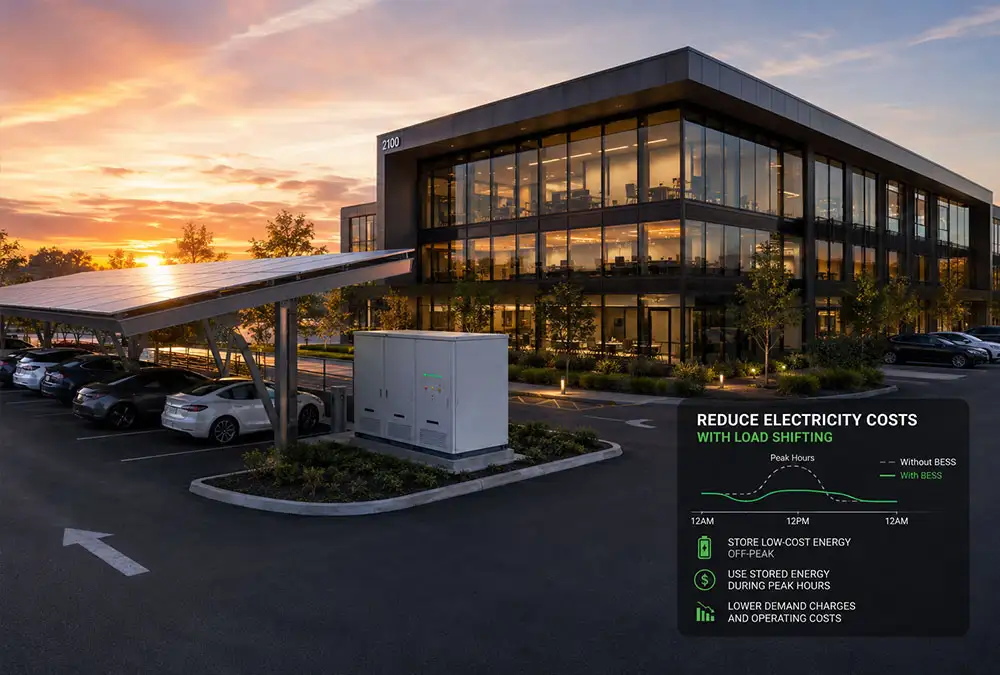
10 Ways Commercial Energy Storage Saves Money for Businesses
1. Demand Charge Reduction
For many factories and commercial buildings, demand charges can account for up to 50% of the total electricity bill. This is a fee based on the single highest 15-minute window of usage during the month. By discharging the battery during these spikes, you effectively “clip” the peak, leading to significant battery storage for demand charge reduction.
2. Peak Shaving Energy Storage Strategy
Utilities often implement Time-of-Use (TOU) rates, where electricity costs 3–5 times more during the afternoon and early evening. Peak shaving energy storage allows you to run your facility off stored energy during these expensive hours, bypassing high rates entirely.
3. Energy Arbitrage
This is the classic “buy low, sell high” model applied to electrons. Energy arbitrage involves charging the BESS at night when rates are at their lowest (or even negative in some renewable-heavy markets) and using that energy during the day.
4. Load Shifting for Electricity Cost Optimization
By utilizing a load shifting strategy, businesses can redistribute their energy consumption profile without altering their production schedule. This ensures that the facility’s average draw remains within the most favorable tariff bracket.
5. Backup Power Avoids Downtime Losses
A hidden but massive part of the commercial battery storage ROI calculation is the avoidance of downtime. For data centers or cold storage facilities, a 30-minute outage can cost hundreds of thousands of dollars. A BESS provides instantaneous backup, acting as a high-capacity UPS (Uninterruptible Power Supply).
6. Solar + Storage Maximizes Self-Consumption
Standalone solar often wastes energy by exporting it to the grid at low feed-in tariffs. Solar plus storage savings come from capturing that excess midday solar and using it at night, effectively making your facility 100% powered by your own green energy.
7. EV Charging Cost Optimization with Battery Storage
As businesses install high-power DC fast chargers for fleets or employees, the grid impact is immense. An EV charging energy storage solution buffers the chargers, drawing a steady trickle from the grid and providing the high-current “bursts” needed for the vehicles, avoiding massive infrastructure upgrade costs.
8. Reduce Grid Dependency and Price Volatility Risks
Energy markets are increasingly volatile. By having a stationary battery storage system for commercial use, you insulate your operational budget from sudden geopolitical or weather-related price hikes.
9. Participation in Grid Services
In 2026, many regions allow BESS for commercial buildings to participate in “Demand Response” or “Frequency Regulation” programs. The utility actually pays you to allow them to briefly use your battery to stabilize the grid.
10. Deferred Infrastructure Upgrades
If your facility is expanding, the local utility might require you to pay for a new transformer or substation upgrade—a cost that can reach millions. Industrial energy storage solutions can provide the extra “boost” needed for expansion without requiring a physical grid upgrade.
How Much Can Commercial Energy Storage Save? (ROI & Cost Analysis)
The financial viability of a commercial battery energy storage system has improved by nearly 25% since 2024. Below is a breakdown of typical performance across sectors in 2026.
Typical Savings Range by Application
| Application Sector | Est. Annual Bill Reduction | ROI Period (Years) | Primary Savings Driver |
| Manufacturing/Industrial | 20% – 35% | 3 – 5 | Demand Charge Reduction |
| Retail/Shopping Centers | 10% – 25% | 5 – 7 | Peak Shaving (TOU) |
| EV Fast Charging Hubs | 25% – 45% | 3 – 4 | Transformer Deferral |
| Data Centers | 15% – 30% | 4 – 6 | Arbitrage + Backup |
ROI of Commercial Battery Storage Systems
To perform a commercial battery storage ROI calculation, we use the following standard formula:
ROI (%) = ((Total Annual Savings + Grid Service Revenue - Annual O&M) / Total Initial Investment) * 100
For a typical 500kW/1MWh system installed at a manufacturing plant in 2026:
- Total Initial Cost (CAPEX): $350,000
- Annual Savings (Demand + TOU): $85,000
- Annual O&M: $5,000
- Result:
(($85,000 - $5,000) / $350,000) * 100 = 22.8% Annual ROI - Payback:
Approx. 4.4 Years
Key Factors Affecting Savings
How much can energy storage save businesses depends heavily on your local utility’s tariff structure. If your utility has a high “Peak-to-Off-Peak” ratio (e.g., $0.40/kWh vs $0.08/kWh), your arbitrage savings will be the dominant factor. If your load is highly erratic with sharp “spikes,” commercial energy storage peak shaving savings will offer the highest return.Best Use Cases for Commercial Battery Energy Storage Systems
Industrial Manufacturing Facilities
Factories with large motors, CNC machines, or high-heat furnaces often have “spiky” loads. Industrial energy storage solutions are perfect here for smoothing the load and preventing expensive demand charge penalties.
Commercial Buildings & Shopping Centers
HVAC systems are the primary driver of peak demand in commercial real estate. Using BESS to handle the “afternoon cooling peak” significantly reduces monthly overhead.
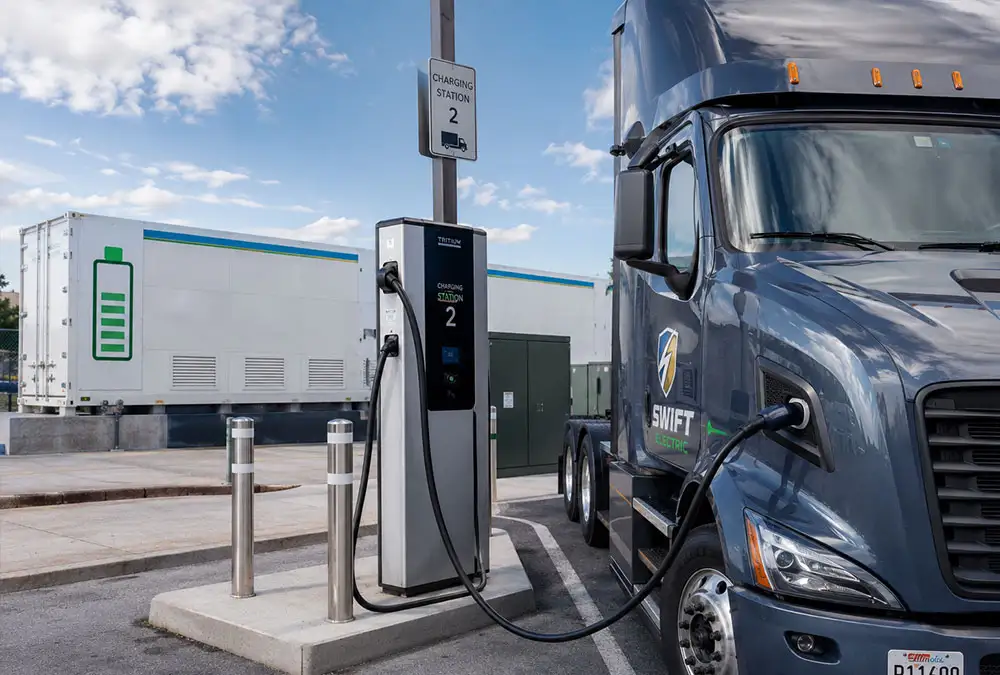
EV Fast Charging Stations
Charging operators use BESS to maintain high uptime and fast speeds without being penalized by the grid for high instantaneous power draw. This is the cornerstone of a profitable EV charging energy storage solution.
System Sizing: How to Calculate the Right Battery Capacity and Power
A common mistake is oversizing the battery, which kills the ROI. You must distinguish between Power (kW) and Energy (kWh).
Power vs Energy (kW vs kWh) Explained
- Power (kW): The “width of the pipe.” This determines how much demand charge you can reduce. If your peak spike is 200kW above your target, you need a 200kW PCS.
- Energy (kWh): The “size of the tank.” This determines how long you can sustain that discharge. To shave a 200kW peak that lasts 2 hours, you need at least 400kWh of usable energy.
Required Capacity (kWh) = Peak Reduction Goal (kW) * Duration of Peak (h) / Depth of Discharge (%)
Commercial Energy Storage vs Alternative Solutions
Diesel Generators vs Battery Storage
While diesel generators have lower upfront costs, their operational costs (fuel, maintenance, emissions compliance) make them much more expensive over 10 years. Furthermore, generators cannot perform energy arbitrage or peak shaving energy storage effectively due to slow start times and fuel costs.
Grid Upgrade vs BESS
A utility grid upgrade is a “sunk cost”—once you pay for the transformer, that money is gone. A battery energy storage system is a revenue-generating asset that pays for itself while solving the same capacity problem.
Challenges and Limitations of Commercial Energy Storage Systems
High Initial Investment
Despite the falling stationary battery energy storage system cost per kWh, the upfront CAPEX can be a barrier. In 2026, many companies are opting for “Storage-as-a-Service” (SaaS) or PPA models to avoid upfront costs.
Battery Degradation and Lifecycle
Batteries are chemical devices. Every cycle causes a tiny amount of degradation. To ensure energy storage financial benefits last for 15 years, it is crucial to use liquid-cooled LFP systems and avoid discharging below 10% State of Charge (SoC).
Recommended Industrial Storage Products
For heavy industrial applications in 2026, we recommend Liquid-Cooled Containerized LFP Systems. These units provide the highest energy density and safety.
- The “PowerVault” Industrial Series: A modular 250kW/522kWh cabinet designed for behind-the-meter battery storage with integrated fire suppression.
- The “GridBuffer” 20ft Container: A utility scale stationary battery storage solution offering 2MWh of capacity, ideal for large factories or EV charging hubs.
Future of Commercial Energy Storage in Grid-Scale Energy Systems
The transition to a “Smart Grid” will see every battery storage plant becoming a node in a decentralized network. By 2028, AI-driven EMS will automatically trade energy between buildings, creating a “Virtual Power Plant” where your BESS earns money even when your factory is closed.
FAQ (Featured Snippet Capture)
How much can commercial energy storage save?
Commercial energy storage saves most businesses between 10% and 40% of their total electricity expenditure. The specific amount is determined by the ratio of demand charges to energy charges in your utility bill.
H3: Is commercial battery storage worth it?
Yes. With the stationary battery energy storage system cost per kWh hitting new lows in 2026, most systems achieve a full payback within 4 to 6 years, with another 10 years of pure profit thereafter.
What size battery system does my business need?
Sizing is based on your “Load Profile.” You need enough Power (kW) to cover your highest spikes and enough Energy (kWh) to sustain that reduction throughout the utility’s peak window.
Summary:
As we have explored, commercial energy storage saves money through a multi-layered approach of demand reduction, arbitrage, and operational resilience. For businesses looking to secure their energy future, the data is clear: the energy storage financial benefits far outweigh the initial investment, providing a competitive edge in a power-hungry world.
 https://anengjipower.com/wp-content/uploads/2026/09/AnengJipower-Inside-a-5MWh-DC-Battery-Block.webp
675
1000
Charging Station Engineer
https://anengjipower.com/wp-content/uploads/2025/09/anengji-dc-fast-charging-station-manufacturer-and-supplier-logo-white-1.png
Charging Station Engineer2026-09-30 07:13:562026-09-30 07:14:125MWh BESS Cost Europe: DC Block vs Installed Project
https://anengjipower.com/wp-content/uploads/2026/09/AnengJipower-Inside-a-5MWh-DC-Battery-Block.webp
675
1000
Charging Station Engineer
https://anengjipower.com/wp-content/uploads/2025/09/anengji-dc-fast-charging-station-manufacturer-and-supplier-logo-white-1.png
Charging Station Engineer2026-09-30 07:13:562026-09-30 07:14:125MWh BESS Cost Europe: DC Block vs Installed Project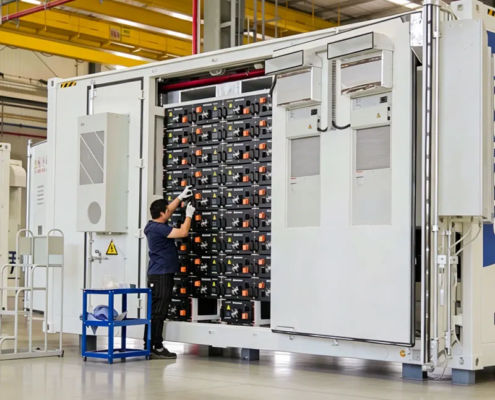 https://anengjipower.com/wp-content/uploads/2026/05/5mwh-liquid-cooled-bess-container-internal-inspection-factory.webp
800
800
Charging Station Engineer
https://anengjipower.com/wp-content/uploads/2025/09/anengji-dc-fast-charging-station-manufacturer-and-supplier-logo-white-1.png
Charging Station Engineer2026-09-29 08:37:462026-09-29 08:38:005MWh BESS Guide: Design, Applications, Cost & Sizing
https://anengjipower.com/wp-content/uploads/2026/05/5mwh-liquid-cooled-bess-container-internal-inspection-factory.webp
800
800
Charging Station Engineer
https://anengjipower.com/wp-content/uploads/2025/09/anengji-dc-fast-charging-station-manufacturer-and-supplier-logo-white-1.png
Charging Station Engineer2026-09-29 08:37:462026-09-29 08:38:005MWh BESS Guide: Design, Applications, Cost & Sizing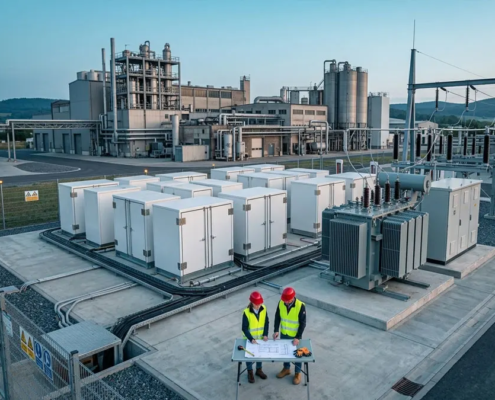 https://anengjipower.com/wp-content/uploads/2026/09/AnengJipower-European-BESS-Project-Design-Environment-1.webp
675
1000
Charging Station Engineer
https://anengjipower.com/wp-content/uploads/2025/09/anengji-dc-fast-charging-station-manufacturer-and-supplier-logo-white-1.png
Charging Station Engineer2026-09-24 09:05:462026-09-24 09:08:39Battery Energy Storage System Design Guide for Europe
https://anengjipower.com/wp-content/uploads/2026/09/AnengJipower-European-BESS-Project-Design-Environment-1.webp
675
1000
Charging Station Engineer
https://anengjipower.com/wp-content/uploads/2025/09/anengji-dc-fast-charging-station-manufacturer-and-supplier-logo-white-1.png
Charging Station Engineer2026-09-24 09:05:462026-09-24 09:08:39Battery Energy Storage System Design Guide for Europe


Leave a Reply
Want to join the discussion?Feel free to contribute!