
Introduction
Building a scalable EV Charging Business Model requires looking way beyond simple electricity reselling margins. Hardware purchases are straightforward, but long-term profitability depends on grid access, utilization rates, and smart software control. Early operators often burn capital fast because unexpected utility transformer upgrades eat their financial runways completely. Designing a resilient EV Charging Business Model protects your capital while maximizing daily revenue per plug. Every commercial property type demands a tailor-made balance between charging speed, customer stay time, and power capacity. Integrating battery storage into your EV Charging Business Model eliminates brutal demand charges and unlocks higher profit margins.
Featured Snippet: What Is an EV Charging Business Model?
An EV charging business model defines how companies generate revenue from electric vehicle charging infrastructure. Common models include charging fees, subscription services, advertising revenue, partnerships with commercial properties, fleet charging solutions, and energy management services. A successful EV charging business depends on location, charger type, customer demand, electricity costs, and operational strategy.
Understanding Commercial EV Charging Business Models
Unlocking steady cash flow requires aligning hardware speed with site parking habits. Too many site owners overspend on high-power DC cabinets where standard Level 2 AC units work better.
What Is a Commercial EV Charging Business?
A commercial EV charging operation spans several distinct real estate and operational categories:
- Public Charging Networks: High-visibility stations serving daily commuters and highway travelers.
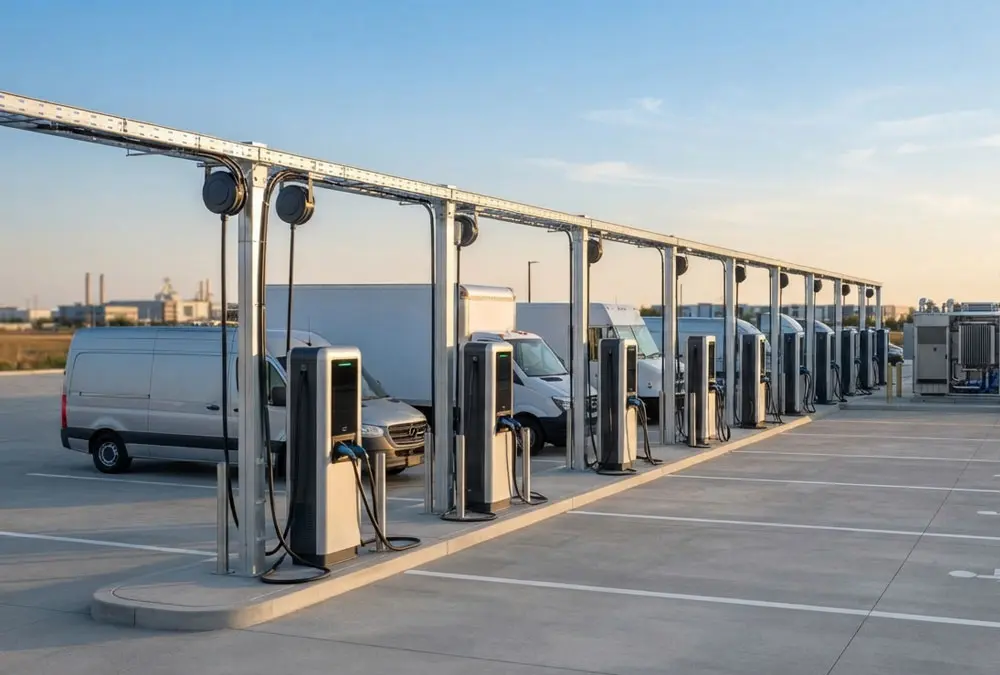
- Fleet Charging: Overnight or fast-turnaround depots for commercial electric vans, taxis, and heavy trucks.
- Workplace Charging: Dual-port AC chargers providing amenity charging for employees during eight-hour shifts.
- Retail Charging: Medium-to-fast charging hubs deployed at shopping malls, supermarkets, and restaurants to boost customer dwell times.
- Highway Charging: High-power hubs delivering rapid range top-ups for long-distance drivers.
Why EV Charging Infrastructure Is Becoming a Growing Business Opportunity
According to the BloombergNEF Electric Vehicle Outlook 2026 report, over 23 million passenger electric vehicles will sell globally this year. Public charging networks expanded by 28% in 2025, pushing worldwide deployed connectors past 6.7 million. This massive vehicle surge creates immense commercial opportunities for businesses adding commercial charging stations to their properties.
Key Factors That Determine EV Charging Business Success
Profitability comes down to managing operational efficiency while pushing daily utilization rates higher.
- Site Location: High traffic density and easy highway access drive organic charging demand.
- Charger Utilization Rate: Keeping plugs active for multiple sessions daily amortizes fixed installation costs quickly.
- Electricity Cost Control: Avoiding utility peak demand charges preserves operational revenue margins.
- Charging Speed Alignment: Matching charger power with driver parking duration prevents site congestion.
How to Start an EV Charging Business: 4 Key Strategies for Success
Building a profitable deployment requires methodical site selection, software planning, and electrical design.
Strategy 1: Understand Your Market and Choose the Right EV Charging Business Model
Conduct detailed local market research before ordering physical hardware. Analyze neighborhood EV adoption rates, nearby competitor pricing, and typical grid feeder capacity. Choose between destination charging for long parking stays or DC fast charging for quick customer turnovers. Identify target customer segments including retail shoppers, highway commuters, and local logistics fleets.
Strategy 2: Build a Reliable EV Charging Technology Stack
Your physical hardware and backend software must work seamlessly together. Deploying robust hardware prevents frequent out-of-service errors that turn customers away.
- AC Chargers (7kW – 22kW): Perfect for hotels, offices, and residential complexes where cars park for hours.
- DC Fast Chargers (30kW – 360kW+): Essential for highway corridors, logistics depots, and busy commercial hubs needing fast turnarounds.
Pair hardware with a scalable OCPP EV charging management system for remote diagnostics, billing, and user access control.
Tech Term Explained: What Is OCPP?
OCPP (Open Charge Point Protocol) is the open communication standard connecting physical EV chargers to backend management software. Choosing an OCPP-compliant charger ensures you are never locked into a single software vendor. You can easily switch network management providers without replacing expensive hardware.
Tech Term Explained: Dynamic Load Balancing (DLB)
Dynamic Load Balancing (DLB) is an intelligent software feature that constantly monitors local building electrical loads. DLB automatically distributes available power among connected EV chargers in real-time. This prevents circuit overloads without requiring expensive main service panel upgrades.
Strategy 3: Develop a Strategic EV Charging Station Deployment Plan
Target high-value real estate locations like shopping malls, office parks, and highway service plazas. Select a balanced charging speed mix based on customer dwell times:
| Charger Type | Power Output | Typical Application | Target Driver Stay Time | Buyer Operational Benefit |
|---|---|---|---|---|
| Commercial AC | 7kW – 22kW | Hotels, Workplaces, Apartments | 4 – 8 Hours | Low equipment cost; uses existing electrical panels without grid upgrades. |
| Fast DC | 30kW – 60kW | Supermarkets, Gyms, Retail Outlets | 45 – 90 Minutes | Increases customer store spending while generating steady charging fees. |
| Ultra-Fast DC | 120kW – 480kW | Highway Hubs, Commercial Fleets | 15 – 30 Minutes | Maximizes daily turnover capacity and maximizes throughput revenue per stall. |
Prevent future utility bottlenecks by choosing modular charging hardware that supports simple power module upgrades.
Strategy 4: Build Strong Partnerships and Improve Customer Experience
Partner with local utility companies early to assess grid interconnection timelines. Work with commercial property owners on revenue-sharing arrangements to secure prime parking spaces. Provide seamless mobile app experiences featuring live charger status, simple contactless payments, and 24/7 customer support.
EV Charging Revenue Models: How Do Charging Stations Make Money?
Successful operators diversify their revenue streams instead of relying solely on raw kilowatt-hour sales.
Direct Revenue from EV Charging Fees
- kWh Pricing: Billing drivers directly for the exact electricity volume consumed.
- Time-Based Pricing: Charging flat minute-based fees to encourage drivers to move vehicles once charged.
- Subscription Models: Offering monthly memberships with discounted charging rates for frequent users.
Indirect Revenue from Commercial Businesses
Commercial hosts use charging infrastructure as a powerful customer acquisition tool. Drivers choose retail centers with fast charging over competing locations lacking plugs. Longer stay times translate directly into higher retail store sales and restaurant bills.
Different EV Charging Business Models and Their Advantages
Selecting the right commercial model determines your upfront capital requirements and operational risks.
Loss-Leader EV Charging Model
Properties offer free or discounted charging to attract high-income EV drivers into their facilities. Direct charging profits are zero, but store revenues increase significantly. Best suited for retail shopping centers, hotels, and luxury car dealerships.
Cost Recovery EV Charging Model
Prices are set strictly to recover electricity costs, maintenance expenses, and software fees. Provides a clean amenity without creating ongoing financial liabilities for property managers. Ideal for workplace charging and multi-family residential developments.
Profit-Oriented EV Charging Model
Designed specifically to generate strong standalone returns through premium pricing on fast charging. Requires higher upfront investment in DC fast charging infrastructure and active network management. Best suited for highway charging hubs, urban fast-charging centers, and busy fleet depots.
EV Charging Station Business Costs: What Are the Investment Requirements?
Detailed cost planning requires evaluating hardware, site preparation, and ongoing software licenses. Data from the National Laboratory of the Rockies (NLR) estimates commercial Level 2 hardware around $3,500 per port. DC fast charger hardware costs range from $38,000 to $90,000+ per connector based on power output. Total turnkey installation costs for DC fast chargers often reach $75,000 to $150,000 per unit. Transformer modifications and heavy underground trenching account for most site installation expense variances.
Target Application Scenarios & Investment Architecture
Understanding site-specific layouts helps buyers match capital budgets with operational goals. 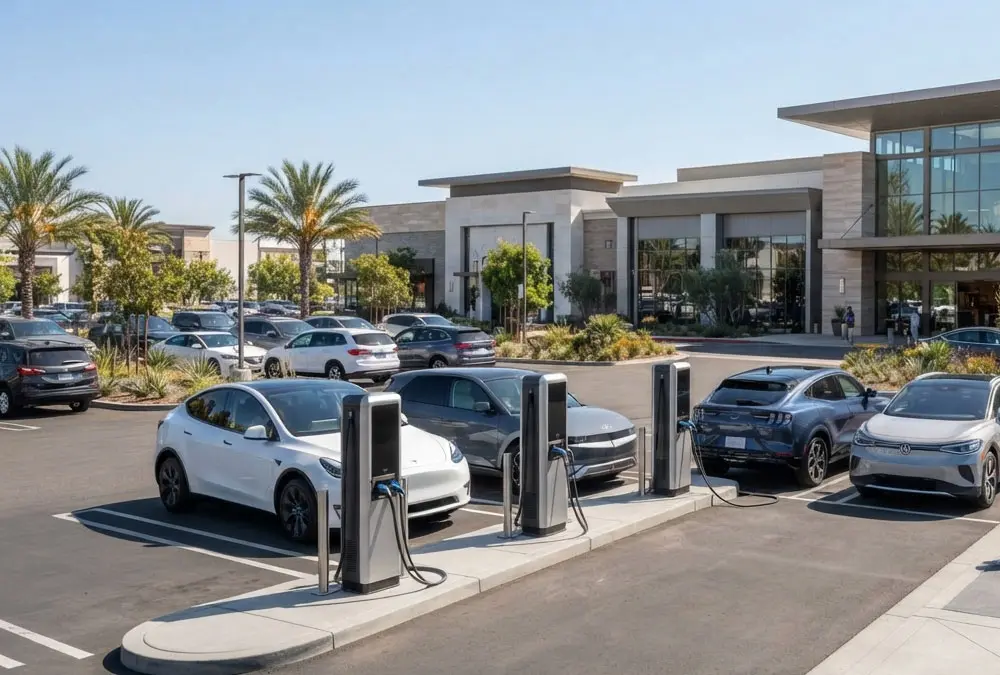
Scenario 1: Commercial Retail & Shopping Centers
Deploying four 60kW DC chargers creates an ideal destination charging hub for retail shoppers. Drivers recharge 80% of their battery while shopping for 45 minutes. Site hosts earn direct charging fees while benefiting from increased store sales.
Scenario 2: Commercial Logistics Fleet Depots
Electrifying delivery fleets requires high-power 120kW to 240kW DC fast chargers paired with software scheduling. Vehicles charge during off-peak night hours or during rapid shift changes. Automated load management prevents simultaneous power spikes across multiple fleet stalls.
Scenario 3: Highway & Urban Travel Plazas
High-volume highway hubs demand 180kW to 360kW+ ultra-fast charging split cabinets. Drivers expect 15-minute top-ups to continue long-distance travel without delay. High utilization rates drive maximum session throughput and rapid capital payback.
Solar + Battery Energy Storage + EV Charging: The Future Business Model
Integrating renewable energy generation and energy storage solves severe grid capacity bottlenecks.
Why EV Charging Businesses Need Battery Energy Storage
High-power DC charging draws massive electrical current in short bursts. Utilities charge heavy monthly demand charges based on a site’s single highest 15-minute power peak. NLR research shows demand fees can increase session costs by up to 70x at low utilization sites. Installing an industrial Battery Energy Storage System (BESS) caps peak grid draw through automated peak shaving.
Tech Term Explained: What Is Peak Shaving in BESS?
Peak Shaving uses a battery system to deliver extra power locally whenever multiple EVs plug in simultaneously. Instead of pulling huge power surges from the main electrical grid, the BESS discharges stored energy. This prevents expensive utility demand charges and allows high-power charger installation on limited grid panels.
Tech Term & Technology Alternative: Energy Arbitrage & Alternative Solutions
Energy Arbitrage means charging your BESS using cheap off-peak grid electricity or solar power during the day. The BESS then discharges that energy during peak hours when electricity tariffs are highest.
BESS Alternative Solutions: If a permanent BESS installation is not feasible due to space constraints, operators can consider Mobile Battery Power Carts for temporary fast-charging or install upgraded Grid Capacitors & Solid-State Transformers to stabilize grid voltage locally without chemical batteries.
Integrating Commercial BESS Systems to Maximize ROI
Choosing the right battery capacity protects your electrical budget while unlocking new revenue opportunities. Below are specialized industrial BESS solutions designed for commercial charging hubs:
| BESS Capacity | Ideal Deployment Scenario | Key System Feature | Buyer Operational Benefit |
|---|---|---|---|
| 100kWh BESS | Retail Plazas & Small Fleet Yards | Compact Cabinet Footprint | Avoids expensive transformer upgrades; caps utility demand fees on dual DC fast chargers. |
| 261kWh BESS | Commercial Depots & Highway Sites | Liquid Cooling Technology | Enables longer sustained fast-charging discharges; provides extra capacity for solar power storage. |
| 418kWh BESS | Transit Hubs & Heavy Logistics Depots | Modular Container Design | Supports multi-megawatt fleet charging hubs; eliminates major utility interconnect wait times. |
| 1MWh BESS | Utility-Scale Charging Plazas | High Energy Density Storage | Delivers full off-grid fast charging capability; maximizes grid arbitrage profit margins. |
How to Choose an EV Charging Solution Provider
Selecting an experienced technology partner ensures high system reliability and faster project execution.
- Manufacturer Experience: Verify product safety certifications, factory quality standards, and global project track records.
- Hardware Compatibility: Ensure chargers support CCS2, CHAdeMO, GB/T, and NACS connector standards.
- Software Openness: Mandate full OCPP compliance to prevent vendor lock-in.
- Turnkey Support: Choose partners providing end-to-end site power analysis, equipment supply, and technical service.
Frequently Asked Questions About EV Charging Business Models
Is an EV charging business profitable?
Yes, EV charging businesses are profitable when operators secure high-traffic locations, manage electricity demand fees, and maintain high equipment uptime.
How much does it cost to start an EV charging station business?
Commercial Level 2 setups cost $6,000 to $12,000 per stall installed. DC fast-charging hub investments range from $80,000 to over $300,000 depending on power output and grid upgrade requirements.
What is the best EV charging business model?
The best model depends on your business goals. Retail locations benefit from loss-leader or cost-recovery models, while highway sites require profit-oriented DC fast-charging models.
How do EV charging stations generate revenue?
Stations earn money through direct kilowatt-hour fees, session connection charges, parking time fees, monthly driver subscriptions, and on-site retail cross-selling.
Are DC fast charging stations more profitable?
DC fast charging stations generate significantly higher revenue per session due to premium pricing, though they require higher upfront capital investment.
How long does it take to recover an EV charging investment?
Well-utilized commercial fast-charging stations typically achieve full payback within 2 to 4 years, especially when leveraging government grants and tax credits.
Can solar and battery storage improve EV charging profitability?
Yes. Combining solar panels and BESS battery storage reduces grid energy purchase costs, avoids peak demand charges, and enables fast charging in areas with limited grid capacity.
Conclusion: Building a Profitable EV Charging Business with the Right Strategy
Unlocking long-term success with your EV Charging Business Model requires picking hardware and software that fits your real estate footprint. Combine high-efficiency DC chargers with smart energy management software to keep operational costs low. Integrating BESS battery storage protects your bottom line against rising utility demand charges.
Related Article
 https://anengjipower.com/wp-content/uploads/2026/06/epc-vs-turnkey-solar-project-bess.webp
675
1000
Charging Station Engineer
https://anengjipower.com/wp-content/uploads/2025/09/anengji-dc-fast-charging-station-manufacturer-and-supplier-logo-white-1.png
Charging Station Engineer2026-06-22 07:16:042026-06-24 07:13:17What Is the Difference Between EPC and Turnkey Contract Models in Energy Projects?
https://anengjipower.com/wp-content/uploads/2026/06/epc-vs-turnkey-solar-project-bess.webp
675
1000
Charging Station Engineer
https://anengjipower.com/wp-content/uploads/2025/09/anengji-dc-fast-charging-station-manufacturer-and-supplier-logo-white-1.png
Charging Station Engineer2026-06-22 07:16:042026-06-24 07:13:17What Is the Difference Between EPC and Turnkey Contract Models in Energy Projects? https://anengjipower.com/wp-content/uploads/2026/06/anengji-commercial-solar-plus-storage-benefits-site.webp
675
1000
Charging Station Engineer
https://anengjipower.com/wp-content/uploads/2025/09/anengji-dc-fast-charging-station-manufacturer-and-supplier-logo-white-1.png
Charging Station Engineer2026-06-20 14:34:102026-06-20 14:37:43What Are the Top Benefits of Solar Battery Storage in Factories?
https://anengjipower.com/wp-content/uploads/2026/06/anengji-commercial-solar-plus-storage-benefits-site.webp
675
1000
Charging Station Engineer
https://anengjipower.com/wp-content/uploads/2025/09/anengji-dc-fast-charging-station-manufacturer-and-supplier-logo-white-1.png
Charging Station Engineer2026-06-20 14:34:102026-06-20 14:37:43What Are the Top Benefits of Solar Battery Storage in Factories? https://anengjipower.com/wp-content/uploads/2026/06/modular-commercial-solar-battery-storage-cabinet.webp
675
1000
Charging Station Engineer
https://anengjipower.com/wp-content/uploads/2025/09/anengji-dc-fast-charging-station-manufacturer-and-supplier-logo-white-1.png
Charging Station Engineer2026-06-18 09:16:522026-07-03 03:05:13What Is Solar Battery Storage? Complete C&I Engineering Guide
https://anengjipower.com/wp-content/uploads/2026/06/modular-commercial-solar-battery-storage-cabinet.webp
675
1000
Charging Station Engineer
https://anengjipower.com/wp-content/uploads/2025/09/anengji-dc-fast-charging-station-manufacturer-and-supplier-logo-white-1.png
Charging Station Engineer2026-06-18 09:16:522026-07-03 03:05:13What Is Solar Battery Storage? Complete C&I Engineering Guide


Leave a Reply
Want to join the discussion?Feel free to contribute!