
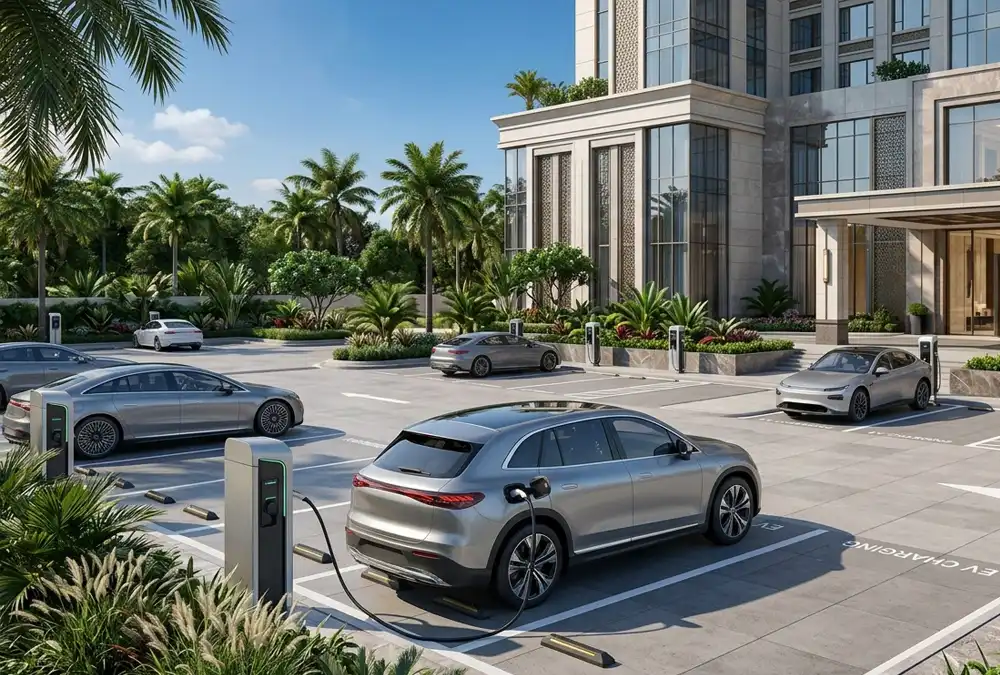
Introduction Destination Charging Solutions
Plugging an electric car into a wall socket at home is easy. But powering commercial sites requires real engineering. Deploying robust Commercial DC Fast Charging Solutions along with destination chargers means solving tight power grid limits, high peak charges, and complex conduit layouts. Building these stations isn’t just about bolting hardware onto concrete. It is about balancing building energy demands, choosing reliable power converters, and generating steady foot traffic or fleet uptime. Done right, your commercial property turns parking spots into long-term profit centers.
Real Buyer Perspective: “Will installing fast charging trigger massive demand charges on my monthly electric bill?”
This single concern stops over a third of property owners from starting EV projects. When multiple vehicles plug in at once, your peak power draw spikes. Local utilities charge heavy extra fees for these sudden power spikes. The fix isn’t skipping chargers. The fix is using dynamic load management software paired with smart battery storage. These systems cap power draws safely below utility penalty thresholds while keeping chargers running smoothly.
What Is Destination EV Charging? A Complete Overview of Destination Charging Solutions
What Is Destination Charging?
Destination charging means powering up electric vehicles while they are parked at a specific location. Drivers do not stand around waiting for a quick charge. Instead, they park to shop, work, dine, or sleep while their car charges quietly in the background.
- Longer Parking Dwell Times: Drivers usually park for one to eight hours.
- Flexible Power Delivery: Uses medium AC power or compact DC fast chargers for business needs.
- Customer Value Focus: Converts passive parking spaces into premium customer amenities.
How Destination EV Charging Is Different From Traditional Charging
Understanding charging styles helps site owners select the right equipment without overspending on grid upgrades:
- Home Charging: Slow overnight AC charging overnight using residential power supplies.
- Public Highway Fast Charging: High-power charging designed to add 200 miles in 15 minutes along travel corridors.
- Destination Charging: Park-and-charge convenience built directly into everyday business locations.
Why Destination Charging Is Becoming Important for Businesses
Electric vehicle adoption is accelerating rapidly across commercial sectors. According to the IEA Global EV Outlook 2024 report, global electric car sales reached nearly 14 million units in a single year. Commercial properties without charging hardware risk losing high-income customers, corporate tenants, and green building points to modern competitors.
How Do Destination EV Charging Solutions Work?
Step 1: EV Drivers Arrive at the Destination
Drivers pull into commercial parking lots at hotels, shopping malls, offices, or resorts. Navigation apps lead them straight to designated EV parking bays.
Step 2: Vehicle Connects to EV Charging Station
The driver plugs the charging cable into the vehicle inlet. Authorization takes seconds via RFID card, smartphone app, or contactless credit card reader.
Step 3: Smart Charging System Manages Energy Flow
Once connected, modern smart EV charging solutions begin coordinating power distribution:
- OCPP Platform Links: Software manages driver access, session billing, and real-time station health monitoring.
- Energy Management Systems (EMS): Controls total facility power draws safely.
- Dynamic Load Balancing (DLB): Automatically shifts power between active chargers to protect site electrical panels.
Step 4: Vehicle Charges During Parking Time
The vehicle charges seamlessly while the driver conducts business, attends meetings, or enjoys dinner. Parking time transforms directly into productive charging time.
Benefits of Installing Destination EV Charging Stations for Businesses
Increase Customer Stay Time and On-Site Spending
Drivers who plug in stay longer. Studies highlighted in the NJ DEP Workplace & Destination Charging Toolkit show that EV owners spend significantly more money at retail sites while waiting for their battery to charge up.
Attract and Retain EV Customers
EV drivers actively choose destinations based on charger availability. Offering reliable plug-in points builds long-term customer loyalty and drives repeat visits to your property.
Improve Brand Image and Sustainability Goals
Installing visible charging infrastructure demonstrates corporate commitment to green operations. It helps properties earn LEED certifications, fulfill corporate ESG targets, and appeal to eco-conscious consumers.
Lower Infrastructure Costs Compared With Fast Charging
Deploying commercial EV charging infrastructure for destination sites usually costs far less than highway charging hubs. Lower electrical power draws reduce the need for massive utility grid upgrades.
Create Additional Revenue Opportunities
Commercial properties generate steady income through direct per-kWh energy fees, hourly parking surcharges, digital screen advertising, and premium membership tiers.
Optimize Energy Usage With Smart Charging
Integrated energy software caps electrical loads automatically. This prevents expensive utility demand spikes and lets operators integrate local solar and energy storage systems easily.
Destination EV Charging Applications: Where Can Destination Chargers Be Installed?
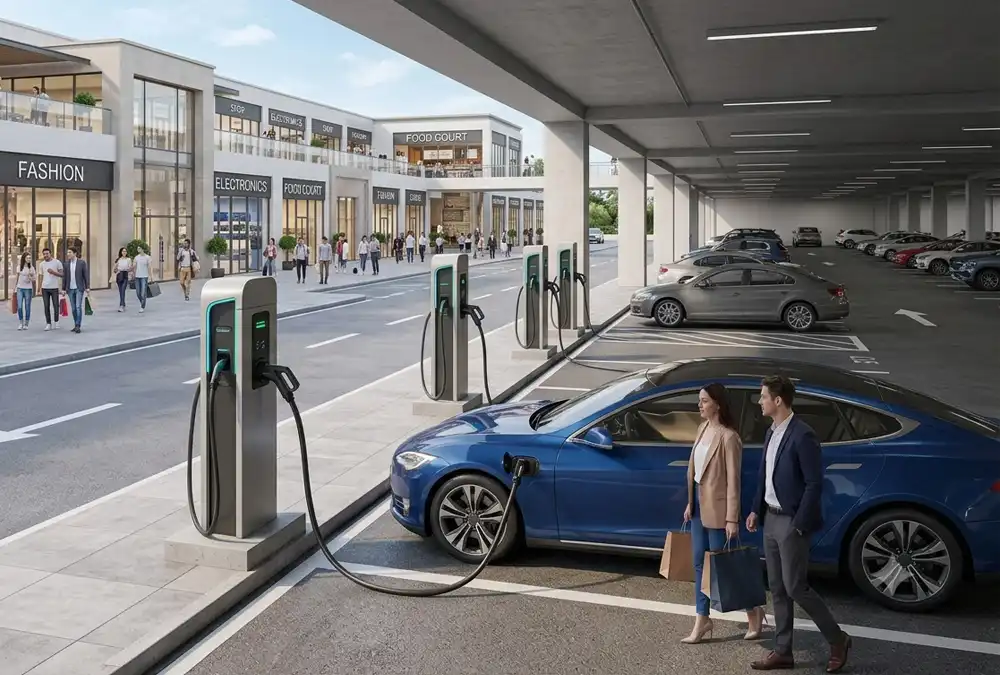
Retail Stores and Shopping Centers EV Charging Solutions
Malls and plazas use dual-port 11kW-22kW AC wallboxes or compact 30kW DC chargers. These units boost customer dwell times while keeping upfront equipment costs manageable.
Hotel and Resort Destination EV Charging Solutions
Overnight hotel guests expect convenient charging access. Equipping hotel parking spaces with 7kW to 22kW AC chargers ensures guests wake up to a 100% full battery every morning.
Workplace and Business Park EV Charging
Business parks require reliable commercial DC fast charging solutions for fleets alongside standard Level 2 chargers. This mix powers employee commuter vehicles during work hours and tops up company service vans rapidly between shifts.
Airport and Transportation Hub Charging
Airports cater to long-term travelers and commercial ride-share fleets. Long-term garages benefit from AC chargers, while short-term staging lots need high-power DC hardware.
Restaurant and Cafe EV Charging Stations
Installing 30kW to 60kW turnkey commercial DC fast charging solutions at dining locations gives drivers a quick 45-minute boost while enjoying a full meal.
Healthcare Facilities EV Charging
Hospitals offer charging spots to support medical staff working long shifts, visiting patients, and fleet ambulances requiring dependable power access around the clock.
Parks, Resorts and Tourist Attractions
Remote tourist destinations use solar-assisted charging stalls to attract road-tripping EV drivers without putting heavy electrical strains on rural power grids.
How Long Does It Take to Charge an EV With Destination Charging?
Typical Destination Charging Speed
Charging speeds depend on the output rating of the station and the onboard converter capacity of the vehicle:
- 7kW AC Output: Adds roughly 25 miles of driving range per hour.
- 11kW AC Output: Adds roughly 40 miles of driving range per hour.
- 22kW AC Output: Adds roughly 75 miles of driving range per hour (requires compatible onboard car charger).
- 30kW-60kW DC Output: Adds 100 to 200 miles of driving range in under an hour.
How Long Should EVs Charge at a Destination?
Charge times depend on battery capacity, current state-of-charge (SOC), and charger output. A 2-hour stay at a 11kW charger gives most EV commuters enough power for their weekly drive.
Destination Charging vs Fast Charging Time Comparison
| Charging Type | Typical Power Level | Charging Time (20%-80%) | Primary Commercial Use Case | Direct Buyer Advantage & Choice Value |
|---|---|---|---|---|
| Home Level 2 | 3.7kW – 7.4kW AC | 6 to 10 Hours | Overnight Private Residential | Lowest equipment cost; uses standard single-phase residential electrical hookups. |
| Destination AC | 7kW – 22kW AC | 2 to 5 Hours | Hotels, Workplaces, Long Parking | Cost-effective installation; scales to dozens of stalls without grid upgrades. |
| Destination Compact DC | 30kW – 60kW DC | 45 to 90 Minutes | Restaurants, Supermarkets, Depots | Delivers rapid turnaround for short customer visits without full transformer overhauls. |
| High-Power Fast Charger | 120kW – 360kW+ DC | 15 to 30 Minutes | Highway Corridors, Busy Fleets | Maximizes per-hour vehicle turnover; commands premium charging price margins. |
Destination Charging vs Other EV Charging Solutions
Destination Charging vs Home Charging
Home charging serves single drivers overnight. Destination charging gives commercial properties shared multi-user hardware equipped with payment processors, dynamic load balancing, and cloud billing controls.
Destination Charging vs Public Fast Charging
Public highway fast chargers require heavy megawatt grid hookups to get drivers back on the road in minutes. Destination charging matches lower power draws with standard driver parking times, keeping equipment costs manageable.
Choosing the Right Charging Solution for Your Business
Choosing the right equipment depends on driver dwell times. Sites where drivers park for 4+ hours should deploy 11kW-22kW AC chargers. Sites with 1-hour parking turnarounds need 30kW-60kW DC fast charging solutions for businesses.
Destination EV Charging Solutions: A Strategic Guide for Commercial Properties
Step 1: Analyze Parking Duration and User Behavior
Track daily parking patterns. Calculate average stay durations for customers, employees, or fleet vehicles to choose between AC wallboxes and compact DC dispensers.
Step 2: Evaluate Electrical Capacity
Have a licensed electrical engineer assess your main panel, step-down transformer headroom, and local grid feed limits. Official station counts rely directly on data from the U.S. Alternative Fuels Data Center.
Step 3: Select the Right Charger Type
Combine hardware strategically. A hotel might install ten 11kW AC charging stalls for overnight guests alongside two 60kW DC chargers for visitors needing a quick top-up.
Step 4: Integrate Smart Energy Management
Install load management software running OCPP 1.6J or OCPP 2.0.1 protocols. Smart load management shifts power output dynamically across active chargers to prevent site overloads.
Step 5: Plan Future Expansion
Lay oversized underground conduit during initial civil works. Adding extra wiring runs during initial trenching cuts overall civil construction costs by up to 60% when expanding later.
Challenges of Implementing Destination EV Charging Infrastructure
Initial Investment Cost
Upfront capital covers hardware purchase, civil asphalt cutting, copper cabling, safety switchgear, and software activation. Smart site planning keeps these initial costs under control.
Grid Capacity and Electrical Upgrades
When local transformer capacity is tight, utility grid expansion costs can stall projects. Integrating battery energy storage systems (BESS) buffers power demands locally, letting you install chargers without expensive grid upgrades.
Installation Planning and Permits
Navigating municipal zoning codes, civil engineering approvals, and electrical safety inspections takes time. Working with experienced EPC turn-key partners prevents permitting delays.
Charger Utilization Management
Low charger utilization hurts project returns. Setting flexible pricing models—like free charging for the first hour followed by idle fees—encourages driver turnover.
How Much Does Destination EV Charging Cost?
Destination EV Charger Hardware Cost
Commercial Grade Level 2 AC chargers cost between $600 and $2,500 per port. Compact 30kW to 60kW commercial EV fast charging infrastructure cabinets range from $12,000 to $28,000 based on power rating and connector configuration.
Installation and Infrastructure Cost
Civil works, trenching, concrete pad pouring, and copper cabling typically add $1,500 to $5,000 per AC stall. High-power DC sites requiring dedicated transformers incur higher civil costs.
Software and Maintenance Cost
Cloud-based OCPP software management fees range between $100 and $300 per port per year. Regular preventative maintenance checks ensure 99%+ station operational uptime.
Factors That Affect Total Destination Charging Cost
Total costs depend on panel distances, trenching lengths through asphalt, main panel upgrades, and chosen connector types (CCS1, NACS, CCS2).
Is Destination EV Charging Free? Business Models Explained
Free Charging Model
Hotels, luxury retailers, and car dealerships often provide complimentary charging as a premium customer perk. The operational electricity cost is offset by increased store sales and room bookings.
Paid Charging Model
Property operators charge drivers directly per kWh consumed or per minute connected. Integrated payment terminals process credit cards and mobile app payments instantly.
Hybrid Revenue Model
Hybrid models offer two hours of free charging for validated store customers, followed by standard hourly rates. This model keeps charging accessible while preventing stall hogging.
Is Destination EV Charging Worth It for Businesses?
Business Benefits vs Investment Cost
Well-located commercial chargers recover capital costs quickly through higher retail sales, new parking revenue, and enhanced brand equity among affluent EV drivers.
Calculate Destination Charging ROI
Calculating project payback balances initial hardware and installation costs against daily session utilization, electricity markups, and local clean energy grants.
Why Early Investment Creates Long-Term Advantage
Installing charging infrastructure early locks in loyal local drivers, satisfies upcoming municipal building codes, and establishes your property as a green commercial hub.
Solar + Battery Storage + Destination EV Charging Solutions
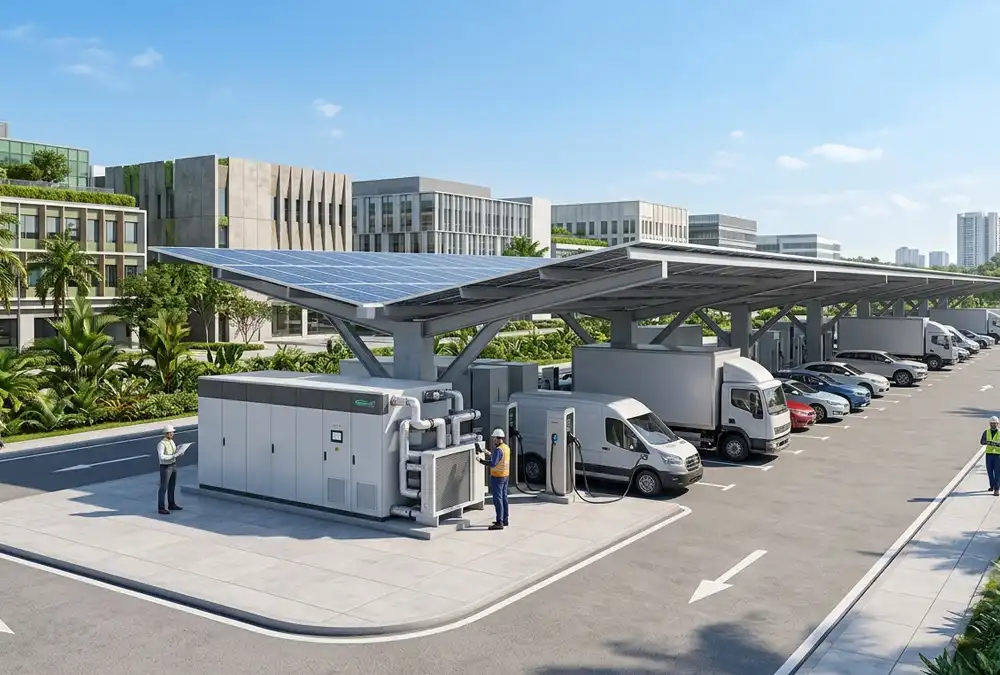
Reduce Electricity Costs With Battery Energy Storage
Adding battery storage for EV charging lets properties store low-cost energy during off-peak hours and discharge during peak fast-charging demand windows. Groundbreaking research published in Nature Communications confirms that localized battery storage buffers peak grid impacts significantly while improving total system energy efficiency.
Technical Glossary: Battery Chemistry Breakdown
Lithium Iron Phosphate (LFP / LiFePO4): The premier battery chemistry for stationary energy storage. LFP provides high thermal stability, zero risk of thermal runaway, and a deep cycle life exceeding 6,000+ cycles to 80% State of Health (SOH).
Alternative Systems (NMC vs. Sodium-Ion): Nickel Manganese Cobalt (NMC) delivers higher energy density but carries stricter thermal management requirements. Emerging Sodium-Ion chemistries offer low-cost potential for extreme cold environments, though LFP remains the undisputed commercial standard for industrial life-cycle reliability.
Selecting the right industrial BESS capacity depends directly on your site load profile and peak fast charging requirements:
| BESS Product Specs | Thermal Management | Recommended Commercial Site Matching | Direct Buyer Advantage & Choice Value |
|---|---|---|---|
| 100kWh Cabinet | Smart Air Cooling HVAC | Retail Plazas & Hotels (30kW-60kW Chargers) | Compact footprint; eliminates minor demand surcharges on limited site transformers. |
| 261kWh Cabinet | Liquid Cooled Industrial System | Commercial Buildings & Medium Depots | Uniform cell temperatures extend battery life by 20%; supports consecutive fast charges smoothly. |
| 418kWh Cabinet | High-Density Liquid Cooling | Industrial Parks & Fleet Depots | Buffers back-to-back 180kW+ fleet fast charges without triggering expensive grid upgrades. |
| 1MWh Container | Containerized Liquid Cooling Unit | Highway Charging Hubs & Transit Facilities | Megawatt-scale battery buffering enables ultra-fast charging along constrained rural power lines. |
Improve Energy Independence With Solar Integration
Pairing rooftop or carport solar panels with stationary battery storage creates clean energy microgrids. These microgrids generate green electricity locally, lower utility reliance, and ensure charging operations continue during power outages.
Smart Energy Management With EMS
Centralized Energy Management Systems (EMS) coordinate solar generation, battery storage, and EV charging demands in real time. EMS software balances energy flows dynamically to optimize site economics automatically.
Why Choose AnengJI for Destination EV Charging Solutions?
Complete Commercial EV Charging Product Portfolio
AnengJI manufactures durable Level 2 AC chargers (7kW-22kW), compact commercial DC chargers (30kW-60kW), and ultra-fast liquid-cooled systems built for demanding commercial environments.
Customized Solutions for Different Destinations
Our engineering team designs tailored charging hardware for retail centers, hotels, office buildings, logistics fleets, and solar microgrid installations worldwide.
Integrated EV Charging and Energy Storage Solutions
We deliver integrated solar, energy storage (BESS), and EV charging solutions. Our systems feature dynamic load management to protect site transformers and keep operating costs low.
Factory Direct Manufacturing and Engineering Support
Sourcing equipment directly from our manufacturing factory guarantees competitive pricing, OEM/ODM flexibility, global safety certifications (CE, UL, IEC), and full technical support.
Frequently Asked Questions About Destination EV Charging Solutions
What is destination EV charging?
Destination EV charging provides electric vehicle power at locations where drivers naturally park for extended periods, such as hotels, shopping centers, workplaces, and restaurants.
How does destination charging work?
Drivers plug their vehicle into an AC or compact DC charger upon arrival. Smart software manages power distribution while the driver shops, works, or stays overnight.
How long does destination charging take?
Charging times range from 1 to 5 hours on Level 2 AC chargers, or 30 to 60 minutes on compact 30kW-60kW DC chargers, depending on vehicle battery capacity.
Where are destination charging stations installed?
They are installed in parking spaces at retail malls, hotels, resorts, office parks, airports, hospitals, public parks, and dining facilities.
Is destination EV charging free?
Some businesses provide free charging as a customer amenity. Others charge per kWh or per hour using integrated payment processors to generate direct revenue.
How much does destination EV charging cost?
Level 2 AC chargers cost $600 to $2,500 per port. Compact 30kW-60kW DC fast chargers range from $12,000 to $28,000, plus installation and civil works costs.
What is the difference between destination charging and fast charging?
Destination charging utilizes medium power (7kW-60kW) to charge parked vehicles over 1 to 4 hours. Highway fast charging delivers 150kW+ to charge vehicles in under 20 minutes.
Build Your Destination EV Charging Solution With AnengJI
Whether you operate a hotel, shopping center, workplace, or commercial property, AnengJI provides scalable EV charging solutions designed for your specific business needs
Related Article
 https://anengjipower.com/wp-content/uploads/2026/06/epc-vs-turnkey-solar-project-bess.webp
675
1000
Charging Station Engineer
https://anengjipower.com/wp-content/uploads/2025/09/anengji-dc-fast-charging-station-manufacturer-and-supplier-logo-white-1.png
Charging Station Engineer2026-06-22 07:16:042026-06-24 07:13:17What Is the Difference Between EPC and Turnkey Contract Models in Energy Projects?
https://anengjipower.com/wp-content/uploads/2026/06/epc-vs-turnkey-solar-project-bess.webp
675
1000
Charging Station Engineer
https://anengjipower.com/wp-content/uploads/2025/09/anengji-dc-fast-charging-station-manufacturer-and-supplier-logo-white-1.png
Charging Station Engineer2026-06-22 07:16:042026-06-24 07:13:17What Is the Difference Between EPC and Turnkey Contract Models in Energy Projects? https://anengjipower.com/wp-content/uploads/2026/06/anengji-commercial-solar-plus-storage-benefits-site.webp
675
1000
Charging Station Engineer
https://anengjipower.com/wp-content/uploads/2025/09/anengji-dc-fast-charging-station-manufacturer-and-supplier-logo-white-1.png
Charging Station Engineer2026-06-20 14:34:102026-06-20 14:37:43What Are the Top Benefits of Solar Battery Storage in Factories?
https://anengjipower.com/wp-content/uploads/2026/06/anengji-commercial-solar-plus-storage-benefits-site.webp
675
1000
Charging Station Engineer
https://anengjipower.com/wp-content/uploads/2025/09/anengji-dc-fast-charging-station-manufacturer-and-supplier-logo-white-1.png
Charging Station Engineer2026-06-20 14:34:102026-06-20 14:37:43What Are the Top Benefits of Solar Battery Storage in Factories? https://anengjipower.com/wp-content/uploads/2026/06/modular-commercial-solar-battery-storage-cabinet.webp
675
1000
Charging Station Engineer
https://anengjipower.com/wp-content/uploads/2025/09/anengji-dc-fast-charging-station-manufacturer-and-supplier-logo-white-1.png
Charging Station Engineer2026-06-18 09:16:522026-07-03 03:05:13What Is Solar Battery Storage? Complete C&I Engineering Guide
https://anengjipower.com/wp-content/uploads/2026/06/modular-commercial-solar-battery-storage-cabinet.webp
675
1000
Charging Station Engineer
https://anengjipower.com/wp-content/uploads/2025/09/anengji-dc-fast-charging-station-manufacturer-and-supplier-logo-white-1.png
Charging Station Engineer2026-06-18 09:16:522026-07-03 03:05:13What Is Solar Battery Storage? Complete C&I Engineering Guide


Leave a Reply
Want to join the discussion?Feel free to contribute!