
Introduction
Rapid industrial electrification, surging utility demand charges, and mandatory carbon offset goals have forced plant managers to re-evaluate their energy management. Selecting the correct Cabinet vs Containerized BESS architecture is no longer just an engineering footnote—it dictates your facility’s operational uptime, physical footprint, and financial payback for the next 15 years.
When you sit down with an EPC advisor or equipment vendor, you will quickly realize that picking between a modular cabinet BESS and a massive 20-foot or 40-foot containerized battery energy storage system is not about which hardware looks sleeker. It comes down to matching site physics, grid connection limits, and capital constraints with the right physical form factor.
In this guide, we break down the engineering reality behind Cabinet vs Containerized BESS choices, analyzing structural differences, balance-of-plant requirements, thermal behavior, real-world CAPEX/OPEX tradeoffs, and actual field installation risks.
What Are Cabinet and Containerized BESS Architectures?
What Is a Cabinet BESS?
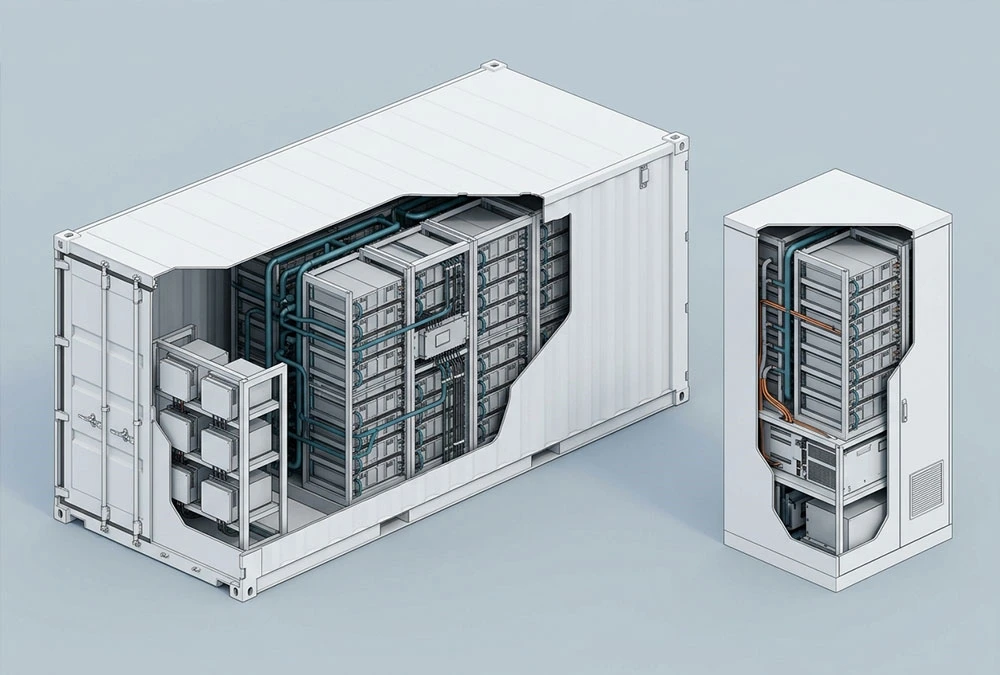
A commercial BESS cabinet vs container layout features a self-contained, highly integrated enclosure designed for localized, modular commercial battery storage cabinet setups. Inside an outdoor BESS cabinet, engineers integrate battery packs, a localized Battery Management System (BMS), a distributed Power Conversion System (PCS) or string inverter, dedicated liquid or air cooling loops, and integrated fire suppression.
Instead of housing everything in an accessible walk-in room, an outdoor energy storage cabinet relies on door-access panels. These modular commercial BESS units sit closer to building switchboards, offering flexible installation for space-constrained industrial sites.
What Is a Containerized BESS?
A containerized battery energy storage system leverages standardized ISO shipping container footprints (typically 20ft or 40ft structures) to house high-density battery rack systems, centralized or string PCS units, master BMS controllers, and industrial-grade HVAC or chillers.
A container BESS acts as a consolidated power block. It is designed for multi-megawatt-hour deployments where centralized balance-of-plant (BOP) infrastructure simplifies grid interconnection at the substation level.
Why BESS Format Should Follow Project Requirements
A common procurement mistake is choosing the BESS enclosure before defining the site load profile. Selecting a container BESS purely because it feels like a “complete power plant” can cripple a project if your facility lacks crane access or setback space. Conversely, stringing together dozens of cabinets for a 20 MWh utility-interconnected site introduces unnecessary wiring complexity. Project mechanics must dictate the hardware format.
Cabinet, Container and Hybrid BESS Architectures
Modern energy storage is not strictly binary. While cabinet battery energy storage system vs container comparisons highlight traditional boundaries, advanced EPCs often deploy hybrid topologies. In these setups, modular outdoor storage cabinets handle distributed high-power EV charging loads, while a centralized containerized BESS manages base-load energy arbitrage across the main site switchgear.
Buyer’s Doubt: “If I buy a cabinet BESS, am I locked into a smaller overall capacity?”
Not at all. Product configurations vary substantially by manufacturer. High-density liquid-cooled BESS cabinets can be paralleled via smart master controllers to deliver multi-megawatt-hour systems. The difference lies in modularity and physical distribution across your facility, not a hard ceiling on usable capacity.
Cabinet BESS: Architecture, Capacity and Deployment Characteristics
Typical Cabinet BESS Internal Architecture
An all-in-one energy storage cabinet packs high-voltage LFP battery modules, a rack BMS, a bidirectional PCS, a liquid-cooling plate system, and gas detection shut-off valves into a single, compact unit. Everything is factory-wired and tested, minimizing on-site integration errors.
Battery Modules, Racks, BMS and PCS Configuration
Within an industrial battery storage cabinet, battery modules are stacked vertically inside built-in frame structures. The localized BMS communicates directly with individual cell sensors, tracking temperature and voltage. Integrated string PCS units convert DC to AC right inside the cabinet, eliminating long DC cable runs across your job site.
Typical Power and Energy Configurations
Configurations span wide ranges depending on application requirements. Commercial BESS cabinets typically range from 100 kWh to 261 kWh, with newer high-density liquid-cooled units reaching up to 418 kWh per cabinet enclosure. These can operate as standalone systems or be scaled in parallel.
Outdoor Enclosure, Footprint and Service Access
NEMA 3R or IP55/IP66 rated outdoor enclosures shield internal hardware from weather, dust, and corrosive industrial air. Service access is front- or rear-door based, allowing technicians to swap individual modules or servicing cooling systems without stepping inside a confined space.
Cabinet Transportation and Site Delivery
Logistics are straightforward. A standard commercial BESS cabinet can be transported via standard flatbed trucks and moved into position using a heavy-duty forklift or a light mobile crane. This drastically reduces site access preparation costs.
Containerized BESS: Architecture, Capacity and Deployment Characteristics
Typical Containerized BESS Internal Architecture
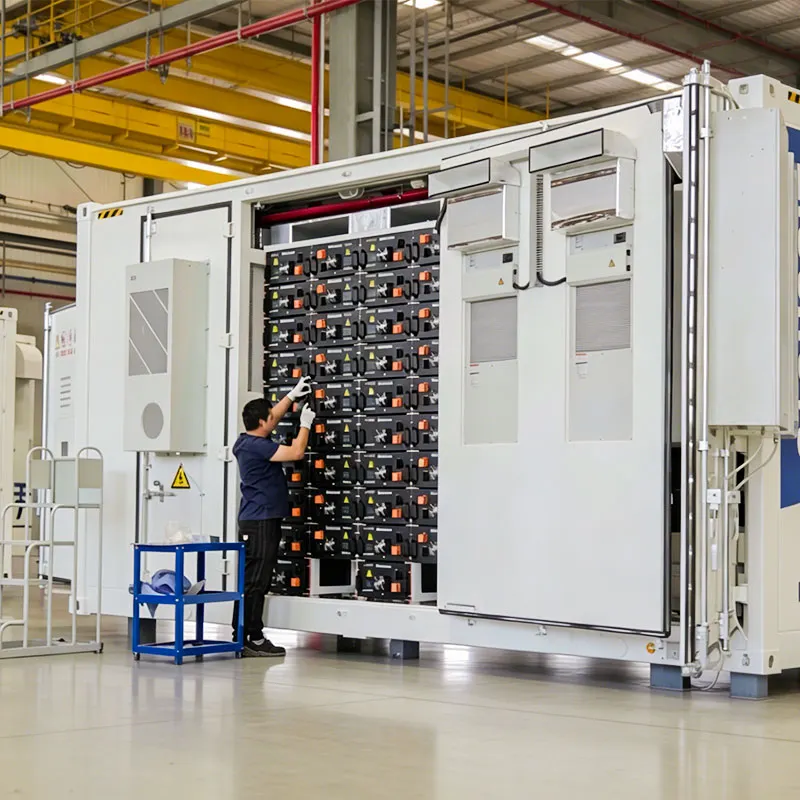
A containerized battery energy storage system functions as an integrated power block. High-density battery racks line the interior walls, connected to centralized DC busbars, master BMS control panels, step-up transformers, and specialized environmental control units.
Battery Racks, BMS, PCS and Auxiliary Systems
Multi-tier battery rack systems route DC power into high-capacity centralized or multi-string PCS units. Integrated auxiliary systems manage thermal fluid circulation, active emergency venting, and aerosol fire suppression across the entire container volume.
MWh-Scale Capacity and Storage Duration
Built for large-scale energy shift, a 20ft containerized storage block routinely houses 2 MWh to 5 MWh of capacity, while 40ft structures can exceed 6 MWh. These systems provide 2-to-8-hour discharge durations for heavy industrial plants or grid support.
Container Footprint, Foundation and Service Access
Though space-efficient in volumetric terms, a container BESS demands a heavily engineered concrete pad foundation. Service access depends on design—walk-in containers require interior maintenance aisles, whereas modern non-walk-in designs allow external door maintenance to maximize cell energy density.
Transport, Crane and Site Preparation Requirements
Deploying a containerized system involves heavy equipment logistics. Transporting a 30-ton loaded container requires specialized heavy-haul trucking, wide-turning radius access roads, and a dedicated mobile crane for pad placement.
Cabinet vs Containerized BESS: The Key Differences
Evaluating a cabinet vs container BESS project requires examining performance, site integration, and operational variables. The table below outlines how these two formats contrast across core engineering metrics.
| Factor | Cabinet BESS | Containerized BESS | Buyer Benefit Analysis |
|---|---|---|---|
| Deployment Unit | Individual outdoor cabinet (100–418 kWh) | Centralized container block (2–6+ MWh) | Cabinets allow granular scaling; containers reduce inter-unit cable connections for multi-MWh sites. |
| Site Flexibility | High (Fits narrow alleyways, roof edges, corner yards) | Lower (Requires wide truck clearance & dedicated yard) | Cabinet format unlocks installation on tight urban or industrial real estate. |
| Civil & Foundation | Lightweight concrete pads or steel frame mounts | Heavy reinforced concrete slab or deep piers | Cabinets cut civil works cost and reduce site permitting timelines significantly. |
| Logistics & Crane | Standard forklift / small boom truck crane | Heavy-haul transport / 50+ ton crane required | Avoids complex local traffic permits and heavy rigging overhead during installation. |
| Maintenance Impact | Isolate single cabinet; 95%+ site online | Block offline during major inverter/BMS service | Cabinet architecture prevents full facility shutdown during routine system maintenance. |
* Note: Actual equipment characteristics vary based on manufacturer integration options and thermal management choices.
How to Choose Between Cabinet and Containerized BESS: The 8-Factor Decision Model
To systematically evaluate your project options, we utilize the BESS Format-Fit Framework™, an 8-factor evaluation model designed to align technical requirements with long-term financial returns.
1. Required Power and Energy
Determine both peak kilowatt (kW) output and total discharge capacity (kWh). Sub-2 MWh projects lean heavily toward cabinet BESS configurations. Above 5 MWh, containerized solutions streamline power routing.
2. Storage Duration
Short-duration peak shaving (1-2 hours) pairs effectively with cabinet setups containing distributed PCS units. Long-duration energy shifting (4+ hours) benefits from the consolidated cell density of containerized blocks.
3. Available Site Footprint
Factor in clearance zones. A compact outdoor BESS cabinet can fit inside unused side lots or near outdoor switchgear, while containers demand a large contiguous footprint.
4. Site Access and Civil Requirements
If your facility has narrow access gates or weight-restricted access bridges, hauling a 40-foot container is impossible. Cabinet units navigate standard roadways easily.
5. Expansion Strategy
Ask yourself if capital budget limits force a phased deployment. Cabinets allow modular expansion as power demands grow, avoiding over-investing in unused capacity upfront.
6. Thermal and Fire Safety Requirements
Consider local fire department requirements. Liquid-cooled outdoor energy storage cabinets isolate risk to smaller individual enclosures, simplifying NFPA 855 separation compliance.
7. Maintenance and Availability Strategy
Evaluate system uptime goals. Modular cabinet BESS designs feature hot-swappable components, whereas containerized BESS servicing might force an entire block offline.
8. Total Lifecycle Cost
Look past sticker price. According to NREL Energy Storage Cost Analysis data, soft costs including site prep, cranes, and switchboard upgrades make up over 25% of total installed CAPEX.
How Does Site Footprint Affect Cabinet vs Containerized BESS Selection?
When comparing space demands, engineers must evaluate the complete installed footprint—not just basic box dimensions. You must calculate:
Standards like NFPA 855 Standard for Stationary Energy Storage Systems mandate strict 10-foot (3-meter) setbacks from adjacent structures and property lines unless large-scale fire testing permits reductions. A single large containerized BESS requires a massive continuous perimeter clearance zone. In contrast, modular outdoor storage cabinets can be grouped along existing factory walls with smaller fire isolation spaces, salvaging valuable industrial land.
How Do Cabinet and Containerized BESS Compare for Scalability and Redundancy?
Feedback from real-world installers on community platforms like Reddit highlights a frequent operational headache: managing single points of failure.
If a central inverter inside a 3 MWh containerized BESS faults, the entire 3 MWh capacity goes offline until a specialist arrives on site. This leaves your industrial facility exposed to severe utility peak demand penalties during outages.
Conversely, an all-in-one BESS cabinet architecture provides inherent N+1 redundancy. If one 215 kWh or 261 kWh outdoor energy storage cabinet experiences a liquid cooling pump alarm, its internal master control toggles it offline. The remaining parallel cabinets continue peak shaving seamlessly. This unit-level resilience protects your facility’s operational uptime.
How Do Thermal Management and Fire Safety Affect the Choice?
Safety performance does not automatically favor one enclosure style over another. Safety depends on system integration quality, protection design, and rigorous testing evidence.
Modern energy storage designs have rapidly shifted from legacy air-cooling to closed-loop liquid cooling. Liquid-cooled BESS architectures maintain cell-to-cell temperature deltas under 2.5°C, drastically extending cycle life and mitigating localized thermal runaway risks.
When sourcing hardware, buyers must demand comprehensive UL 9540A Test Reports. The UL 9540A standard evaluates thermal runaway fire propagation at four distinct levels: Cell, Module, Unit, and Installation. Reviewing unit-level test data verifies whether a cell failure is safely contained within the cabinet chassis without spreading to adjacent hardware.
How Do Cabinet and Containerized BESS Compare in CAPEX and OPEX?
Analyzing financial viability requires looking past baseline equipment hardware costs ($/kWh). As outlined in the Lazard Levelized Cost of Storage (LCOS) Benchmark, long-term project success depends on accounting for all balance-of-plant and operational overhead.
| Cost Category | Cabinet BESS Impact | Containerized BESS Impact | Buyer Financial Advantage |
|---|---|---|---|
| Equipment $/kWh | Slightly higher per kWh due to distributed PCS/BMS per cabinet | Lower unit hardware price per kWh at high volumetric scale | Containers offer lower nameplate hardware costs for large, single-phase deployments. |
| Civil Foundations | Minimal cost; localized pads or existing concrete slabs | High cost; deep structural rebar slab engineering | Cabinet installations reduce upfront civil engineering expenditures significantly. |
| Heavy Rigging & Transport | Standard freight delivery and forklift placement | Expensive heavy transport permits and crane hire | Cabinets eliminate expensive specialized lifting machinery on job sites. |
| Phased Expansion Overhead | Add cabinets as site load increases over time | Requires purchasing full container blocks upfront | Cabinet modularity protects cash flow by aligning storage expenditures with load growth. |
When Is a Cabinet BESS the Right Choice?
Cabinet architectures are an exceptional fit for projects where space, access, or phased growth dominate engineering parameters:
- Commercial Peak Shaving & Load Shifting: Ideal for industrial facilities looking to cap monthly demand charges without taking up valuable parking or yard space.
- Space-Constrained Urban Plants: Easily placed on tight side pads or near secondary electrical rooms where heavy machinery cannot enter.
- EV Charging & Solar Integration: Connects smoothly to localized EV fast-charging hubs, buffering grid spikes without demanding massive site civil overhauls.
- Phased Deployment Projects: Allows businesses to start with a single cabinet today and scale up as facility power needs expand.
Recommended C&I Cabinet Product Spotlight
For small-to-medium industrial facilities, commercial BESS cabinet systems offer plug-and-play simplicity:
- 100 kWh / 261 kWh Liquid-Cooled Cabinet BESS: Features factory-integrated string PCS, active BMS, and smart liquid cooling. Offers a compact footprint, easy forklift installation, and seamless parallel expansion for peak shaving and EV charger buffering.
When Is a Containerized BESS the Right Choice?
A containerized storage block becomes the logical choice when project scale, centralized power routing, and bulk energy capacity lead decision factors:
- Multi-MWh Industrial Storage: Best suited for major manufacturing complexes, chemical plants, or mining sites requiring 5 MWh to 50+ MWh of storage capacity.
- Utility-Connected Solar Plants: Connects directly to high-voltage substations for solar smoothing and grid frequency support.
- Dedicated Greenfield Storage Yards: Perfect for open land sites where concrete pad foundations and heavy crane access are easily planned from day one.
Recommended High-Capacity Product Spotlight
For large-scale industrial infrastructure, high-density modular blocks maximize long-term energy yield:
- 418 kWh Outdoor Cabinet & 1 MWh / 3.35 MWh Containerized BESS Blocks: Heavy-duty liquid-cooled power blocks optimized for long-duration discharge, centralized transformer tie-ins, and high-voltage grid support.
When Does a Hybrid BESS Architecture Make Sense?
Engineering decisions do not always require picking one format exclusively. Many sophisticated C&I facilities utilize hybrid deployments.
For example, a manufacturing facility might place three distributed 261 kWh cabinets near an outdoor EV fleet charging station to manage high-power DC spikes, while positioning a 2 MWh containerized BESS behind the main utility service entrance for plant-wide peak shaving. A unified Energy Management System (EMS) controls both assets under a single operational interface.
How Should You Select a BESS Architecture for a Large C&I Project?
- Step 1 — Define Power and Energy Requirements: Calculate peak kW demand charges and daily kWh shift needs using 12 months of utility interval data.
- Step 2 — Determine Storage Duration: Identify whether your application needs rapid 1-hour discharge or sustained 4-hour back-up power.
- Step 3 — Map Site Space, Access and Civil Constraints: Conduct a physical site audit checking ground slope, soil bearing capacity, and crane turning clearances.
- Step 4 — Check Grid Connection Infrastructure: Inspect main switchboard spare breaker capacity, busbar ratings, and transformer headroom.
- Step 5 — Define Current and Future Expansion: Map out Phase 2 and Phase 3 energy growth over a 5-to-10-year horizon.
- Step 6 — Evaluate Thermal and Fire Safety Requirements: Review local Authority Having Jurisdiction (AHJ) setback rules and verify UL 9540A test documentation.
- Step 7 — Compare Maintenance and Availability Strategies: Establish internal Uptime SLAs to decide if modular cabinet redundancy is required.
- Step 8 — Compare Total Project and Lifecycle Costs: Analyze total fully installed costs—including equipment, civil works, electrical integration, and transport—rather than comparing battery cell prices alone.
How Do Cabinet and Containerized BESS Affect Logistics and Project Execution?
Project execution delays rarely stem from cell manufacturing issues; they are almost always caused by logistics bottlenecks and site preparation oversights.
Installing a containerized system requires booking multi-ton cranes weeks in advance, securing municipal heavy-transport road permits, pouring heavy concrete pads, and scheduling extended utility shutdown windows for high-voltage tie-ins. Conversely, commercial BESS cabinet deliveries utilize standard flatbed freight logistics, can be placed using standard forklifts, and require significantly shorter grid interconnection outage windows.
What Can Go Wrong After Cabinet or Containerized BESS Is Commissioned?
Field discussions across installer communities on Reddit reveal common post-commissioning headaches that engineers must prepare for:
- BMS and PCS Communication Noise: Electromagnetic interference (EMI) along RS485 or CAN bus wiring causing false communication alarms between the PCS and master BMS controller.
- State-of-Charge (SOC) Drift: Lack of regular full calibration cycles causing SOC calibration errors, leading to premature low-voltage cutoffs.
- HVAC & Liquid Chiller Nuisance Trips: Coolant pressure drops or sensor faults shutting down cooling loops, triggering system thermal derating during peak summer heat.
- Spare Parts Availability Delays: Waiting weeks for proprietary inverter power modules or coolant pump replacements, causing prolonged system downtime.
Cabinet vs Containerized BESS: Total Project Requirements Comparison
| Project Requirement | Cabinet BESS | Containerized BESS | Hybrid BESS | Strategic Fit Explanation |
|---|---|---|---|---|
| Space-Constrained Factory Yard | ✓ Strong Fit | △ Weak Fit | ✓ Strong Fit | Cabinet flexibility resolves tight clearance and property setback limitations. |
| 500 kWh – 2 MWh Demand Shaving | ✓ Strong Fit | △ Moderate | — N/A | Cabinet architecture avoids paying oversized container civil balance-of-plant costs. |
| 10+ MWh Industrial Renewable Plant | △ Moderate | ✓ Strong Fit | ✓ Strong Fit | Container blocks simplify high-voltage substation integration at multi-MWh scale. |
| Multi-Stage Expansion Strategy | ✓ Strong Fit | △ Weak Fit | ✓ Strong Fit | Cabinets provide granular capacity growth aligned with expanding plant budgets. |
Common Mistakes When Choosing Cabinet vs Containerized BESS
To protect your capital investment, avoid these standard engineering and procurement pitfalls:
- Choosing the Enclosure Before Defining Energy Demands: Selecting standard sizes without analyzing actual facility load curves.
- Comparing Nameplate kWh Instead of Usable Energy: Failing to account for depth-of-discharge (DoD) limits and auxiliary HVAC power draw.
- Ignoring the Complete Installed Footprint: Forgetting that NFPA 855 fire separation clearances add meters of space around equipment.
- Ignoring Transport and Crane Access: Purchasing a container BESS only to discover local access roads cannot accommodate heavy transport trucks.
- Evaluating Projects Purely on Battery $/kWh: Overlooking civil works, heavy rigging, and switchboard connection costs that drive total project CAPEX.
- Failing to Plan for Future Expansion: Designing a rigid layout that prevents adding capacity when facility power demand expands.
How to Evaluate a Cabinet or Containerized BESS Manufacturer
Selecting a reliable Battery Energy Storage System Manufacturer requires auditing core engineering capabilities.
Look for tier-1 cell integration partnerships, proprietary thermal management designs, and fully documented UL 9540 system certifications alongside UL 9540A fire test reports. Request real-world C&I operational case studies that demonstrate long-term system performance under ambient temperature extremes.
How to Choose a BESS EPC Contractor for Cabinet or Containerized Systems
Partnering with an experienced BESS EPC Contractor ensures seamless project execution from initial engineering through grid commissioning.
An experienced EPC contractor manages structural civil engineering, coordinates utility interconnection studies, executes safe physical installation, and provides ongoing O&M support to ensure long-term system availability.
Why AnengJi Supports Both Cabinet and Containerized BESS Projects
At AnengJi, we do not force projects into a single product format. We recognize that every C&I facility presents unique physical, electrical, and budgetary constraints.
We supply certified, liquid-cooled C&I cabinet energy storage solutions alongside multi-megawatt-hour containerized BESS blocks. Our engineering team designs custom cabinet, container, or hybrid configurations optimized for your facility’s exact load profile, site layout, and ROI goals.
Request a Large C&I BESS Architecture Assessment
Unsure whether a cabinet, containerized, or hybrid BESS architecture fits your site? Share your utility load profile, site constraints, and operational goals with our engineering team.
 https://anengjipower.com/wp-content/uploads/2026/06/epc-vs-turnkey-solar-project-bess.webp
675
1000
Charging Station Engineer
https://anengjipower.com/wp-content/uploads/2025/09/anengji-dc-fast-charging-station-manufacturer-and-supplier-logo-white-1.png
Charging Station Engineer2026-06-22 07:16:042026-06-24 07:13:17What Is the Difference Between EPC and Turnkey Contract Models in Energy Projects?
https://anengjipower.com/wp-content/uploads/2026/06/epc-vs-turnkey-solar-project-bess.webp
675
1000
Charging Station Engineer
https://anengjipower.com/wp-content/uploads/2025/09/anengji-dc-fast-charging-station-manufacturer-and-supplier-logo-white-1.png
Charging Station Engineer2026-06-22 07:16:042026-06-24 07:13:17What Is the Difference Between EPC and Turnkey Contract Models in Energy Projects? https://anengjipower.com/wp-content/uploads/2026/06/anengji-commercial-solar-plus-storage-benefits-site.webp
675
1000
Charging Station Engineer
https://anengjipower.com/wp-content/uploads/2025/09/anengji-dc-fast-charging-station-manufacturer-and-supplier-logo-white-1.png
Charging Station Engineer2026-06-20 14:34:102026-06-20 14:37:43What Are the Top Benefits of Solar Battery Storage in Factories?
https://anengjipower.com/wp-content/uploads/2026/06/anengji-commercial-solar-plus-storage-benefits-site.webp
675
1000
Charging Station Engineer
https://anengjipower.com/wp-content/uploads/2025/09/anengji-dc-fast-charging-station-manufacturer-and-supplier-logo-white-1.png
Charging Station Engineer2026-06-20 14:34:102026-06-20 14:37:43What Are the Top Benefits of Solar Battery Storage in Factories?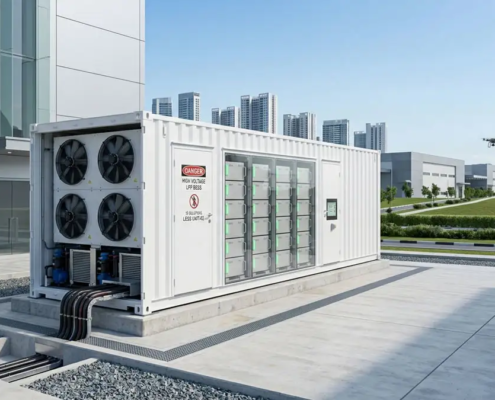 https://anengjipower.com/wp-content/uploads/2026/06/modular-commercial-solar-battery-storage-cabinet.webp
675
1000
Charging Station Engineer
https://anengjipower.com/wp-content/uploads/2025/09/anengji-dc-fast-charging-station-manufacturer-and-supplier-logo-white-1.png
Charging Station Engineer2026-06-18 09:16:522026-07-03 03:05:13What Is Solar Battery Storage? Complete C&I Engineering Guide
https://anengjipower.com/wp-content/uploads/2026/06/modular-commercial-solar-battery-storage-cabinet.webp
675
1000
Charging Station Engineer
https://anengjipower.com/wp-content/uploads/2025/09/anengji-dc-fast-charging-station-manufacturer-and-supplier-logo-white-1.png
Charging Station Engineer2026-06-18 09:16:522026-07-03 03:05:13What Is Solar Battery Storage? Complete C&I Engineering Guide

Leave a Reply
Want to join the discussion?Feel free to contribute!