
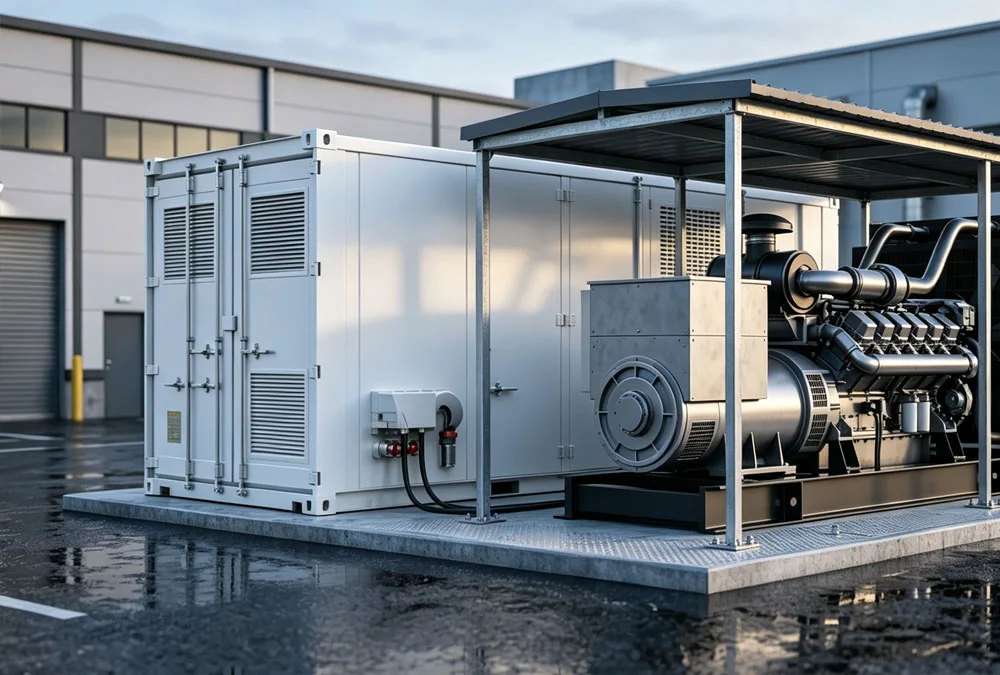
Introduction
Evaluating a battery backup vs generator for commercial and industrial facilities comes down to a trade-off between instant response, daily peak shaving revenue, and extended multi-day runtime. If your plant faces sudden voltage sags or short grid trips, a diesel engine simply cannot start fast enough to save your PLC lines from tripping. That leaves you with massive scrap losses. On the flip side, relying purely on a battery storage system during an extended multi-day blackout might deplete your reserves without continuous onsite generation or PV integration.
A battery backup is generally better for fast-response, short-to-medium-duration backup and facilities that can benefit from peak shaving, solar integration, and lower routine operating requirements. Generators remain strong for long-duration outages and high continuous loads. For facilities requiring both fast response and extended runtime, a battery-generator hybrid can provide a stronger backup strategy. Evaluating these assets solely on initial equipment procurement prices is a mistake; real economic value depends on annual runtime hours, utility demand charges, and avoided downtime costs.
Battery Backup vs Generator: Which Is Better for Commercial Backup Power?
Determining whether a commercial battery backup system vs generator best fits your operational profile requires assessing how your facility uses energy both during a grid collapse and during normal grid operations.
Choose Battery Backup (BESS) If…
- Sub-second response is mandatory: Sensitive industrial electronics, automation lines, and medical packaging cannot endure the 10 to 30 seconds a diesel engine needs to crank and synchronize.
- Outages are frequent but short-to-medium (<4-8 hours): If grid interruptions mostly last under 8 hours, electrochemical storage handles the cycle efficiently with zero site emissions.
- Strict environmental rules apply: Facilities located in urban noise-restricted zones or strict emissions regions face tight limits on local diesel combustion.
- Daily economic value is required: A commercial battery backup can perform peak shaving, demand charge reduction, and solar self-consumption every single day when the grid is working, actively generating financial returns.
Choose a Generator If…
- Outages extend beyond 12–24 hours: When weather events or grid failures last days, refuelable fuel engines provide uncompromised runtime as long as diesel supply lines stay open.
- Extremely high continuous kW loads are required: Large steel foundries or heavy mining operations requiring massive continuous thermal or mechanical power often find megawatt-scale gensets cheaper per initial installed kW.
- Annual utilization is near zero (<50 hours/year): If the asset only runs for a few hours a year purely as catastrophic emergency insurance, low initial CapEx offsets high fuel and standby maintenance costs.
Choose Hybrid Backup If…
- Zero-downtime + multi-day resilience are both required: The BESS absorbs the initial grid voltage dip instantaneously, carrying the critical load while the diesel generator ramps up cleanly to handle long-duration power delivery.
- You want to optimize diesel fuel consumption: A battery generator hybrid allows the diesel engine to run at its optimal efficiency curve (around 70–80% load) rather than lingering at inefficient light loads, drastically cutting diesel fuel burn and engine maintenance.
Quick Selection Decision Matrix
| Facility Requirement | Standalone BESS | Standalone Generator | Hybrid (BESS + Genset) |
|---|---|---|---|
| Seamless Sub-Second Switching | ✔ Optimal | ✖ Delayed (10-30s) | ✔ Optimal |
| Multi-Day Outage (>24 Hours) | ⚠️ Requires PV Recharge | ✔ Optimal (Refuelable) | ✔ Optimal |
| Daily Demand Charge Savings | ✔ High ROI | ✖ None | ✔ High ROI |
| Zero Site Emissions Compliance | ✔ 100% Clean | ✖ High Exhaust Fumes | ⚠️ Reduced Emissions |
💡 Buyer’s Perspective: “Is a battery system really reliable enough to replace my legacy diesel backup?”
Engineering Reality: Yes, but only if engineered correctly. Traditional diesel generators carry a 5% to 15% failure-to-start rate due to starter battery degradation, wet stacking, or fuel contamination. According to the EPRI BESS Failure Incident Database (2025/2026 update), modern utility-scale and industrial BESS failure rates dropped by 99% between 2018 and 2025 as LFP safety protocols, BMS telemetry, and liquid cooling matured. A battery backup system contains no moving mechanical parts, providing near-instantaneous power availability without mechanical cranking risks.
Battery Backup vs Generator Quick Comparison
Evaluating battery backup vs generator for commercial buildings or battery backup vs generator for industrial facilities requires analyzing direct side-by-side technical operational parameters:
| Factor | Battery Backup (BESS) | Generator | Best Fit | Tangible Buyer Benefit |
|---|---|---|---|---|
| Response Time | Very fast (< 20 ms) | Startup delay (10-30s) | Battery Backup | Prevents production line trips and data loss during sags. |
| Backup Runtime | Energy-limited (2h–8h typical) | Fuel-limited (Continuous) | Generator | Guarantees uninterrupted operations over multi-day grid blackouts. |
| Long-Duration Backup | Requires solar/recharge | Strong (Refuelable) | Generator | Eliminates energy exhaustion risks during prolonged severe grid failures. |
| Noise Level | Low (< 65 dB HVAC) | Higher (> 90 dB) | Battery Backup | Complies with urban noise ordinances and improves worker safety. |
| Point-of-Use Emissions | None (Zero local) | Yes (Exhaust fumes) | Battery Backup | Simplifies EPA/ESG permitting without complex exhaust ducting. |
| Routine Maintenance | Generally lower | Generally higher | Battery Backup | Saves maintenance labor, fluid sampling, and monthly engine testing. |
| Fuel Logistics | None required | Required (Diesel contracts) | Battery Backup | Avoids fuel price volatility and supply chain disruptions during storms. |
| Peak Shaving | Yes (Active) | No | Battery Backup | Dramatically cuts monthly demand charges on utility bills. |
| Solar Integration | Excellent | Limited | Battery Backup | Stores cheap solar generation for evening peak shift use. |
| Daily Energy Savings | Yes | No | Battery Backup | Generates ongoing economic return during normal grid conditions. |
| High Continuous Load | Depends on sizing | Strong | Generator | Lower upfront CapEx for massive constant megawatt requirements. |
| Extended Outage | Requires recharge strategy | Strong | Generator | Provides indefinite runtime assuming fuel delivery continuity. |
| Maximum Resilience | Strong | Strong | Hybrid | Combines sub-second response with unlimited long-duration runtime. |
Grid-Forming vs Grid-Following BESS for Backup Power
A common engineering misconception is assuming that any commercial battery system automatically acts as an independent power outage backup source. The critical differentiator lies in the Power Conversion System (PCS) inverter technology:
| Inverter Topology | Backup & Islanding Relevance | Primary Application |
|---|---|---|
| Grid-Following BESS | Depends on an existing external grid voltage/frequency reference; shuts down when grid collapses unless tied to a synchronized generator. | Standard grid-tied peak shaving & solar self-consumption. |
| Grid-Forming BESS | Establishes its own local voltage and frequency reference instantly, permitting seamless islanded microgrid operation during blackouts. | True standby emergency backup & off-grid resilience. |
Critical System Architecture Warning: Not every BESS can operate as a standalone backup source. Islanding capability, grid-forming PCS, protection coordination, and critical-load isolation must be designed together during initial EPC project engineering.
Battery Backup vs Generator Reliability: What Actually Matters?
Reliability in commercial facilities is often misconstrued as simply whether an asset successfully turns on. When comparing a BESS vs generator for backup power, we assess system dependability using our engineering framework:
System Reliability = Response Speed + Runtime Capability + Power Quality + Readiness Availability + Energy Replenishment Strategy
Response Time
Response profiles vary dramatically across technologies. A static double-conversion UPS offers continuous 0ms transfer but lacks long-duration storage capacity. A standalone diesel generator requires ATS signal processing, starter engagement, engine acceleration, and generator governor stabilization, introducing a 10 to 30 second delay. A battery energy storage system (BESS) paired with a grid-forming PCS delivers sub-second response (<20ms). In a hybrid system, the BESS absorbs the initial voltage sag instantly while sending a start signal to the generator.
Power Quality
Industrial sites running large induction motors or precision automation require clean AC power. Starting large motor loads on a diesel generator can trigger severe voltage sags, frequency droop, and harmonic distortion. Advanced inverter-based bess backup power units supply pure sine-wave output with rapid VAR compensation, protecting sensitive electronics and VFDs from harmonic tripping.
Availability and System Readiness
A generator’s readiness depends on battery starter health, clean fuel chemistry, block heaters, and mechanical valve integrity. Conversely, BESS readiness hinges on State of Charge (SOC) management, cell balance, thermal management HVAC functionality, and real-time BMS remote telemetry.
Battery Backup vs Generator: Are They Really Alternatives?
Comparing a battery backup or generator for business as direct mutually exclusive substitutes overlooks their underlying physics.
Battery Backup Stores Energy
A battery does not generate electricity; it captures energy from the grid or solar PV, storing it electrochemically until the PCS converts DC back to AC for critical site loads.
Generators Generate Electricity
A generator converts liquid or gaseous fuel into rotational mechanical energy, driving an alternator to produce ongoing electrical current continuous load delivery.
Conclusion: BESS and generators are not always direct substitutes. In many industrial applications, they operate as complementary assets within a microgrid.
Battery Backup vs UPS vs Generator: Which One Do You Need?
Understanding the precise engineering distinctions between static UPS, battery energy storage (BESS), and engine generators prevents over-specifying hardware costs:
| System Architecture | Primary Operational Role | Key Technical Advantage | Tangible Buyer Benefit |
|---|---|---|---|
| Uninterruptible Power Supply (UPS) | No-break instantaneous power bridge (0 to 4ms) | Absolute zero-break power conditioning | Protects sensitive IT servers and delicate electronics from data corruption. |
| Battery Energy Storage System (BESS) | Energy storage + fast backup + daily management | Sub-second response + 2h-8h duration + peak shaving | Generates daily utility bill savings while backing up critical plant operations. |
| Diesel / Gas Generator | Onsite prime generation for extended outages | Unlimited long-duration fuel energy delivery | Provides continuous extended power during long-term grid outages. |
Can BESS Replace a UPS?
Not necessarily. For data centers, semiconductor fabrication plants, and critical medical infrastructure, dedicated double-conversion UPS units are retained for instantaneous power bridge needs, while BESS provides broader facility backup and daily peak shaving.
What Can a Battery Backup System Do When the Grid Is Working?
The fundamental economic differentiator between these assets is clear: A generator primarily protects a facility during outages. A BESS can provide backup power while also creating economic value during normal grid operation.
Peak Shaving & Demand Charge Reduction
Discharges stored energy during facility power consumption spikes, flattening overall grid demand curves and cutting monthly commercial electric demand bills ($/kW).
Time-of-Use Energy Arbitrage & Solar Self-Consumption
Charges the battery during cheap off-peak hours or excess solar generation times, discharging during expensive peak tariff windows to power evening facility shifts.
How Much Battery Backup Capacity Does a Commercial Facility Need?
Determining actual BESS sizing transitions naturally from desired runtime to nominal nameplate battery capacity. Sizing requires a strict multi-factor engineering model:
Professional BESS Energy Sizing Formula
Usable Energy (kWh) = Critical Load (kW) × Required Backup Runtime (Hours)
Nominal BESS Energy (kWh) ≥ Usable Energy ÷ (DoD × System Efficiency × Temp Derating × End-of-Life Factor)
Concrete Sizing Case Study: 500 kW Critical Load for 4 Hours
Let us evaluate a typical industrial facility requiring standby power for a 500 kW critical load across a 4-hour target outage window:
- Critical Load: 500 kW
- Required Runtime: 4 Hours
- Usable Energy Required: 500 kW × 4 h = 2,000 kWh (2.0 MWh usable)
- Assumed Parameters: 90% DoD (0.90), 90% System Efficiency (0.90), 95% Temp Derating (0.95), 80% EOL Retention (0.80)
- Nominal Installed Capacity Calculation: 2,000 kWh ÷ (0.90 × 0.90 × 0.95 × 0.80) ≈ 3,250 kWh (3.25 MWh nominal)
Engineering Insight: A 500 kW critical load requiring 4 hours of backup needs approximately 2.0 MWh of usable energy. However, after accounting for inverter efficiency, SOC reserve buffers, ambient temperature derating, and 10-year end-of-life capacity retention, the facility must install a nominal nameplate BESS of approximately 3.25 MWh. Motor starting inrush surges must also be evaluated for PCS inverter sizing.
Whole-Facility Backup vs. Critical Load Isolation
Backing up an entire 2 MW facility requires a massive BESS investment. By implementing automated sub-panel load shedding, facilities isolate critical manufacturing lines, saving over 60% on initial BESS CapEx while securing essential business continuity:
Total Facility Load → Critical Load Isolation → PCS Inverter kW Sizing → Nominal Energy Storage kWh Sizing
Battery Backup vs Generator Cost: CapEx, OpEx and TCO
Comparing battery energy storage vs diesel generator cost models requires evaluating upfront system procurement against 15-year lifecycle financial returns.
Financial Modeling Breakdown: 500 kW / 4-Hour System
Below is a comparative 10-year Total Cost of Ownership (TCO) estimate comparing a standalone 500 kW Diesel Generator with a 500 kW / 3.25 MWh Commercial BESS:
| Cost & Revenue Category | Standalone 500 kW Generator | Commercial BESS (500kW / 3.25MWh) |
|---|---|---|
| Initial Turnkey CapEx | ~$120,000 – $180,000 (Lower initial cost) | ~$800,000 – $1,100,000 (Higher initial cost) |
| Annual O&M Expenses | High (Fuel testing, oil, filters, load banking) | Low (Remote software monitoring, HVAC maintenance) |
| Daily Grid Revenue / Bill Savings | $0 / Year (Sunk cost asset) | +$120,000 – $180,000 / Year (Peak shaving) |
| Estimated Financial Payback | None (Pure insurance expenditure) | 3.5 to 6.0 Years (Via tariff optimization) |
Break-Even Financial Analysis
According to the BloombergNEF Energy Storage System Cost Survey (2025/2026 report), falling LFP pack prices have altered asset break-even dynamics:
- Low-Utilization Backup (<50 hrs/yr): If local electricity rates are cheap and demand charges are absent, a diesel generator retains a lower 10-year Net TCO due to low upfront CapEx.
- High-Demand Commercial Utilities (>300 hrs/yr or High Tariff): When utility demand charges exceed $15/kW/month, the BESS actively pays for itself, reaching a full break-even payback within 4 years while offering zero-downtime emergency backup protection.
Hidden Costs of Battery Backup vs Generator
| Technology | Hidden Cost Category | Description & Operational Impact | Tangible Buyer Benefit of Planning |
|---|---|---|---|
| Battery Backup (BESS) | Permitting & Fire Engineering | Third-party peer reviews, UL 9540A testing reports, and local fire marshal approvals. | Avoids unexpected installation delays and costly structural retrofit penalties. |
| HVAC Auxiliary Draw | Continuous parasitic power consumption for liquid thermal management cooling units. | Ensures accurate annual utility savings modeling without parasitic energy surprises. | |
| System Augmentation | Adding battery capacity around Year 10 to offset natural electrochemistry degradation. | Guarantees full nameplate capacity availability over 15-to-20-year project lifetimes. | |
| Diesel Generator | Fuel Maintenance & Polishing | Fuel testing, biocide additives, fuel polishing, and emergency storm delivery premiums. | Prevents engine starting failure caused by degraded or contaminated fuel stock. |
| Noise & Emissions Control | Sound-attenuated enclosures, residential silencers, and extended exhaust stacks. | Ensures full compliance with local municipal noise and environmental zoning codes. | |
| Load Bank Testing | Mandatory monthly engine exercising and annual full-load resistive bank testing. | Eliminates engine wet stacking and verifies mechanical readiness before outages. |
How Does a Battery-Generator Hybrid Backup System Work?
A battery generator hybrid system combines fast-acting energy storage with long-duration engine generation into an integrated microgrid:
Operational Architecture
- Sub-Second Transfer: The grid-forming BESS absorbs the grid voltage drop instantly (<20ms), protecting industrial PLC lines without interruption.
- Generator Ramp-Up: If the blackout exceeds 15 minutes, the EMS sends an auto-start signal to the diesel generator, allowing it to warm up and synchronize smoothly.
- Optimal Efficiency Operation: The generator charges the BESS at its peak fuel efficiency curve (70-80% load), turning off entirely during light-load hours to cut diesel fuel burn by up to 60%.
Procurement Checklist: What to Verify Before Choosing Your Backup Strategy
- Power Capacity (kW/MW): Verify peak facility load and motor-starting surge capability (kVA).
- Usable Energy & DoD (kWh): Confirm actual dischargeable capacity accounting for DoD reserves and degradation.
- PCS Grid-Forming Capability: Confirm whether the inverter supports true standalone islanded backup operation.
- Safety & Compliance Standards: Check for UL 9540, UL 9540A, and NFPA 855 fire protection certifications.
- Warranty Terms: Demand a minimum 10-year / 6,000 cycle capacity retention guarantee.
Why Choose AnengJI for Commercial & Industrial Battery Backup?
According to the S&P Global Commodity Insights Energy Storage Outlook (2025/2026 edition), modular BESS architectures reduce industrial project deployment times by 40%. AnengJI provides turnkey LFP battery energy storage systems engineered for maximum resilience and daily demand charge reduction.
100kWh All-in-One Outdoor BESS
Ideal for: Small commercial buildings, EV charging hubs, retail branches.
- Integrated 50kW PCS + 100kWh LFP Battery Pack
- Compact footprint with internal liquid cooling
- Core Buyer Benefit: Quick plug-and-play installation; eliminates demand charges without major switchgear overhauls.
261kWh Industrial Cabinet BESS
Ideal for: Mid-sized manufacturing plants, logistics warehouses, cold storage.
- High-density Tier-1 LFP cells with intelligent BMS
- Sub-20ms seamless backup switching
- Core Buyer Benefit: Modular expansion allows plants to scale storage capacity as production lines grow over time.
418kWh Heavy-Duty Energy Cabinet
Ideal for: Heavy manufacturing facilities, large solar-plus-storage microgrids.
- Liquid cooling HVAC + aerosol fire suppression
- High C-rate charge/discharge capability
- Core Buyer Benefit: High active power output supporting heavy motor starting and aggressive peak shaving.
1MWh Containerized BESS Station
Ideal for: Utility-scale projects, large industrial complexes, microgrids.
- 20ft ISO container with integrated HVAC & FSS
- Centralized EMS for microgrid control
- Core Buyer Benefit: Maximum energy density for long-duration industrial backup and facility grid independence.
AnengJI provides comprehensive technical support—from initial load profiling and single-line diagram (SLD) engineering to field commissioning and long-term O&M services.
Conclusion: Choosing the Right Backup Architecture for Your Facility
Choosing between a battery backup vs generator is no longer a simple question of initial hardware cost. Generators remain unmatched for continuous multi-day power generation during catastrophic grid blackouts. However, modern commercial battery storage systems (BESS) deliver sub-second outage protection that prevents expensive manufacturing downtime while active peak shaving generates ongoing financial returns during normal grid operations. For energy-intensive facilities requiring both instant response and indefinite runtime, an integrated battery-generator hybrid system represents the peak of modern industrial resilience.
Ready to Optimize Your Facility’s Backup Power Resilience?
Whether your goal is sub-second outage protection, peak shaving utility savings, or a hybrid microgrid architecture, our engineering team is here to model your financial ROI.
Related Article
 https://anengjipower.com/wp-content/uploads/2026/06/epc-vs-turnkey-solar-project-bess.webp
675
1000
Charging Station Engineer
https://anengjipower.com/wp-content/uploads/2025/09/anengji-dc-fast-charging-station-manufacturer-and-supplier-logo-white-1.png
Charging Station Engineer2026-06-22 07:16:042026-06-24 07:13:17What Is the Difference Between EPC and Turnkey Contract Models in Energy Projects?
https://anengjipower.com/wp-content/uploads/2026/06/epc-vs-turnkey-solar-project-bess.webp
675
1000
Charging Station Engineer
https://anengjipower.com/wp-content/uploads/2025/09/anengji-dc-fast-charging-station-manufacturer-and-supplier-logo-white-1.png
Charging Station Engineer2026-06-22 07:16:042026-06-24 07:13:17What Is the Difference Between EPC and Turnkey Contract Models in Energy Projects? https://anengjipower.com/wp-content/uploads/2026/06/anengji-commercial-solar-plus-storage-benefits-site.webp
675
1000
Charging Station Engineer
https://anengjipower.com/wp-content/uploads/2025/09/anengji-dc-fast-charging-station-manufacturer-and-supplier-logo-white-1.png
Charging Station Engineer2026-06-20 14:34:102026-06-20 14:37:43What Are the Top Benefits of Solar Battery Storage in Factories?
https://anengjipower.com/wp-content/uploads/2026/06/anengji-commercial-solar-plus-storage-benefits-site.webp
675
1000
Charging Station Engineer
https://anengjipower.com/wp-content/uploads/2025/09/anengji-dc-fast-charging-station-manufacturer-and-supplier-logo-white-1.png
Charging Station Engineer2026-06-20 14:34:102026-06-20 14:37:43What Are the Top Benefits of Solar Battery Storage in Factories? https://anengjipower.com/wp-content/uploads/2026/06/modular-commercial-solar-battery-storage-cabinet.webp
675
1000
Charging Station Engineer
https://anengjipower.com/wp-content/uploads/2025/09/anengji-dc-fast-charging-station-manufacturer-and-supplier-logo-white-1.png
Charging Station Engineer2026-06-18 09:16:522026-07-03 03:05:13What Is Solar Battery Storage? Complete C&I Engineering Guide
https://anengjipower.com/wp-content/uploads/2026/06/modular-commercial-solar-battery-storage-cabinet.webp
675
1000
Charging Station Engineer
https://anengjipower.com/wp-content/uploads/2025/09/anengji-dc-fast-charging-station-manufacturer-and-supplier-logo-white-1.png
Charging Station Engineer2026-06-18 09:16:522026-07-03 03:05:13What Is Solar Battery Storage? Complete C&I Engineering Guide


Leave a Reply
Want to join the discussion?Feel free to contribute!