
Introduction
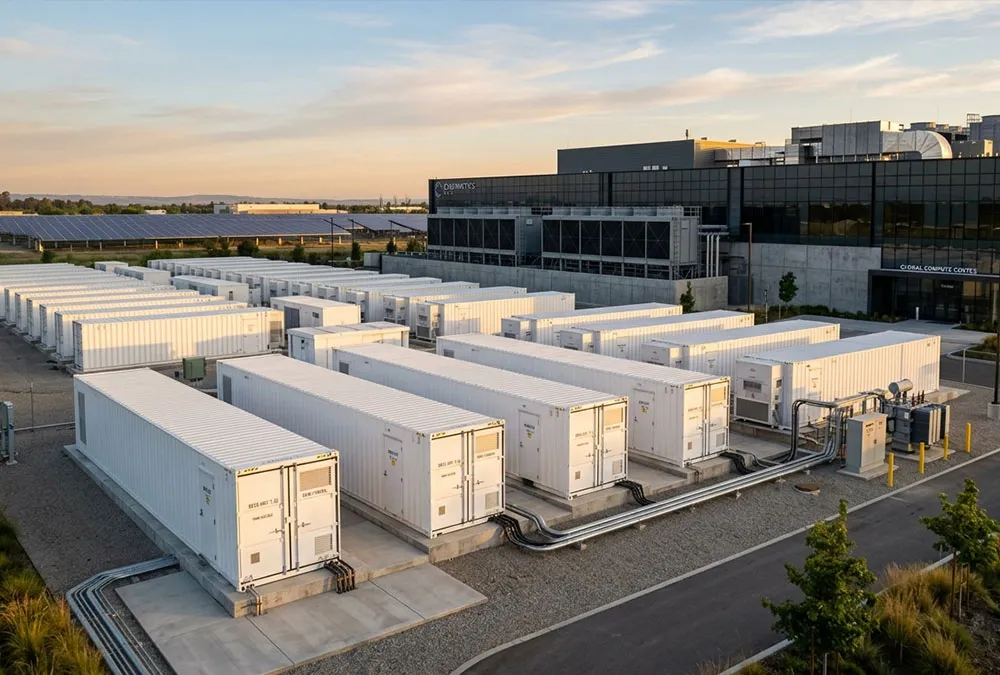
Data centers face rising power demand, strict grid constraints, tighter power reliability requirements, and pressure to manage energy costs. Deploying modern data center energy storage helps address these issues by delivering fast-response power, active peak-load management, renewable energy integration, and resilience.
Hyperscale hyperscalers and co-location facility managers are discovering that legacy infrastructure hits limits under AI workload surges. Electric utilities are delaying interconnection queue timelines by months or even years in major technology hubs like Northern Virginia and Frankfurt. A dedicated data center battery energy storage system provides the bridge needed to scale capacity, lower utility billing, and stabilize critical IT infrastructure.
Quick Answer: Why Are Data Centers Adding Battery Energy Storage?
| Data Center Challenge | How BESS Helps | Tangible Operational Benefit |
|---|---|---|
| Rising power demand | Peak-load management | Prevents main transformer overloading during high-density computing spikes. |
| Grid constraints | Load flexibility | Bypasses temporary utility grid caps while awaiting substation upgrades. |
| Power interruptions | Backup & ride-through support | Delivers immediate sub-second power response during utility voltage drops. |
| Demand charges | Peak shaving | Lowers monthly capacity charges by shaving extreme peak power draws. |
| Renewable integration | Solar + BESS alignment | Stores solar power generated during off-peak hours for peak facility use. |
| High power variability | Fast-response power | Stabilizes bus voltage against erratic GPU dynamic step loads. |
| Sustainability targets | Reduced generator runtime | Cuts diesel engine testing cycles and local carbon emissions. |
Crucially, a battery energy storage system (BESS) does not automatically replace traditional UPS setups or diesel engine generators. Instead, it becomes a key asset within the overall facility electrical network, linking power generation with critical servers.
Need Help Sizing a Data Center BESS?
Share your Critical Load (kW/MW), Target Backup Duration, existing UPS setup, and Site Voltage. Our power application engineering team will provide a tailored preliminary sizing report.
Who Is This Data Center Energy Storage Guide For?
This technical guide provides practical insights for key stakeholders responsible for data center infrastructure performance, system reliability, and financial management:
Data Center Owners and Operators
Evaluating financial returns, operational uptime protection, and total cost of ownership (TCO) across facility expansion cycles.
EPC Contractors and Electrical Engineers
Designing single-line integration, selecting switchgear protection, and coordinating grid-forming PCS control within distribution setups.
Energy Managers and Facility Managers
Seeking daily peak shaving, utility tariff arbitrage, demand charge reduction, and solar self-consumption strategy execution.
Data Center BESS Procurement Teams
Reviewing equipment specifications, Tier-1 LFP battery safety metrics, UL/NFPA compliance standards, and supplier warranties.
Why Are Data Centers Adding Battery Energy Storage?
Rapid technology shifts are pushing legacy data center electrical architectures to their limits. Five main drivers are accelerating adoption of energy storage solutions for AI data centers and commercial facilities:
Growing and More Dynamic Power Demand
Dense server configurations driven by AI workloads, large-language model training, and high-performance GPU clusters have pushed average rack power density from 8 kW to over 40 kW per cabinet. AI workloads increase not only total electricity demand but also power density and dynamic load fluctuations across the facility. When high-density servers switch rapidly between computational tasks, sudden power spikes can strain electrical systems. A fast-acting data center energy storage system helps cushion these step loads, preventing upstream voltage drops.
Grid Capacity and Interconnection Constraints
In major tech hubs, utility interconnection queues can extend up to five years. Transmission constraints and local grid congestion mean power companies often cap initial connection capacity below full facility design needs. Integrating bess for data center backup power allows facilities to manage peak loads effectively. This provides load flexibility while local grid infrastructure catches up, subject to regional interconnection rules and system design.
Reliability and Power Quality Requirements
Modern computing hardware relies on high power quality. Sudden voltage sags, frequency variations, or micro-interruptions lasting just milliseconds can trigger server resets and corrupt active data processes. Advanced bess backup power for data centers acts as a responsive power buffer, delivering fast reactive power compensation and stabilizing bus voltage during grid disturbances.
Rising Electricity Costs and Demand Charges
Utilities charge commercial users steep monthly fees based on peak monthly kilowatt draws. By deploying data center peak shaving battery storage, facilities discharge stored energy during peak utility periods. This lowers total demand charges and allows managers to take advantage of time-of-use rate structures.
Renewable Energy and Sustainability Requirements
Corporate clean energy targets require moving away from continuous fossil-fuel back-feed. Paired with rooftop solar or offsite power purchase agreements (PPAs), battery energy storage for data centers stores excess renewable generation for later use. It also cuts down on routine diesel generator testing, helping lower Scope 1 local emissions.
Industry Benchmark Data: According to the IEA Electricity 2024 Analysis Report, global electricity demand from data centers, artificial intelligence, and cryptocurrency is projected to double by 2026. This trajectory highlights why energy storage systems are becoming vital for managing grid constraints and stabilizing local facility power.
What Is Data Center Energy Storage and How Does It Work?
A commercial BESS for data centers is an integrated electrochemical system designed to store electrical energy from the grid or solar PV, discharging it when required. Understanding how these systems operate requires examining their five core subsystems:
1. Battery Subsystem
The battery subsystem consists of individual cells configured into modules, racks, and battery enclosures. Most modern installations use Lithium Iron Phosphate (LiFePO4 or LFP) chemistry due to its strong thermal stability, long cycle life (often exceeding 6,000 cycles), and reliable safety profile.
2. Power Conversion System (PCS)
The PCS acts as a bi-directional inverter, converting incoming AC power from the grid to DC power to charge the battery bank. During discharge, it converts stored DC energy back into synchronized AC power. Advanced grid-forming PCS units can independently establish stable voltage and frequency references during power outages.
3. Battery Management System (BMS)
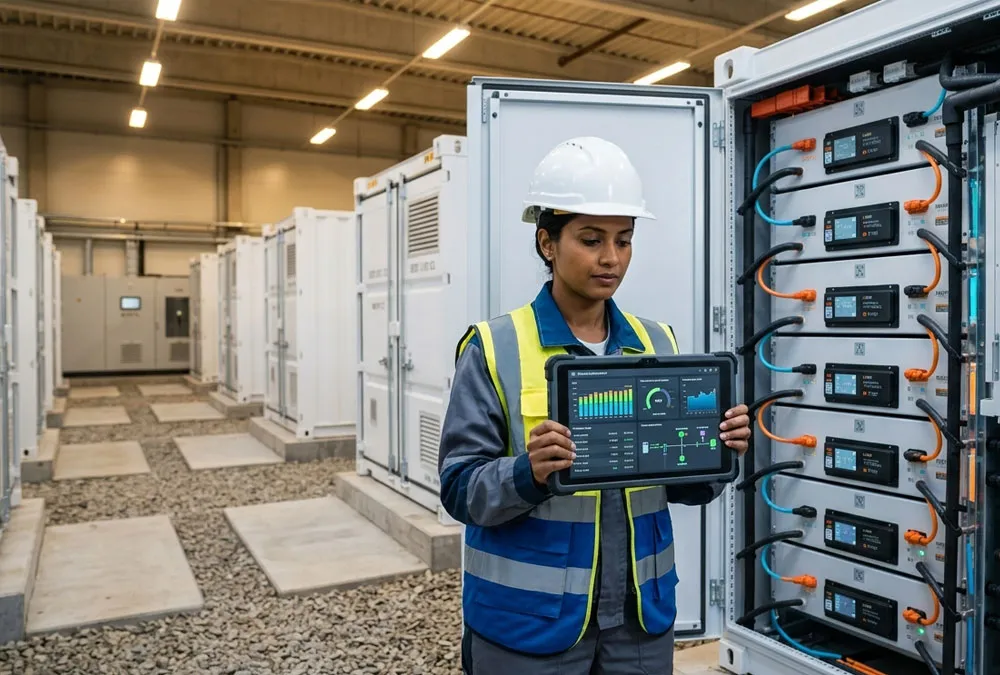
The BMS acts as the primary safety controller. It actively monitors individual cell voltage, current, internal temperature, and state-of-charge (SOC). If parameters drift beyond operational safety limits, the BMS adjusts charging currents or triggers protective breaker isolation.
4. Energy Management System (EMS)
The EMS serves as the top-level software hub. It connects energy storage operations with utility pricing signals, facility power meters, and overall site demand profiles. The EMS determines optimal times to store power, shave peak loads, or hold reserves for emergency backup.
5. Thermal Management and Safety Systems
To maintain stable operating temperatures (typically 20°C to 25°C), industrial battery enclosures use liquid-cooling systems or dedicated HVAC setups. Integrated safety features include aerosol-based fire suppression, early-stage gas detection sensors, and explosion vent panels designed to meet UL 9540 and NFPA 855 guidelines.
How Does BESS Fit Into a Data Center Power Architecture?
Integrating battery energy storage systems for data centers into an existing power distribution network requires carefully planning power flows and system communications. The diagram below illustrates how electricity moves between the grid, storage equipment, onsite generators, and critical IT server racks:
Grid / Renewable Energy Source
│
▼
PCS (Bi-Directional Inverter)
↕
Battery Enclosure (LFP Cells)
│
▼
Critical IT Server Loads
[ EMS SOFTWARE CONTROL BUS ]
│
┌───────────────────┼───────────────────┐
│ │ │
Utility Grid BESS Inverter Standby Generator
│ │ │
└────────────── Main Power Bus ─────────┘
│
Static UPS Unit
│
Critical IT Server Load
How EMS Coordinates BESS, Grid, UPS, and Generators
The Energy Management System (EMS) monitors grid conditions and main bus voltage. Under standard grid conditions, the EMS manages peak shaving and demand response. If an upstream utility outage occurs, the EMS triggers the BESS to support the main bus. At the same time, it signals the standby diesel generator to start up, managing power transfers without disrupting upstream static UPS operations.
Where BESS Sits in the Electrical Distribution System
Depending on design requirements, a data center battery backup system can be connected at medium voltage (MV) or low voltage (LV) levels:
- MV Integration (Facility Transformer Bus): Positioned upstream on the main 11kV/33kV bus bar to manage whole-building demand, perform site peak shaving, and optimize large solar PV inputs.
- LV Integration (Critical Switchgear Bus): Positioned on the main 400V/480V low-voltage bus bar adjacent to Automatic Transfer Switches (ATS) to provide fast backup power directly to UPS inputs.
Data Center Energy Storage vs UPS vs Generator: What’s the Difference?
A common procurement misconception is assuming that a BESS, a traditional UPS, and a standby generator are interchangeable alternatives. Each performs a distinct role within a modern power system:
UPS: Immediate Power Continuity
A traditional double-conversion data center UPS delivers continuous, uninterrupted power conditioning (0ms to 4ms transfer time). However, standard lead-acid or short-duration lithium UPS batteries are typically sized for brief runtimes (5 to 15 minutes), acting primarily as a bridge while standby generators start up.
BESS: Energy Storage and Flexible Power
A dedicated data center BESS solution provides larger energy capacity, typically supporting 2 to 8 hours of continuous operation. Beyond backup power, a BESS actively shaves daily energy peaks, performs load shifting, and generates tariff-based cost savings—functions traditional standby UPS hardware cannot perform.
Generator: Long-Duration Power Generation
Diesel or natural gas generators convert liquid fuel into ongoing electrical power, offering extended runtime during long grid blackouts. However, engine generators take 10 to 30 seconds to start and stabilize, require regular mechanical maintenance, and produce local combustion emissions.
BESS Does Not Automatically Replace a UPS
It is crucial to clarify: A BESS provides reliable backup energy, but whether it can deliver true zero-break power depends on the PCS inverter design, transfer switch speed, and overall system controls. For mission-critical IT environments, static UPS units are usually kept to maintain uninterrupted power quality, while a BESS handles main site energy management.
The Data Center Power Resilience Stack
Static UPS / STS — Filters power disturbances, prevents server resets, and secures brief ride-through windows.
Commercial BESS — Provides fast power, performs daily peak shaving, and reduces reliance on diesel generators during medium outages.
Standby Generators — Delivers continuous power during major regional outages as long as fuel supplies remain available.
💡 Buyer Insight: “Can’t I just buy extra batteries for my existing UPS instead of installing a separate BESS?”
Engineering Reality: Expanding standard UPS battery cabinets increases emergency ride-through time, but classic UPS hardware is built for continuous floating standby mode—not frequent daily charge-discharge cycling. Running standard UPS batteries for daily peak shaving will rapidly degrade the cell pack and void manufacturer warranties. A dedicated BESS features high-cycle LFP cells, specialized HVAC cooling, and advanced EMS controls tailored specifically for daily cycle management.
What Can BESS Do for a Data Center?
Evaluating data center energy storage requires looking beyond basic backup power. A BESS provides multiple operational and financial benefits across a facility’s lifecycle:
- Backup Power and Ride-Through Support: Supplies clean power to essential IT systems, cooling pumps, and environmental controls during local grid trips.
- Peak Shaving and Demand Charge Reduction: Automatically discharges during peak facility operation, lowering maximum monthly kW readings and utility demand charges.
- Load Shifting and Time-of-Use Optimization: Charges during lower-cost off-peak hours and discharges during high-cost peak rate periods to lower daily power costs.
- Renewable Energy Integration: Captures local solar PV generation, smoothing out intermittency and helping facility managers meet sustainability goals.
- Power Quality and Fast Power Response: Delivers rapid sub-second VAR compensation to stabilize voltage and balance phase harmonics across dense compute buses.
- Generator Runtime Reduction: Handles brief 15-to-30-minute grid drops without cranking diesel engines, reducing thermal stress and fuel consumption.
- Demand Response and Grid Services: Enables facilities to participate in utility demand response programs, creating new revenue streams by helping stabilize regional power grids.
Core Commercial Insight:
A standby generator primarily creates value when the main utility grid fails. In contrast, a modern data center battery energy storage system generates economic value every day during normal operations through demand reduction while maintaining emergency backup capacity.
How Much BESS Capacity Does a Data Center Need?
Properly sizing a BESS requires evaluating both output power requirements (MW) and total energy capacity (MWh). Engineering teams use a six-step sizing process:
Step 1 — Identify Critical Loads
Separate total facility load into non-critical office lighting, semi-critical cooling chillers, and critical IT server racks. Avoid sizing storage systems for non-essential loads unless full-facility backup is explicitly required.
Step 2 — Determine Required Backup Duration
Establish the target operational window (e.g., 30 minutes for quick bridging, or 2 to 4 hours for extended ride-through and peak shaving flexibility).
Step 3 — Calculate Required BESS Power (MW)
Required BESS Power (kW/MW) ≥ Maximum Peak Critical Load. Ensure the system handles motor-starting inrush currents from cooling chillers and pumps.
Step 4 — Calculate Required Usable Energy Capacity (MWh)
Usable Energy (kWh) = Critical Load (kW) × Target Duration (Hours).
Step 5 — Account for Reserve SOC, Efficiency, and Battery Degradation
To protect cell health, systems operate within defined Depth of Discharge (DoD) limits (typically 90%). System derating must also account for round-trip efficiency (RTE), ambient operating temperatures, and expected capacity degradation over a 10-year period.
Step 6 — Consider Load Growth
Account for future expansion plans. High-density AI computing hardware often requires scalable, modular energy storage configurations that can grow over time.
Get a Preliminary BESS Sizing Recommendation
Avoid over-specifying hardware costs. Submit your site energy profiles to receive an engineering recommendation tailored to your facility.
Data Center BESS Sizing Example: From MW to MWh
Let us work through a practical sizing example for a mid-sized data center facility:
Sizing Case Study: 2 MW Critical IT Load for 2 Hours
- Critical IT & Cooling Load: 2,000 kW (2 MW)
- Target Backup Duration: 2 Hours
- Required Usable Energy: 2,000 kW × 2 h = 4,000 kWh (4.0 MWh usable)
- Operational Parameters: 90% DoD (0.90), 90% PCS System Efficiency (0.90), 95% Temp derating (0.95), 80% EOL Retention factor (0.80)
- Calculation: 4,000 kWh ÷ (0.90 × 0.90 × 0.95 × 0.80) = 4,000 ÷ 0.6156 ≈ 6,497 kWh (6.5 MWh nominal)
Engineering Takeaway: Supporting a 2 MW load for 2 hours requires 4 MWh of usable power. However, to account for system losses, operating reserves, and 10-year cell degradation, the facility should install roughly 6.5 MWh of nominal nameplate storage capacity.
Why MW and MWh Both Matter
Power (MW) determines the maximum load the system can support at any instant, which drives PCS inverter selection. Energy capacity (MWh) dictates how long that power can be sustained, determining the number of battery racks required.
C-Rate and Power-to-Energy Ratio
The C-rate defines how fast a battery charges or discharges relative to its total capacity. A 2 MW / 2 MWh setup operates at a 1C rate (full discharge in one hour). A 2 MW / 8 MWh system operates at 0.25C (full discharge over four hours). Lower C-rates generally reduce thermal stress and extend cell cycle life.
Should You Back Up the Whole Data Center or Only Critical Loads?
Choosing between whole-facility backup and critical-load isolation is a key cost driver when configuring commercial BESS for data centers:
| Strategy | Electrical Load Covered | BESS Size Needed | Relative CapEx | Tangible Operational Benefit |
|---|---|---|---|---|
| Critical-Load Backup | Servers, networking gear, essential pumps | Optimized (Lower) | Lower CapEx | Secures core operations at roughly 40% lower equipment cost. |
| Partial-Facility Backup | Critical loads + select HVAC chillers | Moderate | Medium CapEx | Maintains server cooling while keeping overall battery sizing manageable. |
| Whole-Facility Backup | 100% site power including admin & lighting | Very Large | Highest CapEx | Simplifies transfer switch logic but requires substantial battery investment. |
Design Recommendation: Sizing should align with your specific resilience targets and load profile, rather than simply matching total utility connection capacity.
What Load Characteristics Matter When Designing Data Center Energy Storage?
MW capacity figures alone are not enough to size a system accurately. Engineering teams evaluate seven key electrical load characteristics:
- Base Load: The continuous minimum electrical draw required under standard operating conditions.
- Peak Load: The absolute maximum power draw recorded during heavy computing periods.
- Critical Load Profile: The subset of IT equipment that requires uninterrupted power coverage.
- Peak Duration: How long daily power demand spikes typically last.
- Load Variability: The frequency and amplitude of power fluctuations caused by dynamic computing workloads.
- Ramp Rate: How quickly IT computing loads ramp up or down during processing cycles.
- Future Load Growth: Projected compute expansion over a 3-to-5-year operational horizon.
What Are the Key Data Center BESS Design Considerations?
Designing a high-reliability data center battery energy storage system involves key choices across five technical areas:
Battery Chemistry: LFP vs Standard Lithium Options
Lithium Iron Phosphate (LFP) has become the industry standard for stationary energy storage. Compared to Nickel Manganese Cobalt (NMC) chemistries, LFP offers superior thermal stability, lower risk of thermal runaway, longer cycle life (6,000+ cycles at 80% DoD), and eliminates cobalt supply chain risks.
Grid-Following vs Grid-Forming BESS Inverters
Grid-following inverters rely on an active utility grid signal to synchronize voltage and frequency. During a blackout, grid-following systems trip offline unless paired with a running generator. Grid-forming inverters can independently establish voltage and frequency references, enabling true islanded microgrid operation during grid outages.
BMS and EMS Integration Protocols
Ensure system controllers support industrial communication protocols such as Modbus TCP, CANbus, or IEC 61850. Smooth integration with existing Data Center Infrastructure Management (DCIM) platforms is vital for real-time monitoring and automated control.
Thermal Management: Liquid Cooling vs Air Cooling
Liquid cooling systems maintain cell-to-cell temperature variations within ±2°C. This uniform thermal distribution helps prevent localized hot spots, improves round-trip efficiency by up to 3%, and extends overall battery service life compared to traditional forced-air HVAC cooling.
System Scalability and Modular Architecture
Deploying modular outdoor battery cabinets allows operators to add storage capacity incrementally as computing loads scale, optimizing initial capital outlay.
How Is BESS Integrated With UPS, ATS, STS, and Generators?
A successful project integrates new energy storage hardware into existing facility protection schemes without causing electrical conflicts:
BESS + UPS Coordination
The BESS handles main bus voltage management, load shifting, and primary ride-through support. The static UPS remains online, filtering residual harmonics and securing 0ms power continuity for critical server power supply units (PSUs).
BESS + Generator Synchronization
During extended grid outages, the BESS covers initial load demand while sending a remote start signal to the diesel generator. Once the generator stabilizes, an Automatic Transfer Switch (ATS) or Static Transfer Switch (STS) synchronizes both power sources cleanly.
Islanding and Microgrid Operation
A motorized isolation breaker detaches the facility from the utility grid during fault conditions. The grid-forming BESS then establishes local islanded voltage, maintaining stable site power until grid service is restored.
Talk to a BESS Application Engineer
Discuss your single-line diagram (SLD), transfer switch coordination, and grid-forming inverter needs with our senior electrical technical team.
Data Center BESS Safety, Reliability, and Compliance
Safety and regulatory compliance are top priorities when installing large battery systems in mission-critical facilities:
- Thermal Runaway Protection: Multi-layer cell spacing, ceramic insulation, and active BMS temperature monitoring prevent thermal issues from spreading between cells.
- Fire Detection and Suppression: Off-gas sensors detect early-stage cell venting. Automated aerosol or clean-agent fire suppression systems deploy before thermal events escalate.
- Emergency Isolation: Physical emergency push-buttons and automated contactors isolate the battery system under fault conditions.
- Key Industry Certifications:
- UL 9540: Standard for Energy Storage Systems and Equipment.
- UL 9540A: Test Method for Evaluating Thermal Runaway Fire Spread.
- NFPA 855: Standard for the Installation of Stationary Energy Storage Systems.
- IEC 62619: Safety Requirements for Secondary Lithium Cells and Batteries.
Safety Benchmark Data: According to the EPRI BESS Failure Incident Database (2025/2026 update), modern utility and commercial energy storage failure rates dropped by over 95% following widespread adoption of UL 9540A cell-level burn testing and liquid cooling architectures.
How Much Does Data Center Energy Storage Cost?
Turnkey data center energy storage system costs depend on system capacity, battery chemistry, cooling design, and electrical connection requirements:
| Cost Component | Share of Total CapEx | Description & Engineering Drivers | Tangible Buyer Benefit of Planning |
|---|---|---|---|
| Battery Racks & Enclosures | 50% – 60% | Tier-1 LFP battery cells, rack frames, and modular outdoor enclosures. | Secures long cycle life (6,000+ cycles) and strong manufacturer warranty terms. |
| PCS & Inverters | 15% – 20% | Bi-directional grid-forming power inverters and isolation transformers. | Ensures rapid power conversion and standalone microgrid islanding support. |
| Installation & EPC Balance of System | 15% – 25% | Concrete pads, cable trenching, switchgear integration, and commissioning. | Prevents field delays and avoids switchgear retrofitting costs. |
| Thermal & Safety Infrastructure | 5% – 10% | Liquid cooling chillers, aerosol fire suppression systems, and off-gas detectors. | Maintains uniform cell temperatures, extending operational battery life. |
Market Price Data: Based on the BloombergNEF Energy Storage System Cost Survey (2025/2026 report), average turnkey LFP containerized battery storage prices dropped below $220/kWh for multi-megawatt configurations. This cost curve improves financial returns for commercial facility operators.
Can Data Center BESS Reduce Energy Costs?
Yes. While a backup generator acts strictly as an insurance expense, a commercial BESS for data centers creates ongoing revenue through several mechanisms:
- Peak Shaving Savings: Shaving top peak demand lowers monthly utility capacity charges.
- Time-of-Use Arbitrage: Charging during low-cost off-peak hours and discharging during expensive peak rate windows cuts energy costs.
- Solar Self-Consumption: Capturing excess onsite solar generation avoids selling power back to utilities at low feed-in rates.
- Grid Response Revenue: Participating in local frequency regulation or demand response programs yields utility incentive payments.
The Data Center BESS Net TCO Model
Net TCO = (CapEx + Installation + Maintenance + Augmentation) − (Peak Shaving Savings + TOU Arbitrage + Avoided Outage Downtime Costs)
Commercial Takeaway: In regions with high demand charges (exceeding $15/kW/month), a well-designed BESS can achieve financial payback within 4 to 6 years while providing standby power protection.
What Are the Challenges and Limitations of Data Center BESS?
A complete evaluation must consider potential project constraints:
- Higher Upfront CapEx: Battery storage systems require higher initial capital investment compared to standalone diesel generators.
- Finite Energy Capacity: Unscheduled multi-day outages can deplete battery reserves if continuous onsite generation or solar input is unavailable.
- Capacity Degradation: Battery cells lose capacity over time based on cycle frequency and ambient temperatures, requiring periodic system augmentation around Year 10.
- Physical Footprint and Weight: High-density battery cabinets require concrete pad foundations, outdoor clearance zones, and physical space planning.
- Permitting and Safety Regulations: Navigating local fire codes, NFPA 855 setback limits, and utility interconnection approvals requires dedicated planning.
When Does Data Center BESS Make the Most Sense?
Deploying a data center battery energy storage system provides strong business value under these operational conditions:
- High Utility Demand Charges: Facilities paying high peak demand fees ($15 to $35/kW/month) can achieve rapid financial returns through automated peak shaving.
- Grid Capacity Limits: Sites facing utility connection caps can use storage to support peak computing loads without waiting for grid upgrades.
- Frequent Short Outages: Locations prone to brief voltage sags or storm trips benefit from instant, zero-emission BESS ride-through support.
- Onsite Solar PV Deployment: Sites with rooftop or ground-mount solar can store excess daytime generation for peak evening use.
- Strict Local Emission Rules: Urban facilities facing strict diesel noise and exhaust limits can reduce engine testing cycles.
When Should a Data Center Keep or Add a Generator?
Standby engine generators remain essential under specific operating requirements:
- Multi-Day Backup Requirements: Facilities located in areas prone to severe storms require refuelable fuel engines for long-duration outages.
- Remote Locations with Weak Grids: Facilities connected to unstable regional grids need onsite fuel generation.
- High Continuous Loads: Facilities with continuous multi-megawatt loads may find diesel back-feed more cost-effective for long outage windows.
Why Hybrid BESS + Generator Systems Are Becoming More Attractive
Rather than choosing between storage and diesel generation, leading facilities combine both into an integrated hybrid microgrid:
Onsite Solar ──┼──► [ EMS System ] ──► Main Facility Switchgear ──► Critical IT Loads
BESS Unit ──┤
Generator ──┘
In a hybrid configuration, the BESS handles sub-second ride-through power, smoothing short trips without starting diesel engines. If an outage extends beyond 15 minutes, the generator starts and runs at its optimal efficiency curve (70%–80% load) to charge the battery bank. This approach cuts fuel consumption by up to 50% and reduces engine wear.
Microgrid Research Data: Research in the NREL Microgrid Design Analysis (2025/2026 report) shows that hybrid BESS-generator configurations reduce total annual fuel burn by 40% to 65% compared to standalone diesel back-feed setups, while significantly extending engine service intervals.
Data Center Energy Storage Decision Matrix
Use this decision matrix to evaluate equipment choices based on site priorities:
| Requirement | Standalone BESS | Traditional UPS | Diesel Generator | Hybrid (BESS + Genset) |
|---|---|---|---|---|
| Sub-Second Response | Strong (<20ms) | Optimal (0-4ms) | Delayed (10-30s) | Strong (<20ms) |
| Short Outage (2-4 Hours) | Optimal | Limited (5-15m) | Capable | Optimal |
| Long Outage (24+ Hours) | Needs Solar/Recharge | Exhausted | Optimal (Refuelable) | Optimal |
| Daily Peak Shaving | High ROI | No | No | High ROI |
| Solar PV Integration | Optimal | Limited | Limited | Optimal |
| Demand Charge Reduction | High ROI | No | No | High ROI |
How to Choose a Data Center Energy Storage Supplier
Selecting the right BESS equipment vendor requires thorough engineering review:
- Battery Cell Grade: Confirm the vendor uses Tier-1 LFP cells backed by UL 9540A fire test reports.
- PCS Compatibility: Verify whether inverters support both grid-following and grid-forming modes.
- Software Integration: Ensure the EMS integrates smoothly with site SCADA and DCIM control platforms via Modbus TCP or IEC 61850.
- Safety Certification: Demand full compliance documentation for UL 9540, NFPA 855, and IEC 62619 standards.
- Warranty Terms: Request clear 10-year warranty coverage outlining capacity retention levels (e.g., 70% or 80% remaining capacity at Year 10).
Why Choose AnengJI for Data Center Energy Storage?
AnengJI provides turnkey energy storage solutions designed for commercial and industrial facilities. Our modular systems integrate Tier-1 LFP battery packs, smart BMS controllers, bi-directional PCS units, and liquid cooling systems into outdoor-rated enclosures.
Market Trend Benchmark: According to the S&P Global Commodity Insights Energy Storage Outlook (2025/2026 edition), pre-engineered modular BESS enclosures reduce site installation and commissioning timelines by up to 40% compared to custom built-in-place battery rooms.
Recommended Industrial BESS Products for Data Centers
100kWh All-in-One Outdoor Energy Storage System
Ideal for: Edge data centers, network nodes, small commercial server facilities.
- Integrated 50kW PCS + 100kWh LFP battery pack in a compact footprint.
- Plug-and-play installation; reduces demand charges without switchgear overhauls.
261kWh Commercial & Industrial Battery Cabinet
Ideal for: Mid-sized co-location facilities and regional data hub expansions.
- High-density Tier-1 LFP cells with intelligent liquid cooling management.
- Sub-20ms transfer capability to support critical facility loads.
418kWh Heavy-Duty Energy Storage Enclosure
Ideal for: High-density AI processing sites and solar-plus-storage microgrids.
- Advanced aerosol fire suppression with automated off-gas monitoring.
- High C-rate output to absorb heavy dynamic GPU power swings.
1MWh Containerized BESS Station
Ideal for: Large enterprise data centers, hyperscale campuses, utility microgrids.
- 20ft ISO containerized station with integrated HVAC and centralized EMS.
- High energy density for multi-megawatt peak shaving and grid independence.
AnengJI supports clients through every stage of development, from initial load profiling and single-line diagram (SLD) engineering to system commissioning and ongoing operational maintenance.
Frequently Asked Questions About Data Center Energy Storage
What is data center energy storage?
It refers to deploying battery systems (BESS) within a data center power architecture to store electricity from the grid or solar PV, providing fast backup power and managing facility peak loads.
Why do data centers need battery storage?
BESS helps manage surging AI power demands, bypasses local grid capacity constraints, reduces utility demand charges, and integrates renewable energy sources.
Can BESS replace a UPS?
Not completely. Static UPS units provide instantaneous 0ms power continuity for critical servers, while a BESS handles medium-duration backup, peak shaving, and demand management across the broader facility.
Can BESS replace a diesel generator?
For short outages (under 4 to 8 hours), yes. However, for multi-day blackouts, generators remain necessary unless substantial onsite solar or continuous battery recharging is available.
How long can a BESS power a data center?
Systems are typically engineered for 2 to 8 hours of backup, depending on critical load sizing and nominal battery storage capacity (MWh).
How much BESS does a data center need?
Capacity depends on the peak critical load (kW), target backup duration (hours), system losses, Depth of Discharge (DoD) limits, and expected 10-year battery degradation.
How does BESS reduce data center energy costs?
BESS cuts energy costs through peak shaving (lowering monthly demand fees) and time-of-use arbitrage (charging during cheap off-peak hours and discharging during expensive peak periods).
Is LFP suitable for data center energy storage?
Yes. LFP (Lithium Iron Phosphate) is the preferred chemistry due to its strong thermal safety profile, long cycle life (6,000+ cycles), and stable operating characteristics.
What is the difference between MW and MWh for data center BESS?
MW measures instant power delivery capacity (driven by inverter sizing), while MWh measures total stored energy capacity over time (driven by battery quantity).
Can BESS and generators work together?
Yes. In a hybrid configuration, the BESS delivers immediate sub-second ride-through power while the generator handles extended runtime, reducing fuel consumption and engine wear.
Conclusion: Data Center Energy Storage Is Becoming a Core Infrastructure Asset
Battery energy storage has evolved beyond standalone emergency backup. A well-engineered data center energy storage system serves as a versatile infrastructure layer—delivering immediate power response, enabling peak shaving savings, and supporting renewable energy integration across modern digital facilities.
Looking for a Data Center BESS Solution?
Our application engineering team provides customized BESS sizing, single-line diagram configuration, and ROI modeling for your facility.
Related Article
 https://anengjipower.com/wp-content/uploads/2026/06/epc-vs-turnkey-solar-project-bess.webp
675
1000
Charging Station Engineer
https://anengjipower.com/wp-content/uploads/2025/09/anengji-dc-fast-charging-station-manufacturer-and-supplier-logo-white-1.png
Charging Station Engineer2026-06-22 07:16:042026-06-24 07:13:17What Is the Difference Between EPC and Turnkey Contract Models in Energy Projects?
https://anengjipower.com/wp-content/uploads/2026/06/epc-vs-turnkey-solar-project-bess.webp
675
1000
Charging Station Engineer
https://anengjipower.com/wp-content/uploads/2025/09/anengji-dc-fast-charging-station-manufacturer-and-supplier-logo-white-1.png
Charging Station Engineer2026-06-22 07:16:042026-06-24 07:13:17What Is the Difference Between EPC and Turnkey Contract Models in Energy Projects? https://anengjipower.com/wp-content/uploads/2026/06/anengji-commercial-solar-plus-storage-benefits-site.webp
675
1000
Charging Station Engineer
https://anengjipower.com/wp-content/uploads/2025/09/anengji-dc-fast-charging-station-manufacturer-and-supplier-logo-white-1.png
Charging Station Engineer2026-06-20 14:34:102026-06-20 14:37:43What Are the Top Benefits of Solar Battery Storage in Factories?
https://anengjipower.com/wp-content/uploads/2026/06/anengji-commercial-solar-plus-storage-benefits-site.webp
675
1000
Charging Station Engineer
https://anengjipower.com/wp-content/uploads/2025/09/anengji-dc-fast-charging-station-manufacturer-and-supplier-logo-white-1.png
Charging Station Engineer2026-06-20 14:34:102026-06-20 14:37:43What Are the Top Benefits of Solar Battery Storage in Factories?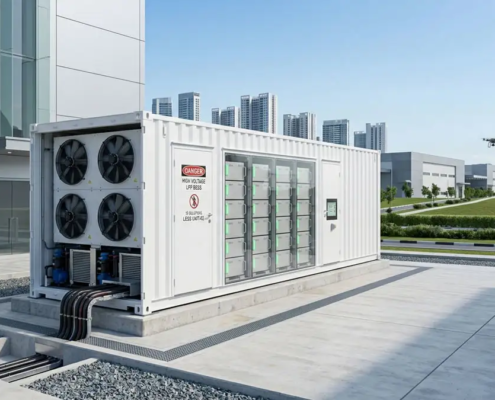 https://anengjipower.com/wp-content/uploads/2026/06/modular-commercial-solar-battery-storage-cabinet.webp
675
1000
Charging Station Engineer
https://anengjipower.com/wp-content/uploads/2025/09/anengji-dc-fast-charging-station-manufacturer-and-supplier-logo-white-1.png
Charging Station Engineer2026-06-18 09:16:522026-07-03 03:05:13What Is Solar Battery Storage? Complete C&I Engineering Guide
https://anengjipower.com/wp-content/uploads/2026/06/modular-commercial-solar-battery-storage-cabinet.webp
675
1000
Charging Station Engineer
https://anengjipower.com/wp-content/uploads/2025/09/anengji-dc-fast-charging-station-manufacturer-and-supplier-logo-white-1.png
Charging Station Engineer2026-06-18 09:16:522026-07-03 03:05:13What Is Solar Battery Storage? Complete C&I Engineering Guide


Leave a Reply
Want to join the discussion?Feel free to contribute!