
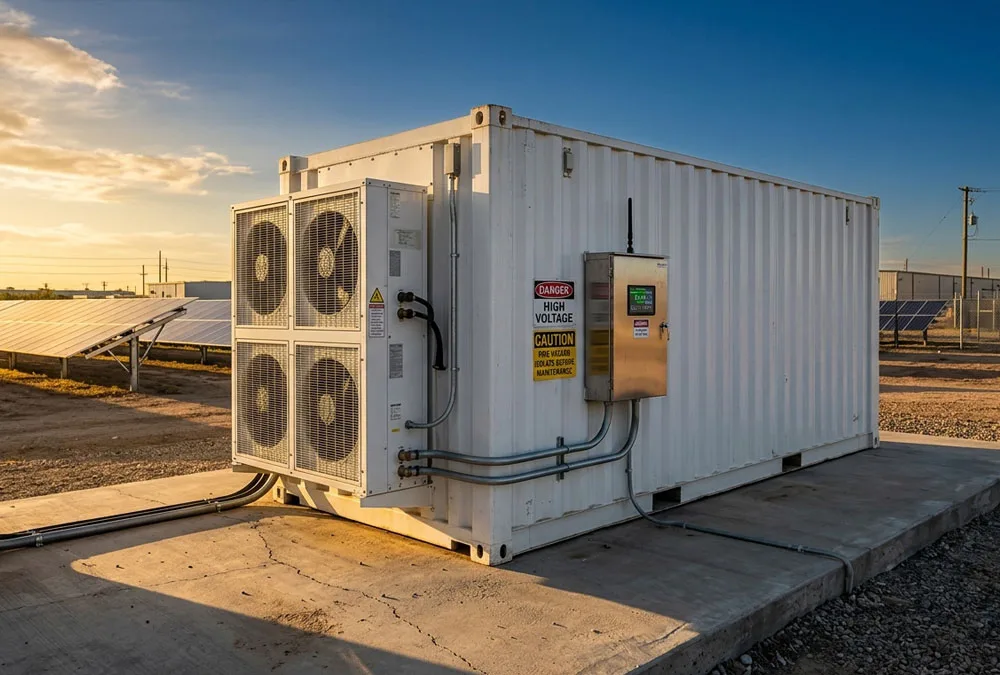
How Hybrid Energy Storage Systems Combine Different Technologies for Higher Power, Energy, and System Flexibility
A single energy storage technology does not always provide the right combination of power, energy capacity, response time, cycle life, and cost. Modern power demands are harsh. A hybrid energy storage system combines two or more complementary storage technologies so that each technology handles the part of the load it is best suited for, overcoming single-media limitations. High-power devices like supercapacitors or flywheels absorb aggressive transients, lithium batteries handle sustained energy output, and thermal or hydrogen systems cover long-duration needs—all coordinated via DC/DC converters, PCS, and an intelligent EMS.
Bottom line: A hybrid energy storage system is most valuable when your facility faces both high-power transients and sustained energy delivery demands simultaneously.
What Is a Hybrid Energy Storage System?
What Does “Hybrid” Mean in Energy Storage?
When engineers talk about a hybrid energy storage system (HESS), they aren’t just referring to putting a few extra battery cabinets in a parking lot. True hybrid energy storage relies on three non-negotiable criteria:
- Two or more storage technologies operating within a single electrical ecosystem.
- Distinct electrical characteristics or operating roles (e.g., rapid power response vs. deep energy shifting).
- Coordinated power management using specialized power electronics to balance dynamic loads.
Let’s clear up a common misconception: stringing two identical LFP (Lithium Iron Phosphate) battery racks together in parallel does not make a hybrid energy storage system. That is simply a expanded battery storage system. A system becomes truly hybrid when you pair high-power assets (like ultracapacitors) with high-energy assets (like electrochemical batteries).
What Makes a Storage System Truly Hybrid?
To help navigate the technical definitions and avoid vendor buzzwords, use this quick classification guide:
| Configuration | Is It a HESS? | Technical Rationale | Buyer Benefit |
|---|---|---|---|
| Two identical LFP battery cabinets | Usually No | Shares identical electrical & degradation characteristics. | Simple capacity expansion, but retains single-technology weaknesses. |
| Battery + Supercapacitor | Yes | Splits fast power response from sustained energy discharge. | Protects battery life from micro-cycles and peak voltage drops. |
| Battery + Flywheel | Yes | Combines mechanical inertia/rapid power with electrochemical storage. | Handles intense short-duration spikes without degrading chemical cells. |
| BESS + Diesel Generator | Hybrid Power System | Combines fuel-based generation with storage rather than multi-storage media. | Ensures off-grid resilience, though generator runtime adds fuel costs. |
Hybrid Energy Storage System vs Hybrid Power System
In EPC contract negotiations, terms get tossed around loosely. Customers often ask us for a “hybrid system” when they actually mean two completely different engineering setups. Let’s make sure we are speaking the same language before you spend capital.
What Is a Hybrid Energy Storage System?
A hybrid energy storage system strictly refers to multiple storage assets operating in tandem. Think of a system using a lithium battery energy storage system paired with a supercapacitor bank on a shared DC bus. Its primary job is to optimize how electrical energy is stored, buffered, and released across distinct timeframes (milliseconds to hours).
What Is a Hybrid Power System?
A hybrid power system is a broader architecture. It merges energy generation sources (like solar PV arrays, wind turbines, or diesel generators) with energy storage media. A classic example is a remote mine site running a hybrid solar battery energy storage system backed by diesel gensets.
Why the Difference Matters for System Design
Why fight over semantics? Because it changes the single-line diagram (SLD), protection relays, and control topology completely. If you order a standard hybrid renewable energy storage system expecting it to handle sudden 10-millisecond motor starting spikes without voltage sag, you’ll be disappointed if the underlying chemistry is built purely for slow energy dispatch.
Why Do Energy Storage Systems Need a Hybrid Architecture?
The Power-Energy Mismatch
Here is an uncomfortable truth in power engineering: Power ≠ Energy. Standard lithium-ion batteries are great workhorses for sustained energy delivery. However, force them to dump massive currents in seconds over and over again, and thermal stress takes over.
High Power and High Energy Have Different Requirements
Consider two different operational needs: delivering 1 MW for 5 seconds versus delivering 1 MW for 4 hours. The peak power requirement is identical (1 MW), but the thermal stress, C-rate demand, and electrochemical wear on the storage media are fundamentally different. Expecting a single chemical battery to handle both cost-effectively is like using a heavy freight truck to compete in a Drag Race—it works, but you will wreck the transmission.
Reduce High-Power Stress on the Battery
By directing high-frequency power transients to a fast-acting secondary medium (such as ultracapacitors), a hybrid battery storage setup can potentially reduce battery stress. According to testing metrics highlighted in the IEEE Transactions on Energy Conversion (2025), diverting transient high-frequency power spikes away from LFP cells can lower internal thermal degradation and extend usable battery lifecycle by 18% to 27%.
Improve System Flexibility
A multi-tier architecture gives plant managers an operational edge:
- Sub-millisecond dynamic response to handle grid frequency shifts.
- Sustained multi-hour output for demand charge management.
- Enhanced power quality during sudden transformer energized inrush currents.
How Does a Hybrid Energy Storage System Work?
HESS System Architecture
To understand how power flows inside a hybrid BESS system for microgrid or industrial duties, examine this simplified control scheme:
                     ┌────────────────────────────────────────┐
                     │     Energy Management System (EMS)    │
                     └───────────────────┬────────────────────┘
                                         │  (Modbus TCP / CAN)
                 ┌───────────────────────┴───────────────────────┐
                 │                                               │
      ┌──────────▼──────────┐                         ┌──────────▼──────────┐
      │  Battery BMS        │                         │ Fast-Storage Controller│
      └──────────┬──────────┘                         └──────────┬──────────┘
                 │                                               │
      ┌──────────▼──────────┐                         ┌──────────▼──────────┐
      │  Bi-Directional     │                         │  Bi-Directional     │
      │  DC/DC Converter    │                         │  DC/DC Converter    │
      └──────────┬──────────┘                         └──────────┬──────────┘
                 │                                               │
                 └───────────────► COMMON DC BUS ◄───────────────┘
                                         │
                               ┌─────────▼─────────┐
                               │ Power Conversion  │
                               │   System (PCS)    │
                               └─────────┬─────────┘
                                         │
                                3-Phase AC Output / Load
Role of the Battery
The primary battery bank provides long-term energy capacity. It covers base-load demands, performs peak shaving across multi-hour windows, and offers continuous backup power during grid blackouts.
Role of Supercapacitors, Flywheels, or High-Power Assets
These units handle fast power response. When heavy industrial equipment turns on, or a cloud briefly covers a 2 MW solar array, high-power assets react instantaneously to plug the energy gap.
Role of PCS and DC-DC Converters
Power electronics determine how different storage technologies interact with the electrical bus. Highly responsive bi-directional DC-DC buck/boost converters allow components operating at different voltage thresholds to output to a single stable DC bus without cross-feeding issues.
Role of BMS and EMS
The BMS manages cell health, thermal limits, and state-of-charge (SOC) inside individual battery racks. Meanwhile, the central Energy Management System (EMS) acts as the high-level brain—running real-time algorithms to split power requests based on grid codes, load spikes, and electricity pricing signals.
HESS Architectures: AC-Coupled vs DC-Coupled
DC-Coupled Hybrid Energy Storage
In a DC-coupled hybrid energy storage system architecture, all storage media connect to a shared DC bus via individual DC/DC converters before reaching a central Power Conversion System (PCS).
- Higher Efficiency: Fewer DC-to-AC conversion steps reduce total round-trip energy losses.
- Tight Dynamic Response: Fast energy transfer directly across the DC bus.
AC-Coupled Hybrid Energy Storage
In an AC-coupled layout, each storage device features its own independent PCS that ties directly into the facility’s main AC switchgear.
- High Modularity: Easily retrofit a supercapacitor bank or new BESS container onto an existing plant.
- Redundancy: A failure in one inverter unit won’t take down the entire DC architecture.
💡 Engineering Reality Check: AC vs. DC Coupling for C&I Facilities
Buyers often worry that choosing DC-coupling locks them into proprietary component vendors. While DC-coupling saves 2% to 4% on round-trip conversion efficiency, an AC-coupled commercial hybrid energy storage system is often easier to upgrade. It allows you to scale up battery storage down the road without having to redesign your central DC bus voltage controls.
What Are the Main Types of Hybrid Energy Storage Systems?
1. Battery + Supercapacitor (Energy + Power)
The most widespread hybrid battery energy storage system configuration. Lithium batteries store energy for hours, while supercapacitors handle violent short-duration bursts. This pairing is ideal for stabilizing fast power transients.
2. Battery + Flywheel
This pairing combines chemical storage with high-speed mechanical flywheels. Flywheels offer near-infinite cycle life for heavy power bursts, protecting the main lithium battery from physical degradation during frequent cycling events.
3. Battery + Thermal Energy Storage
Common in large commercial buildings or manufacturing plants with heavy cooling and heating loads. Excess electricity powers thermal chillers or hot water storage banks, reducing electrical battery sizing requirements.
4. Battery + Hydrogen Energy Storage
Short-to-medium duration battery energy storage manages rapid daily shifts, while hydrogen electrolyzers and fuel cells store bulk energy seasonally across weeks or months.
Battery vs Supercapacitor vs Hybrid: Which Is Better?
| Metric | Pure Lithium BESS | Supercapacitor | Hybrid Energy Storage System | Buyer Advantage |
|---|---|---|---|---|
| Energy Density | High (150-250 Wh/kg) | Very Low (5-15 Wh/kg) | High (Balanced) | Saves footprint while retaining multi-hour runtimes. |
| Response Time | Milliseconds to Seconds | Microseconds | Sub-millisecond | Prevents sensitive precision machinery from tripping. |
| Cycle Life | 6,000 – 10,000 cycles | 500,000+ cycles | Extended Battery Life | Pushes battery asset replacement out by several years. |
| Relative Cost | Moderate ($/kWh) | High ($/kWh), Low ($/kW) | Optimized Capital Cost | Prevents over-sizing expensive battery cells for short peak loads. |
Key takeaway: Hybrid systems are not automatically superior for every site. They deliver the highest return on investment when your load profile includes steep power spikes paired with sustained energy demands.
How Does a HESS Control and Allocate Power?
Rule-Based Energy Management
Simple logic gates dictate operations based on preset thresholds. If the load exceeds a defined limit (e.g., 500 kW), the secondary storage technology triggers automatically to support the main battery bank.
Threshold-Based Power Sharing (Frequency Splitting)
The EMS uses low-pass filters to split power requirements into two channels: high-frequency ripple components pass directly to the supercapacitor bank, while smooth low-frequency currents route to the main battery cells.
Optimization-Based Energy Management
Advanced EMS software uses predictive models—factor in real-time energy prices, battery degradation profiles, and short-term weather forecasts—to continually optimize power distribution between storage units.
Recommended Industrial BESS Building Blocks
Building a reliable industrial hybrid energy storage system requires starting with robust, high-safety energy storage units. Below are core commercial and industrial (C&I) BESS configurations engineered to pair seamlessly into hybrid setups:
100kWh All-In-One Cabinet
Ideal for Small Commercial & EV Hubs
- Built-in PCS & smart liquid/air cooling.
- Compact footprint for tight equipment rooms.
- Core Advantage: Plug-and-play expansion for fast project installation.
261kWh Liquid-Cooled BESS
The Benchmark for Industrial Factories
- High-density LFP cells with tight cell-to-cell delta T.
- Direct integration with hybrid EMS controllers.
- Core Advantage: Excellent thermal management for aggressive charge/discharge cycles.
418kWh Heavy Commercial Cabinet
For High-Power Industrial Plants
- Designed to handle high peak load shaving.
- Integrated fire suppression system.
- Core Advantage: Maximizes storage capacity within standard footprint limits.
1MWh / 2MWh Containerized BESS
Utility & Large Microgrids
- Standardized ISO container design.
- Multi-tier safety protection matrix.
- Core Advantage: Turnkey utility-scale installation with straightforward grid interconnectivity.
HESS Sizing Example: From Load Profile to System Capacity
Let’s look at a practical sizing calculation for a steel fabrication facility facing heavy peak demand charges and frequent voltage dips caused by large arc-welding operations.
Project Engineering Parameters:
- Facility Peak Demand Load: 1,000 kW
- Continuous Baseline Load: 600 kW
- Transient Load Spikes: 1,000 kW spikes lasting 15 to 30 seconds multiple times per hour.
- Required Backup Runtime: 2 hours at continuous baseline (1,200 kWh).
The Solution: Standard BESS vs. HESS Strategy
Option A (Pure Lithium BESS):
To cover a 1,000 kW surge without over-stressing standard LFP cells (keeping discharge around 0.5C to protect battery health), you would need to install a 2,000 kWh battery storage container, even though you only need 1,200 kWh of energy storage capacity. That leads to unnecessary upfront capital expense.
Option B (Engineered HESS Deployment):
- Energy Layer: Install a 418kWh industrial BESS cabinet x 3 (Approx 1.25 MWh) to cover the baseline energy and backup needs at continuous rate (~0.5C).
- Power Layer: Install a 250 kW / 2 kWh Supercapacitor Bank tied to the DC bus to handle every 15-to-30 second power spike instantly.
Result: CapEx is reduced by roughly 22%, system footprint drops by 30%, and high-stress micro-cycling on the main battery cells is completely eliminated.
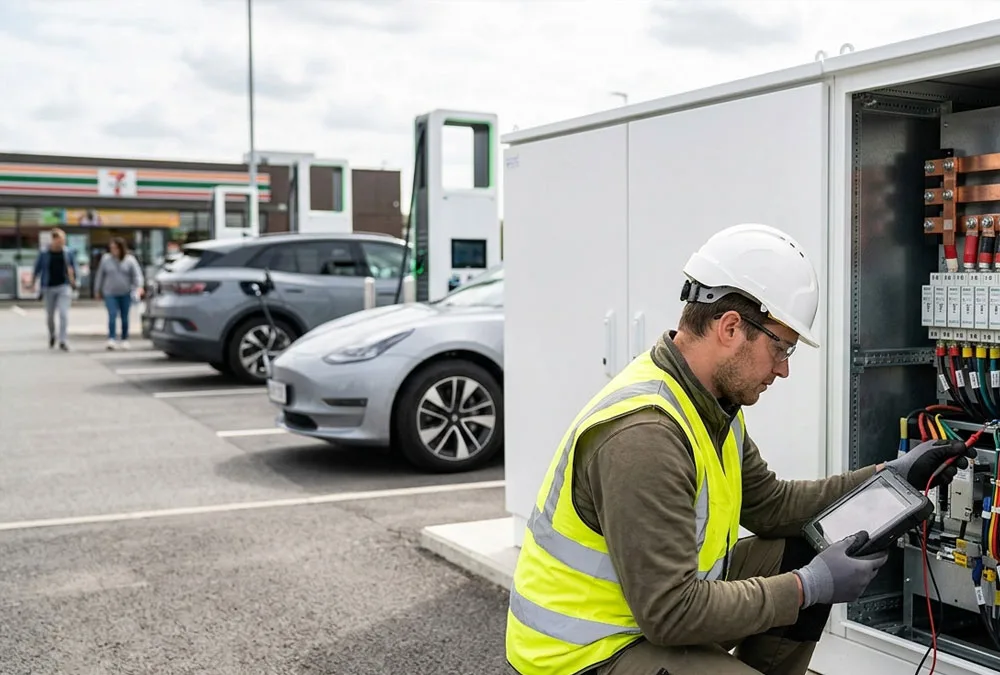
Where Are Hybrid Energy Storage Systems Used?
HESS for Commercial & Industrial Facilities
Factories operating heavy pumps, crushers, or compressors often face steep utility demand charges triggered by brief current spikes. A hybrid energy storage system for commercial and industrial sites buffers those spikes smoothly without deep-cycling the main battery bank.
HESS for EV Charging Infrastructure
When an EV fast charger jumps from 0 to 350 kW in seconds, the local distribution grid takes a heavy hit. Integrating a hybrid buffer system helps charge stations deliver high power to vehicles without triggering massive utility peak demand fees.
HESS for Microgrids and Hybrid Backup Power
Mining operations and remote communities rely on stable microgrids. Combining a hybrid energy storage system with diesel generator units allows gensets to operate at peak fuel efficiency while storage handles dynamic load shifts.
What Are the Benefits of a Hybrid Energy Storage System?
- Higher Power and Energy Flexibility: Delivers long-term continuous energy and high-power discharge from a single managed system.
- Faster Response to Transient Loads: Reacts within sub-milliseconds to correct line voltage drops.
- Potentially Lower Battery Stress: Minimizes internal heat buildup in main battery cells by smoothing out peak demand profiles.
- Better Renewable Energy Integration: Buffers fast cloud-induced solar fluctuations smoothly.
- Potentially Lower Total Cost of Ownership (TCO): Extending main battery replacement schedules offsets the higher upfront engineering cost.
What Are the Challenges and Limitations of HESS?
To keep this discussion objective, let’s address the potential drawbacks. A hybrid energy storage system isn’t always the right answer.
- Higher Upfront Control Complexity: Requires sophisticated multi-tier BMS and EMS software integration.
- Increased Capital Outlay on Power Electronics: Dual bi-directional DC/DC converters add equipment costs.
- Additional Maintenance Requirements: Servicing two distinct storage technologies requires trained technicians.
When Is a Hybrid Energy Storage System Not Worth It?
If your facility load profile is predictable—like a distribution warehouse running continuous LED lighting and basic HVAC—a standard LFP battery energy storage system is usually the most cost-effective path forward. Adding supercapacitors to a steady, low-surge load adds extra cost without real operational benefit.
The 8-Step HESS Fit Model for Procurement
When evaluating suppliers or requesting an EPC quote, follow this structured evaluation process:
- Define the Load Profile: Log high-resolution load data (1-second sampling intervals) to catch transient spikes.
- Define Power Requirements: Measure peak motor starting surges versus steady baseline usage.
- Define Energy Duration: Calculate necessary backup time during grid outages.
- Define Cycling Frequency: Determine how many high-power transients occur per day.
- Select Complementary Technologies: Match your power and energy needs to the right equipment mix (e.g., LFP + Ultracapacitor).
- Choose AC or DC Coupling: Base your choice on existing site infrastructure and efficiency targets.
- Evaluate TCO & ROI: Calculate total cost of ownership including projected battery degradation curves over 10 years.
- Validate Safety & Compliance: Ensure all components carry international certifications like UL9540A, IEC 62619, and NFPA 855.
HESS Decision Tree: Which Architecture Fits Your Site?
Q1: Does your facility face steep power spikes lasting under 30 seconds?
➔ NO: A standard single-technology BESS is usually the most cost-effective choice.
➔ YES: Proceed to Question 2.
Q2: Do you also require sustained energy storage for 2+ hours during outages or peak tariffs?
➔ NO: A pure high-power storage device (flywheel or supercapacitor bank) meets your needs.
➔ YES: A Hybrid Energy Storage System (HESS) is the optimal solution.
Q3: Is your site completely off-grid or backed by diesel generators?
➔ YES: Deploy a broader Hybrid Power System architecture (PV + BESS + Diesel Genset integration).
Frequently Asked Questions About Hybrid Energy Storage Systems
What is a hybrid energy storage system?
A hybrid energy storage system combines two or more complementary storage technologies with different performance profiles—such as high-energy lithium batteries paired with high-power supercapacitors—managed by smart power electronics to optimize performance, cost, and system lifespan.
What is the main difference between BESS and HESS?
A standard Battery Energy Storage System (BESS) relies on a single electrochemical battery technology (like LFP or NMC). A Hybrid Energy Storage System (HESS) uses multiple complementary storage assets operating together to handle diverse load requirements.
Can HESS be integrated with solar power and diesel generators?
Yes. In fact, a hybrid energy storage system for solar power microgrids is one of the most popular setups today. It buffers fast solar fluctuations while reducing diesel generator run hours and fuel costs.
Is HESS more expensive than a standard BESS?
Initial equipment costs for a HESS can be higher due to specialized power electronics and EMS integration. However, for applications with heavy dynamic power spikes, a HESS often delivers a lower 10-year Total Cost of Ownership (TCO) by reducing required battery system size and extending cell lifespan.
Conclusion: Is HESS Right for Your Facility?
A hybrid energy storage system makes the most practical sense when your project requires both immediate sub-second power response and multi-hour sustained backup. Combining high-energy LFP battery chemistry with fast high-power storage units delivers optimal power quality, protects battery cell health, and lowers overall lifecycle costs.
Whether you are designing an off-grid industrial microgrid, adding EV fast charging hubs, or upgrading factory equipment, proper system sizing is essential.
Optimize Your Commercial Energy Storage Architecture
Need help selecting the right BESS cabinets, designing a DC-coupled hybrid bus, or sizing your system based on real load logs? Speak directly with an experienced system engineering team.
Related Article
 https://anengjipower.com/wp-content/uploads/2026/06/epc-vs-turnkey-solar-project-bess.webp
675
1000
Charging Station Engineer
https://anengjipower.com/wp-content/uploads/2025/09/anengji-dc-fast-charging-station-manufacturer-and-supplier-logo-white-1.png
Charging Station Engineer2026-06-22 07:16:042026-06-24 07:13:17What Is the Difference Between EPC and Turnkey Contract Models in Energy Projects?
https://anengjipower.com/wp-content/uploads/2026/06/epc-vs-turnkey-solar-project-bess.webp
675
1000
Charging Station Engineer
https://anengjipower.com/wp-content/uploads/2025/09/anengji-dc-fast-charging-station-manufacturer-and-supplier-logo-white-1.png
Charging Station Engineer2026-06-22 07:16:042026-06-24 07:13:17What Is the Difference Between EPC and Turnkey Contract Models in Energy Projects? https://anengjipower.com/wp-content/uploads/2026/06/anengji-commercial-solar-plus-storage-benefits-site.webp
675
1000
Charging Station Engineer
https://anengjipower.com/wp-content/uploads/2025/09/anengji-dc-fast-charging-station-manufacturer-and-supplier-logo-white-1.png
Charging Station Engineer2026-06-20 14:34:102026-06-20 14:37:43What Are the Top Benefits of Solar Battery Storage in Factories?
https://anengjipower.com/wp-content/uploads/2026/06/anengji-commercial-solar-plus-storage-benefits-site.webp
675
1000
Charging Station Engineer
https://anengjipower.com/wp-content/uploads/2025/09/anengji-dc-fast-charging-station-manufacturer-and-supplier-logo-white-1.png
Charging Station Engineer2026-06-20 14:34:102026-06-20 14:37:43What Are the Top Benefits of Solar Battery Storage in Factories? https://anengjipower.com/wp-content/uploads/2026/06/modular-commercial-solar-battery-storage-cabinet.webp
675
1000
Charging Station Engineer
https://anengjipower.com/wp-content/uploads/2025/09/anengji-dc-fast-charging-station-manufacturer-and-supplier-logo-white-1.png
Charging Station Engineer2026-06-18 09:16:522026-07-03 03:05:13What Is Solar Battery Storage? Complete C&I Engineering Guide
https://anengjipower.com/wp-content/uploads/2026/06/modular-commercial-solar-battery-storage-cabinet.webp
675
1000
Charging Station Engineer
https://anengjipower.com/wp-content/uploads/2025/09/anengji-dc-fast-charging-station-manufacturer-and-supplier-logo-white-1.png
Charging Station Engineer2026-06-18 09:16:522026-07-03 03:05:13What Is Solar Battery Storage? Complete C&I Engineering Guide


Leave a Reply
Want to join the discussion?Feel free to contribute!