
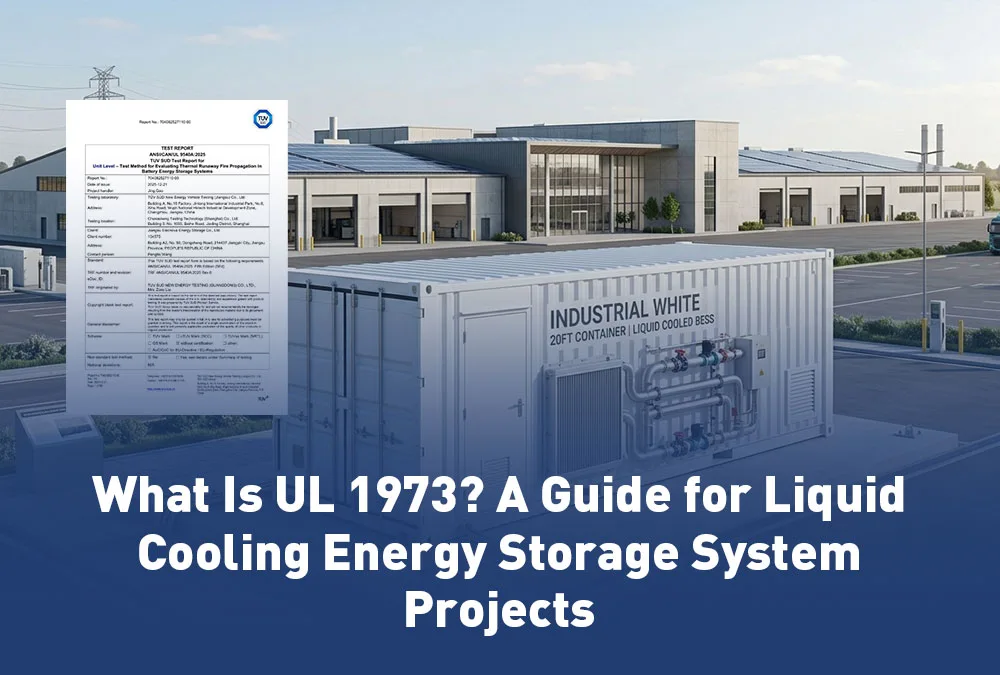
Introduction
Navigating the complex landscape of stationary energy deployment requires a strict commitment to safety, engineering precision, and regulatory alignment. For project developers, system integrators, and engineering, procurement, and construction (EPC) companies, the core of any dependable installation rests on the components used.
A critical part of this foundation is understanding a liquid cooling energy storage system that meets stringent international safety protocols. As modern electrical infrastructure scales up, the market increasingly relies on standardized testing to mitigate risk. Among these safety frameworks, UL 1973 has established itself as an essential benchmark for battery packs, modules, and rack architectures utilized in stationary applications. This guide provides an in-depth, expert-level technical breakdown of the UL 1973 standard, its testing criteria, and its importance in deploying safe, reliable commercial and industrial energy storage infrastructure.
What Is UL 1973 and Why Does It Matter for Energy Storage Systems
Definition of UL 1973 Certification
UL 1973 is the Standard for Batteries for Use in Stationary and Motive Auxiliary Power Applications. Developed by Underwriters Laboratories (UL), this safety standard focuses on evaluating the structural integrity, electrical safety protection boundaries, and environmental resilience of battery systems. Crucially, a UL 1973 certified battery energy storage system is not rated as a complete standalone turnkey unit; rather, it represents a rigorous component-level or sub-system listing. It ensures that the underlying battery cells, modules, and integrated battery rack systems are fundamentally secure against catastrophic failures before they are interconnected into a broader power conversion framework.
What Types of Battery Energy Storage Systems Require UL 1973
Any large-scale installation utilized for grid support, peak shaving, demand response, or backup power relies on battery modules that must comply with UL 1973 requirements for lithium battery systems. This includes containerized commercial energy storage system configurations, indoor battery cabinets, telecom backup power systems, and specialized motive auxiliary power units. Whether utilizing Lithium Iron Phosphate (LFP) chemistry or Nickel Manganese Cobalt (NMC), the energy storage compliance pathway for any industrial-grade installation mandates this standard as its primary foundation.
The Difference Between UL 1973 and General Battery Certifications
General consumer-centric or portable electronic battery certifications—such as UL 1642 (for individual cells) or UN 38.3 (for shipping transport safety)—are insufficient for large-scale energy infrastructure. While UL 1642 examines individual cell vulnerabilities under extreme stress, it does not account for the high-voltage series-parallel connections, thermal communication, or heavy structural loads found in industrial environments. UL 1973 bridges this gap by evaluating how individual cells behave collectively when aggregated into large modules and high-voltage rack assemblies managed by integrated electronic controls.
Why UL 1973 Is Considered the Gold Standard for Battery Safety
The comprehensive nature of UL 1973 makes it an industry benchmark. It treats battery safety as a multi-layered, holistic engineering challenge. By evaluating electrical, mechanical, environmental, and material characteristics simultaneously, it ensures that a single localized defect will not compromise the entire installation. This strict approach minimizes field failures and guarantees that the system’s design maintains structural and operational stability over long lifecycles under varying conditions.
Why UL 1973 Certification Is Critical for Commercial and Industrial Energy Storage
UL 1973 Improves Battery Energy Storage System Safety
In Commercial and Industrial (C&I) environments, a battery energy storage compliance failure can lead to severe operational issues. Achieving a liquid cooling energy storage system design listed to UL 1973 ensures the battery assembly can withstand electrical faults, localized hot spots, and external mechanical stresses without escalating into a broader thermal emergency. This protects surrounding infrastructure and facility personnel from potential hazards.
UL 1973 Helps Ensure Regulatory Compliance
The regulatory landscape for energy storage systems in the North America energy storage market is highly prescriptive. Authorities Having Jurisdiction (AHJs), electrical inspectors, and municipal planners rely heavily on unified standards to approve local installations. A commercial energy storage system UL 1973 certified provides immediate, verifiable proof to regulators that the core battery assembly adheres to regional building and electrical codes, streamlining local permitting workflows.
UL 1973 Supports Global Market Access
While UL is traditionally rooted in North American compliance, the testing methodologies embedded within UL 1973 align closely with international standards, such as IEC 62619. For manufacturers, designing a commercial lithium battery system to satisfy UL 1973 principles ensures simpler cross-border compliance. This framework reduces engineering variance when adapting products for deployment across Europe, Asia-Pacific, and South American markets.
UL 1973 Builds Investor and Customer Trust
Clean energy infrastructure requires significant capital investment. Financial institutions, asset managers, and insurance underwriters closely evaluate safety portfolios before committing funds. Utilizing a UL listed energy storage system component base minimizes technology risk metrics, which can lower insurance premiums and help secure more favorable financing terms for project developers.
Why EPCs and Developers Prefer UL 1973 Certified BESS Solutions
For Engineering, Procurement, and Construction (EPC) firms, field integration risks represent a significant source of potential liability. Specifying battery modules that already carry an independent UL 1973 battery safety certification eliminates the need for expensive, time-consuming on-site field evaluations. This lets engineers focus on optimizing system efficiency, grid synchronization, and overall balance-of-plant performance.
How UL 1973 Protects Battery Energy Storage Systems From Thermal Runaway
Understanding Thermal Runaway Risks in Lithium Battery Storage
Thermal runaway occurs when an internal or external fault causes a battery cell to generate more heat than it can dissipate. This triggers self-sustaining exothermic chemical reactions that can cause venting, fire, or explosive gas accumulation. Managing this risk is a central focus of modern BESS fire safety design, particularly given the high energy density of contemporary battery chemistries.
Fire Prevention Mechanisms Required by UL 1973
UL 1973 addresses fire safety by mandating strict material choices and construction parameters. Components must utilize flame-retardant polymers that satisfy specialized UL 94 flammability ratings. Additionally, the standard requires adequate spatial isolation, electrical trace shielding, and robust thermal boundaries to prevent an isolated cell failure from spreading to adjacent cells or modules.
Battery Isolation and Fault Protection Strategies
When an internal short circuit occurs, massive localized current spikes can develop. UL 1973 requires that system architectures integrate rapid physical disconnect mechanisms, high-interrupting-capacity fuses, and heavy-duty contactors. These components must be capable of isolating an affected battery string before cascading electrical damage occurs across parallel circuits.
How BMS Works With UL 1973 Safety Requirements
The Battery Management System (BMS) serves as the primary digital safeguard for the energy architecture. Under UL 1973 functional safety guidelines, the BMS must maintain constant surveillance over individual cell voltages, state-of-charge (SoC) parameters, and surface temperatures. If any monitored metric crosses predefined safe operating limits, the BMS must automatically trigger isolation protocols to prevent damage.
Why Thermal Management Is Essential for Large-Scale BESS Projects
For high-capacity installations, passive cooling is rarely sufficient to handle high-rate charging and discharging. Integrating a liquid cooling energy storage system allows for precise, active temperature regulation across thousands of individual cells. Maintaining uniform temperature profiles minimizes cell degradation and helps eliminate the localized thermal imbalances that can precede runaway events.
Key Components Evaluated Under UL 1973 for Battery Energy Storage Systems
The evaluation framework under UL 1973 treats the battery system as an integrated ecosystem of hardware and software components:
- Battery Cells, Modules, and Battery Rack Systems: Every layer of structural containment is tested to verify it can support structural loads, resist corrosion, and maintain physical alignment during long-term operation.
- Battery Management System (BMS) Functional Safety: The software and hardware controls of the BMS undergo detailed analysis to ensure fail-safe performance under simulated control failures or communication drops.
- Power Conversion System (PCS) and Electrical Protection: The standard reviews the terminal interfaces and connection points to verify they are rated for expected short-circuit currents and high-voltage isolation.
- Energy Management System (EMS) Communication and Monitoring: Telemetry loops are evaluated to ensure critical environmental alerts and fault diagnostic codes are accurately communicated without latency.
- Cooling Systems and Fire Suppression Design: Fluid circulation loops, chillers, and containment barriers are assessed to prevent leaks and ensure continuous operation during thermal events.
- Enclosure Safety and Structural Integrity: The outer protective cabinets or internal rack structures are evaluated for environmental sealing, ingress protection, and grounding reliability.
UL 1973 Testing Requirements for Lithium-Ion Battery Energy Storage Systems
To secure a complete UL 1973 listing, sample battery systems must undergo an extensive regime of physical testing conducted in accredited laboratory environments. These tests simulate severe electrical, mechanical, and environmental abuse scenarios.
Electrical Safety Testing
Overcharge and Overdischarge Protection
Engineers intentionally disable primary BMS software controls and subject the battery modules to continuous overcharging conditions. The system must not catch fire, explode, or vent hazardous gases. Similarly, the overdischarge evaluation forces the cells into a deep-voltage drain condition to verify that the internal physical structures do not suffer structural collapses that could lead to subsequent short circuits during recharging cycles.
Short Circuit and Insulation Tests
A direct, low-resistance short circuit is introduced across the high-voltage battery terminals while operating at maximum state-of-charge. Internal protective fuses or contactors must safely interrupt the fault current. Additionally, insulation resistance testing applies high-voltage potentials between live electrical paths and exposed metal frames to confirm that no leakage paths exist.
Mechanical and Structural Testing
Vibration and Shock Resistance
Industrial battery packs are often subjected to mechanical movement during transit or operational lifecycles. Test samples are mounted to specialized multi-axis shake tables that simulate seismic vibrations and repetitive industrial drops. The structural frames, busbars, and cell connections must retain mechanical integrity without loose connections or insulation wear.
Crush and Impact Testing
To simulate severe accidental mechanical damage, modules are subjected to direct crushing forces and heavy kinetic impacts. The mechanical design must protect the internal cells from puncture or extreme deformation that could trigger an internal short circuit.
Environmental and Thermal Testing
High Temperature and Humidity Testing
Battery enclosures are placed inside environmental chambers and exposed to prolonged high heat and humidity cycles. The system must maintain its electrical insulation properties and show no signs of material degradation, trace leakage, or accelerated corrosion that could compromise long-term operations.
Thermal Cycling and Heat Propagation Analysis
This phase evaluates the system’s resilience under rapid temperature transitions. Samples are repeatedly cycled between extreme sub-zero cold and high operational heat. This process checks for thermal expansion stresses on mechanical linkages, seal compromises in liquid cooling channels, and overall material fatigue.
Lithium-Ion Battery Safety and Propagation Testing
A core element of the evaluation involves single-cell thermal runaway induction. Using localized heaters or puncture mechanisms, a single cell is driven into full thermal runaway inside a populated module. To pass UL 1973, the resulting fire or thermal energy must be contained; it cannot propagate to adjacent cells or cause external flaming of the module enclosure.
Fire Resistance and Explosion Prevention Evaluation
The standard requires detailed analysis of any gases vented during thermal stress. Enclosure ventilation and exhaust configurations are evaluated to ensure that flammable gases cannot accumulate to dangerous concentrations, keeping installations in compliance with regional fire safety regulations.
UL 1973 Certification Process for Commercial Battery Energy Storage Manufacturers
Securing compliance requires an organized, multi-stage engineering partnership between the manufacturer and the certification body:
- Product Design and Engineering Preparation: Manufacturers must document all circuit schematics, bill of materials (BOM), cell specifications, plastics ratings, and BMS functional safety loops for initial review.
- Laboratory Testing and Compliance Verification: Physical prototypes are shipped to an approved testing facility (such as UL Solutions), where they undergo the full electrical, mechanical, and thermal abuse testing regimes over several months.
- Factory Inspection and Manufacturing Quality Audit: Field engineers inspect the actual production facilities to verify that quality control processes, assembly workflows, and end-of-line electrical testing match the certified prototype standard.
- Certification Documentation and Reporting: Upon successful testing and factory verification, a formal evaluation report is issued, and the manufacturer is granted the right to apply the UL certification mark to the product line.
- Ongoing Compliance Monitoring and Recertification: To maintain the listing, production facilities undergo unannounced quarterly follow-up audits. Any subsequent design updates or component changes require formal engineering review to ensure continued compliance.
The Cost of Non-Compliance in Battery Energy Storage Projects
Delayed Project Approvals and Utility Connection Issues
Attempting to deploy uncertified or non-compliant equipment often leads to project delays. Local utilities and grid operators routinely require documented proof of testing before granting permission to interconnect (PTO). Lacking a valid UL certified battery system listing can stall a project during the administrative review phase.
Increased Fire and Operational Risks
Without the structured safety testing mandated by UL 1973, latent manufacturing or design defects may go undetected. This increases the risk of field failures, ranging from localized cell degradation to significant thermal events that can endanger facility infrastructure.
Financial Losses From System Failures
Unscheduled operational downtime caused by component failures can quickly erode the economic returns of a C&I storage asset. Replacing uncertified equipment, managing emergency repairs, and facing unexpected capacity losses can significantly impact project profitability.
Insurance and Liability Challenges
Modern commercial insurance providers are highly aware of the risks associated with large-scale battery deployments. Operating an uncertified battery assembly can make it difficult to secure asset insurance, or result in high premiums and restrictive liability clauses.
Damage to Brand Reputation and Investor Confidence
A highly public safety incident can negatively impact a developer’s reputation and erode investor confidence. Prioritizing validated compliance helps safeguard long-term corporate viability and maintains trust with investment partners.
UL 1973 vs Other Energy Storage Safety Standards
Understanding the distinction between overlapping safety standards is essential for proper project engineering and design:
| Standard Reference | Primary Evaluation Level | Core Regulatory Scope & Purpose |
|---|---|---|
| UL 1973 | Component / Sub-system Level | Evaluates the safety of internal battery cells, modules, and rack structures prior to full balance-of-plant integration. |
| UL 9540 | Complete System Level | Evaluates the entire integrated configuration, combining the battery, inverter (PCS), thermal controls, and enclosures as a single system. |
| UL 9540A | Standardized Test Method | Not a certification; it provides data on thermal runaway fire propagation characteristics and gas generation profiles. |
| IEC 62619 | Component / Sub-system Level | The international standard for industrial lithium battery safety, commonly utilized across European and Asia-Pacific regions. |
| NFPA 855 | Installation / Siting Level | Defines fire protection criteria, spatial separation distances, and ventilation infrastructure for the physical asset site. |
Which Certification Is Most Important for Commercial Energy Storage Systems?
These standards work together rather than in isolation. A system cannot easily achieve a full UL 9540 system-level listing unless its underlying storage racks are already certified to UL 1973. In the North American market, achieving compliance with both standards is typically required for commercial installations.
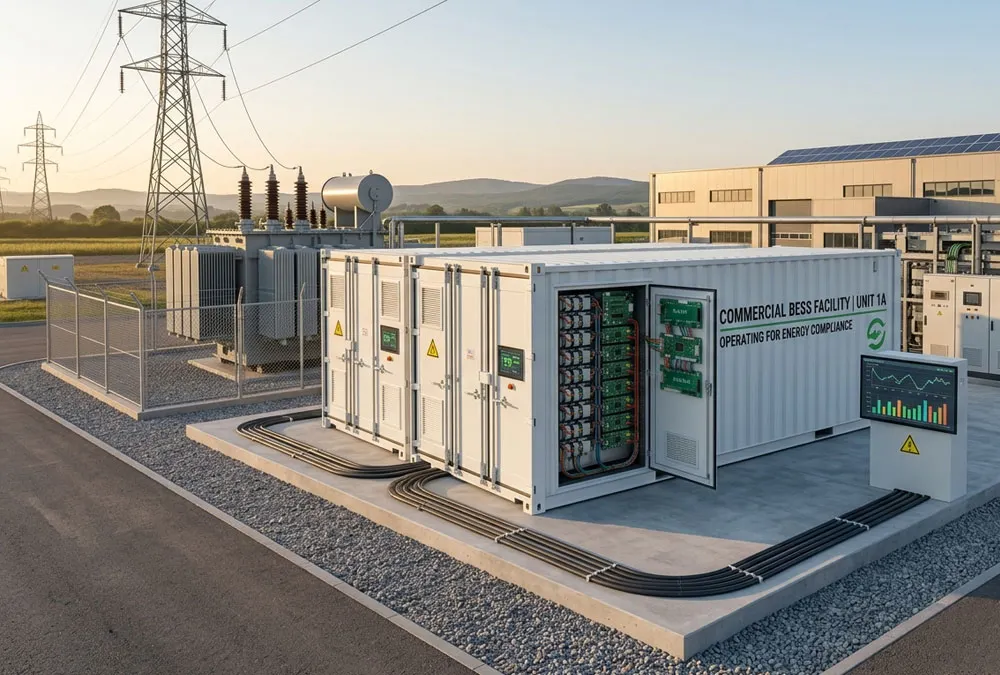
Why UL 1973 Certified Liquid Cooling Energy Storage Systems Are Becoming the Industry Standard
Advantages of Liquid Cooling in Certified BESS Projects
As energy density rises to maximize space efficiency, traditional forced-air cooling struggles to maintain stable internal temperatures. Integrating a liquid cooling energy storage system provides a significantly higher heat transfer coefficient. This allows for more effective thermal regulation during high-power charging cycles.
How Liquid Cooling Improves Battery Temperature Consistency
According to recent industry technical reviews, liquid cooling plates can maintain cell-to-cell temperature deltas within a narrow ±2°C window. This uniformity minimizes localized cell degradation, prevents premature capacity loss, and reduces the likelihood of localized thermal imbalances.
Why High Energy Density Systems Require Advanced Cooling
Modern industrial energy storage installations pack several megawatt-hours of capacity into standard 20-foot shipping containers. This dense concentration of lithium cells generates significant thermal energy under high loads. Advanced liquid-glycol distribution loops are required to safely dissipate this heat and prevent heat accumulation.
Combining UL 1973 Certification With Intelligent EMS and BMS
The transition toward liquid cooling works in tandem with advanced controls. By combining certified hardware with intelligent BMS and EMS software, the system can dynamically adjust coolant flow rates based on real-time operational data. This proactive approach helps mitigate thermal issues before they escalate.
UL 1973 Certified Battery Energy Storage Applications
Certified battery systems are deployed across various critical sectors of the modern grid:
- Commercial and Industrial Energy Storage Systems: Factory installations utilize certified systems for demand charge management, peak shaving, and providing reliable facility backup power.
- Solar + Storage Projects: Large-scale solar arrays pair with BESS assets to smooth generation profiles, store midday energy, and dispatch power during peak evening hours.
- EV Charging and Battery Buffer Storage: High-power DC fast-charging stations use integrated battery systems as power buffers, reducing sudden demand spikes on the local electrical grid.
- Utility-Scale Battery Energy Storage Stations: Grid operators deploy large-scale battery banks to provide frequency regulation, voltage support, and spinning reserves.
- Data Centers and Critical Backup Power Applications: Enterprise facilities use certified lithium storage to replace traditional diesel generator configurations, providing immediate backup power without operational interruptions.
Why Choose a UL 1973 Certified Energy Storage Manufacturer
Faster Project Approval and Easier Deployment
Partnering with a manufacturer that prioritizes certified component engineering simplifies the local permitting process. The provided documentation helps satisfy the safety requirements of local inspectors and permitting authorities.
Safer Long-Term Battery Operation
Certified manufacturing ensures that every battery rack produced adheres to verified design standards. This consistent quality translates into more predictable operational profiles and reduced risk of safety incidents over the system’s operational life.
Lower Operational and Maintenance Risks
When battery systems are engineered to pass comprehensive electrical and mechanical abuse testing, field maintenance requirements are typically lower. This reliability helps minimize unscheduled service calls and reduces overall maintenance costs.
Better Compatibility With Global Energy Markets
A certified product architecture provides a standardized framework that simplifies deployment across multiple international markets, making it easier to adapt to varying regional grid requirements.
Integrated BMS, PCS, and EMS Engineering Advantages
Leading manufacturers design their internal battery packs, thermal management components, and monitoring software as an integrated ecosystem. This close coordination ensures robust fault detection and reliable system operation.
How AnengJi Power Delivers UL 1973 Certified Battery Energy Storage Solutions
UL 1973 Certified Commercial and Industrial BESS Products
AnengJi Power focuses on developing high-performance energy storage solutions tailored for global markets. The company’s product line includes specialized commercial and industrial cabinets designed for seamless integration into diverse facility infrastructures.
Advanced Thermal Runaway Protection Design
AnengJi Power systems integrate multi-layered physical and structural safeguards. From flame-retardant internal insulation barriers to automated pressure relief venting, the enclosures are engineered to safely contain thermal events.
Intelligent EMS and Multi-Level BMS Architecture
The control framework uses a high-performance, multi-level BMS architecture. This system provides continuous monitoring from the individual cell level up to the entire battery rack array, enabling rapid fault isolation and precise diagnostics.
Liquid Cooling Technology for Enhanced Safety and Efficiency
AnengJi Power incorporates advanced liquid cooling systems into its high-density BESS products. This approach ensures optimal thermal management, helps extend battery lifecycles, and maintains high round-trip efficiency under challenging operational loads.
Global Certifications and Overseas Project Experience
With experience deploying energy storage solutions across international markets, AnengJi Power aligns its manufacturing processes with major global standards, helping clients navigate complex regional compliance requirements.
The Future of UL 1973 in the Global Energy Storage Industry
Growing Demand for Certified Lithium Battery Storage
As the transition toward renewable energy continues to accelerate, the demand for verified, high-capacity stationary storage continues to grow. Compliance frameworks like UL 1973 will remain essential to ensuring these installations deploy safely.
Increasing Global Safety Regulations for BESS
Regulatory frameworks are updating quickly, with standards like the 2026 edition of NFPA 855 introducing more comprehensive requirements for safety analyses and large-scale fire testing. Aligning with UL 1973 is a core step in meeting these evolving criteria.
AI-Based Safety Monitoring and Predictive Maintenance
The future of battery safety will increasingly incorporate advanced software analytics. Integrating cloud-based machine learning models with onboard BMS telemetry allows for predictive maintenance, identifying potential cell anomalies before they develop into operational faults.
The Role of Certification in Large-Scale Renewable Energy Integration
To successfully replace traditional fossil-fuel generation, clean energy infrastructure must deliver consistent, predictable performance. Independent safety certifications help build the regulatory and public trust required to scale these technologies globally.
FAQ About UL 1973 Certification and Energy Storage Systems
What is UL 1973 certification used for?
It is used to verify the electrical, mechanical, and environmental safety of battery packs, modules, and rack systems designed for stationary energy storage and motive auxiliary power applications.
Is UL 1973 required for battery energy storage systems?
While technically a voluntary product standard, it is practically required across North America and many global markets because system-level certifications (like UL 9540) and local building codes depend on it.
What is the difference between UL 1973 and UL 9540?
UL 1973 is a component-level safety standard focused on the battery modules and racks. UL 9540 is a system-level safety certification that evaluates the complete integrated assembly, including the batteries, inverter (PCS), and overall containment system.
Does UL 1973 apply to lithium-ion batteries?
Yes, it applies extensively to lithium-ion chemistries (such as LFP and NMC), as well as other battery technologies like flow batteries and sodium-based chemistries used in stationary applications.
Why is UL 1973 important for commercial and industrial BESS projects?
It ensures the core battery components can safely handle electrical and thermal stress, which helps streamline project permitting, lower insurance risks, and prevent costly operational failures.
How long does UL 1973 certification take?
The complete process typically takes several months, depending on design complexity, as it requires extensive physical testing, laboratory evaluations, and manufacturing facility quality audits.
Can UL 1973 certified systems reduce fire risks?
Yes, by requiring strict material selections, thermal separation designs, and functional safety testing, it helps prevent single-cell failures from propagating into larger fire events.
What industries require UL 1973 certified battery systems?
Industries deploying commercial solar-plus-storage installations, telecom infrastructure, high-power EV charging hubs, data centers, and grid-scale utility stations regularly require these certified systems.
Quick Summary — UL 1973 Certification for Battery Energy Storage Systems
UL 1973 Ensures Battery Safety and Thermal Runaway Protection
The standard establishes clear criteria for validating component-level safety, ensuring that battery modules are built to contain thermal events and resist physical or electrical abuse.
UL 1973 Helps Commercial BESS Projects Meet Regulatory Requirements
Utilizing certified components provides verifiable proof of compliance, helping developers satisfy local electrical codes and accelerate the permitting process with relevant authorities.
UL 1973 Improves Market Access and Customer Confidence
Aligning with this standard demonstrates a commitment to quality engineering, which helps secure project financing, optimize insurance terms, and build long-term trust with asset owners.
Certified Energy Storage Systems Deliver Better Long-Term Reliability
Rigorous testing and ongoing manufacturing audits help ensure consistent product quality, resulting in more stable operational profiles and lower maintenance overhead over the system’s life.
UL 1973 Is Becoming Essential for Global Commercial Energy Storage Deployment
As grid infrastructure grows larger and safety codes become more stringent, specifying a certified liquid cooling energy storage system architecture is a key strategy for mitigating risk and ensuring project success.
 https://anengjipower.com/wp-content/uploads/2026/10/AnengjiPowr-AC-Coupled-Battery-Storage-at-a-CI-Solar-Site.webp
675
1000
Charging Station Engineer
https://anengjipower.com/wp-content/uploads/2025/09/anengji-dc-fast-charging-station-manufacturer-and-supplier-logo-white-1.png
Charging Station Engineer2026-10-16 03:03:192026-10-16 03:03:49What Is AC-Coupled Battery Storage? C&I BESS Guide
https://anengjipower.com/wp-content/uploads/2026/10/AnengjiPowr-AC-Coupled-Battery-Storage-at-a-CI-Solar-Site.webp
675
1000
Charging Station Engineer
https://anengjipower.com/wp-content/uploads/2025/09/anengji-dc-fast-charging-station-manufacturer-and-supplier-logo-white-1.png
Charging Station Engineer2026-10-16 03:03:192026-10-16 03:03:49What Is AC-Coupled Battery Storage? C&I BESS Guide https://anengjipower.com/wp-content/uploads/2026/10/AnengjiPower-What-Is-Peak-Shaving-at-an-Industrial-Site.webp
675
1000
Charging Station Engineer
https://anengjipower.com/wp-content/uploads/2025/09/anengji-dc-fast-charging-station-manufacturer-and-supplier-logo-white-1.png
Charging Station Engineer2026-10-15 06:49:012026-10-15 06:50:23What Is Peak Shaving? How Battery Energy Storage Reduces C&I Peaks
https://anengjipower.com/wp-content/uploads/2026/10/AnengjiPower-What-Is-Peak-Shaving-at-an-Industrial-Site.webp
675
1000
Charging Station Engineer
https://anengjipower.com/wp-content/uploads/2025/09/anengji-dc-fast-charging-station-manufacturer-and-supplier-logo-white-1.png
Charging Station Engineer2026-10-15 06:49:012026-10-15 06:50:23What Is Peak Shaving? How Battery Energy Storage Reduces C&I Peaks https://anengjipower.com/wp-content/uploads/2026/10/anengjipower-Peak-Shaving-vs-Load-Shifting-at-an-Industrial-Site.webp
675
1000
Charging Station Engineer
https://anengjipower.com/wp-content/uploads/2025/09/anengji-dc-fast-charging-station-manufacturer-and-supplier-logo-white-1.png
Charging Station Engineer2026-10-14 07:47:372026-10-14 07:48:01Peak Shaving vs Load Shifting: C&I Energy Storage Decision Guide
https://anengjipower.com/wp-content/uploads/2026/10/anengjipower-Peak-Shaving-vs-Load-Shifting-at-an-Industrial-Site.webp
675
1000
Charging Station Engineer
https://anengjipower.com/wp-content/uploads/2025/09/anengji-dc-fast-charging-station-manufacturer-and-supplier-logo-white-1.png
Charging Station Engineer2026-10-14 07:47:372026-10-14 07:48:01Peak Shaving vs Load Shifting: C&I Energy Storage Decision Guide


Leave a Reply
Want to join the discussion?Feel free to contribute!