
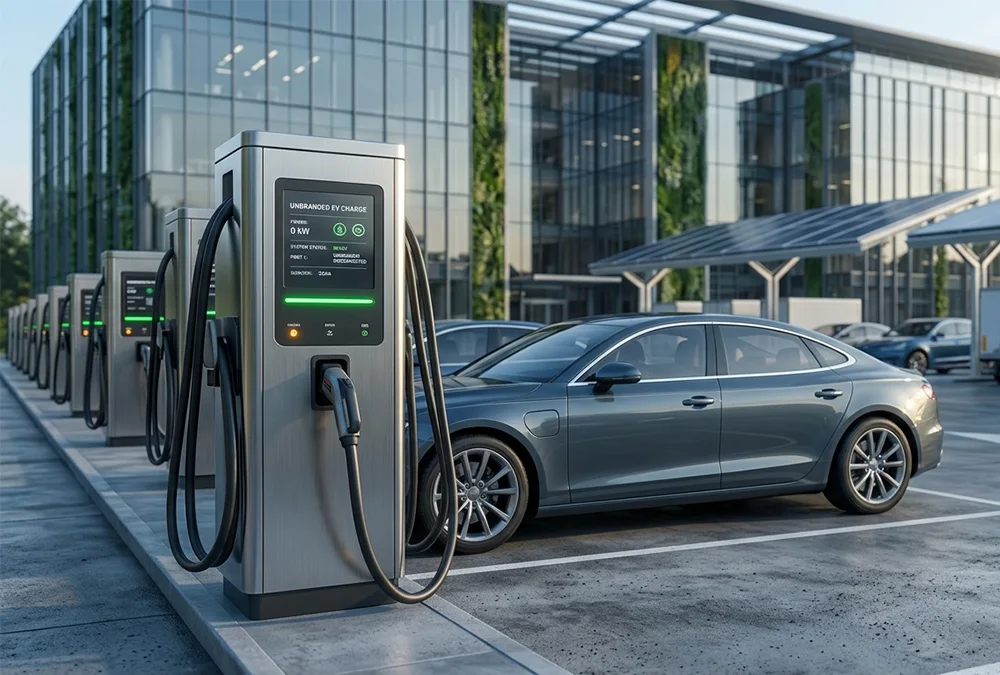
Navigating the total electric car charging stations cost for a commercial project isn’t as simple as checking hardware price tags. Honestly, when I look at site estimates across different properties, the sticker price on the charger box usually makes up just a fraction of your real spend. The price of the charger is only one part of the project. Electrical capacity, transformer upgrades, trenching, civil work, permitting, networking, commissioning and long-term operating costs can significantly change the final project budget.
Quick Cost Layer Breakdown Matrix™
| Cost Layer | What It Includes | Budget Impact | Buyer Benefit & Choice Advantage |
|---|---|---|---|
| Charger Hardware | Level 2 charger / DC Fast Chargers (DCFC) | Low–High | Selecting scalable modular hardware allows stepping up power without swapping whole cabinets later. |
| Electrical Infrastructure | Panel, Switchgear, Wiring, Breakers | Medium–High | Upfront rightsizing prevents costly secondary retrofits when adding vehicle capacity. |
| Utility Upgrade | Grid connection, Transformer additions | High | Integrating battery buffers can bypass multi-year grid delays and utility surcharge spikes. |
| Civil & Site Work | Trenching, Boring, Concrete pads, Asphalt | Medium–High | Short cable routing significantly reduces per-foot excavation expenses. |
| Design & Soft Costs | PE Stamped drawings, Permits, Utility filings | Medium | Pre-approved standardized engineering speeds up local government permitting sign-offs. |
| Software & Network | OCPP Backend, Payment systems, Cellular SIM | Low–Medium | Open-protocol software prevents vendor lock-in and enables custom charging tariffs. |
| O&M & Lifetime TCO | Preventive maintenance, Spare parts, Warranties | Long-term | Guaranteed SLAs keep uptime above 98%, maximizing ongoing session revenue. |
How Much Do Commercial Electric Car Charging Stations Cost in 2026?
When evaluating the total commercial EV charging station cost, developers and site owners frequently face wide budget variations. Equipment costs alone span from a few thousand dollars for a basic wall mount to well over six figures for high-power DC fast charging dispensers. According to the U.S. Joint Office of Energy and Transportation (2025 Infrastructure Report), public and commercial chargers require careful alignment between vehicle dwell times and electrical throughput to prevent over-capitalization.
Commercial Level 2 Charging Station Cost
A standard commercial Level 2 EV charging station operating at 208/240V typically ranges between $1,500 and $7,500 per hardware unit. A single-port non-networked wall-mounted unit represents the lower entry tier ($1,200–$2,500), while dual-port networked pedestal chargers with integrated payment credit card readers, retractable cables, and OCPP cellular modems fall into the $4,500–$9,000 range.
Commercial DC Fast Charging Station Cost
When looking at commercial DC fast charging station cost metrics, hardware prices escalate alongside power capabilities:
- 50 kW – 100 kW Standalone Units: $28,000 to $55,000 per charger.
- 120 kW – 180 kW Dual-Dispenser Units: $50,000 to $85,000 per charger.
- 240 kW – 360 kW High-Power Systems: $90,000 to $160,000+ per power cabinet set.
Keep in mind that power module output scales non-linearly. Doubling the kW output does not double hardware cost, but it can trigger massive grid upgrade thresholds.
Liquid-Cooled High-Power DC Charger Cost
For ultra-fast charge plazas charging heavy-duty electric trucks or highway fleets at 400kW to 600kW+, air-cooled cables become too heavy and hot for manual handling. Liquid-cooled high-power DC systems split hardware into centralized power cabinets and slim dispenser stalls with active chiller units. Hardware setups for liquid-cooled systems start around $130,000 and can reach $220,000 per stall.
What a Typical Commercial Charging Project Budget Should Include: The Total Cost Stack™
To prevent unexpected cost overruns, engineering teams utilize the Total Cost Stack™ framework. A realistic commercial budget must account for hardware, distribution switchgear, utility transformer upgrades, civil trenching, professional engineering stamps, local authority permits, network subscription fees, and long-term operating maintenance.
Commercial EV Charging Station Cost Breakdown: Hardware vs Installation
A frequent misconception in procurement is assuming the EV charger hardware cost represents the main budget line item. In truth, labor, material logistics, and utility adjustments often equal or surpass hardware expenses. Data published in the Alternative Fuels Data Center (AFDC 2025 Analysis) shows that installation labor and electrical materials frequently make up 45% to 65% of total capital expenditure for fast-charging deployments. Understanding this split helps streamline your investment overall.
Charger Hardware
This encompasses the main charging enclosure, internal silicon carbide (SiC) power conversion modules, liquid cooling pumps (for ultra-fast units), touchscreens, MID/CT metered billing modules, and CCS1/NACS charging cables.
Electrical Installation
The EV charger electrical upgrade cost includes high-gauge copper or aluminum conductors, rigid conduit, main distribution panels, step-down transformers, circuit breakers, emergency stop controls, and dedicated switchgear tailored to handle continuous duty cycles.
Civil and Site Work
Site civil work covers directional boring, asphalt sawing, open-cut trenching, pre-cast concrete mounting pad installation, protective steel bollards, wheel stops, and fresh parking lot striping.
Engineering, Permitting and Inspection
Includes professional engineer (PE) signed electrical site plans, single-line diagrams (SLD), zoning approvals, municipal building permits, utility interconnection studies, and final inspector sign-offs.
Software, Networking and Payment Systems
Cloud-based OCPP (Open Charge Point Protocol) management software platforms charge recurring annual network fees ($200–$600 per port/year) for remote diagnostics, dynamic load balancing, credit card payment gateway routing, and user authentication.
Why Can Two EV Charging Projects With the Same Number of Chargers Cost 3× More?
I’ve seen site managers get completely shocked when quoted $45,000 for a 4-port installation at Site A, while Site B down the road receives a $140,000 quote for the exact same four chargers. The reason behind this disparity boils down to site-specific infrastructure dynamics rather than equipment markup.
The Seven Biggest Variables Behind EV Charging Station Cost
- Charger Power Output: Jumping from 11.5 kW Level 2 to 180 kW DCFC radically changes current draw requirements from 48A to hundreds of amps.
- Number of Charging Ports: More active ports require larger busbars and higher main panel breaker capacity.
- Available Electrical Capacity: Sites with headroom on their existing service avoid costly switchgear replacements.
- Transformer or Utility Service Upgrade: If the local utility feeder line is constrained, adding a new pad-mounted transformer can add $30,000–$80,000.
- Trenching Distance: Running heavy conduit 20 feet across soft dirt is vastly cheaper than core-drilling through 300 feet of reinforced concrete.
- Civil and ADA Accessibility Work: Upgrading parking spaces to conform with mandatory accessibility paths can involve extensive regrading.
- Networking and Utility Costs: Local demand charges and mandatory utility interconnect studies directly alter project economics.
The “3× Cost Gap” Real-World Comparison
| Project Scope Factor | Site A: Low-Cost Deployment ($42,000) | Site B: High-Cost Deployment ($135,000) | Strategic Buyer Takeaway |
|---|---|---|---|
| Electrical Service | 200A spare capacity on existing main panel | Panel fully loaded; needs new 800A switchgear | Saves $35,000+ by utilizing spare headroom. |
| Utility Transformer | Existing grid transformer sufficient | Requires new 500 kVA utility transformer | Avoids utility lead times (6–12 months). |
| Trenching & Run Distance | 15 feet through landscaping soft dirt | 180 feet cutting asphalt parking lot | Placing chargers close to utility room minimizes cutting costs. |
| ADA Accessibility | Existing curb ramp meets local slope rules | Requires repaving, custom ramp, van-accessible stall | Site selection dramatically dictates civil expenditure. |
Level 2 vs DC Fast Charging Station Cost: Which Is More Economical?
Choosing between a Level 2 commercial EV charging station cost profile and a DC fast charging station model depends entirely on vehicle dwell time. Evaluating charger output against how long drivers park ensures you won’t over-spec power equipment.
Commercial Level 2 Charging
Ideal for locations where cars sit for 4 to 8 hours (workplaces, hotels, apartment buildings). They feature minimal upfront CAPEX, simpler 208V/240V AC power requirements, and lower overall installation complexity.
Commercial DC Fast Charging
Essential for highway plazas, retail hubs, transit corridors, and fleet depots requiring 15 to 45-minute charge cycles. While initial CAPEX is higher, revenue turnaround per stall is significantly faster.
Liquid-Cooled DC Fast Charging for High-Power Applications
When charging logistics trucks or heavy commercial fleets, liquid-cooled DC stations provide continuous 350kW+ energy flow without thermal throttling, maximizing operational uptime for tight logistics schedules.
Commercial Charging Cost Comparison Matrix
| Metric | Level 2 (7kW – 19kW) | DC Fast Charging (50kW – 180kW) | High-Power Liquid-Cooled (240kW – 480kW+) | User Selection Advantage |
|---|---|---|---|---|
| Hardware Cost Range | $1,500 – $7,500 | $28,000 – $85,000 | $100,000 – $220,000 | Match equipment spend to expected charging tariff tolerance. |
| Average Installation Cost | $2,000 – $10,000 | $20,000 – $75,000 | $60,000 – $150,000+ | Level 2 keeps installation manageable for multi-stall parking. |
| Dwell Time / Turnaround | 4 – 8 Hours | 30 – 60 Minutes | 15 – 25 Minutes | High-Power units maximize throughput for commercial highway plazas. |
| Best Commercial Use Case | Workplaces, Hotels, Apartments | Retail Malls, Public Plazas | Fleet Depots, Highway Corridors | Aligning charger speed with dwell time prevents wasted capital. |
What Are the Real Installation Costs for a Commercial EV Charging Station?
Calculating your true electric car charging station installation cost involves executing a multi-step engineering workflow. Skipping steps during preliminary planning almost always leads to costly change orders later on.
Step 1 — Site Assessment: Electrical contractors evaluate panel loading, peak kW history, conduit pathways, and cellular signal strength for network connectivity.
Step 2 — Electrical and Engineering Design: Licensed professional engineers produce stamped single-line diagrams, site plan layouts, and structural engineering prints for concrete pads.
Step 3 — Utility Coordination: Submitting load additions to the local electric distribution company to assess grid feeder capacity and transformer requirements.
Step 4 — Permitting: Submitting site packages to municipal authorities for electrical, structural, and zoning clearance.
Step 5 — Construction and Installation: Executing directional trenching, setting concrete pedestals, pulling heavy copper feeders, mounting chargers, and landing terminations.
Step 6 — Inspection: City or county electrical inspectors perform safety checks and sign off on ground fault and code compliance.
Step 7 — Commissioning: Verifying voltage balance, phase rotation, insulation resistance, and power module output under load.
Step 8 — Network Activation: Provisioning cloud connectivity, setting pricing rules, testing RFID authentication, and validating payment gateways.
Commercial EV Charging Station Installation Cost Checklist
Keep this practical procurement checklist handy when reviewing turn-key contractor proposals:
- Charger Hardware: Units, mounting plates, cable management retractor arms.
- Mounting Hardware and Bollards: Heavy-duty galvanized or stainless steel crash bollards.
- Wiring, Conduit and Switchgear: THHN/THWN conductors, PVC/RMC conduit, sub-panels.
- Trenching and Pavement Restoration: Saw-cutting asphalt, backfilling, cold patching, or concrete pouring.
- Transformer and Utility Upgrades: Secondary meter sockets, utility interconnect fees.
- Engineering and Stamped Drawings: Electrical engineering stamps, land survey reviews.
- Permits and Inspection: Local municipal filing fees and third-party inspection costs.
- ADA Accessibility: Level parking surface, van-accessible stalls, compliant reach-height mounting.
- Signs, Striping and Wheel Stops: Thermoplastic paint markings, customized EV parking signage.
- Networking and Payment: Gateway setup, SIM card activation, backend portal onboarding.
- Commissioning: On-site load testing, thermal scanning of connections, end-to-end activation.
- Maintenance and Software Fees: Initial 3-to-5-year extended service agreements and SaaS subscriptions.
How Long Does Commercial EV Charging Station Installation Take?
Physical construction on site usually takes under two weeks. However, overall timeline schedules are dominated by utility interconnection reviews and municipal permitting. A standard installation project timeline looks like this:
Commercial EV Charging Station Requirements: Power, Permits and Accessibility
Meeting federal, state, and local electrical compliance standards is essential for a smooth installation. Knowing these regulatory requirements helps prevent operational delays down the road.
Electrical Capacity Requirements
Under National Electrical Code (NEC Article 625), EVSE loads are defined as continuous loads. That means breakers and supply conductors must be sized at 125% of the charger’s rated output. For instance, a 48A Level 2 charger requires a dedicated 60A circuit breaker.
Transformer and Utility Service Requirements
DC fast charging chargers require 480V 3-phase power. If your commercial property only has 120/208V 3-phase or 120/240V single-phase service, a dedicated step-up or utility transformer is mandatory.
How ADA and Site Accessibility Requirements Can Affect Your Project Budget
Commercial charging sites open to the public must comply with Americans with Disabilities Act (ADA) accessibility guidelines. Incorporating compliant reach heights (15 to 48 inches above finished floor), operable parts without tight grasping, clear floor space, and smooth path-of-travel access can impact site civil construction expenses depending on existing parking grade and layout.
Commercial EV Charging Station Cost by Property Type
Your facility type directly influences overall charging hardware choices and grid integration economics:
Office Buildings and Workplaces
Workplace charging relies heavily on networked Level 2 stations (7.7 kW to 11.5 kW). Employees dwell for 8 hours, allowing smart dynamic load sharing across multiple chargers to keep overall connection capacity low.
Retail Centers and Shopping Malls
Shoppers park for 1 to 2 hours. A hybrid mix of dual-port Level 2 and 60kW–120kW DC fast chargers drives foot traffic and boosts retail dwell-time revenue.
Multifamily Properties and Hotels
Overnight charging requires robust Level 2 pedestal chargers equipped with user authentication (RFID or app-based) so management can automatically bill residents or guests for kilowatt-hours consumed.
Fleet Depots and Logistics Centers
High-throughput distribution hubs require 180kW to 360kW DC fast charging cabinets, paired with dynamic load distribution software to guarantee trucks are fully charged before morning dispatch shifts.
How to Reduce Commercial EV Charging Station Installation Costs
Controlling your total project expenditure doesn’t require compromising on quality or scale. These proven engineering strategies help keep overall costs in check:
Right-Size the Charger Power
Do not buy maximum power out of habit. Match charger power output to vehicle dwell time. Installing a 180 kW fast charger where cars routinely park for 6 hours wastes capital on unused capacity.
Deploy Dynamic Load Balancing (DLB)
DLB technology intelligently adjusts charging power in real time across multiple dispensers based on the facility’s live electrical load. Dynamic load management can significantly trim peak site demand, helping defer or minimize expensive grid and transformer upgrades depending on site conditions and utility rules.
Can Battery Energy Storage Reduce EV Charging Infrastructure Costs?
When grid utility upgrades require hundreds of thousands of dollars or face multi-year delays, integrating a commercial Battery Energy Storage System (BESS) provides a practical peak-shaving solution. BESS buffers store grid energy during low-demand periods and discharge during high-power fast charging sessions, reducing demand spikes.
Recommended Industrial Battery Energy Storage Systems (BESS) for EV Hubs
Selecting the right energy storage capacity allows site operators to bypass major utility infrastructure upgrades while capping high demand charges:
100kWh Industrial Cabinet (e.g., AnengJI Smart-Store 100):
Core Selling Point & Buyer Advantage: Compact, liquid-cooled, plug-and-play design. Perfect for Level 2 commercial stations and small 50kW DC chargers to perform peak shaving and reduce monthly demand charges without footprint expansion.
261kWh / 418kWh Modular BESS Systems (e.g., AnengJI PowerCube Series):
Core Selling Point & Buyer Advantage: High-density C&I energy storage with integrated fire suppression and smart EMS. Supports multi-port 180kW–240kW DC fast chargers by boosting continuous power during peak utilization hours, avoiding $100k+ utility grid transformer upgrades.
1MWh Containerized BESS Station (e.g., AnengJI MegaVault 1MWh):
Core Selling Point & Buyer Advantage: Utility-grade storage container for commercial truck fleet depots and highway charging hubs. Enables solar PV integration, grid arbitrage, and emergency backup power while serving ultra-fast charging sessions simultaneously.
Grid–Charger–Battery Decision Matrix
| Site Grid Capacity Status | Recommended Architecture | Upfront Cost Profile | Long-Term Buyer Operational Benefit |
|---|---|---|---|
| Grid Capacity Sufficient | Direct Grid-Connected Chargers | Standard CAPEX | Lowest initial deployment footprint; simplest control scheme. |
| Grid Capacity Moderately Limited | Smart Charging + DLB Software | Low CAPEX Addition | Eliminates minor electrical panel upgrades by dynamically capping maximum site draw. |
| Grid Capacity Severely Constrained | 261kWh – 418kWh BESS Buffer | Medium–High Initial CAPEX | Avoids 12–18 month utility transformer lead times and eliminates steep peak demand penalties. |
| High Solar Generation Available | Integrated PV + 1MWh BESS + DCFC | Higher CAPEX / Lowest OPEX | Unlocks maximum self-consumption, zero-carbon charging, and grid service resale revenue. |
Technical Deep Dive: Battery Tech in EV Chargers & Alternative Architectures
Battery Chemistry in Charger Buffers: Modern BESS-assisted chargers rely on Lithium Iron Phosphate (LFP – LiFePO4) chemistry. LFP is favored over NMC (Nickel Manganese Cobalt) due to superior thermal stability, extended cycle life (6,000+ deep discharge cycles vs ~2,000 for NMC), and zero dependence on cobalt.
Alternative Grid-Buffer Options: Aside from stationery BESS, alternatives include flywheel kinetic storage (suitable for frequent short bursts of high power) and microgrids powered by hydrogen fuel cells or natural gas linear generators. However, LFP battery storage currently remains the most cost-effective and scalable choice for commercial sites.
Commercial EV Charging Station Incentives and Tax Credits in 2026
Federal, state, and utility incentives can significantly lower your net project expenditure. Utilizing these financial programs makes deployment far more economical.
Federal EV Charging Tax Credits (IRS Section 30C)
According to official tax guidelines published on the IRS Alternative Fuel Vehicle Refueling Property Credit (Section 30C) portal, qualified commercial installations placed in service before June 30, 2026, eligible for federal tax credits, are subject to location and labor compliance rules:
- Base Credit Rate: 6% of eligible project cost for commercial/investment properties.
- Bonus Credit Rate: Up to 30% credit rate when Prevailing Wage and Apprenticeship (PWA) requirements are met.
- Cap Limit: Capped at $100,000 per single item of refueling property.
- Location Eligibility: Property must be installed in eligible low-income community census tracts or non-urban census tracts.
Utility Rebates and Make-Ready Programs
Many electric utilities offer “Make-Ready” incentive programs that fund up to 100% of the electrical supply infrastructure costs (transformers, trenching, panels), leaving the property owner responsible only for the charger hardware purchase.
Commercial EV Charging Station ROI: Can EV Charging Make Money?
A commercial installation shouldn’t be viewed solely as an expense. Under the right pricing model, charging infrastructure generates predictable passive revenue and boosts direct retail foot traffic.
The 5-Step EV Charging ROI Calculation Model™
Step 1 — Calculate Annual Charging Energy: Multiply daily sessions × average kWh delivered per session × 365 days.
Step 2 — Estimate Electricity Cost: Calculate base energy cost ($/kWh) drawn from the local power grid.
Step 3 — Add Demand Charges: Account for utility peak demand fees ($/kW per month).
Step 4 — Calculate Charging Revenue: Total driver billing charges (kWh markup + session connection fee + idle parking penalty fees).
Step 5 — Calculate Payback Period: Apply net annual cash flow against net upfront capital expenditure.
Annual Net Cash Flow = Charging Revenue − Electricity Cost − Demand Charges − Software SaaS − Maintenance
Simple Payback Period (Years) = Net Project Cost ÷ Annual Net Cash Flow
*Note: Complete financial models should also incorporate accelerated asset depreciation (e.g., MACRS), financing interest rates, utilization growth curves, and equipment residual values.
How Utility Demand Charges Affect EV Charging Station ROI
Utility demand charges are calculated based on your site’s single highest 15-minute power peak during a billing cycle. If two 180kW DC fast chargers ramp up simultaneously, they draw 360kW of instantaneous power. If your electric utility assesses a $20/kW demand charge, that single 15-minute peak generates a $7,200 charge on your monthly bill, regardless of total energy consumed! Implementing BESS peak shaving or dynamic software load capping protects site profitability from these spikes.
Commercial EV Charging Station Lifetime Cost: The 10-Year View
Evaluating your investment strictly on initial CAPEX overlooks long-term operating parameters. Managing operational spend over time requires looking closely at total cost of ownership.
A comprehensive 10-year total cost of ownership model includes initial equipment and civil buildout, utility kWh costs, peak demand surcharges, recurring software network subscriptions, periodic wear-and-tear repairs (such as replacing worn cable connectors), and warranty extensions.
How to Build a Commercial EV Charging Station Budget for 2026
To build an accurate project budget, follow this structured engineering roadmap:
2. Determine Charger Type and Power Output: Match charging speed to average driver dwell times.
3. Audit Available Electrical Capacity: Assess existing main panel breaker headroom and transformer capacity.
4. Estimate Site and Civil Work: Calculate trenching distance, concrete cutting, and parking stall layout.
5. Calculate Software and Operating Costs: Factor in annual network platform fees and routine maintenance.
6. Evaluate BESS and Load Management Integration: Compare battery energy storage costs against grid utility line extension quotes.
7. Calculate Net Cost After Incentives: Apply federal tax credits, state grants, and utility make-ready rebates.
8. Build a 10-Year TCO and ROI Model: Forecast projected session revenue against lifetime operational costs.
The 6-Step EV Charging Cost Decision Model™
1. CHARGING DEMAND → 2. CHARGER POWER → 3. AVAILABLE GRID CAPACITY → 4. SITE & INSTALLATION COST → 5. SMART CHARGING / BESS → 6. TCO + ROI
Core Philosophy: Lowest Charger Price ≠ Lowest Project Cost. Always pursue the Lowest Cost per Useful Charging Capacity and Best Lifetime ROI!
Get a Commercial EV Charging Station Cost Estimate From AnengJI
Navigating commercial charging hardware options, electrical engineering designs, and battery storage integration requires an experienced partner. At AnengJI, we provide complete end-to-end commercial charging and energy storage solutions tailored precisely to your operational goals.
Why Partner With AnengJI?
- Match Charger Power to Your Business Case: From 7kW Level 2 commercial units to 360kW+ high-power liquid-cooled DC fast chargers.
- Optimize Infrastructure With Dynamic Load Management: Intelligently distribute available power to avoid costly electrical panel upgrades.
- Integrated PV + BESS + Charging Ecosystems: Pair chargers with our 100kWh, 261kWh, 418kWh, or 1MWh energy storage solutions to shave peak demand charges.
- OEM/ODM Commercial Solutions: Fully customizable branding, custom OCPP backend integrations, and tailored hardware configurations.
- Turn-key EPC Management: Complete support covering site evaluation, engineering design, equipment procurement, testing, and long-term maintenance.
Frequently Asked Questions About Electric Car Charging Station Cost
How much does a commercial electric car charging station cost?
Commercial charging hardware spans from $1,500 to $7,500 for Level 2 chargers, and $28,000 to over $150,000 for DC fast chargers. Total installed cost depends heavily on site civil work and utility grid capacity.
How much does it cost to install an EV charging station?
Installation labor and materials typically range from $2,000 to $10,000 per charger for Level 2 units, and from $20,000 to $85,000+ per unit for DC fast charging stations requiring new panels or transformers.
Why is EV charger installation so expensive?
Main cost drivers include heavy copper feeder conductors, asphalt cutting and directional trenching, structural concrete pads, professional engineering stamps, utility interconnect fees, and mandatory ADA accessibility updates.
Does Level 2 or DC fast charging cost more to install?
DC fast charging costs significantly more to install because it requires 480V 3-phase high-amperage power service, dedicated step-down or step-up transformers, heavy-duty switchgear, and extensive cooling support.
Do EV charging stations require a transformer?
If your facility lacks existing 480V 3-phase service and you are installing DC fast charging equipment, a dedicated utility or customer-owned step-up transformer is required.
Can dynamic load balancing reduce installation costs?
Yes. Dynamic Load Balancing (DLB) software actively caps peak power consumption across active chargers, often allowing property owners to install more stalls without undergoing expensive main electrical panel upgrades.
Can battery storage reduce EV charging costs?
Integrating a Battery Energy Storage System (BESS) allows you to discharge stored energy during peak charging hours, suppressing utility demand charges and mitigating expensive grid transformer additions.
Are there EV charging tax credits in 2026?
Yes, under IRS Section 30C, qualified commercial projects placed in service before June 30, 2026, located in eligible census tracts can claim a credit up to 30% (when meeting Prevailing Wage and Apprenticeship rules), capped at $100,000 per property item.
Ready to Plan Your Commercial EV Charging Project?
Avoid unexpected grid upgrade fees and optimize your total cost of ownership. Contact our engineering team today for a tailored commercial assessment and equipment quote.
Related Article
- Top 10 EV Charging Manufacturers in the World: 2026 Procurement & Technical Guide
- Best EV Charging Companies in The World 2026: Top 10 Suppliers Compared
- EV Charging Solutions for Hotels: Build Smart Infrastructure
- Benefits of Commercial EV Charging Stations for Businesses | ROI & Strategy
- Commercial EV DC Fast Charging Solutions | Modular Stations & BESS
 https://anengjipower.com/wp-content/uploads/2026/06/epc-vs-turnkey-solar-project-bess.webp
675
1000
Charging Station Engineer
https://anengjipower.com/wp-content/uploads/2025/09/anengji-dc-fast-charging-station-manufacturer-and-supplier-logo-white-1.png
Charging Station Engineer2026-06-22 07:16:042026-06-24 07:13:17What Is the Difference Between EPC and Turnkey Contract Models in Energy Projects?
https://anengjipower.com/wp-content/uploads/2026/06/epc-vs-turnkey-solar-project-bess.webp
675
1000
Charging Station Engineer
https://anengjipower.com/wp-content/uploads/2025/09/anengji-dc-fast-charging-station-manufacturer-and-supplier-logo-white-1.png
Charging Station Engineer2026-06-22 07:16:042026-06-24 07:13:17What Is the Difference Between EPC and Turnkey Contract Models in Energy Projects? https://anengjipower.com/wp-content/uploads/2026/06/anengji-commercial-solar-plus-storage-benefits-site.webp
675
1000
Charging Station Engineer
https://anengjipower.com/wp-content/uploads/2025/09/anengji-dc-fast-charging-station-manufacturer-and-supplier-logo-white-1.png
Charging Station Engineer2026-06-20 14:34:102026-06-20 14:37:43What Are the Top Benefits of Solar Battery Storage in Factories?
https://anengjipower.com/wp-content/uploads/2026/06/anengji-commercial-solar-plus-storage-benefits-site.webp
675
1000
Charging Station Engineer
https://anengjipower.com/wp-content/uploads/2025/09/anengji-dc-fast-charging-station-manufacturer-and-supplier-logo-white-1.png
Charging Station Engineer2026-06-20 14:34:102026-06-20 14:37:43What Are the Top Benefits of Solar Battery Storage in Factories? https://anengjipower.com/wp-content/uploads/2026/06/modular-commercial-solar-battery-storage-cabinet.webp
675
1000
Charging Station Engineer
https://anengjipower.com/wp-content/uploads/2025/09/anengji-dc-fast-charging-station-manufacturer-and-supplier-logo-white-1.png
Charging Station Engineer2026-06-18 09:16:522026-07-03 03:05:13What Is Solar Battery Storage? Complete C&I Engineering Guide
https://anengjipower.com/wp-content/uploads/2026/06/modular-commercial-solar-battery-storage-cabinet.webp
675
1000
Charging Station Engineer
https://anengjipower.com/wp-content/uploads/2025/09/anengji-dc-fast-charging-station-manufacturer-and-supplier-logo-white-1.png
Charging Station Engineer2026-06-18 09:16:522026-07-03 03:05:13What Is Solar Battery Storage? Complete C&I Engineering Guide


Leave a Reply
Want to join the discussion?Feel free to contribute!