
Hotels are becoming an important destination for EV charging because guests often park for several hours or overnight. Finding a reliable charging spot isn’t just a nice perk anymore; it drives where travelers book their stay. Deploying tailored ev charging solutions for hotels helps property owners boost guest satisfaction, attract high-spending EV drivers, create fresh revenue streams, and hit aggressive sustainability targets. Whether running a boutique inn or a sprawling resort, the right hardware keeps your business future-proof.
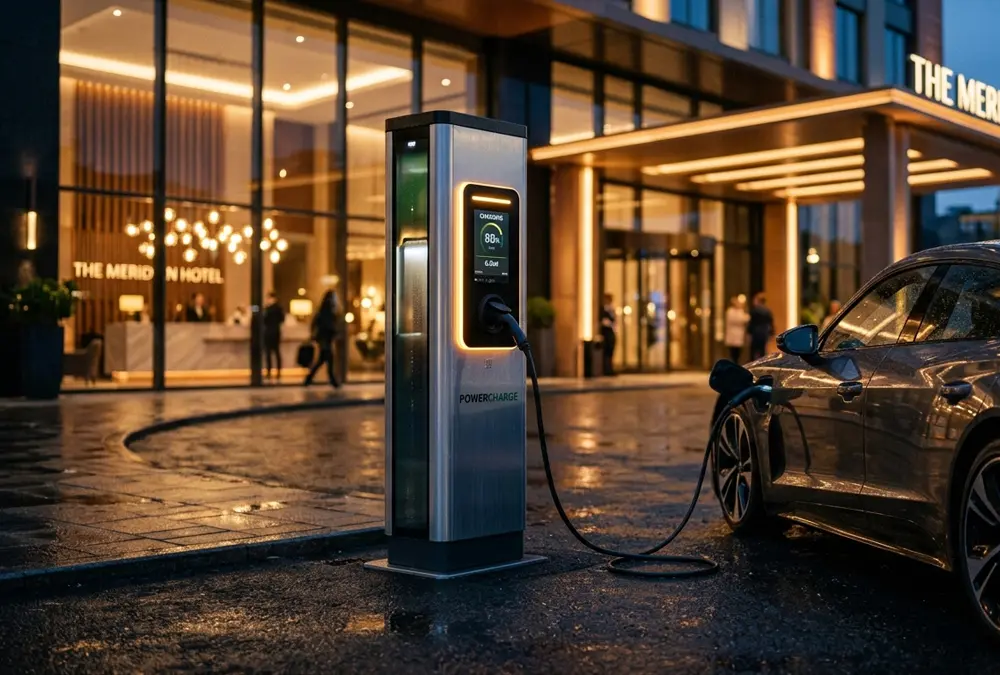
Why Do Hotels Need EV Charging Stations for Guests and EV Drivers?
The hospitality landscape is shifting fast. Travelers no longer look only for free Wi-Fi or complimentary breakfast. Modern guests expect hassle-free charging right where they sleep.
More EV Drivers Are Looking for Charging at Their Destination
As electric vehicle adoption surges globally, long-distance road trips in EVs are becoming completely routine. Drivers don’t want to sit in a dark public parking lot for an hour before checking into their room. They actively search for lodging that offers on-site destination charging so they can wake up to a fully charged battery every single morning.
Why Do EV Drivers Need to Charge at Hotels?
Consider the average hotel guest’s schedule. They arrive in the late afternoon or evening, check in, park their vehicle, eat dinner, sleep, and check out early the next day. Their car stays stationary in your parking lot for 8 to 12 hours. This long dwell time creates the absolute perfect opportunity to charge without forcing the guest to alter their daily plans.
Hotel EV Charging Can Become Part of the Guest Experience
Integrating charging into your guest services elevates the overall brand experience. When a traveler knows they can arrive, park, plug in, relax, and leave fully charged, you eliminate range anxiety entirely. That peace of mind builds deep brand loyalty and drives repeat direct bookings.
What Are the Benefits of EV Charging Solutions for Hotels?
Installing commercial EV charging stations is far more than a green marketing stunt. It delivers measurable commercial returns across your property operations.
Improve Guest Convenience and Satisfaction
Nothing ruins a vacation or business trip like hunting down a working public charger in an unfamiliar city. Providing dedicated hotel EV charging stations saves guests time and frustration. A frictionless parking and charging setup directly translates into glowing five-star online reviews.
Attract More EV Travelers and Digital-Age Customers
EV drivers rely heavily on navigation apps like Google Maps, PlugShare, and Tesla’s trip planner to choose hotels. Adding EV chargers for hotels instantly flags your property on these digital booking platforms, putting your hotel in front of high-income travelers who specifically filter search results by charging availability.
Create an Additional Revenue Stream
Charging doesn’t have to be a free giveaway. Modern cloud management platforms let property owners set custom billing structures. You can charge by the kilowatt-hour (kWh), by the hour, or apply idle fees when charging finishes. Alternatively, offer complimentary top-offs exclusively to VIP loyalty members while charging non-registered guests a premium rate.
Support Sustainability and Green Hospitality Goals
Corporate travel planners increasingly demand eco-friendly hotel infrastructure. Installing clean hotel electric vehicle charging infrastructure strengthens your ESG compliance metrics, making your facility eligible for lucrative corporate travel contracts and municipal green building certifications.
Buyer Insight: “Will non-guests take over our chargers and block paying hotel guests?”
This is a major concern for general managers. Modern smart systems solve this cleanly through access controls. You can issue RFID room cards at check-in, set up private QR codes, or require app authorization so only registered guests can activate the chargers during peak stay hours.
What Commercial EV Charging Solutions Are Available for Hotels?
Selecting the right charging hardware depends heavily on your property type, typical guest dwell time, and available electrical capacity.
Level 2 AC EV Chargers for Hotels
Level 2 AC chargers operating between 7 kW and 22 kW are the workhorses of hotel parking facilities. They add roughly 25 to 80 miles of range per hour. Since overnight guests stay parked for 8+ hours, Level 2 AC units provide a full charge by morning at a very reasonable equipment and installation cost.
DC Fast Charging Stations for Hotels
Direct current (DC) fast chargers ranging from 60 kW to 240 kW+ cater to short-stay visitors, conference attendees, and highway road trippers. A DC fast charger tops up a vehicle battery from 20% to 80% in 20 to 45 minutes, turning your hotel restaurant or lobby cafe into a busy rest stop for highway commuters.
Multi-Port Commercial EV Charging Stations
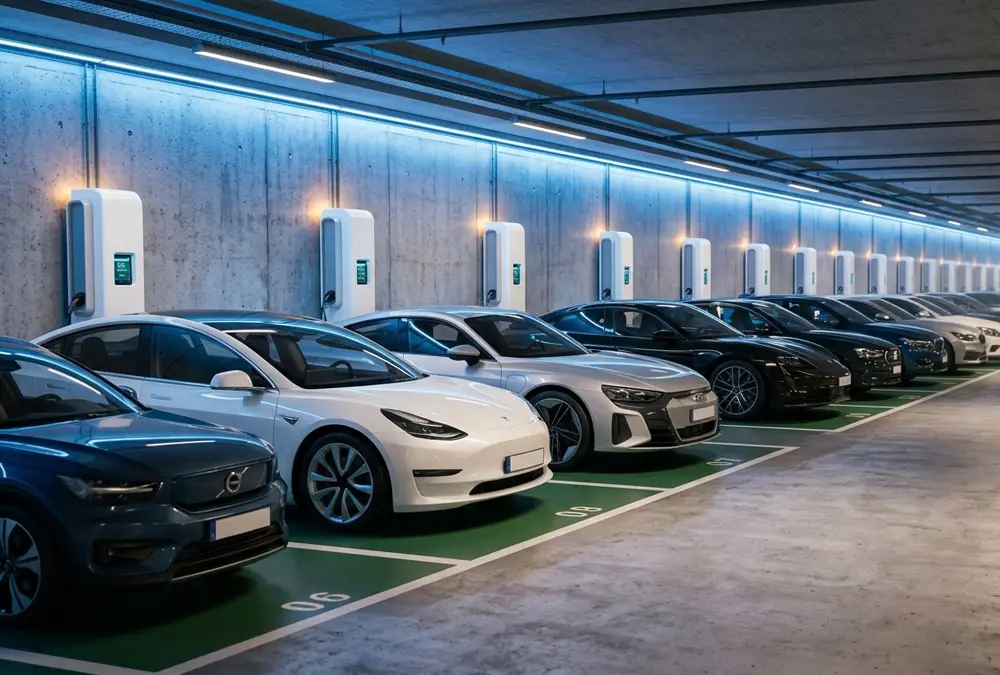
Multi-port units share power dynamically across several parking bays from a single central power cabinet. This setup optimizes physical parking space, simplifies underground conduit trenching, and reduces upfront hardware expense per plug.
OCPP-Based Cloud EV Charging Management
Always insist on chargers built on the Open Charge Point Protocol (OCPP). Open software prevents vendor lock-in, letting you manage billing, monitor charger uptime, adjust pricing, and control access permissions remotely from a single web dashboard.
Level 2 AC vs DC Fast Charging for Hotels: Which Is Better?
Both charging speeds serve distinct guest use cases. Comparing their specifications helps you design an effective parking layout:
| Technical Feature | Level 2 AC Charging | DC Fast Charging (DCFC) | User Advantage & Strategic Value |
|---|---|---|---|
| Power Output Range | 7 kW to 22 kW | 60 kW to 240 kW+ | Level 2 provides low cost per plug; DCFC delivers rapid turnaround. |
| Average Charge Time | 4 to 8 Hours (Full) | 20 to 45 Minutes (80%) | Matches overnight stay vs short cafe/dining stops perfectly. |
| Equipment & Installation Cost | Low to Moderate ($1k – $3k/plug) | High ($30k – $90k+/station) | Allows budget-friendly deployment across dozens of bays. |
| Electrical Capacity Demand | Minimal (208V/240V AC) | Significant (480V 3-Phase DC) | AC avoids immediate, expensive utility transformer upgrades. |
| Primary Guest Use Case | Overnight stays & employees | Highway travelers & diners | Serves core lodging guests vs driving high-margin non-guest traffic. |
Explore our detailed article:Level 2 vs Level 3 EV Charging Stations: What’s the Difference?
When Should a Hotel Choose Level 2 AC Charging?
If your property primary serves multi-night tourists, convention centers, or city-center lodging where guests leave their vehicles parked overnight, Level 2 AC chargers are the clear financial winner. They maximize plug availability without blowing out your electrical budget.
When Should a Hotel Choose DC Fast Charging?
Highwayside hotels, luxury resorts, and properties near major airports benefit immensely from DC fast charging. Passing drivers will purposefully stop at your hotel to recharge, grabbing lunch, purchasing coffee, or paying for day pass amenities while waiting.
Why a Hybrid AC + DC Charging Strategy Can Be Better
For larger resorts, combining both technologies offers the ultimate solution. Installing 8 to 12 Level 2 AC plugs alongside 2 DC fast charging bays covers every traveler scenario—overnight sleepers get low-cost top-offs, while rushed day-visitors get lightning-fast range boosts.
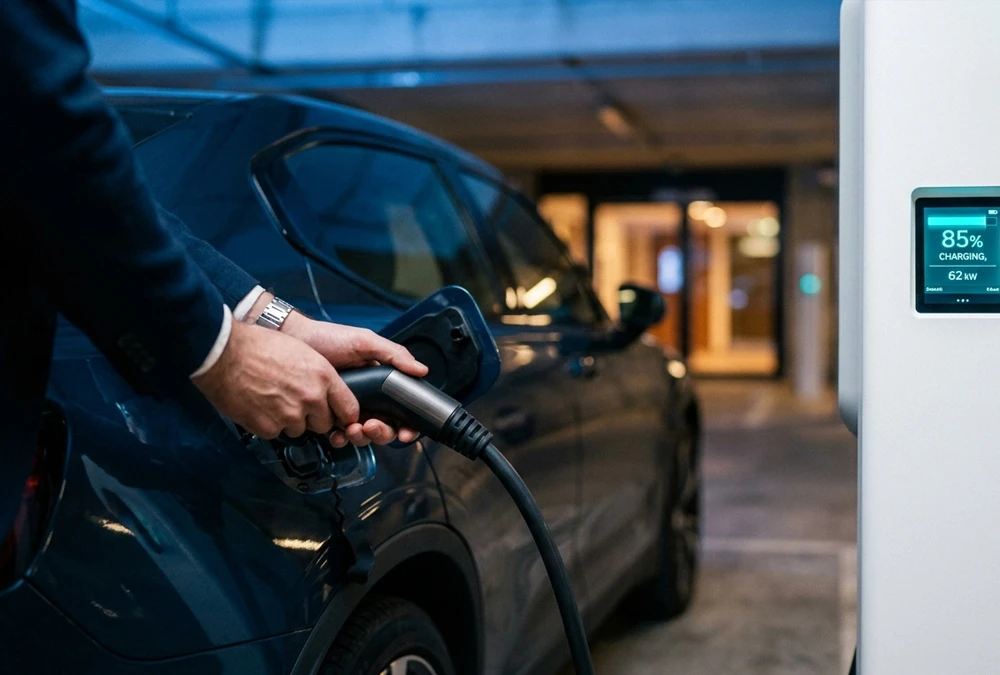
What Smart EV Charging Features Should Hotels Look For?
Not all chargers are created equal. Buying basic, unmanaged hardware creates operational nightmares down the road. Look for intelligent, enterprise-ready features.
Smart Charging Management
Smart charging management software gives hotel operators full control over charging schedules, session durations, energy allocation, and real-time fault alerts directly through a centralized portal.
Dynamic Load Balancing for Hotel EV Charging
A hotel electrical system already handles heavy demands from HVAC units, commercial kitchens, elevators, laundry facilities, and lighting. If dozens of electric cars start charging simultaneously at 7:00 PM, total site power draw can easily exceed your utility panel limit, triggering massive demand fees or breaker trips. Dynamic Load Balancing (DLB) actively monitors overall building power consumption in real time, automatically throttling EV charger output when hotel electrical loads peak, then ramping charging back up when guest power usage drops overnight.
Cloud-Based Monitoring and Remote Management
Cloud-connected hardware alerts your engineering team immediately if a charger experiences a cable error or ground fault. Remote diagnostics allow staff to reboot equipment digitally, maintaining high uptime without waiting for technician site visits.
Guest Authentication and Access Control
Protect your electrical infrastructure from unauthorized public use. Flexible platforms support room card RFID tapping, mobile app scanning, or custom access codes provided at front desk check-in.
Flexible EV Charging Billing
Easily adjust fee structures according to season, time of day, or guest status. You can automate credit card processing, push revenue straight to property accounts, or integrate billing into property management systems (PMS).
What Are the Key Hotel EV Charging Installation Considerations?
Proper site engineering prevents costly project scope revisions midway through installation.
Evaluate Available Electrical Capacity
Before purchasing hardware, conduct a comprehensive electrical load study. An engineer must measure main service panel capacity, transformer headroom, and historical peak consumption to determine how many chargers your current system can safely support.
Plan Hotel Parking Spaces for EV Charging
Position charging bays close to main electrical rooms to minimize expensive conduit trenching across your asphalt parking lot. Ensure spaces are well-lit, clearly signposted, covered by security cameras, and compliant with local accessibility rules.
Consider Future EV Charging Expansion
Don’t just design for today’s needs. Laying larger underground conduit during initial civil works costs very little extra, but saves massive amounts of money when you inevitably expand from 4 chargers to 20 chargers over the next three years.
Ensure Reliable Network Connectivity
Smart billing, app access, and load management require dependable communications. Verify strong Wi-Fi, hardwired Ethernet, or 4G/5G cellular connectivity in outdoor parking lots or underground garages before installing chargers.
How Many EV Charging Stations Does a Hotel Need?
Determining the right ratio of chargers to parking spots keeps installation expenses reasonable while avoiding guest queuing conflicts.
Factors That Determine the Number of Hotel EV Chargers
Calculate your starting charger count based on total room capacity, overall parking lot spaces, regional EV sales penetration, average length of stay, and proximity to major highways.
Recommended Hotel EV Charging Deployment Strategy
As a general industry rule of thumb, aim to make 5% to 10% of your total parking bays EV-ready today:
- Boutique Hotels (20–50 Rooms): Start with 2 to 4 Level 2 AC chargers.
- Mid-Sized Properties (50–150 Rooms): Deploy 4 to 8 Level 2 AC chargers + 1 optional DC fast charger.
- Large Resorts & Conference Facilities (150+ Rooms): Install 12+ Level 2 AC chargers + 2 to 4 DC fast charging bays supported by dynamic load management.
How to Choose the Right EV Charging Connector for Hotels?
Connector compatibility across regional markets ensures every single guest can charge without frustration.
NACS EV Charging
The North American Charging Standard (NACS), originally developed by Tesla, has been widely adopted by major global automakers across North America. Installing NACS-compatible plugs gives Tesla owners and newer non-Tesla EVs native plug-and-play access.
J1772 Charging
The J1772 (Type 1) connector remains the legacy standard for Level 2 AC charging across North America and Asia, supporting millions of older electric vehicles on the road today.
Why Hotels May Need Multiple Charging Connector Options
Offering a multi-standard setup—such as dual-head chargers featuring both NACS and J1772 connectors, or Type 2 plugs in European markets—eliminates cable adapter headaches, lowers equipment downtime, and keeps your parking bays accessible to every brand of vehicle.
How to Design a Hotel EV Charging Plan?
A structured engineering process guarantees flawless project execution from initial site plan to final commissioning.
Step 1 — Analyze Hotel Guest and Parking Demand
Gather hard site data: average nightly occupancy rates, peak parking lot utilization times, guest stay durations, and local EV demographic trends.
Step 2 — Conduct an Electrical Site Assessment
Have a qualified engineer evaluate your main switchgear, circuit breakers, sub-panels, and transformer capacity to identify available power margins.
Step 3 — Select AC, DC or Hybrid Charging
Select the right hardware mix that fits your guest profile and site power limits without overspending on unnecessary grid capacity.
Step 4 — Design Charging Locations
Map out parking space layouts, cable reach, lighting, signage, bollard protection, and future conduit pathways to streamline civil construction.
Step 5 — Integrate Smart Load Management
Connect all chargers to a central management platform with dynamic load balancing to protect building electrical operations automatically.
Explore our detailed article:EV Charging Station Business: A Practical Step-by-Step Guide
How Can Hotels Reduce EV Charging Infrastructure Costs?
Upfront installation expenses don’t have to break your capital expenditure budget. Smart engineering slashes deployment costs dramatically.
Use Dynamic Load Balancing to Avoid Unnecessary Grid Upgrades
Upgrading an industrial transformer can easily add $50,000 to $100,000+ to your project budget and delay installation by 12 months. Deploying dynamic load management lets you install multiple chargers safely on your existing panel, saving massive upfront capital.
Combine Solar PV With Hotel EV Charging
If your hotel features roof space or parking canopy arrays, routing solar power directly to charging stations offsets grid electricity purchases, creating a self-sustaining green energy loop.
Add Battery Energy Storage for High-Power Charging
Integrating Battery Energy Storage Systems (BESS) protects hotels from utility peak demand spikes during high occupancy hours. BESS stores low-cost off-peak power and releases it instantly during rapid DC fast charging sessions, eliminating expensive demand penalties.
Industrial BESS Storage Selection for Hotel Microgrids
Integrating battery storage with hotel EV chargers buffers peak power draw while protecting facility operations:
| BESS Capacity | Battery Technology | Target Hotel Application | Core Feature & Engineering Spec | Concrete User Value & Cost Benefit |
|---|---|---|---|---|
| 100 kWh System | LFP (Smart Air-Cooled Enclosure) | Boutique hotels & medium parking lots | Compact footprint, outdoor IP65 rated cabinet | Shaves peak demand spikes, eliminating monthly utility penalties without taking up valet space. |
| 261 kWh System | LFP (Advanced Liquid-Cooled Loop) | Mid-sized conference hotels & resorts | 6,000+ cycle life, 1C discharge capability | Provides a 250 kW power boost for DC fast chargers, cutting transformer upgrade fees by up to 50%. |
| 418 kWh System | LFP (Liquid-Cooled Cabinet) | Large casino resorts & highway plazas | Modular parallel expansion up to 2.5 MWh | Enables multi-megawatt fast charging during expensive peak tariff hours without grid penalty fees. |
| 1 MWh Container | LFP (Containerized System) | Utility-scale hospitality complexes | Integrated HVAC, BMS & aerosol fire protection | Acts as emergency backup power for critical hotel operations while powering a massive charging hub. |
Technology Terms Decoded:
LFP (Lithium Iron Phosphate): A highly stable cell chemistry known for exceptional thermal safety, non-combustibility, and long cycle life.
Liquid Cooling Loop: Circulates coolant directly across battery cold plates to maintain optimal uniform cell temperatures (25°C ± 2°C) during heavy discharge.
Why Do Hotels Need Smart EV Charging Solutions?
Unmanaged chargers are liability risks. Smart platforms turn hardware into automated, self-sustaining profit centers.
Balance Hotel Loads and EV Charging Loads
Unifying building power management and charging management ensures guest comfort (HVAC, hot water, kitchen facilities) always receives top priority while electric cars charge smoothly in the background.
Reduce Peak Demand and Operating Costs
Smart scheduling shifts high-power charging to late-night off-peak windows when utility electricity rates drop, keeping monthly power bills predictably low.
Create a Scalable Hotel Charging Network
Centralized cloud platforms let hotel groups manage charging infrastructure across dozens of properties from one single master enterprise dashboard.
What Are the Business Models for Hotel EV Charging?
Select a monetization model that matches your brand positioning and guest demographic.
Free Charging for Hotel Guests
Luxury resorts absorb minor electricity costs as an premium amenity, driving direct bookings and higher room rates that far outweigh small power expenses.
Paid EV Charging
Bill users directly per kWh consumed or per hour connected. This model quickly pays back initial equipment capital while generating steady monthly net income.
Hybrid Charging Model
Provide two hours of free charging for registered hotel guests, then apply standard fees afterward. Charge non-staying public drivers full retail rates from minute one.
Why Choose AnengJI for Hotel EV Charging Solutions?
Executing a successful commercial charging installation requires a technical partner with deep industrial energy expertise.
Complete AC and DC EV Charging Solutions
AnengJI manufactures commercial AC chargers and ultra-fast DC stations built for heavy daily use, delivering robust reliability across all hospitality applications.
Smart Dynamic Load Balancing
Our intelligent hardware integrates seamlessly with hotel electrical infrastructure, managing load sharing automatically to prevent costly grid upgrade expenses.
OCPP-Based Charging Management
AnengJI open software architecture gives property owners full control over guest access, custom pricing rules, user billing, and performance monitoring.
Integrated EV Charging + Energy Storage Solutions
We combine solar PV, liquid-cooled BESS battery cabinets, and smart chargers into clean, self-sustaining microgrids engineered specifically for modern commercial properties.
Customized Hotel EV Charging Projects
From initial site electrical audits to equipment manufacturing, installation, and ongoing maintenance, AnengJI delivers complete end-to-end project execution.
Frequently Asked Questions About EV Charging Solutions for Hotels
Why should hotels install EV charging stations?
Installing chargers attracts high-spending EV drivers, improves booking conversion rates, generates extra charging revenue, and supports eco-friendly hotel certifications.
How many EV chargers does a hotel need?
Aim to convert 5% to 10% of total parking spaces into charging bays. Most mid-sized properties start with 4 to 8 Level 2 AC chargers and scale as demand grows.
Should hotels install Level 2 or DC fast chargers?
Level 2 AC chargers suit overnight lodging guests best. DC fast chargers work better for highway hotels, resorts, and short-stay dining visitors needing rapid top-offs.
How much does a hotel EV charging station cost?
Level 2 AC commercial chargers cost between $1,000 and $3,000 per plug for hardware, plus installation. DC fast chargers range from $30,000 to $90,000+ depending on power output.
Can hotel EV chargers generate additional revenue?
Yes. You can bill users per kWh, by session time, or charge non-staying public visitors higher parking and charging fees through automated software.
Can EV charging stations be integrated with solar panels?
Yes. Routing solar PV power directly to EV chargers lowers grid electricity expenses and creates a zero-emission charging experience for guests.
Can battery storage support hotel EV charging?
Yes. BESS battery units buffer high-power demand spikes during fast charging, allowing hotels to avoid expensive transformer utility upgrades.
What EV charging connector should hotels use?
Deploying multi-connector stations with NACS and J1772 (or Type 2 in Europe) ensures universal compatibility for all guest electric vehicles.
Can hotel EV charging stations be managed remotely?
Yes. OCPP cloud platforms allow property managers to track energy consumption, adjust billing rates, and troubleshoot issues remotely from any device.
Upgrade Your Hotel With a Future-Ready EV Charging Solution
AnengJI helps hotel owners design scalable, cost-effective EV charging infrastructure that boosts guest bookings and drives revenue.
✓ Detailed Electrical Capacity Audits & Site Assessment
✓ Commercial Level 2 AC & High-Power DC Fast Chargers
✓ Dynamic Load Balancing & Cloud Management Software
✓ Integrated BESS Energy Storage & Solar Microgrid Systems
 https://anengjipower.com/wp-content/uploads/2026/06/epc-vs-turnkey-solar-project-bess.webp
675
1000
Charging Station Engineer
https://anengjipower.com/wp-content/uploads/2025/09/anengji-dc-fast-charging-station-manufacturer-and-supplier-logo-white-1.png
Charging Station Engineer2026-06-22 07:16:042026-06-24 07:13:17What Is the Difference Between EPC and Turnkey Contract Models in Energy Projects?
https://anengjipower.com/wp-content/uploads/2026/06/epc-vs-turnkey-solar-project-bess.webp
675
1000
Charging Station Engineer
https://anengjipower.com/wp-content/uploads/2025/09/anengji-dc-fast-charging-station-manufacturer-and-supplier-logo-white-1.png
Charging Station Engineer2026-06-22 07:16:042026-06-24 07:13:17What Is the Difference Between EPC and Turnkey Contract Models in Energy Projects? https://anengjipower.com/wp-content/uploads/2026/06/anengji-commercial-solar-plus-storage-benefits-site.webp
675
1000
Charging Station Engineer
https://anengjipower.com/wp-content/uploads/2025/09/anengji-dc-fast-charging-station-manufacturer-and-supplier-logo-white-1.png
Charging Station Engineer2026-06-20 14:34:102026-06-20 14:37:43What Are the Top Benefits of Solar Battery Storage in Factories?
https://anengjipower.com/wp-content/uploads/2026/06/anengji-commercial-solar-plus-storage-benefits-site.webp
675
1000
Charging Station Engineer
https://anengjipower.com/wp-content/uploads/2025/09/anengji-dc-fast-charging-station-manufacturer-and-supplier-logo-white-1.png
Charging Station Engineer2026-06-20 14:34:102026-06-20 14:37:43What Are the Top Benefits of Solar Battery Storage in Factories? https://anengjipower.com/wp-content/uploads/2026/06/modular-commercial-solar-battery-storage-cabinet.webp
675
1000
Charging Station Engineer
https://anengjipower.com/wp-content/uploads/2025/09/anengji-dc-fast-charging-station-manufacturer-and-supplier-logo-white-1.png
Charging Station Engineer2026-06-18 09:16:522026-07-03 03:05:13What Is Solar Battery Storage? Complete C&I Engineering Guide
https://anengjipower.com/wp-content/uploads/2026/06/modular-commercial-solar-battery-storage-cabinet.webp
675
1000
Charging Station Engineer
https://anengjipower.com/wp-content/uploads/2025/09/anengji-dc-fast-charging-station-manufacturer-and-supplier-logo-white-1.png
Charging Station Engineer2026-06-18 09:16:522026-07-03 03:05:13What Is Solar Battery Storage? Complete C&I Engineering Guide


Leave a Reply
Want to join the discussion?Feel free to contribute!