
Introduction
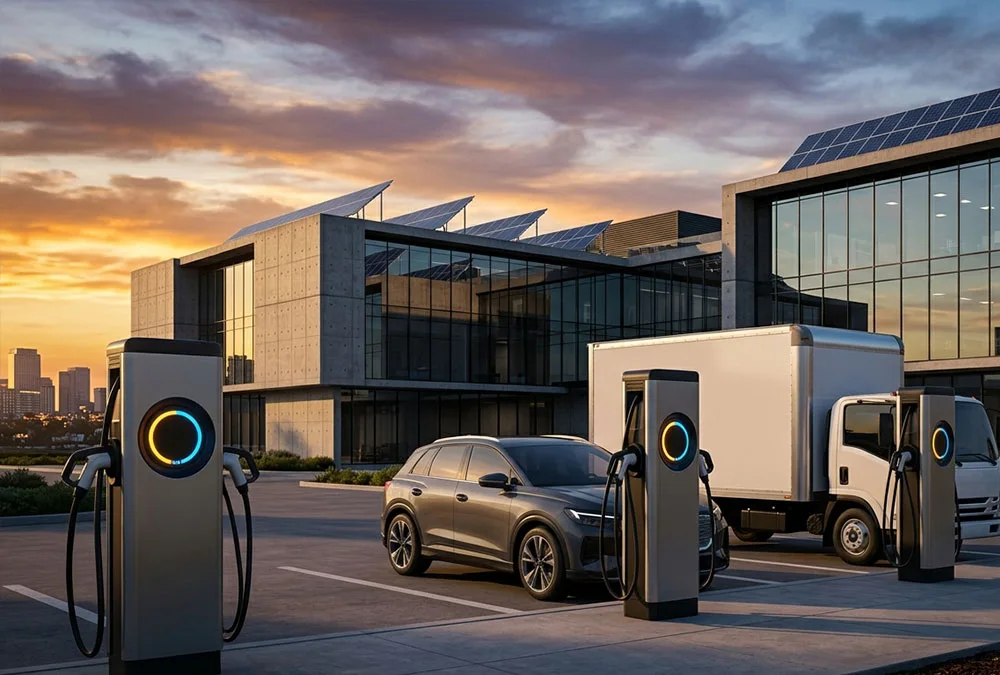
When commercial facility managers and fleet operators look at a parking lot full of electric delivery vans or employee cars, they usually see a massive utility liability. But early adopting business leaders are realizing that deploying Commercial Bidirectional EV Charging transforms those parked batteries into dynamic energy resources. According to research by the Electric Power Research Institute (EPRI) and NREL, bidirectional energy management can reduce facility peak demand charges by up to 30-45% when integrated with fleet dispatch schedules. By enabling power to flow both into the vehicle and back into building switchboards or utility grids, bidirectional systems redefine how enterprises manage high peak electricity rates.
However, transitioning to two-way charging involves technical choices regarding standard smart charging vs bidirectional power, OEM vehicle compatibility, and regional grid interconnection standards. In this technical guide, we break down real-world deployment costs, global grid certification requirements, and hardware selection steps to help you decide if commercial bidirectional EV charging fits your site’s energy profile.
What Is Commercial Bidirectional EV Charging?
At its core, standard charging moves alternating current (AC) from the grid through an EV charger, where the car converts it into direct current (DC) to store in its battery pack. Commercial Bidirectional EV Charging removes this single-direction limitation by allowing dual-quadrant inverters to discharge stored DC power from the EV battery, convert it back into AC power, and feed it straight into commercial electrical switchboards or the public utility grid under strict compliance with international grid codes like IEEE 1547 and IEC 61851-23.
Bidirectional Charging vs. Conventional EV Charging
The core difference between traditional and bidirectional architecture comes down to power control and dual-quadrant inversion capability:
Conventional Charging Flow:
Grid → EV Charger → Vehicle Battery (One-Way Consumption)
Bidirectional Charging Flow:
Grid ↔ EV Charger ↔ Vehicle Battery (Two-Way Power Flow via ISO 15118-20 / IEC 61851)
Featured Insight: Bidirectional charging is the underlying physical power-flow capability, while V2G, V2B and V2H describe specific operational topology applications recognized by smart grid standards.
What Is a Commercial Bidirectional EV Charging System?
A commercial bidirectional charging system is more than a charger. It functions as an integrated microgrid hub certified under national grid safety standards, requiring precise communication between several hardware and software sub-components:
- EV Battery Pack: The mobile electrochemical storage asset (ranging from 60 kWh in light commercial vehicles to over 200–500 kWh in heavy electric trucks and transit buses).
- Commercial Bidirectional EV Charger: Advanced dual-quadrant AC wallbox or DC fast charger equipped with SiC (Silicon Carbide) power conversion electronics and UL 1741 SB / IEC 62477-1 certification.
- Energy Management System (EMS): The software engine executing real-time dispatch decisions based on tariff rates, vehicle departure schedules, and facility load profiles using OpenADR 2.0b and OCPP 2.0.1 protocols.
- Grid Interconnection & Metering: Utility-grade bidirectional meters, ANSI C12.20 / MID-certified revenue meters, protective relays, and rapid anti-islanding contactors enforcing grid safety.
- Building Switchboard & Facility Load: Main distribution boards designed for reverse power flow injection, protected by directional circuit breakers.
- EV Fleet Deployment: Operational vehicles providing controllable battery storage during non-shift dwell windows.
- Solar PV & BESS (Optional Integration): Local renewable generation and stationary battery energy storage systems (BESS) acting alongside mobile batteries.
V2G vs V2B vs V2H vs V2X Topology Breakdown
The term V2X charging serves as a broad operational umbrella defined by SAE J3072 guidelines. Depending on energy flow destinations, engineers apply specific technical topologies:
| Technology | Energy Flow | Main Use | Typical Application & Standards |
|---|---|---|---|
| V2G (Vehicle-to-Grid) | EV ↔ Grid | Frequency regulation & grid capacity markets | Fleets, transit depots (IEEE 1547 / G99 compliant) |
| V2B (Vehicle-to-Building) | EV ↔ Building | Peak demand charge management & emergency backup | Commercial offices, logistics hubs (UL 1741 SB / VDE-AR-N 4105) |
| V2H (Vehicle-to-Home) | EV ↔ Home | Residential resilience & solar optimization | Single-family homes, small private garages |
| V2X (Vehicle-to-Everything) | EV ↔ Any System | Integrated microgrid & dynamic multi-asset dispatch | Industrial campuses, smart cities (SAE J3072 / ISO 15118-20) |
What Are the Commercial Applications of Bidirectional EV Charging?
Where can enterprise facilities deploy two-way power capabilities? Application pathways depend heavily on vehicle duty cycles, site utility rate structures, and regional grid regulations.
Bidirectional EV Charging for Fleets
Commercial vehicle depots represent the primary use case for bidirectional deployment. School buses, municipal service vehicles, and delivery fleets remain parked during predictable windows. According to U.S. Department of Energy (DOE) fleet studies, school buses spend over 80% of summer peak energy hours idle, making them ideal assets for utility grid stabilization. However, fleet operators must enforce a strict priority rule: vehicle route completion always takes precedence over power export schedules.
Commercial V2B Charging Systems for Facilities
A commercial V2B charging system protects facilities against severe utility demand charges. Commercial electricity invoices typically charge high rates based on a facility’s peak 15-minute kW demand interval. By discharging power from connected EVs into the internal distribution switchboard during high-load manufacturing shifts, enterprises can effectively shave energy spikes down without interrupting operations.
Commercial V2G Charging Systems for Grid Services
Deploying a commercial V2G EV charger enables fleet operators to aggregate battery capacity into Virtual Power Plant (VPP) networks. When regional grid operators experience extreme load events, automated signals (via OpenADR 2.0b) trigger controlled vehicle discharges, yielding capacity and ancillary service revenues for fleet owners.
Commercial Bidirectional EV Charging System with Solar and BESS
Integrating solar PV generation with vehicle batteries creates a resilient, low-carbon microgrid. A commercial bidirectional EV charging system with solar and BESS ensures daytime solar production charges stationary battery systems and parked vehicles. During high-cost evening rate windows, the central EMS coordinates both battery systems to power facility loads, minimizing grid electricity imports.
How Does a Commercial Bidirectional EV Charging System Work?
To visualize how these hardware and software components interface under global grid standards, review this commercial microgrid architecture:
↓
Utility Grid ↔ EMS (OpenADR) ↔ Bidirectional Charger ↔ EV Fleet (ISO 15118-20)
↕ ↕
Stationary BESS Building Switchboard & Load
System Architecture Roles:
• Grid: Delivers utility power and receives regulated V2G power exports.
• EV Fleet: Mobile battery assets providing bidirectional energy capability.
• Bidirectional Charger: Executes dual-quadrant AC/DC power conversion and safety isolation.
• EMS: Analyzes tariff schedules, building load profiles, and vehicle SOC to dispatch power.
• Solar PV: Supplies on-site renewable power for charging and building loads.
• BESS: Fixed stationary battery storage that maintains baseline site resilience.
• Building Load: Facility electrical consumption offset by discharging vehicle batteries.
ISO 15118 vs. OCPP: Key Protocol Differences
Distinguishing between vehicle communication protocols and network management standards is crucial for technical engineering teams:
- ISO 15118 (ISO 15118-20): Regulates communication between the Vehicle (EV) and the Charger (EVSE). ISO 15118-20 specifies bidirectional power flow, dynamic charging profiles, and encrypted Plug & Charge authentication.
- OCPP (OCPP 2.0.1 / 2.1): Regulates communication between the Charger and the CSMS / EMS Cloud Platform. It enables remote command execution, tariff management, and VPP aggregation control.
Technical Note: Basic OCPP support does not inherently guarantee bidirectional functionality. Chargers must explicitly feature dual-quadrant power electronics certified to regional grid standards alongside ISO 15118-20 compatibility.
Regional Grid Certifications & Technical Requirements
Because bidirectional EV chargers inject electrical power back into commercial building switchboards and utility infrastructure, certification requirements vary significantly across geographic regions. Commercial buyers must verify compliance with local grid interconnections, electrical codes, and safety standards before deployment.
| Region | Safety & Inverter Standards | Grid Interconnection Rules | Communication Protocols | Key Technical Focus |
|---|---|---|---|---|
| North America (US & Canada) | UL 1741 SB, UL 2231-1/-2, UL 9741 (V2G EVSE standard) | IEEE 1547-2018, California Rule 21, Hawaii Rule 14H | SAE J3072, ISO 15118-20, OpenADR 2.0b | Anti-islanding protection, rapid grid disconnect, smart inverter volt-VAR response. |
| European Union (EU) | IEC 61851-23/24, IEC 62477-1, CE Mark / Low Voltage Directive | EN 50549-1 / EN 50549-2, VDE-AR-N 4105 (Germany), Redes Eléctricas (Spain) | ISO 15118-20, OCPP 2.0.1, EEBUS | Harmonic distortion limits, frequency containment response (FCR), European grid safety compliance. |
| United Kingdom (UK) | BS EN 61851, UKCA Compliance, EV Smart Charge Points Regs | ENA Engineering Recommendation G99 (Loss of Mains protection), G100 | ISO 15118-20, OpenADR, OCPP 2.0.1 | Export limitation management (G100), automated demand response capabilities. |
| Asia-Pacific (APAC / Japan / Aus) | AS/NZS 4777.2 (Australia), CHAdeMO V2H Standard (Japan), GB/T (China) | National Electricity Rules (NER), JET Guidelines (Japan) | ISO 15118, CHAdeMO 2.0/3.0, OCPP 2.0.1 | Grid isolation relays, strict emergency backup transfer switching times. |
Detailed Breakdown of Core Regional Requirements
- North American Market Requirements: In North America, dual-quadrant inverters inside bidirectional chargers must comply with UL 1741 SB (Supplement B for Smart Inverters) and UL 9741 (Dedicated standard for Electric Vehicle Power Export Systems). The interconnection must follow IEEE 1547-2018 to protect line workers by disconnecting within milliseconds during a grid outage unless configured as an isolated islanded microgrid. Additionally, state-level regulations such as California Rule 21 require active volt-AMP-reactive control.
- European Union & UK Market Requirements: European projects demand adherence to IEC 61851-23/24 for DC power transfer and EN 50549-1/2 for power generation assets connected to low-voltage distribution networks. In Germany, compliance with VDE-AR-N 4105 is strictly enforced by distribution system operators (DSOs). In the UK, systems exporting energy into the utility network must obtain certification under Energy Network Association (ENA) EREC G99 and deploy G100 export limitation hardware to prevent switchboard overloads.
- Asia-Pacific Market Requirements: Australia requires all grid-tied bidirectional chargers to hold AS/NZS 4777.2:2020 certification for grid connection of energy systems via inverters. In Japan, bidirectional power transfer historically relies on certified CHAdeMO V2H/V2G protocol guidelines backed by JET (Japan Electrical Testing Laboratories) safety approvals, though CCS/ISO 15118-20 adoption is expanding in industrial applications.
What Are the Benefits of Commercial Bidirectional EV Charging?
By transforming parked fleets into dispatchable storage, enterprise facilities unlock layered financial and operational benefits.
Commercial Bidirectional Charging Value Stack
| Value Layer | Primary Objective | Example Operational Scenario |
|---|---|---|
| Charging Optimization | Shift charging away from high rates | Charging delivery vans overnight during low off-peak tariff periods |
| Peak Demand Management | Reduce high facility monthly demand spikes | Discharging EV power into building switchboards during heavy plant equipment starts |
| Solar Self-Consumption | Store and use on-site solar generation | Charging EVs during daytime solar peaks; discharging during evening facility operations |
| Energy Resilience | Maintain emergency backup power | Powering critical IT servers or cold storage using fleet batteries during grid blackouts |
| Grid Services (VPP) | Monetize fleet batteries via utility programs | Exporting stored energy during regional grid events to earn capacity payments |
What Are the Limitations and Risks of Commercial Bidirectional Charging?
To keep project assessments grounded in real-world feasibility, facility management teams must evaluate technical challenges alongside revenue projections:
- Vehicle Firmware & Hardware Compatibility Gaps: Not all commercial EVs natively support reverse power dispatch. Compatibility must be verified directly with vehicle OEMs.
- Operational Schedule Constraints: Vehicle dispatch routes must always take precedence over energy discharge cycles. If vehicles leave early, facility peak shaving performance may be affected.
- Higher Initial Capital Expenditure (CapEx): Bidirectional DC fast chargers require advanced dual-quadrant power electronics, resulting in higher equipment costs than unidirectional chargers.
- Battery Degradation Controls: Increased battery cycling requires strict software controls. Operating within 20% to 80% State of Charge (SOC) buffers helps preserve battery health over time.
- Utility Interconnection Permitting Lead Times: Obtaining approval for grid power injection (under standards like IEEE 1547 or ENA G99) can extend project development timelines depending on regional utility capacity.
How Much Does Commercial Bidirectional EV Charging Cost?
Cost Drivers for Commercial Bidirectional Systems
Unlike simple residential wallboxes, evaluating a commercial bidirectional EV charger cost involves multiple technical design factors:
- Power Output & Voltage Rating: A 19.2 kW AC bidirectional charger costs substantially less than a 60 kW to 180 kW DC fast bidirectional terminal.
- AC vs. DC Architecture: DC bidirectional chargers relocate power conversion hardware from the vehicle into the charging terminal, increasing equipment costs while widening vehicle compatibility.
- Interconnection & Control Software: Licensing fees for cloud EMS platforms, ISO 15118-20 protocol stacks, and VPP control capabilities.
Charger Cost vs. Total Project Budget
Purchasing charging terminals accounts for only a portion of total project capital expenditure:
Payback Period Calculation Method
Payback Period (Years) = Total Initial Project Cost ÷ Annual Net Financial Savings
Where Annual Net Financial Savings equals Demand Charge Reductions + TOU Rate Arbitrage + Utility Grid Revenues minus Annual Operating & Maintenance Costs.
Is Commercial Bidirectional EV Charging Worth the Investment?
Evaluating bidirectional charging investments requires matching facility energy goals with physical site infrastructure.
Commercial Strategy Decision Matrix
| Project Site Profile | Recommended System Strategy | Primary Financial Benefit |
|---|---|---|
| Basic charging needs, flat utility rates | Standard Unidirectional Smart Charging (V1G) | Lowest initial capital investment |
| High utility demand fees, vehicles idle during peak shifts | Commercial V2B Bidirectional System | Direct reduction in monthly demand charges |
| On-site solar PV generation, multi-shift fleet operations | V2B + Solar PV + Stationary BESS Microgrid | Maximized solar self-consumption and site resilience |
| Uninterrupted 24/7 backup power requirement | Dedicated Commercial BESS System | Guaranteed fixed energy backup independent of vehicle movement |
Pairing Bidirectional Fleets with Commercial BESS Products
Because vehicle fleets operate on transit schedules, robust microgrids combine bidirectional EV chargers with stationary Battery Energy Storage Systems (BESS). Below are standard stationary BESS options designed to maintain baseline power resilience when vehicle fleets are off-site:
| BESS Capacity | Target Facility Type | Core Value Proposition | Buyer Decision Advantage |
|---|---|---|---|
| 100 kWh BESS Cabinet | Small commercial facilities, retail sites | Compact outdoor footprint, turnkey load management | Lower initial CapEx; easily integrates adjacent to existing distribution panels without major civil work. |
| 261 kWh Liquid-Cooled BESS | Medium industrial plants, fleet depots | Liquid thermal control, sustained continuous discharge rates | Advanced liquid cooling maintains battery cycle life under heavy daily peak shaving cycles compared to standard air-cooled designs. |
| 418 kWh – 1 MWh BESS Container | Large logistics hubs, transit depots | Modular containerized footprint, VPP integration ready | Provides complete microgrid islanding for industrial facilities, maintaining power continuity during extended utility blackouts. |
How to Choose a Commercial Bidirectional EV Charging System
Follow these technical procurement steps when evaluating a bidirectional EV charger for commercial buildings:
- 1. Confirm Regional Grid & Safety Compliance: Verify charger certifications (UL 1741 SB / UL 9741 in North America, IEC 61851 / EN 50549 in Europe, AS/NZS 4777.2 in Australia).
- 2. Match Output Capacity to Fleet Dwell Windows: Evaluate whether low-power AC or high-power DC bidirectional terminals fit your fleet’s daily parking schedules.
- 3. Ensure Protocol Compatibility: Confirm full implementation of ISO 15118-20 between vehicles and terminals, alongside OCPP 2.0.1 for central software controls.
- 4. Assess EMS Optimization Features: Select an Energy Management System capable of coordinating EV chargers, solar generation, BESS units, and main building load meters.
- 5. Verify Vehicle OEM Warranty Protections: Confirm that bidirectional battery usage adheres to manufacturer warranty guidelines.
How to Pilot a Commercial Bidirectional EV Charging Project
Deploying bidirectional charging across commercial infrastructure works best using a phased rollout:
- Select a Pilot Vehicle Fleet: Install 2 to 4 bidirectional chargers on vehicles operating on consistent daily routes.
- Establish Historical Utility Baselines: Record building energy consumption profiles and demand fee spikes for 60 days prior to enabling bidirectional discharge.
- Validate Discharge Performance: Monitor V2B peak shaving efficiency, State of Charge management, and driver schedule adherence.
- Fine-Tune EMS Settings: Adjust EMS software dispatch parameters to optimize financial returns while preserving battery health.
- Expand System Deployment: Scale charger installations across fleet depots after verifying financial savings and grid compliance.
Common Commercial Bidirectional EV Charging Mistakes
Avoid these common project design oversights:
- Procuring Equipment Prior to Vehicle Validation: Purchasing bidirectional hardware without written compatibility confirmation from EV manufacturers.
- Assuming Basic OCPP Guarantees V2G Support: Assuming standard OCPP compliance implies bidirectional dynamic power control.
- Neglecting Fleet Departure Requirements: Discharging vehicle batteries during peak windows without reserving enough energy for upcoming transport routes.
- Underestimating Grid Interconnection Lead Times: Overlooking local utility interconnection filing requirements (such as IEEE 1547 or ENA G99 approvals).
Commercial Bidirectional EV Charging FAQ
What is commercial bidirectional EV charging?
Commercial bidirectional EV charging is a two-way energy management system allowing electric vehicles to charge from the grid and discharge power back to building switchboards (V2B) or public electrical grids (V2G) under certified grid safety standards.
What standard governs bidirectional vehicle-to-charger communication?
ISO 15118-20 serves as the primary international standard defining bidirectional power flow and digital communication between electric vehicles and bidirectional chargers.
What safety standards are required for V2G chargers in North America and Europe?
In North America, chargers must meet UL 1741 SB and IEEE 1547-2018 standards. In Europe, compliance with IEC 61851-23/24, IEC 62477-1, and EN 50549-1/2 grid connection standards is required.
Can V2B charging lower commercial electricity bills?
Yes. Discharging vehicle battery energy during high facility load periods reduces peak demand kW spikes, lowering monthly utility demand fees.
Does bidirectional discharging void vehicle battery warranties?
Major commercial EV manufacturers approve bidirectional operation when controlled by certified EMS software within recommended battery SOC limits (e.g., 20% to 80%).
Commercial Bidirectional EV Charging Solutions
Whether managing a logistics depot, an industrial plant, or a commercial office building, implementing bidirectional EV charging infrastructure requires specialized engineering. Our team delivers turnkey microgrid design, certified hardware selection, and EMS platform integration tailored to regional utility grid requirements.
Request a Technical Site & Regional Compliance Assessment
Planning to deploy DC bidirectional fast terminals, rooftop solar integration, or stationary BESS units? Connect with our microgrid engineers to evaluate your regional grid codes, verify equipment compatibility, and project your financial ROI.
Related Article
 https://anengjipower.com/wp-content/uploads/2026/06/epc-vs-turnkey-solar-project-bess.webp
675
1000
Charging Station Engineer
https://anengjipower.com/wp-content/uploads/2025/09/anengji-dc-fast-charging-station-manufacturer-and-supplier-logo-white-1.png
Charging Station Engineer2026-06-22 07:16:042026-06-24 07:13:17What Is the Difference Between EPC and Turnkey Contract Models in Energy Projects?
https://anengjipower.com/wp-content/uploads/2026/06/epc-vs-turnkey-solar-project-bess.webp
675
1000
Charging Station Engineer
https://anengjipower.com/wp-content/uploads/2025/09/anengji-dc-fast-charging-station-manufacturer-and-supplier-logo-white-1.png
Charging Station Engineer2026-06-22 07:16:042026-06-24 07:13:17What Is the Difference Between EPC and Turnkey Contract Models in Energy Projects? https://anengjipower.com/wp-content/uploads/2026/06/anengji-commercial-solar-plus-storage-benefits-site.webp
675
1000
Charging Station Engineer
https://anengjipower.com/wp-content/uploads/2025/09/anengji-dc-fast-charging-station-manufacturer-and-supplier-logo-white-1.png
Charging Station Engineer2026-06-20 14:34:102026-06-20 14:37:43What Are the Top Benefits of Solar Battery Storage in Factories?
https://anengjipower.com/wp-content/uploads/2026/06/anengji-commercial-solar-plus-storage-benefits-site.webp
675
1000
Charging Station Engineer
https://anengjipower.com/wp-content/uploads/2025/09/anengji-dc-fast-charging-station-manufacturer-and-supplier-logo-white-1.png
Charging Station Engineer2026-06-20 14:34:102026-06-20 14:37:43What Are the Top Benefits of Solar Battery Storage in Factories? https://anengjipower.com/wp-content/uploads/2026/06/modular-commercial-solar-battery-storage-cabinet.webp
675
1000
Charging Station Engineer
https://anengjipower.com/wp-content/uploads/2025/09/anengji-dc-fast-charging-station-manufacturer-and-supplier-logo-white-1.png
Charging Station Engineer2026-06-18 09:16:522026-07-03 03:05:13What Is Solar Battery Storage? Complete C&I Engineering Guide
https://anengjipower.com/wp-content/uploads/2026/06/modular-commercial-solar-battery-storage-cabinet.webp
675
1000
Charging Station Engineer
https://anengjipower.com/wp-content/uploads/2025/09/anengji-dc-fast-charging-station-manufacturer-and-supplier-logo-white-1.png
Charging Station Engineer2026-06-18 09:16:522026-07-03 03:05:13What Is Solar Battery Storage? Complete C&I Engineering Guide


Leave a Reply
Want to join the discussion?Feel free to contribute!