
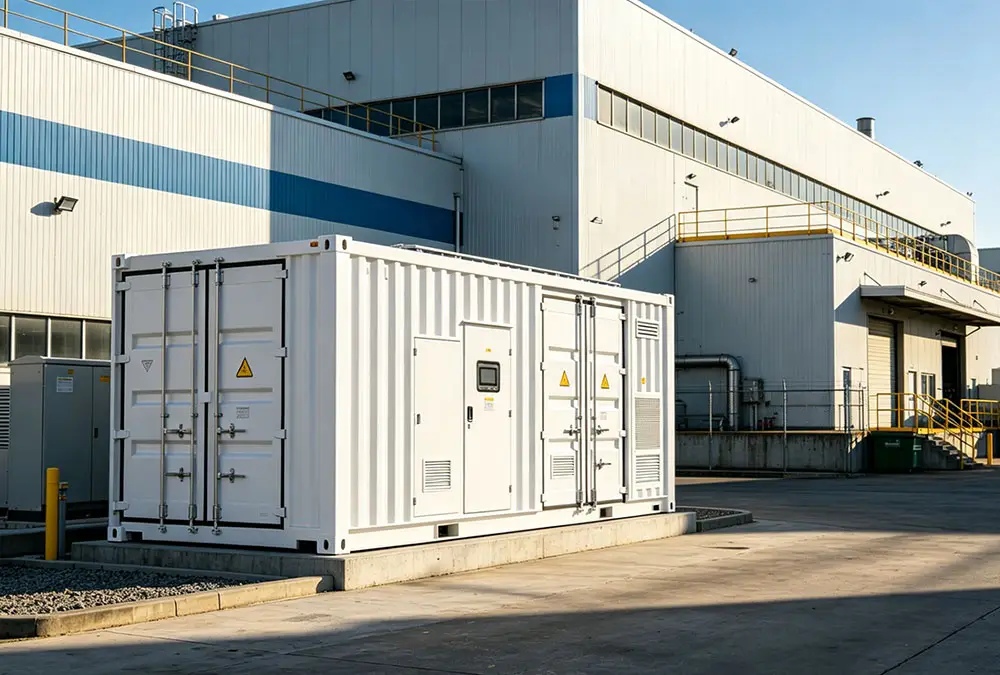
Introduction
Unprecedented utility tariff hikes, extreme grid destabilization, and strict corporate ESG targets leave plant managers, EPC contractors, and energy project developers under constant pressure. Industrial energy buyers cannot rely on legacy electrical distribution grids that subject facilities to severe peak demand charges and costly power outages. Deploying a commercial or utility-scale lithium battery energy storage project directly solves these operational bottlenecks. By capturing low-cost off-peak generation, smoothing dynamic load spikes, and providing sub-second grid support, high-density battery storage transforms static electrical infrastructure into an agile, revenue-generating asset.
Buyer Perspective: “How do we prevent early capacity fade and preserve 10+ year CAPEX assumptions?”
Engineers often fear capacity fade ruin financial projections. The primary driver of early degradation is non-uniform cell temperature distribution across large battery strings. Unbalanced micro-climates inside enclosures accelerate Solid Electrolyte Interphase (SEI) layer growth on anode surfaces. Modern industrial BESS solves this by shifting from forced-air HVAC to multi-stage liquid cooling cold-plates. This maintains strict inter-cell temperature variances under 2.5°C, ensuring battery cells complete over 6,000 to 8,000 full operational cycles while retaining 70% state of health (SOH).
What Is Lithium Battery Energy Storage System?
A lithium battery energy storage system (BESS) is an integrated electro-chemical engineering setup designed to absorb, store, and dispatch high-density electrical power. At its core, the system acts as a bi-directional power reservoir, converting Alternating Current (AC) from utility feeds or solar arrays into Direct Current (DC) stored within specialized battery chemistry structures, and releasing it back as clean AC power on demand.
Understanding Lithium Battery Energy Storage Technology
To understand system mechanics, we examine how energy moves through the electrochemical interface during cycling. When charging, lithium ions (Li+) migrate from the cathode through an organic electrolyte solution, inserting themselves into the graphite or synthetic anode host matrix (intercalation). During discharge, the physical process reverses, releasing electrons through an external circuit to power heavy commercial machinery.
Research published by the Clean Energy Institute at the University of Washington emphasizes that the fundamental electrochemistry of lithium-ion technology gives it an inherent advantage: lithium has the lowest reduction potential of any chemical element, granting it the highest energy density per unit mass compared to alternative metals.
- Energy Charge Phase: Excess AC power from a lithium battery energy storage solutions for solar power array passes through a bi-directional inverter, converting AC to DC to drive lithium-ion intercalation into the anode layer.
- Energy Retention Phase: Chemically bound lithium ions hold charge within the lattice structure with minimal self-discharge (less than 1.5% per month).
- Power Discharge Phase: Upon EMS dispatch signals, de-intercalation transfers stored energy back through bi-directional power conversion units to offset plant load spikes.
Why Lithium Is Used in Battery Energy Storage Systems
The global industrial sector shifted away from lead-acid and nickel-cadmium solutions because of energy density limits and severe memory effects. A lithium battery storage system operates at higher nominal cell voltages (3.2V to 3.7V depending on chemistry versus 2.0V for lead-acid), drastically reducing the physical string counts needed to build high-voltage (1000V–1500V DC) battery architectures. This compact physical footprint allows factory managers to install megawatt-scale BESS solutions in tight outdoor utility footprints.
Why Choose Lithium Instead of Other Battery Materials for Energy Storage?
When choosing energy storage assets for commercial or grid projects, procurement engineers evaluate lifetime levelized cost of storage (LCOS), footprint constraints, and round-trip efficiency (RTE). Alternative chemistries often present hidden costs in physical footprint, thermal HVAC maintenance, or low energy efficiency.
Lithium Battery vs Traditional Energy Storage Technologies
Recent technological benchmarking published in peer-reviewed journals like Renewable and Sustainable Energy Reviews (ScienceDirect) confirms that lithium-based BESS architectures maintain superior round-trip efficiency (RTE exceeding 88–92%) compared to flow batteries (65–75%) and pumped hydro installations (70–80%).
| Technology Type | Energy Density (Wh/kg) | Round-Trip Efficiency (RTE) | Cycle Life (80% DOD) | Direct Engineering & Buyer Benefit |
|---|---|---|---|---|
| Lithium (LFP) | 140 – 170 Wh/kg | 88% – 93% | 6,000 – 10,000 cycles | Lowest overall LCOS, minimal land consumption, rapid setup without civil earthworks. |
| Lead-Acid (AGM/Gel) | 30 – 50 Wh/kg | 70% – 80% | 500 – 1,200 cycles | Low upfront capital expenditure, but short cycle life requires full battery replacement every 3 years. |
| Vanadium Redox Flow | 15 – 25 Wh/kg | 65% – 75% | 15,000+ cycles | Ideal for 8+ hour continuous discharge, but massive physical footprints increase site civil work cost. |
| Sodium-Ion (Na-Ion) | 100 – 130 Wh/kg | 82% – 88% | 3,000 – 5,000 cycles | Strong low-temperature performance, though mature commercial manufacturing supply chains remain developing. |
Why Lithium Iron Phosphate (LFP) Battery Is Widely Used in BESS
While Nickel Manganese Cobalt (NMC) chemistries dominated early electric vehicle platforms due to high volumetric energy density, the stationary energy storage sector has overwhelmingly standardizes on Lithium Iron Phosphate (LFP).
Technical Terminology Breakdown: LFP Chemical Stability
Strong P-O Covalent Bonds: Unlike the weaker metal-oxygen bonds in NMC cells, LFP cathode structures feature strong phosphorus-oxygen (P-O) covalent bonds within the PO4 tetrahedral units.
Thermal Runaway Suppression: During extreme mechanical damage or electrical shorting, LFP chemistry releases heat at a drastically lower rate and resists oxygen release up to 500°C (compared to 210°C for NMC cells), virtually eliminating thermal runaway cascade risks in an industrial lithium battery energy storage system.
How Does Lithium Battery Energy Storage System Work?
A complete containerized battery energy storage system operates through a multi-tiered control architecture. System execution coordinates electrochemistry, hardware switching, real-time sensing, and supervisory software algorithms.
Battery System: The Core Energy Storage Unit
The physical stack begins at individual prismatic cell units. Cell terminals are laser-welded via copper-aluminum busbars into battery modules. Modules are organized into vertical battery racks rated from 700V to 1500V DC. Modern high-voltage configurations minimize current draw, reducing resistive thermal losses ($I^2R$) across inter-rack cabling.
Battery Management System (BMS): Ensuring Battery Safety and Performance
The Battery Management System (BMS) operates across a three-layer hierarchy (Cell Level Slave BMS, Rack Level Master BMS, System Level Controller).
- Active Cell Balancing: Redistributes charge between high-and-low voltage cells during operation to maximize total usable pack energy capacity.
- State of Charge (SOC) & State of Health (SOH) Estimation: Employs adaptive Kalman Filter algorithms to measure state parameters, preventing over-charge or over-discharge stress.
- Fault Protection Triggers: Executes millisecond isolations via DC contactors upon detecting over-current, short-circuits, or insulation resistance drops.
Power Conversion System (PCS): Managing Energy Conversion
The Power Conversion System (PCS) serves as the bi-directional inverter bridge connecting the DC battery voltage bus to the site’s three-phase AC distribution busbar. Utilizing high-frequency Insulated Gate Bipolar Transistors (IGBTs) or Silicon Carbide (SiC) power electronics, modern PCS units achieve higher than 98.5% conversion efficiency. They deliver four-quadrant active ($P$) and reactive ($Q$) power controls required for strict utility grid compliance.
Energy Management System (EMS): Intelligent Energy Optimization
The Energy Management System (EMS) controls overall system dispatch strategies. Communicating via industrial Modbus TCP or IEC 60870-5-104 protocols, the EMS monitors plant meter points, dynamic utility pricing schedules, and real-time site generation data. It triggers precise battery cycling modes including peak shaving, solar self-consumption smoothing, and tariff arbitrage automatically.
Thermal Management and Safety System
Industrial BESS enclosures integrate active HVAC or closed-loop liquid chillers alongside multi-stage fire safety networks. Thermal isolation plates prevent heat spread between cells. Safety suites include off-gas detection sensors (detecting early hydrogen or carbon monoxide venting), ambient smoke detectors, Novec 1230 / FK-5-1-12 gaseous fire suppression, and emergency dry-pipe sprinkler connections meeting strict international standards.
Main Types of Lithium Battery Energy Storage Systems
Energy storage designs vary significantly based on scale, voltage connections, and duty cycles. Choosing the right system architecture ensures maximum operational effectiveness.
Residential Lithium Battery Energy Storage Systems
Engineered for residential rooftop solar applications, these compact wall-mounted or floor-standing systems operate between 5kWh and 30kWh capacity range. They enable high self-consumption of clean solar generation, providing emergency backup power during localized residential blackout events.
Commercial and Industrial Lithium Battery Energy Storage Systems
Designed for commercial buildings, manufacturing plants, and processing facilities, commercial storage solutions range from 100kWh cabinets to multi-megawatt outdoor setups. These units allow commercial buyers to avoid expensive utility demand spikes and gain grid resiliency.
Off-Grid and Remote Lithium Battery Energy Storage Solutions
Isolated mining operations, island networks, and agricultural facilities rely on specialized off-grid BESS assets. Operating alongside micro-grid controllers and solar arrays, a specialized lithium ion battery energy storage system for commercial use eliminates high diesel fuel logistical costs while delivering clean continuous power.
Backup and Emergency Lithium Battery Storage Systems
Mission-critical environments like data centers, hospitals, and semiconductor cleanrooms require Uninterruptible Power Supply (UPS) capabilities. High-rate lithium battery systems instantly inject megawatt power within milliseconds, filling grid dropouts smoothly until diesel generators pick up full standby loads.
Key Applications of Lithium Battery Energy Storage Technology
Commercial energy storage systems perform multiple operational roles simultaneously, stacked to unlock compound savings and grid revenues.
Lithium Battery Storage for Solar Energy Systems
Solar generation suffers from diurnal duck curve mismatch—producing peak solar energy around noon when industrial load profiles may stay low. Paired storage absorbs excess solar generation during midday periods, discharging energy during late afternoon peak tariff hours to maximize onsite clean power utilization.
Lithium Battery Energy Storage for Grid Stabilization
Transmission system operators utilize large-scale grid scale battery storage assets to supply fast frequency response (FFR), primary frequency regulation, and voltage control services. When thermal power plant trips occur on the transmission network, BESS assets react within 100 milliseconds to preserve grid balance.
Lithium Battery Storage for EV Charging Infrastructure
High-power DC fast-charging stations (150kW to 360kW per plug) cause extreme, unpredictable demand surges on distribution feeders. Integrating an intermediate battery storage cabinet buffers electric vehicle charging demand spikes, keeping transformer distribution connection requests within budget.
Portable and Mobile Lithium Battery Energy Storage Applications
Trailerized skid-mounted battery enclosures provide portable high-power energy for urban construction, outdoor events, and mobile emergency power restoration efforts.
Advantages of Lithium Battery Energy Storage Systems
Buyer Perspective: “Are high initial turnkey BESS costs justified compared to low-cost alternatives?”
While initial upfront CAPEX for lead-acid or diesel generators appears lower, calculating lifetime Total Cost of Ownership (TCO) proves lithium’s financial advantage. Thanks to 90% round-trip efficiency, zero routine electrolyte top-offs, low HVAC parasitics, and 6,000+ cycle life, LFP lithium storage delivers a drastically lower cost per kWh cycled over a 15-year operational lifecycle.
High Energy Density for Space-Efficient Energy Storage
Volumetric efficiency allows system engineers to fit multi-megawatt systems inside standardized 20ft or 40ft ISO shipping container footprints, avoiding the need for dedicated brick-and-mortar battery buildings.
Long Cycle Life Reduces Total Cost of Ownership
Tier-1 LFP cells routinely deliver 6,000 to 8,000 full depth-of-discharge (80% DOD) cycles under controlled operating conditions. This extended lifecycle allows financial modeling over 12-to-15-year project periods without requiring expensive midpoint battery replacements.
Fast Charging Capability and High Energy Efficiency
Lithium batteries accept high continuous C-rates (0.5C to 1C charge, 1C to 2C discharge), allowing full capacity recharge in under 2 hours during narrow solar peak windows. High round-trip efficiency ensures minimal power losses during energy exchange.
Advanced Safety Management Improves System Reliability
Integrated digital sensors continuously feed operational telemetry into cloud-based predictive maintenance systems, preventing thermal issues before they disrupt facility operations.
How Lithium Battery Energy Storage Supports Renewable Energy Future
Decarbonizing industrial energy grids requires converting variable renewable resources into dispatchable, firm energy baseloads.
Enabling Solar and Wind Energy Integration
Grid operators frequently curtail solar and wind generation when peak output exceeds feeder capacity limits. Implementing industrial storage assets captures otherwise wasted clean energy, releasing it during tight grid conditions.
Improving Energy Independence and Grid Resilience
A commercial facility equipped with localized solar and battery assets can seamlessly isolate from utility grid blackouts, protecting automated assembly lines from expensive downtime.
Choosing the Right Lithium Battery Energy Storage Solution
Correct BESS hardware selection requires careful matching of capacity specifications, voltage matching, thermal cooling architectures, and system safety certifications.
Commercial & Industrial BESS Models for Turnkey Projects
Aligning BESS capacity to your plant 15-minute interval demand data avoids over-paying for unused capacity while delivering maximum peak demand savings:
- 100kWh Industrial Energy Storage Cabinet: Turnkey liquid-cooled cabinet with built-in 50kW PCS. Ideal for commercial EV fast-charging stations and small industrial workshops seeking demand charge relief.
- 261kWh Commercial All-In-One BESS: Integrated LFP battery racks, liquid cooling plate, smart BMS, and bi-directional PCS inverter. Optimized for medium manufacturing facilities looking to maximize solar self-consumption.
- 418kWh Heavy Industrial Energy Storage Unit: Extended 4-hour discharge duration unit designed for heavy industrial factories operating under long peak-tariff rate windows.
- 1MWh – 5MWh Containerized Energy Storage Systems: Fully equipped 20ft/40ft ISO container systems complete with automated aerosol fire protection, HVAC, liquid chillers, and EMS. Engineered for utility-scale solar farms, microgrids, and large industrial parks.
Select Storage Capacity Based on Energy Requirements
System sizing requires evaluating peak demand baseline curves ($kW$), daily energy consumption requirements ($kWh$), and maximum allowed interconnection limits.
| Facility Type | Typical Capacity Range | Primary Operational Strategy | Key Selection & Value Criterion |
|---|---|---|---|
| Residential / Light Commercial | 5kWh – 100kWh | Solar self-consumption & critical circuit backup | Compact wall footprint, quiet operation, simple AC coupling. |
| Commercial Buildings & Workshops | 100kWh – 261kWh | Peak shaving & demand charge reduction | Fast ROI payback driven by localized utility peak rate shaving. |
| Heavy Manufacturing Plants | 418kWh – 1MWh+ | Heavy load motor smoothing & phase balancing | High discharge C-rate capability combined with advanced liquid cooling. |
| Utility Solar Farms & Substations | 2MWh – 5MWh Containerized | Frequency regulation & energy arbitrage | High density, ISO modular container layout, SCADA utility integration. |
Consider Battery Chemistry, Safety, and Certification
Commercial deployment requires rigorous compliance with safety standards. Verify that BESS equipment suppliers hold complete third-party certification documentation:
- UL 1973: Standard for Batteries in Stationary Applications.
- UL 9540A: Test Method for Evaluating Thermal Runaway Fire Propagation in Battery Energy Storage Systems.
- IEC 62619: Safety Requirements for Secondary Lithium Cells and Batteries for Industrial Applications.
- NFPA 855: Standard for the Installation of Stationary Energy Storage Systems.
Choose an Experienced Storage Manufacturer
Selecting an experienced manufacturing partner ensures your project receives end-to-end engineering support—from early load profiling and system sizing to grid interconnection modeling, site commissioning, and long-term service level agreements (SLA).
Why Choose AnengJi Power Energy Storage Solutions
AnengJi Power delivers engineered, commercial, and utility-scale energy storage hardware designed to perform reliably in demanding operational environments.
Advanced Lithium Storage Technology
Our system engineering incorporates Tier-1 LFP chemistry, ultra-precise bi-directional PCS units, active liquid thermal management plates, and intelligent EMS software designed for demanding industrial cycling profiles.
Safe and Reliable System Engineering
Safety is built directly into our hardware design. AnengJi Power BESS units feature multi-layer cell telemetry monitoring, rapid gas detection, physical thermal propagation barriers, and integrated fire suppression setups meeting stringent international standards.
Flexible Energy Storage Solutions from kWh to MWh
Whether you require a compact 100kWh cabinet for commercial peak shaving or a multi-megawatt 5MWh containerized solution for a solar farm installation, AnengJi Power builds customized hardware matched to your operational requirements.
Key Takeaways: Energy Storage Systems Explained
What Is Lithium Battery Energy Storage?
Lithium battery energy storage uses advanced electrochemical cells to capture surplus electricity and supply it automatically during peak rate demand windows or power grid blackouts.
Why Are Lithium Batteries Preferred for Energy Storage?
LFP lithium units provide high energy density, 6,000+ cycle lifespans, sub-second fast response times, high round-trip energy efficiency (88-92%), and exceptional thermal safety stability.
What Are Key Commercial Storage Applications?
Industrial BESS solutions provide peak demand shaving, solar optimization, backup emergency power, EV fast-charging support, and grid microgrid stabilization.
Get Your Customized Energy Storage Sizing & ROI Analysis
Contact AnengJi Power application engineers today for a complete evaluation of your facility load profile, BESS configuration, and estimated project payback timeframe.
 https://anengjipower.com/wp-content/uploads/2026/06/epc-vs-turnkey-solar-project-bess.webp
675
1000
Charging Station Engineer
https://anengjipower.com/wp-content/uploads/2025/09/anengji-dc-fast-charging-station-manufacturer-and-supplier-logo-white-1.png
Charging Station Engineer2026-06-22 07:16:042026-06-24 07:13:17What Is the Difference Between EPC and Turnkey Contract Models in Energy Projects?
https://anengjipower.com/wp-content/uploads/2026/06/epc-vs-turnkey-solar-project-bess.webp
675
1000
Charging Station Engineer
https://anengjipower.com/wp-content/uploads/2025/09/anengji-dc-fast-charging-station-manufacturer-and-supplier-logo-white-1.png
Charging Station Engineer2026-06-22 07:16:042026-06-24 07:13:17What Is the Difference Between EPC and Turnkey Contract Models in Energy Projects? https://anengjipower.com/wp-content/uploads/2026/06/anengji-commercial-solar-plus-storage-benefits-site.webp
675
1000
Charging Station Engineer
https://anengjipower.com/wp-content/uploads/2025/09/anengji-dc-fast-charging-station-manufacturer-and-supplier-logo-white-1.png
Charging Station Engineer2026-06-20 14:34:102026-06-20 14:37:43What Are the Top Benefits of Solar Battery Storage in Factories?
https://anengjipower.com/wp-content/uploads/2026/06/anengji-commercial-solar-plus-storage-benefits-site.webp
675
1000
Charging Station Engineer
https://anengjipower.com/wp-content/uploads/2025/09/anengji-dc-fast-charging-station-manufacturer-and-supplier-logo-white-1.png
Charging Station Engineer2026-06-20 14:34:102026-06-20 14:37:43What Are the Top Benefits of Solar Battery Storage in Factories? https://anengjipower.com/wp-content/uploads/2026/06/modular-commercial-solar-battery-storage-cabinet.webp
675
1000
Charging Station Engineer
https://anengjipower.com/wp-content/uploads/2025/09/anengji-dc-fast-charging-station-manufacturer-and-supplier-logo-white-1.png
Charging Station Engineer2026-06-18 09:16:522026-07-03 03:05:13What Is Solar Battery Storage? Complete C&I Engineering Guide
https://anengjipower.com/wp-content/uploads/2026/06/modular-commercial-solar-battery-storage-cabinet.webp
675
1000
Charging Station Engineer
https://anengjipower.com/wp-content/uploads/2025/09/anengji-dc-fast-charging-station-manufacturer-and-supplier-logo-white-1.png
Charging Station Engineer2026-06-18 09:16:522026-07-03 03:05:13What Is Solar Battery Storage? Complete C&I Engineering Guide


Leave a Reply
Want to join the discussion?Feel free to contribute!