
Introduction
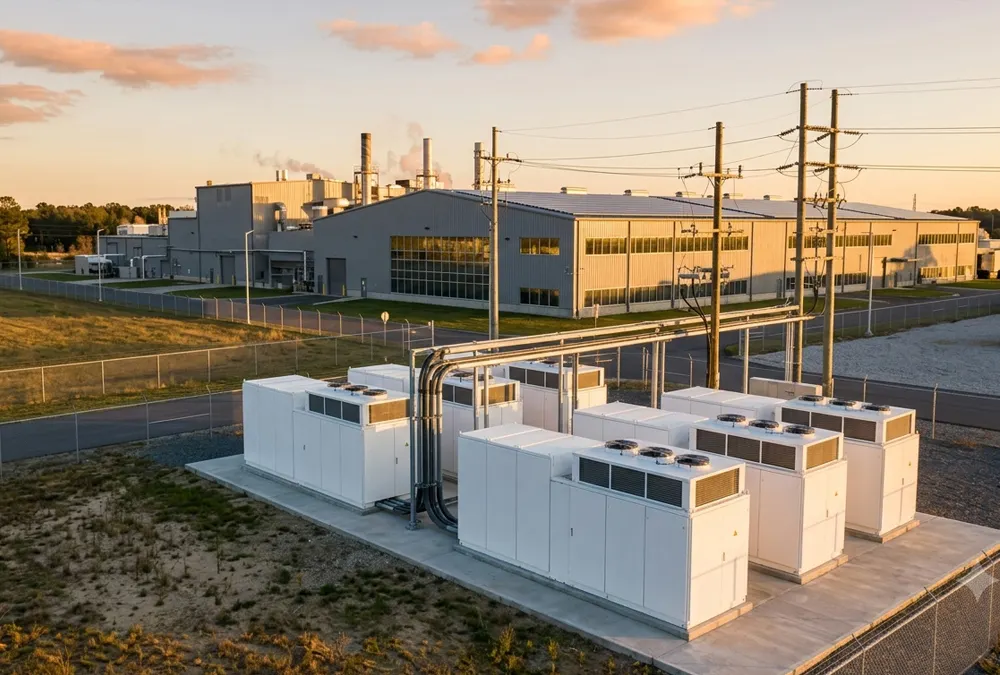
Surging electricity tariffs, sudden grid sags, and strict corporate ESG targets put severe operational pressure on plant managers today. You cannot rely on an aging grid that subjects your plant to unpredictable demand charges or line drops. Deploying a commercial or utility-scale lithium battery energy storage project directly solves these bottlenecks. By trapping cheap off-peak electricity, buffering heavy motor startup loads, and supplying sub-second emergency power, modern battery arrays turn static power distribution networks into active, cost-saving infrastructure.
Buyer Dilemma: “Will battery capacity fade ruin our 10-year project ROI calculations?”
Engineers often fear premature capacity degradation. Early stationary storage systems degraded rapidly because simple forced-air cooling allowed wide temperature swings across cell racks. Unbalanced internal cell climates accelerate Solid Electrolyte Interphase (SEI) growth on graphite anodes. Modern industrial BESS cabinets fix this with closed-loop liquid cooling cold-plates. They maintain inter-cell temperature variances strictly under 2.0°C across the cabinet. Tier-1 LFP cells comfortably deliver over 6,000 to 8,000 full daily cycles while holding 70% state of health (SOH) after 12+ years of operation.
What Is a Lithium Battery Energy Storage System?
A lithium battery energy storage system for BESS projects is an integrated electrochemical setup built to store and dispatch electric power on demand. At its core, the system operates as a bi-directional energy buffer. It converts AC grid electricity into DC power for electrochemical storage, and converts DC back into synchronized AC electricity when site loads peak.
Understanding Lithium Storage Technology
The physics behind a modern lithium battery energy storage system center on reversible ion insertion. During the charging phase, external voltage forces lithium ions ($\text{Li}^+$) to leave the cathode host lattice. The ions travel through an organic liquid electrolyte, entering the graphite anode layer via intercalation.
During discharge, the natural electrochemical potential gradient reverses this flow. Lithium ions de-intercalate from the anode, traveling back to the cathode. Meanwhile, liberated electrons flow through external power circuits, driving heavy factory machinery cleanly.
How Energy Storage Systems Work
A commercial lithium battery energy storage system manages three continuous operational cycles:
- Charging Routine: Surplus rooftop solar PV output or low-cost off-peak grid energy flows into the bi-directional inverter (PCS), converting AC power to DC to charge battery strings.
- Energy Retention Phase: Multi-tier BMS controllers track voltage profiles and thermal states, keeping battery self-discharge rates below 1.5% per month.
- Discharging Routine: Intelligent EMS software triggers rapid discharge during peak utility rate hours, feeding plant loads directly to eliminate expensive peak demand surcharges.
Why Lithium Is the Preferred BESS Technology
Industrial facility managers abandoned lead-acid and nickel-cadmium batteries long ago. Low energy density, high self-discharge, and toxic acid spills make legacy chemistries unviable for modern commercial sites.
Higher Energy Density for Compact Industrial Footprints
Modern LFP cells achieve gravimetric energy densities exceeding 160–185 Wh/kg and volumetric energy densities above 350 Wh/L. High energy density allows integrators to package up to 5MWh of usable capacity inside standard 20ft ISO container footprints. Factory owners can place large energy storage capacity on small outdoor concrete pads without sacrificing valuable manufacturing space.
Long Cycle Life Lowers Total Cost of Ownership
Evaluating energy storage economics requires examining the lifetime Levelized Cost of Storage (LCOS). According to recent research benchmark reports from the National Renewable Energy Laboratory (NREL) and BloombergNEF, utility-scale LFP battery assets deliver an LCOS below $0.07/kWh over a 15-year duty cycle.
High initial purchase prices are offset by long operational lifespans. Delivering over 6,000 continuous 100% Depth-of-Discharge (DOD) cycles dramatically lowers long-term capital replacement costs.
Fast Response and High Energy Efficiency
A modern lithium ion battery storage system switches from full charge to full discharge in under 20 milliseconds. High Round-Trip Efficiency (RTE between 89% and 93%) ensures very little electrical energy gets lost as resistive heat during daily energy arbitrage routines.
Why LiFePO4 Is the Best Choice for Energy Storage
Electric vehicle manufacturers often use Nickel Manganese Cobalt (NMC) cells to maximize driving range per kilogram. However, stationary commercial BESS deployments overwhelmingly prefer Lithium Iron Phosphate (LiFePO4 / LFP) chemistry.
What Is LiFePO4 Battery Technology?
LiFePO4 cathode structures feature strong phosphorus-oxygen ($\text{P-O}$) covalent bonds organized in an olivine crystal layout. The binding energy of the $\text{P-O}$ covalent bond is significantly higher than the nickel-oxygen or cobalt-oxygen bonds found in NMC chemistries.
Even under extreme electrical overcharge or ambient overheating up to 500°C, the LFP cathode lattice resists structural collapse and avoids releasing free oxygen gas. This structural stability prevents self-sustaining thermal runaway cascades.
LiFePO4 vs Other Lithium Chemistries
Comparing core electrochemical attributes reveals clear practical advantages for commercial energy storage buyers:
| Technology Parameter | LiFePO4 (LFP) | NMC (Nickel Manganese Cobalt) | LTO (Lithium Titanate) | Direct Buyer Benefit & Impact |
|---|---|---|---|---|
| Thermal Runaway Temp | ~270°C to 500°C | ~210°C | > 500°C | Easier insurance approval and zero risk of catastrophic fire cascades. |
| Cycle Life (80% DOD) | 6,000 – 10,000 cycles | 2,500 – 4,000 cycles | 15,000+ cycles | LFP delivers 12–15 years of daily cycling without expensive cell retrofits. |
| Nominal Cell Voltage | 3.2 V | 3.6 V – 3.7 V | 2.3 V | Stable voltage platform simplifies BMS tracking and active balancing. |
| Raw Material Supply Risk | Low (Iron/Phosphate) | High (Cobalt/Nickel) | Moderate (Titanium) | Avoids volatile cobalt metal price surges and supply chain disruptions. |
Technical Concepts Explained: Storage Technologies & Alternatives
Sodium-Ion (Na-Ion): Uses sodium ions ($\text{Na}^+$) as charge carriers. While raw sodium salt is abundant, sodium ions have a larger ionic radius than lithium ions ($1.02\text{ \AA}$ vs $0.76\text{ \AA}$). This larger size causes higher volumetric strain during intercalation, resulting in lower energy density (~120 Wh/kg) and lower round-trip efficiency than LFP.
Vanadium Redox Flow Batteries (VRFB): Store energy in liquid vanadium electrolyte tanks. They offer unlimited cycle life for 8+ hour continuous discharge. However, VRFB installations suffer from low round-trip efficiency (65–75%) and large physical land requirements, making them less suitable for commercial plant grounds.
Why Industrial BESS Projects Prefer LiFePO4
Industrial facility projects demand strict risk management. Deploying a LiFePO4 lithium battery energy storage system provides predictable long-term performance, high safety margins, and simple compliance with local fire authority rules.
Key Components of Storage Systems
A commercial BESS is an integrated power platform. Every system relies on interconnected sub-systems working in sync.
Cells, Modules, and High-Voltage Battery Racks
Prismatic 280Ah or 314Ah LFP cell units connect in series inside protective aluminum enclosures to form battery modules. Modules stack vertically inside heavy steel racks. Racks connect in high-voltage DC series strings (typically 1000V DC to 1500V DC) to minimize $I^2R$ electrical resistance losses across internal cables.
Battery Management System (BMS): The Three-Tier Guard
The Battery Management System (BMS) operates across a three-layer hierarchy:
- BMU (Cell Level): Monitors individual cell voltages, temperature points, and executes active bidirectional cell balancing.
- BCU (Rack Level): Calculates Rack State of Charge (SOC) and State of Health (SOH), controlling high-voltage DC contactors.
- BMS Master (System Level): Aggregates system telemetry, isolates faulted racks, and interfaces directly with the central site controller.
Power Conversion System (PCS): Bi-Directional Power Inverter
The Power Conversion System (PCS) uses high-speed Silicon Carbide (SiC) or IGBT power switches to manage bi-directional AC/DC power flows.
Operating across four power quadrants, the PCS adjusts active power ($P$) and reactive power ($Q$) independently. This capability lets the system perform voltage stabilization and power factor correction at the local plant busbar.
Energy Management System (EMS): Algorithmic Brain
The Energy Management System (EMS) runs site control software algorithms. Communicating via industrial Modbus TCP and IEC 60870-5-104 protocols, the EMS analyzes plant meter signals, utility tariff schedules, and solar forecasts to automate peak shaving routines.
Thermal Management and Fire Protection Systems
Modern BESS enclosures integrate active liquid chilling loops that circulate glycol coolant across battery cold-plates.
Safety suites include off-gas sensors (detecting early hydrogen or carbon monoxide venting), optical smoke detectors, and aerosol or FK-5-1-12 gas fire suppression systems designed to meet NFPA 855 codes.
Applications of Storage Systems
Installing a commercial lithium battery energy storage system creates multiple financial streams by stacking operational benefits.
Commercial and Industrial Energy Storage (C&I BESS)
Factories use an industrial lithium battery energy storage solution to clip expensive peak demand charges during high-tariff production windows.
Industrial Deployment Case Study: 261kWh Liquid-Cooled BESS
A automotive parts metal stamping factory experienced frequent demand spikes whenever heavy hydraulic presses ran concurrently. Installing a pre-integrated 261kWh liquid-cooled LFP cabinet delivered immediate financial savings:
- Peak Demand Shaving: Capped incoming grid draw at 400kW, reducing monthly utility demand charges by 32%.
- Solar PV Absorption: Captured 100% of excess midday rooftop solar generation, preventing clean energy curtailment.
- Financial Payback: Achieved complete project CAPEX payback in 3.6 years based on local peak-to-valley tariff spreads.
Utility Scale Battery Energy Storage Projects
Independent power producers place containerized utility scale battery storage assets adjacent to high-voltage substations. These large systems supply fast frequency response (FFR) and spinning reserve services to transmission grid operators.
Solar + Battery Storage Integration
Pairing solar arrays with renewable energy storage solutions resolves diurnal duck curve generation mismatches. Excess midday solar power is absorbed automatically and discharged during late afternoon production shifts.
Support for EV Charging Infrastructure
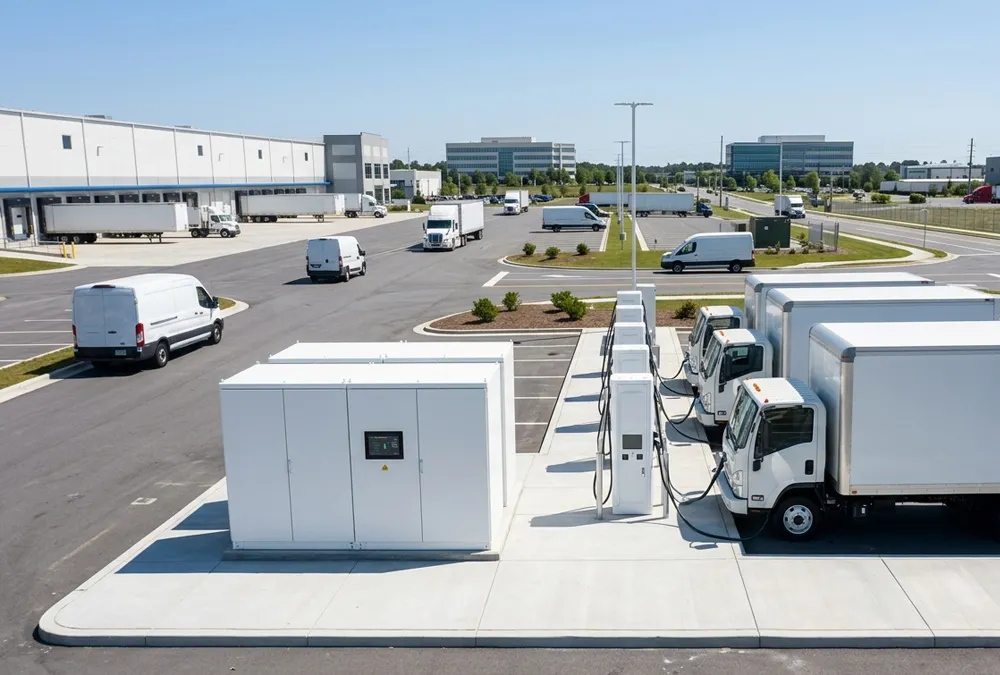
High-power DC fast-charging hubs (150kW to 360kW) cause severe localized demand spikes on distribution lines. Intermediate battery storage cabinets buffer vehicle charging demand, avoiding expensive grid transformer upgrades.
Safety Advantages of Storage Systems
BESS site safety relies on combining chemical stability, physical isolation, electrical controls, and emergency hardware setups.
Advanced Battery Safety Management
Digital BMS controllers track cell telemetry in real time. If cell voltage or temperature strays outside normal thresholds, the system isolates affected racks instantly.
Thermal Runaway Prevention Technology
Combining stable LFP chemistry with liquid cold-plates and thermal insulation barriers prevents heat from spreading between cells, stopping thermal runaway propagation before it starts.
International Safety Certifications for BESS
Ensure your equipment supplier provides complete third-party certification documentation:
- UL 1973: Standard for stationary battery module safety.
- UL 9540A: Test method for evaluating thermal runaway fire propagation in battery energy storage systems.
- IEC 62619: Safety requirements for secondary industrial lithium batteries.
- CE Compliance: European safety, health, and environmental standards.
How to Choose the Right Storage System
Proper BESS hardware sizing requires evaluating historical 15-minute load profiles, target discharge hours, and available site footprint.
Determine Required Energy Capacity and Modular Sizing
Matching system capacity to your operational requirements prevents over-spending while ensuring project payback goals are met:
Industrial BESS Hardware Selection Matrix
- 100kWh All-In-One Outdoor Cabinet: Integrated liquid cooling plate and 50kW PCS inverter. Designed for commercial EV charging hubs and small commercial workshops.
- 261kWh Industrial BESS Unit: High C-rate capability, engineered to absorb motor-inrush currents in medium manufacturing plants.
- 418kWh Heavy Commercial Storage Unit: Extended discharge capacity providing full 4-hour coverage during long utility peak tariff rate windows.
- 1MWh – 5MWh Containerized BESS: High-density 20ft/40ft ISO modular container layout built for large industrial parks, IPP solar projects, and substations.
| System Rating | Target Facility Profile | Primary Duty Cycle | Direct User Benefit & Advantage |
|---|---|---|---|
| 100kWh Cabinet | EV Charging Hubs / Small Buildings | Peak shaving & charge buffering | Smallest footprint, easy installation on standard concrete pads. |
| 261kWh Cabinet | Medium Factories & Machining Plants | Motor-inrush buffer & solar smoothing | Optimal capacity for 2-hour peak tariff rate windows. |
| 418kWh Unit | Heavy Industrial Processing Facilities | 4-Hour peak shift & backup power | Covers long peak tariff windows without deep cycle stress. |
| 1MWh – 5MWh Container | Solar Farms & Microgrids | Grid frequency control & energy arbitrage | Turnkey container layout cuts site civil installation expense. |
Evaluate System Safety Design
Verify that your system vendor provides active liquid thermal cooling, multi-stage BMS controls, and full UL 9540A thermal runaway fire propagation reports.
Choose an Experienced Storage Manufacturer
Partner with a trusted LiFePO4 battery energy storage system manufacturer that provides full engineering support—from early site load profiling to commissioning and long-term service level agreements (SLA).
Why Choose AnengJi Power Energy Storage Solutions
AnengJi Power builds commercial and industrial energy storage hardware engineered for demanding operating conditions.
Advanced LiFePO4 Battery Technology
Our hardware incorporates Tier-1 LFP chemistry, active liquid thermal cooling, bi-directional PCS units, and intelligent EMS software designed for long-term cycling stability.
Integrated BESS Design Capability
We engineer fully pre-integrated hardware cabinets, simplifying field installation and cutting site commissioning timelines.
Flexible Energy Storage Solutions from 100kWh to MWh Scale
From 100kWh outdoor cabinets up to 5MWh containerized systems, our modular equipment configurations adjust easily to match your site load profile.
Global Certifications and Project Experience
AnengJi Power BESS units carry complete CE and UL-related safety compliance documentation, supported by experienced field engineers worldwide.
Future Trends in Lithium Storage Systems
The future of commercial energy storage lies in smart software automation. AI-driven EMS controllers evaluate dynamic spot market prices, weather forecasts, and plant consumption curves to optimize charge and discharge schedules automatically.
Key Takeaways: Why LiFePO4 Is the Future of BESS
Quick Answer: Why is LiFePO4 preferred for BESS?
LiFePO4 (LFP) is preferred for BESS projects because its strong covalent $\text{P-O}$ molecular bonds deliver unmatched thermal stability (resisting runaway up to 500°C), long lifecycle performance (6,000–10,000 cycles), low maintenance requirements, and zero cobalt supply risk—delivering the lowest lifetime Levelized Cost of Storage (LCOS).
What is a lithium battery energy storage system?
It is an electrochemical energy storage solution using lithium cells, BMS monitoring, PCS inverters, and EMS controls to store and dispatch electrical power on demand.
Why is LiFePO4 used in battery energy storage systems?
LiFePO4 offers high thermal stability, long cycle life (6,000+ cycles), high round-trip efficiency (89–93%), and reliable safety for stationary commercial storage applications.
How long does a commercial lithium battery storage system last?
Quality liquid-cooled LFP battery systems comfortably deliver 12 to 15+ years of reliable daily operation before capacity drops to 70% state of health.
What are the main components of a battery storage system?
A complete setup includes LFP battery racks, Battery Management System (BMS), Power Conversion System (PCS), Energy Management System (EMS), and thermal safety systems.
Is lithium battery storage suitable for industrial applications?
Yes. Industrial facilities use commercial BESS assets to reduce peak demand surcharges, smooth motor startup surges, and ensure uninterrupted power during grid blackouts.
Request Your Facility BESS Sizing & Financial ROI Analysis
Contact AnengJi Power application engineers today for a complete review of your site load profile, equipment selection, and project payback calculation.
 https://anengjipower.com/wp-content/uploads/2026/06/epc-vs-turnkey-solar-project-bess.webp
675
1000
Charging Station Engineer
https://anengjipower.com/wp-content/uploads/2025/09/anengji-dc-fast-charging-station-manufacturer-and-supplier-logo-white-1.png
Charging Station Engineer2026-06-22 07:16:042026-06-24 07:13:17What Is the Difference Between EPC and Turnkey Contract Models in Energy Projects?
https://anengjipower.com/wp-content/uploads/2026/06/epc-vs-turnkey-solar-project-bess.webp
675
1000
Charging Station Engineer
https://anengjipower.com/wp-content/uploads/2025/09/anengji-dc-fast-charging-station-manufacturer-and-supplier-logo-white-1.png
Charging Station Engineer2026-06-22 07:16:042026-06-24 07:13:17What Is the Difference Between EPC and Turnkey Contract Models in Energy Projects? https://anengjipower.com/wp-content/uploads/2026/06/anengji-commercial-solar-plus-storage-benefits-site.webp
675
1000
Charging Station Engineer
https://anengjipower.com/wp-content/uploads/2025/09/anengji-dc-fast-charging-station-manufacturer-and-supplier-logo-white-1.png
Charging Station Engineer2026-06-20 14:34:102026-06-20 14:37:43What Are the Top Benefits of Solar Battery Storage in Factories?
https://anengjipower.com/wp-content/uploads/2026/06/anengji-commercial-solar-plus-storage-benefits-site.webp
675
1000
Charging Station Engineer
https://anengjipower.com/wp-content/uploads/2025/09/anengji-dc-fast-charging-station-manufacturer-and-supplier-logo-white-1.png
Charging Station Engineer2026-06-20 14:34:102026-06-20 14:37:43What Are the Top Benefits of Solar Battery Storage in Factories?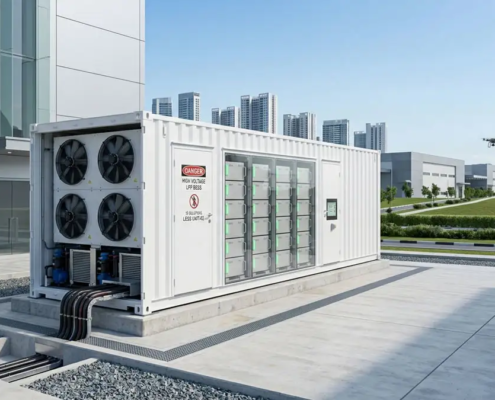 https://anengjipower.com/wp-content/uploads/2026/06/modular-commercial-solar-battery-storage-cabinet.webp
675
1000
Charging Station Engineer
https://anengjipower.com/wp-content/uploads/2025/09/anengji-dc-fast-charging-station-manufacturer-and-supplier-logo-white-1.png
Charging Station Engineer2026-06-18 09:16:522026-07-03 03:05:13What Is Solar Battery Storage? Complete C&I Engineering Guide
https://anengjipower.com/wp-content/uploads/2026/06/modular-commercial-solar-battery-storage-cabinet.webp
675
1000
Charging Station Engineer
https://anengjipower.com/wp-content/uploads/2025/09/anengji-dc-fast-charging-station-manufacturer-and-supplier-logo-white-1.png
Charging Station Engineer2026-06-18 09:16:522026-07-03 03:05:13What Is Solar Battery Storage? Complete C&I Engineering Guide


Leave a Reply
Want to join the discussion?Feel free to contribute!