
Introduction
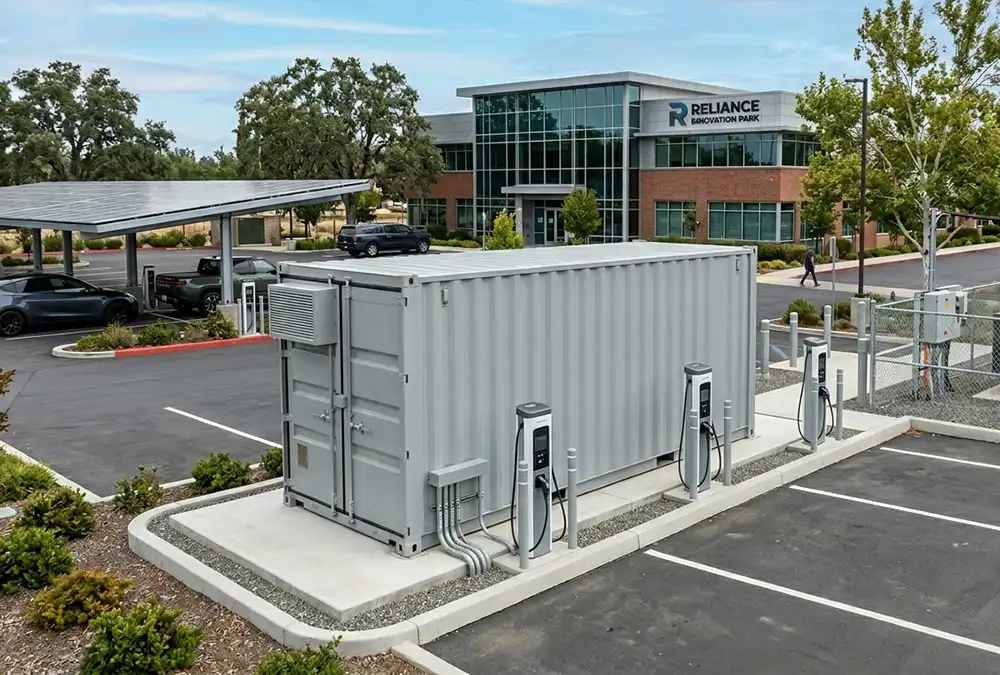
The global transition toward electric mobility is moving at an unprecedented pace, placing massive pressure on traditional electrical grids. When deployment teams scale up infrastructure, finding an optimized 1MW battery storage system for EV charging stations becomes a critical operational milestone. Integrating high-power charging with a stationary battery energy storage system (BESS) allows operators to cross the gap between immediate power availability and local utility grid constraints. This comprehensive guide details the real-world engineering mechanics, financial frameworks, sizing metrics, and return on investment (ROI) dynamics of deploying a 1MW battery infrastructure to power the heavy-duty fast-charging networks of tomorrow.
—
Why EV Charging Stations Need Battery Energy Storage Systems (BESS)
The Rapid Growth of DC Fast Charging Infrastructure
Modern fleet operations and public highway hubs are shifting away from slow overnight AC chargers toward ultra-rapid DC fast charging infrastructure. To satisfy drivers who expect fill-up times comparable to fossil-fuel stations, modern passenger vehicles and commercial trucks require massive delivery blocks of direct current. However, building out this fast-charging infrastructure introduces heavy grid-side strain. The instantaneous draw required to power multiple mega-watt chargers simultaneously creates volatile, unpredictable load curves that local power distribution systems were never designed to handle.
Challenges Facing Modern EV Charging Stations
Limited Grid Capacity
Many prime commercial locations, highway service stations, and logistics depots suffer from local distribution grids that lack spare electrical capacity. A station planning to run multiple high-output chargers simultaneously can easily exceed the thermal limits of existing local lines and substations, bringing expansion plans to an immediate halt.
High Demand Charges
Commercial utility companies structure billing using two primary fees: standard consumption charges (per kWh used) and peak demand charges. Demand charges are calculated based on the highest amount of power drawn within a single short interval (often 15 minutes) during the entire billing cycle. Because high-power fast charging creates massive, sudden spikes in power consumption, operators are often penalized with thousands of dollars in demand charges based on just a brief period of maximum usage.
Rising Electricity Prices
Grid power pricing has grown increasingly volatile, characterized by time-of-use (TOU) tariffs that penalize operators who draw grid energy during peak operational windows. Buying power exclusively from the utility during high-demand daytime intervals heavily undercuts the profitability of public and private charging facilities.
Long Utility Upgrade Timelines
Requesting a distribution transformer upgrade or an entirely new medium-voltage grid connection line from local utility providers frequently involves complicated regulatory hurdles. These civil engineering and administrative delays can push project timelines back by 12 to 24 months, delaying revenue generation.
How Battery Energy Storage Solves These Problems
Stationary battery storage for fast charging decouples grid consumption from vehicle power delivery. By acting as a dynamic power buffer, a site-level battery storage installation draws energy from the grid at a continuous, controlled, low-power rate during off-peak times. When an electric vehicle plugs in demanding a high-power charge, the localized battery discharges its stored energy instantly to support the vehicle’s intake curve. This buffering process shields the local electrical grid from sudden demand spikes, slashes utility demand charges, and allows operators to deploy high-output chargers in locations where the grid would otherwise fail to support them.
—
What Is a 1MW Battery Storage System for EV Charging Stations?
Understanding MW vs MWh in Battery Storage
To properly size and evaluate hardware specifications, engineers must distinguish between power capacity and energy capacity:
- MW (Megawatt): A measure of instantaneous electrical power capacity. This defines the maximum rate at which the system can deliver or absorb energy at any given second. A 1MW system can output up to 1,000 kilowatts (kW) of continuous power.
- MWh (Megawatt-hour): A measure of total electrical energy capacity. This defines how much energy the storage system can hold and deliver over a duration of time. For example, a 2MWh battery can deliver 1MW of continuous power for exactly two hours, or 500kW of continuous power for four hours.
extinction
Typical 1MW BESS Configurations
Depending on the specific charging profile and traffic patterns of a site, a 1MW power-rated system is generally paired with one of three standard energy storage duration depths:
1MW/1MWh Battery Storage System
A 1-hour duration configuration. This is a highly responsive power-focused system optimized for high-power injection, frequent peak shaving, and short-burst buffering where vehicles stop infrequently or grid support requirements are intermittent.
1MW/2MWh Battery Storage System
A 2-hour duration system, widely considered the baseline balance point for industrial and commercial hubs. It offers an excellent combination of sustained peak shaving capacity, short-term backup power, and energy arbitrage capabilities during extended high-traffic periods.
1MW/4MWh Battery Storage System
A 4-hour deep-duration system optimized for heavy energy storage use cases. This layout is ideal for locations integrating heavy on-site solar generation, fleet yards with overnight charging requirements, or sites dealing with long utility peak pricing windows.
How a Battery Storage System Works with EV Chargers
The integrated system functions via a synchronized power loop. The local utility feed enters a primary distribution panel, which is split between the EV chargers and the containerized BESS. When station demand is low, power flows from the grid to replenish the battery. When multiple vehicles hook up to chargers and the combined power draw crosses a pre-set site threshold, the internal control software commands the battery storage system to discharge parallel power into the microgrid bus, ensuring total demand on the utility line remains flat and controlled.
Key Components of an EV Charging Battery Storage System
Battery Modules and Battery Packs
The core chemistry units that store direct current energy. Individual prismatic cells are assembled into structurally sound, insulated modules, which are wired in series and parallel to build high-voltage battery packs capable of matching industrial inverter DC buses.
Battery Management System (BMS)
The hardware and software safety foundation that monitors cell voltages, currents, state-of-charge (SoC), and internal module temperatures. The BMS prevents overcharging, cell degradation, and thermal runaway events by executing balancing algorithms and isolating packs if safety parameters are breached.
Power Conversion System (PCS)
The bi-directional inverter system responsible for converting Alternating Current (AC) from the grid into Direct Current (DC) to charge the cells, and vice versa when discharging. The efficiency and response speed of the PCS dictates how effectively the installation handles real-time vehicle load steps.
Energy Management System (EMS)
The intelligence system controlling the entire site microgrid. The EMS monitors utility tariffs, site demand meters, solar generation curves, and vehicle charger outputs to run predictive algorithms, deciding exactly when to store, discharge, or hold power for maximum financial return.
Cooling and Fire Protection Systems
Thermal management systems that maintain the battery array within its optimal operating temperature window (typically 20°C to 25°C). This is coupled with advanced multi-stage fire suppression systems, including gas fire extinguishing agents and integrated deflagration venting to guarantee site safety.
—
Battery Energy Storage for EV Charging: Major Challenges Operators Face
Deploying public fast chargers or high-capacity private hubs requires addressing several interconnected technical and economic hurdles:
- High Peak Demand Charges Reduce Profitability: High utility peak demand charges can easily account for up to 50% to 70% of an EV charging station’s monthly electric bill, making the business model financially unsustainable without a localized mitigation solution.
- Grid Connection Limitations Delay Projects: Waiting for local utilities to approve high-voltage distribution lines or substation expansions can stall projects for months or years, racking up holding costs and delaying market entry.
- Fast Charging Creates Significant Power Peaks: High-power fast chargers operate like on/off switches, drawing immense currents the moment a vehicle connects and dropping to zero when finished. These severe step-loads stress upstream distribution gear.
- Renewable Energy Integration Remains Difficult: Solar generation peaks mid-day, whereas public vehicle charging frequently peaks during morning and evening commute windows, creating a distinct mismatch between clean energy generation and consumption.
- Balancing Charging Demand During Peak Hours: Attempting to manage vehicle charging speeds during high-traffic times to protect the local electrical system often results in slower charging speeds, reducing customer satisfaction and station throughput.
—
Benefits of a 1MW Battery Storage System for EV Charging Stations
Reduce EV Charging Electricity Costs
A localized lithium battery storage system allows operators to utilize energy arbitrage. By programming the system to charge during late-night or early-morning off-peak utility periods when electricity prices are low, and discharging that power to vehicles during expensive daytime peak tariff windows, operators can systematically lower their per-kWh operational costs.
Lower Demand Charges Through Peak Shaving
How Peak Shaving Works
The EMS sets a strict consumption ceiling for the utility grid connection. If the combined draw from vehicles approaches this ceiling, the 1MW BESS instantly discharges matching power to cover the excess load, keeping the utility meter flat and under the high-tariff threshold.
Real-World Demand Charge Savings
By using a peak shaving battery system to lower a site’s measured peak demand by several hundred kilowatts month after month, operators can directly eliminate thousands of dollars in line penalties, transforming operational margins from negative to positive.
Increase EV Charging Capacity Without Grid Upgrades
Instead of investing massive capital into upgrading physical utility transformers and trenching new incoming high-voltage feeds, an operator can place a 1MW system inline. The stationary battery serves as a local power reservoir, augmenting a low-capacity grid connection to successfully supply multiple ultra-fast chargers at their maximum rates simultaneously.
Improve Reliability and Energy Resilience
In the event of a local utility grid outage or rolling blackout, a configured 1MW BESS can shift the site into an islanded microgrid state. This provides essential backup power to keep critical charging points, security infrastructure, and payment processing terminals active, maintaining true 24/7 mission-critical uptime.
Enhance Renewable Energy Utilization
Deploying a solar EV charging station infrastructure transforms the facility into a self-sustaining asset. Instead of exporting excess daytime solar production back to the utility grid at low feed-in credit rates, the energy is directed into the local battery modules to charge vehicles after dark, maximizing clean energy self-consumption.
Improve Overall Charging Station Efficiency
By stabilizing on-site voltages and preventing the severe voltage drops commonly caused by high-power vehicle demands, a centralized battery setup reduces structural losses across distribution equipment, maintaining optimal energy delivery efficiency across the entire facility footprint.
—
How Many EV Chargers Can a 1MW Battery Storage System Support?
Typical Charger Power Levels
To analyze support capacity, we must look at the standard power ratings of modern DC fast charging infrastructure installed across commercial networks:
- 60kW DC Chargers: Commonly used for urban public parking lots, commercial retail fleets, and delivery vans with longer dwell times.
- 120kW DC Fast Chargers: The standard deployment choice for commercial shopping centers, corporate parks, and medium-duty fleet hubs.
- 180kW Fast Chargers: High-speed units optimized for rapid passenger vehicle charging along transit corridors and regional logistics distribution centers.
- 240kW Ultra-Fast Chargers: Next-generation high-power dispensers designed to rapidly recharge premium passenger EVs and heavy-duty logistics trucks.
- 350kW Ultra-Fast Chargers: Maximum-output highway corridor chargers engineered to deliver ultra-fast replenishment to long-haul commercial trucks and high-voltage vehicle architectures.
EV Charger Support Examples by Battery Capacity
The number of chargers a site can support is directly tied to the total energy depth (MWh) paired with the 1MW power-inverter configuration. The following framework outlines typical real-world station capacities based on recent 2025/2026 deployment models:
| Battery Configuration | Typical Charger Support Capacity | Target Site Application Profile |
|---|---|---|
| 1MW / 1MWh | Up to 4 x 120kW or 2 x 240kW Chargers | Small charging sites, urban hubs, and fleet yards with structured, predictable vehicle arrival intervals. |
| 1MW / 2MWh | Up to 6 x 180kW or 4 x 240kW Chargers | Medium charging hubs, regional highway service Plazas, and busy public commercial retail charging networks. |
| 1MW / 4MWh | Up to 4 x 350kW or 8 x 180kW Chargers | High-utilization fast charging sites, logistics depots, and multi-vehicle highway corridors with overlapping charging sessions. |
Factors Affecting Charging Duration and Capacity
When calculating these ratios, deployment teams must factor in actual site utilization metrics. Vehicles rarely draw their maximum rated power across the entire charging cycle due to internal battery thermal management curves. Additionally, fluctuating vehicle arrival rates, overlapping charging sessions, and the integration of smart sequential charging controls mean a 1MW system can often support a larger footprint of chargers than a simple static calculation would suggest.
—
Battery Storage Sizing for EV Charging Infrastructure
Correctly sizing a localized EV charging station battery storage deployment requires meticulous data modeling to prevent both costly over-engineering and ineffective under-sizing:
- Assessing Daily Charging Demand: Sizing begins by analyzing full 24-hour load profiles, charting total vehicle arrivals, average kWh consumed per session, and identifying the total volume of energy delivered across a typical high-traffic day.
- Understanding Peak Charging Loads: Engineers isolate worst-case scenarios—such as a Friday afternoon when multiple vehicles plug in simultaneously while the facility is already running its baseline cooling or heating loads.
- Selecting the Right Battery Capacity: The data is mapped to choose the ideal power-to-energy ratio. A 1MW/1MWh layout is chosen if the primary goal is suppressing short, sharp peak demand charges. A 1MW/2MWh or 1MW/4MWh system is selected if the application demands prolonged energy discharge across extended utility peak pricing periods.
- Planning for Future EV Charging Expansion: Modular hardware integration should always be factored in. Selecting an architecture that permits stacking additional battery enclosures onto the existing PCS bus ensures the site can seamlessly scale its capacity as EV adoption increases.
Solar Plus Battery Storage for EV Charging Stations
Why Solar and Battery Storage Are a Perfect Match
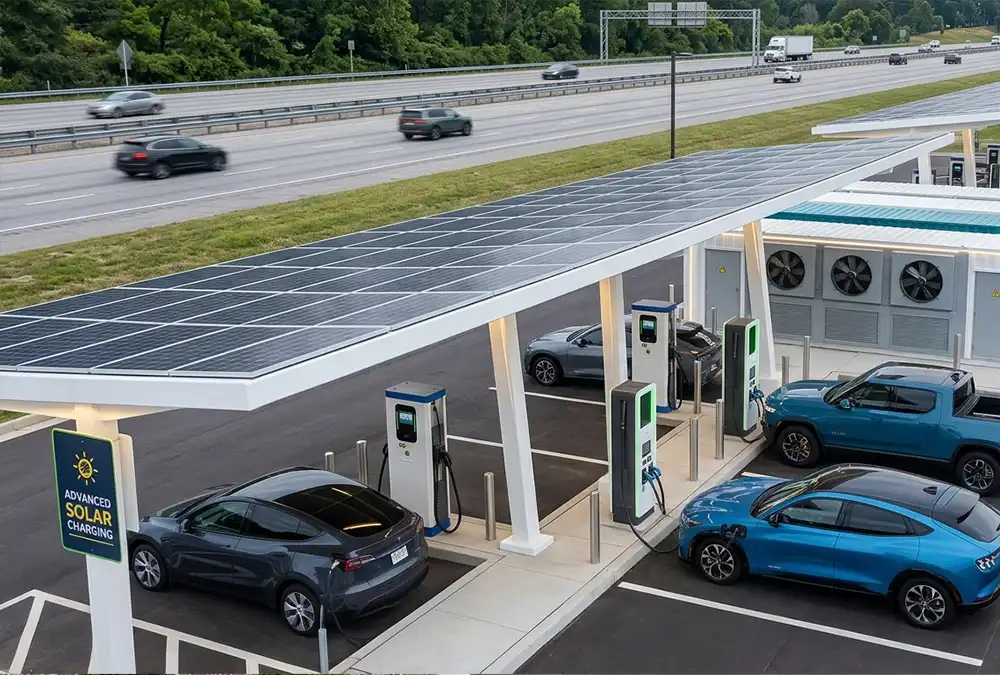
Deploying standalone fast chargers remains heavily dependent on external energy providers. Combining solar generation with a commercial battery storage container creates a highly efficient, symbiotic microgrid loop that optimizes both energy generation and consumption.
Solar Energy Generation During the Day
Photovoltaic arrays mounted on station canopies, roof structures, or adjacent ground spaces generate clean direct current during peak daylight hours. This generation curve often aligns perfectly with empty or low-occupancy charging stalls between morning and evening transit peaks.
Storing Excess Solar Energy for EV Charging
Instead of curtailing solar production or sending it back to the utility grid for minimal financial compensation, the site EMS routes this excess generation into the localized battery banks. This captures and preserves zero-carbon energy for later use.
Reducing Grid Dependency
When charging demand peaks in the evening, the system draws heavily on this stored solar energy rather than relying on fossil-fuel grid power. This lowers overall utility demand and shields the operator from grid rate hikes and time-of-use penalties.
Typical Solar + Storage Configurations for Charging Stations
Most modern high-efficiency installations utilize a common DC-coupled or highly optimized AC-coupled architecture. Here, solar inverters feed a centralized distribution bus monitored by a unified control network, allowing energy to step between the solar panels, battery racks, and vehicle dispensers with minimal conversion losses.
—
Peak Shaving Battery Storage Solutions for EV Charging Stations
What Is Peak Shaving?
Peak shaving is the process of lowering the maximum amount of power drawn from the utility grid during short, high-demand periods. For an EV hub, this involves substituting grid power with local battery power whenever vehicle demand surges.
How Battery Storage Reduces Peak Demand Charges
Consider a facility with a 300kW grid allocation. If four vehicles plug into 120kW fast chargers simultaneously, the total required load shoots up to 480kW. Without a battery buffer, the facility would breach its grid limit, triggering severe utility demand charge penalties. With a 1MW peak shaving system in place, the battery instantly delivers the 180kW deficit, ensuring the utility meter never records a draw above the approved 300kW baseline.
Utility Demand Charge Structures Explained
Many commercial utilities bill demand charges on a tiered scale, where crossing certain kW thresholds drastically increases the cost per kW across the entire billing period. This means even a single 15-minute peak demand spike can negatively impact station profitability for a whole month.
Real ROI Benefits from Peak Shaving
By flattening volatile load spikes, peak shaving provides immediate financial savings. These direct cost reductions on monthly utility bills offer clean, verifiable line-item savings that form the financial backbone of the project’s return on investment analysis.
—
1MW Battery Storage System Cost for EV Charging Stations
Average Cost of a 1MW Battery Storage System
According to comprehensive industrial energy storage benchmarks from organizations like BloombergNEF and the International Energy Agency (IEA), the total fully installed capital cost for a commercial-grade 1MW BESS for EV charging station cost project typically spans a wide range depending on the chosen energy duration depth:
- 1MW/1MWh System: $350,000 to $450,000 (Fully integrated containerized layout)
- 1MW/2MWh System: $550,000 to $750,000 (Industry standard balance for commercial sites)
- 1MW/4MWh System: $950,000 to $1,300,000 (Deep energy duration layout)
Cost Breakdown by Component
A standard budget allocation for an integrated 1MW industrial energy storage project breaks down roughly as follows:
Standard Industrial 1MW BESS Budget Allocation Breakdown:
- Battery Cells and Modules (LFP): 45% – 55% of total project cost
- PCS Equipment (Bi-directional Inverters): 15% – 20% of total project cost
- BMS and EMS Systems (Control Software & Hardware): 8% – 12% of total project cost
- Cooling and Fire Protection (Liquid chilling/gas flooding): 7% – 10% of total project cost
- Container and Structural Design (IP55/NEMA 3R enclosures): 5% – 8% of total project cost
- Installation and Commissioning (Civil works, permitting, grid hookup): 10% – 15% of total project cost
Factors Affecting Total Project Cost
Battery Chemistry
Opting for highly stable Lithium Iron Phosphate (LFP) chemistry balances high cycle life with affordable manufacturing costs, making it the preferred standard over alternative lithium chemistries for stationary commercial storage applications.
Certification Requirements
Meeting rigorous international safety compliance standards—such as UL1973 for battery packs, UL1741 for inverters, and full UL9540A system-level fire safety testing—adds minor upfront engineering costs but remains mandatory for local commercial permitting and insurance coverage.
Site Conditions
Extensive civil engineering requirements, such as long-distance trenching, pouring specialized seismic concrete pads, or navigating complex zoning challenges in dense urban zones, can noticeably increase installation and commissioning costs.
Project Scale
Deploying a single, isolated 1MW system incurs standard individual asset deployment costs, whereas deploying multiple identical systems across a broader regional charging network unlocks clear volume discounts on hardware procurement and engineering labor.
—
ROI Analysis of Battery Energy Storage for EV Charging Stations
Revenue Sources and Cost Savings
The financial justification for integrating a 1MW system relies on stacking multiple operational cost-saving and revenue-generating streams:
- Demand Charge Reduction: Saving thousands of dollars each month by cutting out high utility peak demand penalties.
- Energy Arbitrage: Shifting energy consumption profiles to purchase cheap off-peak power and deploy it during peak high-tariff hours.
- Solar Self-Consumption: Eliminating the need to buy retail grid electricity by storing and utilizing zero-cost on-site solar energy.
- Reduced Grid Upgrade Costs: Avoiding the massive capital expenditure and long timelines associated with traditional utility substation and line expansions.
Typical Payback Period
For high-utilization public charging plazas or heavy-duty commercial truck depots operating under aggressive time-of-use utility tariffs, a well-optimized 1MW battery storage asset typically achieves a full return on investment and enters net-positive profitability within a 3.5 to 5.5-year payback window.
Factors That Influence ROI
The speed of project payback is driven by local utility rate structures (larger spreads between peak and off-peak tariffs yield faster returns), daily vehicle traffic density, and the efficient configuration of the automated EMS control software.
Example ROI Scenario for a Fast Charging Station
A regional highway charging plaza running six 180kW fast chargers experiences sharp traffic spikes every afternoon, resulting in $12,000 per month in utility peak demand charges. By installing a 1MW/2MWh liquid-cooled BESS, the operator trims the site’s recorded peak grid draw by 400kW, saving approximately $8,000 per month in demand penalties.
Concurrently, by shifting 1,200 kWh of daily charging load from peak daytime rates to cheaper night tariffs via energy arbitrage, the system yields an extra $2,500 in monthly energy cost savings. Combining these factors yields $10,500 in total monthly savings ($126,000 annually). Against a fully installed project cost of $580,000, the station achieves a clean, asset-backed payback period of roughly 4.6 years, well within the 15-year operational lifespan of the battery modules.
—
Battery Storage Components That Improve EV Charging Performance
Advanced Battery Management Systems (BMS)
Modern three-tier master-slave BMS architectures monitor system diagnostics down to the individual cell level. By constantly analyzing state-of-health (SoH) data and managing cell balancing in real time, these systems maximize capacity utilization and prevent accelerated cell degradation during rapid charging cycles.
Intelligent Energy Management Systems (EMS)
Top-tier EMS systems leverage predictive AI modeling to continuously analyze local weather patterns, historical station traffic, and real-time spot market utility pricing. This allows the system to optimize charging and discharging schedules, ensuring the battery is always prepared for high-traffic events.
High-Efficiency Power Conversion Systems (PCS)
Utilizing next-generation silicon carbide (SiC) switching topologies allows modern power conversion inverters to achieve round-trip conversion efficiencies exceeding 98.5%. This minimizes thermal energy losses during AC/DC transformation steps.
Liquid Cooling Battery Storage Technology
Rather than relying on traditional HVAC air circulation, cutting-edge systems route a specialized liquid glycol solution through dedicated cooling plates embedded directly within the battery modules. This provides uniform thermal management across every cell, extending overall system life.
Multi-Layer Fire Protection Systems
Comprehensive safety designs incorporate early-stage gas detection sensors (which spot off-gassing before temperatures spike), localized aerosol or clean-agent gas flooding suppression, and structural physical barriers between modules to prevent thermal propagation.
—
Liquid Cooling Battery Storage vs Air Cooling for EV Charging Applications
Cooling Performance Comparison
Because high-output vehicle charging requires the stationary battery to rapidly cycle energy, it generates significant internal thermal energy. Liquid cooling systems feature a thermal conductivity capacity up to 25 times higher than traditional air-cooled setups, allowing them to rapidly dissipate heat and maintain uniform temperatures across the entire enclosure.
Safety and Thermal Stability
Air-cooled designs often suffer from internal thermal stratification, creating hot spots where cells in the center of a pack run noticeably hotter than those near the exterior vents. Liquid plates eliminate these hot spots, maintaining cell temperature differentials within a tight ±2°C window to minimize thermal runaway risks.
Battery Lifespan Benefits
Operating cells outside of their ideal temperature windows accelerates capacity fade. Maintaining tight temperature control via liquid cooling can extend the operational life of an LFP battery pack by up to 20% to 30%, delivering thousands of additional charge cycles over its lifespan.
Total Cost of Ownership Comparison
While liquid-cooled configurations carry a slightly higher upfront capital cost, they consume significantly less parasitic auxiliary power to operate than high-power HVAC air fans. Combined with extended cell lifespans, they offer a noticeably lower total cost of ownership over the project life.
Why Liquid Cooling Is Becoming the Industry Standard
As vehicle charging demands trend toward ever-higher wattages, the rapid charge and discharge rates required of stationary support batteries make air cooling impractical. Liquid cooling technology provides the reliable thermal performance needed to handle these demanding duty cycles safely.
—
Best Applications for 1MW Battery Storage in EV Charging Networks
A 1MW BESS serves as a versatile infrastructure asset across several key market segments:
- Highway Service Areas: Providing high-power backup along major transit routes to support ultra-fast chargers for long-distance commuters without straining rural utility lines.
- Fleet Charging Depots: Enabling corporate logistics, public transit buses, and last-mile delivery vehicles to charge efficiently overnight without triggering massive utility peak demand penalties.
- Commercial Parking Facilities: Enhancing multi-story urban parking structures and public commuter garages to support fast-charging stalls without requiring expensive structural grid upgrades.
- Retail and Shopping Centers: Attracting premium EV drivers with reliable fast charging while shielding the primary commercial property from high utility demand charges.
- Public Fast Charging Hubs: Maximizing station throughput and improving operational margins at high-density inner-city multi-vehicle charging stations.
- Logistics and Distribution Centers: Supporting heavy-duty Class 8 electric trucks with rapid mid-day turnarounds while maintaining flat utility load profiles across the facility.
—
Why Choose AnengJi Power Battery Storage Solutions for EV Charging Stations?
Extensive Experience in Solar + Storage + EV Charging Projects
AnengJi Power brings a long, proven track record to the design and manufacturing of heavy-duty power distribution and energy storage infrastructure. Having developed and deployed numerous containerized microgrids worldwide, AnengJi offers field-tested engineering expertise tailored to the unique demands of modern EV integration.
Fully Integrated BESS and Charging Solutions
AnengJi Power delivers complete, turnkey systems. By manufacturing both the containerized liquid-cooled BESS units and the corresponding high-power DC fast chargers in-house, AnengJi ensures seamless component integration, eliminating compatibility issues and simplifying site commissioning.
High-Efficiency Liquid Cooling Technology
AnengJi’s 1MW containerized storage platforms feature advanced, proprietary liquid-cooling plates. This highly efficient thermal design ensures optimal temperature uniformity across all internal cell modules, guaranteeing safe operation and maximum lifecycle performance under heavy fast-charging conditions.
Intelligent EMS for Load Management
Every AnengJi system features a robust, built-in Energy Management System tailored for high-demand charging hubs. The system dynamically tracks real-time vehicle power demands, executing automated peak shaving and energy arbitrage algorithms to maximize monthly utility savings.
Flexible 1MW to Multi-MW Expansion Capability
AnengJi designs its modular storage solutions with future scaling in mind. Operators can deploy a standard 1MW baseline configuration today and easily scale capacity in parallel as station traffic increases, protecting their initial infrastructure investment.
Global Certifications and Compliance
AnengJi Power prioritizes rigorous safety and build quality, ensuring all systems carry full international compliance certifications required for smooth permitting and insurance approval:
CE Certification
Guarantees full alignment with European Union performance, safety, and environmental health directives for deployment across European markets.
UL1973-Compliant Battery Systems
Verifies that all internal battery packs have successfully passed stringent structural and electrical safety testing criteria for stationary energy storage applications.
UL9540A Tested Products
Confirms comprehensive system-level evaluation for thermal runaway fire propagation prevention, meeting the highest modern building and electrical safety codes.
Global Service and Spare Parts Support
Backed by an international technical support network and dedicated regional spare parts hubs, AnengJi Power provides proactive field servicing, remote performance monitoring, and rapid response support to ensure maximum operational uptime for your charging network.
—
Future Trends in EV Charging Battery Storage Systems
Looking ahead, several key technical and market trends are shaping the future of energy storage integration:
- Growth of Ultra-Fast Charging Networks: The rapid rollout of 350kW+ ultra-fast charging corridors will make localized battery buffering a standard infrastructure requirement rather than an optional upgrade.
- Increasing Demand for Battery Buffering: As regional grids face increasing supply constraints, decentralized stationary batteries will play a critical role in stabilizing local distribution systems.
- Integration with Renewable Energy: Virtual Power Plant (VPP) software platforms will increasingly link distributed solar-plus-storage stations together, allowing them to collectively support the broader electrical grid.
- AI-Based Energy Optimization: Advanced machine-learning algorithms will continue to improve EMS efficiency, using highly precise forecasting to optimize battery cycling and maximize financial returns.
- Vehicle-to-Grid (V2G) Opportunities: Emerging bidirectional charging standards will eventually allow parked EVs to interact dynamically with localized station batteries, creating highly flexible, multi-directional energy ecosystems.
—
FAQ About 1MW Battery Storage for EV Charging Stations
How much does a 1MW battery storage system cost?
A fully integrated 1MW system typically ranges from $350,000 for a 1MWh configuration up to $1,300,000 for a deep 4MWh configuration, depending on total energy duration, battery chemistry, and specific site installation requirements.
How many EV fast chargers can a 1MW BESS support?
A standard 1MW/2MWh system can comfortably support four 240kW ultra-fast chargers or six 180kW fast chargers simultaneously by dynamically balancing load requirements and injecting stored energy during high-demand vehicle arrival spikes.
What battery capacity is best for EV charging stations?
A 1MW/2MWh configuration is widely considered the ideal baseline for most commercial hubs. It offers an optimal balance of power delivery, peak-shaving capacity, and cost-effective return on investment.
How does battery storage reduce demand charges?
The system monitors site energy consumption in real time. When vehicle charging loads threaten to cross a pre-set utility threshold, the battery discharges local power to absorb the excess demand, keeping the utility meter flat and under penalty limits.
Can battery storage eliminate the need for grid upgrades?
Yes. By serving as a local energy reservoir that slowly recharges during off-peak windows and discharges rapidly into vehicles, a 1MW BESS allows operators to deploy high-output fast chargers on low-capacity grid connections without expensive utility upgrades.
Is solar plus battery storage suitable for EV charging stations?
Absolutely. Combining solar arrays with localized battery storage captures clean daytime energy that can be deployed to charge vehicles during peak hours, reducing grid dependency and maximizing site sustainability.
What is the ROI of a battery storage system for EV charging?
Most high-utilization commercial charging plazas achieve a full return on investment within a 3.5 to 5.5-year payback window, driven by significant utility demand charge reductions and energy arbitrage savings.
How long does a commercial battery storage system last?
High-quality LFP battery systems typically deliver an operational lifespan of 15 to 20 years, supporting between 6,000 and 8,000 full charge-discharge cycles before dropping to 80% of their original capacity.
What certifications should an EV charging battery storage system have?
To ensure smooth local permitting, safety compliance, and insurance coverage, systems should carry recognized international certifications, including CE, UL1973, and full UL9540A system-level fire safety testing.
Why is liquid cooling recommended for EV charging applications?
Liquid cooling delivers vastly superior thermal dissipation compared to traditional air systems, maintaining uniform cell temperatures and preventing localized hot spots. This significantly extends battery lifespan and improves overall system safety under heavy, rapid charging cycles.
 https://anengjipower.com/wp-content/uploads/2026/10/AnengjiPower-Load-Shifting-Energy-Storage-at-a-CI-Site.webp
675
1000
Charging Station Engineer
https://anengjipower.com/wp-content/uploads/2025/09/anengji-dc-fast-charging-station-manufacturer-and-supplier-logo-white-1.png
Charging Station Engineer2026-10-19 03:47:032026-10-19 03:47:31Load Shifting Energy Storage: C&I Sizing & Cost Guide
https://anengjipower.com/wp-content/uploads/2026/10/AnengjiPower-Load-Shifting-Energy-Storage-at-a-CI-Site.webp
675
1000
Charging Station Engineer
https://anengjipower.com/wp-content/uploads/2025/09/anengji-dc-fast-charging-station-manufacturer-and-supplier-logo-white-1.png
Charging Station Engineer2026-10-19 03:47:032026-10-19 03:47:31Load Shifting Energy Storage: C&I Sizing & Cost Guide https://anengjipower.com/wp-content/uploads/2026/10/AnengjiPowr-AC-Coupled-Battery-Storage-at-a-CI-Solar-Site.webp
675
1000
Charging Station Engineer
https://anengjipower.com/wp-content/uploads/2025/09/anengji-dc-fast-charging-station-manufacturer-and-supplier-logo-white-1.png
Charging Station Engineer2026-10-16 03:03:192026-10-16 03:03:49What Is AC-Coupled Battery Storage? C&I BESS Guide
https://anengjipower.com/wp-content/uploads/2026/10/AnengjiPowr-AC-Coupled-Battery-Storage-at-a-CI-Solar-Site.webp
675
1000
Charging Station Engineer
https://anengjipower.com/wp-content/uploads/2025/09/anengji-dc-fast-charging-station-manufacturer-and-supplier-logo-white-1.png
Charging Station Engineer2026-10-16 03:03:192026-10-16 03:03:49What Is AC-Coupled Battery Storage? C&I BESS Guide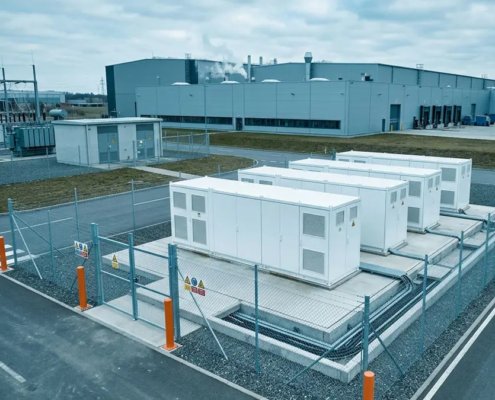 https://anengjipower.com/wp-content/uploads/2026/10/AnengjiPower-What-Is-Peak-Shaving-at-an-Industrial-Site.webp
675
1000
Charging Station Engineer
https://anengjipower.com/wp-content/uploads/2025/09/anengji-dc-fast-charging-station-manufacturer-and-supplier-logo-white-1.png
Charging Station Engineer2026-10-15 06:49:012026-10-15 06:50:23What Is Peak Shaving? How Battery Energy Storage Reduces C&I Peaks
https://anengjipower.com/wp-content/uploads/2026/10/AnengjiPower-What-Is-Peak-Shaving-at-an-Industrial-Site.webp
675
1000
Charging Station Engineer
https://anengjipower.com/wp-content/uploads/2025/09/anengji-dc-fast-charging-station-manufacturer-and-supplier-logo-white-1.png
Charging Station Engineer2026-10-15 06:49:012026-10-15 06:50:23What Is Peak Shaving? How Battery Energy Storage Reduces C&I Peaks


Leave a Reply
Want to join the discussion?Feel free to contribute!