

Introduction
If you are looking at a C&I electricity bill with a cheap period and an expensive one, load shifting energy storage can seem like an obvious win: charge low, discharge high, keep the difference. This is also where many early business cases become too optimistic. Can production really move? Will the battery finish charging before the next expensive window? Could charging create a new demand peak? Once conversion losses, auxiliary power and battery wear are included, how much of the apparent saving is still yours?
That gap between “possible on paper” and “workable on site” is not unusual. The International Energy Agency’s 2026 Electricity 2026 flexibility analysis describes how businesses can shift or shed electricity use in response to market or grid signals. It estimates that only around 100 GW of demand response was being utilised globally in 2024, despite much larger technical potential. The reason matters to your project: physical process limits, market rules, available controls and real-world participation barriers decide how much flexibility can actually be used.
In plain terms: load shifting means moving electricity use—or the grid supply behind that use—to a better time. You may move the task itself, or let a battery keep the task running while changing when the site imports power. The second option is often easier operationally, but it is not loss-free.
You do not need to begin with a battery catalogue. Begin with the bill, the load curve and the operating schedule. This guide walks through the same questions an owner and EPC should settle before requesting a firm quotation: what creates value, what can really move, how much power and energy are needed, how the EMS should prioritise competing services, and how the promised result will be measured.
What Is Load Shifting in Electricity?
Think of load shifting as changing the timetable, not deleting the work. The source period may offer cheaper electricity, surplus on-site solar or spare import capacity. The target period may be expensive or constrained. You can move the task itself, or store electricity earlier and use it later while the operation continues on its normal schedule.
How Does Load Shift Work Across a Daily Load Curve?
Suppose your process draws 500 kW from 17:00 to 20:00. You have two very different options. Move the process to a cheaper period—if production, staffing, noise and delivery commitments allow it—or leave production untouched and discharge a battery behind the meter during those three hours. Both reshape grid demand, but they affect your operation and cost structure differently.
This distinction matters because direct scheduling and battery storage solve different operational problems. Direct scheduling usually avoids electrochemical conversion losses and battery CAPEX, but it may impose a production cost. A BESS protects the operating schedule, but it introduces efficiency losses, degradation, controls, maintenance and financing. Thermal storage provides a third route when the required service is cooling or heating rather than electricity itself.
Load Shifting Is Not Peak Shaving, Efficiency or Load Shedding
- Load shifting moves kWh from one time window to another.
- Peak shaving limits maximum kW or kVA, often during a short interval.
- Energy efficiency reduces total energy required for the same output or service.
- Load shedding disconnects or curtails a load rather than preserving the task at another time.
Confusing these objectives can produce the wrong specification. A battery sized only for three hours of energy shifting may not have enough PCS power to suppress a sharp 15-minute demand spike. Conversely, a high-power, short-duration system designed for peak shaving may not contain enough usable energy for a long evening tariff window. If the primary question is which strategy applies, use the detailed guide to peak shaving versus load shifting before developing the BESS duty cycle.
When Does Load Shifting Energy Storage Actually Create Value?
Ask one question before discussing battery size: Which cost or constraint will this dispatch actually change? Map every relevant bill and contract item to its unit, measurement interval and dispatch response. A storage system can follow its schedule perfectly and still disappoint you if the dominant charge on the bill never moves.
| Value signal | Measured as | Question to verify | Buyer implication |
|---|---|---|---|
| Time-of-use or dynamic energy price | €/kWh by interval | Which energy, network, tax and supplier components actually vary? | Model the avoidable price difference, not the headline market price. |
| Solar surplus | Exported or curtailed kWh | What export compensation or alternative use is being given up? | Stored solar has an opportunity cost; it is not automatically free. |
| Demand charge | Maximum kW/kVA over a defined interval | Is the charge coincident, non-coincident, seasonal or subject to a ratchet? | The design may need peak control rather than energy-only shifting. |
| Connection or import limit | kW/kVA at the connection point | Can the battery recharge without breaching the same limit? | Recharge capacity can be more restrictive than discharge energy. |
For Europe, Directive (EU) 2019/944 does not create one universal commercial tariff. Its Article 11 on dynamic electricity price contracts requires national frameworks that enable suppliers to offer dynamic contracts and allows final customers with smart meters to request such a contract under the stated conditions. Actual eligibility, supplier terms, network charges, taxes and settlement rules still require country- and customer-specific verification. A German project therefore needs its real supply contract and network tariff; an EU-level principle is not a bankable German price spread.
Have interval data and a current electricity contract, but no clear storage duty cycle?
Load Shifting Examples: Which C&I Loads Can You Realistically Move?
This is where a spreadsheet and the production floor often disagree. A load may be technically movable, yet shifting it could trigger overtime, delay an order, upset tenants or push a cold room beyond an acceptable temperature band. The IEA’s “Demand response offers breakthrough benefits” section identifies batch and heat-based industrial processes, cold storage, compressor systems and controllable building loads as flexibility resources. Just as importantly, it distinguishes theoretical potential from flexibility that remains usable after real operating constraints are applied.
| Load or process | Possible shift mechanism | Hard constraint | Data needed | Buyer benefit |
|---|---|---|---|---|
| Batch production | Move start time or use BESS during the expensive window | Delivery schedule, staffing, minimum run time and restart cost | 15-minute demand, production schedule and throughput value | Compares operational disruption with storage cost. |
| Compressed air or pumping | Pre-charge storage, adjust sequence or support with BESS | Pressure, volume, water level and equipment cycling limits | Submetering, control states and minimum service level | Reveals whether controls can deliver value before CAPEX. |
| HVAC or cold storage | Pre-cool, thermal storage or battery support | Comfort, food safety, thermal recovery and rebound peak | Weather, temperature, occupancy and compressor demand | Protects service quality while quantifying flexible energy. |
| Fleet charging | Schedule chargers, cap site import or charge BESS earlier | Departure time, route energy and vehicle availability | Charger sessions, connection limit and fleet timetable | Separates charging flexibility from mandatory transport energy. |
Sit down with the people who operate the equipment and classify each candidate as flexible, conditionally flexible or fixed. Record earliest start, latest finish, minimum and maximum power, minimum run time, ramp limit, recovery behaviour and the cost of breaking the constraint. Otherwise, the model may report savings while the site absorbs lost output, overtime, comfort complaints or product-quality risk.
Should You Shift the Process or Add a Battery?
If the production manager says, “That process cannot move,” the conversation is not over—it simply changes. Battery-based energy shifting may keep production untouched while moving grid import. But where a pump, charger or thermal process already has scheduling flexibility, using that flexibility first may be simpler and cheaper. Start technology-neutral, then pay for storage only where it solves a real operating constraint.
| Option | What moves | Main limitation | Best-fit condition | Buyer benefit |
|---|---|---|---|---|
| Operational scheduling | The task itself | Production, labour or service disruption | The task has a wide completion window | Potentially low CAPEX and no battery conversion loss. |
| Thermal storage | Heating or cooling production | Applicable only to a thermal service | The facility has predictable thermal demand | Stores the required service directly. |
| Load shifting battery storage | When electricity crosses the meter | CAPEX, loss, degradation and recharge requirement | The process cannot move but the energy-supply window can | Protects production while reshaping grid import. |
| Hybrid | Part of the task and part of its supply | More complex optimisation and controls | No single resource covers the full window | Can reduce battery size without compromising operations. |
So the useful question is not simply, “Can a battery do this?” It is, “What is the lowest-risk lifetime way to deliver the shift without hurting the operation?” Compare lost output, labour and restart effects with the lifetime cost of delivered battery energy. That comparison can save you from buying electrochemical capacity for flexibility your site already owns.
How Load Shifting Battery Storage Works From Charge to Delivery
Establish the Charging Source and Measurement Boundary
Before comparing supplier numbers, ask them where those numbers are measured. A load shifting BESS may charge from the grid, on-site PV, otherwise-curtailed renewable generation or a combination. Energy may be reported at the battery DC terminals, PCS AC terminals or the point of common coupling (PCC). A battery-level efficiency figure cannot be compared directly with revenue-meter savings when the site figure also includes PCS, transformer and auxiliary losses.
For a customer-side project, the electrical and commercial boundary can be explored further in the guide to behind-the-meter energy storage. Establishing this boundary early prevents a common procurement dispute: one party reports DC efficiency while the owner expects AC bill savings.
Define Charge, Hold, Discharge and Recharge Windows
The dispatch calendar should cover weekdays, weekends, holidays, seasonal tariff changes and daylight-saving transitions. Forecast error also matters. If solar is expected to charge the battery but cloud cover reduces generation, the EMS needs a rule for grid top-up, reserve SOC or reduced discharge. If the tariff window changes by season, a fixed schedule can charge at the wrong time.
Account for Losses and Auxiliary Energy
Round-trip efficiency (RTE) is the ratio of discharged energy to charged energy across an agreed boundary. It is condition-dependent: power level, temperature, standby duration, HVAC, transformer losses and state of charge all affect the result. The US Department of Energy’s Battery Energy Storage System Evaluation Method defines performance evaluation using metered charge and discharge data and highlights the importance of accurate measurements of energy into and out of the battery. That makes the measurement boundary part of the commercial specification, not a reporting detail.
How to Size a Load Shifting Battery Without Missing the Recharge Window
This is the point where apparently similar quotations often separate. One supplier sizes the discharge duty; another also checks how the battery will be ready for tomorrow. A useful calculation needs both envelopes: the discharge envelope defines the power and energy required in the target period, while the recharge envelope confirms that the energy can be restored without breaking the connection, tariff or PCS limit.
1. Calculate Required Discharge Power and Delivered Energy
Delivered shift energy = Σ(BESS discharge power × interval duration)
Power in kW or MW determines how fast the BESS must respond. Energy in kWh or MWh determines how long it can sustain the response. Do not use these terms interchangeably. If the site needs 500 kW for three hours, the delivered-energy requirement is 1,500 kWh, but that does not yet define the nominal battery capacity.
2. Convert Delivered AC Energy to Initial Nominal DC Capacity
Initial nominal DC energy = required delivered AC energy ÷ discharge-path efficiency ÷ usable SOC window
End-of-life capacity, degradation trajectory, temperature derating, availability, auxiliary load and augmentation strategy must then be addressed explicitly. They should not be hidden inside an unexplained “safety factor.” For a deeper treatment of duration, see how to choose BESS duration and the broader European battery energy storage system design guide.
3. Verify Recharge Power and Time
Average recharge power = required charging energy ÷ available charging hours
Compare the result with the PCS charge rating, spare import capacity after base load, available PV surplus and any demand threshold. A project may contain enough MWh yet remain unusable because there is insufficient MW—or enough discharge capability but no practical recharge window. Charging a large battery as quickly as possible can also create the very peak the energy strategy was intended to avoid.
Worked Engineering Example
Illustrative assumptions—not a product recommendation: the site wants to supply 500 kW for three hours, equal to 1.5 MWh delivered AC. Assume a 95% discharge-path efficiency and an 85% usable SOC window.
Initial nominal DC energy
1.50 MWh ÷ 0.95 ÷ 0.85 ≈ 1.86 MWh
The 1.86 MWh result is only an initial energy conversion. It precedes the end-of-life design basis, availability strategy, thermal conditions, auxiliary consumption and any reserved energy for backup. If the assumed AC-to-AC RTE is 88%, delivering 1.50 MWh requires approximately 1.70 MWh of charging input. A three-hour charge window would therefore require about 568 kW average charging power before considering simultaneous base load and power limits.
Make Sure the EMS Does Not Optimise the Wrong Thing
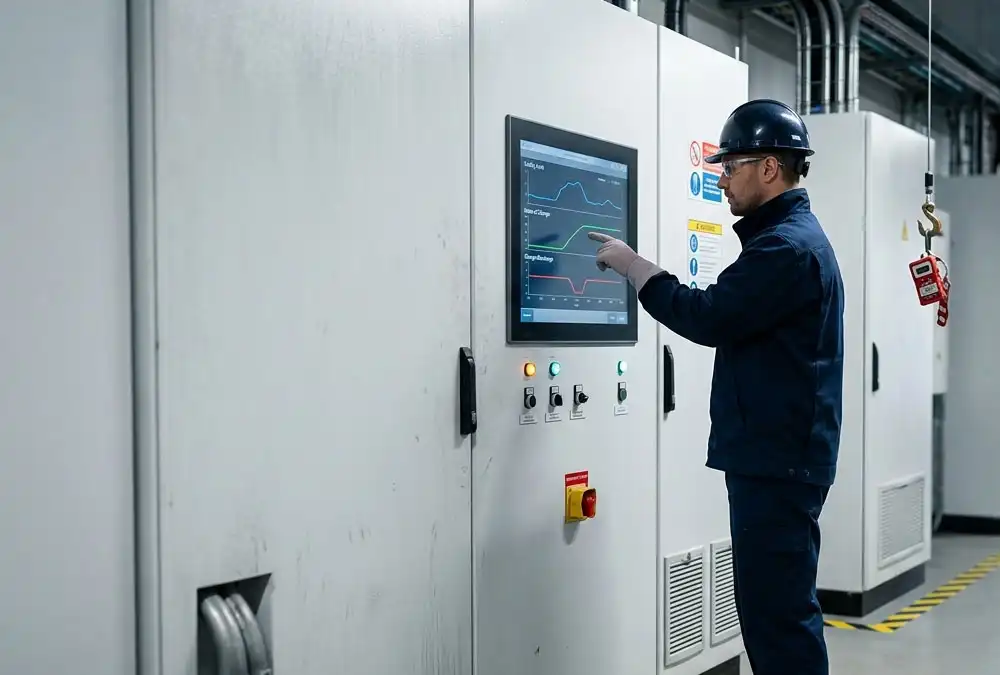
A battery can follow the wrong instruction very efficiently. If the EMS sees only electricity price, it may charge into a demand peak or discharge the reserve you expected to keep for backup. It needs measured load, tariff or market price, PV forecast, weather, operating calendar, battery SOC, connection limit and service reservations. It also needs a clear answer to a less glamorous question: what should happen when the forecast or communication link fails?
Prevent Recharge From Creating a New Peak
Use a site-import ceiling, ramp-rate limit and forecast-aware charging schedule. A battery that saves an energy charge during one interval can increase a demand charge during another if charging is uncontrolled. This is why the avoidable-cost map and the EMS setpoints must be designed together.
Reserve SOC and PCS Headroom
A perfectly executed price-based discharge can empty the battery before a grid event, production peak or outage. Increasing energy capacity is not the only solution. Reserve SOC, reserve charge/discharge power, forecast horizons and override rules can protect the higher-value service. A project-specific priority hierarchy could place safety and connection compliance first, followed by backup reserve, peak control, load shifting and optional market services. That order is an engineering example, not a universal standard.
Define a Safe Local Fallback
Specify the local schedule, safe SOC range, alarm ownership and recovery procedure used when price feeds, forecasts or plant communications are unavailable. A control concept that works only with perfect external data is not an operational design.
What Does Load Shifting Battery Storage Really Cost?
If a model says, “Buy at €0.10 and avoid €0.22, so the margin is €0.12/kWh,” it is not finished. You buy more energy than the battery later delivers, and every cycle uses some of the asset’s warranted throughput. Gross price spread is not battery profit. Compare charged-energy cost with delivered-energy value, then include variable fees, degradation, auxiliaries and incremental O&M.
Net cycle value = avoided energy cost − charging energy cost − variable fees − degradation cost − incremental auxiliary/O&M cost
Continue the illustrative example with an assumed charging price of €0.10/kWh and an avoided-import price of €0.22/kWh. Delivering 1.50 MWh avoids €330 of energy cost, while 1.70 MWh of charging input costs approximately €170. The gross cycle margin is therefore about €160 before degradation, taxes, network charges, auxiliaries, maintenance, downtime and financing. These assumed prices are not typical European tariffs and must not be used for a real investment decision.
For US projects, the Department of Energy FEMP page on evaluating utility rate options separates energy, demand and fixed charges and recommends reviewing bills and interval data. It also notes that time-variable rates may include fixed time-of-use periods or dynamic rates reflecting underlying markets. That framework is useful for US screening, but it should not be transferred unchanged to Europe.
Annual feasibility then requires an interval simulation rather than multiplying the best daily spread by 365. Include non-operating days, seasonal price windows, battery availability, forecast errors, warranty throughput, degradation, reserve SOC and downside scenarios. A site with an attractive winter spread may have weak summer utilisation; another may have abundant solar energy but little evening load.
What Should You Give an EPC or BESS Supplier Before They Quote?
| Gate | Decision | Minimum evidence | Buyer benefit |
|---|---|---|---|
| S — Signal | Identify the exact avoidable cost or constraint. | Supply contract, tariff and connection terms | Prevents dispatch against the wrong commercial signal. |
| H — Hours | Define source, target and recharge windows. | Interval load, prices, PV and operating calendar | Establishes duration and recurrence. |
| I — Inventory | Classify flexible loads and storage options. | Process constraints and operational cost | Avoids battery-first overinvestment. |
| F — Feasibility | Model power, energy, recharge, losses and net value. | PCS limits, SOC window, efficiency and cost inputs | Produces an auditable provisional MW/MWh range. |
| T — Test | Specify EMS priorities, metering and acceptance. | Baseline, meter boundary and KPI definitions | Turns a savings claim into a verifiable requirement. |
Before sending the same short enquiry to three suppliers, give them the same design basis. Monthly bills alone are not enough because they hide when demand occurs and how long it lasts. Where available, provide at least 12 months of 15-minute interval data, the current electricity contract, operating schedule, PV generation and export data, connection limits, single-line information, backup reserve and other service requirements. Use finer data where short peaks or fast controls materially affect the design. Better inputs will not guarantee identical quotations, but they make the differences much easier to challenge.
A preliminary review can test whether the signal, shift window and available site data justify detailed BESS engineering.
How Will You Prove the Savings After Commissioning?
Imagine the system has been operating for six months and the finance team asks whether it delivered the promised saving. Can the owner reproduce the result, or only read a dashboard total? Define the meter boundary, data interval, baseline period, tariff version, excluded operating conditions and treatment of production, occupancy or weather changes before commissioning. Charge and discharge energy should be measured separately wherever possible; netting them inside a long interval can hide throughput and loss.
| Contracted output | Boundary or unit | Supplier evidence | Acceptance approach | Buyer benefit |
|---|---|---|---|---|
| Shifted energy | AC kWh at PCC or agreed BESS terminal | Meter architecture and calculation method | Witnessed duty-cycle test plus operational reporting | Confirms the energy reaches the intended commercial boundary. |
| Efficiency | Discharged kWh ÷ charged kWh | Conditions, auxiliaries and excluded energy | Agreed charge/hold/discharge cycle | Prevents DC and AC efficiency claims from being mixed. |
| Reserve compliance | SOC and available kW/kWh | EMS logs and service-priority logic | Event replay or controlled dispatch test | Protects backup and higher-value services. |
| Availability and reporting | Defined available hours and data latency | Alarm, outage and data-completeness records | Defined reporting-period review | Makes operational underperformance visible. |
The DOE evaluation method notes that low-resolution data can obscure charging and discharging within the same time step. It states that one-hour data may be sufficient for many load-shifting or solar-storage evaluations because those uses normally create a meaningful hourly change in battery charge, while faster applications may need finer measurement. The project specification should therefore select resolution from the actual duty cycle, not copy one interval into every use case.
When Should You Walk Away From a Load Shifting Project?
Sometimes the most valuable result of a feasibility study is permission not to buy. Walking away is sensible when:
- the tariff is flat or the avoidable difference is too small;
- operations cannot move and storage economics do not close;
- the available charge window or spare import capacity is insufficient;
- conversion loss, degradation and auxiliary cost exceed avoided energy cost;
- charging would create a new demand peak;
- production, comfort, food-safety or product-quality consequences are unacceptable;
- backup or another service requires the same SOC and PCS headroom; or
- metering and controls cannot support reliable dispatch and verification.
The better answer may be an efficiency project, direct scheduling, thermal storage, a smaller hybrid system—or waiting until the contract changes. That is not a failed storage study. It is how you avoid owning a battery that cycles every day without creating enough net value.
Frequently Asked Questions
What is load shifting in electricity?
It is the relocation of electricity consumption—or the grid supply serving a fixed load—from one time window to another. The purpose may be to use lower prices, absorb renewable surplus, respect an import constraint or respond to a grid signal.
How does load shift work with a battery?
The BESS charges in the source window, holds energy if necessary, and discharges behind the meter in the target window. It then recharges under limits set by the tariff, connection, base load, PV production and EMS service priorities.
Does load shifting reduce total electricity consumption?
Not necessarily. Direct scheduling may leave total kWh almost unchanged. Battery storage requires more charging energy than it later delivers because of conversion and auxiliary losses, although it may reduce electricity cost or improve renewable self-use.
What is the difference between peak shaving and load shifting?
Peak shaving controls maximum power, while load shifting moves energy across time. A project can require both, but the power, energy and EMS reservations should be calculated separately before selecting a shared BESS.
Is a battery required for load shifting?
No. The underlying task can sometimes be rescheduled, and thermal storage can move heating or cooling production. A battery is useful when the process must continue but the timing of grid supply can change.
How do you calculate load shifting battery capacity?
Calculate the required AC power and delivered energy from interval data, convert the energy through the agreed efficiency and usable-SOC boundaries, then apply the end-of-life and availability design basis. Finally, verify that the battery can recharge within the available hours and power limits.
Can load shifting create a new peak?
Yes. Uncontrolled or overly rapid charging can raise site demand. Use an import ceiling, ramp limits and forecast-aware charging while accounting for the facility’s simultaneous base load.
Can one BESS combine load shifting, peak shaving and backup?
Potentially, but the services compete for SOC and PCS power. The design needs explicit energy and power reservations, priority rules, forecast logic and fallback behaviour. Nameplate capacity alone does not prove that all services are simultaneously available.
Is load shifting profitable in Europe?
There is no universal European answer. Profitability depends on the national and customer-specific tariff, contract eligibility, network charges, taxes, operating profile, charge source, system efficiency, degradation, financing and competing uses of the battery.
Validate the Shift Before Requesting a Battery Quote
If you remember only one method, use the five SHIFT gates: identify the Signal, define the Hours, build the flexibility Inventory, test technical and commercial Feasibility, and specify how performance will be Tested. Once those questions are answered, a battery and PCS quotation becomes far more meaningful.
If you already have interval load data and a current electricity contract, you have enough to start a useful conversation. A preliminary load shifting energy storage review can test the shift window, operating constraints, PV or grid charging opportunities, connection limits, reserve requirements and measurement boundary. It can narrow the required MW/MWh range without pretending that final sizing is possible before site engineering, supplier performance data, warranty conditions and local connection requirements are known.
Turn your tariff, interval load and operating constraints into a preliminary load-shifting design basis.
Related Articles
- Peak Shaving vs Load Shifting: C&I Energy Storage Decision Guide
- BESS Duration Guide: How to Choose 1, 2 or 4 Hours
- Battery Energy Storage System Design Guide for Europe
- Commercial and Industrial Battery Energy Storage Systems
Sources and Evidence
- International Energy Agency, Electricity 2026 — Flexibility, especially “Demand response offers breakthrough benefits, yet its potential is largely untapped.”
- International Energy Agency, The Value of Demand Flexibility, 2025 overview and framework.
- European Union, Directive (EU) 2019/944, Article 11, entitlement to a dynamic electricity price contract.
- US Department of Energy FEMP, Evaluating Your Utility Rate Options, electricity cost components and interval-data review.
- US Department of Energy FEMP, Battery Energy Storage System Evaluation Method, 2023, pages 8 and 17–19.
 https://anengjipower.com/wp-content/uploads/2026/06/epc-vs-turnkey-solar-project-bess.webp
675
1000
Charging Station Engineer
https://anengjipower.com/wp-content/uploads/2025/09/anengji-dc-fast-charging-station-manufacturer-and-supplier-logo-white-1.png
Charging Station Engineer2026-06-22 07:16:042026-06-24 07:13:17What Is the Difference Between EPC and Turnkey Contract Models in Energy Projects?
 https://anengjipower.com/wp-content/uploads/2026/06/anengji-commercial-solar-plus-storage-benefits-site.webp
675
1000
Charging Station Engineer
https://anengjipower.com/wp-content/uploads/2025/09/anengji-dc-fast-charging-station-manufacturer-and-supplier-logo-white-1.png
Charging Station Engineer2026-06-20 14:34:102026-06-20 14:37:43What Are the Top Benefits of Solar Battery Storage in Factories?
 https://anengjipower.com/wp-content/uploads/2026/06/modular-commercial-solar-battery-storage-cabinet.webp
675
1000
Charging Station Engineer
https://anengjipower.com/wp-content/uploads/2025/09/anengji-dc-fast-charging-station-manufacturer-and-supplier-logo-white-1.png
Charging Station Engineer2026-06-18 09:16:522026-07-03 03:05:13What Is Solar Battery Storage? Complete C&I Engineering Guide


Leave a Reply
Want to join the discussion?Feel free to contribute!