
Introduction
The rapid transition toward electric mobility has placed unprecedented strain on local electrical distribution systems. Implementing strategic energy storage for EV charging networks has evolved from an experimental luxury into an operational necessity for site hosts and utility networks alike. When multiple electric vehicles hook up to high-output dispensers simultaneously, the localized demand profile shifts aggressively, often outstripping the immediate supply thresholds of standard commercial service drops. By buffering these extreme load profiles, stationary battery units allow infrastructure developers to deploy highly competitive refueling installations without incurring prohibitive structural overhead or multi-year utility delays.
What Are the Benefits of Battery Energy Storage for EV Charging?
Battery Energy Storage Systems (BESS) help EV charging stations overcome grid limitations, reduce electricity demand charges, support high-power DC fast charging, and improve renewable energy utilization. By storing electricity during off-peak periods and discharging it during charging peaks, energy storage enhances charging reliability while lowering infrastructure and operational costs.
For site hosts evaluating the deployment of modern fleet networks, commercial parking facilities, or highway corridor plazas, evaluating the intersection of battery capacity and conversion topology is vital. This comprehensive architectural analysis covers the underlying electrical engineering, economic mechanics, and field-tested hardware configurations driving today’s smart energy infrastructure.
—
Why Energy Storage Is Becoming Essential for EV Charging Infrastructure
Rapid Growth of Electric Vehicle Adoption
Global passenger and commercial electric vehicle sales continue to follow an aggressive upward trajectory. According to the International Energy Agency (IEA) Global EV Outlook report, electric vehicle infrastructure requirements must scale rapidly to keep pace with fleet distribution, meaning standard low-voltage grid connections face an compounding influx of daily charging cycles.
Increasing Demand for DC Fast Charging Stations
Modern drivers and enterprise fleet operations no longer tolerate multi-hour replenishment windows. The market has definitively shifted toward High-Power Charging (HPC) environments, where dispensers are expected to deliver anywhere from 180kW to 360kW+ per stall, allowing vehicles to achieve an 80% state of charge within fifteen minutes.
Why Traditional Grid Connections Are No Longer Enough
Bringing online a cluster of four 350kW DC fast chargers requires a localized capacity allocation of up to 1.4 Megawatts. Most existing commercial utility circuits simply do not possess this level of unallocated thermal capacity. To supply this power directly, utilities must frequently install entirely new medium-voltage distribution lines, concrete substations, and utility transformers—a process that can take up to 24 months in congested municipal regions.
The Growing Role of Battery Energy Storage Systems (BESS)
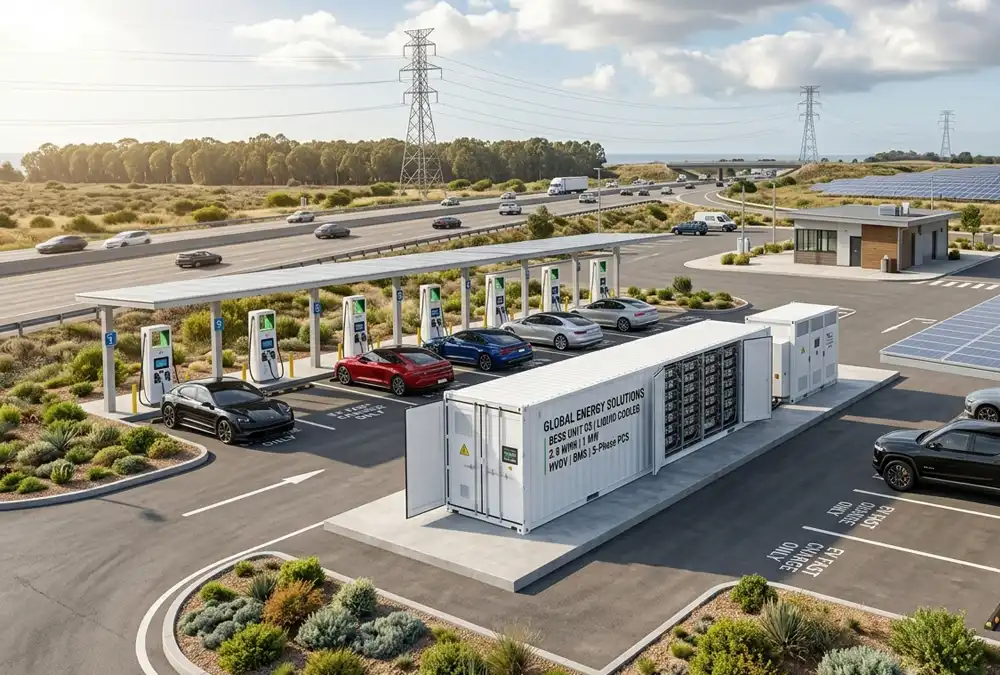
Stationary battery storage decouples vehicle grid draw from immediate distribution constraints. By acting as a decentralized energy reservoir, an onsite battery energy storage system for EV charging stations acts as a physical buffer, continuously drawing energy from the utility grid at a low, stable rate, and then dumping that high-power capacity into the vehicle’s battery pack when a dispenser activates.
—
What Is Battery Energy Storage for EV Charging?
Understanding Battery Energy Storage Systems (BESS)
A turnkey industrial stationary energy storage configuration consists of four interconnected core subsystems engineered to operate under continuous cycle strain:
- Battery System: High-density electrochemical blocks consisting of cells grouped into modules and integrated into vertical steel racking configurations designed to safely support precise operating voltages.
- PCS (Power Conversion System): A heavy-duty bidirectional, four-quadrant inverter setup responsible for converting incoming AC grid electricity to DC for battery storage, and rectifying it back to AC or routing it directly to DC charger links during discharge modes.
- BMS (Battery Management System): A critical multi-tier hardware control loop that continuously tracks cell-level cell voltages, internal temperature values, and isolation resistances to ensure the chemistry never operates outside of strict safety parameters.
- EMS (Energy Management System): The overarching software brain that actively monitors utility tariff pricing, real-time building load profiles, and dispenser utilization rates to orchestrate optimal charge and discharge behaviors.
How Energy Storage Works with EV Charging Stations
The operational logic follows a coordinated path designed to shield the local network breaker panel. During idle operational periods when no vehicles are hooked up, the EMS allows grid current to pass through the PCS to charge the stationary battery reserve. The moment a vehicle connects to a high-power dispenser, the EMS prevents the charger from pulling its full load from the utility line. Instead, the stationary battery system discharges its saved energy directly through the distribution link to the EV charger, supplementing or completely replacing the grid current to feed the vehicle’s onboard management system.
Difference Between Direct Grid Charging and Battery-Assisted Charging
Direct grid charging exposes the facility’s main distribution breaker directly to the intermittent, high-amplitude spikes generated by electric vehicle dispensers. Conversely, battery-assisted charging isolates the utility meter from these extreme spikes, maintaining a smooth, flat building profile while using the local energy reserve to satisfy the rapid high-kilowatt demands of the vehicle.
—
Challenges Facing Modern EV Charging Infrastructure
Limited Grid Capacity for High-Power Charging
Transformer capacity bottlenecks represent the single greatest challenge to rapid network expansion. Many industrial parks, commercial retail hubs, and public parking decks are constrained by rigid upstream sub-station limits, meaning that trying to connect multiple high-current dispensers directly will cause localized voltage drops or trigger upstream protection equipment.
High Demand Charges and Rising Electricity Costs
Commercial electricity billing structures rely heavily on demand fees, calculated based on the single highest 15-minute consumption spike recorded during the entire billing cycle. A single unmanaged ultra-fast charging event can easily push a facility into an elevated demand tariff bracket, severely eroding the project’s long-term operating margins.
Peak Load Stress During Simultaneous Charging
When multiple high-power dispensers operate simultaneously—such as during mid-day logistics hub turnarounds or evening commuting hours—the aggregate power draw creates a sharp peak load. Without intelligent local management, this synchronization can lead to equipment overheating, phase imbalances, and localized system failures.
Integrating Renewable Energy with EV Charging
While installing rooftop solar awnings over charging bays helps offset grid reliance, solar energy generation is fundamentally intermittent. When peak solar generation occurs during low-demand mid-day periods, excess green energy is often wasted or exported back to the grid for minimal financial credit, leaving the station completely exposed to high utility rates once the sun sets.
—
Integrating Battery Energy Storage Systems with Fast Charging Infrastructure
How BESS Supports DC Fast Charging Stations
Integrating a stationary battery directly into the facility’s internal DC or AC busbar network allows operators to deliver consistent high-power charging capacity. By managing localized power distribution dynamically, a dedicated battery storage for DC fast charging setup ensures dispensers can output their maximum rated kilowatts even if the local utility connection is strictly capped.
Peak Shaving and Load Management
The system uses peak shaving algorithms to smooth out consumption spikes. The EMS establishes a strict kilowatt ceiling for the utility meter; whenever the combined load of the building and the active dispensers threatens to breach this threshold, the battery instantly discharges to absorb the excess peak load locally.
Energy Arbitrage and Smart Charging
The system leverages time-of-use (TOU) pricing structures through automated energy arbitrage. The system draws grid electricity during low-cost nighttime or off-peak hours to replenish its reserves, then strategically deploys that low-cost stored energy to power vehicles during high-tariff peak demand periods.
Supporting Ultra-Fast EV Charging Without Grid Upgrades
By relying on a stationary energy buffer, site hosts can install 150kW or 350kW dispensers on small 50kW or 100kW utility grid connections, bypassing the extensive delays, permitting requirements, and heavy infrastructure investments associated with traditional substation transformer upgrades.
Typical Architecture of an EV Charging + BESS System
Modern fast-charging hubs integrate multiple energy sources into a cohesive local network. A typical system deployment combines on-site Solar PV generation and the primary Utility Grid into a central Power Conversion System (PCS). Guided by an intelligent Energy Management System (EMS), this configuration routes power directly to the high-voltage stationary Battery Storage array and the corresponding DC Fast Chargers, maximizing overall energy efficiency.
—
Common Technologies Used in Energy Storage Systems for EV Charging
Lithium-Ion Battery Technology
The performance profile of a stationary installation depends heavily on the chosen electrochemical composition. Industrial projects generally balance energy density, cycle durability, and thermal safety across two primary chemistries:
Battery Management System (BMS)
The safety and longevity of the system depend on continuous, high-speed monitoring at the cell level. The master BMS manages three critical functions: Safety Control (isolating contactors during overvoltage or thermal anomalies), State of Charge (SOC) tracking (balancing energy levels across parallel strings), and State of Health (SOH) tracking (monitoring changes in internal resistance over time).
Power Conversion System (PCS)
The electrical heart of the system, comprising high-speed insulated-gate bipolar transistor (IGBT) or silicon carbide (SiC) bidirectional inverter topologies. The PCS converts incoming AC grid electricity to DC for efficient battery storage, and rectifies it back to high-quality AC or routes it directly to DC charger links during discharge modes with response times measured in milliseconds.
Energy Management System (EMS)
The system’s intelligent software layer. The EMS continuously monitors building load profiles, reads utility tariff data, and executes real-time optimization strategies—such as automated peak shaving, load shifting, and energy arbitrage—to maximize economic returns without requiring daily manual adjustments.
Thermal Management Systems
Operating temperature is a primary driver of battery safety and cycle life. Modern high-capacity systems use either forced-air cooling (utilizing HVAC air ducts, best for low-demand environments) or advanced closed-loop liquid cooling (circulating a glycol-water coolant through internal thermal plates). Liquid cooling maintains cell temperatures within a narrow ±2°C window, minimizing degradation and reducing internal energy consumption.
—
Key Benefits of Battery Energy Storage for EV Charging
Reduce Grid Upgrade Costs
Deploying a robust commercial battery storage for EV charging configuration allows station operators to install high-speed chargers without funding expensive utility infrastructure upgrades. Bypassing utility transformer retrofits saves substantial upfront capital and drastically accelerates project deployment timelines.
Lower Demand Charges and Operating Expenses
By flattening sudden consumption spikes through automated peak shaving, a local energy storage container minimizes monthly demand charges. This keeps the station within lower-cost utility tariff brackets and lowers overall operating expenses, significantly shortening the facility’s payback period.
Improve Fast Charging Performance
Integrating dedicated battery storage ensures dispensers can consistently deliver their maximum rated kilowatts to vehicles, eliminating sudden voltage drops or power throttling when multiple chargers activate simultaneously, thereby maximizing the driver experience.
Enhance Grid Stability and Reliability
Onsite storage serves as a valuable resource for the surrounding distribution network. The bidirectional PCS can inject active power to provide voltage support and fast frequency response, helping protect local distribution lines from transient electrical anomalies.
Enable Greater Renewable Energy Utilization
Pairing a high-capacity solar and battery storage for EV charging system allows operators to store excess green energy generated during sunny, low-traffic periods and deploy it to power vehicles overnight, maximizing renewable self-consumption and reducing carbon emissions.
Accelerate EV Charging Infrastructure Deployment
Decoupling your site plan from complex, multi-year utility transformer review processes allows infrastructure developers to quickly secure municipal approvals and bring high-power charging locations online months ahead of traditional grid-dependent layouts.
—
Economic Benefits of Energy Storage Systems in Fast EV Charging Applications
Avoiding Utility Connection Upgrade Costs
Traditional grid expansion costs can easily derail a fast-charging project before construction even begins. If a local utility requires a site host to pay for upgrading upstream transformers and running new underground medium-voltage lines, the cost can easily exceed several hundred thousand dollars. Utilizing a 1MW storage system allows the developer to keep their existing low-voltage service drop intact, completely avoiding these heavy capital expenditures.
Reducing Peak Demand Charges
Commercial utility tariffs often charge between $15 and $40 per kilowatt for peak demand spikes. If an unmanaged 350kW DC fast charger runs directly from the grid, that single vehicle plug-in can add up to $14,000 to the facility’s monthly utility bill. A stationary battery system caps these spikes, delivering direct, predictable savings on every monthly billing cycle.
Increasing Charging Station Revenue Potential
Stations that can guarantee consistent high-power charging performance can charge a premium for their services. By ensuring dispensers never suffer from power throttling or voltage dropouts, operators can maintain high throughput and increase daily vehicle turnover rates, boosting overall station revenue.
Improving Return on Investment (ROI) and Shortening Payback Periods
Industrial energy storage installations balance hardware costs with clear, ongoing operational savings. According to recent 2025 and 2026 clean energy infrastructure finance reports, pairing energy storage with high-utilization fast-charging hubs shortens full project capital payback periods to an efficient 3.5 to 5.0 years, delivering long-term, high-value returns.
How Does Battery Storage Reduce EV Charging Costs?
Battery storage reduces EV charging costs by storing low-cost electricity during off-peak hours and supplying energy during peak demand periods. This lowers demand charges, reduces grid upgrade requirements, and improves charging station profitability.
—
Real-World Applications of Solar and Battery Storage for EV Charging
Remote and Off-Grid EV Charging Stations
Deploying fast-charging infrastructure along remote highways, national park corridors, or isolated industrial mining sites is often hindered by a complete lack of high-voltage transmission lines. Combining a high-capacity battery storage container with a large localized solar array creates an independent microgrid capable of delivering reliable DC fast charging without any utility connection.
Urban Fast Charging Stations
Commercial shopping malls, multi-story downtown parking decks, and public charging hubs are often constrained by tight space limitations and strictly capped electrical service allocations. Installing a space-saving outdoor containerized battery allows these urban locations to support high-speed charging without overloading the building’s primary electrical distribution network.
Fleet Charging Depots
Logistics operators, e-commerce delivery fleets, and public transit bus networks face heavy, concentrated electrical loads when hundreds of vehicles return to a central depot for overnight charging. A 1MW battery system allows fleet managers to smooth out these massive charging blocks, protecting local transformers and avoiding high peak-demand utility fees.
Solar-Powered EV Charging Hubs
Next-generation highway superstations utilize large solar canopies over their charging bays to offset grid reliance. Integrating a high-efficiency liquid-cooled battery storage system allows these modern hubs to store excess daytime solar generation and deploy it to power vehicles overnight, maximizing renewable self-consumption and driving down corporate carbon emissions.
—
Challenges and Considerations When Deploying Battery Storage for EV Charging
While the operational and financial benefits are substantial, deploying high-capacity energy storage requires careful engineering and site planning. Site hosts must balance several key technical factors to ensure long-term project success:
| Engineering Challenge | Primary Site Impact | Technical Mitigation Strategy |
|---|---|---|
| Initial Investment Costs | Elevated upfront capital expenditure (CAPEX) for battery container and inverter hardware. | Utilize federal clean energy tax incentives, state grants, or explore Energy-as-a-Service (EaaS) financing models to minimize upfront costs. |
| Battery Sizing & Capacity | Undersized systems cause early depletion during peak hours; oversized layouts increase payback periods. | Perform precise 15-minute interval load analysis and use predictive modeling to perfectly match battery capacity with anticipated dispenser utilization. |
| Safety & Regulatory Compliance | Complex local zoning approvals, building permits, and strict municipal fire safety reviews. | Specify factory-integrated systems that hold verified product certifications, including full system-level UL 1973 and UL 9540A safety listings. |
| Battery Degradation Management | Improper operational profiles accelerate cell degradation, shortening the system’s useful service life. | Deploy intelligent EMS software to maintain optimal State of Charge limits and utilize precision liquid cooling to maximize cell longevity. |
| System Integration Complexity | Communication lag between dispensers, the local battery, and the building’s main breaker panel. | Implement high-speed, standardized industrial communication protocols—such as Modbus TCP or CAN bus interfaces—to ensure millisecond response times. |
—
High-Performance Industrial Energy Storage Product Recommendations
Selecting the right hardware architecture is critical for ensuring reliable performance under continuous fast-charging loads. For industrial sites, commercial charging plazas, and heavy-duty fleet hubs, we recommend deploying factory-integrated, turnkey liquid-cooled container systems. These platforms combine premium LFP chemistry, multi-tier safety controls, and intelligent EMS software into a pre-tested, weatherproof enclosure engineered for rapid site installation and maximum thermal efficiency.
—
FAQs About Energy Storage for EV Charging
What size battery storage system is needed for an EV charging station?
Sizing depends on your site’s grid connection capacity and expected dispenser utilization. A typical public plaza with four 150kW fast chargers frequently deploys a 500kW/1000kWh system, while large highway hubs or heavy-duty fleet depots typically require a 1MW/2MWh or larger containerized configuration to manage peak demand loads effectively.
Can battery storage eliminate the need for grid upgrades?
Yes. By discharging power locally to handle rapid vehicle charging spikes, a stationary battery system allows site hosts to install ultra-fast chargers on existing low-voltage service lines, completely bypassing the extensive costs and multi-month delays associated with traditional utility transformer expansions.
How much can battery storage reduce demand charges?
By using intelligent peak shaving algorithms to smooth out high-current consumption spikes, an integrated battery storage container can reduce a commercial facility’s monthly utility demand charges by 20% to 40%, delivering a clear, predictable line-item cost reduction.
What battery chemistry is best for EV charging applications?
Lithium Iron Phosphate (LFP) is the undisputed industry standard for stationary charging infrastructure. LFP offers superior thermal stability, advanced fire safety characteristics, and an exceptional lifecycle of 6,000 to 8,000 full charge-discharge cycles, outperforming traditional NMC alternatives in high-use commercial applications.
Can solar panels and battery storage fully power EV charging stations?
Yes, in specialized off-grid or microgrid configurations with high solar availability. However, for standard urban or commercial installations, combining solar panels and battery storage with a stable baseline utility connection provides the optimal balance of continuous reliability and maximum operating cost savings.
Is battery energy storage suitable for fleet charging depots?
Absolutely. Fleet depots experience heavy, concentrated electrical loads when dozens of delivery trucks or transit buses return for simultaneous charging. Implementing a stationary battery allows fleet managers to flatten these massive consumption blocks, protecting local infrastructure and avoiding expensive peak demand fees.
—
Conclusion: The Future of EV Charging Depends on Intelligent Energy Storage
The transition toward high-power electric vehicle infrastructure is structurally inseparable from the deployment of smart, decentralized energy storage solutions. Relying entirely on traditional grid expansions is no longer a viable strategy for scaling fast-charging networks. By integrating advanced energy storage for EV charging sites, network developers can successfully eliminate grid capacity bottlenecks, insulate their operations from high utility demand charges, and deliver the consistent, high-speed charging performance that modern drivers demand. As the global energy ecosystem continues to evolve, stationary battery storage will remain the fundamental foundation driving the future of electrified transportation.
 https://anengjipower.com/wp-content/uploads/2026/10/AnengjiPower-Load-Shifting-Energy-Storage-at-a-CI-Site.webp
675
1000
Charging Station Engineer
https://anengjipower.com/wp-content/uploads/2025/09/anengji-dc-fast-charging-station-manufacturer-and-supplier-logo-white-1.png
Charging Station Engineer2026-10-19 03:47:032026-10-19 03:47:31Load Shifting Energy Storage: C&I Sizing & Cost Guide
https://anengjipower.com/wp-content/uploads/2026/10/AnengjiPower-Load-Shifting-Energy-Storage-at-a-CI-Site.webp
675
1000
Charging Station Engineer
https://anengjipower.com/wp-content/uploads/2025/09/anengji-dc-fast-charging-station-manufacturer-and-supplier-logo-white-1.png
Charging Station Engineer2026-10-19 03:47:032026-10-19 03:47:31Load Shifting Energy Storage: C&I Sizing & Cost Guide https://anengjipower.com/wp-content/uploads/2026/10/AnengjiPowr-AC-Coupled-Battery-Storage-at-a-CI-Solar-Site.webp
675
1000
Charging Station Engineer
https://anengjipower.com/wp-content/uploads/2025/09/anengji-dc-fast-charging-station-manufacturer-and-supplier-logo-white-1.png
Charging Station Engineer2026-10-16 03:03:192026-10-16 03:03:49What Is AC-Coupled Battery Storage? C&I BESS Guide
https://anengjipower.com/wp-content/uploads/2026/10/AnengjiPowr-AC-Coupled-Battery-Storage-at-a-CI-Solar-Site.webp
675
1000
Charging Station Engineer
https://anengjipower.com/wp-content/uploads/2025/09/anengji-dc-fast-charging-station-manufacturer-and-supplier-logo-white-1.png
Charging Station Engineer2026-10-16 03:03:192026-10-16 03:03:49What Is AC-Coupled Battery Storage? C&I BESS Guide https://anengjipower.com/wp-content/uploads/2026/10/AnengjiPower-What-Is-Peak-Shaving-at-an-Industrial-Site.webp
675
1000
Charging Station Engineer
https://anengjipower.com/wp-content/uploads/2025/09/anengji-dc-fast-charging-station-manufacturer-and-supplier-logo-white-1.png
Charging Station Engineer2026-10-15 06:49:012026-10-15 06:50:23What Is Peak Shaving? How Battery Energy Storage Reduces C&I Peaks
https://anengjipower.com/wp-content/uploads/2026/10/AnengjiPower-What-Is-Peak-Shaving-at-an-Industrial-Site.webp
675
1000
Charging Station Engineer
https://anengjipower.com/wp-content/uploads/2025/09/anengji-dc-fast-charging-station-manufacturer-and-supplier-logo-white-1.png
Charging Station Engineer2026-10-15 06:49:012026-10-15 06:50:23What Is Peak Shaving? How Battery Energy Storage Reduces C&I Peaks


Leave a Reply
Want to join the discussion?Feel free to contribute!