
Introduction
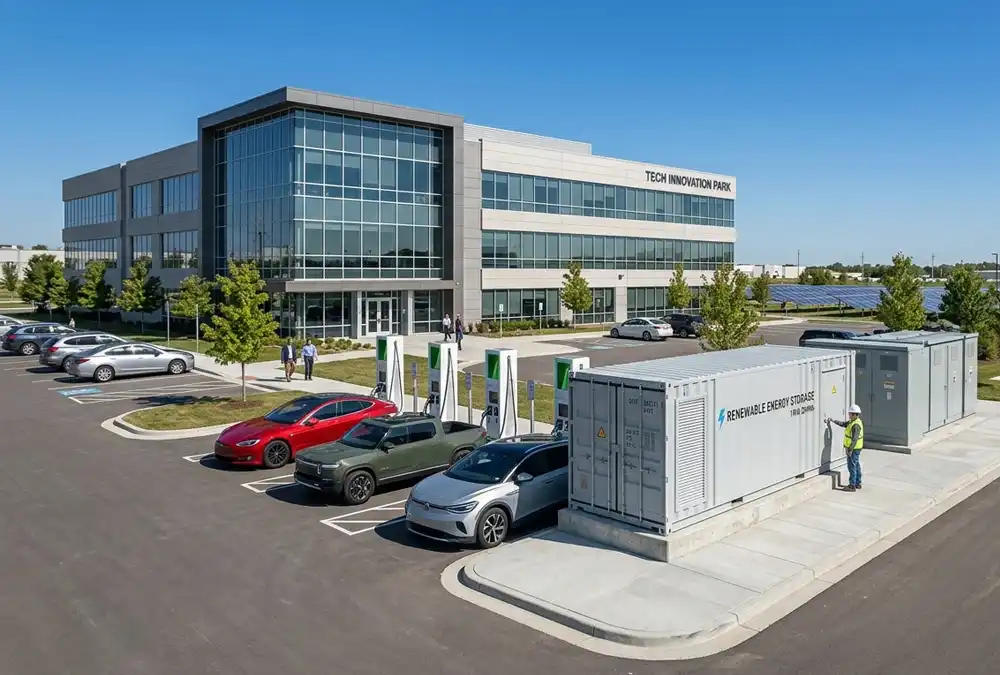
Deploying high-power DC fast charging infrastructure presents a unique set of electrical engineering challenges, primarily centered around localized grid capacity constraints and soaring operational utility expenses. As charging networks scale up to accommodate next-generation electric vehicles, operators face a critical choice regarding site design: how to accurately evaluate a **1MW vs 2MW battery storage for EV charging** configuration. Incorporating a multi-megawatt battery energy storage system (BESS) allows fleet operators and commercial hub developers to stabilize field voltage, avoid expensive utility substation upgrades, and dramatically mitigate monthly EV charging demand charges. Choosing between a 1MW and a 2MW system depends on your specific daily duty cycles, active load profiles, and long-term infrastructure expansion plans.
Understanding the interplay between peak power output (measured in megawatts) and overall energy capacity (measured in megawatt-hours) is essential for modern project design. This in-depth technical analysis breaks down the performance characteristics, sizing methodologies, operational life cycles, and return-on-investment (ROI) metrics of 1MW and 2MW energy storage systems configured for high-demand commercial charging hubs.
Quick Answer: 1MW vs 2MW Battery Storage for EV Charging
The primary difference between 1MW and 2MW battery storage for EV charging is maximum instantaneous power output and scalable energy capacity. A 1MW BESS typically delivers 2MWh to 4MWh of storage, supporting 2 to 6 DC fast chargers. A 2MW BESS scaling from 4MWh to 8MWh is engineered for large-scale hubs or heavy-duty truck fleets running 6 to 12+ high-output dispensers simultaneously.
What Is the Main Difference Between 1MW and 2MW Battery Storage?
| Technical Metric | 1MW BESS Configuration | 2MW BESS Configuration |
|---|---|---|
| Maximum Output Power | 1.0 Megawatt (MW) | 2.0 Megawatts (MW) |
| Typical Energy Capacity Range | 2.0 MWh to 4.0 MWh | 4.0 MWh to 8.0 MWh |
| Supported High-Output Chargers | 2 to 6 DC Fast Chargers (HPC) | 6 to 12+ DC Fast Chargers (HPC) |
| Grid Support Capability | Medium (Localized Peak Shaving) | High (Dynamic Microgrid & Ancillary Response) |
| Initial Capital Investment (CAPEX) | Lower baseline equipment cost | Higher industrial-scale deployment cost |
| Optimized Site Profile | Small-to-medium commercial hubs, retail parking | Highway plazas, bus depots, heavy fleet terminals |
Which System Should You Choose?
Selecting the ideal hardware architecture requires balancing immediate grid constraints against real-time dispenser utilization curves. From a field engineering perspective, your asset allocation strategy should follow these criteria:
Choose a 1MW BESS if:
- Your facility operates fewer than 6 high-power DC fast dispensers simultaneously.
- The local utility grid connection capacity is moderately restricted but present.
- Your capital allocation budget requires an optimized, fast-payback asset profile.
- Localized EV charging demand charges represent the primary operational bottleneck you need to resolve.
Choose a 2MW BESS if:
- You are engineering a high-utilization highway corridor fast charging hub.
- The facility supports heavy-duty class 8 electric truck or municipal transit bus fleets with high-kilowatt acceptance rates.
- Traditional physical utility grid upgrades are cost-prohibitive or delayed by several years.
- The multi-year site development plan anticipates substantial localized load growth.
—
What Is a Battery Energy Storage System (BESS) for EV Charging?
Why EV Charging Stations Need Battery Storage
When an electric vehicle connects to a high-power dispenser, the building’s load profile experiences an immediate, near-vertical power spike. If multiple vehicles plug in simultaneously, the aggregate demand can easily exceed the thermal limits of local facility transformers. Utilizing **EV charging battery storage** solves these infrastructure challenges through several core mechanisms:
- Managing Peak Charging Demand: The system discharges stored energy locally during peak vehicle arrival blocks, maintaining building consumption within safe operational parameters.
- Reducing Utility Demand Charges: It flattens the utility meter profile, preventing the facility from triggering expensive peak tariff thresholds.
- Supporting Grid-Constrained Locations: It enables ultra-fast charging infrastructure deployment in regions where the upstream utility connection capacity is strictly limited.
- Improving Charging Reliability: It isolates sensitive charger power modules from grid voltage sags, phase imbalances, and brief supply disruptions.
- Increasing Renewable Energy Integration for EV Charging: It serves as a local green energy buffer, storing daytime solar generation for deployment during high-traffic evening periods.
Key Components of a Battery Storage System
A turnkey megawatt-scale energy storage container is a complex, multi-layered industrial asset consisting of five integrated subsystems:
—
Understanding 1MW Battery Storage for EV Charging
Typical Configuration of a 1MW BESS
A standard 1MW turnkey industrial storage unit is typically housed within a compact 20-foot weatherproof ISO container enclosure. This space-saving configuration integrates a 1MW bidirectional PCS alongside an LFP battery array that usually ranges from 2MWh to 4MWh in total energy capacity. The entire container arrives pre-wired and factory-tested, requiring only a concrete pad foundation and a single low- or medium-voltage coupling to the facility’s main switchgear panel.
How Many EV Chargers Can a 1MW Battery Support?
Answering **how many EV chargers can a 1MW battery support** requires analyzing the exact power ratings of your dispensers alongside the site’s baseline utility allocation. Assuming a grid connection capacity of 200kW, a 1MW BESS can supplement the station to provide up to 1,200kW of total peak capacity. This enables several dispenser combinations:
- 120kW Chargers: Supports 6 to 8 dispensers running concurrently without overloading local transformers.
- 180kW Chargers: Reliably supports 4 to 6 chargers operating at full output during peak multi-vehicle charging events.
- 350kW High-Power Chargers: Supplies enough supplementary power to support 2 to 3 ultra-fast dispensers during high-throughput highway transit cycles.
Best Applications for 1MW Battery Storage
The 1MW architecture excels in environments where spatial footprint is premium and deployment speed is a primary project driver. It is the ideal choice for retail lifestyle centers, multi-tenant commercial office parking decks, premium hotel destinations, and decentralized municipal fleet yards where standard delivery vans charge overnight.
Understanding 2MW Battery Storage for EV Charging Infrastructure
Typical Configuration of a 2MW BESS
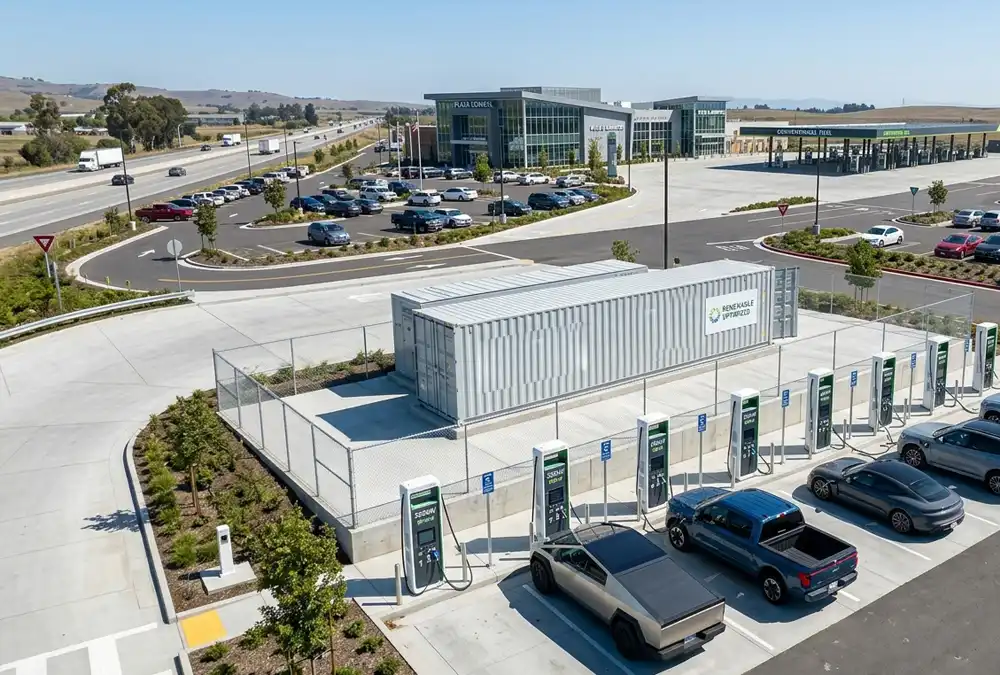
Stepping up to a 2MW configuration transitions the site into **megawatt-scale energy storage** territory. This setup is typically housed in a larger 40-foot container or split across a modular multi-container architecture. It pairs a heavy-duty 2MW PCS inverter station with a massive LFP battery core designed to deliver between 4MWh and 8MWh of total energy reserves, making it well-suited for high-intensity, continuous cycling environments.
How Many EV Chargers Can a 2MW Battery Support?
A 2MW energy storage system provides the massive power injection required to operate large-scale public fast-charging plazas. When integrated with an intelligent **fast charging station energy management** platform, a 2MW system can reliably support:
- 180kW Chargers: Manages a large block of 8 to 12 high-output dispensers, perfect for highway travel plazas and public charging hubs.
- 240kW Chargers: Powers 6 to 10 high-speed chargers, making it ideal for modern regional logistics hubs and delivery vehicle networks.
- 350kW Ultra-Fast Chargers: Delivers the high instantaneous current required to run 5 to 8 ultra-fast dispensers concurrently, ensuring maximum vehicle throughput.
Best Applications for 2MW Battery Storage
The 2MW BESS is engineered for heavy-duty, high-throughput transport infrastructure. Its primary deployments include key highway corridor travel centers, multi-class regional logistics depots, heavy-duty electric truck highway charging stops, municipal transit bus maintenance terminals, and large-scale public energy hubs.
—
1MW vs 2MW Battery Storage Comparison for DC Fast Charging
Power Output Comparison
The core difference between the two systems lies in their instantaneous electrical responsiveness. A 1MW system can inject up to 1,000kW of supplementary power into the facility’s internal busbar. While this is sufficient for standard light-duty vehicle stations, a 2MW system doubles that capability to 2,000kW of instantaneous injection. This high-power delivery is critical for preventing voltage sags when multiple heavy-duty vehicles plug in at the exact same moment.
Energy Capacity Comparison
Power output determines how many vehicles can charge at once; energy capacity (MWh) determines how long that power delivery can be sustained. A 1MW/2MWh system can deliver its full rated power for two hours, whereas a 2MW/8MWh system can sustain a high-power discharge for up to four hours. This extended duration is vital for managing long, continuous morning or evening charging blocks without depleting the station’s energy reserves.
Charging Capacity Comparison
A 1MW system is typically configured to support mid-sized commercial installations with a diversified turnover rate. In contrast, a 2MW platform provides the robust electrical headroom needed to handle consecutive, uncoordinated fast-charging sessions throughout the day, ensuring dispensers always deliver their maximum rated kilowatts to every vehicle.
Scalability Comparison
Modern 2MW platforms are built with a modular, highly scalable internal architecture. While expanding a standard 1MW container often requires installing an entirely new parallel enclosure, a 2MW modular container allows operators to easily add internal battery racks over time, making it simple to scale up capacity as local vehicle charging traffic increases.
Reliability and Redundancy Comparison
High-capacity 2MW systems utilize multi-string configurations with independent BMS controls and segmented PCS inverter blocks. If a single battery module or inverter string requires maintenance, the EMS can isolate that specific section while keeping the rest of the container online at reduced capacity, ensuring the charging station faces zero operational downtime.
—
Grid Connection Capacity and EV Charging Load Management
Common Grid Constraints for Commercial Charging Stations
Securing sufficient electrical capacity from local utilities has become a primary bottleneck for charging network expansion. High interconnection costs, expensive substation transformer retrofits, and multi-year utility review delays regularly stall new projects. Utilizing onsite energy storage allows developers to deploy high-power charging sites without waiting for extensive utility infrastructure upgrades.
How 1MW BESS Supports Peak Shaving
A 1MW battery system utilizes **peak shaving for EV charging** algorithms to establish a firm consumption ceiling at the utility meter. Whenever active vehicle dispensers threaten to push the facility’s total load past this pre-set limit, the EMS instantly engages the battery system to handle the excess demand locally, maintaining a flat, predictable grid consumption profile.
How 2MW BESS Reduces Grid Upgrade Requirements
For large-scale travel plazas and freight terminals, a 2MW BESS functions as a localized virtual power plant. By continuously drawing a stable, low-current stream from the utility grid during low-traffic periods, it builds a massive energy reserve that handles multi-megawatt charging blocks locally, completely eliminating the need for extensive utility grid upgrades.
—
Cost Comparison of 1MW vs 2MW Battery Storage Systems
Equipment Cost Breakdown
When evaluating a **1MW battery storage for EV charging station cost**, developers must look beyond the initial purchase price of the battery container itself. A comprehensive project budget must factor in several key capital expenditures:
| Cost Component | 1MW / 2MWh BESS Project | 2MW / 4MWh BESS Project |
|---|---|---|
| Core Battery Cell & Rack Assembly | Baseline LFP container pricing | Scale discount per kWh on cells |
| PCS Bidirectional Inverter Station | 1MW modular liquid-cooled inverter | 2MW heavy-duty multi-string inverter |
| EMS Software & Site Controls | Turnkey localized optimization software | Advanced dynamic microgrid orchestration |
| Onsite Civil & Electrical Installation | Standard concrete pad and 480V coupling | Reinforced foundation and MV transformer step-up |
Operating Cost Considerations
Long-term operational expenses are primarily driven by auxiliary HVAC power consumption, scheduled filter and coolant changes, and cell degradation management. Modern liquid-cooled 2MW configurations offer enhanced thermal efficiency, which reduces internal parasitic loads and significantly extends the useful life of the cells compared to older air-cooled 1MW designs.
Total Cost of Ownership (TCO)
While a 2MW system requires a larger upfront capital investment, its lifecycle cost per kilowatt-hour is often substantially lower. This improved cost efficiency stems from industrial-scale hardware pricing, minimized installation overhead relative to system size, and advanced multi-string safety configurations that reduce long-term maintenance costs.
—
ROI Analysis of Battery Storage for EV Charging Stations
Demand Charge Savings
Commercial utility tariffs often penalize high consumption spikes with heavy demand charges, which can range from $15 to $40+ per kilowatt each month. By using targeted peak shaving to eliminate these extreme charging spikes, an integrated energy storage system can save operators thousands of dollars on their monthly utility bills, directly improving the site’s operating margins.
Energy Arbitrage Opportunities
An intelligent EMS maximizes returns by executing automated energy arbitrage. The system draws grid electricity during low-cost, off-peak night hours to charge the battery reserves, then strategically deploys that low-cost stored energy to power vehicles during high-tariff peak afternoon windows, capturing clear operational savings.
Revenue from Faster Charging Availability
Drivers heavily favor charging locations that consistently deliver fast, reliable charging speeds. By preventing power throttling during busy high-traffic periods, an integrated BESS shortens vehicle charging times, reduces driver queues, and increases daily vehicle turnover, boosting overall station revenue.
Typical Payback Period
Financial payback periods vary based on local utility tariff structures and daily charger utilization rates. According to clean energy infrastructure deployment data from 2025 and 2026, typical project returns follow these timelines:
- 1MW BESS Configuration: Achieves full capital payback within 4 to 7 years, driven primarily by localized demand charge savings at commercial sites.
- 2MW BESS Configuration: Reaches full payback within 5 to 8 years, leveraging large-scale energy arbitrage, high fleet throughput, and participation in utility-scale demand response programs.
—
Renewable Energy Integration with EV Charging Battery Storage
Combining Solar and Battery Storage
Pairing onsite solar generation with stationary battery storage creates an optimized, self-sustaining energy ecosystem. This integration allows operators to capture clean solar energy during peak daytime hours, store it locally, and deploy it to power vehicles whenever needed, maximizing renewable energy utilization and reducing overall grid dependence.
Solar + 1MW BESS Applications
The solar-boosted 1MW architecture is ideal for suburban retail centers, corporate campus parking lots, and municipal park-and-ride facilities. It allows operators to use rooftop solar awnings to offset daily building consumption while keeping an optimized energy reserve ready to handle standard passenger EV charging spikes.
Solar + 2MW BESS Applications
Large-scale highway travel plazas and heavy-duty logistics corridors require a robust 2MW BESS configuration. These massive installations integrate expansive solar canopy structures with megawatt-scale storage to create resilient regional microgrids, capable of delivering continuous fast charging to electric truck and bus fleets even during complete grid outages.
—
How to Choose the Right Battery Storage Size for Your EV Charging Project
Key Factors to Evaluate
Selecting the ideal **best battery size for DC fast charging station** deployments requires analyzing several critical operational variables:
- Number of Active Chargers: Calculate the maximum number of vehicles your station needs to serve simultaneously during peak arrival windows.
- Charger Power Ratings: Map out your dispenser mix, factoring in the high-current demands of 150kW, 180kW, or 350kW ultra-fast charging units.
- Available Grid Capacity: Coordinate with your local utility to determine the absolute thermal limit of your existing building service drop.
- Future Expansion Plans: Evaluate whether your site layout will need to support additional high-power dispensers within the next 36 to 60 months.
- Electricity Tariff Structure: Analyze your local utility bills to determine exactly how much you are paying for peak demand charges versus standard consumption.
Decision Matrix
| Operational Site Scenario | Recommended Storage Technology Choice |
|---|---|
| 2 to 4 Standalone 150kW Dispensers | 1MW BESS (Optimized for localized peak shaving) |
| 4 to 8 Diversified High-Power Chargers | 1MW to 2MW BESS (Depending on daily vehicle turnover rates) |
| 8 to 12+ Ultra-Fast 350kW Plugs | 2MW BESS (Engineered for heavy multi-vehicle peak loads) |
| Class 8 Truck & High-Throughput Transit Hubs | 2MW+ BESS (With extended 4-hour discharge capacity) |
—
High-Performance Industrial Energy Storage Product Recommendations
Selecting reliable, industry-certified hardware is critical for ensuring long-term performance under demanding charging loads. For commercial charging hubs, highway plazas, and heavy-duty fleet depots, we recommend deploying factory-integrated, turnkey liquid-cooled container systems. These industrial-grade platforms combine premium LFP chemistry, advanced multi-tier safety controls, and intelligent EMS software into a pre-tested, weatherproof enclosure engineered for seamless site integration and maximum lifecycle efficiency.
—
Frequently Asked Questions About 1MW vs 2MW Battery Storage for EV Charging
Is a 1MW battery enough for a fast charging station?
Yes, a 1MW battery system is highly effective for small-to-medium commercial installations running 2 to 6 fast chargers. By utilizing automated peak shaving, it easily keeps the facility’s total grid consumption within safe limits and eliminates expensive peak utility fees.
How long can a 1MW battery power EV chargers?
The continuous runtime depends on the system’s total megawatt-hour (MWh) capacity. A standard 1MW/2MWh system can deliver its maximum power output for two hours straight, while a larger 1MW/4MWh configuration can sustain high-power delivery for up to four hours before needing to recharge.
How many EV chargers can a 2MW battery support?
A high-capacity 2MW battery system can reliably support a large public plaza running 6 to 12+ high-output dispensers simultaneously, making it the preferred choice for busy highway travel plazas and heavy-duty commercial fleet terminals.
What battery capacity is recommended for truck charging stations?
Heavy-duty electric trucks require massive amounts of energy to recharge efficiently. To handle these intense, continuous loads, truck charging stations typically require a robust 2MW BESS configuration with at least 4MWh to 8MWh of total energy capacity.
Can battery storage eliminate the need for grid upgrades?
Yes, absolutely. By discharging power locally to handle rapid vehicle charging spikes, an integrated battery storage system allows site hosts to install ultra-fast chargers on existing low-voltage service lines, completely bypassing the extensive costs and multi-month delays associated with traditional utility transformer expansions.
Is solar plus battery storage worth it for EV charging stations?
Yes, especially in regions with high peak-demand charges or unreliable grid connections. Combining solar panels with a dedicated battery system allows operators to capture free daytime energy and deploy it whenever needed, maximizing utility savings and significantly shortening the project’s payback period.
—
Conclusion: 1MW vs 2MW Battery Storage—Which Is the Better Investment?
Selecting the right energy storage architecture is a foundational decision that directly shapes the long-term profitability and operational reliability of your EV charging infrastructure. A 1MW BESS offers an optimized, highly efficient solution for mid-sized commercial stations and retail hubs focused on eliminating localized demand charges. Meanwhile, a heavy-duty 2MW BESS provides the robust electrical headroom and scalable capacity required to anchor large highway travel plazas, logistics networks, and high-volume fleet depots. Rather than undertaking slow, expensive grid expansions, integrating a correctly sized battery storage system provides a faster, more flexible, and highly economical path to scaling up your high-power fast-charging network.
Related Articles
- What is the 1MW vs 2MW Battery Storage System Cost Comparison for Sites?
- What Is the Best 1MW Battery Storage System for EV Charging Stations?
- What Is the 1MW Battery Storage Cost in 2026? Pricing & ROI Guide
- PV ESS EV Charging: Solar & Storage Solutions for Commercial Use
- Ukraine 1MW/2MWh Energy Storage: 20ms Seamless Backup for Industrial Resilience
- Energy Storage for EV Charging: Fast Charging & Grid Cost Solutions
 https://anengjipower.com/wp-content/uploads/2026/10/AnengjiPower-Multi-Service-BESS-Dispatch-at-a-CI-Site.webp
675
1000
Alex Yang
https://anengjipower.com/wp-content/uploads/2025/09/anengji-dc-fast-charging-station-manufacturer-and-supplier-logo-white-1.png
Alex Yang2026-10-22 06:21:262026-10-22 06:21:47Multi-Service BESS Dispatch: EMS Priority Guide
https://anengjipower.com/wp-content/uploads/2026/10/AnengjiPower-Multi-Service-BESS-Dispatch-at-a-CI-Site.webp
675
1000
Alex Yang
https://anengjipower.com/wp-content/uploads/2025/09/anengji-dc-fast-charging-station-manufacturer-and-supplier-logo-white-1.png
Alex Yang2026-10-22 06:21:262026-10-22 06:21:47Multi-Service BESS Dispatch: EMS Priority Guide https://anengjipower.com/wp-content/uploads/2026/10/AnengjiPower-Time-of-Use-Battery-Storage-at-a-European-CI-Site.webp
675
1000
Alex Yang
https://anengjipower.com/wp-content/uploads/2025/09/anengji-dc-fast-charging-station-manufacturer-and-supplier-logo-white-1.png
Alex Yang2026-10-21 03:56:212026-10-21 03:56:32Time-of-Use Battery Storage for European C&I Sites
https://anengjipower.com/wp-content/uploads/2026/10/AnengjiPower-Time-of-Use-Battery-Storage-at-a-European-CI-Site.webp
675
1000
Alex Yang
https://anengjipower.com/wp-content/uploads/2025/09/anengji-dc-fast-charging-station-manufacturer-and-supplier-logo-white-1.png
Alex Yang2026-10-21 03:56:212026-10-21 03:56:32Time-of-Use Battery Storage for European C&I Sites https://anengjipower.com/wp-content/uploads/2026/10/AnengjiPower-CI-Load-Shifting-Site-Assessment.webp
675
1000
Alex Yang
https://anengjipower.com/wp-content/uploads/2025/09/anengji-dc-fast-charging-station-manufacturer-and-supplier-logo-white-1.png
Alex Yang2026-10-20 06:55:042026-10-20 09:14:46Load Shifting Battery Calculator for C&I BESS Sizing
https://anengjipower.com/wp-content/uploads/2026/10/AnengjiPower-CI-Load-Shifting-Site-Assessment.webp
675
1000
Alex Yang
https://anengjipower.com/wp-content/uploads/2025/09/anengji-dc-fast-charging-station-manufacturer-and-supplier-logo-white-1.png
Alex Yang2026-10-20 06:55:042026-10-20 09:14:46Load Shifting Battery Calculator for C&I BESS Sizing


Leave a Reply
Want to join the discussion?Feel free to contribute!