
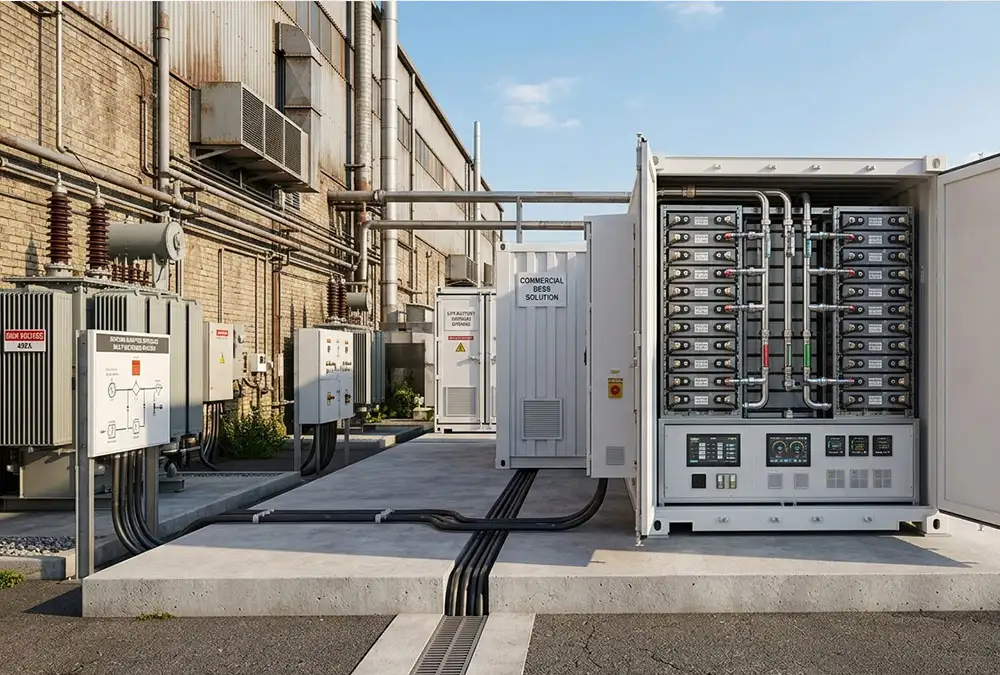
Introduction to 100kWh Solar Battery Storage Systems in Europe
The European commercial and industrial (C&I) sector is undergoing a massive clean energy transition. Driven by volatile energy markets, strict corporate ESG targets, and the rapid expansion of electric vehicle infrastructure, businesses are seeking localized, resilient, and intelligent power infrastructures. At the heart of this decentralization is the commercial battery energy storage system (BESS). Among various capacities, the 100kWh setup has emerged as the definitive structural sweet spot for small-to-medium enterprises (SMEs), agricultural operations, and localized manufacturing units.
When analyzing a 100kWh solar battery storage system cost in Europe, commercial buyers must look past simple equipment prices. A true financial evaluation demands a holistic assessment of hardware engineering, soft costs, localized grid complexities, and regional regulatory compliance. This comprehensive guide provides an analytical breakdown of capital expenditure (CAPEX), hardware topographies, operational mechanics, and ROI formulas to equip commercial developers and enterprise financial officers with actionable data for deployment in 2026.
Are You Considering Installing a 100kWh Solar Battery Storage System?
Rising electricity prices across Europe
The operational landscape for European businesses has shifted permanently. Data from Eurostat and the International Energy Agency (IEA) reveals that while extreme wholesale market peaks have stabilized compared to previous crisis years, retail electricity rates for non-household consumers remain structurally elevated. In 2026, medium-sized commercial enterprises across major European economies face stark geopolitical and network cost realities. For instance, business electricity rates including grid fees and environmental levies hover around €0.27/kWh in Germany and over £0.28/kWh in the United Kingdom. These persistently high operational expenditures drain corporate margins, turning power bills from predictable overhead into financial vulnerabilities.
Concerns about installation costs and ROI
Investing in a commercial ESS solution requires significant upfront capital. Corporate boards frequently hesitate due to the perceived ambiguity of the total installed cost, potential hidden fees in grid connections, and complex payback structures. Calculating an accurate return on investment (ROI) involves navigating regional time-of-use (ToU) tariffs, calculating peak demand shaving variables, and forecasting utility rate inflation over a 10-to-15-year lifecycle. This guide addresses these concerns directly with empirical market data.
Growing demand for energy independence
Grid fragility and localized infrastructure constraints are no longer abstract policy problems—they are active business disruptions. Across Western and Eastern Europe, aging distribution networks struggle to handle both high-volume renewable integration and localized demand spikes from fast fleet charging. Installing an industrial solar energy system paired with modular battery storage grants deep resilience. It allows an enterprise to isolate itself from macro-grid fluctuations, unexpected voltage drops, and localized brownouts.
Why commercial businesses are investing in solar + storage systems
A standalone commercial solar array is a partial solution; it generates power when the sun is at its zenith, which rarely aligns with industrial peak consumption curves. Integrating a robust solar plus storage solution transforms volatile, intermittent generation into a predictable, dispatchable asset. By capturing excess afternoon generation and deploying it during high-tariff periods, businesses unlock multi-layered economic benefits: lower peak demand penalties, absolute self-consumption optimization, and an emergency backup infrastructure that keeps production lines moving during grid failures.
What This Guide Will Cover
To provide corporate stakeholders with complete clarity, this industrial handbook explores the following critical domains:
- Average 100kWh solar battery storage system cost in Europe: Comprehensive 2026 pricing across equipment, logistics, engineering, and soft costs.
- Key factors affecting pricing: Technical differentiators including cell engineering (LFP vs. NMC), thermal management architecture (liquid vs. air), and grid interconnection fees.
- ROI and energy savings analysis: Empirical calculation formulas for peak shaving, solar self-consumption, and localized demand charge reductions.
- How to choose the right installer and battery supplier: Vetting protocols covering global safety certifications, utility-scale experience, and long-term asset management.
- Common customer pain points and practical recommendations: Mitigation paths for cold weather efficiency losses, safety misconceptions, and regulatory red tape.
What Is a 100kWh Solar Battery Storage System?
A 100kWh battery energy storage system is a specialized, industrial-grade power asset engineered to store 100 kilowatt-hours of electrical energy and dispatch it via a coordinated multi-megawatt-rated power conversion interface. Unlike residential units, which function primarily as basic voltage followers for household backup, a C&I energy storage system operates with continuous bidirectional balancing, high-fault tolerance, and deep communication links with factory automation networks and localized SCADA setups.
Difference Between 100kW and 100kWh in Solar Storage Systems
In industrial energy planning, confusing power and capacity can derail a project’s financial modeling. This distinction governs system engineering:
For example, if an industrial facility deploys a system with a 50kW Power Conversion System (PCS) paired with a 100kWh lithium ion battery storage container, the system can discharge at its maximum rate of 50kW for exactly 2 hours ($50\text{ kW} \times 2\text{ hours} = 100\text{ kWh}$). Conversely, pairing that same 100kWh battery pack with a 100kW PCS allows the system to deliver twice the power blast but for only 1 hour ($100\text{ kW} \times 1\text{ hour} = 100\text{ kWh}$). Selecting the right power-to-energy ratio (C-rate) determines whether the hardware is optimized for brief, high-intensity peak-shaving or prolonged commercial solar backup power.
Main Components of a Commercial Solar Battery Storage System
A field-ready 100kWh solar plus storage solution integrates five primary physical and digital subsystems:
Solar Panels
The primary generation layer. For a 100kWh commercial project, developers generally deploy between 80kWp and 150kWp of high-efficiency monocrystalline solar modules. These generation arrays supply the operational facility load while routing all surplus electrons directly to the DC or AC-coupled inverter topology to charge the stationary storage cells.
Lithium Battery Storage System
The physical storage core consisting of tightly packed, chemically stable battery cells grouped into series-parallel modules and housed within a heavy-duty NEMA 3R or IP55 outdoor industrial enclosure. Modern 2026 stationary architectures rely exclusively on high-density lithium iron phosphate chemistry to optimize cycle life and structural safety.
PCS (Power Conversion System)
The bidirectional power inverter interface. The PCS manages the dynamic transition from the DC power generated by the solar panels and stored by the batteries into clean, grid-synchronized three-phase AC power ($400\text{V}$, $50\text{Hz}$ in Europe) required by industrial machinery.
BMS (Battery Management System)
The multi-tiered hardware controller embedded within the battery racks. The BMS monitors cell-level parameters, including individual cell voltages, localized internal temperatures, and state-of-charge (SoC) parameters. It dynamically balances the cells to prevent over-charging, over-discharging, and cell degradation, acting as the primary defense against internal electrical faults.
EMS (Energy Management System)
The intelligent software brain of the entire configuration. The EMS coordinates real-time telemetry from the solar panels, the battery pack, the building’s consumption profile, and the local utility market prices. By executing predictive software algorithms, the EMS dictates exactly when to store energy, when to power the factory floor, and when to execute automated peak shaving algorithms.
Inverter and Safety Protection Systems
Industrial micro-grids require industrial safety layers. This incorporates integrated multi-stage DC disconnects, rapid-shutdown controls, overcurrent protection fuses, and integrated HVAC or liquid-glycol thermal distribution lines coupled with automated fire suppression agents (such as Novec 1230 or Aerosol canisters).
How a 100kWh Solar + Battery Storage System Works
The operational lifecycle of a grid-tied C&I energy storage system follows a dynamic three-stage daily sequence dictated entirely by the EMS:
- Generation & Charging Phase (Daytime): The solar array generates power that exceeds the building’s baseline needs. The EMS directs the PCS to route this excess DC power into the lithium battery storage bank, filling the 100kWh capacity at a controlled charging rate.
- Peak-Shaving & Load Management (On-Peak Hours): The factory starts heavy machinery, creating a sharp spike in energy consumption that triggers expensive utility peak demand charges. The EMS senses the surge and commands the battery racks to discharge stored electricity into the facility. This keeps the grid draw below a pre-set threshold.
- Arbitrage & Nighttime Support (Off-Peak/Night): The solar array stops producing power. The system switches to drawing low-cost, off-peak electricity from the grid to top off the batteries if needed, or it simply discharges the remaining stored clean energy to support the facility’s evening operations.
Why Businesses in Europe Are Investing in Solar Battery Storage Systems
The decision to install a C&I battery storage system is driven by clear economic advantages and operational necessity.
Rising Commercial Electricity Costs Across Europe
According to BloombergNEF (BNEF) and European energy market reports from early 2026, European non-household power markets are structurally volatile. Industrial operations can no longer depend on stable long-term flat-rate energy supply agreements. By deploying a 100kWh battery system, an enterprise establishes a definitive localized hedge, decoupling a minimum of $30,000\text{–}45,000\text{ kWh}$ of their annual high-tier electricity consumption from erratic wholesale pricing structures.
Reducing Peak Demand Charges Through Battery Storage
In most European grid jurisdictions, industrial utility bills are divided into two primary costs: total kilowatt-hours consumed ($\text{kWh}$) and the peak demand charge ($\text{kW}$). The peak demand charge is a steep fee based on the single highest 15-minute consumption spike recorded during the billing cycle. A factory might run efficiently for 29 days, but a single simultaneous startup of heavy compressors can spike their demand charge by thousands of Euros. A peak shaving system uses intelligent algorithm dispatch to clip these extreme consumption points, dropping the peak grid profile and saving thousands in monthly utility penalties.
Improving Energy Security During Grid Instability
As European transmission operators adapt to a decentralized generation mix, localized power quality issues like micro-outages, voltage sags, and transient frequency dips have risen. For precision manufacturing lines, food logistics warehouses, or cold-chain operations, a 30-second power outage can ruin an entire production batch. A commercial ESS solution configured for high-speed automated backup acts as an un-interruptible power barrier, transitioning the facility to islanded local power within milliseconds of a detected grid anomaly.
Supporting ESG and Carbon Reduction Goals
The European Union’s Corporate Sustainability Reporting Directive (CSRD) mandates that mid-sized and enterprise firms provide verified documentation of their carbon footprint reduction paths. A 100kWh solar plus storage solution directly cuts Scope 1 and Scope 2 emissions by replacing carbon-heavy nighttime grid electricity with stored localized solar energy.
Increasing Solar Self-Consumption Rates
Without localized stationary storage, standard commercial solar arrays often achieve a self-consumption rate of only 30% to 40% because industrial peak usage profiles rarely line up with midday generation. Adding a 100kWh battery system allows a company to store that stranded midday energy, boosting their solar self-consumption rate up to 80% or 90%. This captures the full value of the generation asset.
Common Customer Pain Points Before Installing a 100kWh Solar Battery Storage System
Evaluating a large-scale commercial project brings out valid technical concerns from corporate decision-makers.
“The Initial Investment Seems Too Expensive”
Understanding Long-Term ROI Instead of Upfront Cost
Focusing entirely on initial capital expenditure distorts the actual financial impact. A commercial energy storage system is a multi-decade infrastructure investment. Thanks to recent shifts in the global supply chain, the cost of lithium ion battery per kWh has dropped drastically. BloombergNEF’s 2025 Energy Storage Systems Cost Survey revealed that turnkey BESS costs plunged over 30% year-over-year, hitting historic global lows. When amortized over a 6,000-to-8,000-cycle operational life, the hardware pays for itself multiple times over.
Comparing Utility Bills vs. Solar + Storage Savings
A standard factory running without localized storage remains exposed to rising grid fees and variable network tariffs indefinitely. In contrast, a facility deploying an optimized storage solution fixes its long-term power generation costs. The operational savings on utility demand charges and peak-hour energy avoidance create a clear, predictable path to positive cash flow.
“Will the System Work Efficiently in Europe’s Weather Conditions?”
Solar Performance in Northern vs. Southern Europe
While Spain, Italy, and Southern France enjoy ideal solar irradiance, Northern and Central European regions like Germany, Poland, and the Netherlands still offer strong financial viability. Modern Tier 1 monocrystalline solar panels are highly sensitive and generate valuable energy even under diffuse, overcast northern skies.
Battery Efficiency During Winter Conditions
Lithium cells experience slowed internal chemical reactions when exposed to sub-zero temperatures, which can impact their charge acceptance and total capacity. However, commercial-grade systems resolve this environmental issue entirely. Industrial storage enclosures feature integrated environmental control systems—either intelligent forced-air HVAC units or advanced liquid cooling systems—that keep the battery modules within an ideal operating temperature range ($15^\circ\text{C}$ to $25^\circ\text{C}$) even during harsh European winters.
“How Can I Ensure the System Is Safe and Reliable?”
Importance of BMS and EMS in Commercial Storage
Thermal runaway is a critical concern for any facility manager. Industrial stationary storage addresses this through layered safety loops. The localized BMS constantly evaluates internal cell parameters, automatically isolating individual modules at the first sign of an electrical anomaly or temperature spike before it can spread. Simultaneously, the higher-level EMS provides constant remote diagnostics, sending real-time alerts to operations teams before minor issues turn into hardware faults.
Fire Safety Standards and Thermal Management
Industrial-grade 100kWh installations rely on advanced structural safety barriers. Enclosures are engineered with high-grade structural separation, internal blast deflecting paths, and direct multi-point gas sensing lines. If abnormal outgassing is detected, the automated fire suppression system activates instantly, flooding the sealed module compartments with clean fire suppressants to eliminate thermal risks without damaging adjacent electronics.
CE, IEC, and UL9540A Certifications Explained
When sourcing commercial storage hardware in Europe, non-negotiable compliance parameters must be verified. Ensure all equipment carries official European CE markings and meets strict IEC 62619 standards for industrial lithium safety. Furthermore, look for systems that have completed full UL9540A testing. This rigorous standard evaluates large-scale thermal runaway fire propagation, ensuring the container architecture can safely withstand extreme internal faults without endangering your broader facility.
Key Factors Affecting 100kWh Solar Battery Storage System Cost in Europe
The final turnkey estimate for a 100kWh commercial project is determined by a few critical technical and regional variables.
Solar Panel Type and Quality
Monocrystalline vs. Polycrystalline Solar Panels
Polycrystalline modules have largely been phased out of modern commercial layouts due to their lower efficiency profiles ($15\%\text{–}17\%$). Modern developers deploy advanced Monocrystalline PERC or N-Type TOPCon modules, which deliver efficiency ratings between $21.5\%$ and $23\%$. These high-efficiency panels maximize power production per square meter of available roof area.
Tier 1 Solar Panel Brands and Efficiency Differences
Sourcing modules from BloombergNEF Tier 1 verified manufacturers ensures long-term power output reliability. Tier 1 brands use premium silicon wafers, offer verified linear performance warranties spanning 25 to 30 years, and maintain much lower annual degradation rates (under $0.55\%$ per year).
Commercial Installation Costs in Europe
Labor Costs in Different European Countries
The cost of specialized electrical labor varies widely across Europe. Deploying a system in Western and Northern Europe (e.g., Germany, the Netherlands, Ireland) requires higher labor budgets due to strict union standards and high hourly rates for certified high-voltage technicians. Conversely, installation labor costs in Eastern Europe (e.g., Poland, Romania) are generally lower, which reduces the total soft-cost budget of the project.
Roof-Mounted vs. Ground-Mounted Installation Costs
Roof-mounted commercial solar arrays are typically more cost-effective because they leverage existing building structures. However, they require careful structural engineering reviews, advanced roof penetration sealing, and localized fire access pathways. Ground-mounted systems require dedicated civil concrete foundations, extensive trenching, and perimeter security fencing, which can increase initial structural costs.
Grid Connection and Engineering Costs
Connecting a 100kWh BESS with a high-power PCS inverter to the local distribution network requires official approval from the local Distribution Network Operator (DNO). Depending on the local substation capacity, businesses may need to account for grid protection relays, specialized bi-directional smart meters, or localized transformer upgrades.
Inverter Type and Power Capacity
Hybrid Inverters vs. Standard Solar Inverters
Standard solar installations use traditional grid-tied string inverters that shut down during grid outages for utility safety. A commercial ESS solution uses a smart hybrid inverter or a standalone bidirectional PCS interface. This advanced hardware can seamlessly manage power flows between the solar panels, battery cells, and building loads simultaneously, enabling islanded backup capabilities during grid outages.
PCS Efficiency and System Performance
High-efficiency PCS units leverage advanced Silicon Carbide (SiC) power electronics to achieve bidirectional conversion efficiency ratings above $98.5\%$. Selecting a premium PCS minimizes round-trip energy losses, ensuring that stored electricity is transferred with minimal thermal waste.
Battery Energy Storage System (BESS) Configuration
Lithium Iron Phosphate (LFP) vs. Other Battery Chemistries
While electric vehicles often use Lithium Nickel Manganese Cobalt (NMC) chemistry for its high weight-to-volume density, the global stationary storage market has shifted decidedly toward Lithium Iron Phosphate ($\text{LiFePO}_4$ or LFP) technology.
Technical Clarification: NMC chemistry offers higher volumetric energy density but carries a higher risk of thermal runaway and relies on volatile cobalt supply chains. LFP chemistry features a structurally stable crystalline layout that can withstand much higher temperatures without releasing oxygen, virtually eliminating thermal runaway risks. Furthermore, LFP cells deliver more than twice the operational cycle life of NMC variants at a significantly lower upfront cost per kilowatt-hour.
Air Cooling vs. Liquid Cooling Systems
Legacy C&I battery enclosures use standard mechanical HVAC fans to circulate air across the battery racks. However, this can create internal localized temperature pockets, leading to uneven cell aging. Modern premium systems utilize advanced closed-loop liquid cooling plates that circulate a water-glycol fluid directly against the cell modules. This precise thermal management keeps cell temperature differentials under $2\text{–}3^\circ\text{C}$, extending the lifespan of the battery bank by up to 20%.
Battery Cycle Life and Long-Term Value
A high-quality commercial LFP cell operating under proper thermal conditions delivers between 6,000 and 8,000 continuous cycles at a 90% Depth of Discharge (DoD) before its original capacity degrades to 80%. This translates to an operational lifespan of 15 to 20 years, yielding excellent long-term asset value compared to cheaper, lower-grade alternatives.
Government Subsidies and Incentives in Europe
Solar Incentives in Germany, Netherlands, Italy, and Poland
- Germany: The KfW Bank group provides dedicated low-interest environmental loans (Program 270) alongside localized regional grants (such as the “Progres.nrw” initiative) that subsidize commercial storage equipment investments.
- The Netherlands: The EIA (Energie-investeringsaftrek) program allows companies to deduct up to 40% of their total clean energy investment costs directly from their corporate taxable profits.
- Italy: Ongoing structural tax credits and specialized regional funding pools support sustainable infrastructure updates for manufacturing businesses.
- Poland: Broadening national funding pools and structural modernization grants provide strong capital support for C&I companies deploying localized solar-plus-storage microgrids.
Tax Credits and Commercial Energy Grants
Many European jurisdictions offer accelerated depreciation schedules for green infrastructure assets. This allows companies to write off the bulk of their 100kWh BESS hardware costs during the initial years of operation, delivering immediate corporate tax relief.
Feed-in Tariffs and Energy Export Policies
While traditional flat-rate Feed-in Tariffs (FiTs) for large commercial solar installations are decreasing across Europe, dynamic export markets are taking their place. Modern regulatory frameworks allow commercial battery operators to export power back to the grid during high-demand periods via dynamic corporate Power Purchase Agreements (PPAs), opening up an additional revenue stream.
Average Cost of a 100kWh Solar Battery Storage System in Europe
Turnkey pricing for a commercial project varies based on engineering choices, site conditions, and components. Based on industry data for 2026, the baseline capital requirements can be broken down into clear categories.
Typical Price Range for Commercial Solar + Storage Projects
For a standard C&I deployment featuring a 100kWp Solar PV Array paired with a 100kWh Turnkey LFP Battery Storage System, the all-inclusive installed market cost across Europe typically ranges from €85,000 to €145,000.
Equipment Cost Breakdown
The following data represents the typical structural cost distribution for a commercial-grade 100kWp Solar + 100kWh BESS configuration in 2026:
| Component / Cost Center | Average Price Range (EUR) | Share of Total Budget (%) |
| Tier 1 Solar Modules (100kWp Monocrystalline) | €22,000 – €32,000 | 24% |
| 100kWh BESS Enclosure (Grade-A LFP, BMS, Cooling) | €28,000 – €42,000 | 31% |
| 50kW–100kW Bidirectional Hybrid PCS Inverter | €11,000 – €18,000 | 13% |
| EMS Controller & Intelligent Software Integration | €4,000 – €7,000 | 5% |
| Structural Racking, DC/AC Cabling, Switchgear | €6,000 – €11,000 | 8% |
| Engineering, DNO Grid Interconnection & Labor | €14,000 – €35,000 | 19% |
| Total Turnkey Commercial Project Investment | €85,000 – €145,000 | 100% |
Estimated Cost by European Region
Western Europe (Germany, France, Netherlands, Belgium)
- Turnkey Price Range: €105,000 – €145,000
- Primary Drivers: Strict grid compliance requirements, comprehensive permitting procedures, and higher labor rates for certified high-voltage electrical engineers.
Northern Europe (Sweden, Denmark, Norway, Finland)
- Turnkey Price Range: €110,000 – €140,000
- Primary Drivers: Advanced thermal management requirements (highly insulated enclosures and advanced liquid heating/cooling setups) to maintain battery efficiency through cold winters, paired with specialized structural wind-load engineering.
Eastern Europe (Poland, Czechia, Romania, Hungary)
- Turnkey Price Range: €85,000 – €115,000
- Primary Drivers: Lower localized electrical installation labor costs and streamlined regional structural permitting processes.
Hidden Costs Businesses Often Overlook
Maintenance and Monitoring Costs
While modern LFP systems are largely automated, they are not completely maintenance-free. Commercial operators should budget approximately 1% to 2% of their initial hardware cost annually for ongoing preventative maintenance. This covers checking thermal fluid levels, inspecting electrical torque points, cleaning air filters, and maintaining cloud-based EMS software subscriptions.
Grid Upgrade Expenses
If a facility’s local distribution network is heavily loaded, the DNO may require the installation of specialized directional protection relays or demand-limiting grid trip meters before approving the interconnection. Identifying these requirements early through an initial grid connection study prevents unexpected costs later in the project.
Insurance and Compliance Costs
Integrating a large mid-voltage electrical asset on-site requires updating the facility’s commercial property insurance policy. Ensuring the installation strictly complies with international standards like CE, IEC, and UL9540A helps keep additional insurance premiums to a minimum.
How to Maximize ROI from a 100kWh Solar Battery Storage System
An optimized energy storage system functions as a reliable, automated revenue generator for a commercial facility.
Using Battery Storage for Peak Shaving
Reducing Commercial Demand Charges
By configuring the software-driven EMS to monitor real-time power draw at the main facility meter, the system can instantly step in when loads approach expensive peak thresholds. The battery injects stored electricity to cover these brief spikes, keeping the measured grid profile flat and lowering the facility’s monthly demand charges.
Lowering Factory Energy Costs
For manufacturing facilities running heavy, intermittent machinery, automated peak-shaving provides predictable savings that shelter the business from costly tariff penalties.
Increasing Solar Self-Consumption
Storing Excess Solar Energy for Nighttime Use
Instead of exporting clean midday solar energy to the grid for minimal financial return, the facility stores those electrons in the 100kWh battery bank. The EMS then discharges this zero-cost energy later in the afternoon and evening when utility rates climb back to peak levels.
Reducing Grid Electricity Purchases
Maximizing self-consumption helps an industrial facility significantly reduce its reliance on external utility energy purchases, locking in highly predictable power costs.
Usable Capacity (kWh) = Total Nominal Capacity * Depth of Discharge (DoD) * System RTE
To calculate the realistic daily contribution of a storage asset, engineering teams use this foundational formula. If a commercial site deploys a premium 100kWh battery system configured to run at a 90% Depth of Discharge (DoD) with a verified 92% system Round-Trip Efficiency (RTE), the actual usable energy delivered per full cycle is calculated as follows:
Usable Capacity = 100 kWh * 0.90 * 0.92 = 82.80 kWh per day
By dispatching this $82.80\text{ kWh}$ of stored clean electricity every single day during the facility’s highest peak tariff periods, the enterprise maximizes its utility cost avoidance.
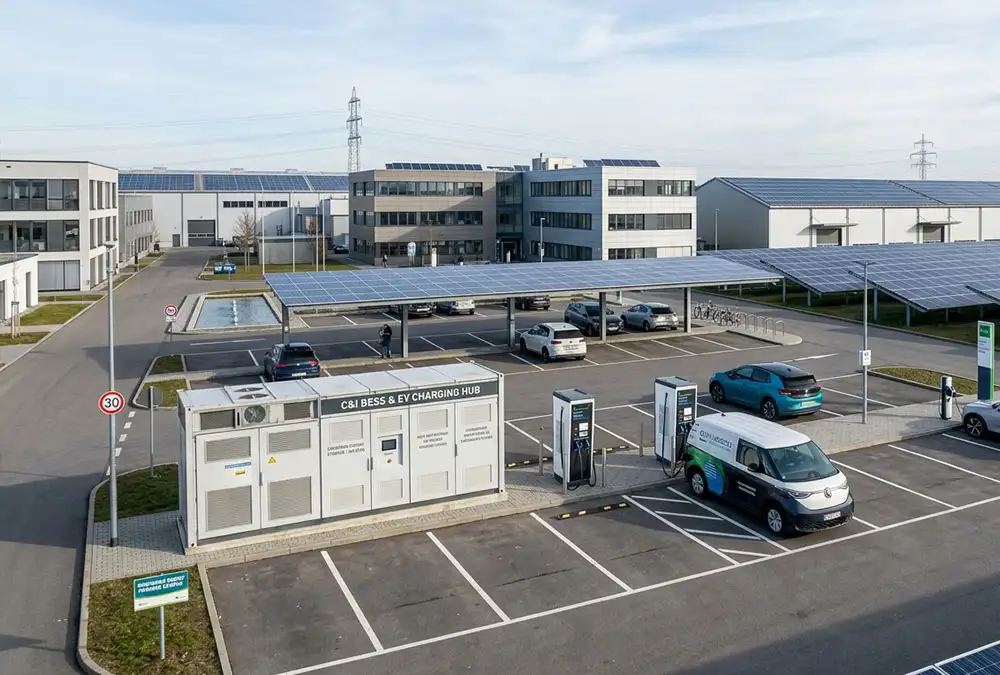
Integrating EV Charging with Solar Battery Storage
Supporting Fast EV Charging Without Grid Upgrades
Adding high-power DC fast chargers for employee fleets or delivery vans can easily overload a facility’s existing electrical service line. A 100kWh battery system acts as an electrical buffer. It discharges rapidly to support fast EV charging sessions and then recharges slowly from solar power or off-peak grid electricity, saving the business from expensive utility transformer upgrades.
Improving EV Charging Profitability
Pairing fleet charging infrastructure with a solar-plus-storage setup allows logistics operators to power their vehicles with clean, self-generated electricity, minimizing operational transportation costs.
Participating in Energy Trading and Grid Services
Demand Response Programs
Many forward-looking European grid operators pay commercial energy consumers to temporarily reduce their grid draw during regional power shortages. An EMS-controlled battery system can automatically shift a facility’s load away from the grid during a demand response event without disrupting ongoing factory operations.
Energy Arbitrage Opportunities in Europe
In countries with highly dynamic time-of-use tariffs, the EMS can execute automated energy arbitrage strategies. The system purchases low-cost electricity during negative-priced or off-peak hours, stores it, and then dispatches that energy when market prices peak, creating a reliable, software-driven return.
How to Choose the Right Solar Battery Storage Installer in Europe
Partnering with an experienced engineering, procurement, and construction (EPC) team is essential for a successful commercial installation.
Check Relevant Certifications and Compliance Standards
Never accept unverified hardware claims. Review the manufacturer’s technical documentation to ensure the entire system has successfully completed recognized testing frameworks:
- CE Certification: Confirms full alignment with European health, safety, and environmental protection directives.
- IEC Standards: Verifies that both the lithium cells (IEC 62619) and the power electronics (IEC 62477) meet strict international industrial safety rules.
- UL9540A Fire Safety Testing: Provides verified engineering data regarding fire safety and thermal performance under extreme fault conditions.
Evaluate Experience and Technical Expertise
Review the installer’s active portfolio of completed commercial and industrial installations. Ensure their engineering team is fully certified for high-voltage AC connections and has hands-on experience integrating solar-plus-storage microgrids with complex building automation networks.
Review Customer Testimonials and Case Studies
Ask for real-world case studies detailing verified project performance. Look for actual data demonstrating realized demand charge reductions, documented solar self-consumption improvements, and long-term asset reliability.
Request Detailed Quotations and Compare Costs
A professional commercial quote should be completely transparent, detailing exact component specifications, specific structural mounting hardware, full engineering and permitting fees, and clear DNO interconnection line items. Avoid vague proposals that aggregate equipment and labor costs into a single opaque price.
Review Warranty and Maintenance Plans
- Battery Warranty Terms: Look for a comprehensive linear performance warranty that guarantees at least 60% to 70% retained battery capacity after 10 years or a specific throughput volume (e.g., a set number of megawatt-hours).
- Remote Monitoring and After-Sales Service: Ensure the provider includes a cloud-based EMS dashboard for real-time performance monitoring, along with a reliable SLA for on-site technical support.
- Spare Parts Availability in Europe: Confirm that the manufacturer maintains a dedicated logistics warehouse within Europe. Having local access to critical spare components like BMS boards, cooling pumps, and PCS fuses ensures rapid support and avoids lengthy shipping delays.
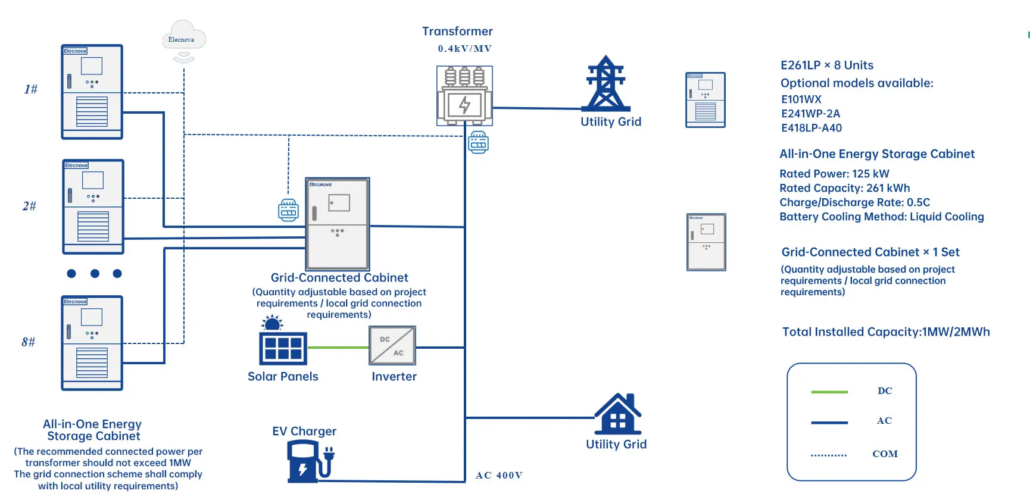
Why More European Businesses Are Choosing Integrated Solar + Battery Storage Solutions
The global trend is moving quickly away from piecemeal, multi-vendor components and toward fully integrated “all-in-one” energy storage cabinets. Buying separate battery modules, sourcing a third-party inverter, and attempting to stitch them together with custom code introduces significant engineering risks.
Modern integrated configurations deliver optimized compatibility out of the box. By sourcing a single integrated enclosure that houses pre-matched battery racks, an optimized PCS, a factory-tested BMS, and a unified EMS controller, commercial operators avoid common communication errors, streamline the local permitting process, and significantly reduce on-site installation times.
Technical Analysis of Storage Alternative Technologies
When exploring options for a 100kWh commercial project, buyers may encounter references to alternative energy storage concepts. Understanding these technical trade-offs clarifies why LFP lithium systems remain the industry standard:
Flow Batteries (e.g., Vanadium Redox Flow Systems): These systems store energy in external liquid electrolyte tanks. They offer exceptional lifespan with virtually no capacity degradation over decades, making them a strong fit for large, multi-megawatt, long-duration utility projects. However, they suffer from a low round-trip efficiency ($65\%\text{–}75\%$) and require a much larger physical footprint, which makes them impractical for space-constrained 100kWh commercial sites.
Sodium-Ion Batteries: An emerging alternative technology that replaces lithium with abundant sodium. They offer excellent low-temperature performance and strong safety characteristics. However, in 2026, sodium-ion systems still carry a lower volumetric energy density and are in the early stages of industrial commercialization, leaving them without the long-term field-testing data that backs LFP technology.
Lead-Acid Batteries (Legacy Systems): While cheap upfront, lead-acid systems are entirely obsolete for modern C&I applications. They suffer from a very short cycle life ($500\text{–}1,500$ cycles), toxic material constraints, and low depths of discharge ($50\%$), resulting in much higher lifetime operational costs compared to lithium solutions.
Community Insight & DIY Feasibility: Some facility managers note discussions on industrial forums asking: “Can a business source individual lithium cells online and assemble their own 100kWh battery bank to save on equipment costs?”
From an industrial engineering perspective, the answer is a definitive no. Assembling raw lithium cells into a multi-kilowatt configuration requires professional cleanroom manufacturing, automated laser-welding equipment, precise thermal management integration, and complex high-voltage safety engineering. A self-assembled DIY system cannot secure official CE or IEC compliance certifications, will fail local DNO grid interconnection reviews, and carries significant safety hazards that violate commercial property insurance policies. Commercial reliability requires field-proven, factory-certified hardware.
Why Choose AnengJi for Commercial Solar Battery Storage Projects?
AnengJi stands at the forefront of high-performance energy infrastructure engineering, delivering robust, field-proven storage platforms tailored precisely to the unique operational demands of the European C&I market.
Advanced BMS + PCS + EMS Integrated Architecture
AnengJi platforms eliminate integration headaches by utilizing a fully unified multi-tier architecture. Our intelligent, factory-optimized system bridges cell-level BMS telemetry directly with high-efficiency bidirectional PCS power stages and cloud-connected EMS intelligence, ensuring seamless power transitions and optimal efficiency.
High-Efficiency Liquid-Cooled Battery Systems
Built for demanding industrial duty cycles, AnengJi systems leverage advanced closed-loop liquid cooling technology. By maintaining optimal internal cell temperatures within a tight window across all seasonal extremes, our liquid-cooled systems significantly extend asset cycle life and maximize long-term financial performance.
CE-Certified Commercial Energy Storage Solutions
Safety is our ultimate design baseline. AnengJi’s complete line of commercial energy storage enclosures are fully certified to rigid European CE, IEC, and international UL9540A safety standards, providing facility managers, local utilities, and insurance providers with complete peace of mind.
Experience in European Commercial and Industrial Projects
With a deep track record of successful clean energy deployments across diverse European jurisdictions, AnengJi brings unmatched regulatory and technical expertise to your project, ensuring a smooth path from initial grid modeling through final commissioning.
Complete Support from Design to Installation and Maintenance
AnengJi provides comprehensive, turn-key project execution. Our dedicated team of applications engineers guides your enterprise through every single step of the process: detailed initial site sizing, local DNO grid application support, premium hardware delivery, physical commissioning, and automated long-term asset optimization.
Overseas Technical Support and Spare Parts Service
We safeguard your operational uptime through our localized European service network. By maintaining dedicated regional logistics hubs staffed with certified technicians and fully stocked with critical spare components, AnengJi guarantees rapid on-site support and uninterrupted long-term operational performance.
Conclusion: Is a 100kWh Solar Battery Storage System Worth It in Europe?
Deploying a 100kWh solar battery storage system is a highly effective, practical investment for modern European enterprises looking to lower operational overhead, protect against volatile energy pricing, and secure reliable on-site backup power. By pairing a premium, factory-integrated LFP enclosure with a high-efficiency solar array, commercial operations can significantly reduce expensive utility demand charges, maximize their clean energy self-consumption, and ensure long-term energy independence. Partnering with a proven manufacturer like AnengJi ensures a smooth, reliable installation that delivers strong financial and sustainability returns for decades to come.
FAQ About 100kWh Solar Battery Storage Systems in Europe
How much electricity can a 100kWh battery store?
A 100kWh battery pack has a raw storage capacity of 100 kilowatt-hours of electrical energy. Accounting for an industrial standard 90% Depth of Discharge (DoD) to ensure cell longevity and an standard 92% round-trip efficiency factor, the system reliably delivers approximately $82.8\text{ kWh}$ of usable, dispatchable electricity per full charge cycle.
How many solar panels are needed for a 100kWh system?
To reliably charge a 100kWh battery bank while simultaneously supporting a typical commercial building’s daily operational load, developers usually install between 80kWp and 120kWp of solar panels. Using modern, high-efficiency 500W+ monocrystalline modules, this translates to an array of roughly 160 to 240 solar panels.
Is a 100kWh battery system suitable for factories?
Yes. A 100kWh capacity is an ideal modular building block for small-to-medium manufacturing plants, precision machine shops, and processing facilities. It provides excellent peak-shaving capabilities to eliminate expensive monthly demand charges and delivers essential high-speed backup power to protect sensitive production machinery during local grid interruptions.
How long can a 100kWh battery power a commercial building?
The exact backup duration depends entirely on the building’s operational load. If a facility draws a steady continuous baseline load of 10kW during a grid outage, a fully charged 100kWh system can sustain operations for approximately 8 to 9 hours. For larger facilities drawing 50kW, the battery provides around 1.5 to 2 hours of emergency backup time, allowing for an organized, safe shutdown of critical systems.
What is the lifespan of a lithium battery storage system?
Premium commercial systems utilizing Grade-A Lithium Iron Phosphate (LFP) cells typically deliver between 6,000 and 8,000 complete operational cycles before original capacity drops to 80%. When managed by a proper liquid cooling system and a high-quality BMS, this translates to an exceptional service life of 15 to 20 years.
Which European countries offer the best solar storage incentives?
Germany leads Europe with its low-interest KfW environmental credit programs and targeted regional capital grants. The Netherlands offers excellent financial support through the EIA program, which allows substantial investment deductions from corporate taxable profits. Italy and Poland also provide strong financial support through structural tax credits and targeted green energy modernization funds.
Is liquid cooling better for commercial battery storage systems?
Yes, liquid cooling is superior for commercial and industrial applications. Compared to standard air-cooled systems, liquid cooling maintains a highly uniform temperature across all internal cells, keeping temperature variations under $2\text{–}3^\circ\text{C}$. This superior thermal control prevents localized cell degradation, ensures reliable efficiency during hot summer peaks, and extends the overall operational lifespan of the battery asset by up to 20%.
 https://anengjipower.com/wp-content/uploads/2026/10/AnengjiPowr-AC-Coupled-Battery-Storage-at-a-CI-Solar-Site.webp
675
1000
Charging Station Engineer
https://anengjipower.com/wp-content/uploads/2025/09/anengji-dc-fast-charging-station-manufacturer-and-supplier-logo-white-1.png
Charging Station Engineer2026-10-16 03:03:192026-10-16 03:03:49What Is AC-Coupled Battery Storage? C&I BESS Guide
https://anengjipower.com/wp-content/uploads/2026/10/AnengjiPowr-AC-Coupled-Battery-Storage-at-a-CI-Solar-Site.webp
675
1000
Charging Station Engineer
https://anengjipower.com/wp-content/uploads/2025/09/anengji-dc-fast-charging-station-manufacturer-and-supplier-logo-white-1.png
Charging Station Engineer2026-10-16 03:03:192026-10-16 03:03:49What Is AC-Coupled Battery Storage? C&I BESS Guide https://anengjipower.com/wp-content/uploads/2026/10/AnengjiPower-What-Is-Peak-Shaving-at-an-Industrial-Site.webp
675
1000
Charging Station Engineer
https://anengjipower.com/wp-content/uploads/2025/09/anengji-dc-fast-charging-station-manufacturer-and-supplier-logo-white-1.png
Charging Station Engineer2026-10-15 06:49:012026-10-15 06:50:23What Is Peak Shaving? How Battery Energy Storage Reduces C&I Peaks
https://anengjipower.com/wp-content/uploads/2026/10/AnengjiPower-What-Is-Peak-Shaving-at-an-Industrial-Site.webp
675
1000
Charging Station Engineer
https://anengjipower.com/wp-content/uploads/2025/09/anengji-dc-fast-charging-station-manufacturer-and-supplier-logo-white-1.png
Charging Station Engineer2026-10-15 06:49:012026-10-15 06:50:23What Is Peak Shaving? How Battery Energy Storage Reduces C&I Peaks https://anengjipower.com/wp-content/uploads/2026/10/anengjipower-Peak-Shaving-vs-Load-Shifting-at-an-Industrial-Site.webp
675
1000
Charging Station Engineer
https://anengjipower.com/wp-content/uploads/2025/09/anengji-dc-fast-charging-station-manufacturer-and-supplier-logo-white-1.png
Charging Station Engineer2026-10-14 07:47:372026-10-14 07:48:01Peak Shaving vs Load Shifting: C&I Energy Storage Decision Guide
https://anengjipower.com/wp-content/uploads/2026/10/anengjipower-Peak-Shaving-vs-Load-Shifting-at-an-Industrial-Site.webp
675
1000
Charging Station Engineer
https://anengjipower.com/wp-content/uploads/2025/09/anengji-dc-fast-charging-station-manufacturer-and-supplier-logo-white-1.png
Charging Station Engineer2026-10-14 07:47:372026-10-14 07:48:01Peak Shaving vs Load Shifting: C&I Energy Storage Decision Guide


Leave a Reply
Want to join the discussion?Feel free to contribute!