
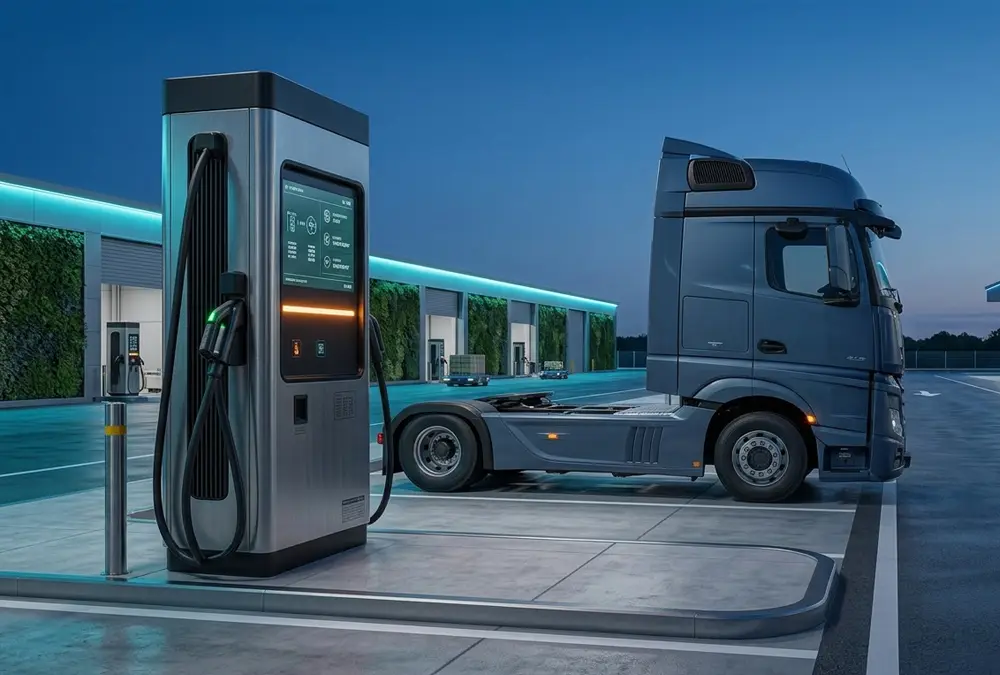
Introduction
High power EV charging enables electric vehicles to recharge significantly more energy in a shorter period, typically using high-power DC charging systems. But choosing a 350kW, 500kW or even megawatt charging system is not simply a matter of selecting the highest available output. Vehicle charging capability, battery voltage, site power capacity, simultaneous charging demand, installation costs and energy management all determine whether a high power EV charging project is technically and economically viable. Without calculating these operational variables, installing ultra-fast hardware often leads to idle capacity and stranded capital.
What This Commercial Guide Solves:
- Clear definitions of high-power DC systems and core technical mechanics
- Key differences between 350kW, 500kW, and 1MW megawatt charging setups
- Physical limits explaining why vehicles rarely draw full rated charger output
- Grid infrastructure bottlenecks and transformer expansion strategies
- Dynamic load balancing techniques to eliminate unnecessary demand fees
- Economic conditions where BESS storage integration delivers positive ROI
- European deployment compliance including CCS2, ISO 15118, MID, and AFIR mandates
The Evolution of EV Charging: From Slow Charging to High Power EV Charging
Charging infrastructure didn’t jump to ultra-fast outputs overnight. It evolved alongside battery chemistry, vehicle electrical architectures, and commercial fleet demands. Understanding this path keeps site operators from over-specifying hardware on constrained budgets.
Level 1 and Level 2 Charging Built the Early EV Charging Infrastructure
Early EV adoption relied heavily on Level 1 AC units (1.4kW–1.9kW) and Level 2 AC hardware (3.7kW–22kW). These systems matched residential charging, workplace charging, and overnight destination charging where vehicles parked for hours. Dwell time was long. High peak power was unnecessary.
DC Fast Charging Changed the EV Refueling Model
Commercial fleets and highway corridors exposed the limits of AC power. AC requires an On-Board Charger (OBC) inside the vehicle to convert grid AC to battery DC. Vehicle space and heat dissipation keep OBCs small. DC Fast Charging shifted that conversion entirely to ground equipment, bypassing the OBC and feeding power directly to the battery traction pack.
This bypass slashed dwell times. It created the modern commercial refueling model built on high turnover rates. Drivers stopped thinking in terms of hours and started thinking in minutes. You can check our breakdown on DC Fast Charging mechanics to see how power conversion limits operate.
Why 350kW and Beyond Became Important
Battery pack capacities grew rapidly. Passenger cars now feature 70kWh to 100kWh+ packs, while commercial trucks run 300kWh to 600kWh+ systems. Standard 50kW to 150kW fast chargers leave heavy vehicles stranded for hours. Highway travel and fleet utilization demand 350kW+ hardware to push 20% to 80% charge times down under 15 minutes.
From High Power Charging to Megawatt Charging
Long-haul trucks, bus fleets, and logistics hubs need even more power. Charging a 600kWh truck battery on a 350kW plug takes nearly an hour. The industry solved this with the Megawatt Charging System (MCS). MCS supports up to 1250V and 3000A, delivering 1MW to 3.75MW per connector to turn heavy-duty commercial transport green.
What Is High Power EV Charging? Understanding the Technology
Engineers and commercial site planners define a high power EV charger by its architecture and DC power delivery capacity rather than arbitrary marketing labels.
What Makes an EV Charger “High Power”?
No single global regulation fixes the exact boundary. However, industry standards classify any DC system outputting above 150kW/350kW as high power. Here is how current engineering classifications map out:
| Charging Class | Typical Power Range | Typical Application | User Business Benefit |
|---|---|---|---|
| AC Charging | 3.7–22kW | Home / Workplace | Lowest equipment cost; ideal for overnight parking. |
| DC Fast Charger | 50–150kW | Urban Public / Retail Park | Balances hardware CAPEX with 45-minute dwell times. |
| High Power DC | 150–350kW+ | Commercial Hub / Highway | Delivers 15-minute top-ups; maximizes site turnover revenue. |
| Ultra-High Power | 350–600kW+ | Highway Hub / Fleet Depot | Fully unlocks 800V vehicle architectures for gas-station speed. |
| Megawatt (MCS) | 1MW–3.75MW | Heavy-Duty Fleet / Marine | Recharges heavy trucks during mandatory driver rest breaks. |
How High Power DC Charging Works
High-power systems convert grid electricity into clean DC power through precise power electronics. The core energy flow follows a clear path:
Grid AC Supply → AC/DC Power Conversion (PCS Modules) → High-Voltage DC Output → Liquid-Cooled Cable → EV Battery (BMS)
The system relies on internal 30kW or 40kW power modules linked in parallel. At currents above 250A, air-cooled cables become too thick and heavy for human handling. High-power units use active liquid-cooled cables to keep handling manageable while suppressing heat up to 500A+ continuous operation.
Why Charger Power Is Not the Same as Actual Charging Power
Buyers often fall into a simple trap: assuming a 350kW high power EV charger delivers 350kW to every car plugged into it. In real operations, Rated Power ≠ Delivered Power.
Delivered power is constrained by the weakest link in the chain. The physical limit formula dictates:
PActual = Min ( PCharger_Max , VBattery × ICharger_Max , PVehicle_BMS_Limit , PSite_Available )
Plug a 400V EV into a 350kW charger with a 500A cable limit. The math is brutal: 400V × 500A = 200kW maximum real output. The vehicle will never see 350kW. Only 800V architecture vehicles can draw full power at 500A (800V × 500A = 400kW, capped at the charger’s 350kW rating).
350kW vs 500kW vs 1MW: How Much High Power EV Charging Do You Really Need?
Selecting charger outputs requires balancing capital expenditure (CAPEX) against actual vehicle capabilities. Overspecifying hardware burns grid budget on unused capacity.
350kW High Power EV Charging
350kW is the current benchmark for highway stops and commercial charging hubs. It handles 800V passenger vehicles like the Porsche Taycan or Hyundai Ioniq 5 effortlessly, adding 300km of range in 15 minutes. It offers mature supply chains, but requires substantial grid allocation.
500kW High Power EV Charging
500kW units target heavy commercial fleets, transit buses, and next-generation passenger vehicles. Operating at 600A–700A peak currents with liquid cooling, 500kW chargers trim crucial minutes off heavy battery sessions. Installing 500kW units for standard 400V fleets, however, wastes capital.
1MW High Power EV Charging
1MW chargers aren’t just scaled-up standard units. They use specialized Megawatt Charging System (MCS) connectors, liquid coolant lines, and heavy insulation. Heavy-duty trucks carrying 400kWh–800kWh battery packs rely on 1MW charging to recover full range within a driver’s mandatory 30-minute break.
Charging Power–Dwell Time–Grid Demand Matrix
| Application Scenario | 150kW DC | 350kW HP | 500kW Ultra | 1MW+ MCS | Decision Benefit for Operators |
|---|---|---|---|---|---|
| Passenger EV (400V) | ✓ Optimal | Δ Amperage Limit | ✗ Overkill | ✗ Incompatible | Saves hardware cost; 400V vehicles hit current limits long before 350kW. |
| Passenger EV (800V) | Δ Slow | ✓ Optimal | ✓ Peak Performance | ✗ Overkill | Unlocks fast turnaround times and higher revenue per parking stall. |
| Highway Charging Hub | Δ Baseline | ✓ Primary Plugs | ✓ Premium Stalls | Δ Truck Lanes | Split topology (e.g., 2x350kW + 4x150kW) lowers transformer CAPEX. |
| Electric Bus Depot | ✓ Overnight | ✓ Route Top-Up | Δ Emergency | ✗ Unnecessary | 150kW handles slow night charging; 350kW handles mid-day terminal boosts. |
| Heavy Truck Corridor | ✗ Unusable | Δ Minimum | ✓ Fast Route | ✓ Optimal Future | MCS keeps commercial truck fleets on schedule, protecting logistics revenue. |
What Determines Real-World High Power EV Charging Speed?
Site managers often wonder why an EV plugged into a high power DC fast charging station tops out at 180kW instead of 350kW. Real speeds depend on six interconnected variables:
1. Vehicle Maximum Charging Power
The vehicle’s BMS controls the session. If BMS firmware caps input at 160kW, the charger backs off immediately, regardless of its maximum capacity.
2. Battery Voltage: 400V vs 800V EV Architecture
Ohm’s Law governs output: Power = Voltage × Current. Because cable thickness limits current to 500A, doubling voltage from 400V to 800V is the only way to double real-world power delivery.
3. Battery State of Charge (SOC)
Batteries take peak power only when nearly empty (10%–30% SOC). As state of charge passes 80%, the BMS ramps down current to prevent lithium plating and thermal degradation.
4. Battery Temperature
Cold lithium-ion cells resist rapid charging. Below 10°C, the BMS throttles input to prevent internal damage. Above 45°C, power drops to avoid thermal runaway. Optimal performance requires battery temperatures between 25°C and 35°C.
5. Charging Curve
Every automaker codes a distinct charging curve into their software. Some vehicles hold peak power for 3 minutes before stepping down; others maintain a stable, moderate power band throughout the session.
6. Charger Power and Power Sharing
When multiple vehicles connect to a shared power cabinet, internal power modules switch dynamically between dispensers, adjusting single-gun power in real time.
Engineering Reality:
Charging Speed = Vehicle Capability × Charger Capability × Available Site Power
Not: Charging Speed = Charger kW Rating on the Nameplate.
The Real Challenges of High Power EV Charging
Deploying ultra-fast charging hardware introduces major infrastructure bottlenecks that go well beyond purchasing hardware.
Challenge 1: High Electrical Demand
Consider an eight-dispenser highway plaza running 350kW units. Peak demand hits 2.8MW. That matches the power load of an industrial factory or hundreds of residential homes hitting one local substation at once.
Challenge 2: Grid Upgrade Costs
Local utilities rarely carry megawatt-level spare capacity on low-voltage lines. Operators must pay for dedicated transformers, switchgear, medium-voltage drop cables, and trenching. Utility work frequently consumes 30% to 50% of total site CAPEX.
Challenge 3: Peak Demand Charges
Utilities bill commercial sites using two metrics: total energy consumed (kWh) and peak power demand (kW). Spike your site demand for just 15 minutes during a simultaneous charging event, and your utility demand charges for the entire month will skyrocket.
Challenge 4: Simultaneous Charging
Planning grid connections around worst-case simultaneous peaks (e.g., 8 vehicles drawing 350kW at once = 2.8MW) creates massive capital waste. Yet failing to plan for peak events triggers breaker trips or leaves drivers stranded on throttled cables.
Challenge 5: High CAPEX and Long Project Lead Times
Equipment procurement, civil engineering, utility easement approvals, and final grid commissioning take anywhere from 6 to 18 months. Industry data shows fully installed 350kW dual-dispenser stations cost $100,000 to $150,000 per stall once civil work finishes.
Smart High Power EV Charging: How Intelligent Energy Management Solves the Problem
Intelligent software management lets operators bypass expensive electrical upgrades while maintaining rapid charging speeds.
Dynamic Load Balancing
Dynamic load balancing monitors total site power consumption at the main transformer in real time. As site consumption approaches capacity, controller algorithms dynamically reduce power outputs across active dispensers to keep the site safe without tripping breakers.
Power Sharing Between Multiple Chargers
Modern DC matrix cabinets switch internal power modules dynamically. Suppose a site has a 1MW grid connection and four 350kW dispensers (1.4MW potential load):
- Vehicle A (800V, 15% SOC): Allocated 350kW peak power.
- Vehicle B (400V, 60% SOC): Allocated 150kW based on its voltage cap.
- Vehicle C & D (Fleet vans): Allocated 250kW each.
As Vehicle A fills up and its charging curve drops, software automatically reassigns freed modules to Vehicle C and D. 1MW of grid capacity easily services 1.4MW of total charger hardware.
Charging Management Based on Vehicle Priority
Fleet operators prioritize power delivery based on vehicle schedules, route lengths, and departure times. A delivery van leaving in 20 minutes receives max power, while a truck parked overnight charges at a steady 30kW rate.
OCPP and Cloud-Based Charging Management
Open Charge Point Protocol (OCPP 1.6J / 2.0.1) lets operators manage remote diagnostics, session billing, load management, and automated demand-response signals from central cloud dashboards.
How BESS Can Support High Power EV Charging
When grid operators quote long lead times or multi-million-dollar upgrades, Battery Energy Storage Systems (BESS) offer a faster, more cost-effective alternative.
Why Battery Storage Matters for High Power Charging
BESS acts as an electrical buffer. It draws power from the grid at low rates (50kW–100kW) during off-peak hours and stores it. When an EV plugs in demanding 350kW, the BESS discharges rapidly alongside the grid to supply the required power without stressing local transformers.
Peak Shaving for EV Charging
BESS caps grid draw below pre-set thresholds, eliminating peak demand charges and significantly trimming monthly operating bills.
Reducing the Need for Immediate Grid Expansion
BESS cannot replace grid upgrades in every application. Small battery enclosures will deplete under constant back-to-back heavy vehicle sessions. However, for sites with predictable traffic peaks, BESS reduces required grid capacity upgrades by over 50%.
Solar + BESS + High Power EV Charging
Pairing solar PV, BESS storage, and fast chargers creates a self-sustaining microgrid:
Solar Array → BESS Storage → Intelligent EMS → High-Power DC Chargers → Fleet EVs
This layout lowers Levelized Cost of Energy (LCOE) while providing emergency backup power during grid blackouts.
Industrial BESS Recommendations for EV Charging Hubs
| BESS Capacity | Core Technical Advantage | Best Fit Application | User Financial Benefit |
|---|---|---|---|
| 100kWh BESS | Compact footprint; liquid-cooled; plug-and-play installation. | Retail parking with 2x150kW chargers. | Low CAPEX; eliminates sudden demand fee spikes on small transformers. |
| 261kWh BESS | High energy density LFP cells; modular rack architecture. | Logistics parks with 2x350kW dispensers. | Sustains 1–2 hours of high output; avoids $200k+ in utility expansion fees. |
| 418kWh BESS | High C-rate discharge capability; integrated EMS controller. | Highway stops and solar-integrated hubs. | Maximized solar self-consumption; supports continuous high turnover. |
| 1MWh+ Container | 20ft ISO containerized system; megawatt discharge rated. | Heavy truck depots and MCS charging corridors. | Provides grid buffering for multiple megawatt truck chargers charging at once. |
Grid–Battery–Charger Decision Model
| Grid Capacity Status | Demand Tariff Structure | BESS Strategic Value | Recommended Deployment Strategy |
|---|---|---|---|
| Sufficient Power Available | Low / Flat Rate | Low Priority | Direct grid hookup; rely entirely on dynamic software load management. |
| Moderate Grid Limit | High Demand Charges | Medium-High Value | Deploy 100kWh–261kWh BESS focused purely on peak shaving. |
| Severe Grid Bottleneck | Very High Peak Rates | Critical Asset | Deploy 418kWh–1MWh BESS to build an isolated buffer microgrid. |
High Power EV Charging for Commercial Fleets
Commercial operators adopting high power EV charging solutions for fleets face a clear financial reality: vehicle downtime represents lost revenue.
Why Fleet Operators Need High Power Charging
Unlike personal EVs that sit idle overnight, commercial delivery vans, buses, and semi-trucks operate on tight schedules. Extended charging times force operators to purchase extra vehicles to maintain route coverage, pushing capital costs out of reach. High-power systems maintain vehicle uptime and preserve fleet lean-ratio goals.
High Power Charging for Electric Trucks & Buses
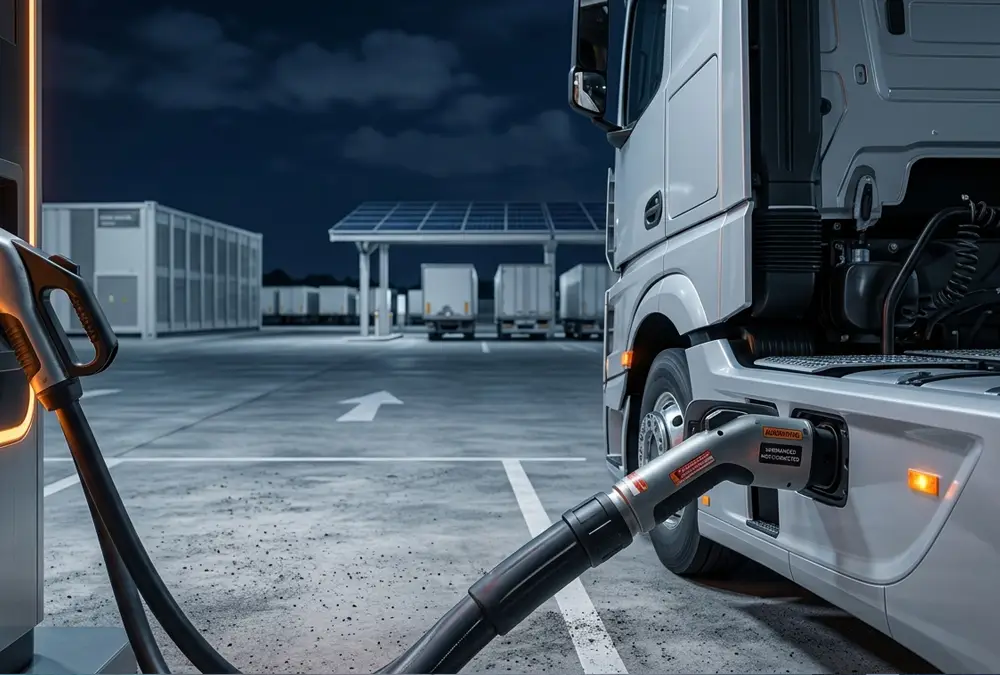
Transit buses and long-haul delivery trucks carry massive battery packs. 350kW and 500kW fast dispensers allow trucks to recharge during 30-minute driver rest breaks. Municipal buses leverage opportunity charging at route end-points, adding 10 minutes of ultra-fast power to complete remaining loops.
Depot Charging vs Highway High Power Charging
| Dimension | Fleet Depot Charging | Highway High Power Station | Impact on Fleet Selection |
|---|---|---|---|
| Dwell Time | Longer (4–8 hours overnight) | Very Short (15–30 minutes) | Depots favor shared power matrixes; highway stalls require maximum single-port speeds. |
| Power Allocation | Medium per plug (Managed) | Maximum output per plug | Depots prioritize scheduled software limits over raw equipment kW ratings. |
| BESS Role | Tariff arbitrage & peak capping | High-current buffer discharge | BESS protects operating margins across both operational models. |
| MCS Requirement | Selective (Class 8 trucks) | Essential for future corridors | Long-haul fleets must plan for MCS hardware along transit lines. |
High Power EV Charging Infrastructure in Europe
Europe continues to lead ultra-fast charging mandates, driving strict engineering and grid compliance requirements across all member states.
Europe Is Moving Toward Higher-Power Public Charging
The EU’s Alternative Fuels Infrastructure Regulation (AFIR) mandates charging coverage along core TEN-T transport corridors. By regulation, public charging pools must offer at least 400kW total power (including at least one 150kW charger) every 60 km. That minimum requirement rises to 600kW total pool power by 2027, sparking massive demand for 350kW installations.
CCS2, NACS and Connector Compatibility in Europe
While North America shifts toward NACS (SAE J3400), Europe remains standard on Combined Charging System Type 2 (CCS2) for light-to-medium vehicles. ISO 15118 compliance is standard across European networks, enabling seamless Plug & Charge payment flows without manual credit card swipes. Heavy trucks are standardizing on the global MCS connector interface.
European Standards, Safety and Compliance
Deploying high-power units in Europe requires strict certification compliance well beyond basic self-declared CE paperwork:
- CE / LVD (Low Voltage Directive): Certified safety under EN 61851-1 and EN 61851-23.
- EMC Directive: Class A/B electromagnetic interference immunity under EN 61000-6-2 and EN 61000-6-4 to protect nearby grid equipment.
- MID Certification: Measuring Instruments Directive compliance. Commercial resale of electricity in Europe mandates MID-certified DC meters inside the charger cabinet.
- Grid Compliance Codes: Compliance with local grid standards (such as Germany’s VDE-AR-N 4110/4120) for medium-voltage connections, requiring automated reactive power compensation and fault ride-through protection.
How Much Does High Power EV Charging Cost?
Commercial project evaluations must analyze total cost of ownership (TCO) rather than focusing solely on invoice quotes for charging hardware.
Breakdown of CAPEX Elements
- High Power Charger Hardware: Dual-dispenser 350kW liquid-cooled charger cabinets average $45,000–$75,000 per unit depending on power topology and software features.
- Transformer & Electrical Substation: 1000kVA medium-voltage step-down transformers, switchgear, and protective panels average $30,000–$60,000.
- Civil Engineering & Installation: Trenching, concrete pads, conduits, bollards, and asphalt work range from $20,000 to $50,000 per site.
- Software & Management Networking: OCPP cloud platform licensing, cellular telemetry, and payment gateway subscriptions.
- BESS Hardware (Optional): Integrated 261kWh container systems with factory liquid cooling.
Operator Key Performance Metric:
Leading charge point operators evaluate sites using “Cost per usable kW capacity” and “Cost per vehicle served” rather than simple “Cost per plug” benchmarks. Dynamic power distribution cuts equipment cost per usable kW by up to 25%.
The High Power EV Charging ROI Decision Framework
Use this five-step framework to evaluate equipment choices and financial feasibility:
5-Step High Power Charging ROI Model
- Step 1 — Calculate Daily Energy Demand: Multiply estimated daily vehicle visits by average kWh delivered per session = Total Daily Energy Throughput (kWh).
- Step 2 — Calculate Peak Charging Load: Estimate max simultaneous vehicle plug-ins to establish worst-case peak load (kW).
- Step 3 — Estimate Grid Upgrade Cost: Request formal utility interconnection quotes for transformer capacity upgrades.
- Step 4 — Compare Smart Charging and BESS Options: Calculate capital saved by replacing dedicated grid expansion with dynamic load management software and a 261kWh/418kWh BESS unit.
- Step 5 — Calculate Payback Period: Model tariff savings, energy resale margins, and operational CAPEX/OPEX to target a 3.5 to 5-year ROI payback window.
Financial Rule: Maximum Power Output ≠ Maximum Return on Investment
Optimal Power = Required Throughput + Acceptable CAPEX + Available Grid Capacity
How to Choose the Right High Power EV Charging Solution
Review this technical checklist before finalizing procurement orders for ultra-fast charging hardware:
- ✓ Start With Vehicle Requirements: Are customer vehicles 400V delivery vans, 800V passenger cars, or Class 8 heavy trucks?
- ✓ Match Charger Power to Demand: Select 150kW, 350kW, or 500kW configurations based on average customer dwell time.
- ✓ Check Grid Capacity: Measure local transformer head-room and determine medium-voltage service requirements.
- ✓ Evaluate Dynamic Load Balancing: Verify power module granular switching down to 30kW/40kW increments inside the cabinet.
- ✓ Evaluate OCPP and Software: Confirm native OCPP 1.6J/2.0.1 compliance for flexible backend platform integration.
- ✓ Check Connector Compatibility: Select CCS2 for Europe or NACS/CCS1 for North America with liquid-cooled cable assemblies.
- ✓ Evaluate Safety and Certifications: Audit CE, MID, EMC, and local grid compliance documentation.
- ✓ Consider BESS Integration: Ensure the power cabinet includes pre-engineered DC or AC coupling interfaces for battery storage.
- ✓ Evaluate Warranty and Support: Confirm 24/7 remote technical support and local spare parts availability.
High Power EV Charging Applications
Commercial deployment of ultra-fast DC systems spans several growing sectors:
- Highway Charging Stations: Highway plazas requiring 15-minute driver turnarounds.
- Commercial Parking Facilities: Retail centers offering high-speed top-offs while shoppers visit stores.
- Fleet Depots: Last-mile delivery hubs needing managed overnight and fast afternoon recharges.
- Logistics Centers: Freight hubs supporting heavy electric trucks between long runs.
- Electric Bus Depots: Municipal transit depots utilizing depot charging alongside route terminal boosters.
- Gas Station EV Charging: Traditional fuel stations transitioning bays to high-margin electric charging.
- Solar + Storage + EV Charging Hubs: Off-grid microgrid setups maximizing clean solar generation.
Why Choose AnengJI for High Power EV Charging Solutions?
With extensive engineering background in power conversion and commercial energy storage, AnengJI delivers complete, turnkey ultra-fast charging solutions.
High Power DC Charging From 60kW to High-Power Solutions
AnengJI supplies a complete hardware portfolio, ranging from compact 60kW–180kW dual-gun chargers to split-substation 350kW, 500kW, and liquid-cooled megawatt charging systems designed for global infrastructure projects.
Dynamic Load Balancing for Multi-Charger Sites
AnengJI dynamic load controllers monitor site power continuously, adjusting dispenser outputs automatically. Operators run high-dispenser sites on modest utility connections without risking overloads or expensive transformer upgrades.
EV Charging + BESS Integration
AnengJI integrates native 100kWh, 261kWh, 418kWh, and 1MWh+ commercial battery systems alongside charging matrixes. Controlled by our unified EMS software, AnengJI solar-plus-storage chargers protect site profitability.
OEM/ODM for Commercial EV Charging Projects
We provide full OEM and ODM customization for CPOs, distributors, and fleet managers—including custom enclosure branding, physical housing adaptations, and tailored backend software integrations.
Project-Level Engineering Support
AnengJI engineers support your project across its life cycle: site layout design, grid capacity modeling, hardware selection, commissioning support, and ongoing remote technical maintenance.
Frequently Asked Questions About High Power EV Charging
What is considered high power EV charging?
High-power charging refers to DC fast systems delivering 150kW and above. Outputs from 350kW to 600kW represent ultra-high-power charging designed for rapid vehicle turnover and commercial fleets.
Is 350kW charging faster than 150kW charging?
Yes, but only if the vehicle supports it. EVs built on 800V architectures charge significantly faster on a 350kW unit. Standard 400V EVs hit physical current limits and charge at nearly identical rates on both systems.
Can every EV use a 350kW charger?
Yes. Any vehicle with a matching CCS or NACS port can safely plug into a 350kW charger. The vehicle’s onboard BMS dictates real voltage and current draw, preventing battery damage.
What is the difference between 350kW and 500kW EV charging?
350kW is the current benchmark for passenger EVs. 500kW systems deliver higher continuous amperages through active liquid cooling, catering to heavy transit vans, commercial trucks, and high-capacity battery packs.
Does high power EV charging damage the battery?
Modern EVs use automated thermal liquid cooling and smart BMS safeguards to keep cell temperatures stable during high-power sessions, preserving long-term battery health.
How much electricity does a 350kW EV charger use?
Running continuously at max output, a 350kW charger consumes 350 kWh of energy per hour. However, real session consumption averages 50 kWh to 75 kWh per vehicle as power scales down along the charging curve.
Does high power EV charging require a transformer?
Yes. Commercial high-power sites require step-down transformers (e.g., 10kV/20kV to 400V/800V) to step down utility distribution voltage unless the site carries massive low-voltage spare capacity.
Can BESS reduce the cost of high power EV charging?
Yes. A BESS offsets high peak demand charges via peak shaving and reduces required utility connection sizes, saving tens of thousands in upfront grid upgrade fees.
What is the best high power EV charger for fleets?
The best setup for commercial fleets is a split-matrix DC system equipped with dynamic power sharing software, allowing variable power switching based on vehicle schedules.
Is high power charging the same as MCS?
No. Standard high-power charging uses CCS or NACS connectors up to 350kW–500kW. MCS (Megawatt Charging System) uses a specialized heavy-duty connector designed specifically for commercial Class 8 trucks at outputs up to 3.75MW.
Build Your High Power EV Charging Project With AnengJI
Whether you are a Charge Point Operator scaling a highway corridor or a commercial fleet manager optimizing utility costs, AnengJI engineers deliver complete high-power charging, BESS storage, and dynamic energy management solutions.
Related Article
 https://anengjipower.com/wp-content/uploads/2026/06/epc-vs-turnkey-solar-project-bess.webp
675
1000
Charging Station Engineer
https://anengjipower.com/wp-content/uploads/2025/09/anengji-dc-fast-charging-station-manufacturer-and-supplier-logo-white-1.png
Charging Station Engineer2026-06-22 07:16:042026-06-24 07:13:17What Is the Difference Between EPC and Turnkey Contract Models in Energy Projects?
https://anengjipower.com/wp-content/uploads/2026/06/epc-vs-turnkey-solar-project-bess.webp
675
1000
Charging Station Engineer
https://anengjipower.com/wp-content/uploads/2025/09/anengji-dc-fast-charging-station-manufacturer-and-supplier-logo-white-1.png
Charging Station Engineer2026-06-22 07:16:042026-06-24 07:13:17What Is the Difference Between EPC and Turnkey Contract Models in Energy Projects? https://anengjipower.com/wp-content/uploads/2026/06/anengji-commercial-solar-plus-storage-benefits-site.webp
675
1000
Charging Station Engineer
https://anengjipower.com/wp-content/uploads/2025/09/anengji-dc-fast-charging-station-manufacturer-and-supplier-logo-white-1.png
Charging Station Engineer2026-06-20 14:34:102026-06-20 14:37:43What Are the Top Benefits of Solar Battery Storage in Factories?
https://anengjipower.com/wp-content/uploads/2026/06/anengji-commercial-solar-plus-storage-benefits-site.webp
675
1000
Charging Station Engineer
https://anengjipower.com/wp-content/uploads/2025/09/anengji-dc-fast-charging-station-manufacturer-and-supplier-logo-white-1.png
Charging Station Engineer2026-06-20 14:34:102026-06-20 14:37:43What Are the Top Benefits of Solar Battery Storage in Factories? https://anengjipower.com/wp-content/uploads/2026/06/modular-commercial-solar-battery-storage-cabinet.webp
675
1000
Charging Station Engineer
https://anengjipower.com/wp-content/uploads/2025/09/anengji-dc-fast-charging-station-manufacturer-and-supplier-logo-white-1.png
Charging Station Engineer2026-06-18 09:16:522026-07-03 03:05:13What Is Solar Battery Storage? Complete C&I Engineering Guide
https://anengjipower.com/wp-content/uploads/2026/06/modular-commercial-solar-battery-storage-cabinet.webp
675
1000
Charging Station Engineer
https://anengjipower.com/wp-content/uploads/2025/09/anengji-dc-fast-charging-station-manufacturer-and-supplier-logo-white-1.png
Charging Station Engineer2026-06-18 09:16:522026-07-03 03:05:13What Is Solar Battery Storage? Complete C&I Engineering Guide


Leave a Reply
Want to join the discussion?Feel free to contribute!