
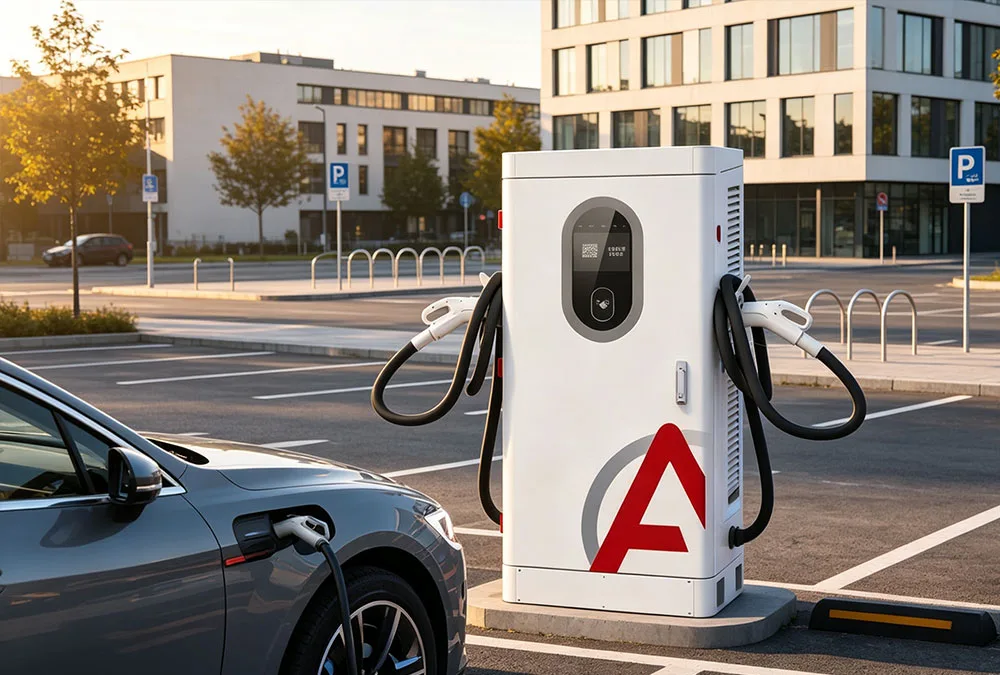
Bidirectional charging enables electricity to flow both into and out of an electric vehicle battery, transforming EVs from simple power consumers into flexible, dynamic distributed energy resources (DERs) for homes, commercial facilities, and microgrids.
By deploying certified bidirectional EV charger infrastructure, vehicle fleets and real estate operators turn parked mobile batteries into continuous energy reserves. This comprehensive guide synthesizes authoritative technical specifications (ISO 15118-20, IEEE 1547, UL 9741), global market data (BloombergNEF, IEA), and commercial engineering strategies across the following areas:
- Core Fundamentals: Mechanics of two-way AC vs. DC bidirectional charging architecture.
- Technical Taxonomy: Engineering breakdowns of V2G, V2H, V2B, V2L, and V2V protocols.
- Global Standards & Interoperability: Regulatory frameworks including ISO 15118-20, UL 1741 SB, and OCPP 2.0.1.
- Battery Health Analysis: OEM warranties, calendar vs. cycle degradation, and electrochemical impacts.
- Commercial Business Models: Peak shaving, demand charge management, VPP aggregation, and revenue math.
- System Architecture & BESS Integration: Combining bidirectional EV terminals with solar PV and stationary storage.
- Deployment Checklist & Economics: Equipment costs, interconnection steps, and hardware selection criteria.
1. What Is Bidirectional EV Charging?
Conventional electric vehicle supply equipment (EVSE) operates strictly on a unidirectional path: alternating current (AC) provided by the utility grid passes through a wall terminal into the car’s internal onboard charger (OBC), which rectifies the alternating current into direct current (DC) to charge the high-voltage battery pack.
Bidirectional EV charging technology removes this operational bottleneck. Through advanced dual-quadrant power electronics, bidirectional hardware permits current to flow in both directions: rectifying AC grid power into DC for charging, and inverting stored battery DC power back into AC electricity for site consumption, facility resilience, or grid stabilization.
According to global industry tracking from BloombergNEF (BNEF) and the International Energy Agency (IEA), cumulative passenger and commercial EV deployments worldwide have pushed total operational battery capacity on wheels into multi-terawatt-hour scales. Because typical light-duty passenger vehicles and commercial delivery vans remain parked for more than 80% to 90% of any given 24-hour cycle, dual-directional power conversion transforms inactive transport assets into flexible decentralized energy storage hubs.
Bidirectional Charging vs Unidirectional Smart Charging (V1G)
It is crucial to distinguish between simple smart charging (V1G) and full bidirectional integration (V2X):
Grid → Smart EVSE → EV Battery (One-Way Consumption; controls charge timing/speed only)
Grid / Solar PV ↔ Bidirectional EV Charger ↔ EV Battery Pack (Two-Way Dynamic Power & Data Exchange)
The Engineering Mechanics: AC vs. DC Bidirectional Systems
Bidirectional power transfer can be engineered at the component level via two main topographies:
- AC Bidirectional Systems: The power inversion from DC back to AC occurs inside the vehicle using a bidirectional onboard charger (OBC). The wall terminal serves primarily as a smart controller, safety relay, and communication gateway. While this keeps wall equipment lightweight, it relies heavily on EV vehicle manufacturers (OEMs) to install heavy, heat-generating bidirectional inverters inside every car.
- DC Bidirectional Systems: High-power DC bidirectional charging infrastructure bypasses the vehicle’s onboard charger entirely. Direct current flows out of the vehicle’s battery through high-power contactors directly into an external station equipped with heavy-duty silicon carbide (SiC) or gallium nitride (GaN) dual-quadrant inverters. This approach enables higher discharge power (from 22 kW up to 180 kW+) and shifts hardware complexity to dedicated stationary infrastructure.
A primary barrier to enterprise V2X adoption is concern over premature battery degradation. Empirical research from institutions like the National Renewable Energy Laboratory (NREL) and the University of Warwick demonstrates that battery degradation is governed primarily by calendar aging (temperature, high state-of-charge exposure) and cyclic aging (depth of discharge, thermal spikes during aggressive fast-charging).
Controlled V2X operations—typically operating at shallow Depth of Discharge (10% to 20% DoD) and low C-rates—incur negligible incremental degradation. In fact, intelligently managed micro-discharging during peak heat hours can lower average pack temperature and avoid high static SoC stress, preserving long-term battery health while generating site revenue.
2. Complete Taxonomy of Bidirectional Charging (V2X)
The term V2X (Vehicle-to-Everything) serves as the overarching technical umbrella for bidirectional applications. Each sub-protocol satisfies a distinct operational profile:
| Protocol | Target Topology | Typical Power Range | Primary Operational Objective |
|---|---|---|---|
| V2G (Vehicle-to-Grid) | Public Distribution Grid | 10 kW to 180 kW+ | Grid capacity expansion, frequency regulation (FCR), virtual power plants (VPPs) |
| V2B (Vehicle-to-Building) | Commercial / Industrial Facilities | 19.2 kW to 150 kW | Peak demand charge reduction, facility resilience, local solar PV optimization |
| V2H (Vehicle-to-Home) | Single/Multi-Family Residential | 6 kW to 19.2 kW | Whole-home emergency islanding backup, time-of-use (TOU) tariff optimization |
| V2L (Vehicle-to-Load) | Off-Grid Standalone Loads | 1.9 kW to 9.6 kW | Direct AC plug-in for power tools, job site gear, camping appliances, roadside rescue |
| V2V (Vehicle-to-Vehicle) | Direct Mobile EV-to-EV Transfer | 3 kW to 22 kW | Peer-to-peer mobile charge recovery for stranded electric vehicles |
V2G (Vehicle-to-Grid) Enterprise Integration
V2G links aggregate mobile battery capacity directly into utility-managed energy markets. When grid demand surges during peak afternoon hours, utility control networks dispatch automated signals through cloud API links. Connected fleet vehicles feed power into the grid, relieving thermal stress on distribution transformers and earning capacity payments for fleet operators.
V2B (Vehicle-to-Building) Operational Savings
V2B focuses on behind-the-meter (BTM) facility optimization. Rather than exporting energy past the utility meter, a bidirectional EV charger for business injects power into commercial building switchboards to supply internal loads. By discharging vehicle power during expensive operational windows, companies trim peak kilowatt demand metrics that dictate monthly utility utility bills.
V2H (Vehicle-to-Home) Domestic Resilience
A V2H bidirectional EV charger setup pairs a vehicle with an automatic transfer switch (ATS) and microgrid controller at the residential service entrance. When severe weather interrupts the utility grid, the system islands the residence within milliseconds, pulling power from the EV battery to maintain home refrigeration, heating, clean water pumps, and critical electrical circuits.
3. Critical Technical Standards, Grid Codes & Safety Compliance
Commercial deployment of bidirectional EV infrastructure requires strict adherence to international electrical, safety, and digital communication protocols:
Key Global Standards Governing Bidirectional Infrastructure:
- ISO 15118-20 (Vehicle-to-Grid Communication Interface): The international gold standard defining digital communication between the EV and EVSE. Version -20 explicitly standardizes bidirectional power flow control, dynamic automated scheduling, plug-and-charge security keys, and real-time power modulation for AC and DC systems.
- UL 9741 (Standard for Bidirectional EV Charging Equipment): The foundational safety certification standard covering electrical insulation, short-circuit containment, thermal management, and power conversion integrity for bidirectional EVSE.
- UL 1741 SB / IEEE 1547-2018 (Interconnection and Interoperability of Distributed Energy Resources): Mandatory North American utility grid-tie standards. They mandate advanced inverter functions, such as anti-islanding protection (preventing dangerous power backfeed during grid maintenance), low/high voltage ride-through, and dynamic reactive power control.
- OCPP 2.0.1 (Open Charge Point Protocol): The communication standard linking physical chargers to central Energy Management Systems (EMS) and cloud management software. OCPP 2.0.1 includes native support for smart charging profiles, V2X dispatch scheduling, and device management.
- IEC 61851-23 / -24 & CHAdeMO 3.0 / ChaoJi: International physical plug and safety specifications ensuring direct current bidirectional compliance across European and Asian markets.
4. Comparative Technical Matrix: V1G vs. V2X Solutions
Evaluating hardware procurement options requires comparing standard smart chargers against bidirectional terminals:
| Architecture Feature | Standard Unidirectional (V1G) | AC Bidirectional (V2X) | DC Fast Bidirectional (V2X) |
|---|---|---|---|
| Power Directionality | Grid to EV only | Two-Way (Vehicle Inverter) | Two-Way (Station Inverter) |
| Typical Discharge Capacity | 0 kW (Charge only) | 7 kW to 19.2 kW | 22 kW to 180 kW+ |
| Inverter Location | Inside vehicle OBC | Inside vehicle OBC | Inside external DC terminal |
| Grid Islanding Capability | None | Supported via ATS panel | Full microgrid integration |
| Communication Protocol | PWM / basic ISO 15118 | ISO 15118-20 / OCPP 2.0.1 | ISO 15118-20 / CAN / OCPP 2.0.1 |
| Primary Cost Factor | Low hardware cost | Moderate hardware cost | Higher initial station investment |
5. Economic Drivers and Business Models for Enterprises
Deploying a bidirectional EV charger for business unlocks value streams across multiple financial mechanisms:
Demand Charge Mitigation (Peak Shaving)
Commercial electricity utility bills often include heavy peak demand charges—penalties based on the single highest 15-minute power draw recorded during a billing cycle. By commanding connected vehicle fleets to discharge power into the facility during peak machinery operation, the EMS caps maximum facility grid demand, generating substantial monthly utility savings.
Time-of-Use (TOU) Energy Arbitrage
In regions with dynamic wholesale tariffs, power prices fluctuate throughout the day. Dual-directional hardware automatically charges fleet batteries during low-cost off-peak hours (e.g., midnight to 5 AM) and discharges back into facility switchboards during high-cost peak hours (e.g., 2 PM to 7 PM).
Virtual Power Plant (VPP) Aggregation
By linking dozens of bidirectional EV chargers into cloud software, energy aggregators combine scattered vehicle batteries into a single Virtual Power Plant. Utilities pay VPP operators capacity fees, spinning reserves compensation, and frequency regulation payments for standing by to supply fast grid support during power crises.
Featured Commercial Case Formula:
Annual V2B ROI = [ Demand Charge Reductions ($/kW/mo) × Capped kW ] + [ TOU Arbitrage Spread ($/kWh) × Annual Discharged kWh ] + [ VPP Capacity Revenue ] − [ Incremental Maintenance & Software Subscriptions ]
6. EV Storage vs. Stationary Battery Energy Storage Systems (BESS)
Enterprise energy planners often compare mobile EV battery capacity against dedicated stationary industrial BESS units:
| Criterion | Mobile EV Battery Pack | Stationary Industrial BESS | Strategic Integration Assessment |
|---|---|---|---|
| Asset Availability | Intermittent (Departs on shift routes) | 100% Fixed On-Site Availability | Stationary BESS provides 24/7 emergency protection while vehicles are away on delivery routes. |
| Capital Cost Structure | Dual-use asset (Transport + Energy) | Dedicated stationary equipment CapEx | Bidirectional chargers increase the financial return of transport vehicles when parked. |
| Thermal & Cycle Tuning | Optimized for weight & vehicle acceleration | Optimized for long cycle life & stationary loads | Liquid-cooled stationary BESS manages fast daily cycling without impacting vehicle drive ranges. |
Designing a Hybrid Microgrid Architecture
Rather than treating EVs and BESS as mutually exclusive, resilient microgrids combine both technologies. A fixed BESS cabinet manages baseline load smoothing and fast response tasks, while parked fleet vehicles serve as expandable energy reserves during major grid outages or peak operational events.
Industrial BESS Configurations for Microgrid Resilience:
To build a balanced energy microgrid, facility engineers often pair bidirectional charging hubs with dedicated stationary storage platforms:
- 100 kWh Outdoor BESS Cabinet: Compact footprint designed for small commercial properties and retail charging installations requiring peak load management.
- 261 kWh Liquid-Cooled Industrial BESS: Engineered for medium industrial manufacturing facilities requiring high thermal performance and continuous charge/discharge cycles.
- 418 kWh to 1 MWh Containerized Energy Storage Systems: Modular utility-scale storage systems for electric truck fleet depots, central transit stations, and heavy microgrid installations.
7. Global Vehicle Compatibility & Ecosystem Readiness
Successful bidirectional integration depends on full compatibility across the EV vehicle platform, wall terminal, and local electric infrastructure:
- V2L Support: Widely integrated across modern E-GMP platforms (Hyundai IONIQ 5/6, Kia EV6), BYD e-Platform models, and the Ford F-150 Lightning (integrated AC outlets).
- V2H / V2B Support: Supported by platforms like the Ford F-150 Lightning (via proprietary home integration equipment), Nissan Leaf (via CHAdeMO protocol), Mitsubishi Outlander PHEV, and GM Ultium-platform EVs rolling out across commercial lineups.
- Next-Gen Native ISO 15118-20 Platforms: Major European and North American OEMs are transitioning to CCS2 and NACS (SAE J3400) inlet designs equipped with native ISO 15118-20 bidirectional firmware.
8. Enterprise Deployment Checklist & Interconnection Roadmap
Bringing a commercial bidirectional project online requires careful execution across technical and regulatory milestones:
| Deployment Stage | Engineering Action Item | Compliance Verification |
|---|---|---|
| 1. Site Capacity Assessment | Audit local transformer capacity, main switchboard head-room, and reverse power flow tolerance. | PE stamped load calculation |
| 2. Fleet Protocol Audit | Verify that vehicle fleet BMS firmware supports bidirectional communication via ISO 15118-20. | OEM V2X authorization certificate |
| 3. Hardware Procurement | Select dual-quadrant AC or DC bidirectional stations based on target discharge rates. | UL 9741 & UL 1741 SB listings |
| 4. Utility Interconnection | File formal distributed energy resource (DER) interconnection requests with the local electric utility. | IEEE 1547 anti-islanding approval |
| 5. Control & EMS Setup | Connect bidirectional EVSE terminals to central building management software via OCPP 2.0.1. | Automated peak shaving test |
9. Common Pitfalls to Avoid in V2X Deployments
- Procuring Uncertified Proprietary Chargers: Installing hardware that lacks open standards like ISO 15118-20 or OCPP 2.0.1 can lead to vendor lock-in and restrict future fleet options.
- Ignoring Utility Interconnection Timeline: Connecting grid-tied discharge systems without early utility approval can delay system commissioning by several months.
- Underestimating Switchboard Upgrades: Backfeeding high-power alternating current into older commercial facilities often requires automated transfer switches (ATS) and panel upgrades to ensure worker safety during grid outages.
- Neglecting Fleet Schedule Constraints: Running discharge programs without integrating real-time vehicle dispatch data risks sending out fleet vehicles with insufficient battery range for daily routes.
10. Frequently Asked Questions (Technical & Commercial)
What is a bidirectional EV charger?
A bidirectional EV charger is a advanced power conversion system that enables two-way current flow—charging an electric vehicle battery from the grid or solar array, and inverting direct current back into AC electricity to power homes, facilities, or grid networks.
What is the practical difference between V2G and V2B?
V2G (Vehicle-to-Grid) exports inverted vehicle power past the utility meter onto public power lines to support grid operations. V2B (Vehicle-to-Building) retains inverted power behind the meter to reduce building demand charges and improve site power resilience.
Does bidirectional charging void electric vehicle warranties?
Not when operated within approved OEM parameter guidelines. Modern electric vehicle manufacturers support V2X functions under official warranty terms when using certified bidirectional chargers and approved communication protocols.
Why are DC bidirectional chargers preferred for commercial fleets?
DC bidirectional chargers house high-capacity inverters directly within the stationary wall terminal. This allows higher power discharge rates (from 22 kW up to 180 kW+), bypassing thermal and capacity limits associated with lightweight onboard vehicle converters.
Strategic Engineering Solutions for Commercial Projects
Deploying bidirectional EV infrastructure converts vehicle fleets into flexible energy assets. By combining solar PV systems, stationary BESS units, and certified bidirectional EV charger hardware under unified EMS control, organizations enhance site power resilience while opening new revenue opportunities.
Accelerate Your Microgrid & Fleet Electrification Architecture
Evaluating high-power DC bidirectional terminals, commercial solar PV integration, or industrial BESS hardware for your facilities? Contact our engineering team for technical system modeling, compliance assistance, and custom single-line diagrams.
Related Article
- Commercial Bidirectional EV Charging: Costs, Benefits & Standards
- Commercial EV DC Fast Charging Solutions | Modular Stations & BESS
- Electric Vehicle Supply Equipment for Commercial Projects
- The 10 Biggest EV Charging Companies in the World
- Top 10 Electric Car Charging Station Manufacturers in China (2026 Guide)
 https://anengjipower.com/wp-content/uploads/2026/06/epc-vs-turnkey-solar-project-bess.webp
675
1000
Charging Station Engineer
https://anengjipower.com/wp-content/uploads/2025/09/anengji-dc-fast-charging-station-manufacturer-and-supplier-logo-white-1.png
Charging Station Engineer2026-06-22 07:16:042026-06-24 07:13:17What Is the Difference Between EPC and Turnkey Contract Models in Energy Projects?
https://anengjipower.com/wp-content/uploads/2026/06/epc-vs-turnkey-solar-project-bess.webp
675
1000
Charging Station Engineer
https://anengjipower.com/wp-content/uploads/2025/09/anengji-dc-fast-charging-station-manufacturer-and-supplier-logo-white-1.png
Charging Station Engineer2026-06-22 07:16:042026-06-24 07:13:17What Is the Difference Between EPC and Turnkey Contract Models in Energy Projects? https://anengjipower.com/wp-content/uploads/2026/06/anengji-commercial-solar-plus-storage-benefits-site.webp
675
1000
Charging Station Engineer
https://anengjipower.com/wp-content/uploads/2025/09/anengji-dc-fast-charging-station-manufacturer-and-supplier-logo-white-1.png
Charging Station Engineer2026-06-20 14:34:102026-06-20 14:37:43What Are the Top Benefits of Solar Battery Storage in Factories?
https://anengjipower.com/wp-content/uploads/2026/06/anengji-commercial-solar-plus-storage-benefits-site.webp
675
1000
Charging Station Engineer
https://anengjipower.com/wp-content/uploads/2025/09/anengji-dc-fast-charging-station-manufacturer-and-supplier-logo-white-1.png
Charging Station Engineer2026-06-20 14:34:102026-06-20 14:37:43What Are the Top Benefits of Solar Battery Storage in Factories? https://anengjipower.com/wp-content/uploads/2026/06/modular-commercial-solar-battery-storage-cabinet.webp
675
1000
Charging Station Engineer
https://anengjipower.com/wp-content/uploads/2025/09/anengji-dc-fast-charging-station-manufacturer-and-supplier-logo-white-1.png
Charging Station Engineer2026-06-18 09:16:522026-07-03 03:05:13What Is Solar Battery Storage? Complete C&I Engineering Guide
https://anengjipower.com/wp-content/uploads/2026/06/modular-commercial-solar-battery-storage-cabinet.webp
675
1000
Charging Station Engineer
https://anengjipower.com/wp-content/uploads/2025/09/anengji-dc-fast-charging-station-manufacturer-and-supplier-logo-white-1.png
Charging Station Engineer2026-06-18 09:16:522026-07-03 03:05:13What Is Solar Battery Storage? Complete C&I Engineering Guide


Leave a Reply
Want to join the discussion?Feel free to contribute!