
Introduction: Why Choosing the Right Solar Battery Storage Supplier Matters
Let’s be completely honest about the current energy market.
Navigating the massive influx of global solar battery storage suppliers has become an absolute nightmare for procurement managers.
The global grid landscape is changing at a breakneck pace right now.
Skyrocketing utility tariffs across Europe are forcing factories to look for immediate on-site relief.
Consequently, hundreds of new companies pop up every month claiming to sell the ultimate energy asset.
But matching your factory’s heavy electrical load with a random hardware box is a recipe for disaster.
A bad procurement choice here doesn’t just mean a minor technical glitch.
It means severe project delays, immediate budget overruns, and unexpected fire safety hazards next to your production lines.
Worse, a low-tier system will suffer from horrible round-trip efficiency losses that destroy your business margins.
Choosing the absolute lowest price option is rarely the smartest decision for your bottom line.
Why Solar Battery Storage Demand Is Growing Worldwide
The push for corporate energy independence is no longer a simple green marketing trend.
According to the latest BloombergNEF Global Energy Storage Outlook, corporate behind-the-meter installations surged past historical benchmarks.
Grid operator data shows that modern automated manufacturing lines cannot tolerate rising grid voltage sags anymore.
At the same time, commercial solar PV generation is breaking records across the continent.
However, exporting unmanaged power back to the regional grid now yields close to zero financial return.
Smart enterprise leaders are shifting toward smart behind-the-meter infrastructure to keep their energy on-site.
Deploying a reliable, heavy-duty electrochemical asset has become the standard defense against volatile spot market spikes.
Featured Snippet – How Do I Compare Solar Battery Storage Suppliers?
The Five Most Important Factors
To evaluate potential partners effectively, you must score them across five non-negotiable operational benchmarks:
- Manufacturing Capability: Verified control over raw cell sourcing and advanced multi-tier pack assembly.
- Product Quality: System round-trip efficiency exceeding 88% under true industrial cycling conditions.
- Technical Expertise: In-house development of the core Battery Management System (BMS) and energy software.
- Certifications: Full compliance documentation including IEC 62619, UL 9540A, and regional grid codes.
- After-Sales Service: Dedicated local engineering teams capable of arriving on-site within 24 hours.
Why Choosing the Right Solar Battery Storage Supplier Is Critical
A BESS project is not a simple commodity purchase like buying backup diesel generators.
You are integrating a live, high-voltage electrochemical powerhouse into your existing facility framework.
Project Performance Depends on System Integration
Many buyers think they are just purchasing a collection of lithium blocks.
In reality, a functional system requires five complex subsystems working together in perfect harmony.
The raw cells must communicate perfectly with the localized Battery Management System.
Then, the bi-directional Power Conversion System must sync with the master Energy Management System software.
If these systems come from different unaligned vendors, your project will suffer constant communication dropouts.
Supplier Quality Directly Affects Project ROI
Low-grade integration leads to rapid cell degradation within the first 24 months of operation.
If your cells run hot due to poor thermal management, your operational lifespan drops by half.
High auxiliary power consumption from inefficient HVAC units also drains your stored solar power silently.
That wasted energy directly reduces your daily peak-shaving savings and ruins your projected payback calculations.
Long-Term Support Is More Valuable Than Initial Cost Savings
You are choosing an industrial partner for the next 15 to 20 years.
If a supplier disappears next year, your expensive warranty becomes a worthless piece of paper.
Finding custom spare parts for a generic, unbranded cabinet will eventually cost you thousands in downtime.
Evaluate the Supplier’s Manufacturing Capabilities
You need to peel back the marketing layers and look directly at the factory floor.
Manufacturer or Trading Company?
Many entities online act as direct factories but are actually just small trading offices.
True solar battery storage manufacturers welcome third-party factory audits and show clear raw material supply chains.
They control the engineering blueprints of the enclosures, the busbars, and the control cabinets directly.
Trading companies can only offer rigid, off-the-shelf sizes and cannot handle complex engineering requests.
Production Capacity and Factory Scale
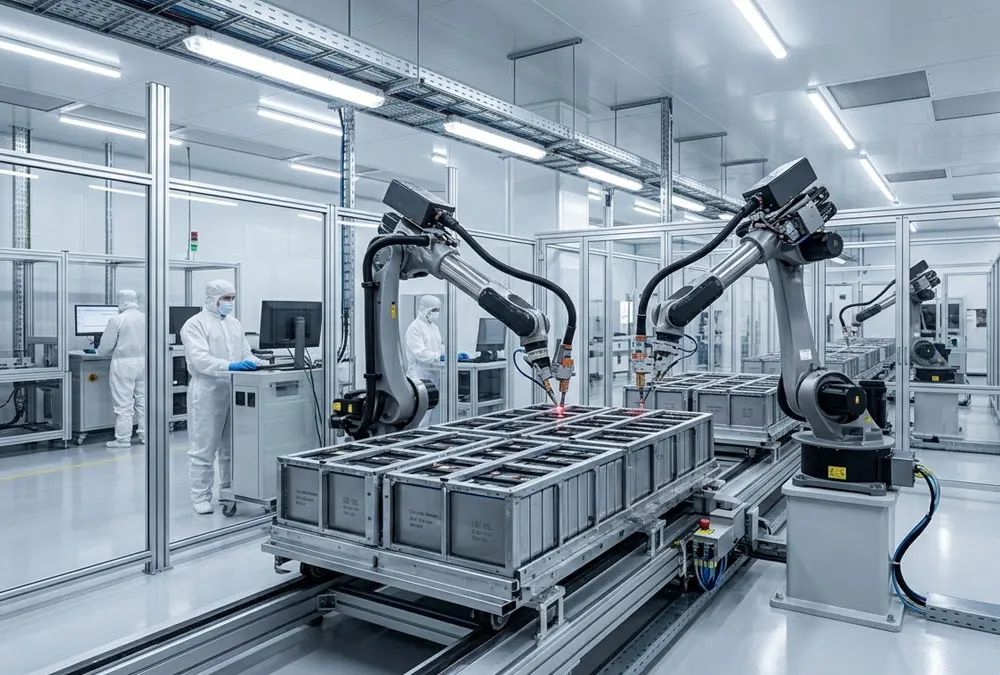
Look for vendors with automated laser welding lines and automatic cell sorting infrastructure.
A reliable supplier should maintain an annual production capacity of at least 2 GWh.
Ask them directly where they buy their raw lithium cells.
Tier-one cell sourcing guarantees tight internal resistance matching, preventing premature pack failure.
Research and Development (R&D)
The energy market changes too fast for copycat hardware configurations.
A top-tier vendor invests heavily in dynamic thermal simulation and advanced short-circuit testing.
OEM / ODM Capabilities
Standard cabinets rarely fit perfectly into tight, real-world factory spatial layouts.
An experienced OEM solar battery storage supplier can re-engineer physical footprints to match specific indoor or outdoor constraints.
Compare Solar Battery Storage Technologies and Product Portfolio
Understanding different battery technologies prevents you from installing the wrong equipment type.
Battery Chemistry Options
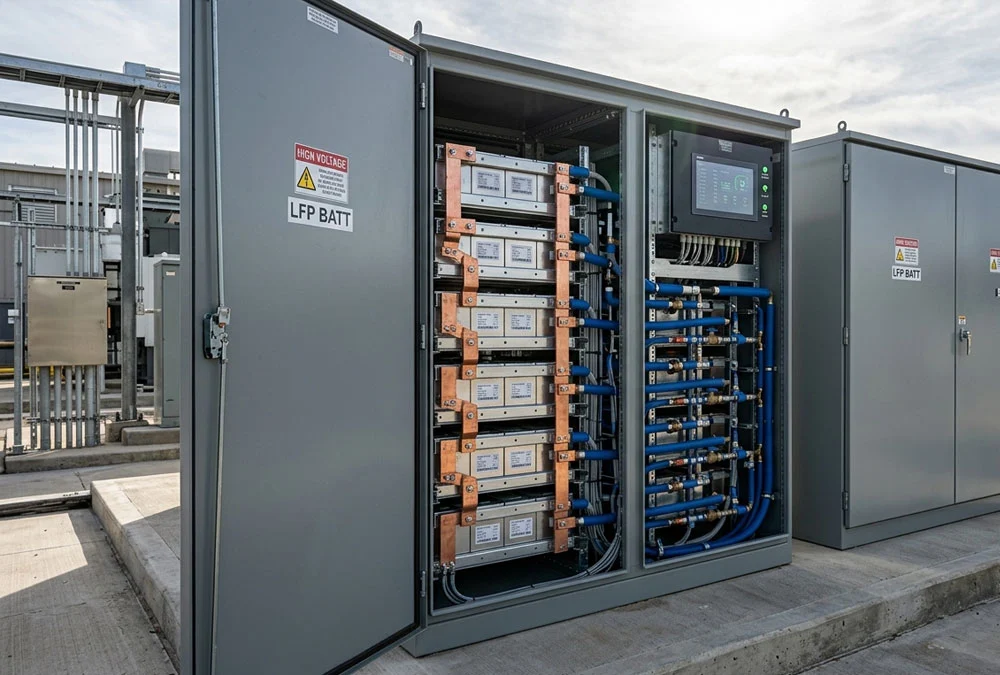
- Lithium Iron Phosphate (LFP): The absolute baseline standard for modern commercial energy storage applications. LFP cells are incredibly stable, completely eliminate thermal runaway risks, and deliver over 6,000 cycles easily.
- Nickel Manganese Cobalt (NMC): Packs high energy density into very tight spaces but carries higher thermal risks. NMC degrades much faster under aggressive daily industrial shifting and requires expensive fire staging.
- Flow Batteries: Utilizes large external liquid tanks containing vanadium electrolyte. Flow systems experience zero degradation over decades but have low efficiency and demand a massive physical footprint.
Commercial and Industrial Product Range
A capable supplier must offer diverse form factors beyond basic residential wall units.
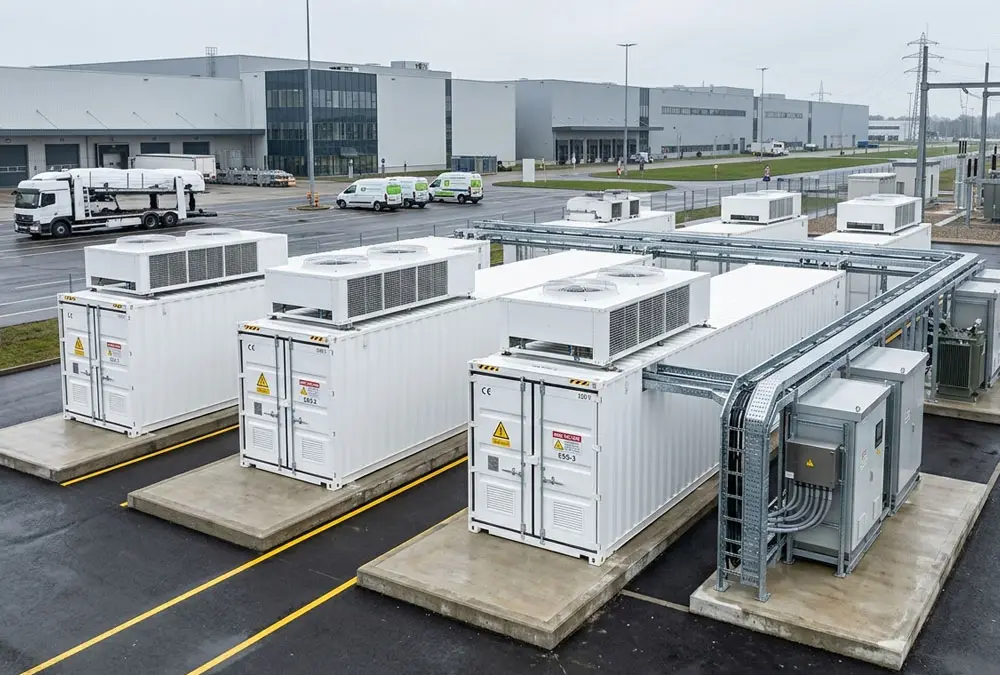
Their portfolio should include compact indoor cabinets, outdoor liquid-cooled enclosures, and massive containerized platforms.
Integrated PCS, BMS and EMS
Ask if the supplier builds the core components or simply buys them from third-party brokers.
Proprietary, single-source integration means the software updates will never break internal system communications.
Standard Products vs Customized Energy Storage Systems
Standard systems work well for basic grid-tied, time-of-use shifting setups.
However, if your plant runs highly erratic loads like robotic welding stations, custom tuning is mandatory.
| Product Platform | Typical Capacity Range | Cooling Method | Ideal Industrial Application |
|---|---|---|---|
| Modular Energy Cabinet | 50 kWh – 215 kWh | Smart Air / Liquid Option | Small commercial properties, retail hubs, hotels |
| Industrial Liquid Enclosure | 215 kWh – 372 kWh | Direct-to-Cell Liquid Plate | Manufacturing plants, high-load EV fast-charging |
| Containerized BESS | 1.2 MWh – 5.0 MWh+ | Advanced HVAC / Liquid Loop | Large factories, heavy mining sites, utility backup |
Check Certifications, Compliance and Safety Standards
Never compromise on international safety compliance to save a few dollars upfront.
International Certifications
Your local electrical utility will refuse to connect your system without proper documentation.
Ensure the vendor provides certified test reports for IEC 62619, CE, and UN38.3 shipping standards.
For demanding markets, look for comprehensive UL 9540A fire propagation test results.
Battery Safety Systems
A safe enclosure must feature multi-layered, active physical mitigation systems.
Look for early off-gas sensors that detect cell venting way before any smoke appears.
The interior must integrate automated aerosol or Novec 1230 gas flooding fire suppression hardware.
Grid Compliance
European grid networks require strict compliance with localized anti-islanding and power quality rules.
Your supplier must provide matching certification pathing for smooth, hassle-free local utility sign-offs.
Evaluate Project Experience and Industry Applications
Theoretical data sheets look great, but real-world field experience is what actually matters.
Commercial Energy Storage Projects
Review their past case studies involving office towers, shopping centers, and hotel networks.
These sites require ultra-low acoustic noise signatures and seamless building management system integration.
Industrial Battery Storage Projects
Heavy industry demands robust equipment that can survive dirty, high-vibration manufacturing environments.
Verify that the vendor has successful deployments handling high inductive loads from large industrial motors.
Utility-Scale Energy Storage Projects
Suppliers with utility-scale experience bring superior high-voltage engineering expertise to smaller projects.
Solar + Storage + EV Charging Projects
Look for proven project examples where the vendor successfully integrated microgrids with DC fast chargers.
Managing the power flow between solar arrays, batteries, and vehicles simultaneously requires highly advanced software logic.
Assess Engineering, EPC and System Integration Capabilities
The boundary line between an equipment vendor and a true engineering partner is incredibly vast.
Equipment Supplier vs System Integrator
A basic equipment seller drops boxes at your factory gate and walks away immediately.
A true system integrator configures the internal power electronics to match your exact on-site transformer setup.
Turnkey EPC Services
If your team lacks high-voltage experience, look for comprehensive turnkey energy storage solutions.
This includes physical site survey work, civil foundation design, structural permitting, and physical installation labor.
Working with a single-source contractor eliminates expensive communication errors during the physical build phase.
Commissioning and Technical Support
The actual energization phase requires precise phase-matching and localized protection setting adjustments.
Your supplier must send field engineers to supervise the live utility connection process directly.
Energy Management Optimization
The software driving your system must adapt dynamically to shifting utility structures.
An intelligent EMS tracks real-time spot prices to optimize your daily financial returns automatically.
Compare Pricing Beyond the Initial Quotation
Do not let cheap upfront hardware quotes blind your long-term capital allocation choices.
Initial Purchase Price
Hardware procurement costs usually represent only around 60% of total project deployment costs.
You must factor in civil works, logistics, safety upgrades, and grid application filing fees.
Lifecycle Cost
Calculate your true cost per stored kilowatt-hour over the entire system operational lifespan.
A high-quality battery energy storage system maintains high efficiency, preserving your cash flow over time.
Factor in the financial cost of operational downtime if the asset fails during critical peak periods.
Warranty Coverage
Look past the bold “10-Year Warranty” marketing headlines on the brochure cover.
Read the fine print to find the strict throughput capacity and energy retention limits.
Expected Return on Investment (ROI)
A premium system pays for itself much faster by consistently unlocking multiple revenue streams.
This includes simultaneous peak-shaving, load shifting, and emergency backup power savings.
Evaluate After-Sales Service and Global Support
The true value of your supplier becomes clear the moment a system component goes offline.
Warranty Terms
Ensure your agreement guarantees a clear capacity retention baseline of at least 70% after ten full years.
Remote Monitoring
The engineering team should provide 24/7 cloud-based monitoring to track cell voltages in real-time.
This allows automated systems to spot and isolate micro-faults before they cause full system shutdowns.
Technical Training
Your on-site facility team needs hands-on instruction regarding emergency shutdown protocols and basic maintenance.
Local Service Availability
For European installations, having regional parts warehouses and local technicians is absolutely critical.
Waiting three weeks for a replacement internal fan module to clear international customs is unacceptable.
Spare Parts Supply
Your contract must guarantee long-term availability of identical replacement parts for at least a decade.
Solar Battery Storage Supplier Comparison Checklist
Technical Evaluation Checklist
Use this direct checklist when interviewing potential manufacturing vendors for your company’s project:
- ✔ Minimum 5 years of verified industrial battery storage production history.
- ✔ 100% verified tier-one LFP cell sourcing with batch traceability documentation.
- ✔ Complete certification files for IEC 62619, CE, and UN38.3 standard testing.
- ✔ Integrated liquid-cooling plates with internal temperature variations kept under 2°C.
- ✔ Proprietary, in-house developed BMS and EMS software blocks with open Modbus API access.
- ✔ Multi-stage fire suppression system featuring built-in off-gas detection sensors.
- ✔ Proven local project references matching your specific industrial application sector.
- ✔ Guaranteed engineering response times with local field technician deployment rules.
- ✔ Clear warranty terms covering unlimited daily cycling within specific temperature bounds.
- ✔ Verified system round-trip efficiency ratings exceeding 88% across full AC loops.
Common Mistakes When Comparing Solar Battery Storage Suppliers
Avoid these common industry procurement traps to protect your corporate investment capital.
Choosing Based Only on Price
Cheap systems use B-grade cells and stripped-down software code that glitches constantly.
The upfront savings vanish the moment your factory faces an unexpected system failure.
Ignoring Technical Support
Never buy from a vendor that doesn’t offer direct telephone access to real application engineers.
Not Reviewing Project References
Always ask for real contact details of past clients running similar industrial operations.
Call those project managers directly to ask about the supplier’s actual post-delivery performance.
Overlooking Certification Requirements
Do not trust basic self-declaration stickers on unverified hardware cabinets.
Insist on viewing official, stamped test certificates from recognized labs like TUV or Intertek.
Failing to Consider Future Expansion
Your plant’s energy consumption will likely grow as you add automated production lines or EV fleets.
Choose an architecture that lets you scale up capacity later without replacing your entire inverter array.
Why AnengJi Power Is a Trusted Solar Battery Storage Supplier
AnengJi Power delivers high-performance, fully integrated solar battery storage solutions for businesses worldwide.
We build tough, industrial-grade platforms engineered specifically for challenging operational environments.
Integrated BESS Manufacturing
We control the complete engineering pipeline from cell testing to advanced structural enclosure build.
Our proprietary BMS and EMS platforms work together natively, eliminating third-party communication bugs.
Commercial & Industrial Energy Storage Expertise
Our engineering teams focus purely on high-demand enterprise applications.
We know how to balance harsh inductive loads while maximizing your peak-shaving cost reductions.
European Project Experience
We design our products to meet strict regional grid codes and European safety standards perfectly.
Our localized supply networks ensure fast equipment delivery and smooth project execution timelines.
Turnkey EPC Solutions
We provide comprehensive system design, local civil preparation, and final grid utility integration supervision.
Comprehensive After-Sales Support
Our dedicated service framework includes continuous cloud monitoring and rapid local maintenance dispatch.
Customized Energy Storage Solutions
We build tailored power setups configured to match your exact physical layout and electrical requirements.
Frequently Asked Questions About Solar Battery Storage Suppliers
How do I choose the best solar battery storage supplier?
Focus on suppliers with deep engineering integration and proven industrial reference sites.
Avoid brokers who simply bundle unbranded hardware components from random sub-vendors.
What certifications should a battery supplier have?
They must provide verified test compliance for IEC 62619, CE, and UN38.3 standards at a minimum.
Industrial projects also benefit greatly from rigorous UL 9540A fire propagation testing reports.
Should I buy from a manufacturer or distributor?
Buying directly from battery energy storage system manufacturers is much better for industrial projects.
Direct access ensures accurate technical customization, better pricing, and faster warranty resolution.
Can one supplier provide the complete BESS?
Yes, top-tier suppliers deliver fully integrated, pre-tested turnkey enclosures straight to your site.
This single-source model prevents communication issues between different component manufacturers.
How important is EPC experience?
EPC experience is absolutely vital for managing civil works and complex grid application processes.
An experienced partner avoids expensive design errors, ensuring smooth project execution.
What warranty should I expect?
Look for a comprehensive 10-year warranty that guarantees at least 70% capacity retention.
Ensure the policy explicitly covers daily heavy industrial cycling profiles.
How do I compare battery quality?
Compare cell-level data sheets, internal resistance matching metrics, and thermal management designs.
Liquid-cooled systems offer much better cell temperature balance and lifespan than basic air systems.
Which supplier is best for commercial projects?
The best partner combines high-efficiency hardware with smart, adaptive EMS control software.
They must offer modular layouts that install easily near active business properties.
Should I buy a standard or customized BESS?
Standard units work well for straightforward peak-shaving applications with regular loads.
Choose a customized solution if your site has strict space limits or erratic machine loads.
Final Thoughts: Choose a Long-Term Solar Battery Storage Partner, Not Just a Supplier
Purchasing an industrial energy asset is a major operational milestone for your company.
The supplier you choose today dictates your facility’s energy stability for the next two decades.
Do not risk your production uptime by chasing cheap, uncertified clearance hardware packages.
Partner with an integrated engineering leader who stands firmly behind their equipment over its full operational life.
Request a Customized Battery Storage Consultation
Stop exposing your business margins to unpredictable utility price spikes.
Contact the AnengJi Power application team today to request a comprehensive system consultation.
We provide detailed engineering simulations, complete product catalogs, and customized turnkey project estimates.
 https://anengjipower.com/wp-content/uploads/2026/06/epc-vs-turnkey-solar-project-bess.webp
675
1000
Charging Station Engineer
https://anengjipower.com/wp-content/uploads/2025/09/anengji-dc-fast-charging-station-manufacturer-and-supplier-logo-white-1.png
Charging Station Engineer2026-06-22 07:16:042026-06-24 07:13:17What Is the Difference Between EPC and Turnkey Contract Models in Energy Projects?
https://anengjipower.com/wp-content/uploads/2026/06/epc-vs-turnkey-solar-project-bess.webp
675
1000
Charging Station Engineer
https://anengjipower.com/wp-content/uploads/2025/09/anengji-dc-fast-charging-station-manufacturer-and-supplier-logo-white-1.png
Charging Station Engineer2026-06-22 07:16:042026-06-24 07:13:17What Is the Difference Between EPC and Turnkey Contract Models in Energy Projects? https://anengjipower.com/wp-content/uploads/2026/06/anengji-commercial-solar-plus-storage-benefits-site.webp
675
1000
Charging Station Engineer
https://anengjipower.com/wp-content/uploads/2025/09/anengji-dc-fast-charging-station-manufacturer-and-supplier-logo-white-1.png
Charging Station Engineer2026-06-20 14:34:102026-06-20 14:37:43What Are the Top Benefits of Solar Battery Storage in Factories?
https://anengjipower.com/wp-content/uploads/2026/06/anengji-commercial-solar-plus-storage-benefits-site.webp
675
1000
Charging Station Engineer
https://anengjipower.com/wp-content/uploads/2025/09/anengji-dc-fast-charging-station-manufacturer-and-supplier-logo-white-1.png
Charging Station Engineer2026-06-20 14:34:102026-06-20 14:37:43What Are the Top Benefits of Solar Battery Storage in Factories? https://anengjipower.com/wp-content/uploads/2026/06/modular-commercial-solar-battery-storage-cabinet.webp
675
1000
Charging Station Engineer
https://anengjipower.com/wp-content/uploads/2025/09/anengji-dc-fast-charging-station-manufacturer-and-supplier-logo-white-1.png
Charging Station Engineer2026-06-18 09:16:522026-07-03 03:05:13What Is Solar Battery Storage? Complete C&I Engineering Guide
https://anengjipower.com/wp-content/uploads/2026/06/modular-commercial-solar-battery-storage-cabinet.webp
675
1000
Charging Station Engineer
https://anengjipower.com/wp-content/uploads/2025/09/anengji-dc-fast-charging-station-manufacturer-and-supplier-logo-white-1.png
Charging Station Engineer2026-06-18 09:16:522026-07-03 03:05:13What Is Solar Battery Storage? Complete C&I Engineering Guide


Leave a Reply
Want to join the discussion?Feel free to contribute!